Histories › The mines and their history
House paint, tire treads, telephone wire, cartridge brass, flashlight batteries and ointment: what the New Jersey Zinc Company made from the ore, and what it was used for.
Products, not ore
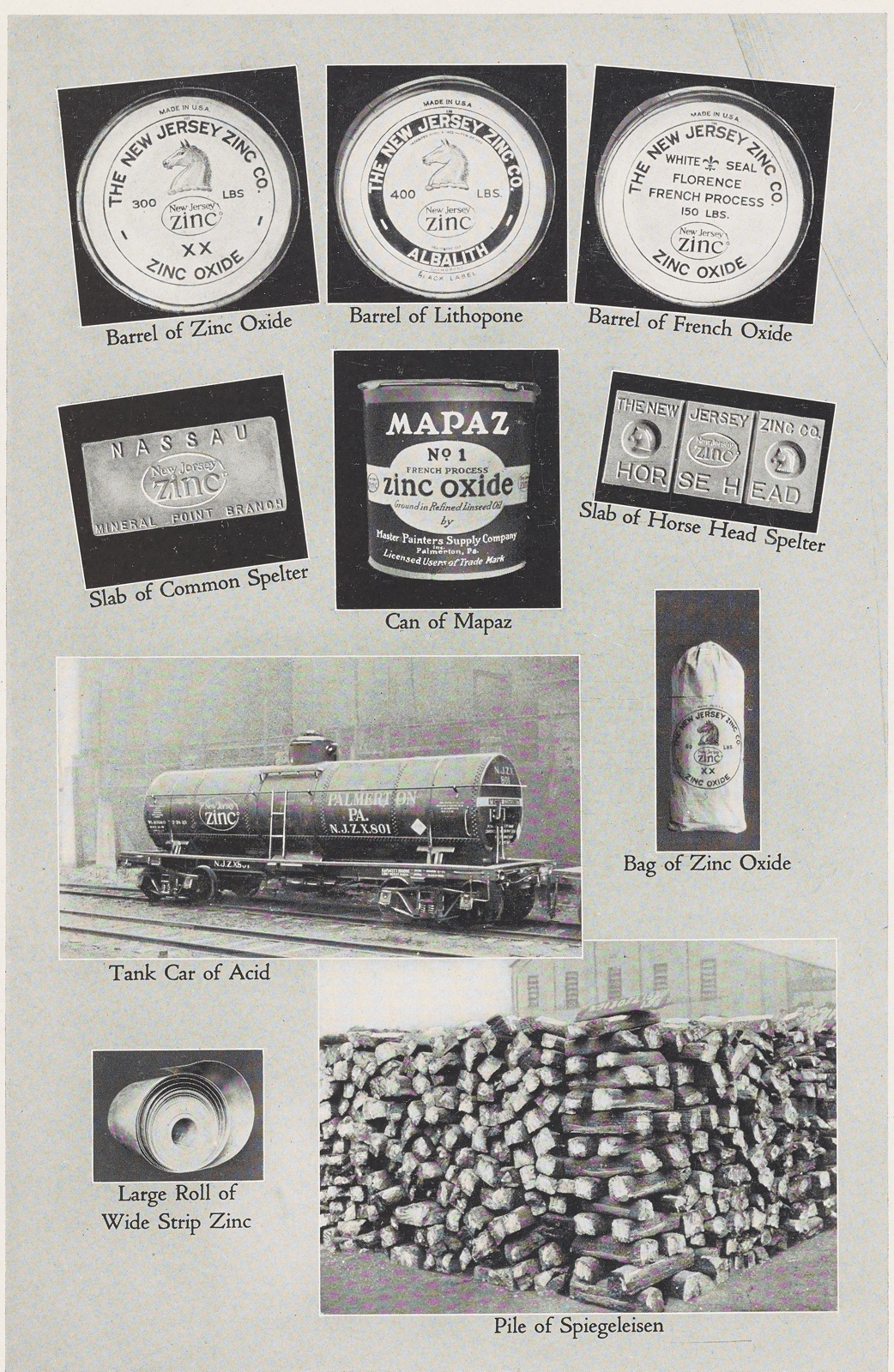
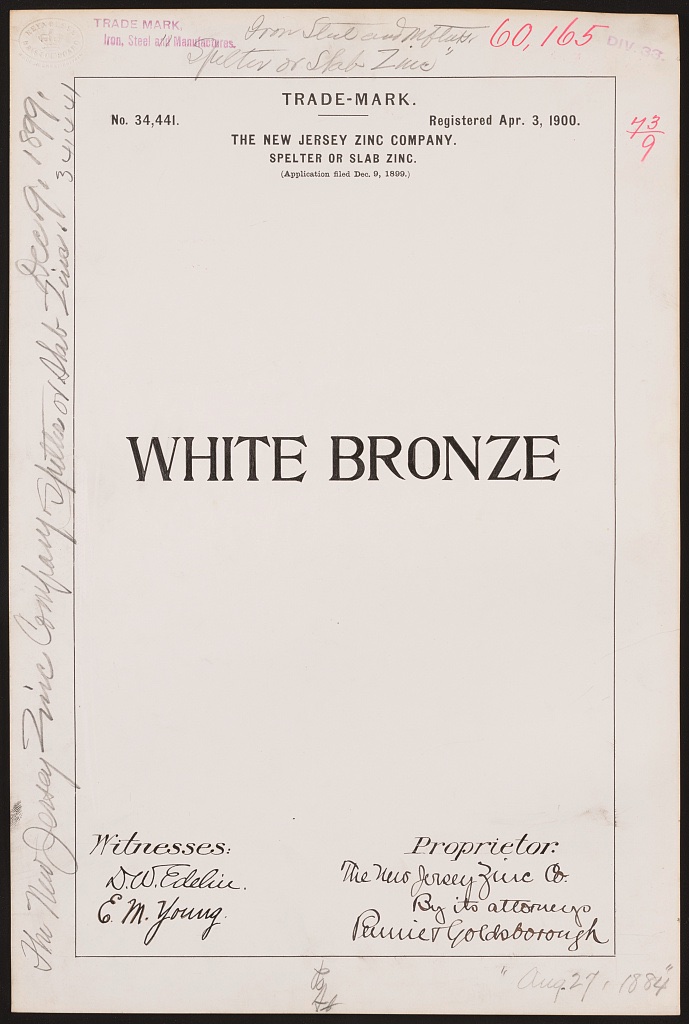
Almost nothing mined at Franklin and Sterling Hill reached its user as ore. It left the district as a product: zinc oxide, slab zinc (spelter), lithopone, and spiegeleisen made from the franklinite. About 1924 the New Jersey Zinc Company described its own history as “in part the history of the development of a new industry involving the production, in quantity, of an almost unknown product, oxide of zinc, by a new process, and the education of the public in its properties and in the best ways of utilizing them” (A record of accomplishment). In the same booklet it listed the uses of its products: oxide of zinc, spiegel iron, metallic zinc, zinc dust, lithopone and sulphuric acid.
One qualification runs through everything below. From the 1890s the company also bought and smelted ores from other districts, in Colorado, Missouri, Wisconsin and Virginia, at plants in the West and, after 1898, at Palmerton, Pennsylvania, where roasted sulphide ores were used “in addition to those from Franklin” (the same history). So not every pound of the company’s zinc came from Sussex County. The Franklin and Sterling Hill ores were where the company and its methods began, and its zinc oxide and its purest metal were built on them (see Pulling franklinite out with magnets).
The scale grew fast. The company gave these figures for the output of all American producers: zinc oxide, 25,000 tons in 1897 and 140,000 tons in 1923; slab zinc, 100,000 and 500,000 tons; lithopone, 4,500 and 100,000 tons.
Zinc white
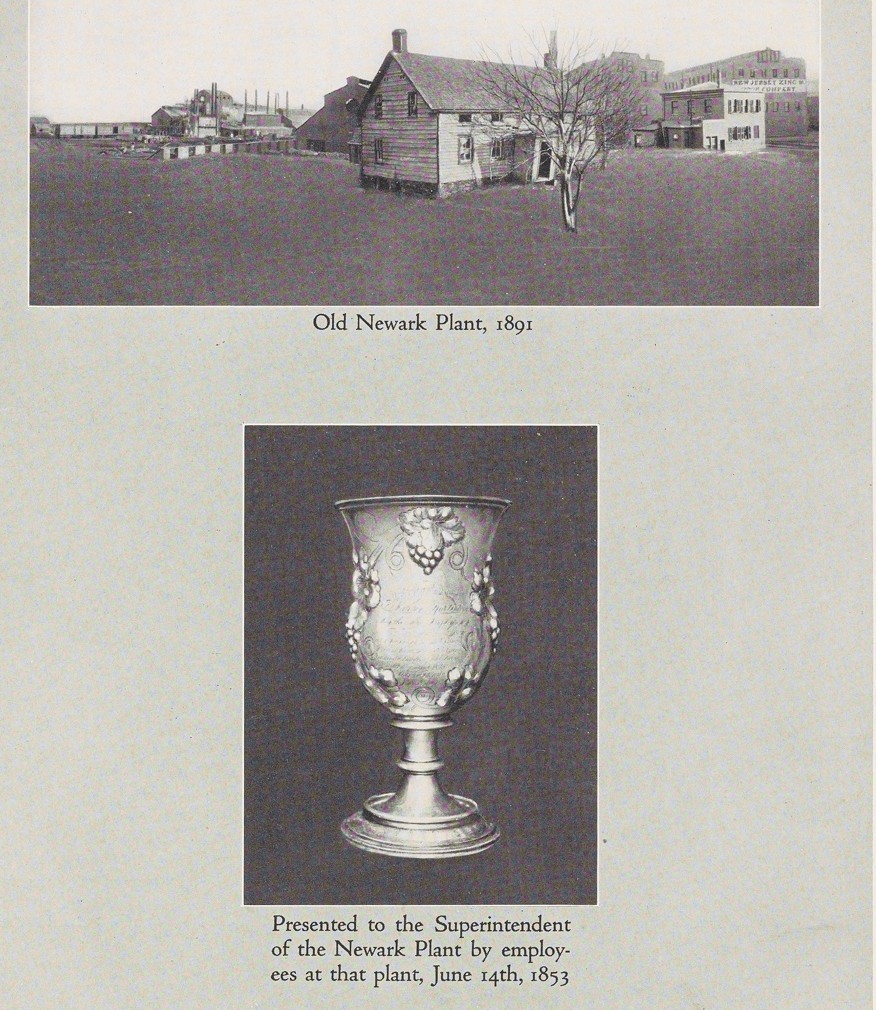
Zinc oxide as a white pigment was older than the company. According to the National Standard Dispensatory (1905), Courtois recommended it in place of white lead in 1780, but it came into use as a paint only about 1844, after Leclaire in Paris worked out a cheap way of making it by burning metallic zinc. That is the French process, and it needed metal to start with.
In Sussex County the first zinc paint is said to have been an accident. The company’s report for 1852, quoted by John L. Baum in The Picking Table in 1986, tells how George Ballou, a New Englander trying to make metallic zinc from the Franklin ore, collected instead “a sub-oxide or bluish-white powder,” which was ground in oil and used to paint the house of Dr. Samuel Fowler at Franklin, in about 1830.
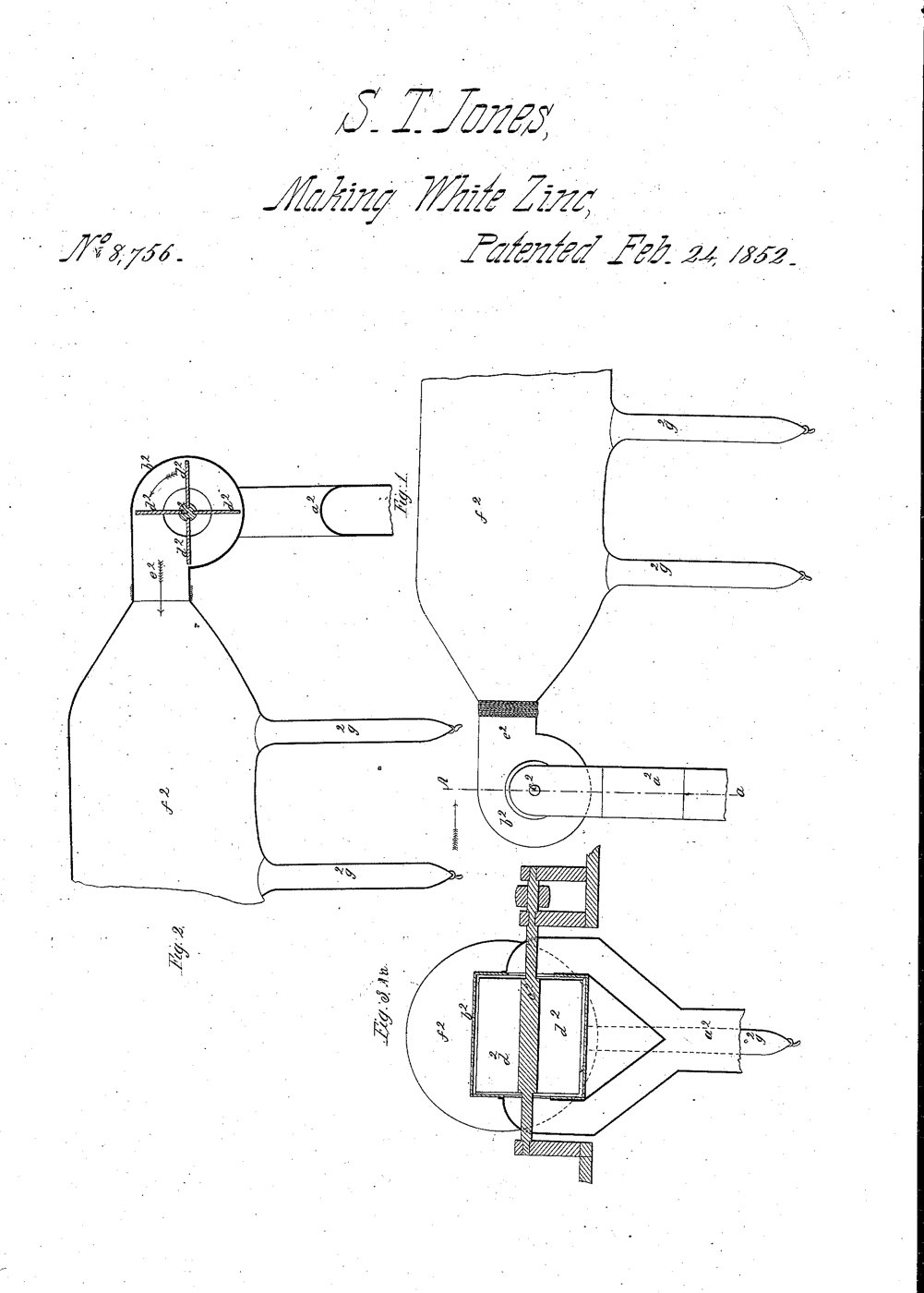
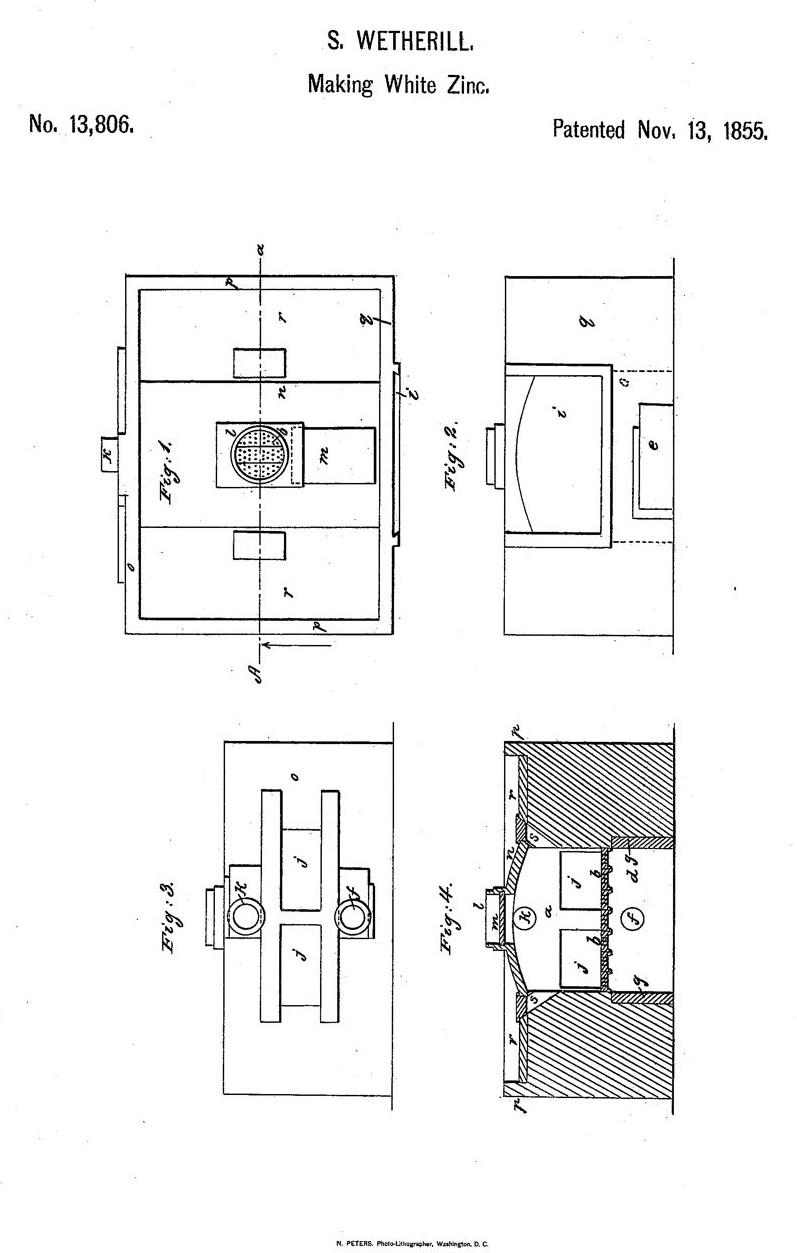
The ore would not yield metal by any method then known, so the company turned to oxide. Its history records that at Newark a process was developed for making zinc oxide directly from the Franklin and Ogdensburg ores “in a single operation,” and a plant was built in 1852; within a few years an entirely new and cheaper process replaced it, and by the 1920s “much the greater part of the oxide of zinc produced in the world” was still made by it. Two patents are behind that process. Samuel T. Jones, of the Newark works, patented the catching of the oxide fume in cloth bags (U.S. Patent 8,756, February 24, 1852), and Samuel Wetherill, the works’ superintendent, patented the furnace (U.S. Patent 13,806, November 13, 1855), in which crushed ore mixed with coal burned in a thin layer on a grate, with air blown through it in many small jets, so that the zinc was reduced, vaporized and burned to oxide all at once. The combination became known as the Wetherill or American process (Kaas, 2016).
Then the paint had to be sold. Baum, in “The first years of the New Jersey Zinc Company” (1976), writes that the company made ready-mixed paint, which he calls the first ever sold, to win the trade over. The 1852 report collected testimonials: the supervisor of the New York and New Haven Railroad had painted station-houses with the company’s zinc paint in the summer of 1850 and found them, in March 1852, looking as well as when first painted, while those done in lead were chalky; and a test engineer at a Navy yard in Virginia reported that the zinc oxide and the company’s brown pigment did better than red lead at keeping barnacles off. In October 1852 the New York City Board of Aldermen, after a committee report on the poisoning of the city’s more than four thousand painters by lead, resolved that the city’s officers should use zinc paint, “especially upon roofs, iron work, and in places exposed to impure air” (Baum, 1986). Baum adds that the company also sold the ground ore itself as pigment, and that franklinite served well for the cheap red paint of barns and outbuildings.
1854: three more patents for zinc white
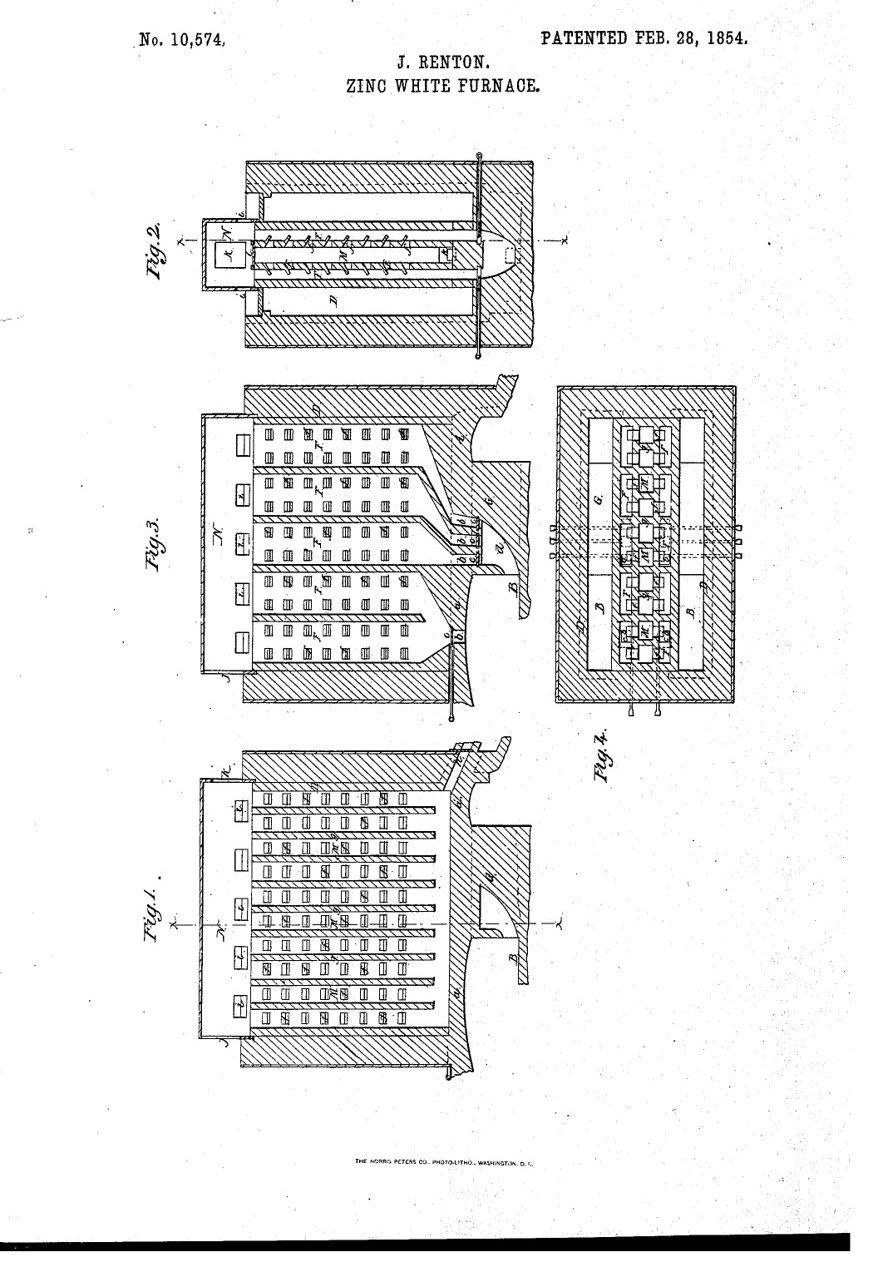
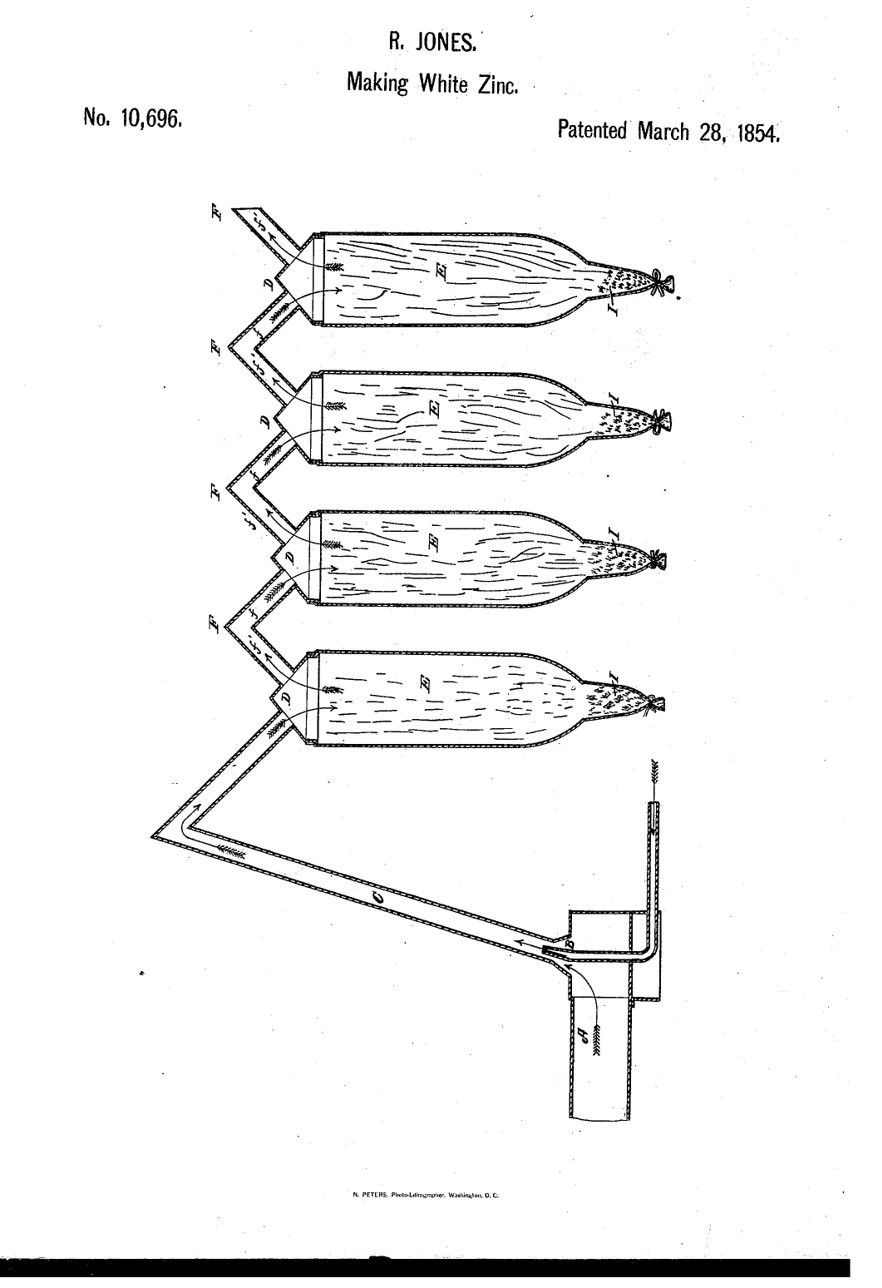
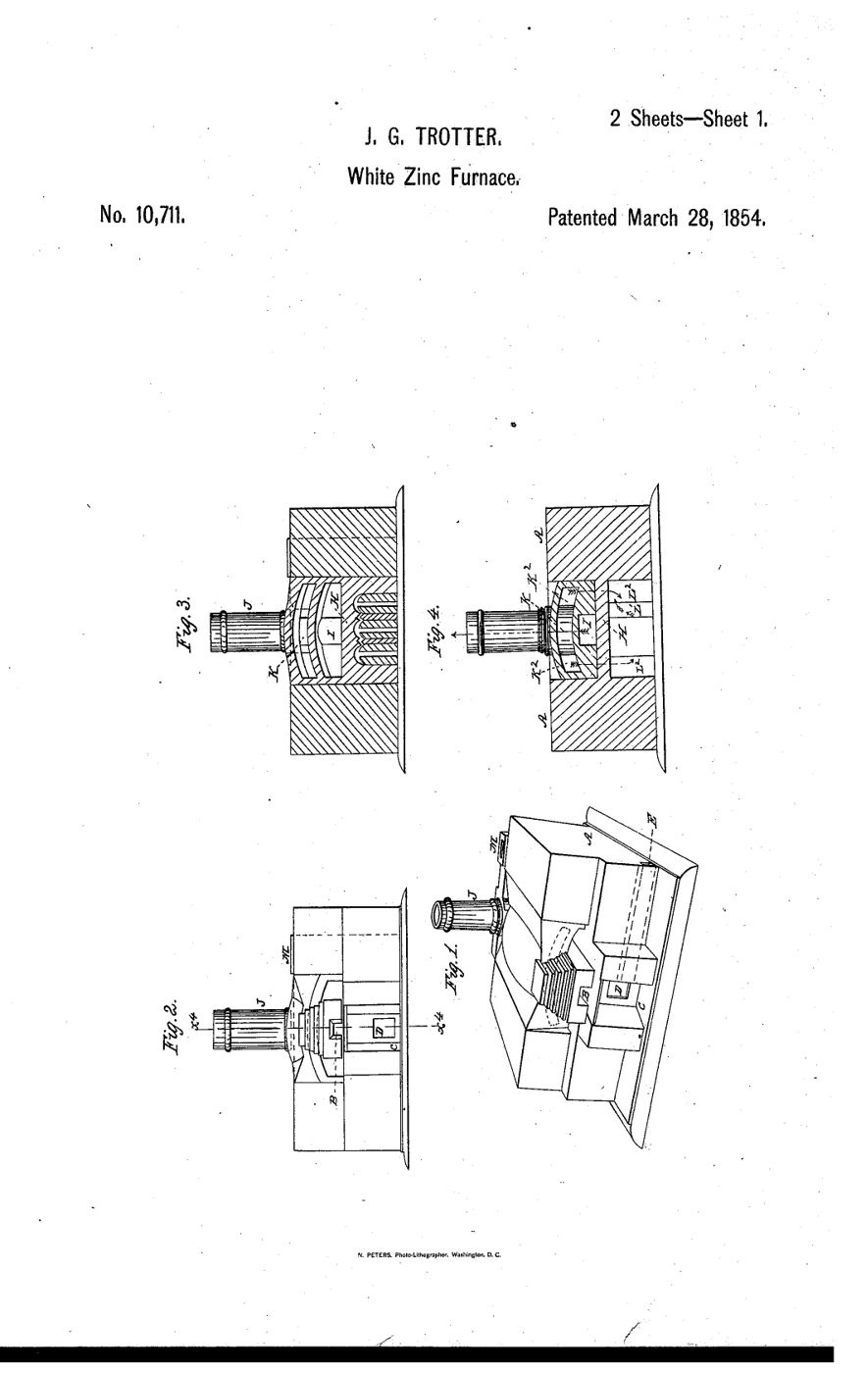
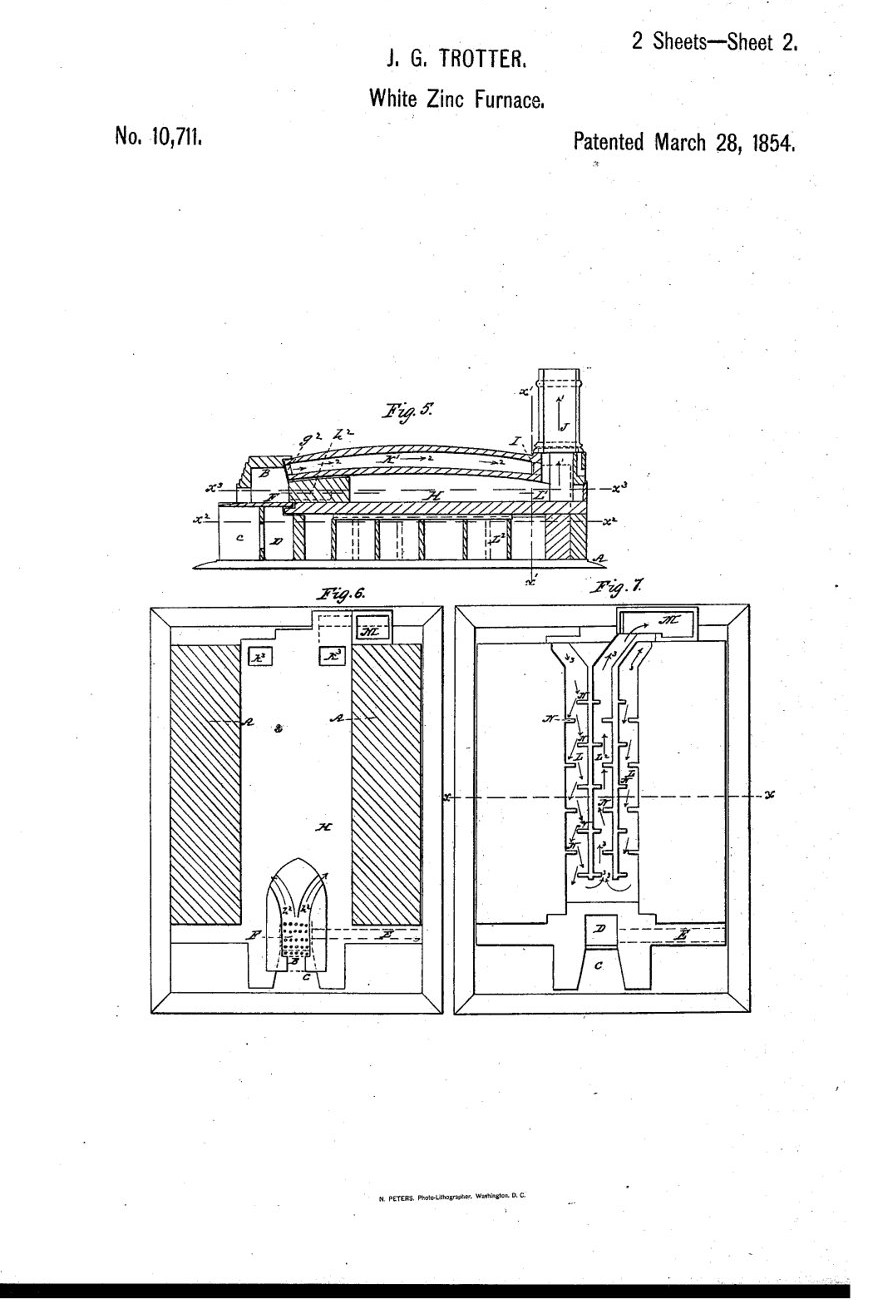
Jones’s bags of 1852 and Wetherill’s grate of 1855 were not the only attempts. The Journal of the Franklin Institute printed the claims of every new American patent each month, and its lists for February and March 1854 hold three more for making zinc white (zinc oxide), all from New Jersey.
James Renton of Newark set rows of ore tubes side by side in a furnace, so that the zinc vapor driven from the ore passed through openings into the cooler tubes or spaces beside them and was carried off under a hood. Richard Jones of Burlington County burned the zinc vapor to oxide with a jet of air let into a closed retort, and sloped every pipe so that the white powder could not settle and clog it. Jonathan G. Trotter of Newark patented a reverberatory furnace, a long low furnace in which the flame from a separate fire-place is thrown down onto a bed of ore, with passages that sent the flame straight onto the ore and carried the lighter gases away through return flues; his claim was for “working zinc ores for making white oxide of zinc.”
In their own words. Renton’s apparatus was “specially constructed for the manufacture of zinc from the franklinite ore, and intended to be combined with an iron-puddling furnace, to be heated by the waste heat therefrom” (U.S. Patent 10,574). For Jones, “The office of this jet of air is to oxidize the vapor of zinc, cool it, and carry it over into the collecting-chambers,” and each chamber was “a sack, E, of muslin, which I deem the best material known for the purpose” (U.S. Patent 10,696). In Trotter’s furnace the flame, playing on the ore, “oxidizes it and carries off the sublimed zinc through the discharge-port I, in the direction of the arrows 1, up the funnel J, to be collected in sacks or chambers placed over it for that purpose” (U.S. Patent 10,711).
The three patents show how open the question still was in Newark in 1854: whether to roast the ore in tubes, in retorts or on a hearth, and how to catch a powder lighter than smoke. Wetherill’s answer of the following year was the one that lasted.
Horse Head “XX” and Florence Brand
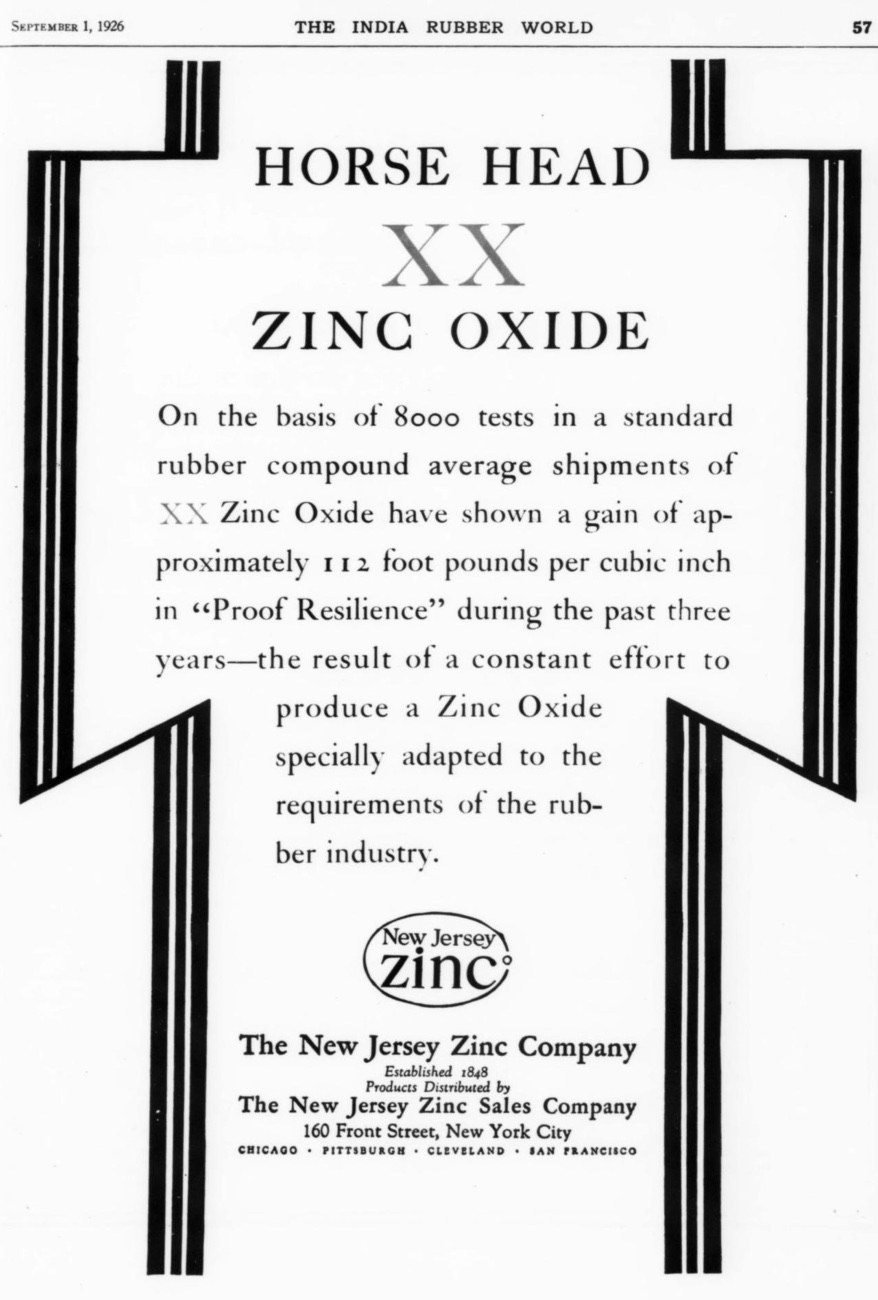
By the 1920s the company made both kinds of oxide. L. H. Trott of its sales company explained the difference to master painters in Illinois in 1928, in a talk the company printed as Zinc oxide and its application to paint. French process oxide, made by vaporizing slab zinc and burning the vapor, was very fine, white and bright and went into the best enamels and lacquers; it was sold in three grades, “White Seal,” “Green Seal” and “Red Seal.” American process oxide, made directly from crushed ore and coal, “was developed within the organization of The New Jersey Zinc Company” and was the one “so largely used in outside house paints.” The back cover named the brands: “Florence Brand” for French process oxide, and Horse Head “XX” for American process, with which, it said, “the reputation of high-grade prepared house paints was made.”
Trott called zinc oxide “merely ‘Zinc Smoke,’” the finest white pigment made, so fine that the most powerful microscope was needed to see its particles. Mixed with white lead it hardened the paint film and slowed its chalking. In 1922 American producers marketed 128,465 tons of it (the company’s figure). Samples of the company’s White Seal and Green Seal zinc white of 1942 are kept in the Forbes Pigment Collection at the Harvard Art Museums. The company also sold metallic zinc dust as a paint pigment for iron and steel, and published its research on it (Nelson and McKim, about 1926).
What chalking is, in the company’s words
Every outdoor paint wears away, and the first sign is chalking: the surface turns to a fine white powder that comes off on the hand. Trott explained it to the master painters with a comparison worth quoting whole: “Can we get a clear idea of just what chalking is? Suppose we were to call it ‘rusting.’ When iron rusts, it takes up oxygen from the air, forming iron oxide which powders off, leaving less iron. The oil in the outer surface of the paint film likewise takes up oxygen from the air, disappears and exposes the bared pigment which in turn becomes loosened at the surface and weathers or rubs off.”
A paint that never chalked, he went on, “has never been developed.” The best science could do was “to slow up the rate of chalking as much as possible, and yet have the paint fail to a repaintable surface.” That was the job of zinc oxide. The “harder drying” zinc oxide, he wrote, “compensates for the other ‘softer drying’ pigments — Lithopone, white lead, titanium pigments — and does not let the film chalk away as fast as would happen were the Zinc Oxide not there.”
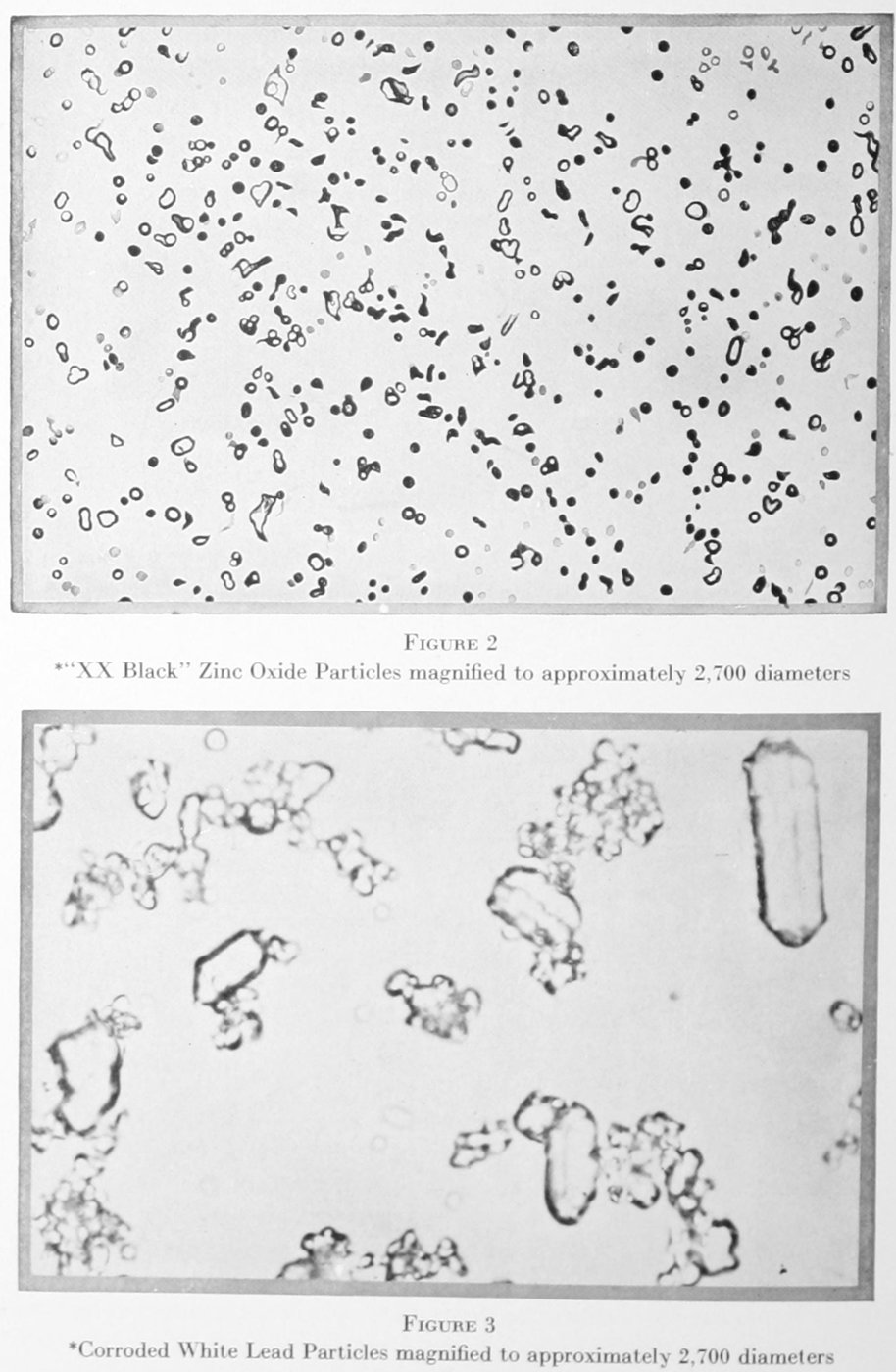
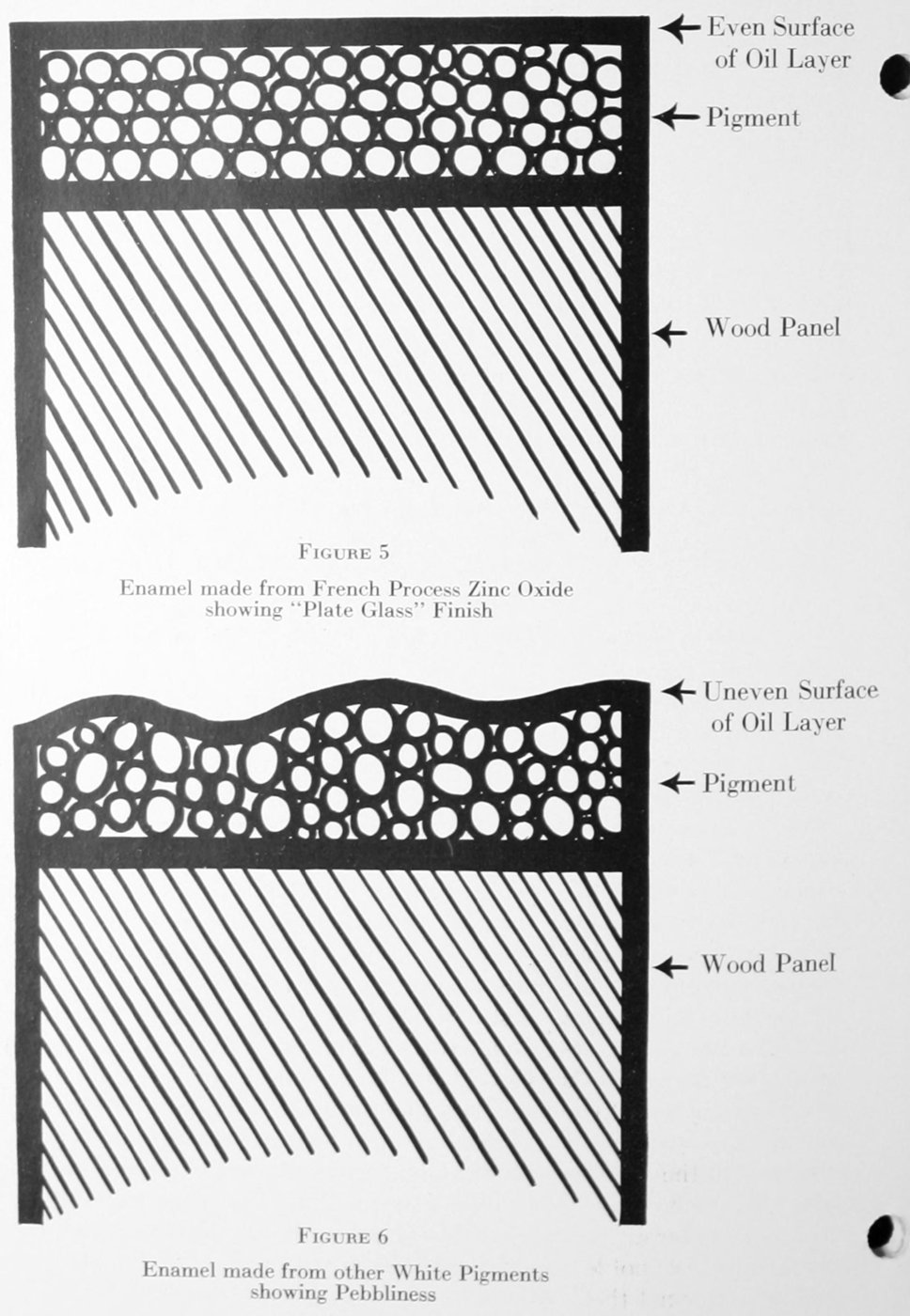
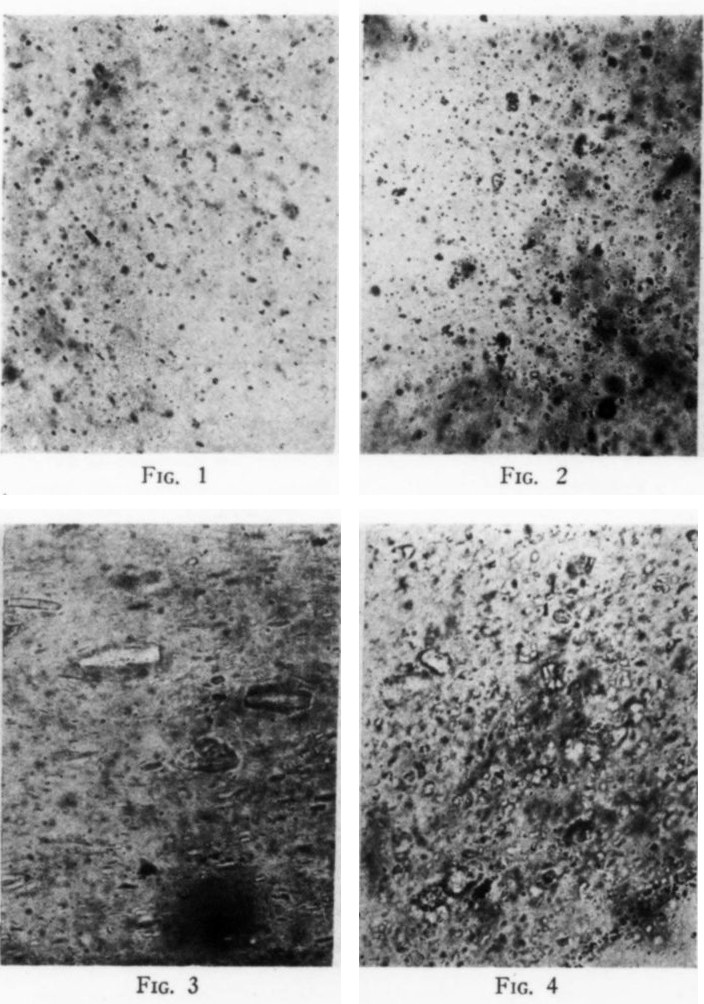
The pictures make the argument visible. Photographed at the same enormous magnification, zinc oxide is a cloud of fine, even specks, and white lead a scatter of large clumps; Trott’s diagrams show why fine, even particles give a smooth, glassy enamel where coarser pigments leave the surface “pebbly.”
It is worth remembering who was speaking. Trott was assistant manager of technical service for the New Jersey Zinc Sales Company, the booklet was printed by the New Jersey Zinc Company, and its last page is an advertisement for the company’s own zinc oxides. The explanation of chalking is sound and still the usual one, but the conclusion, that a good house paint needs zinc oxide, was the company’s sales case as well as its science.
Lithopone
Lithopone is a white of zinc sulphide and barium sulphate, precipitated together from solutions of zinc sulphate and barium sulphide. Trott wrote in 1930 that it was first made in the United States in 1906. The company took it up at Palmerton and called its manufacture “the most difficult problem the Company had undertaken” (A record of accomplishment): a long chain of operations, any one of which could spoil the batch without showing it until the end. In February 1915 the India Rubber World reported that the company was building a large lithopone plant at Palmerton for paint makers, rubber manufacturers “and others.”
By about 1924 lithopone was “the principal pigment in the flat interior wall finishes that have so largely taken the place of wall paper,” and a large part went into oilcloth and linoleum. Early lithopone turned gray, nearly black, in sunlight, which kept it indoors until a manufacturer found a cure in 1920. Trott told painters that two coats of flat white on the walls and ceiling of a twelve-foot room left about thirty pounds of lithopone behind, and that in 1925 about 150,000 tons each of lithopone, zinc oxide and white lead were made. The company sold its own as “Albalith,” “the Super-Lithopone.”
Rubber, and the white tire
Zinc oxide went into rubber long before it was understood. In 1909 Henry C. Pearson’s Crude rubber and compounding ingredients called it the coloring matter used more than any other for white rubber, noted that it grew whiter during vulcanization, and said that a percentage was often added to dark goods “to increase the resiliency of the rubber,” and to insulated wire to improve its insulation. The company itself wrote about 1924 that zinc oxide was used very extensively in rubber goods “because its admixture with the rubber very greatly increases the tensile strength of the product” (A record of accomplishment), and that the rubber industry’s consumption of zinc oxide was about twelve times what it had been twenty years before.
The automobile tire was the reason. In September 1920 two chemists of the company’s research laboratory at Palmerton, I. R. Ruby and Harlan A. Depew, read papers before the Rubber Division of the American Chemical Society in Chicago, printed in the India Rubber World the following January. One opened: “There has been much discussion relative to the merits of carbon black and zinc oxide treads for automobile tires” (p. 246). Treads in which the company’s “XX red” zinc oxide was the only pigment, they wrote, generally carried 55 to 58 percent zinc oxide by weight. Their microscope sections included “a well-known white tread” and a tire sidewall containing zinc oxide.
The chemistry that makes zinc oxide matter is now better known. In the sulfur vulcanization of rubber, zinc oxide is the activator: with a fatty acid such as stearic acid it forms soluble zinc complexes, which react with the organic accelerator and with sulfur and make the cross-linking of the rubber both faster and more efficient. A 2026 study written with the tire maker Pirelli calls microcrystalline zinc oxide “the worldwide most widespread curing activator in the industrial production of rubber” (Mostoni and others, 2026). In 1978 the company still listed automobile tires first among the uses of its zinc oxide (The Picking Table).
Spelter: galvanizing, brass and roofing
Shortly after the Civil War the company began to make metallic zinc at Newark from by-products of its oxide and spiegel furnaces. The metal was “uniformly of extraordinary purity,” and its “Horse Head” and “Bertha” brands of slab zinc became, in the company’s words, “the acknowledged standard of the world” (A record of accomplishment). The reason was the ore. In 1896 J. P. Wetherill wrote in his patent that zinc from the Franklin ores was “of high commercial value, because of its freedom from lead.”
Most American zinc went into galvanizing. The USGS cited estimates for 1910 that put 60 percent of the spelter output into galvanizing, 20 percent into brass, 11 percent into sheet zinc, 1 percent into separating silver from lead, and 8 percent into everything else. The company’s own account of its markets follows the same lines (about 1924). For galvanized sheets the common grade, prime western, was good enough; but for telephone and telegraph wires, “which have to stand severe bending and twisting,” Horse Head zinc was used. In brass, small impurities spoil the metal, and for brass “that must stand severe drawing and pressing” Horse Head zinc was essential. Much slab zinc was rolled into sheets and strips, the largest use being roofing, for which Horse Head made “a particularly soft and ductile sheet.”
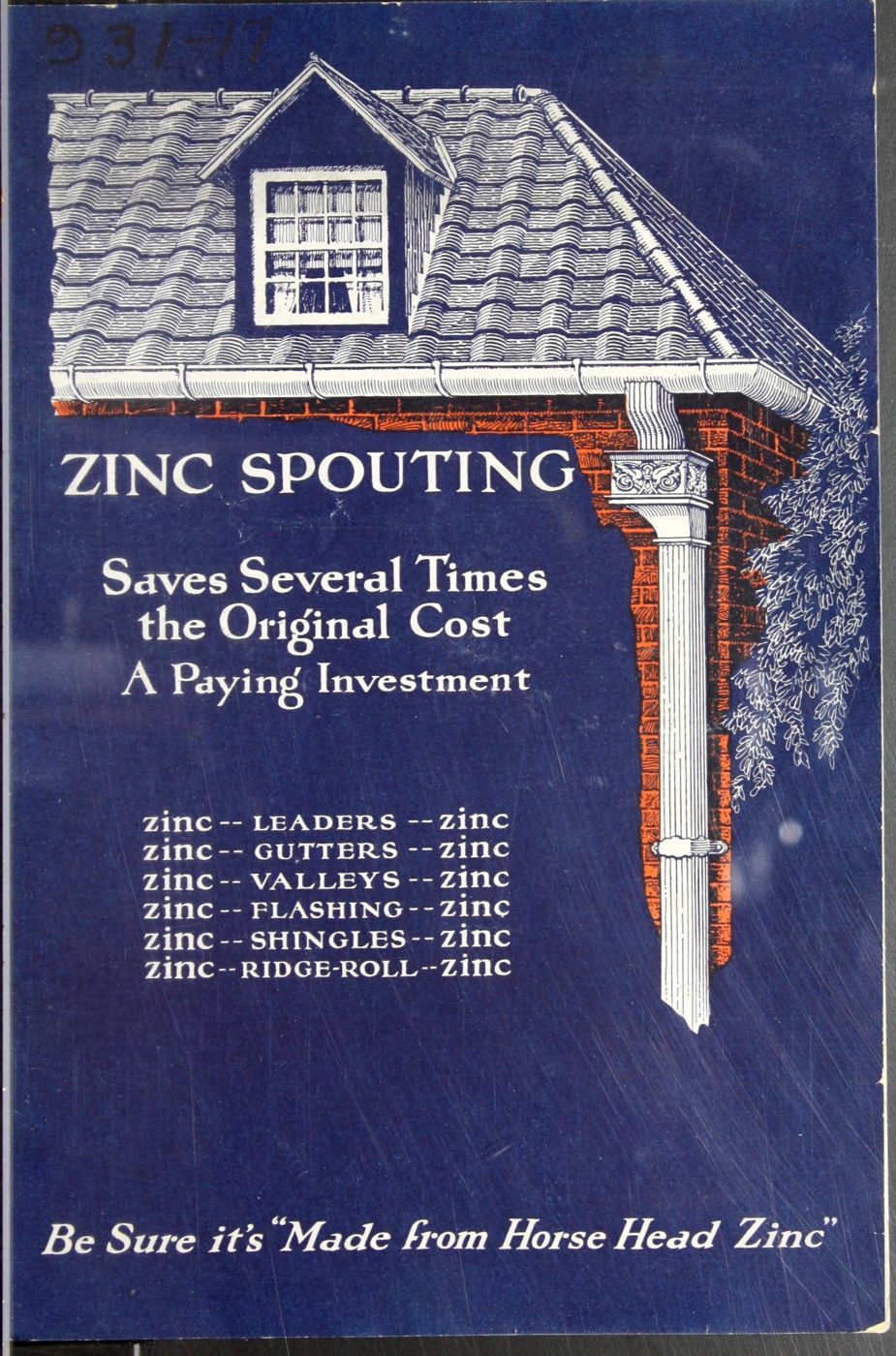
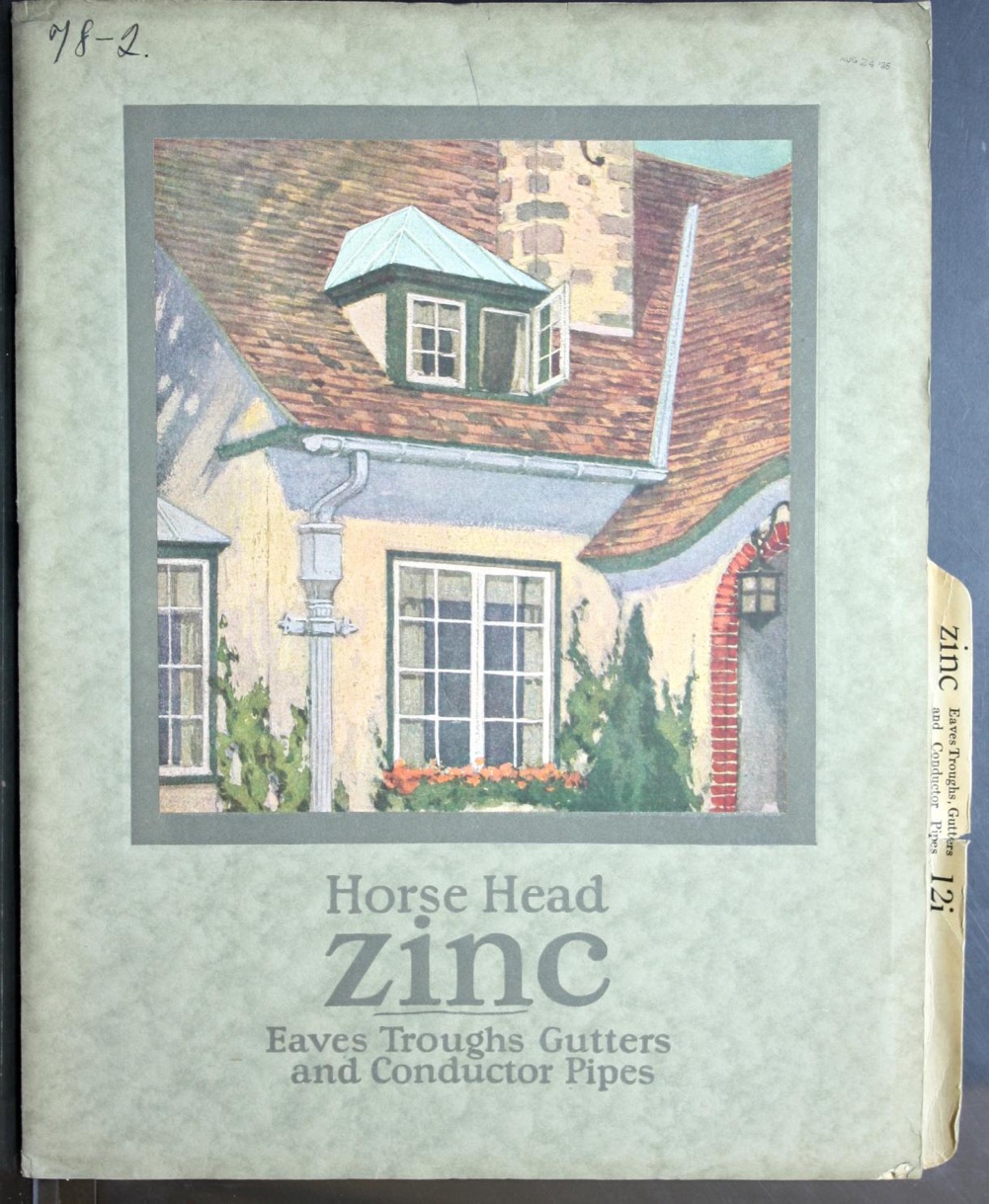
The company pressed the roofing market hard. It built a strip mill at Palmerton and roofed buildings with different designs to learn which suited the American climate (A record of accomplishment). Its booklet Zinc for roofing use told home owners that zinc spouting had been used in Europe for more than a century, that early American trials had failed with unsuitable grades, and that Horse Head rolled zinc, “free from objectionable impurities,” had removed the difficulty. A second booklet of 1925 gave architects specifications for Horse Head zinc eaves troughs, gutters and conductor pipes.
Galvanized wire: bridge cables and farm fences
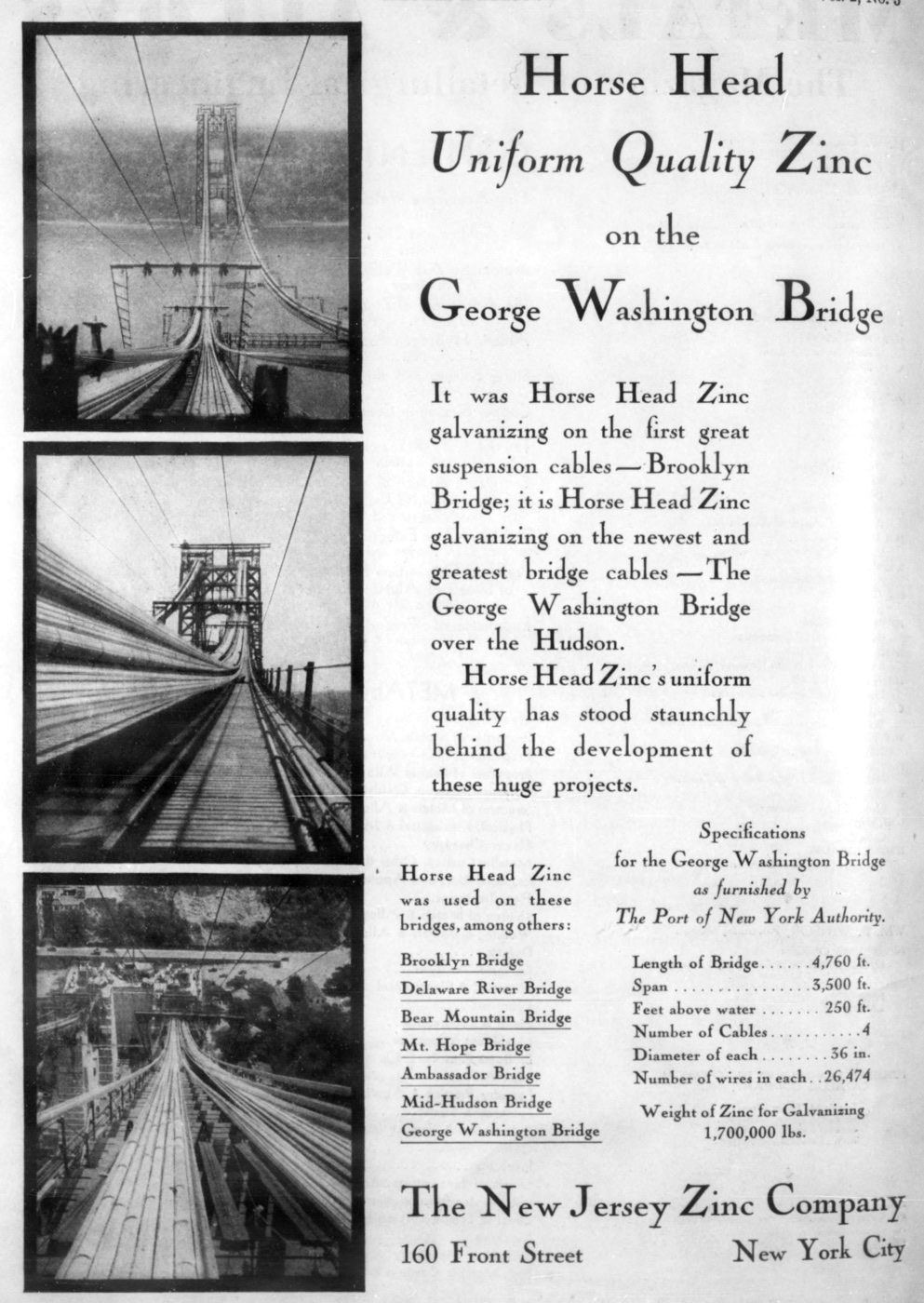
Galvanizing, the coating of iron and steel with zinc, took most of the country’s zinc, and wire took a great deal of it. Bridge cables show why. When Washington A. Roebling wrote the specifications for the cable wire of the Brooklyn Bridge, he explained that the cables would hang over salt water, where paint, oil or varnish “are totally inadequate to prevent rusting, in localities so near the coast. The only certain safeguard is a coating of zinc, which acts by its absolute air-tightness, as well as by its galvanic action, and is not easily abraded” (Report of the Chief Engineer, 1877, p. 74). Roebling is the man for whom roeblingite, a Franklin mineral, is named (see Roebling).
The Brooklyn wire came with a scandal. The contract went to the lowest of nine bidders, J. Lloyd Haigh (Report of the Committee, 1884, p. 35), and in July 1878 Roebling found out how he had cheated: “The wagon-load of wire as it left the Inspector’s room, with his certificate, in place of being driven off to the Bridge, was driven to another building, where it was rapidly unloaded and replaced with a load of the rejected wire.” Worse, “all the rejected wire which has come to the Bridge, has been worked into the cables, and cannot be removed” (pp. 132–133). It was reckoned at 221 tons (p. 38). The bridge still stands.
Half a century later the Port of New York Authority asked for purer zinc. Its specifications for the Hudson River Bridge, as the George Washington Bridge was first called, required that the wire “shall be galvanized in a bath containing 99.75 per cent pure zinc, containing not more than 0.03 per cent iron” (The Iron Age, August 25, 1927, p. 468). Each cable was to hold “26,474 double galvanized, high strength steel wires” (Port of New York Authority, Second Progress Report, 1929, p. 33). John A. Roebling’s Sons of Trenton made the wire, and described how: “Twenty lines of wire are continuously passed through successive baths of melted lead to heat them, through dilute acid to clean them, and through molten zinc to galvanize them,” leaving “a very durable, tenacious zinc skin from 1/1000 to 2/1000 inch thick” (Roebling Cables for the Hudson River Bridge, about 1930, p. 32).
The spinning took less than ten months. “On August 7 the last wire of the total of 105,896 wires was spun … the first wire having been placed Oct. 18, 1929. The wire in the four 36-in. diameter cables weighs 28,400 tons” (E. Warren Bowden, Engineering News-Record, August 14, 1930, p. 242).
Whose zinc was it? Only the New Jersey Zinc Company said. Its advertisement of 1931, above, claimed both bridges: “It was Horse Head Zinc galvanizing on the first great suspension cables—Brooklyn Bridge; it is Horse Head Zinc galvanizing on the newest and greatest bridge cables—The George Washington Bridge over the Hudson,” and gave “Weight of Zinc for Galvanizing 1,700,000 lbs.” (Metals & Alloys, November 1931). An earlier version, in January 1931, still called it the Hudson River Bridge (January 1931, p. 4). No engineering report of the time that we have found names the zinc, so the claim rests on the company’s word.
The whole story of the bridges, from Brooklyn to the George Washington, with the five bridges between and the two whose wire broke, is told on The great suspension bridges and the zinc on their cables.
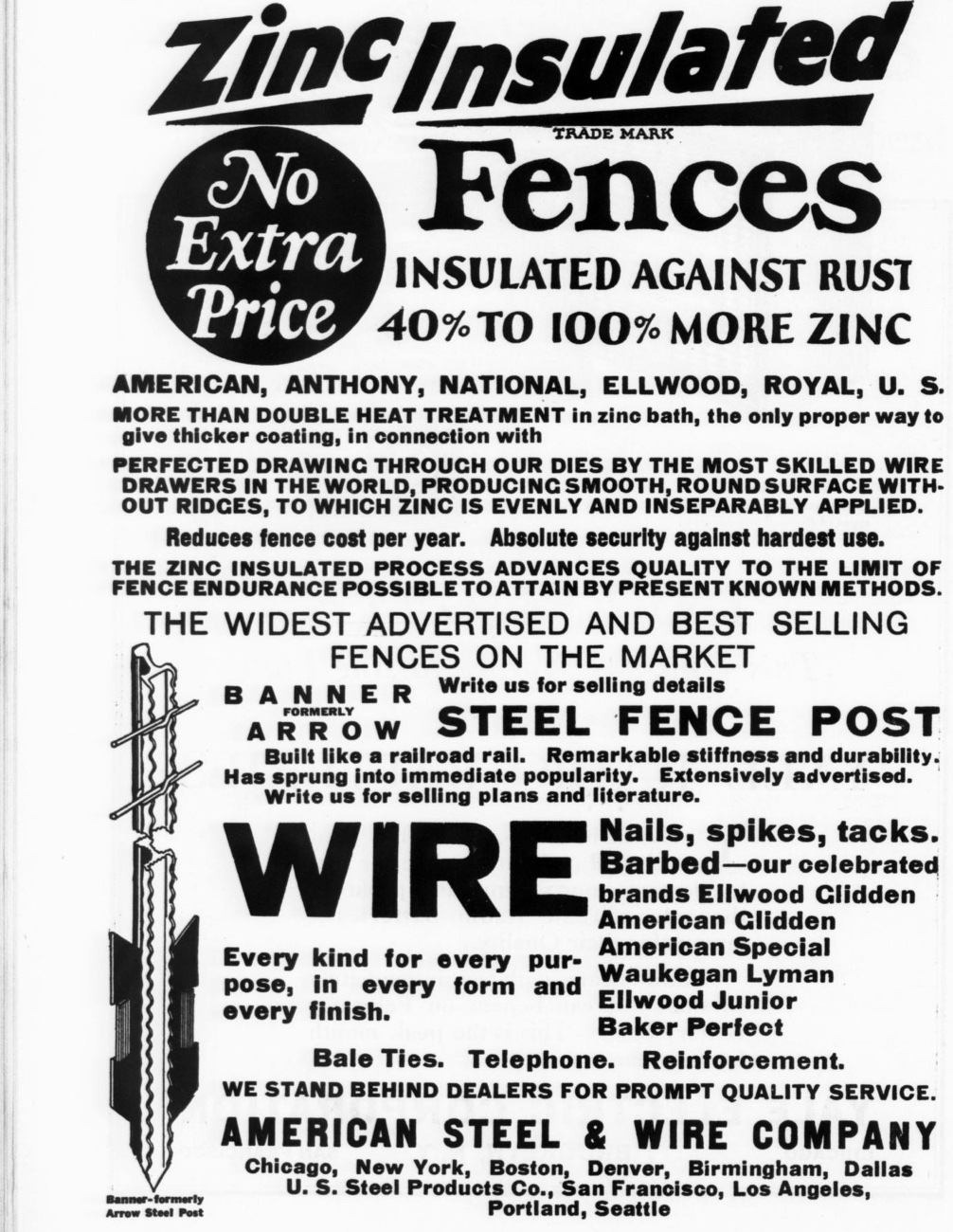
On the farm the same metal kept fences standing. Wire makers sold zinc by the ounce: the American Steel & Wire Company’s “Zinc Insulated” fences of 1925 promised “40% to 100% more zinc,” applied by “more than double heat treatment in zinc bath, the only proper way to give thicker coating” (Hardware Age, 1925). That advertisement does not say whose zinc it used.
After the war: pipe, sheet and fence, 1950–1980
Galvanizing stayed the largest single use of zinc for decades. In 1955 the Bureau of Mines reported that “The principal uses of zinc continued to be in galvanizing and for making zinc-base alloys (chiefly die castings), which utilized 40 and 38 percent, respectively” (Minerals Yearbook, 1955, p. 1282). Its tables show where the galvanizer’s zinc went: most onto sheet and strip for roofing, siding and ducts, a large share onto pipe, and a steady amount onto wire.
| Zinc used to galvanize | 1950 | 1955 | 1960 | 1965 | 1970 | 1975 | 1980 |
|---|---|---|---|---|---|---|---|
| Sheet and strip | 188,406 | 200,403 | 196,057 | 270,826 | 253,155 | 185,795 | 220,744 |
| Tubes and pipe | 91,877 | 98,206 | 56,680 | 63,224 | 64,479 | 47,180 | 37,075 |
| Wire and wire rope | 47,317 | 48,171 | 35,262 | 43,884 | 30,857 | 24,945 | 22,748 |
| Fencing, wire cloth and netting | — | — | — | — | 18,114 | 20,051 | 16,022 |
| All galvanizing | 441,686 | 451,141 | 371,589 | 482,421 | 474,249 | 376,887 | 379,227 |
| All zinc used in the U.S. | 967,134 | 1,119,812 | 877,884 | 1,354,092 | 1,186,951 | 925,330 | 811,146 |
Slab zinc consumed in the United States. Short tons, except 1980, in metric tons. U.S. Bureau of Mines, Minerals Yearbook, zinc chapter: 1950, p. 1294; 1955, p. 1282; 1960, p. 1218; 1965, p. 1028; 1970, p. 1196; 1975, p. 1489; 1980, p. 900. Fencing was counted with other uses until 1966.
Pipe was the use that faded. Zinc on tubes and pipe reached about 98,000 tons in 1955 and fell to about 37,000 metric tons by 1980, while the sheet stayed. Fencing, which includes the chain-link of postwar yards and schoolgrounds though the yearbooks never use that word, took a steady 16,000 to 26,000 tons a year from its first separate count in 1966. In 1965 the Bureau listed the familiar galvanized goods: “roofing and siding sheets, wire and wire products, water tanks, pipe, pails and cans, nails, screws, bolts, and hinges,” and added that “For galvanizing iron and steel products, one of the major uses of zinc, there is no adequate substitute” (Mineral Facts and Problems, 1965, pp. 1091–1092).
The same yearbooks follow the Sussex County mines to the end. In 1950 “The principal producer was again the New Jersey Zinc Co., operating the Franklin and Sterling Hill mines in New Jersey” (1950, p. 1284). In 1955, at Sterling Hill, “a new 2,700-foot shaft was completed” (1955, p. 1272). By 1965 “The only operating mine was the Sterling of The New Jersey Zinc Co.” (1965, p. 1021). And in 1980 the company “ended slab zinc production at its smelter in Palmerton, Pa.,” though “Ore from the Sterling Mine will continue to be shipped there” (1980, p. 886). Sterling Hill closed in 1986.
The First World War
War made pure zinc precious, because the brass for cartridge cases needed it. “Early in 1915,” the company recalled, “it became evident that the war would continue for much longer than was at first expected and that the demand for our high grade metallic zinc would be very large.” The Franklin mine was asked to raise its output as fast as it could. The answer was “We can increase it 50% in three months”; the mine raised it 75 percent in two months and held it about 60 percent above the old level for the rest of the war (A record of accomplishment).
The USGS recorded the premium. Spelter was sold in four grades, high grade, intermediate, brass special and prime western. In 1915 high-grade spelter sold at times for nearly double the price of prime western, and sales of the highest grades were reported at more than 40 cents a pound. Some smelters that treated no ore found it worth redistilling spelter, “on account of the very high prices of spelter suitable for brass used for ammunition” (p. 22).
Other products went to war too. When the government needed, as an antidote to certain German poison gases, a large quantity of zinc oxide purer than any made before, it applied to the company, which built a plant in ninety days and supplied all that was wanted. Zinc dust added to a shell’s charge made a dense white cloud that let gunners see where it burst. And the company’s strong sulphuric acid, made at Palmerton from the gases of roasted sulphide ores, went into high explosives. So the company told it (A record of accomplishment).
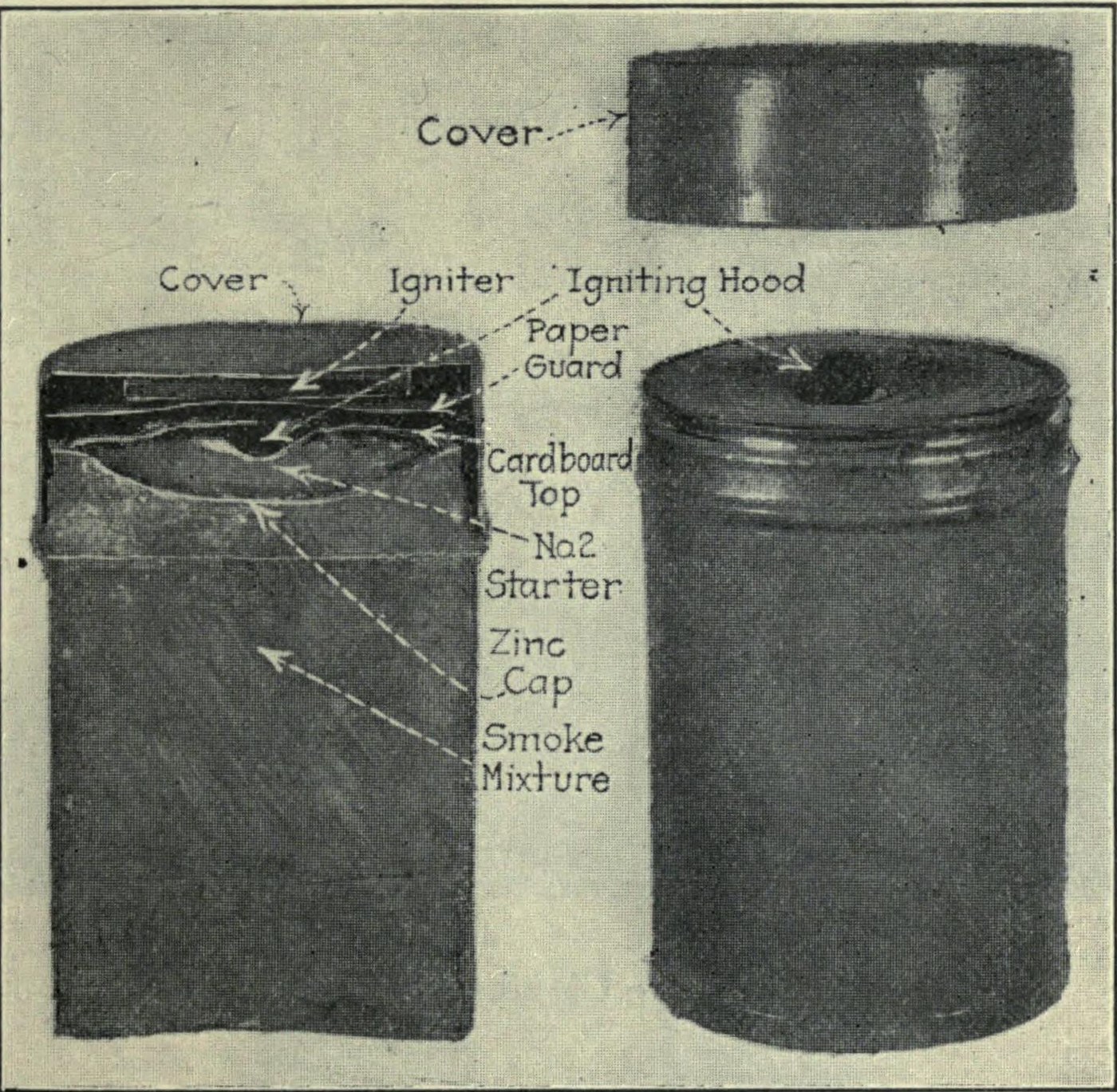
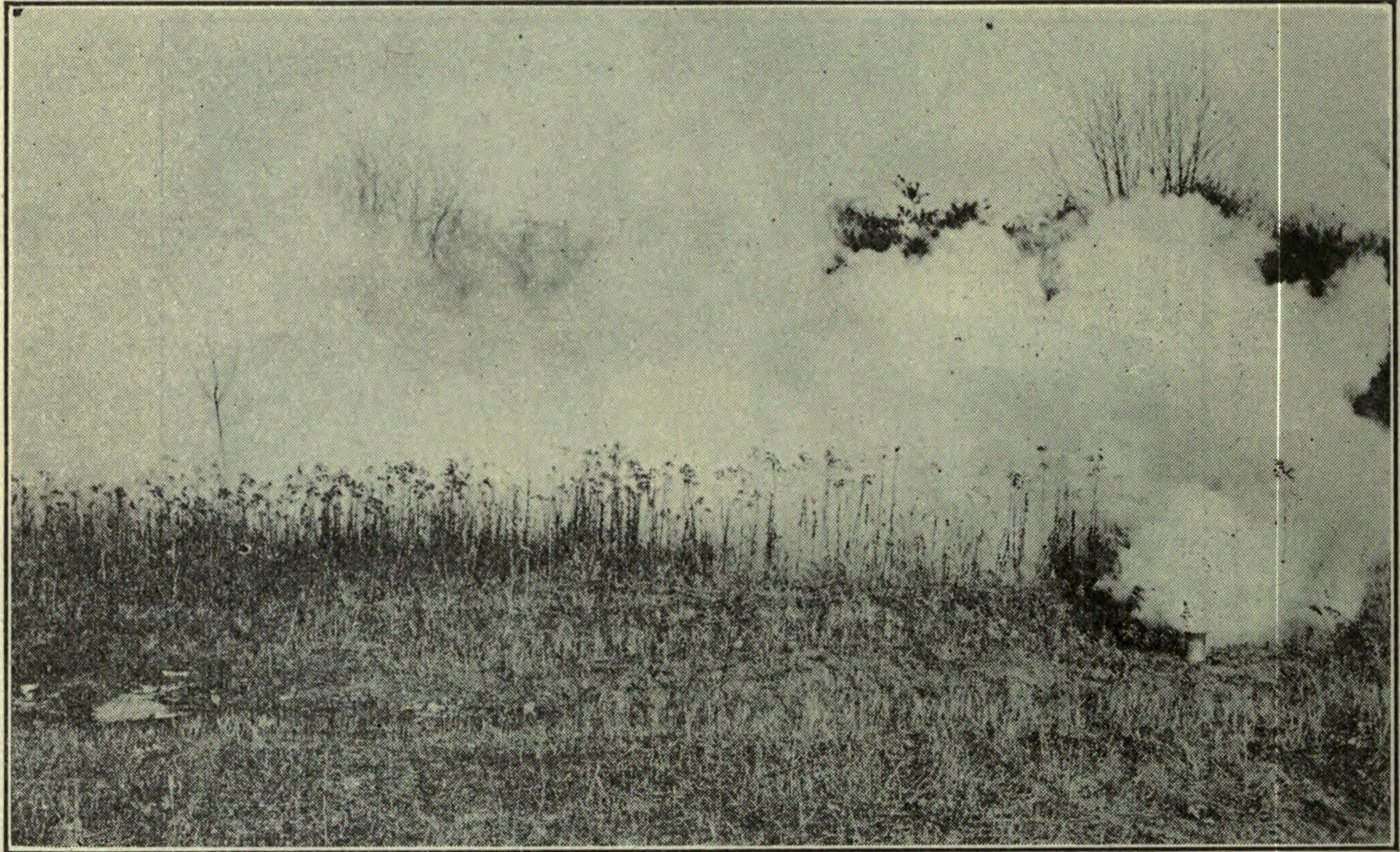
The Army’s own history bears out the smoke, though in a different form. Its standard white smoke screen was a zinc mixture: “One of the most important smoke materials was the zinc-containing mixture, which was used in the smoke box, the smoke candle, certain of the smoke grenades and in various forms of colored smokes.” The final formula was “Zinc 34.6, Carbon tetrachloride 40.8, Sodium chlorate 9.3, Ammonium chloride 7.0, Magnesium carbonate 8.3” (Amos A. Fries and Clarence J. West, Chemical Warfare, 1921, pp. 290–291). The American gas mask itself, as Fries and West describe it, held charcoal and soda-lime, not zinc; it was the French mask whose canister carried “soda-lime, mixed with charcoal and zinc oxide” (p. 205).
The wider story, from the Allies’ loss of their European zinc in 1914 to Edgar Palmer’s chairmanship of the nation’s zinc committee in 1917, is told on Zinc in two world wars.
Die castings
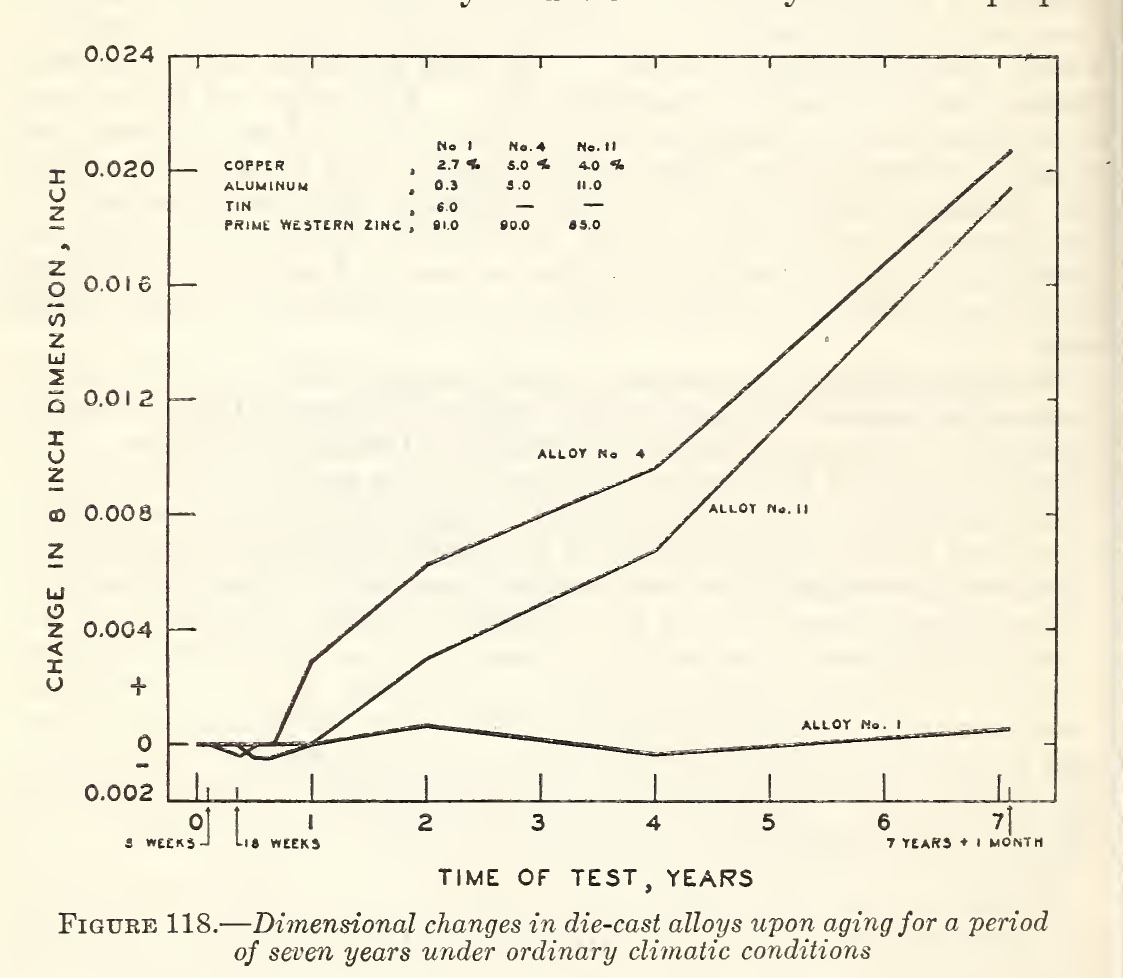
In the twentieth century the purest zinc found a new use in die castings, parts cast under pressure in steel dies. Zinc–aluminum die-casting alloys had a serious fault: in warmth and damp they could suffer “intercrystalline oxidation,” which made castings swell, warp and even fall apart, and lead, even in traces, made it worse. In 1929 Edmund A. Anderson of the company’s Palmerton laboratory applied for a patent (issued October 28, 1930) on an alloy of about 4 percent aluminum and 0.1 percent magnesium in zinc of 99.99 percent purity. The patent explains why: Horse Head zinc, long thought good enough, averaged 99.94 percent zinc with about 0.045 percent lead, and castings free from intercrystalline oxidation needed zinc with no more than 0.01 percent lead and cadmium together. It builds on an earlier company alloy of Willis M. Peirce and Anderson (U.S. Patent 1,596,761, 1926).
Collectors today call the problem “zinc pest.” The government studied it at the time. The Bureau of Standards wrote in 1931 that instability in service “contributed more than any other to the disfavor with which die castings were formerly regarded by many.” Tests had shown that “the corrosion and swelling of zinc-aluminum alloys is decidedly accelerated by the small amounts of lead and cadmium which occur frequently in zinc,” and “emphasized the necessity of using zinc of known purity and pointed to the advantage to be gained by using high-grade zinc” (Zinc and its alloys, p. 183). In a warm, moist atmosphere, “The corrosive attack penetrates into the interior of the alloy by intercrystalline paths, the result being a marked swelling, warping, and cracking in the course of time” (p. 184).
The company sold the alloys as Zamak. In November 1932 Automotive Industries noted “A booklet on Horsehead Zinc for Die Castings … published by the New Jersey Zinc Co. of New York. The book contains information on the physical properties of the various Zamak die-casting alloys produced by the company.” Its examples from the motor industry were “hub caps, radiator ornaments, signal-horn parts, carburetor parts and fuel pump bodies, vacuum-valve and vacuum chamber bodies, windshield frames, body fittings, speedometer main frames, mirror brackets, etc.” (p. 664).
The company did not make the castings itself; die-casting firms did, from its zinc. But it promoted them. Its drawings showed the new “die-cast zinc door handles” of Buick, Pontiac, Hupmobile, Chevrolet and Studebaker at the 1933 New York show (Automotive Industries, 1933, p. 342); its photographs showed 1936 hood louvres for Chrysler, Hupmobile, Studebaker and Nash, and it furnished a table of the weights of zinc-alloy radiator grilles for a dozen makes, from Chrysler to Cadillac (1936, p. 47). What made such large castings possible, the journal wrote, was “the availability of zinc alloys of exceptional purity, the zinc base running 99.99 per cent plus” (p. 46). Even toys: a 1934 photograph “Courtesy New Jersey Zinc Company” showed “Electric Railway Equipment Largely Made of Zinc Die-castings by the Dorfan Co., Newark, N. J.” (Machinery, 1934, p. 237).
By 1978 the company counted die castings as the leading use of zinc: automobile grills, dashboard and door panels, carburetor and fuel-pump parts, and parts for appliances, toys, telephones and cash registers (The Picking Table).
Flashlight batteries
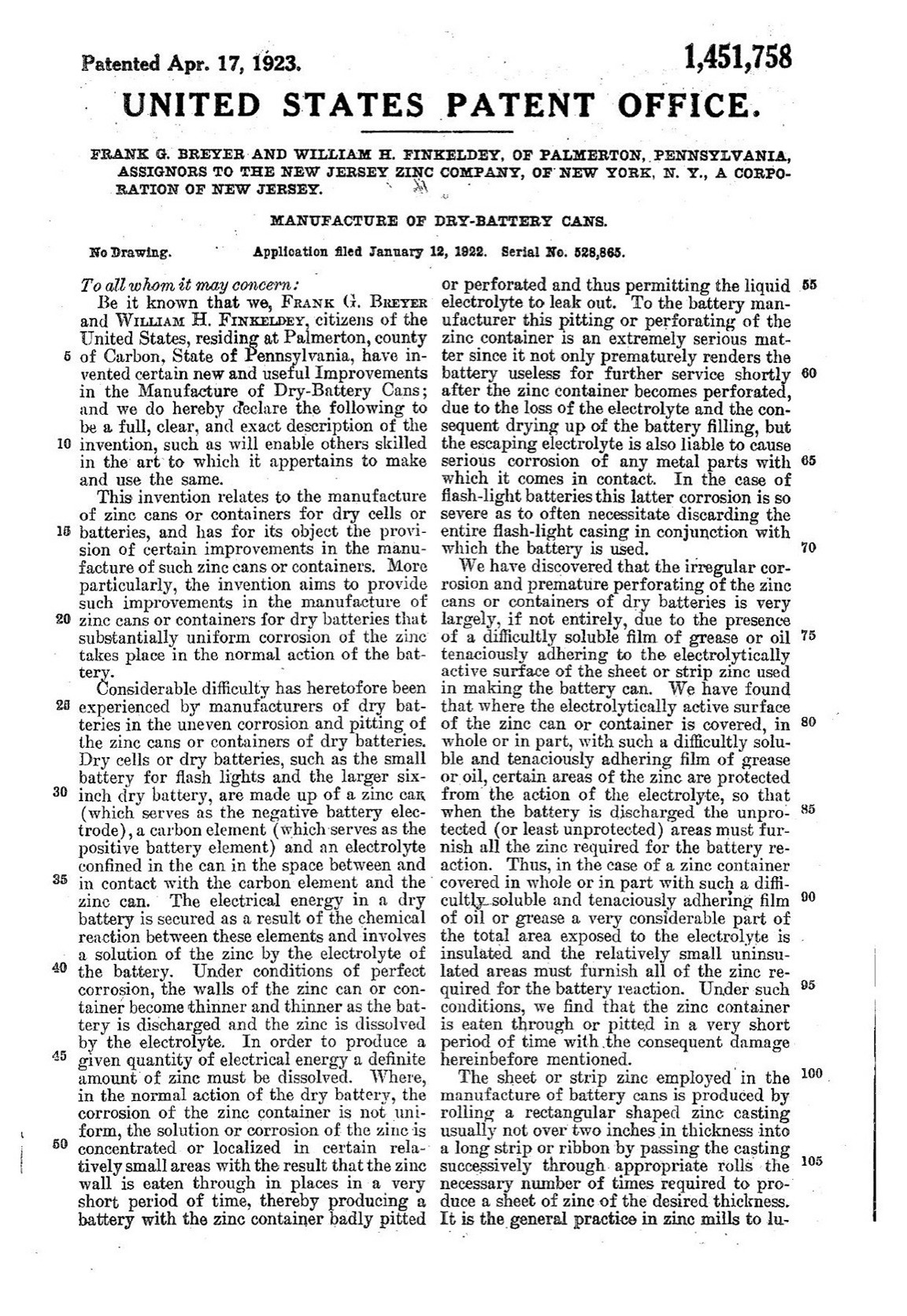
The zinc can of a dry cell is its negative electrode, and it is used up as the battery discharges. In 1922 Frank G. Breyer and William H. Finkeldey of Palmerton applied for a patent, assigned to the company, on the manufacture of dry-battery cans (issued April 17, 1923). Battery makers had long been troubled by cans that pitted and were eaten through, so that the electrolyte leaked out; in flashlight batteries, they wrote, the leak corroded the casing so badly that the whole flashlight often had to be thrown away. They traced the pitting to a thin film of rolling-mill oil left on the sheet zinc, and patented washing it off.
Ointment, and the two calamines
Zinc oxide was an old medicine. Greek and Roman doctors took it from the furnaces where copper was smelted with cadmia, a zinc ore, to make brass. Dioscorides, in the first century AD, says of pompholyx, the fume that settled there, “Pompholyx vero pinguis est et candida, insuperque levissima, ut in aërem evolare possit” (“pompholyx is greasy and white, and moreover so light that it can fly off into the air”), and says it formed when the smiths sprinkled ground cadmia onto the copper (p. 743 of Kurt Sprengel’s 1829 Greek and Latin edition). The furnace crusts of cadmia went into eye salves, “Oculorum autem medicamentis botryitis nomine et onychitis utiles” (“the kinds named botryitis and onychitis are useful in eye medicines,” p. 739), and “Vim habet pompholyx astringendi, refrigerandi, explendi, purgandi, obturandi et quodammodo exsiccandi” (“pompholyx has the power of binding, cooling, filling up, cleansing, closing and in some degree drying,” p. 747; translations ours, from Sprengel’s Latin). Pliny, his contemporary, calls pompholyx “useful as an ingredient in ophthalmic preparations for all diseases of the eyes” and for plasters “gently cooling and desiccative” (Natural History, book 34, ch. 33, Bostock and Riley’s translation of 1857). The translators were less sure than later writers what it was: these substances “are no longer known, but our tutty, or impure oxide of zinc, bears some resemblance to them.”
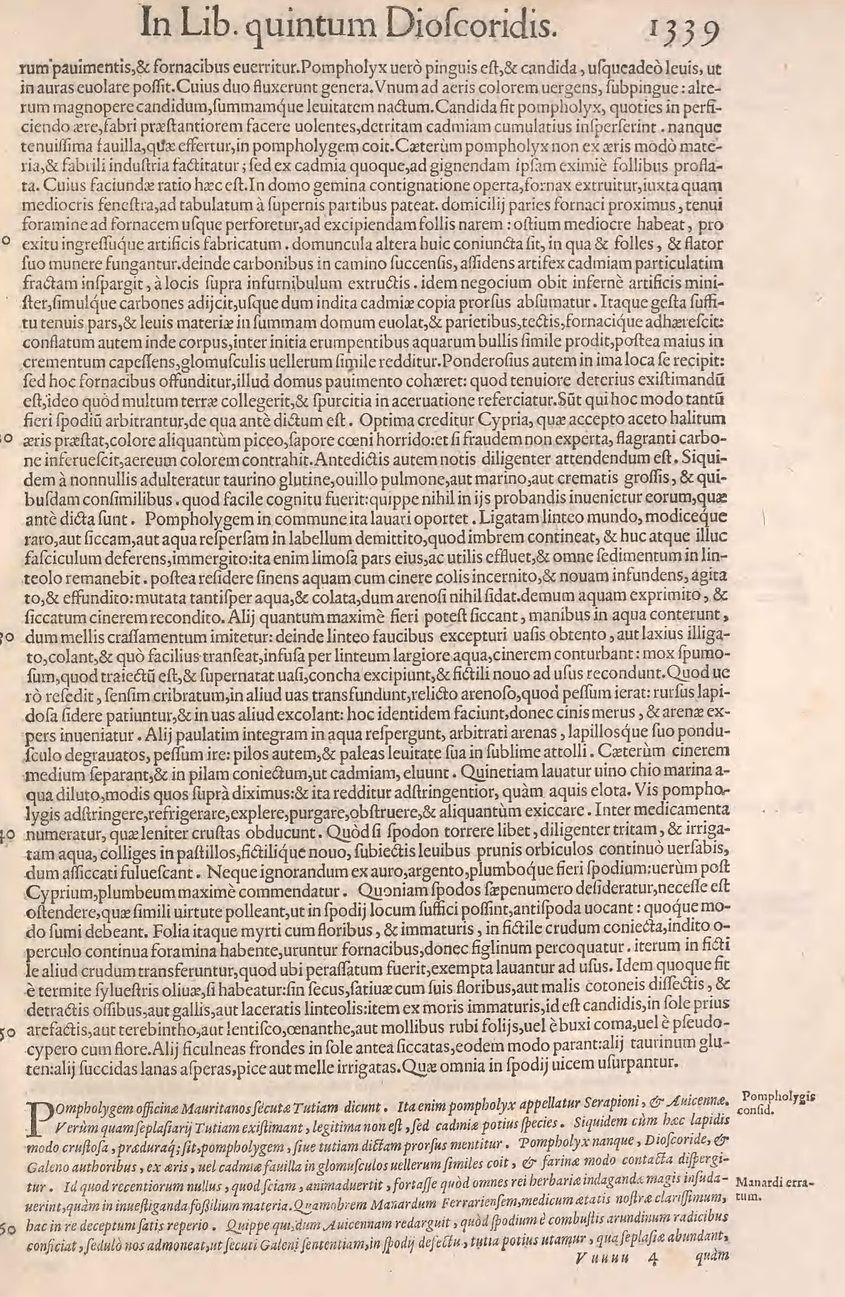
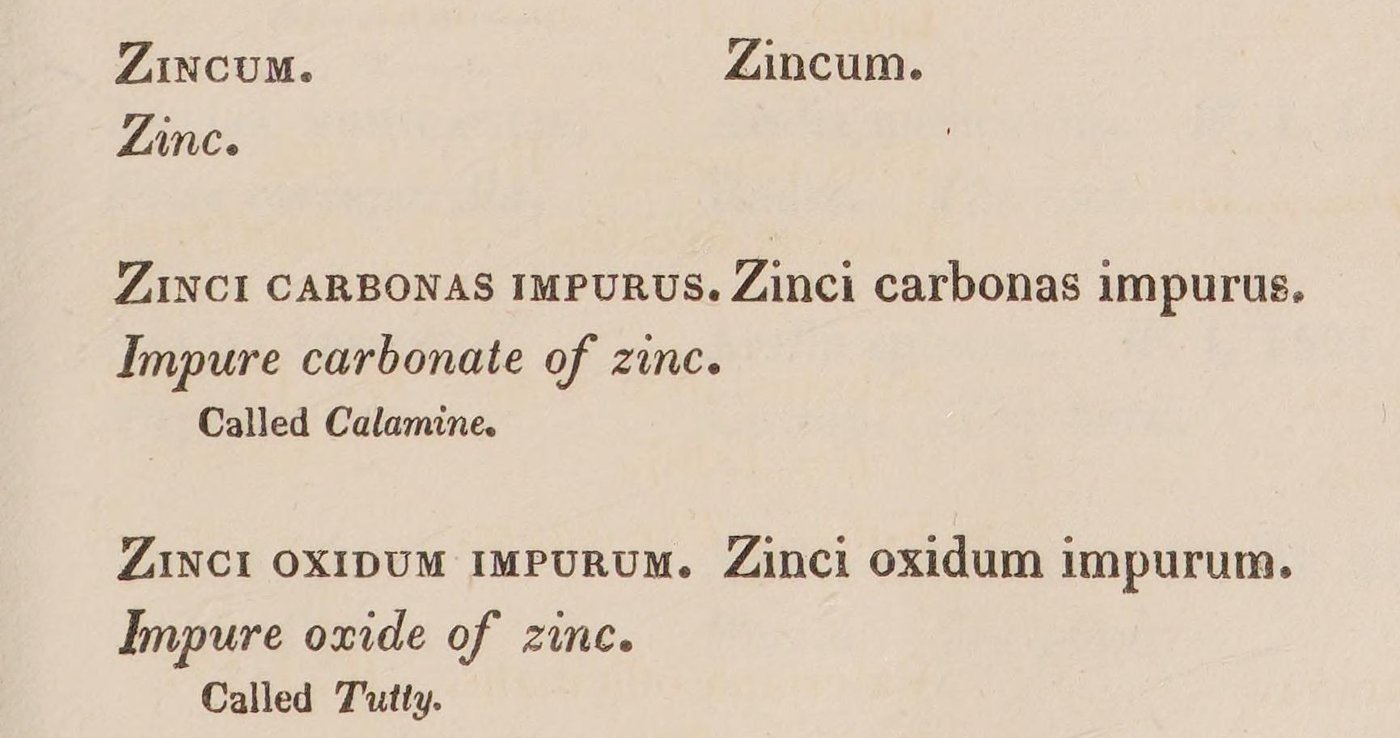
Arab physicians called it tutia, and the word came into European pharmacy with their books. Mattioli, commenting on Dioscorides in 1565, wrote: “Pompholygem officinæ Mauritanos secutæ Tutiam dicunt. Ita enim pompholyx appellatur Serapioni, & Auicennæ” (“the apothecaries’ shops, following the Moors, call pompholyx tutia, for that is its name in Serapion and Avicenna”), but warned that what the druggists took for tutia “legitima non est, sed cadmiæ potius species” (“is not the genuine thing, but rather a kind of cadmia”; p. 1339, our translation). Pomet’s Compleat History of Druggs (London, 1712) has tutty gathered on rolls of earth hung over the furnaces where bell metal was cast, and used “for Diseases of the Eyes, Mixing it with fresh Butter, or Diluting it with Rose or Plantin Water” (p. 341). The first Pharmacopœia of the United States (1820) listed “Impure oxide of zinc. Called Tutty” beside “Impure carbonate of zinc. Called Calamine” (p. 49), and its “Ointment of impure oxide of zinc” was five parts lard to one of prepared tutty (p. 257). By 1905 the pure oxide had taken its place, and the dispensatory explained that the gray furnace oxide was “identical with the impure oxide of zinc, which was formerly used in medicine under the names of tutia, cadmia fornacum, or tutty” (p. 1657). It is still in use: federal rules list zinc oxide, 1 to 25 percent, as a skin protectant (21 CFR 347.10), and it is one of the two sunscreen ingredients the Food and Drug Administration has proposed as safe and effective.
The National Standard Dispensatory of 1905 gives the United States Pharmacopoeia’s ointment of zinc oxide, one part of very fine zinc oxide to four of benzoinated lard, as a soothing, protective dressing for superficial burns, ulcers and eczema. The pharmacopoeia’s medicinal oxide was then made by heating zinc carbonate (p. 1657); in 1978 the company listed medicines among the uses of its zinc oxide (The Picking Table).
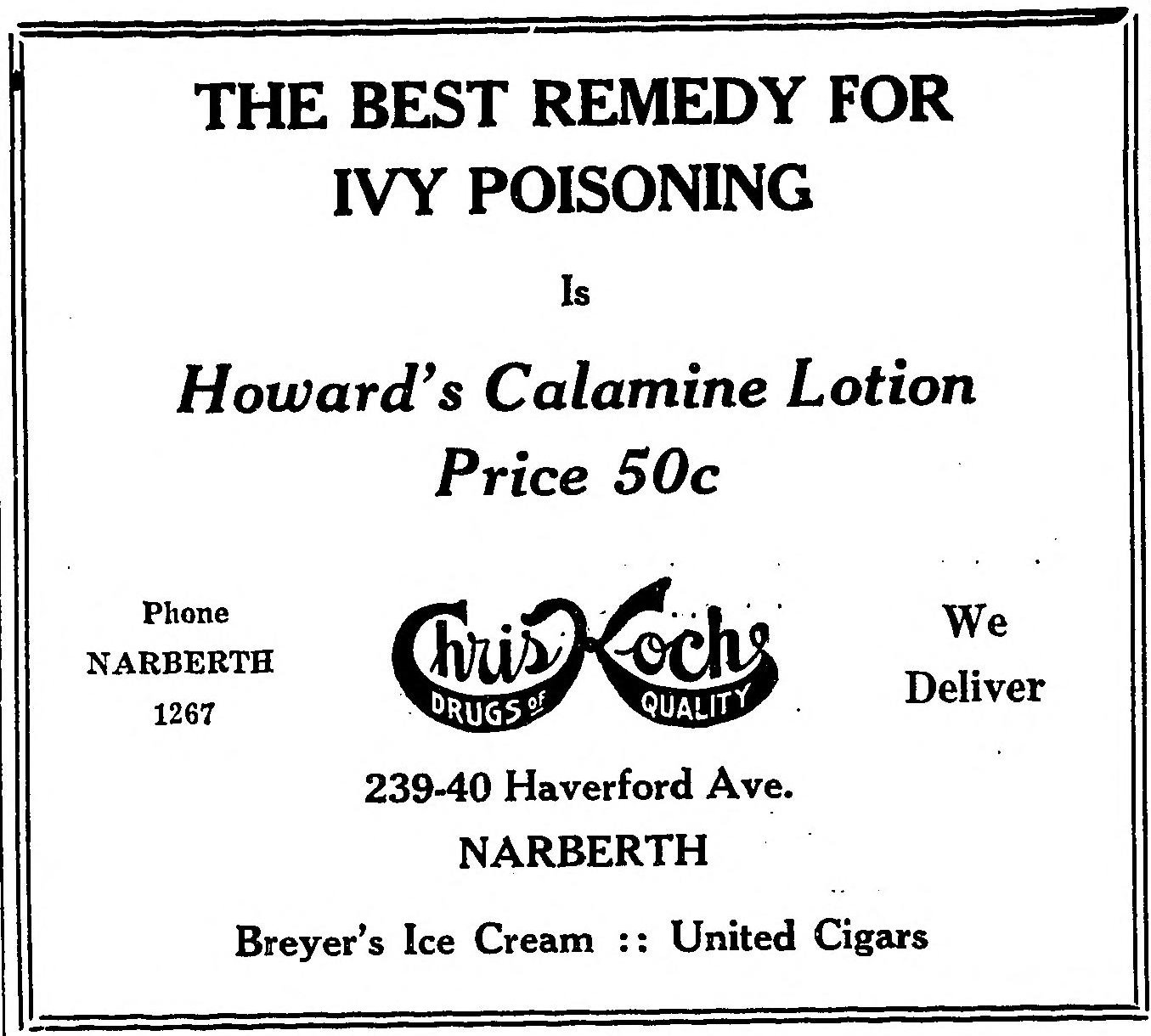
Calamine lotion takes its name from an ore. The same dispensatory calls zinc carbonate “calamine,” the silicate “siliceous calamine,” and lists franklinite among the zinc ores; its “prepared calamine,” native zinc carbonate calcined and powdered, was dropped from the British Pharmacopoeia in 1898. The United States Pharmacopeia now defines calamine as “Zinc Oxide with a small proportion of ferric oxide,” which gives the lotion its pink color. By the 1920s it was sold over the counter: a Narberth, Pennsylvania, druggist advertised it in 1926 as “THE BEST REMEDY FOR IVY POISONING” (Our Town). At Sterling Hill “calamine” meant something else again: the zinc silicate hemimorphite, dug from the Noble and Passaic open pits from the 1860s to the 1890s (Palache, 1935; see The mud zone at Sterling Hill).
Spiegeleisen, and the rest
What the oxide furnaces left of the franklinite was rich in iron and manganese, and the company smelted it into spiegeleisen, a manganese iron. It found little use at first; a few razors were made of it, and it lined safes as “Franklinite iron” because it was too hard to drill. The Bessemer steel process, which needed a manganese alloy, then took all the company could make, and it was used in car wheels and manganese steel (A record of accomplishment). Wetherill’s 1896 patent notes that the manganese of the brown troostite helped make it. That story has its own page: Franklinite, safes and spiegeleisen.
Zinc dust had uses of its own: recovering gold from cyanide solutions, dyeing and textile printing, making dyes, fireworks and flashlight powders. A considerable amount of common zinc went into separating silver and gold from lead bullion (A record of accomplishment).
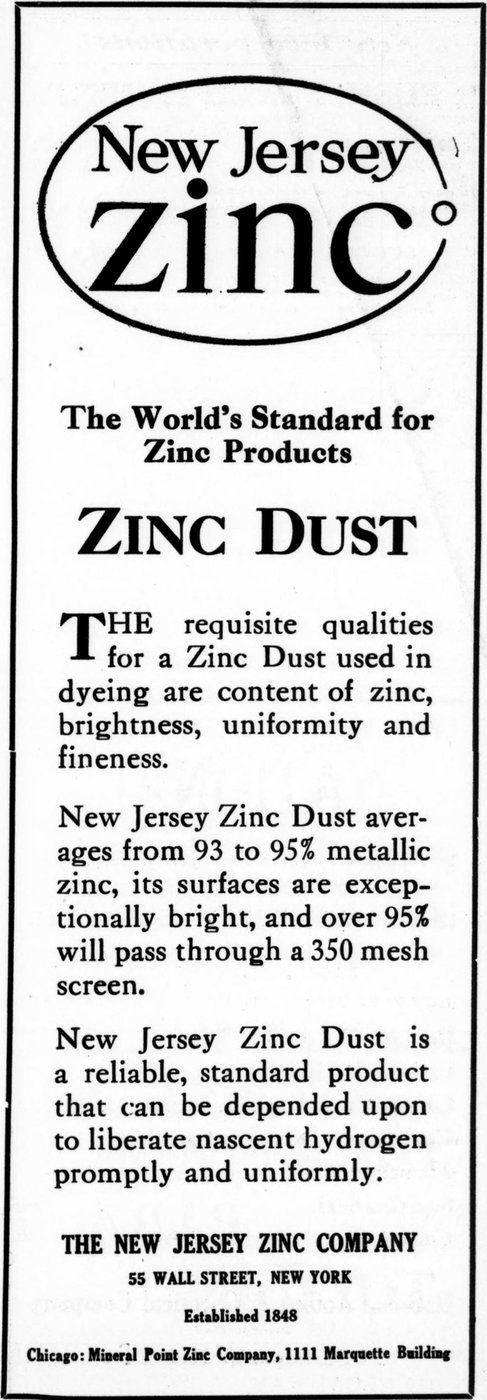
Zinc dust is zinc in a powder so fine that it is never quite free of oxide. In 1902 Walter Renton Ingalls wrote that it was known in the trade as “zinc dust, zinc gray, or indigo auxiliary,” and “employed chiefly as a reducing material in dyeing, whence its name of ‘indigo auxiliary’” (Production and properties of zinc, p. 60). Indigo has to be reduced before it will dye. In the zinc-lime vat, Knecht, Rawson and Loewenthal explained in 1910, zinc powder and slaked lime give hydrogen, which “reduces the indigotin to indigo white”; the vat was “extensively used in continuous dyeing machines, both for cotton warps and piece goods; in the latter case particularly for discharge printing” (A manual of dyeing, p. 317). The company’s advertisements of 1918 promised dye makers that New Jersey Zinc Dust could “be depended upon to liberate nascent hydrogen promptly and uniformly.”
In gold mining the cyanide process, patented in Britain by J. S. MacArthur and R. W. and W. Forrest in 1887, dissolves the gold out of crushed ore (Julian and Smart, p. 4), and zinc throws it down again from the solution. At first the zinc was cut into shavings; “Zinc-dust Precipitation” was “introduced by H. L. Sulman in 1894,” but “the successful application of the process is due to C. W. Merrill,” who mixed the solution with zinc fume and caught the gold in filter presses (p. 223). Julian and Smart describe the usual dust as “a by-product of the distillation process for the extraction of zinc from its ores” (p. 224), and Ingalls too calls it a by-product of smelting. The company’s was not: the United States Tariff Commission reported in 1921 that “Most of the manufacturers make only blue powder. The New Jersey Zinc Co. makes a fumed product from spelter.” It gave the chief American uses as sherardizing (coating other metals with zinc), dyeing and the cyanide process, and dated the first American zinc dust on the market only to 1910 (Tariff information surveys, p. 62).
The zinc used on lead bullion was ordinary slab zinc, not dust. In the Parkes process, Ingalls wrote, zinc’s “ability to rob the latter [the lead] of gold and silver” is put to work by stirring “zinc in the form of the ordinary slabs” into the melted lead “in a large iron pot”; the zinc-silver alloy is skimmed off, and the process had “almost entirely displaced the older methods of cupellation and Pattinsonizing” (p. 59). H. O. Hofman gave it two dates: “Karsten discovered in 1842 that argentiferous lead could be desilverized by the use of zinc, but his discovery could be applied in practice only when Parkes found the means (1850–1852) of working the zinc-silver-lead crust and refining the lead” (The metallurgy of lead, 1893, p. 310).
In The Picking Table
The Picking Table is about minerals, and it has touched the company’s products only now and then, often by reprinting old texts. In issue order: “Data from 1850” (vol. 4, no. 1, February 1963) quotes the Annual of Scientific Discovery for 1850 on Leclaire’s zinc white and on the Sussex Zinc and Copper Mining Company, with a note on the Franklin zinc in the brass of the United States standard weights and on the rise of galvanizing; the reprint of Archibald Bruce’s first description of zincite (vol. 5, no. 2, August 1964) ends with his note on brass; an address of 1854 by Jacob W. Miller (vol. 6, no. 1, February 1965) gives the company’s paint output for 1852 and 1853 and the story of its zinc white at Windsor Castle; and extracts from a company report (vol. 7, no. 1, February 1966) list its products and their markets, from slab zinc for galvanizing and brass to zinc oxide for paint and rubber. John L. Baum wrote “The Weights and Measures Opening” (vol. 16, no. 1, February 1975), “The first years of the New Jersey Zinc Company” (vol. 17, no. 2, September 1976) and “Early products of the New Jersey Zinc Company” (vol. 27, no. 2, Fall 1986), the last two on the paint business of the 1850s; the company’s own “An important part of Sussex County for 125 years” (vol. 19, no. 1, March 1978) closes with a page on the uses of zinc; and in “An Evening with Jack Baum” (vol. 53, no. 1, Spring 2012) Baum recalls that the company “was organized in the beginning to produce zinc oxide for white paint.” No article in The Picking Table has dealt with lithopone, rubber, die castings or batteries. The company’s magazine, Zinc, from 1916, is the place where more of this story should be found (see The New Jersey Zinc Company).
Sources and further reading
- Anderson, E. A., 1930, Zinc base die-casting alloy. U.S. Patent 1,779,525, assigned to the New Jersey Zinc Company. Google Patents
- Baum, J. L., 1976, The first years of the New Jersey Zinc Company. The Picking Table, vol. 17, no. 2, p. 11 ff. The Picking Table (PDF)
- Baum, J. L., 1986, Early products of the New Jersey Zinc Co. The Picking Table, vol. 27, no. 2, p. 11–12. Quotes the company’s report for 1852. The Picking Table (PDF)
- Breyer, F. G., and Finkeldey, W. H., 1923, Manufacture of dry-battery cans. U.S. Patent 1,451,758, assigned to the New Jersey Zinc Company. Google Patents
- Bureau of Standards, 1931, Zinc and its alloys. Circular 395. Zinc-base alloys for die casting, p. 182–184. PDF (NIST)
- Code of Federal Regulations, title 21, § 347.10, Skin protectant active ingredients. eCFR
- Depew, H. A., and Ruby, I. R., 1921, Some microsections cut from vulcanized rubber articles; and Ruby, I. R., and Depew, H. A., The aging of certain rubber compounds. India Rubber World, vol. 63, no. 4 (January 1, 1921), p. 244–247. archive.org
- Dioscorides, 1st century AD, De materia medica, ed. K. Sprengel, 1829, Pedanii Dioscoridis Anazarbei De materia medica libri quinque, vol. 1. Leipzig, Cnobloch. Greek with Latin translation. Cadmia, p. 738–740; pompholyx, p. 742–747. archive.org (Wellcome Collection)
- Hare, H. A., Caspari, C., and Rusby, H. H., 1905, The national standard dispensatory. Philadelphia. Zinc oxide, p. 1657; ointment of zinc oxide, p. 1610; zinc and calamine, p. 1662. archive.org
- Hofman, H. O., 1893, The metallurgy of lead and the desilverization of base bullion. New York, Scientific Publishing Co. Parkes’ process, p. 310 ff. archive.org
- India Rubber World, February 1, 1915: the company’s lithopone plant at Palmerton. archive.org
- Ingalls, W. R., 1902, Production and properties of zinc. New York, Engineering and Mining Journal. Desilverizing lead, p. 59; zinc dust, p. 60. archive.org
- Jones, S. T., 1852, U.S. Patent 8,756 (collecting zinc oxide in bags), February 24, 1852. Google Patents
- Julian, H. F., and Smart, E., 1921, Cyaniding gold and silver ores, 3rd ed., revised by A. W. Allen. London, Griffin. The MacArthur–Forrest patent, p. 4; precipitation by zinc, p. 222–224. archive.org
- Kaas, L. M., 2016, The history of zinc mining in Friedensville, Pennsylvania. Mining History Journal, vol. 23, p. 17 ff. On Wetherill, Jones and the American process. PDF
- Knecht, E., Rawson, C., and Loewenthal, R., 1910, A manual of dyeing, vol. 1. London, Griffin. The zinc-lime vat, p. 317. archive.org
- Mattioli, P. A., 1565, Commentarii in sex libros Pedacii Dioscoridis Anazarbei de medica materia. Venice, Valgrisi. Pompholyx and tutia, p. 1339. archive.org (Smithsonian Libraries)
- Mostoni, S., and others, 2026, Influence of the coordination features of zinc single sites on the reactivity of zinc-based curing activators. Materials Today Chemistry, vol. 55, 103770 (CC BY). PDF
- Nelson, H. A., and McKim, W. A., about 1926, Metallic zinc powder as a paint pigment. New Jersey Zinc Company. archive.org
- New Jersey Zinc Company, 1918, Zinc dust (advertisement). Drug & Chemical Markets, November 6, 1918, p. 31. archive.org
- New Jersey Zinc Company, 1978, The New Jersey Zinc Company: an important part of Sussex County for 125 years. The Picking Table, vol. 19, no. 1, p. 4–8. The Picking Table (PDF)
- New Jersey Zinc Company, about 1920, Zinc for roofing use; and 1925, Horse Head zinc eaves troughs, gutters and conductor pipes. archive.org
- New Jersey Zinc Company, about 1924, A record of accomplishment, 1848–1923: a short history of the New Jersey Zinc Company. See especially “Uses of the Company’s products.” Science History Institute (public domain)
- Our Town (Narberth, Pennsylvania), August 14, 1926. Advertisement for Howard’s Calamine Lotion, Chris Koch, druggist. archive.org
- Palache, C., 1935, The minerals of Franklin and Sterling Hill, Sussex County, New Jersey. U.S. Geological Survey Professional Paper 180. The calamine deposits of Sterling Hill, p. 22–23. PDF
- Pearson, H. C., 1909, Crude rubber and compounding ingredients. New York, India Rubber Publishing Co. Oxide of zinc, p. 176–177. archive.org
- The pharmacopœia of the United States of America, 1820. Boston, Wells and Lilly. Calamine and tutty, p. 49; ointment of impure oxide of zinc, p. 257. archive.org (Wellcome Collection)
- Pliny the Elder, 1st century AD, The natural history of Pliny, tr. J. Bostock and H. T. Riley, vol. 6, 1857. London, Bohn. Book 34, ch. 33, pompholyx, p. 202. archive.org
- Pomet, P., 1712, A compleat history of druggs. London, Bonwicke and others. Of tutty, p. 340–341. archive.org
- Trott, L. H., 1928, Zinc oxide and its application to paint. New Jersey Zinc Company. archive.org
- Trott, L. H., 1930, Lithopone and its part in paint. New Jersey Zinc Company. archive.org
- U.S. Food and Drug Administration, Questions and answers: FDA posts deemed final order and proposed order for over-the-counter sunscreen. FDA
- U.S. Geological Survey, 1917, Mineral resources of the United States, 1915, part I. Zinc: uses, p. 969; grades and prices, p. 974; spelter for ammunition brass, p. 22. archive.org
- U.S. Tariff Commission, 1921, Tariff information surveys on the articles in paragraph 1– of the tariff act of 1913. Zinc dust, p. 62–65. archive.org
- United States Pharmacopeia–National Formulary, Calamine (monograph preview). USP
- Wetherill, J. P., 1896, Separation of franklinite ore and metallurgy thereof. U.S. Patent 555,793. Google Patents
- Wetherill, S., 1855, Improvement in processes for making zinc-white. U.S. Patent 13,806, November 13, 1855. Google Patents
Written with Claude, an AI model made by Anthropic, from the sources listed above, and checked against them. October 2026.