Histories › The mines and their history
How Franklin and Sterling Hill zinc went to two world wars: the mine that doubled its output in 1915, Palmerton’s war plants, the company’s profits and its president on the zinc committee, the cartridge cases and the steel cent of 1943, and the men underground in 1944.
1914: the Allies cut off
Cartridge brass is about one part zinc to two of copper, and galvanized steel needed zinc too. When war broke out in August 1914, Britain and France lost their supply. The U.S. Geological Survey explained why, looking back in 1918: “This burden fell upon the United States because of the fact that of the three main zinc-smelting centers in Europe two were in Germany and the other was along Meuse River in the line of the German advance through Belgium and northern France” (Mineral Resources, 1918, p. 1044).
American spelter went east at once. “The war in Europe, which resulted in practically shutting off their previous supplies of spelter from the allies, soon led to larger exports from the United States, which amounted to 72,542 tons during the latter half of the year” (Mineral Resources, 1914, p. 868). Exports of spelter and sheet zinc “rose from less than 1,000 tons in the period before the war to about 70,000 tons in each period since the war began” (p. 898). The Survey put it plainly: “The main dependence of the world for zinc, outside of the Germanic allies, is, of course, the United States” (p. 876).
Shrapnel, cartridges and the spelter panic
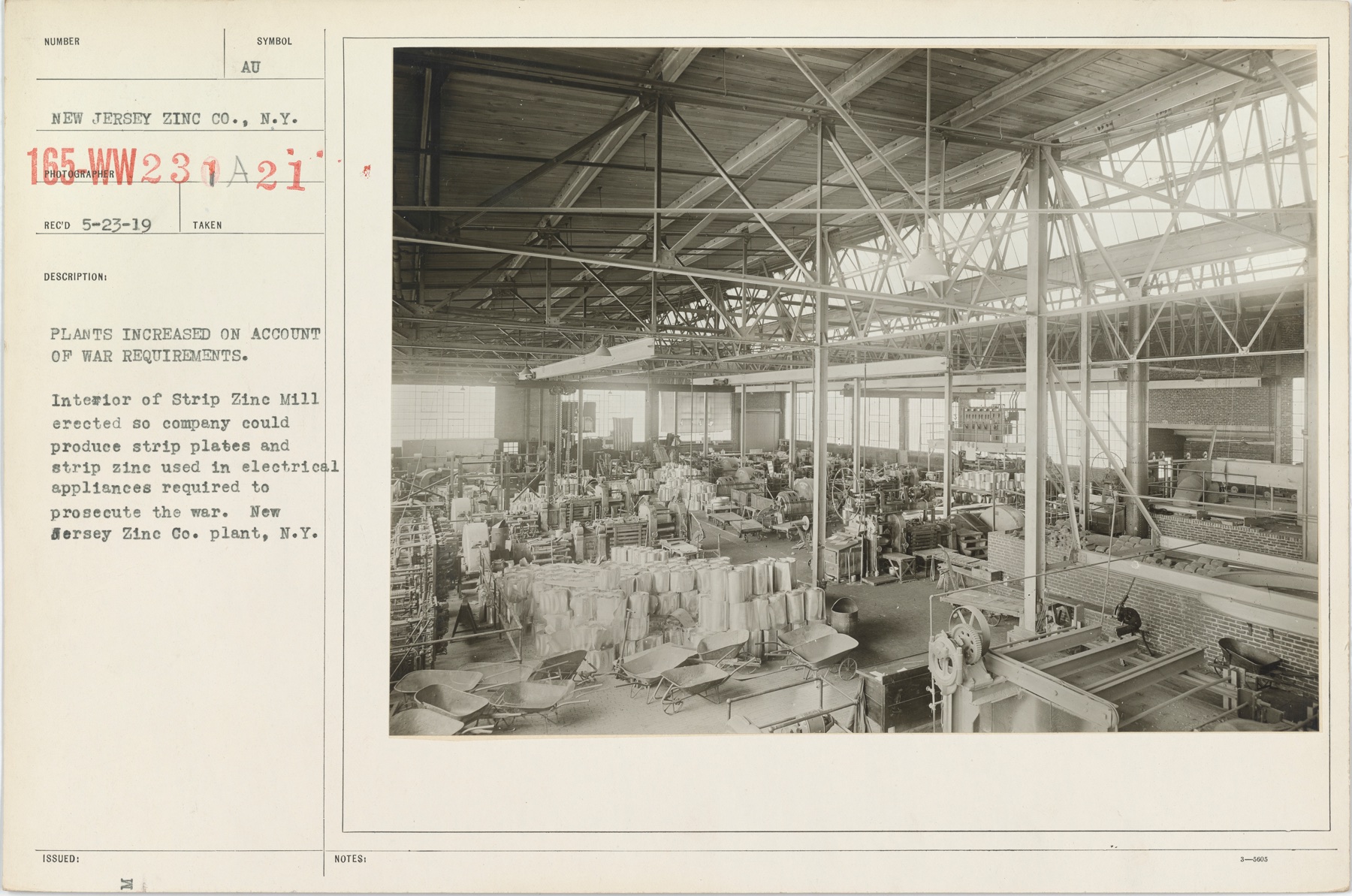
“The war has developed an unexpectedly large demand for zinc,” the Survey wrote, “owing chiefly to the overwhelming use of shrapnel and of huge artillery.” It quoted the British Iron and Coal Trade Review on a British 18-pounder: “Spelter consumption per shell of this size is about 1.87 pounds,” and on the French rifle: “Every 125 of these [Lebel] cartridges consumes 1 pound of spelter” (Mineral Resources, 1914, p. 896).
Prices swung wildly. “The price of spelter responded sharply to the scarcity of the metal in London consequent upon the closing down of the usual European sources,” the Survey wrote, and spoke of “the spelter panic in London” (p. 897). In America the price fell in October 1914 to “the lowest point of the whole war period, 4.6 cents a pound,” and then rose to “26.5 cents a pound for prime western zinc early in June, 1915” (Mineral Resources, 1918, p. 1044). In January 1915 the British government made J. P. Morgan & Co. its purchasing agents “for copper, zinc, brass, and other munitions,” and the French followed in May (p. 1045).
Britain’s answer: Australian ore
Britain could not smelt enough zinc for itself. A British correspondent told the Survey that “The smelting capacity amounted at the outbreak of the war to 26 per cent of the normal consumption” (Mineral Resources, 1915, p. 929). Australia had the ore but sent it abroad to be smelted. In 1914 the Survey called “The dependence of England upon continental Europe for spelter and the dependence of Australia upon continental Europe for a market for zinc concentrates … a source of much embarrassment since the war began” (Mineral Resources, 1914, p. 879).
The answer was a long contract. “As a result of negotiations conducted by W. M. Hughes, the Australian prime minister,” the British government agreed to “purchase from the mines 100,000 tons of concentrates per year for 10 years” (Mineral Resources, 1915, p. 931). The Survey quoted the Mining and Scientific Press of September 1916 on the mood behind it: “the determination to free the world from German domination of the metal trades” (p. 930).
1915: the mine at Franklin doubles its output
Before the war some of Franklin’s ore went to Europe: in 1913 “The New Jersey Zinc Co. exported to Europe willemite concentrates from these mines to the aggregate of 17,713 short tons” (Mineral Resources, 1913, p. 633). The war turned the flow around, and what the warring countries wanted was the purest zinc for cartridge brass. Franklin’s was that zinc. “Franklin Furnace ore, containing no lead or cadmium, yields a high-grade spelter, the well known Horsehead brand, and the great demand for spelter of this grade during the last two years has resulted in a notable increase of the zinc output of these mines” (Mineral Resources, 1915, p. 866).
The Engineering and Mining Journal reported the change from Franklin Furnace in August 1915: “Normal production of this mine is 30,000 tons per month. Owing to demands for high-grade spelter for war munitions, production has been increased to 70,000 tons per month without addition of further equipment or adding to personnel except as to underground miners” (August 21, 1915, p. 333).
Sterling Hill came back to life. The Sterling mine “has been practically closed until very recently … An incline shaft was recently sunk on this ore body to a vertical depth of 1,600 feet … A new mill of 400 tons capacity in 24 hours and similar to the mill at the Franklin mine has been built at the Sterling mine” (Mineral Resources, 1915, p. 867).
| Year | Crude ore (short tons) | Zinc (pounds) |
|---|---|---|
| 1913 | 490,434 | 168,244,000 |
| 1914 | 529,443 | 148,506,500 |
| 1915 | 737,310 | 233,236,000 |
| 1916 | 712,464 | 221,396,000 |
| 1917 | 727,496 | 241,692,000 |
| 1918 | 672,791 | 196,940,000 |
| 1919 | 615,680 | 185,824,000 |
Ore mined and zinc produced in New Jersey, all from the Franklin and Sterling Hill mines. U.S. Geological Survey, Mineral Resources: 1913, p. 184; 1914, p. 152 (which revises the 1913 zinc down to 144,312,560 pounds); 1915, p. 14; 1916, p. 326; 1917, p. 59, with the corrected figures from the errata slip bound into the volume; 1918, p. 214; 1919, p. 45.
Palmerton at war
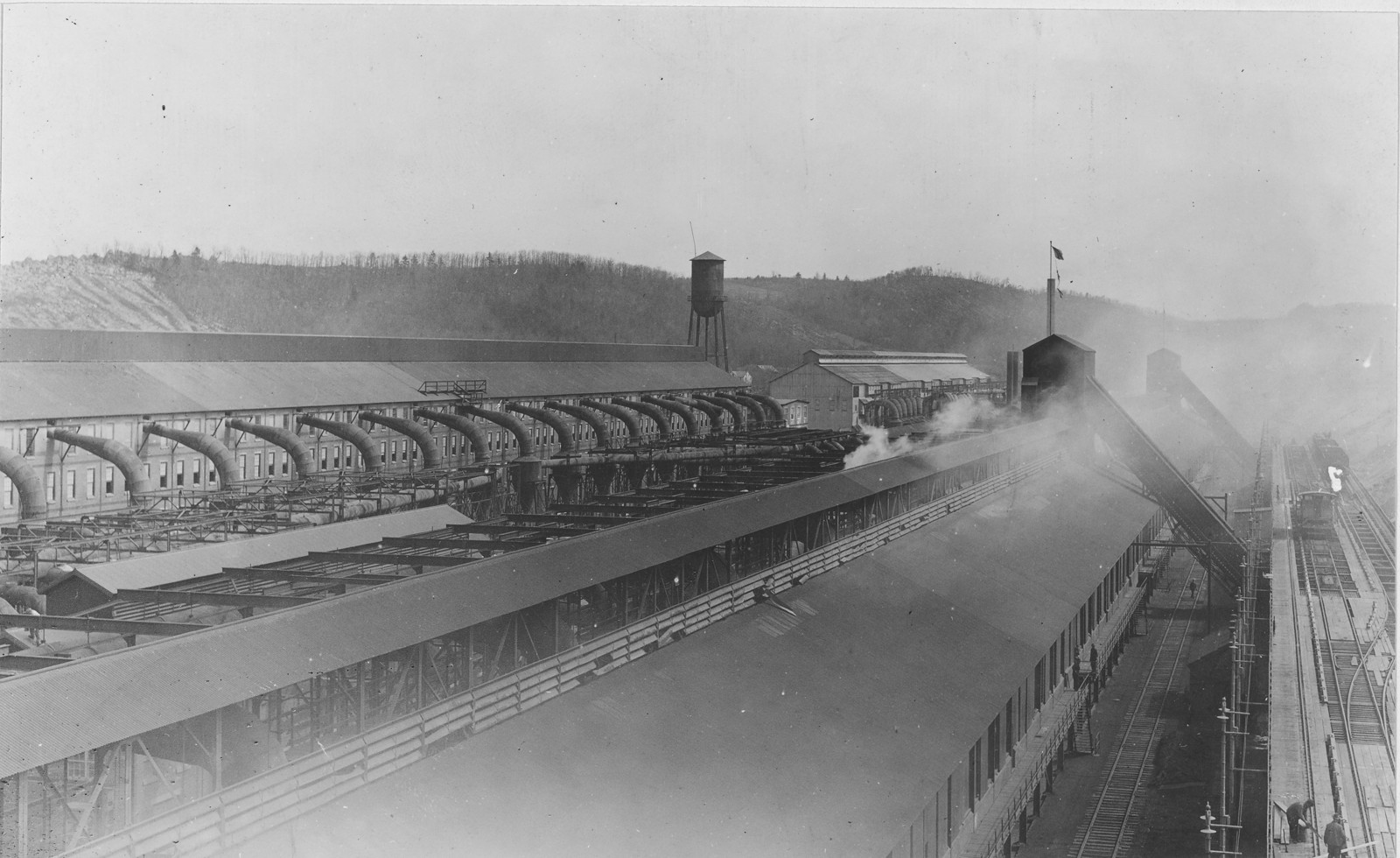
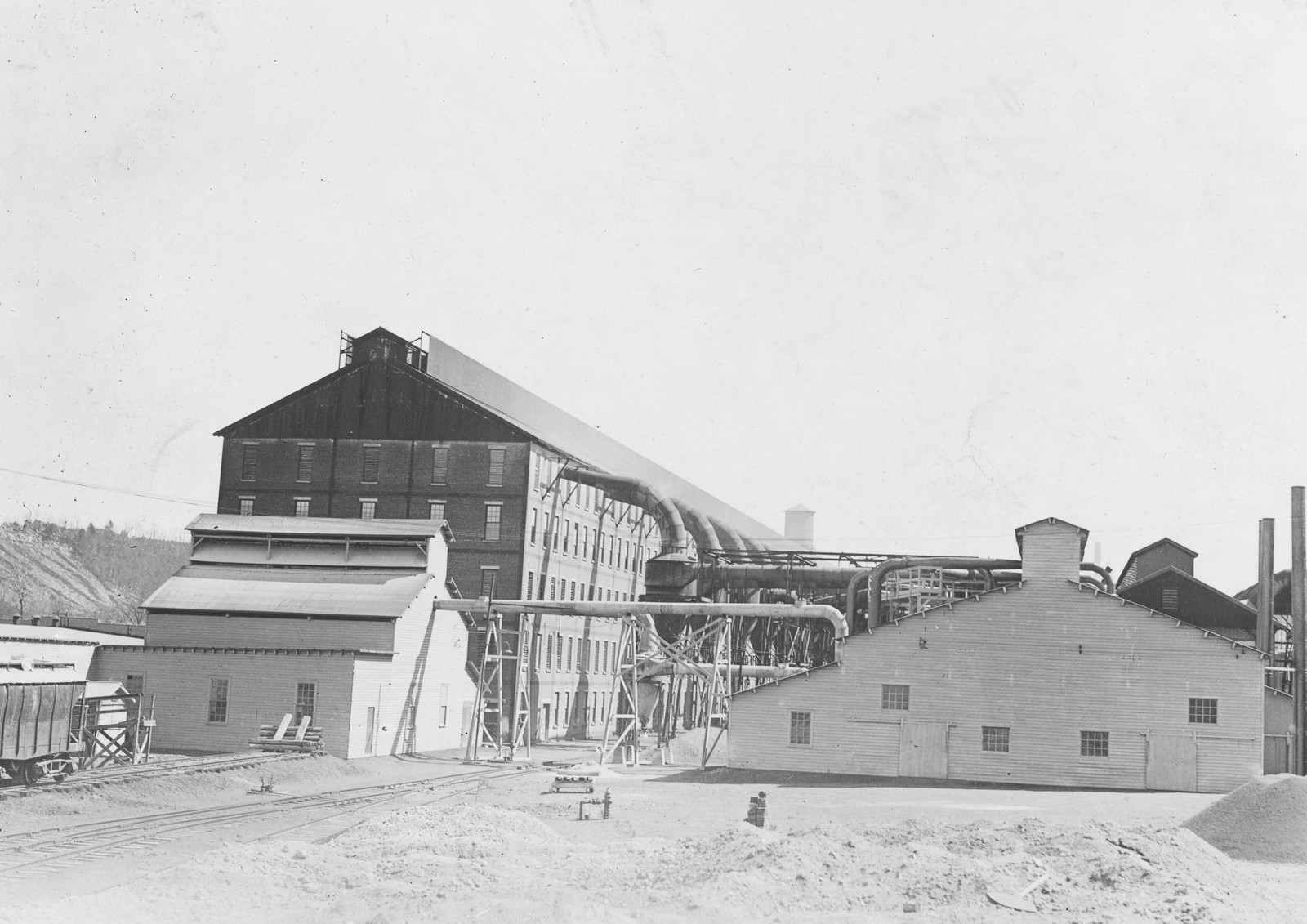
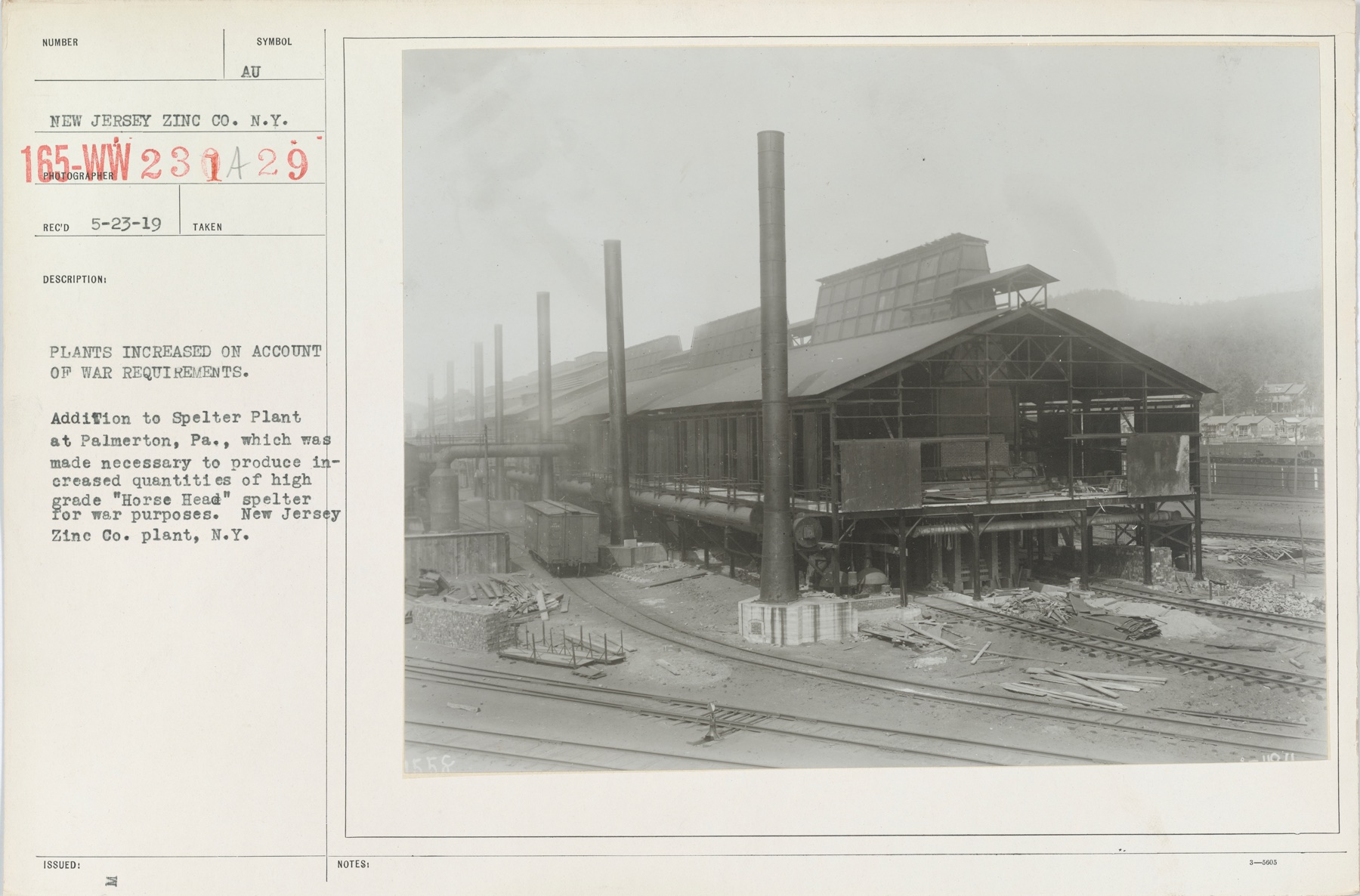
The ore went by train to the company’s works at Palmerton, Pennsylvania, and Palmerton grew. In 1915 “The New Jersey Zinc Co. added about 960 retorts at the Palmerton plant” (Mineral Resources, 1914, p. 893).
Old products found new prices. Two months into the war the Journal noted that “Before the war zinc dust was worth about 6c. per lb. Now it is about 15c. per lb. … This has led the New Jersey Zinc Co. to resume the manufacture of zinc dust at Palmerton” (October 24, 1914, p. 757). And a pile that had embarrassed the company became a fortune: “before the war there was no sale for spiegeleisen. The New Jersey Zinc Co. had stacked up more than 30,000 tons of spiegel, which was virtually unsalable … Within a few months, the present conditions in the steel industry began to develop, and this huge accumulation was sold at a price much higher than that which the company would have been glad indeed to take a few months earlier” (December 15, 1917, p. 1028). Spiegeleisen, the manganese iron left from Franklin’s franklinite, is told on Franklinite safes and spiegel.
The company also began to roll zinc. “The great demand during the war for sheet zinc to line packing cases made for shipment overseas, especially cases containing munitions or other material that was likely to be affected by salt air, led still other firms into the business of rolling zinc. … The New Jersey Zinc Co. made its first output of rolled zinc in 1917” (Mineral Resources, 1918, p. 1031).
1917: the New Jersey Zinc Company’s president runs the zinc committee
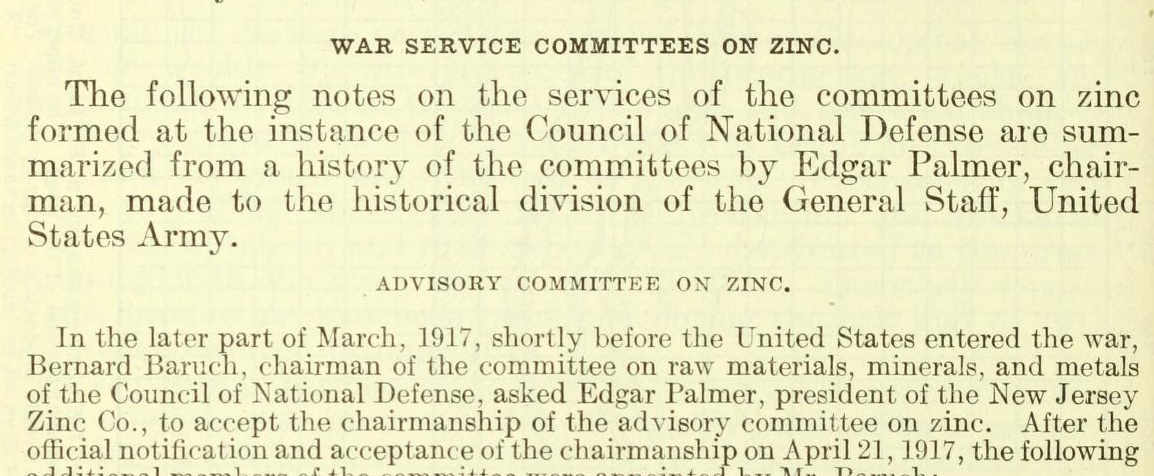
When the United States entered the war, the man it asked to organize the country’s zinc was the head of the company that worked Franklin and Sterling Hill. “In the later part of March, 1917, shortly before the United States entered the war, Bernard Baruch, chairman of the committee on raw materials, minerals, and metals of the Council of National Defense, asked Edgar Palmer, president of the New Jersey Zinc Co., to accept the chairmanship of the advisory committee on zinc.” The committee’s secretary was A. P. Cobb, also of the New Jersey Zinc Co. (Mineral Resources, 1918, p. 1048). The Survey’s account was itself “summarized from a history of the committees by Edgar Palmer.”
The committee’s first job, in April 1917, was about 10,000 tons for the government. It “was furnished at 11½ cents a pound for grade A, 11 cents a pound for grade B, and 9 cents a pound for grade C, although grade A zinc was then selling in open market for 25 cents a pound” (p. 1048). That summer a new law barred anyone who sold to the government from sitting on such committees, and the members resigned. In November 1917 the War Industries Board set up a zinc producers’ committee instead, with “Edgar Palmer (chairman), New Jersey Zinc Co.” (p. 1049).
The mines in Sussex County worked flat out. In 1918 “The production of New Jersey was, as usual, confined to the output of the Mine Hill and Stirling mines at Franklin Furnace,” which produced “672,791 tons of crude ore … which yielded a total of 196,940,000 pounds of zinc” (Mineral Resources, 1918, p. 214).
Edgar Palmer was not only a zinc man. He is the same man who gave Princeton its stadium in 1914 (see What the ore was worth).
The company’s own story of the war years, from its plants and products, is on What Franklin’s zinc was for.
Profits, taxes and the men, 1915–1918
The war made the company very rich. In July 1915 “A 250% stock dividend has been declared … This increases the capital stock to $35,000,000” (Engineering and Mining Journal, July 17, 1915, p. 125). For 1916, “Net profits … were $34,488,239; dividends $26,600,000; profit-sharing payments about $900,000” (February 17, 1917, p. 326). In Sussex County people noticed: “some persons in New Jersey are getting excited over the New Jersey Zinc Co., whose Franklin mine is assessed for taxation at a valuation of about $2,500,000, it is alleged, while the company pays annually many millions in excess of that sum as dividends” (December 11, 1915, p. 980).
In 1918 the Federal Trade Commission looked into war profits and singled out one zinc company. “Most of the evidence in the commission’s possession indicates no unusual profits in the zinc industry, with the exception of the operations of the New Jersey Zinc Company.” It did not call it profiteering. The company’s high profits on its best spelter were “due to the fact that it possesses a natural monopoly of a certain high-grade ore … In fact, the whole explanation of the New Jersey Zinc Co.’s large profits lies in its possession of an orebody of unusual richness and purity” (report quoted in the Engineering and Mining Journal, July 6, 1918, p. 30). The orebody was Franklin’s.
The men who mined it were mostly immigrants. B. F. Tillson, the mine’s engineer, wrote in 1914 that “our mine labor was about 90% of such nationalities as Russians, Poles, Slavs, Lithuanians and Hungarians” (December 12, 1914, p. 1036). For 1916 the company “posted notices in four languages announcing that during 1916 it will pay bonus of 10% of their yearly wages to all employees who have worked for company year or more” (January 22, 1916, p. 203). Labor ran short anyway: in 1917 the company “suffered somewhat from labor shortage,” though ore moved “continuously in solid trains that plied between the company’s mines and reduction works” (January 12, 1918, p. 114). At the smelters it was worse; the company’s George C. Stone said “we have suffered severely from the scarcity of skilled furnacemen,” adding that “Spelter furnacemen, like poets, are largely born and not made” (February 3, 1917, p. 219).
The company lent to the war as well: its subscription to the Third Liberty Loan, through the mining committee, was $1,110,450 (April 27, 1918, p. 806). And with tin and aluminum scarce, it urged manufacturers to “Make It of Zinc,” compiling a list of zinc products such as “pencil tips, shaving-soap containers, trouser buttons, bottle covers” (October 19, 1918, p. 705).
At Franklin the war shut the dumps to collectors. Frederick Canfield wrote to George F. Kunz in November 1917 that “The Zinc Co. has shut down on collecting. I heard yesterday, that boxes of minerals had been held up at the express office in Franklin, also that your baggage is examined in your room in the hotel” (quoted by Richard Hauck, “Times Are Tough!”, The Picking Table, vol. 39, no. 2, Fall/Winter 1998, p. 38). The influenza of 1918 reached the mine captain’s house: one of George H. Rowe’s daughters “died in the influenza epidemic of 1918” (John L. Baum, “Mine Captain George H. Rowe,” vol. 23, no. 1, Spring 1982, p. 17).
1939: Germany takes Poland’s zinc
In the Second World War the balance ran the other way at first. The Bureau of Mines reported: “The capture of the Polish zinc mines and smelters in good working order early in the fall of 1939 made Germany largely self-sufficient in zinc. Germany now should be able to produce more than 300,000 tons of zinc annually without importing foreign ore.” It gave the figures: “German consumption of zinc totaled almost 270,000 metric tons in 1938, in which year it produced 192,000 tons and Poland 108,000 tons” (Minerals Yearbook, 1940, p. 145). These were the same Upper Silesian deposits that, as Prussia’s, had led the world in Whitney’s table of 1853.
On the Allied side, “The Allied blockade diverted shipments of ore from Belgium, the Netherlands, and Norway,” and “Acquisition of Polish smelters and mines placed Germany far in the lead among European countries and made it more than self-sufficient in zinc” (p. 129).
1940–1941: shortage, and a higher price
America felt the pinch before it entered the war. “During 1940 the shortage of zinc became more acute, and by the end of the year producers had voluntarily initiated a system of allocating supplies of zinc to consumers.” Then the government stepped in: “On October 9, 1941, the Office of Price Administration raised the official quotation for Prime Western zinc at St. Louis from 7.25 to 8.25 cents a pound in an effort to expand output from marginal producers. This was the highest price level reached in 15 years” (Minerals Yearbook, 1941, p. 144).
Sussex County’s mines were not marginal. “Zinc ore produced in New Jersey in 1941 totaled 585,463 tons containing 93,781 tons of recoverable zinc as metal or in oxide compared with 556,031 and 91,406 tons, respectively, in 1940. The producing mines were the Mine Hill at Franklin and the Sterling Hill at Ogdensburg, both in Sussex County. The ore bodies in these mines are unique in that they are said to be the only ones in the world from which all three of the minerals franklinite, willemite, and zincite are being mined in commercial quantities” (Minerals Yearbook, 1941, p. 326).
1942–1943: zinc under allocation, and a steel penny
In America zinc came under government control. “Under General Preference Order M-11, in effect at the beginning of 1942, the War Production Board controlled the supply of slab zinc,” and from June 1, 1942, slab zinc was placed “under complete allocation”; a further order restricted its use, “the exceptions being principally for United States Government and Lend-Lease accounts” (Minerals Yearbook, 1942, p. 182).
To coax more out of the mines, the government paid extra for extra zinc. Under the Premium Price Plan, producers “received, through the Metals Reserve Co., 11 cents a pound for zinc produced in excess of quotas based upon 1941 output as against the regular established ceiling price of 8.25 cents at East St. Louis. This plan became effective February 1, 1942, for 2½ years.” The Bureau judged it fairly: “although the expected increase in the rate of production did not materialize, the maintenance of past production was in itself an accomplishment” (Minerals Yearbook, 1942, p. 183).
The war even changed the cent. “Secretary Morgenthau established specifications for a new, wartime 1-cent coin, of the same design as the present penny, but made of zinc-coated steel. Minting of the new pennies will commence about February 1, 1943” (p. 88). Copper was needed for cartridge cases; zinc was used to keep the steel cents from rusting. The story of the cent is told below.
The company also turned its chemistry to the war. In 1943 “The New Jersey Zinc Co., 160 Front Street, New York, announced a zinc borate paint for flameproofing fabrics, tents, lifeboat coverings, and hatches” (Minerals Yearbook, 1943, p. 1557).
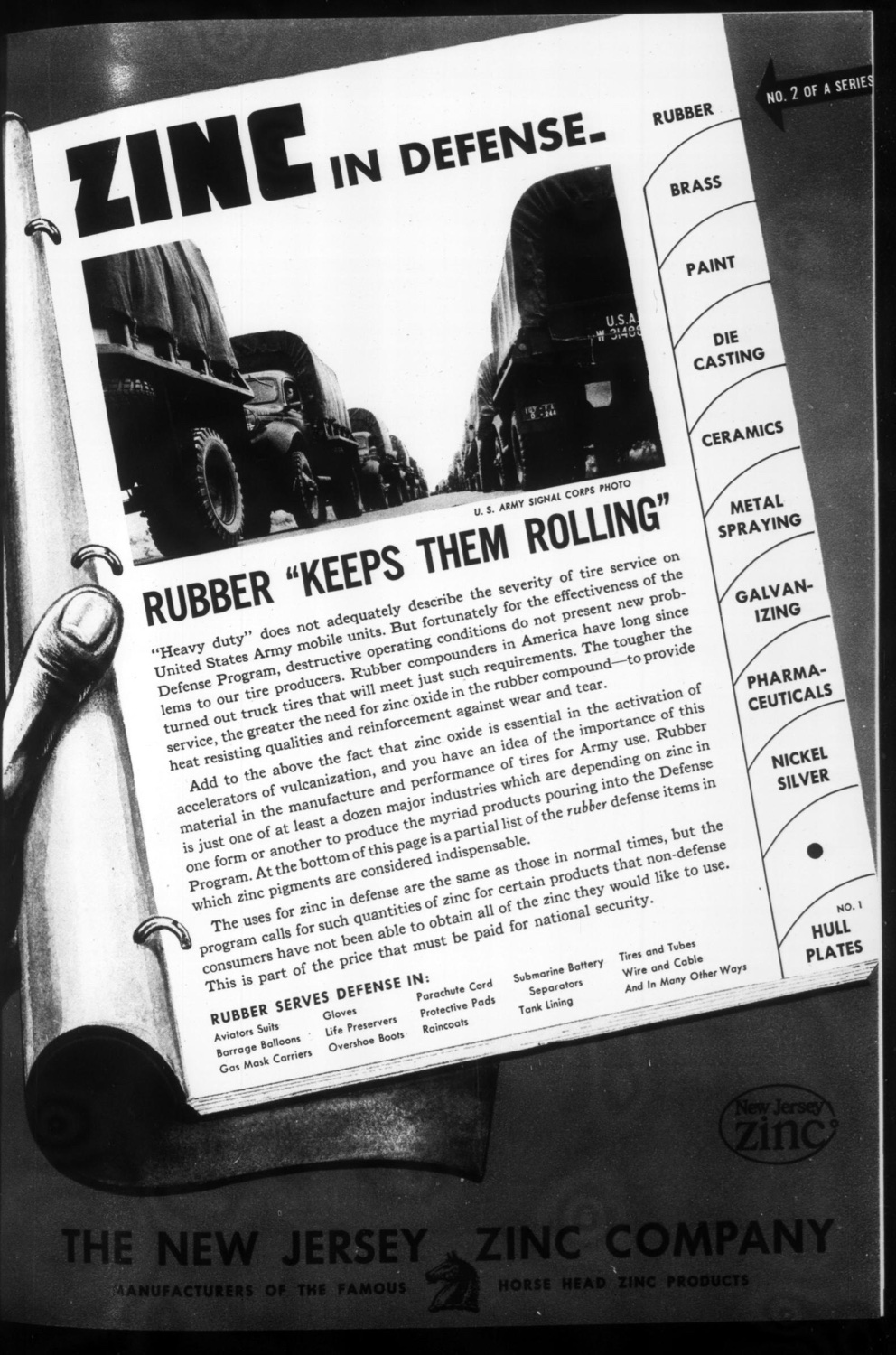
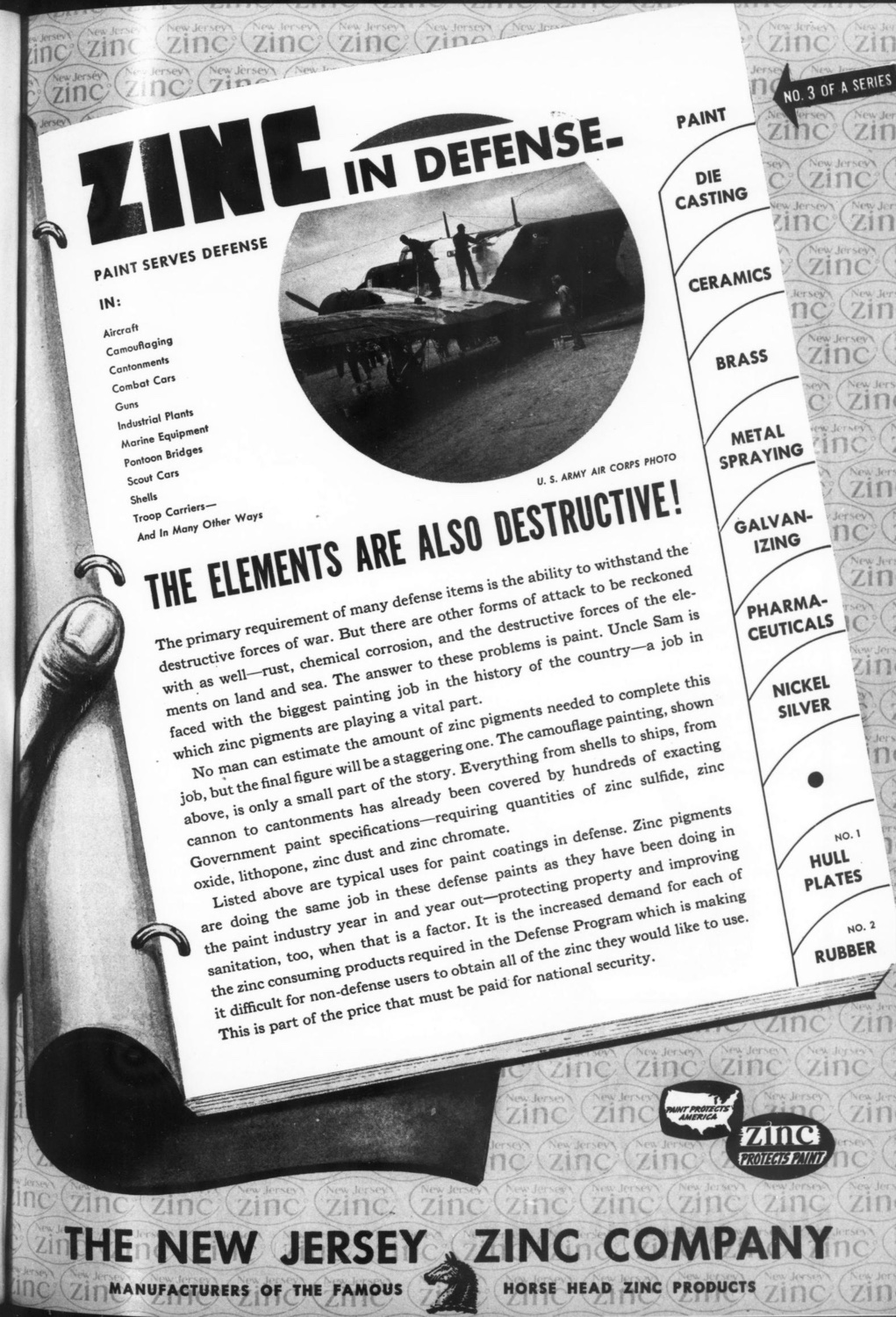
The New Jersey Zinc Company ran a series of advertisements in 1941 called “Zinc in Defense.” One showed an Army truck convoy: “The tougher the service, the greater the need for zinc oxide in the rubber compound—to provide heat resisting qualities and reinforcement against wear and tear.” Another, on paint: “Everything from shells to ships, from cannon to cantonments has already been covered by hundreds of exacting Government paint specifications—requiring quantities of zinc sulfide, zinc oxide, lithopone, zinc dust and zinc chromate” (Machine Design, November and December 1941).
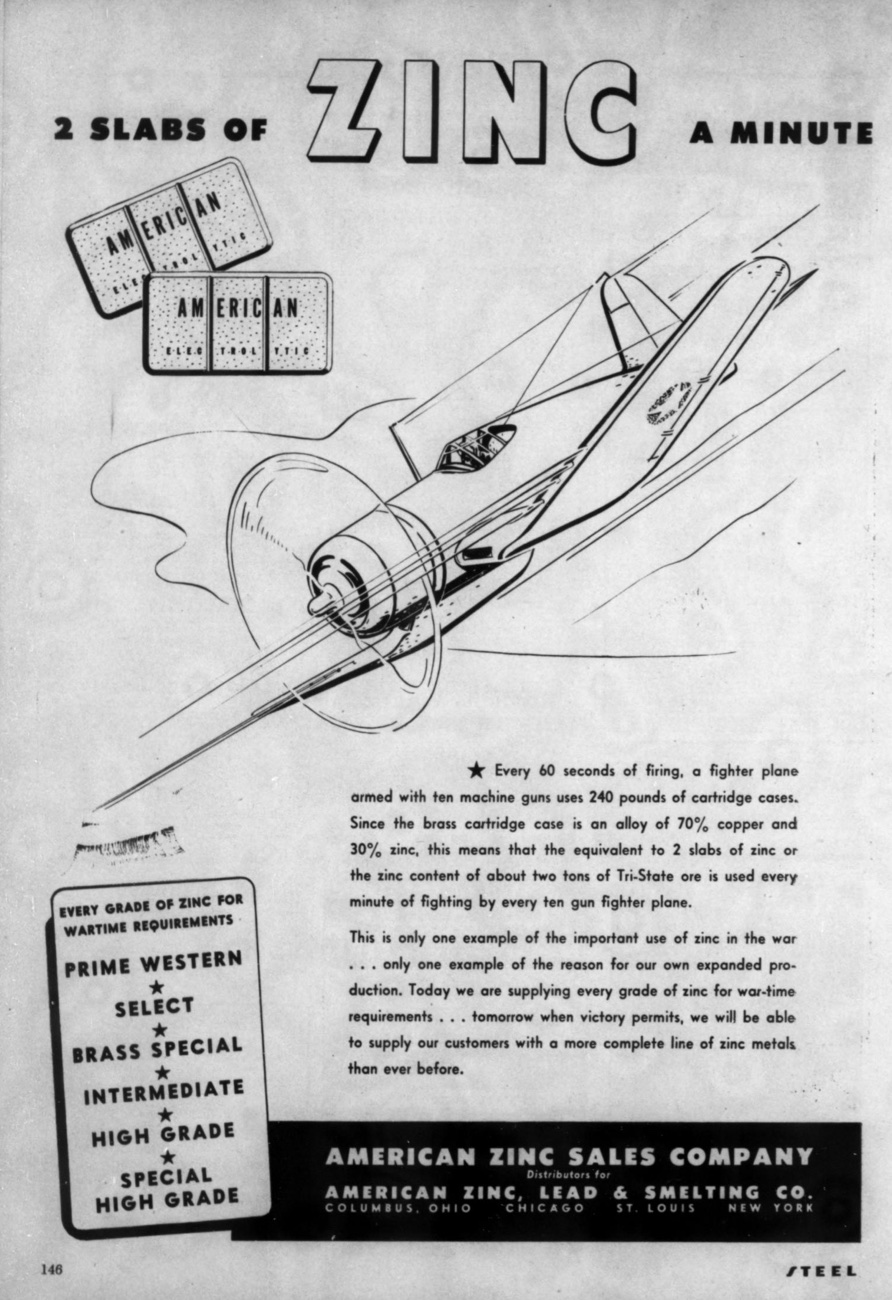
Advertisers made the arithmetic vivid. An American Zinc Sales Company advertisement of 1943 worked it out for a fighter plane: “Every 60 seconds of firing, a fighter plane armed with ten machine guns uses 240 pounds of cartridge cases. Since the brass cartridge case is an alloy of 70% copper and 30% zinc, this means that the equivalent to 2 slabs of zinc … is used every minute of fighting” (Steel, 1943).
New Jersey’s mines kept their share. “Crude zinc ore mined in New Jersey in 1943 totaled 602,646 tons yielding 92,864 tons of recoverable zinc,” against 607,766 and 94,040 tons in 1942, and “the willemite-zincite concentrate is smelted to produce high-grade slab zinc” at Palmerton (Minerals Yearbook, 1943, p. 349).
Two parts copper, one part zinc: the cartridge case
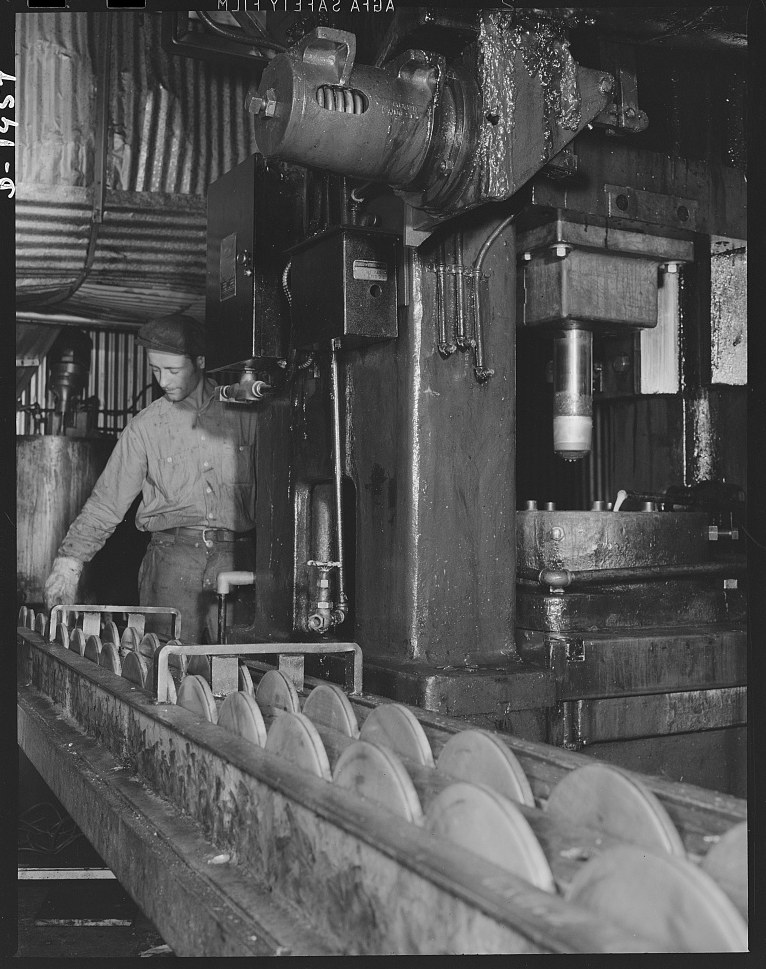
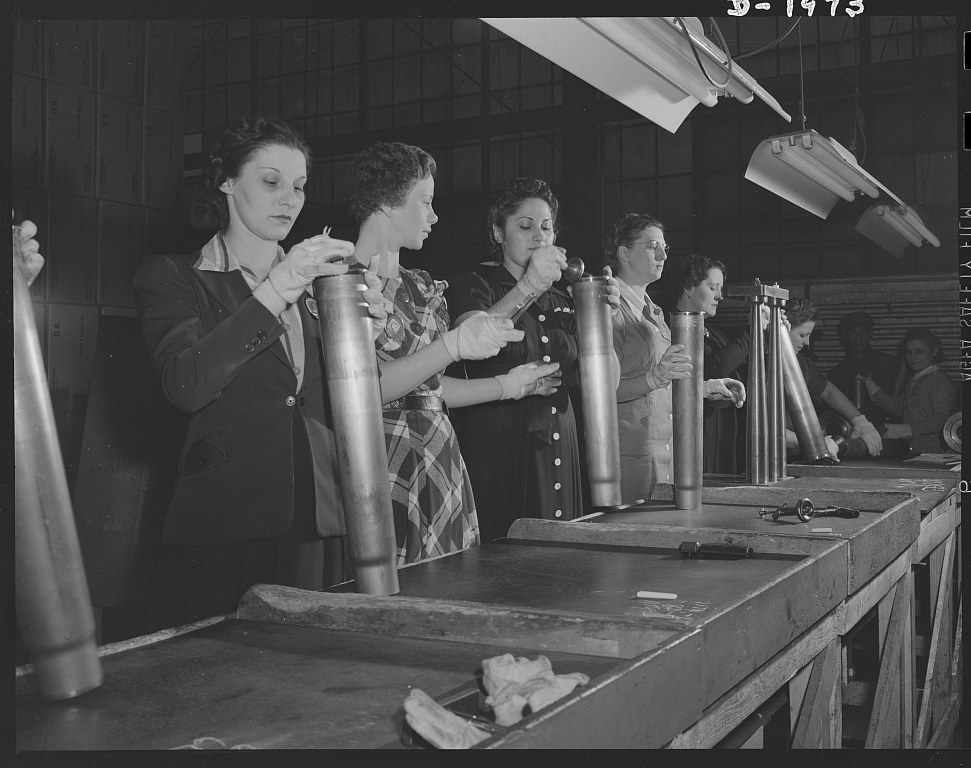
Most of the zinc that went to war went in brass, and most of the brass went into cartridge cases. The 1943 advertisement above gave the proportions: “the brass cartridge case is an alloy of 70% copper and 30% zinc.” A case began as a brass disc punched from heavy sheet, was pressed into a cup, and was drawn longer and thinner, step by step, until it was a shell case, as the government’s photographs of 1942 show.
The cases came back. The Army “had somehow managed the return of approximately 55,000 short tons of fired cartridge cases” in 1944, and the brass went to “a number of other purposes, even [the] coinage of the 1-cent piece, by admixture with primary copper” (Minerals Yearbook, 1944, p. 489).
1943–1946: the steel cent and the shell-case cent
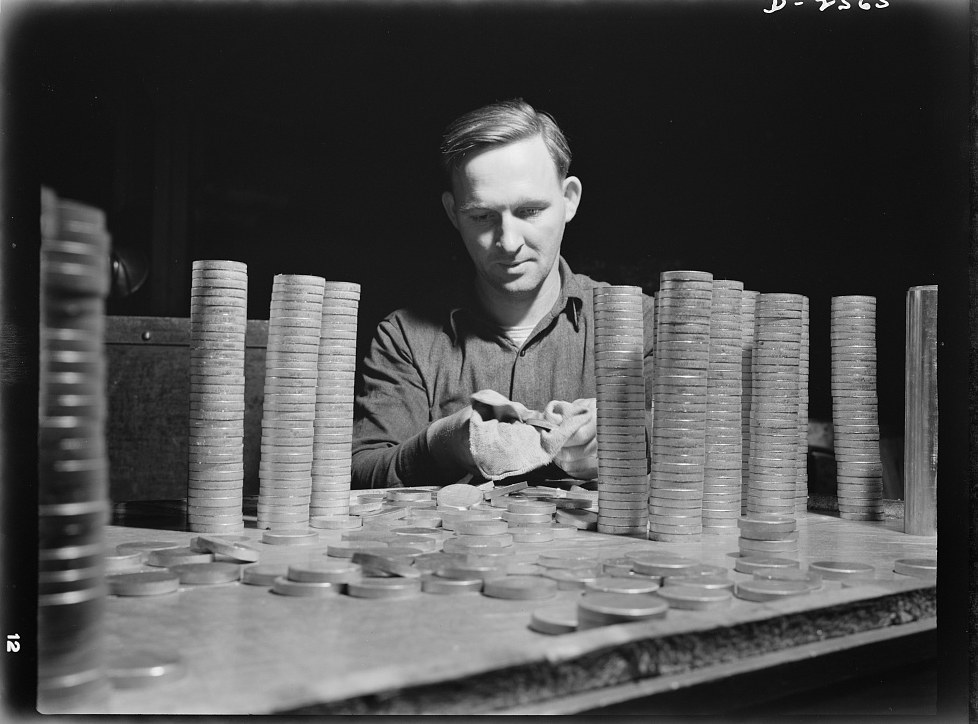
The Mint told the story of the wartime cent in its own reports. “Production of bronze 1-cent coins was sharply curtailed beginning in July 1942 and entirely discontinued in December 1942, due to the necessity of saving copper for our war industries … A zinc-coated steel coin was finally devised, production of which was commenced on February 23, 1943 … The standard weight of the new zinc-coated steel 1-cent coin is 42.5 grains, compared with 48 grains for the bronze 1-cent coin” (Annual Report of the Director of the Mint, 1943, p. 4).
It lasted a year. “Production of the zinc-coated steel cent was discontinued December 31, 1943. The total number of zinc-coated steel coins struck from the beginning of production in February 1943 to their discontinuance December 31, 1943, was 1,093,838,670 pieces, value, $10,938,386.70.” The Bureau of Mines gave the reason plainly: “Permission to coin the familiar copper pennies again, beginning January 1, 1944, responded to overwhelming popular demand” (Minerals Yearbook, 1943, p. 136).
The new cent was made from the war itself. “Beginning January 1, 1944, production of a copper-zinc coin was commenced, the composition of the alloy being 95 percent copper and 5 percent zinc … The change was made as a result of the availability of fired brass cartridge cases, to which copper is added to produce the alloy.” The wartime coins together “freed 3,194 tons of copper, 350 tons of nickel, and 120 tons of zinc for use in furtherance of the war effort” (Annual Report of the Director of the Mint, 1944, p. 2).
Franklin and Sterling Hill at war, 1941–1946
| Year | Crude ore (tons) | Recoverable zinc (tons) |
|---|---|---|
| 1940 | 556,031 | 91,406 |
| 1941 | 585,463 | 93,781 |
| 1942 | 607,766 | 94,040 |
| 1943 | 602,646 | 92,864 |
| 1944 | 543,007 | 80,288 |
| 1945 | 516,225 | 81,392 |
| 1946 | 412,544 | 64,454 |
New Jersey zinc ore and recoverable zinc, all from the Franklin and Sterling Hill mines. Bureau of Mines, Minerals Yearbook: 1941, p. 326; 1943, p. 349; 1944, p. 332; 1945, p. 349; 1946, p. 1419. Ore for 1945 and 1946 is ore hoisted.
The fall in 1944 was not for want of ore. Of the eastern zinc mines the Bureau wrote: “The ore reserves were reported ample to maintain a production rate comparable with that in 1943 had sufficient manpower been available. In some of the large mines fully equipped headings in good ore were worked only part time owing to labor shortage” (Minerals Yearbook, 1944, p. 330). Even so, in 1945 “New Jersey ranked first among the States in zinc production” (Minerals Yearbook, 1945, p. 349).
Jack Baum, then a young company geologist, counted the men. “There were 33 of them [working places] in action in late spring and early summer of 1944, and 254 men underground at the time in two shifts … with two places working only one shift, making 128 runners and helpers, there remain 126 men in support occupations, such as motormen, chute pullers, development drillers, timber shaft people and skip loaders as well as pumpmen and others.” He remembered the men by name, among them “Clyde Rutan and Jim Strait getting the union started” and “Ken Stanaback who had access to ration coupons during the war,” and he remembered his own commute to Sterling Hill: “I rode to the office from home on my bicycle; after all, there was a war on” (“Thoughts on Miners Day, 1997,” The Picking Table, vol. 38, 1997, pp. 21–22).
The geology staff stayed small: “We were never more than two of us at a time for a long while till the war was just about over and then we could get the young men we needed for an exploration program” (Mark Boyer, “An Evening with Jack Baum,” vol. 53, no. 1, Spring 2012, p. 31).
Collectors felt the war too. One visitor came “at least once a year, 1933 to 1952, barring some of the war years when gas was not obtainable” (“J. Kenneth Fisher and Franklin,” vol. 14, no. 1, February 1973, p. 5). Another recalled: “The Franklin Mine was still very active during World War II, but there was no store at which to purchase mineral specimens. I visited the New Jersey Zinc Company office on Main Street and begged a specimen from kindly Mr. Bauer” (Alfred L. Standfast, “Remembrances of Franklin Half a Century Ago,” vol. 32, no. 2, Fall 1991, p. 10).
The town kept two marks of the war in its street names, as Baum noted. On Catlin Road, “Decorative swastikas in the parquet floor of the billiard room caused a fuss during WWII and were removed, when called to the attention of Company executives by mischievous young mining engineers.” And Edmonds Lane was “Named for one of Franklin’s youths, killed in WWII. His mother was a secretary in the main office of the New Jersey Zinc Company” (“Notes on Some Franklin Streets,” vol. 31, no. 2, Fall 1990, p. 12).
Peace brought a strike. “Although the zinc mines in New Jersey were idle from June 17 to August 17 because of a labor strike, the State continued in 1946 to be the leading producer of zinc in the Eastern States and ranked third in the United States” (Minerals Yearbook, 1946, p. 1419). And it brought a new worry, as Baum recalled: “When it began to look as though titanium would replace zinc as the white pigment of choice after World War 2, the Franklin geology department was called upon” to find a source of titanium ore, which it did at Allard Lake in Quebec (“The Geologist,” vol. 57, no. 2, Fall 2016, p. 24).
In The Picking Table
As far as a search of its full text shows (November 2026), The Picking Table has no article on zinc in either world war. Passing notes mention wartime work at the mines: the Taylor tram dump, “During World War II, this waste pile … was processed as low-grade ore” (vol. 58, no. 1, Spring 2017), and the hunt for tungsten ore in the 1940s (vol. 61, no. 2, Fall 2020).
Sources and further reading
- American Zinc Sales Company, 1943, 2 slabs of zinc a minute [advertisement]. Steel, May 24, 1943, p. 146. archive.org
- Annual Report of the Director of the Mint, fiscal years 1943 and 1944. archive.org
- Engineering and Mining Journal, 1914–1918: news of the New Jersey Zinc Co. and the Federal Trade Commission report on war profits (July 6, 1918). archive.org
- Library of Congress, FSA/OWI collection: cartridge-case photographs, 1942. Library of Congress
- National Archives, Record Group 165-WW, New Jersey Zinc Co. photographs received by the War Department May 23, 1919 (NAIDs 45490839, 45490841, 45490843, 45490845, 45490855). National Archives
- New Jersey Zinc Company, 1941, Zinc in defense, nos. 2 and 3 [advertisements]. Machine Design, 13, nos. 11 and 12 (November and December 1941). archive.org
- U.S. Bureau of Mines, 1940, Minerals Yearbook 1940 (review of 1939). Zinc, p. 129, 145. archive.org
- U.S. Bureau of Mines, 1943, Minerals Yearbook 1942. Copper (the steel cent), p. 88; zinc, p. 182. archive.org
- U.S. Bureau of Mines, 1945, Minerals Yearbook 1943. New Jersey zinc, p. 349. archive.org
- U.S. Bureau of Mines, Minerals Yearbook, 1941–1946, zinc chapters and New Jersey sections. archive.org
- U.S. Geological Survey, 1916, Mineral resources of the United States, 1914, part I. Zinc, p. 868–899. archive.org
- U.S. Geological Survey, 1917, Mineral resources of the United States, 1915, part I. Zinc, p. 929–931. archive.org
- U.S. Geological Survey, 1921, Mineral resources of the United States, 1918, part I. New Jersey, p. 214; the zinc industry and the World War, p. 1044–1049. archive.org
Written with Claude, an AI model made by Anthropic, from the sources listed above, and checked against them. October 2026.