Histories › The mines and their history
Why the cables of the great suspension bridges were coated with zinc, from Roebling’s Brooklyn Bridge through the Delaware River, Bear Mountain, Mount Hope, Ambassador and Mid-Hudson bridges to the George Washington Bridge, and which bridges the New Jersey Zinc Company said its zinc was on.
Brooklyn, 1877: “a coating of zinc”
A suspension bridge hangs from its cables, and a cable is thousands of steel wires laid side by side. Bare steel rusts, so every wire was coated with zinc, or galvanized. When Washington A. Roebling wrote the specifications for the cable wire of the Brooklyn Bridge, he explained that the cables would hang over salt water, where paint, oil or varnish “are totally inadequate to prevent rusting, in localities so near the coast. The only certain safeguard is a coating of zinc, which acts by its absolute air-tightness, as well as by its galvanic action, and is not easily abraded” (Report of the Chief Engineer, 1877, p. 74). Roebling is the man for whom roeblingite, a Franklin mineral, is named (see Roebling).
The Brooklyn wire came with a scandal. The contract went to the lowest of nine bidders, J. Lloyd Haigh (Report of the Committee, 1884, p. 35), and in July 1878 Roebling found out how he had cheated: “The wagon-load of wire as it left the Inspector’s room, with his certificate, in place of being driven off to the Bridge, was driven to another building, where it was rapidly unloaded and replaced with a load of the rejected wire.” Worse, “all the rejected wire which has come to the Bridge, has been worked into the cables, and cannot be removed” (pp. 132–133). It was reckoned at 221 tons (p. 38). The bridge still stands.
The Delaware River Bridge, 1924–1926
Philadelphia and Camden’s bridge, now the Benjamin Franklin Bridge, opened in 1926. Its cables were spun in five months: “Stringing of the cable wires was started in August, 1924 and has been completed within five months,” two cables “each containing 18,666 individual wires” (Engineering News-Record, February 5, 1925, p. 251).
The engineers wrote down how pure the zinc had to be. “The wire is galvanized with a coating of 99.75 per cent pure zinc applied by the hot-dip process. The temperature of the zinc bath and the speed at which the wire is passed through it are carefully regulated in this operation, to prevent loss of strength of the wire.” The two cables held “Over 25,000 miles of wire, weighing 6800 tons” (Charles Carswell, Wire & Wire Products, September 1926, p. 157). Even the thinness of the zinc mattered: in the engineers’ friction tests, steel bands bit “into the two- or three-thousandths of an inch of zinc galvanizing on the wire” (Clement E. Chase, Journal of the Franklin Institute, October 1925, p. 434).
Bear Mountain, 1924: the reels of Roebling wire
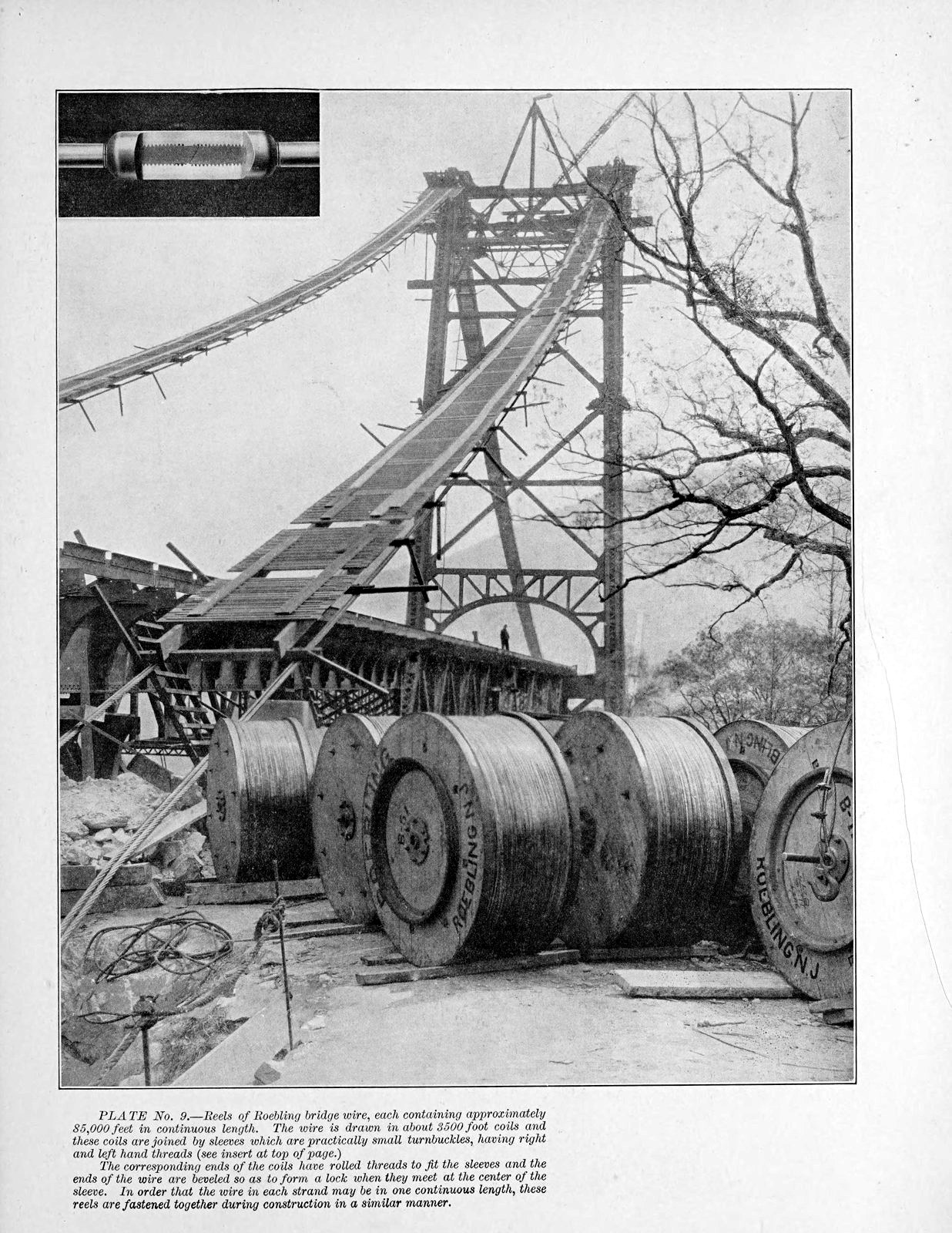
The Bear Mountain Bridge over the Hudson was spun in about ten weeks: “the first wires were spun on June 8, 1924, and the final ones on Aug. 22, 1924” (Howard C. Baird, Engineering News-Record, April 8, 1926, p. 584). Roebling’s Sons made the wire, and in their book on it they described the zinc in their own words: the wire “has an average diameter of 0.195 inches after receiving its protective coating of chemically pure zinc, known as galvanizing” (Construction of Parallel Wire Cables, 1925, p. 8). Each of the two cables held 7,252 wires.
Mount Hope and the Ambassador, 1929: the wire that broke
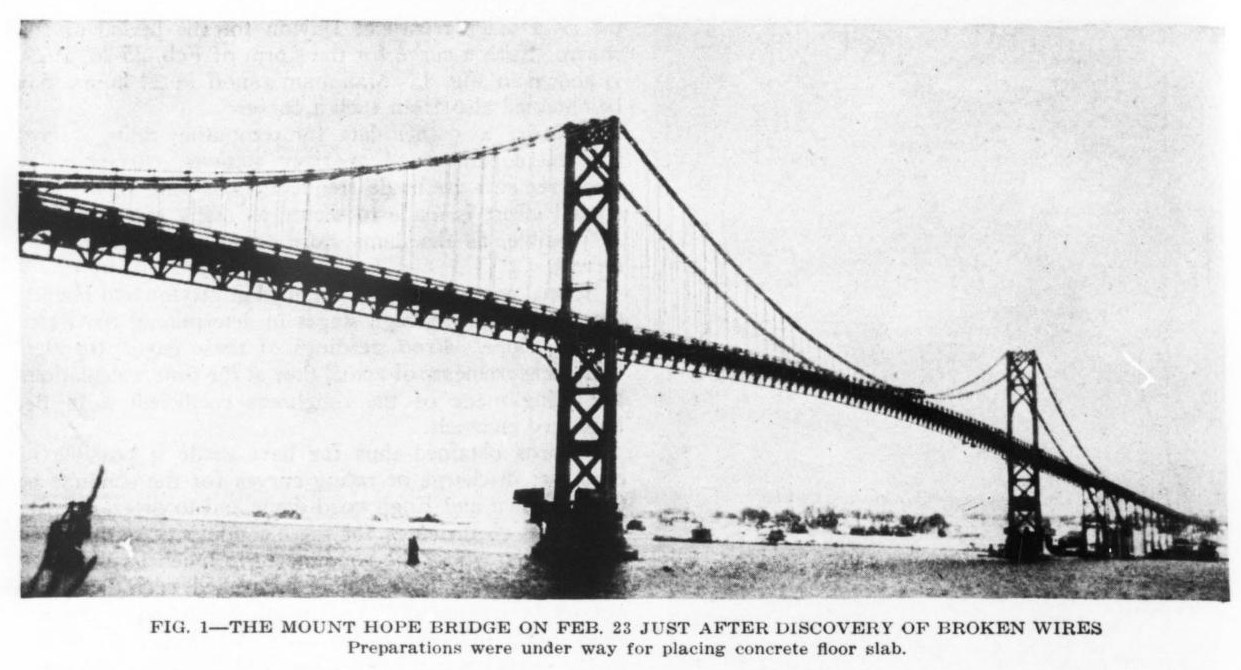
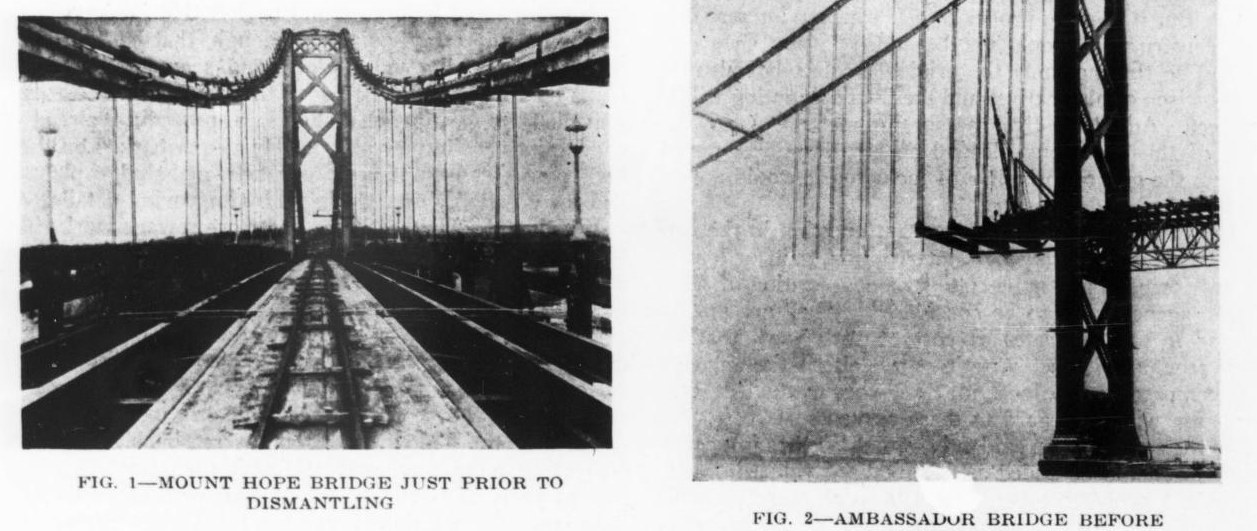
Galvanizing protected wire from the weather, but not from a bad idea. Two bridges finished in 1928, the Mount Hope Bridge in Rhode Island and the Ambassador Bridge between Detroit and Windsor, used a new kind of wire, hardened by heat treatment so that it could carry more load. “The cables on both structures were erected by the Keystone State Corporation, Philadelphia; the wire was manufactured by the American Cable Company, New York” (Engineering News-Record, March 28, 1929, p. 520). It was galvanized like any other: “the wire after drawing is passed through a lead bath and oil quenched, the galvanizing process following as an integral step in the manufacture” (April 11, 1929, p. 605).
In February 1929, before the Mount Hope Bridge opened, its wires began to break. Then breaks were found at Detroit. “Both structures utilized the same kind of wire, a heat-treated product of high elastic limit, heretofore untried in suspension bridge service … No satisfactory explanation of the wire breakages has yet been found” (October 10, 1929, p. 562). Both sets of cables were taken down and spun again, with “cold-drawn steel wire that was known to be dependable for suspension-bridge work” (F. D. McHugh, Scientific American, February 1930, p. 123). The zinc was not the trouble; the steel under it was.
The Mid-Hudson Bridge, 1929–1930
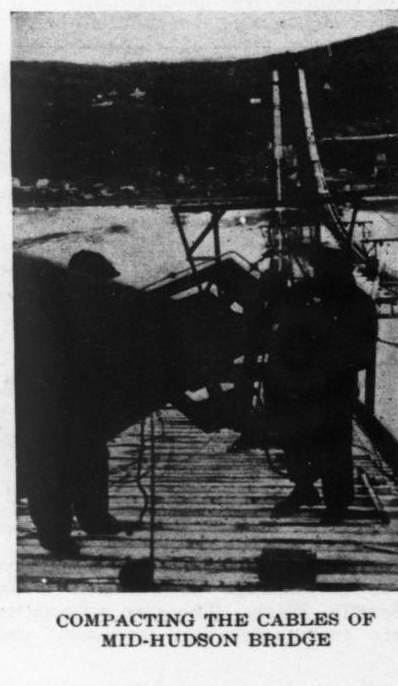
At Poughkeepsie the American Steel & Wire Company made the wire and the American Bridge Company spun it, its first cable of parallel wires. “The wire was galvanized No. 6 gage, having an average diameter of .192 in. before galvanizing and of .195 in. after coating with zinc,” and each cable held “a total of 6,080 wires” (Construction Methods, April 1930, pp. 53–54). Spinning began December 2, 1929; “The last wire was laid in place on March 3” (Engineering News-Record, March 6, 1930, p. 414).
The George Washington Bridge, 1927–1931
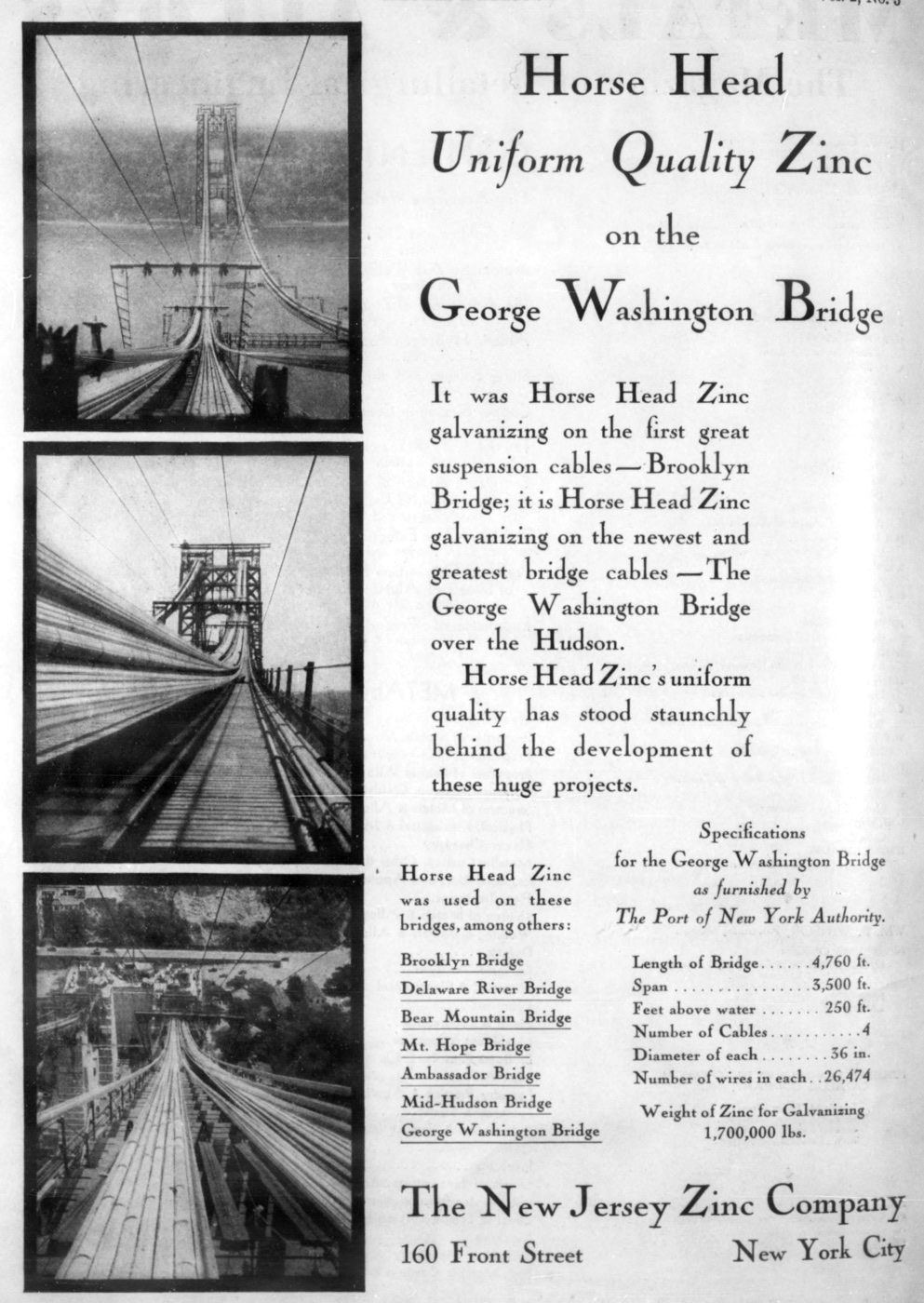
Half a century later the Port of New York Authority asked for purer zinc. Its specifications for the Hudson River Bridge, as the George Washington Bridge was first called, required that the wire “shall be galvanized in a bath containing 99.75 per cent pure zinc, containing not more than 0.03 per cent iron” (The Iron Age, August 25, 1927, p. 468). Each cable was to hold “26,474 double galvanized, high strength steel wires” (Port of New York Authority, Second Progress Report, 1929, p. 33). John A. Roebling’s Sons of Trenton made the wire, and described how: “Twenty lines of wire are continuously passed through successive baths of melted lead to heat them, through dilute acid to clean them, and through molten zinc to galvanize them,” leaving “a very durable, tenacious zinc skin from 1/1000 to 2/1000 inch thick” (Roebling Cables for the Hudson River Bridge, about 1930, p. 32).
The spinning took less than ten months. “On August 7 the last wire of the total of 105,896 wires was spun … the first wire having been placed Oct. 18, 1929. The wire in the four 36-in. diameter cables weighs 28,400 tons” (E. Warren Bowden, Engineering News-Record, August 14, 1930, p. 242).
How the George Washington Bridge cables were made
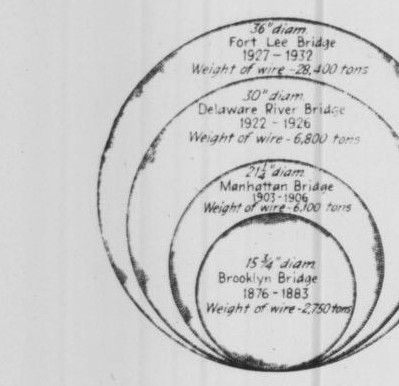
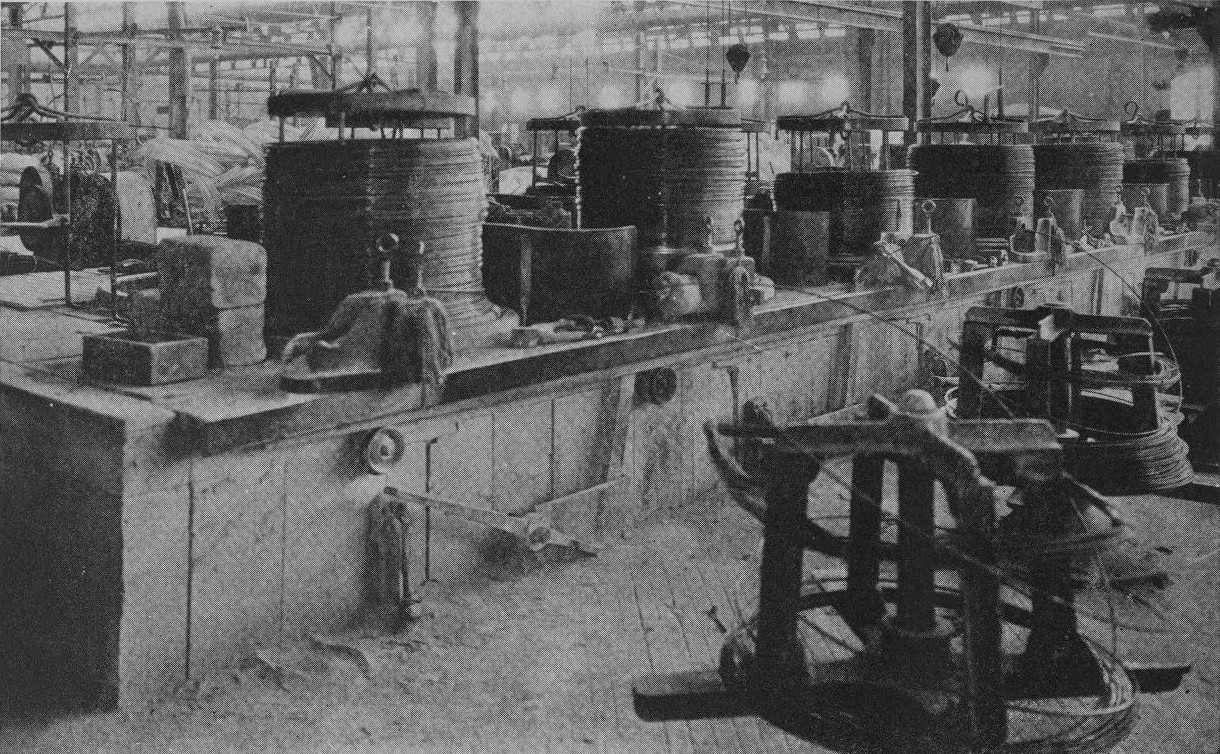
Wire is made by pulling, not pushing. A steel rod, pointed at one end, is pulled through a hole in a hard die a little smaller than the rod; the steel stretches, getting thinner and longer, and harder as it goes. Then it is pulled through a smaller hole, and a smaller one again. At Roebling’s, in the Port Authority’s photograph above, the coils sat on drums along a bench, the wire ran down through dies bolted to the side of the bench, and bags of soap in front of each die kept it slippery.
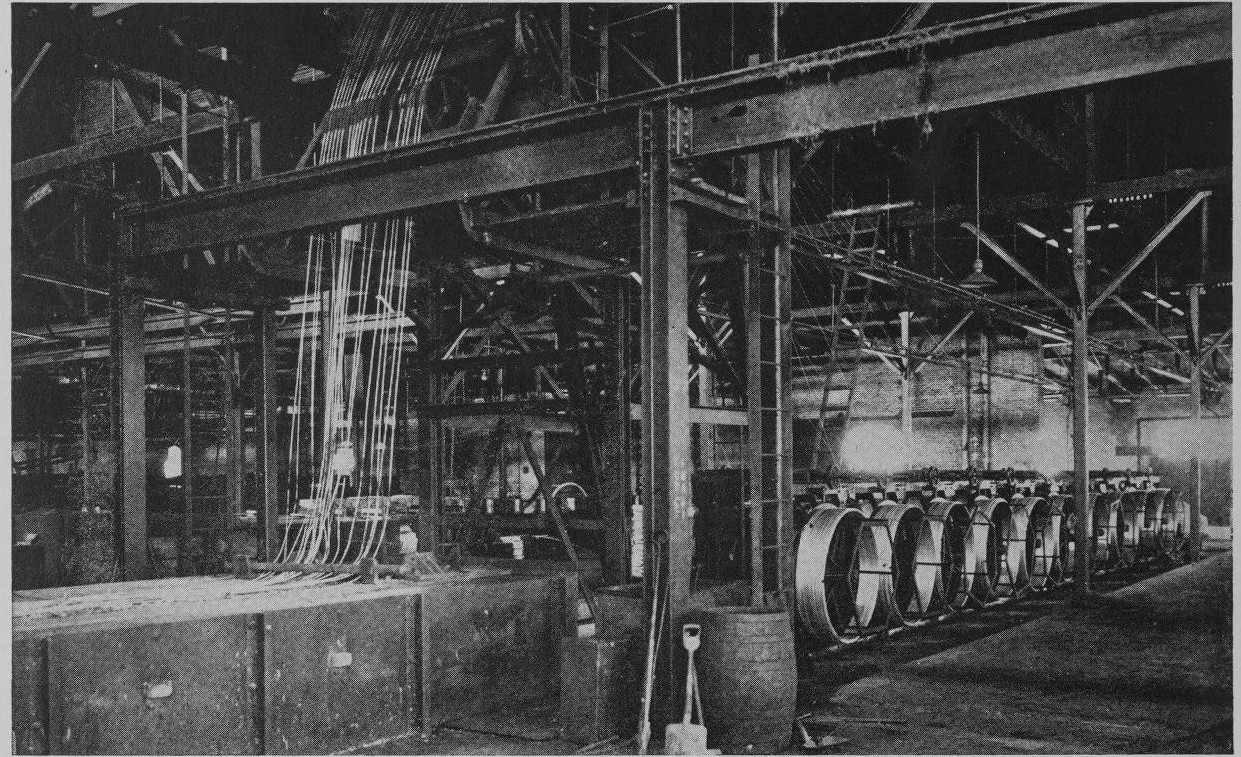
The wire began as steel rod at Roebling’s works in Trenton. “Coils of wire rods are cold drawn again and again, through smaller and smaller holes in steel dies, until they are reduced to the required diameter of about 6¼ thirty-seconds of an inch [about a fifth of an inch, a little thicker than a pencil lead], elongated to a length of 3,800 feet, and have their strength increased until a value of about 260,000 pounds per square inch is obtained” (Roebling, Roebling Cables for the Hudson River Bridge, p. 30). Then it was galvanized, run through molten zinc and up a tall vertical run to cool before it was coiled, as the Port Authority’s photograph shows. Roebling’s contract was for $12,339,977, “for the construction of the 28,600-ton cables” and the steel of the anchorages (p. 6).
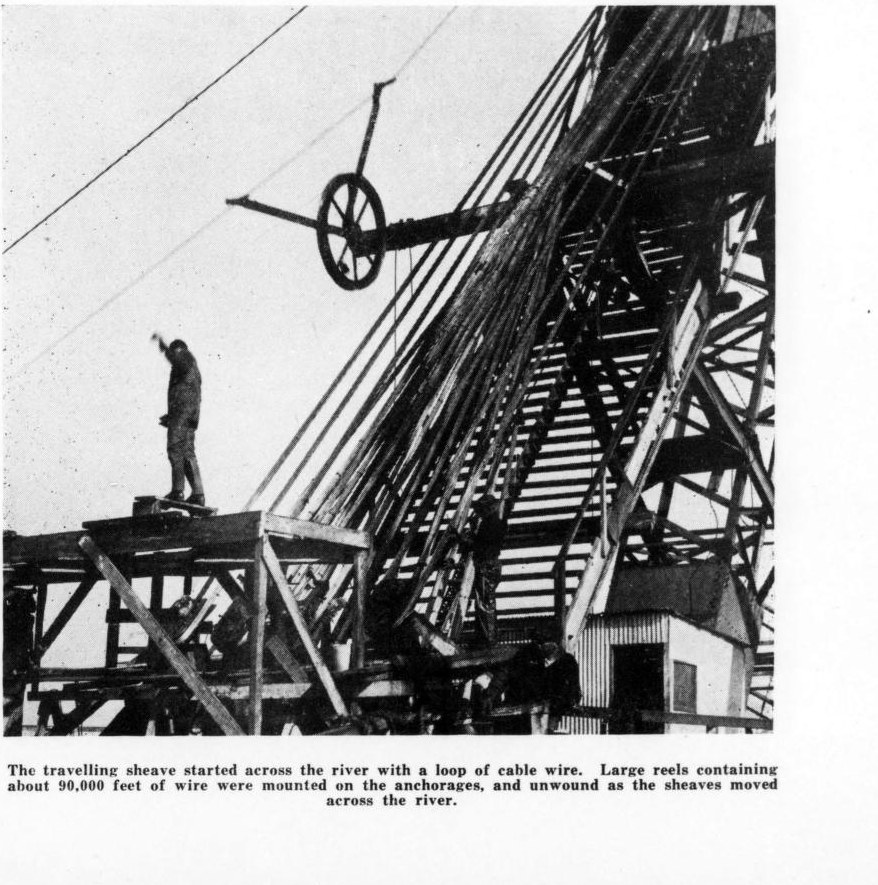
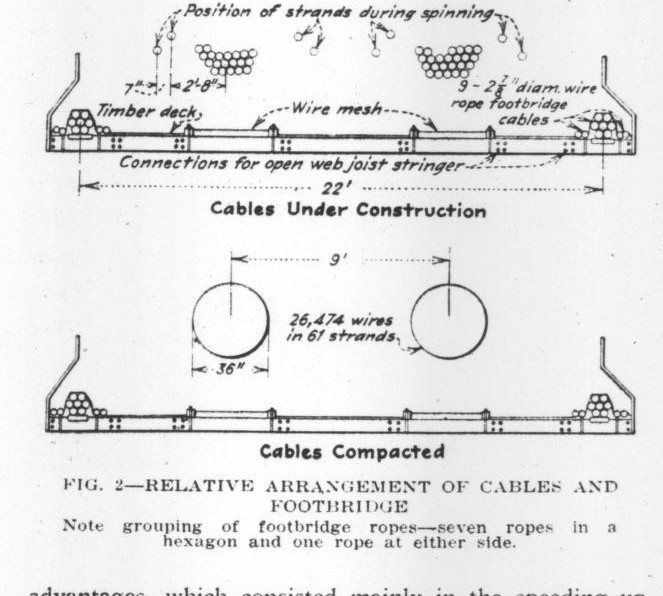
The cables are not woven or twisted. They are “of the parallel-wire type, and each contains 26,474 cold-drawn galvanized wires, 0.196 in. in diameter. When completed the cables will be compacted to a diameter of 36 in. Each individual wire contained in the cables has a strength of more than 7,000 lb., representing an ultimate strength for the material of more than 240,000 lb. per square inch.” The wires were laid in 61 strands of 434 wires each, “each of which … was independently spun and independently attached at the anchorage” (E. Warren Bowden, Engineering News-Record, August 14, 1930, p. 243). Each strand was one continuous wire, carried back and forth across the river by a spinning wheel.
The river span between the towers is 3,500 feet, two-thirds of a mile, and the cables run on over the towers to anchorages on both shores. Roebling explained the spinning: “Each and every one of the 434 parallel parts of a strand is an undivided portion of the same endless wire about 434 miles long … Each spinning wheel lays about two miles of wire on each trip across the river, and it now takes about nine days to spin one strand” (Roebling, p. 124). A wheel carried a loop, so it laid two wires on each trip. That makes 217 crossings for each strand, and for the 244 strands of the four cables, about 53,000 crossings of the Hudson by spinning wheels, between October 18, 1929 and August 7, 1930. (The crossings are our arithmetic from the published figures.)
Once all the strands were in place, the hexagonal bundle was squeezed round. Roebling tested the method on a full-size piece of cable first, with a yoke of “twelve radial hydraulic pistons, together exerting a balanced pressure of about 400 tons that compress the 61 strands from their original hexagonal arrangement, with numerous voids between them, to a substantially solid cylinder approximately 36 inches in diameter in which an indication of the original strand outlines is scarcely perceptible” (p. 20). The zinc on each of the 105,896 wires was the cable’s first protection against the river air.
The seven bridges the company claimed
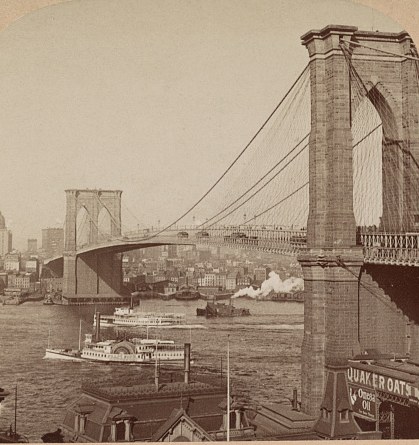
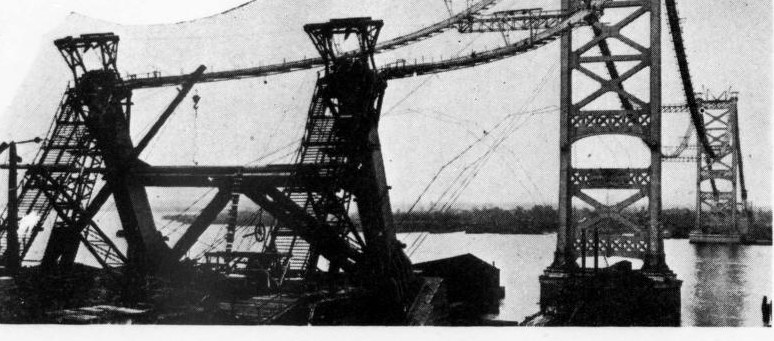
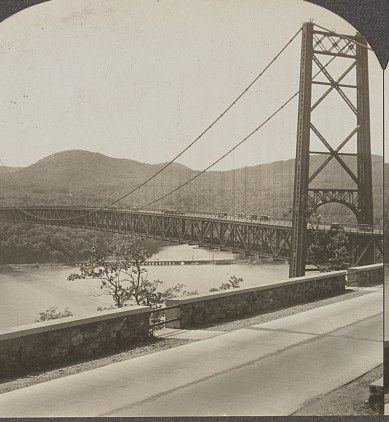
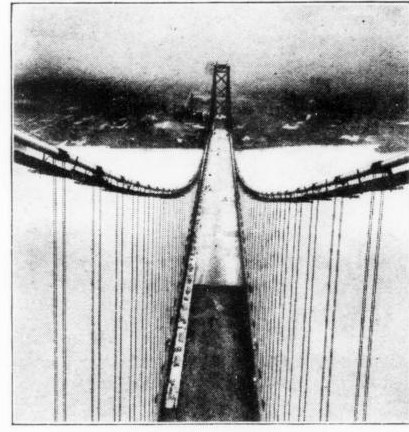
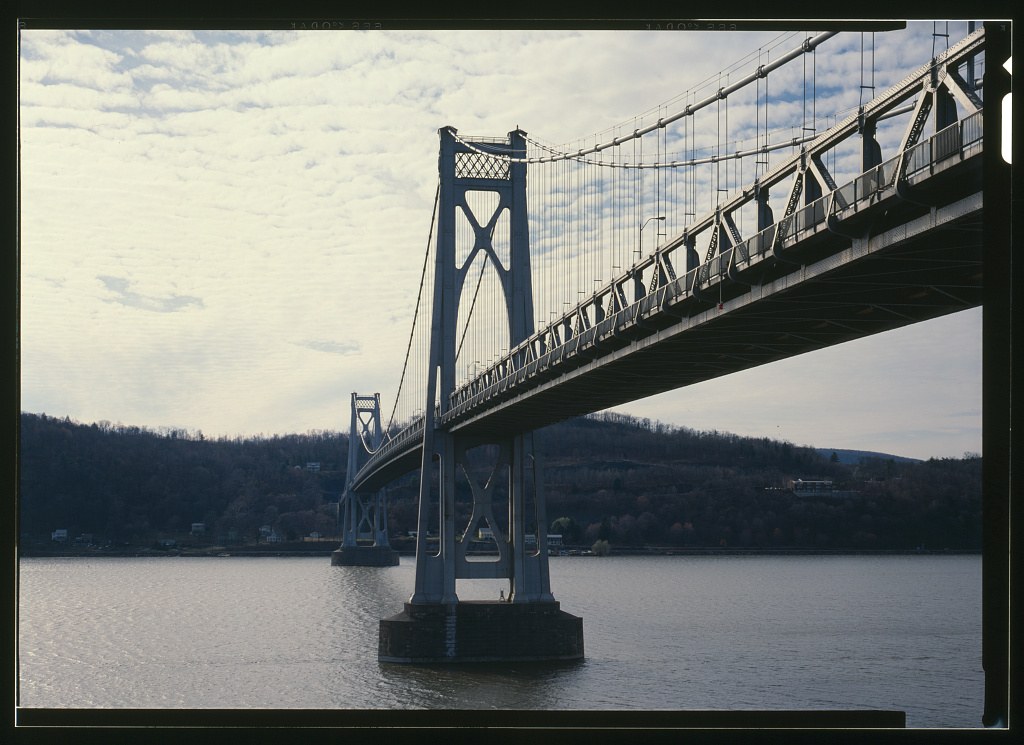
These are the bridges named in the New Jersey Zinc Company’s advertisement, besides the George Washington Bridge shown above. Each is told in its section above.
Whose zinc?
Every one of these bridges hung on galvanized wire, and the engineers specified the zinc closely, down to 99.75 per cent pure. But the wire makers, Roebling, Page, the American Cable Company and American Steel & Wire, bought their zinc, and none of the engineering reports we have found says from whom.
Only the New Jersey Zinc Company said. Its advertisements of 1931 claimed seven bridges: “Horse Head Zinc was used on these bridges, among others: Brooklyn Bridge, Delaware River Bridge, Bear Mountain Bridge, Mt. Hope Bridge, Ambassador Bridge, Mid-Hudson Bridge,” and the George Washington Bridge, with “Weight of Zinc for Galvanizing 1,700,000 lbs.” (Metals & Alloys, November 1931; an earlier version, January 1931, calls the last one the Hudson River Bridge). Franklin’s ore made an unusually pure, high-grade zinc, the kind the bridge specifications asked for (see Zinc in two world wars), so the claim is plausible. But it rests on the company’s word. And the company seems not to have repeated it: a search of Metals & Alloys, Wire and Wire Products and Civil Engineering from 1930 into the 1960s found no later advertisement naming a bridge, not the Golden Gate, the Bay Bridge or any other.
Other great suspension bridges of the time
These bridges are not claimed by the New Jersey Zinc Company in any advertisement we have found, and no source we have read names the zinc on their cables. They are listed so that readers looking for them know where things stand.
Golden Gate Bridge, San Francisco, opened 1937 (Historic American Engineering Record). Not claimed by the New Jersey Zinc Company.
San Francisco–Oakland Bay Bridge, opened 1936 (Historic American Engineering Record). Not claimed by the New Jersey Zinc Company.
Verrazzano-Narrows Bridge, New York, opened 1964 (Historic American Engineering Record). Not claimed by the New Jersey Zinc Company.
Sources and further reading
- Bowden, E. W., 1930, Spinning four 36-in. cables for the Fort Lee Bridge. Engineering News-Record, August 14, 1930, p. 242. archive.org
- Bridgemen construct cables of suspension structure by aerial spinning. Construction Methods, April 1930, p. 52–56. archive.org
- Carswell, C., 1926, Wire in the Delaware Bridge. Wire & Wire Products, vol. 1, no. 9, p. 157. archive.org
- Chase, C. E., 1925, Research and experimental tests in connection with the design of the bridge over the Delaware River between Philadelphia and Camden. Journal of the Franklin Institute, vol. 200, p. 434. archive.org
- Engineering News-Record, 1925–1930: cable spinning (Delaware River, Bear Mountain, Mid-Hudson, Fort Lee); the Mount Hope and Ambassador wire breakages and dismantling (March 28, April 4, April 11 and October 10, 1929). archive.org
- John A. Roebling’s Sons Co., 1925, Construction of parallel wire cables for suspension bridges. Trenton. archive.org
- John A. Roebling’s Sons Co., about 1930, Roebling cables for the Hudson River Bridge. Trenton. P. 32. archive.org
- McHugh, F. D., 1930, The Detroit River is spanned. Scientific American, vol. 142, no. 2, p. 123. archive.org
- The New Jersey Zinc Company, 1931, advertisements, Metals & Alloys, vol. 2, no. 1 (January) and no. 5 (November), p. 4. archive.org
- New York and Brooklyn Bridge, 1884, Report of the Committee appointed by the Board of Trustees … December 31, 1883. Brooklyn. Wire contract, p. 35–38; Roebling’s letter of July 9, 1878, p. 132–133. archive.org
- Port of New York Authority, 1929, Second progress report on Hudson River Bridge. P. 33. archive.org
- Roebling, W. A., 1877, Report of the Chief Engineer of the New York & Brooklyn Bridge, January 1, 1877. Brooklyn. Cable-wire specification, p. 74. archive.org
- Special steel for Hudson bridge. The Iron Age, vol. 120, no. 8, August 25, 1927, p. 468. archive.org
Written with Claude, an AI model made by Anthropic, from the sources listed above, and checked against them. October 2026.