Histories › The mines and their history
The company that mined Franklin and Sterling Hill for nearly ninety years, where its records are, and its magazine, Zinc.
From many companies, one
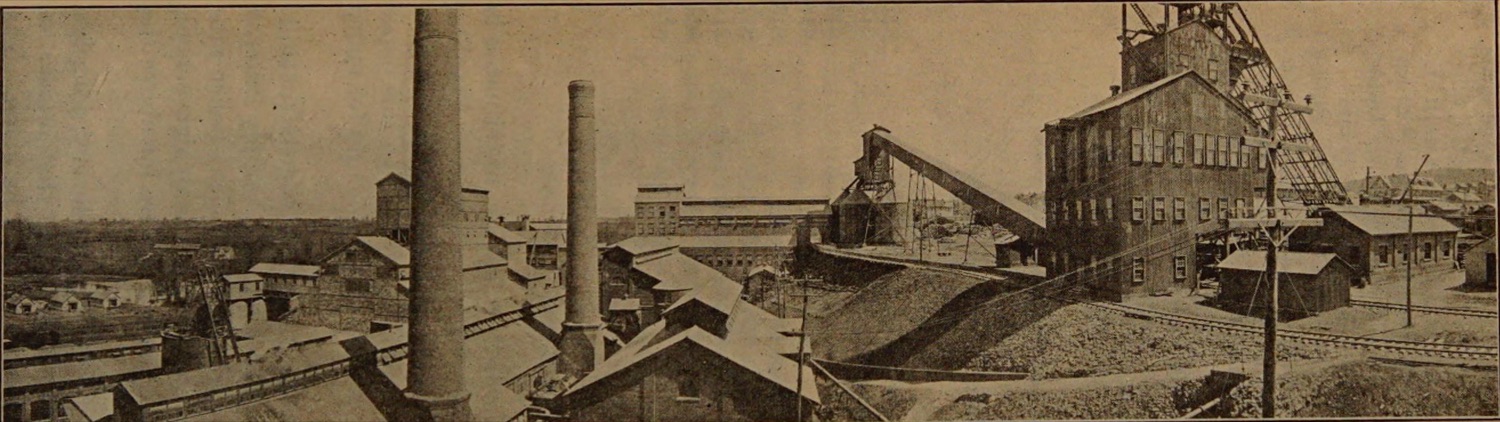
Zinc mining at Franklin and Sterling Hill began as a tangle of rival companies. The Sussex Zinc and Copper Mining and Manufacturing Company was incorporated in 1848, and others followed, some after the zinc, some after the iron in the franklinite. Their claims overlapped on Mine Hill, and for decades they fought in court.
In 1897 the Franklin companies were brought together as the New Jersey Zinc Company, under Stephen S. Palmer and August Heckscher (the company’s own history). The next year the company began its smelting town in the Lehigh Gap of Pennsylvania, named Palmerton for Palmer, where the Franklin ore went to be made into zinc oxide, spelter and spiegeleisen.
The long run
The Franklin mine worked until 1954, when its ore was gone, and its miners were offered work at Sterling Hill. In 1965 the company gave the first exhibit to the new Franklin Mineral Museum. In the mid-1960s it became part of Gulf+Western, and in 1981 of Horsehead Industries. Sterling Hill, the last zinc mine in New Jersey, closed in 1986. The next year the company merged with St. Joe Minerals to form the Zinc Corporation of America. The zinc business passed through more owners. By 2015 Horsehead Holding Corp. of Pittsburgh was using the Palmerton plant to recover zinc from the dust of steel-mill electric furnaces in its “Waelz Kiln” process, and on February 2, 2016, it filed for bankruptcy under Chapter 11 (annual report for 2015).
Its horse-head trademark was on the company’s zinc oxide, paint and roofing zinc.
Zinc white
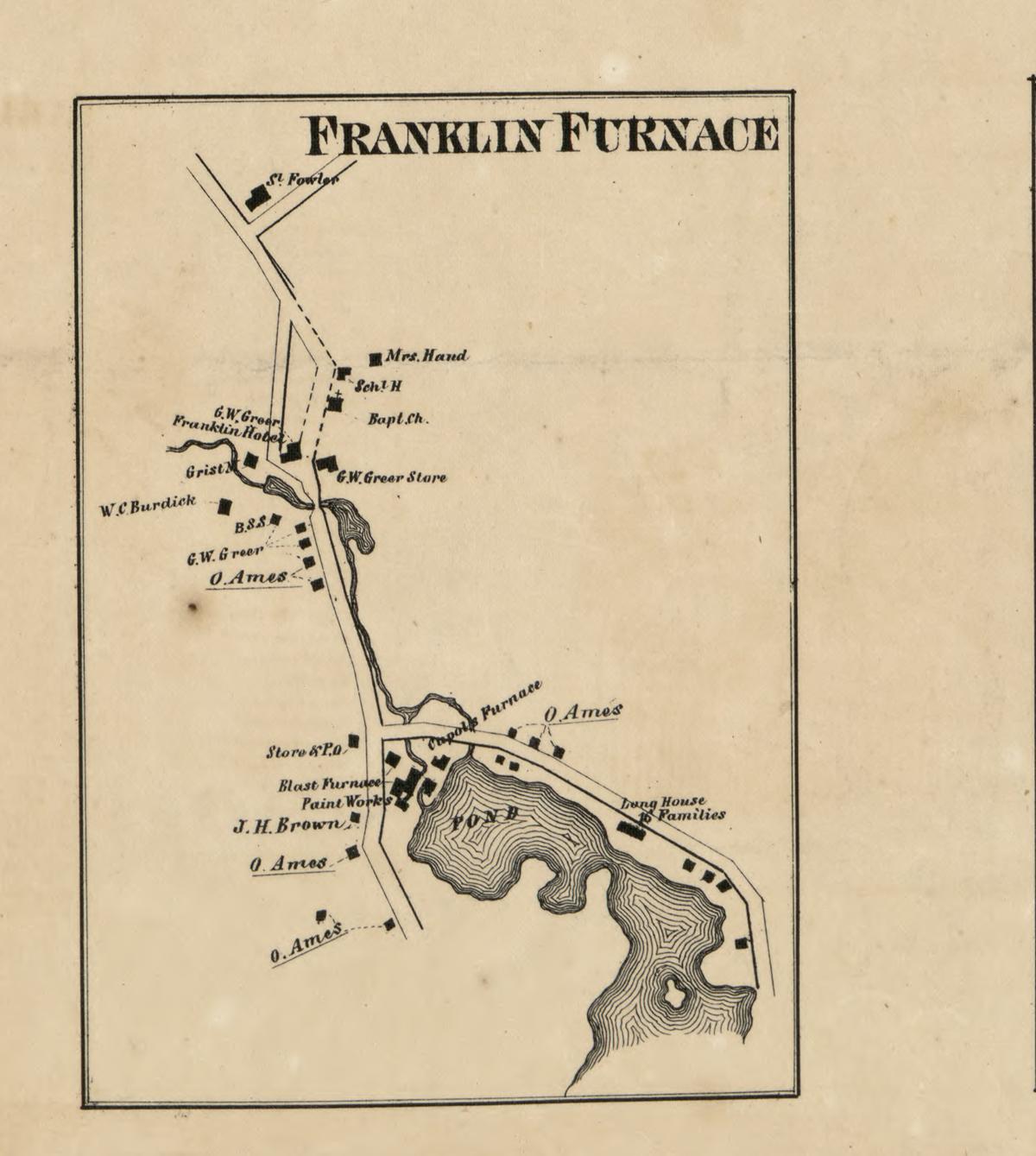
Much of the zinc from Franklin never became metal at all. It became white paint. From the 1850s, Samuel Wetherill’s furnace roasted the Franklin ore and caught the zinc as zinc oxide, a fine white powder (see Pulling franklinite out with magnets). As a pigment it was called zinc white or Chinese white: a cool, clean white that, unlike lead white, did not darken in polluted air and was not poisonous. The 1860 map of Franklin Furnace already shows a “Paint Works” beside the blast furnace; what it made is not recorded in the sources we have found.
The New Jersey Zinc Company made zinc oxide for paint for the next century, and wrote booklets for the paint trade explaining how to use it, such as L. H. Trott’s Zinc oxide and its application to paint (about 1928). It also made lithopone, a white of zinc sulfide and barium sulfate (see the entries for zinc white and lithopone in CAMEO, the Museum of Fine Arts, Boston’s materials database).
Samples of the company’s pigments survive in the Forbes Pigment Collection at Harvard, the reference collection of American art conservation: Zinc White (White Seal) and Zinc White (Green Seal), both of 1942; Lithopone, 1942; and a sample catalogued as sphalerite, zinc sulfide, zinc white, Chinese white, zinc oxide. All four are recorded as manufactured by the New Jersey Zinc Company. So the ore of a Sussex County hillside sits on a shelf of artists’ colors in Cambridge.
Where the records are
Rutgers University, Special Collections: New Jersey Zinc Company Records, MC 672, about 1880–1986, 72 cubic feet; the main body of the company’s papers. Part is stored off site, so ask ahead. Finding aid.
Hagley Museum and Library, Wilmington: the laboratory notebooks of Charles L. Reese, 1900–1927, mostly from his years with the company, and a 1913 fire-insurance plan of the Palmerton West Plant. Hagley.
Virginia Tech, Special Collections: the company’s Austinville, Virginia, mine records, and some issues of Zinc. Finding aid.
The New Jersey State Museum, the Franklin Mineral Museum, the Sterling Hill Mining Museum and the Palmerton Area Historical Society hold company material too, though not in online catalogs.
Zinc, the company magazine
Zinc was the company’s own magazine. Its first volume came out in 1916, and it was still being published in the 1950s. Collectors and historians still turn to it for what it recorded of the mines and the people who worked them. Rutgers keeps a run in the New Jersey Reading Room (call number HD 9539.Z64 N49), and Virginia Tech and the Eagle Valley Library in Colorado hold scattered issues. Issues from 1916 through 1930 are now in the public domain.
Articles from Zinc already in the Franklin and Sterling bibliography, a start on an index: G. C. Stone, “Early history of the N. J. Zinc Company” (vol. 1, 1916); E. A. Sutphen, “Palmerton, an appreciation” (vol. 1, 1916); B. F. Tillson, “Safety measures and recording accidents at Franklin” (vol. 2, 1917); D. Jenkins, “The Franklin laboratory” (vol. 2, 1917); F. P. Nolan, “Properties of the New Jersey Zinc Company” (vol. 4, 1919); B. F. Tillson, “Wawayanda Lake” (vol. 4, 1919); J. G. Walton, “Lake Wawayanda, N.J.” (vol. 5, 1920); E. T. Newpher, “Franklin Neighborhood House” (vol. 5, 1920); “The new Palmerton laboratory” (vol. 5, 1920); E. M. Squier, “The Passaic Zinc Company” (vol. 7, 1922); “Reminiscences of Michael J. Hyde” (vol. 8, 1923); “Leclaire, the inventor of zinc oxide paint” (vol. 11, 1926); E. D. Shuster, “History of the Franklin and Sterling Hill ore deposits” (vol. 15, 1930). See them in the bibliography.
We are building an index of what each issue holds. If you have issues of Zinc, or scans of them, we would be glad to hear from you.
In The Picking Table
In 1966 The Picking Table quoted the company’s own report on its proposed merger with Gulf+Western, with a short corporate history (vol. 7, no. 1). Allen W. Pinger’s “A review of mineralogical, geological and mining activities in the Franklin area” (vol. 14, no. 2, August 1973) runs from the colonial forges to the consolidation of 1897 and the closing of the Franklin mine. John L. Baum’s “The first years of the New Jersey Zinc Company” (vol. 17, no. 2, September 1976) retells A. C. Farrington’s history of 1852 and the start of zinc white at Newark. Vol. 22, no. 2 (1981) reprints the news of Gulf+Western’s sale of the Palmerton and Depue plants and the Sterling mine, with Baum’s “Moses Taylor,” on the financier behind the company of 1880. Maureen Verbeek’s interview with Pete J. Dunn about his history of the Franklin and Sterling Hill mines (vol. 44, no. 2, Fall 2003; part II, vol. 45, no. 1, Spring 2004) is a guide to where the records are. A photograph from the Society’s 2014 banquet shows a CD containing every issue of Zinc (vol. 55, no. 2). No history or index of Zinc itself has appeared in The Picking Table.
Sources and further reading
- Harvard Art Museums, Forbes Pigment Collection: New Jersey Zinc Company zinc white and lithopone samples (Straus.161, 166, 174, 592). Harvard Art Museums
- Mining History Association: Sterling Hill. MHA
- New Jersey Zinc Company, 1948, The first hundred years of the New Jersey Zinc Company, 1848–1948. New York, 69 pp. archive.org (borrow)
- New Jersey Zinc Company, about 1924, A record of accomplishment, 1848–1923: a short history of the New Jersey Zinc Company. Full text (Science History Institute)
- Rutgers University Special Collections: New Jersey Zinc Company Records, MC 672. Finding aid
- Sterling Hill Mining Museum: origin of the mine. Sterling Hill Mining Museum
- Trott, L. H., about 1928, Zinc oxide and its application to paint. New Jersey Zinc Company. archive.org
Written with Claude, an AI model made by Anthropic, from the sources listed above, and checked against them. October 2026.