Histories › The mines and their history
What became of the iron and manganese in the Franklin ore once the zinc was gone: a metal sold to the banks as too hard to drill, and the spiegeleisen that American steel needed.
The residuum: what was left after the zinc
Franklinite is an oxide of iron, zinc and manganese, and at Franklin and Sterling Hill it was mined by the hundreds of thousands of tons. The zinc was the prize.
From the 1850s the zinc was driven off in furnaces and caught as zinc oxide, the white pigment. What was left behind was a black, cindery clinker holding nearly all the iron and manganese of the ore (see Pulling franklinite out with magnets). The zinc companies called it residuum: the iron-manganese clinker that remained once the zinc oxide had been driven off.
Its composition changed with the ore and the method. In 1886 George C. Stone, engineer of the New Jersey Zinc Company, published analyses of the clinker going to his blast furnaces: about 22 to 25 percent iron and 12 to 16 percent manganese, with a great deal of silica and alumina from the ash of the anthracite culm (fine waste coal) burned in the oxide furnaces.
In 1917 the U.S. Geological Survey gave the residuum as about 40 percent iron and 14 percent manganese. Palache (1935) gave the magnetic franklinite concentrate of the Franklin mill as 34 to 40 percent iron, 12 to 16 percent manganese and 14 to 18 percent zinc, and wrote that it was used “in the manufacture of zinc oxide and of spiegeleisen.” The figures differ because they describe different materials at different stages of the process.
This page follows that leftover iron for some eighty years. For a time it was sold to banks as a metal no burglar could drill. For much longer it was spiegeleisen, a manganese-rich pig iron of roughly 10 to 20 percent manganese, which the first American Bessemer steelworks used to finish their steel.
Why the iron was so hard
Pig iron straight from a blast furnace holds several percent of carbon. When it cools, that carbon either separates as soft flakes of graphite, giving grey iron, or stays combined with the iron as iron carbide, called cementite, giving white iron.
The Encyclopædia Britannica of 1911 describes cementite as “harder than glass and nearly as brittle.” Rapid cooling favors cementite, and, as the same article notes, so in most cases does manganese.
Iron smelted from franklinite residuum was rich in manganese, so it set hard and white throughout. It did not need the quick chilling in an iron mold that makers of “chilled iron” relied on to harden only the skin of a casting.
With enough manganese the iron crystallizes in large, flat, brilliant plates. The Germans called such iron Spiegeleisen, “mirror iron,” for the shine of its facets. John Percy’s London treatise of 1864 put it plainly: “Spiegeleisen or specular cast-iron is always, as its name implies, largely crystalline, its fractured surface presenting bright mirror-like cleavage-planes.”
An article on franklinite in Appleton’s New American Cyclopaedia, reprinted in a safe maker’s advertisement in 1863, described the franklinite pig as almost identical in character, appearance and structure with the best iron made from the famous spathic ores (siderite, iron carbonate) of Siegen in Germany. Its fracture showed silver-white lamellar facets, and its crystals were not attracted by the magnet.
Stone recalled that in the early days at the works any iron that did not show large crystals “was considered worthless, and recharged in the furnace.” By 1886 the company had learned the reverse: “this close, fine-grained iron is the best.”
The hardness and the brittleness came together. Both would matter.
1826: Berthier and the white iron of Müsen

The model for all of this was German. In the Siegerland, east of Cologne, the great Stahlberg mine near Müsen yielded a spathic iron ore rich in manganese, and the furnaces around it made a white pig iron that refined into excellent natural steel.
In 1826 Pierre Berthier, the French mining engineer who had named franklinite seven years before (see Franklin, Sterling Hill and Ogdensburg in mineral names), analyzed that iron. His paper, translated in Dingler’s Polytechnisches Journal in 1827, describes the iron of Müsen as usually “dazzling white and foliated,” its cavities full of traces of regular crystallization “so like zinc that at first sight one can hardly tell them apart” (our translation; „die dem Zinke so ähnlich sind, daß man sie bei dem ersten Anblike kaum davon unterscheiden kann“).
It was, he added, “extremely brittle, so that it can even be powdered in a mortar” (ours). His analysis gave about 5 percent manganese and 4 percent carbon.
This is the iron that later took the name Spiegeleisen. A generation on, the iron made from the New Jersey zinc ore would be measured against it again and again: in Newark, in London, in Paris and in Sheffield.
1851: a mineral curiosity in London
The New Jersey ore went abroad first as a specimen. At the Great Exhibition of 1851 in London the New Jersey company showed a block of its ore weighing about 16,000 pounds, with several products made from it.
A German account of 1855 recalled that the mass “attracted the mineralogists’ attention in a high degree, not only as a very fine specimen but also because of the ‘franklinite’ that accompanied it” (our translation). The company, it added, “had not yet had satisfactory results” in its manufacturing processes (ours).
There was talk, too, of franklinite as a cure for bad iron. Iron that was red-short (hot short: brittle when worked hot, usually from sulfur) or cold-short (brittle when cold, usually from phosphorus) was the despair of the forge. Percy, writing in 1864, remembered that “Much was said about it at the Exhibition in 1851, when illustrative specimens were shown.”
In 1859 Dingler’s journal, summarizing the London Mining Journal, reported a trial of 15 to 20 percent franklinite added to a very impure iron ore. Iron that had given both red-short and cold-short bar iron “is said to have equaled the best iron” (our translation; „soll … dem besten Eisen gleichgekommen seyn“). The “is said” is the journal’s.
1852–1856: “franklinite iron” at Franklin Furnace
Before anyone thought of safes, “franklinite iron” meant wrought iron and steel made at Franklin Furnace from the ore itself. The New Jersey Franklinite Company advertised it, and the papers repeated its claims.
A paragraph printed in the New Orleans Daily Crescent in August 1852 went the rounds: “The New Jersey Franklinite Iron, which has been tested in New York, Baltimore, and in the French marine forges at Paris, is proved to be several thousand pounds stronger to the square inch than Swedes, English, or even Russia iron.”
It went on: “It has been examined by mechanics of the National Armory, Springfield, Mass., with reference to its use for guns and sword-blades, and found to be perfectly fibrous, which is the desideratum for strength.” This is a company claim passed along by a newspaper. We have found no record of the Springfield examination itself.
In March 1854 the money column of the New York Herald reported samples of steel made from franklinite iron: “On comparison with English, and other kinds of American steel, the franklinite is much finer in the fibre, and is said by manufacturers to be superior for purposes of cutlery to any now in the market.”
The column ended with a flourish: “It is not impossible that these franklinite mines may revolutionize not only New Jersey, but the hardware and steel trade throughout the country.”
The money was real, even if the revolution was not. In February 1855 the West-Jersey Pioneer of Bridgeton reported that the company had “expended over $160,000 in preparing their works at Franklin Furnace for the manufacture of this iron.” The old furnace there, rebuilt by the company in 1854 to burn anthracite, was in blast only from that winter to the spring of 1855.
The same paragraph named the trouble that would follow the iron for thirty years: “The chief obstacle to its production hitherto has been the difficulty of separating the zinc from the iron.”
The name was already a brand. In April 1856 the Herald had to correct its report of sales on the New York Mining Board: shares listed as Franklinite and New Jersey Franklinite “should have been Franklinite Steel, an entirely different company from the former.”
1853–1855: Detmold’s furnace at Newark
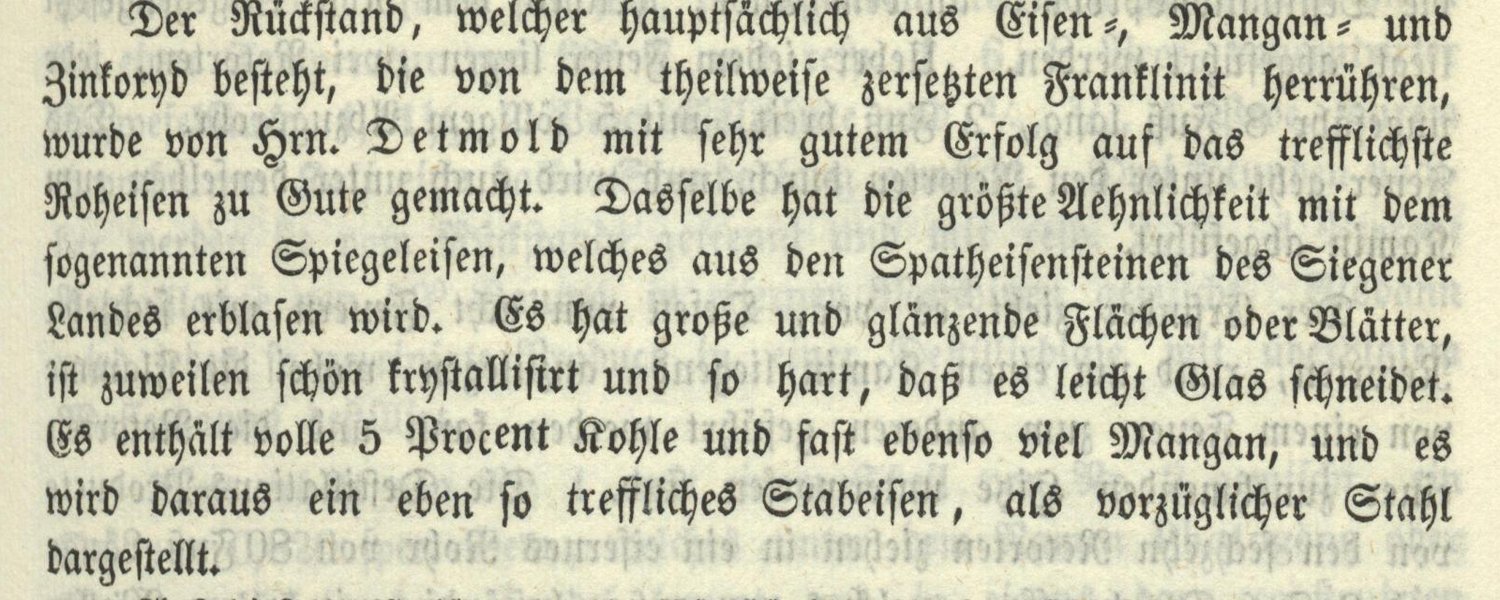
The answer came not from smelting the ore but from smelting what the zinc makers threw away. The New Jersey Zinc Company made its zinc oxide at Newark, and it was at Newark that it first smelted the residuum.
Stone wrote in 1886 that the company “was the first to make spiegel from franklinite residuum,” and that its first furnace was built in 1855: 19 feet by 7, with an open front, an open top and three three-inch tuyeres (the nozzles that blow air into a furnace).
The intention had been to make wrought iron, but there was too much waste in puddling (stirring molten pig iron in a furnace to burn out its carbon), and the company decided to sell the pig iron instead.
An older account disagrees on the date. The Appleton’s article says that early in 1853 E. Post of Stanhope made some pig iron from the ore in anthracite furnaces there, and that “in the same year” C. E. Detmold “successfully and permanently established” the smelting of the residuum at the company’s works.
The earliest European text we have found to call it spiegel came out of a visit to Newark. In December 1854 a Professor Wilson described his tour of the mines and, with Detmold, of the Newark works, and Dingler translated it in 1855. The residue, he wrote, had been worked by Detmold “with great success into pig iron of the finest kind” (our translation).
It “most closely resembles the so-called Spiegeleisen smelted from the spathic iron ores of the Siegen district” (ours; „hat die größte Aehnlichkeit mit dem sogenannten Spiegeleisen“). It had large, brilliant plates, was sometimes beautifully crystallized, and was “so hard that it cuts glass easily.” It held “a full 5 percent of carbon and almost as much manganese.”
Percy, a decade later, gave Detmold the credit for the idea of franklinite as a cure for bad iron, and kept his distance from it: “The merit of this alleged discovery is ascribed to Mr. Detmold.”
1859–1860: Floyd patents the drill-proof iron
Somebody had to notice that a metal too hard to work was worth something. In 1859 and 1860 Thaddeus Selleck of Greenwich, Connecticut, patented the use of franklinite pig metal to face iron against wear (U.S. 24,665) and as a grinding surface (U.S. 28,107).
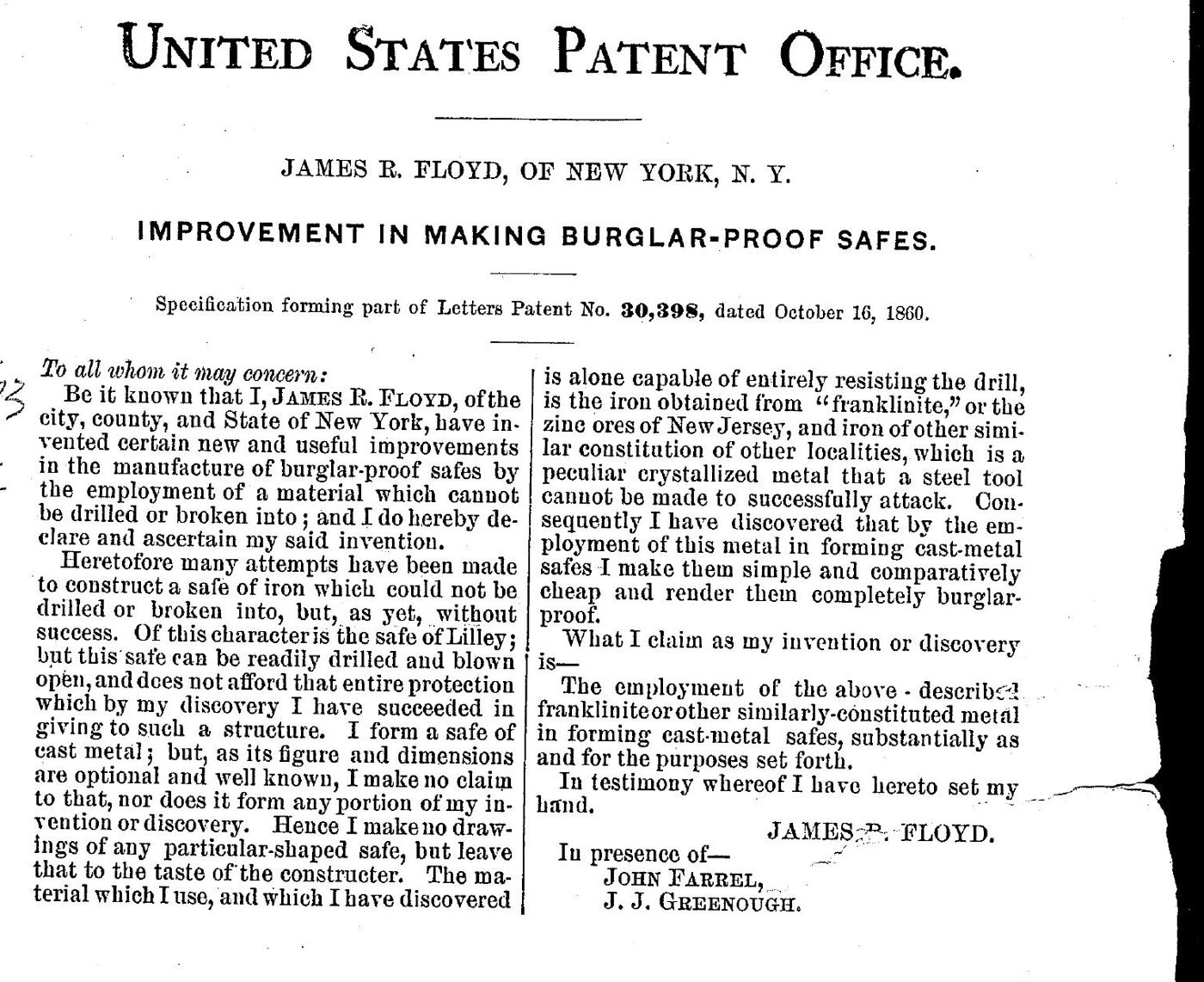
On October 16, 1860, James R. Floyd of New York was granted U.S. Patent 30,398 for an improvement in making burglar-proof safes. Earlier attempts to build an iron safe that could not be drilled had failed, he wrote. The safe of Lilley (Lillie of Troy, maker of safes of chilled cast iron) “can be readily drilled and blown open.”
The only material capable of entirely resisting the drill was “the iron obtained from ‘franklinite,’ or the zinc ores of New Jersey,” which he called “a peculiar crystallized metal that a steel tool cannot be made to successfully attack.”
He claimed the use of franklinite or similar metal in cast safes, and nothing else: no shape, no drawings.
The witness who signed first was John Farrel, a partner of Silas C. Herring, the New York safe maker. Now his firm had a metal.
1861: Selleck and Butler’s rival patent
Floyd’s was not the only claim. On October 8, 1861, Selleck and William H. Butler of New York took U.S. Patent 33,455 for burglar-proof safes of franklinite iron, cast onto wrought or cast iron, or set in the frame as plates.
“Our improvement consists in the use of that peculiar metal known as “Franklinite iron,” principally procured from the zinc ores of New Jersey,” they wrote, “either alone or in combination with other metal, as a material for safes and other burglar-proof structures. It is based on the property possessed by that metal of resisting all attempts to work it by means of steel tools, either by cutting or abrasion.”
They were candid about its weakness. It was better to enclose the casting in a wrought-iron case, or to cast wrought-iron bars into it, “as the extreme brittleness of the Franklinite iron renders it liable to give way under repeated concussions.”
Cast thinly on a wrought-iron safe, they added, “it will not give way to the hammer, except to crack into pieces more or less minute, still adhering firmly to the structure. Such safes are, we believe, completely burglar-proof, if protected by a proper lock.”
A few months later the Herald named the safe makers Valentine & Butler as coating plates with franklinite. That the patentee was the Butler of that firm is likely, but no document we have read says so.
1862: an honourable mention in London
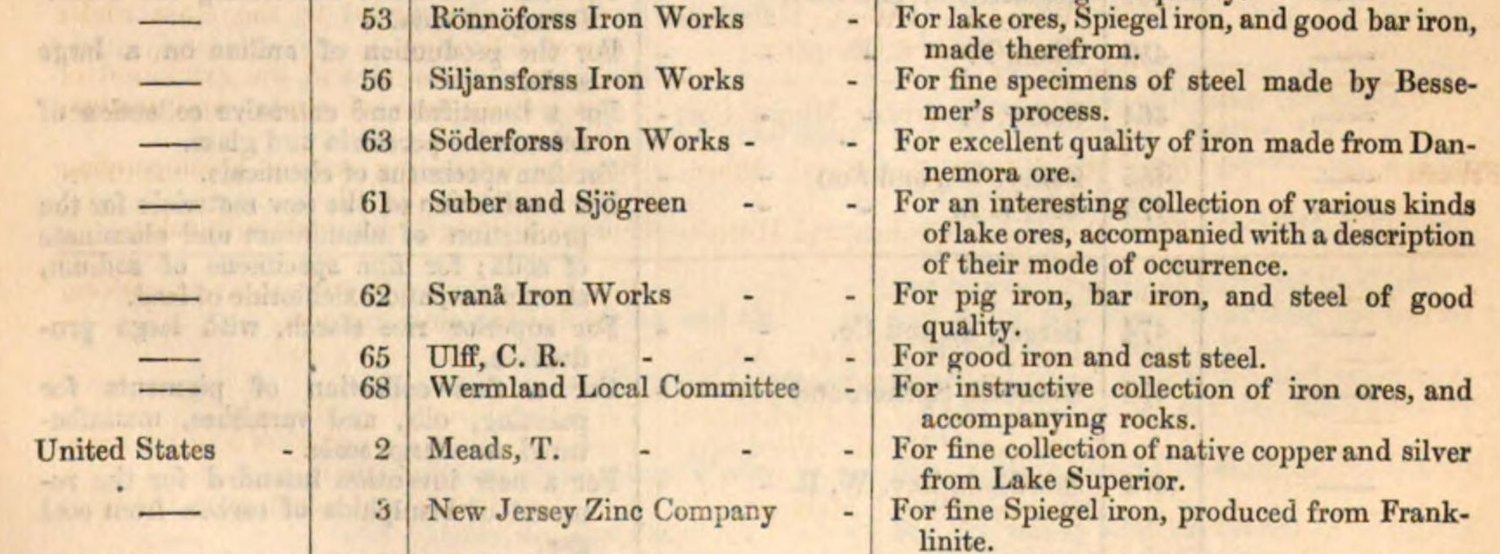
In 1862 the iron itself went to London. At the International Exhibition the juries of Class I (mining, metallurgy and mineral products) gave the New Jersey Zinc Company an honourable mention, not a medal: “For fine Spiegel iron, produced from Franklinite.” It stood in the same list as the Swedish works rewarded for spiegel iron and Bessemer steel.
Percy saw the specimens. In his Metallurgy: Iron and Steel he wrote that the residue, smelted in a blast furnace, “yielded characteristic spiegeleisen. Specimens of this were shown at the International Exhibition of 1862, and very good they appeared to be.”
He was less sure about the larger claims. “The ore has been recommended as an antidote both to red-shortness and cold-shortness,” he noted, and then: “Whether there may have been any confusion between the post hoc and the propter hoc with regard to the supposed influence of franklinite the future will decide.” That is, whether the iron improved because of the franklinite, or merely after it.
He printed an analysis of a specimen “obtained in smelting Franklinite,” communicated to him by E. F. Sanderson of Sheffield: 11.5 percent manganese and 6.9 percent carbon. That was more manganese than the German spiegel of the day.
Percy remembered the reaction of the Austrian ironmaster Peter Tunner: “When Professor Tunner was in London, in 1862, I informed him that I had a specimen of spiegeleisen from the United States containing more than 11% of manganese; but he appeared somewhat sceptical as to the fact.”
May 1862: Floyd’s patent reissued, with drawings
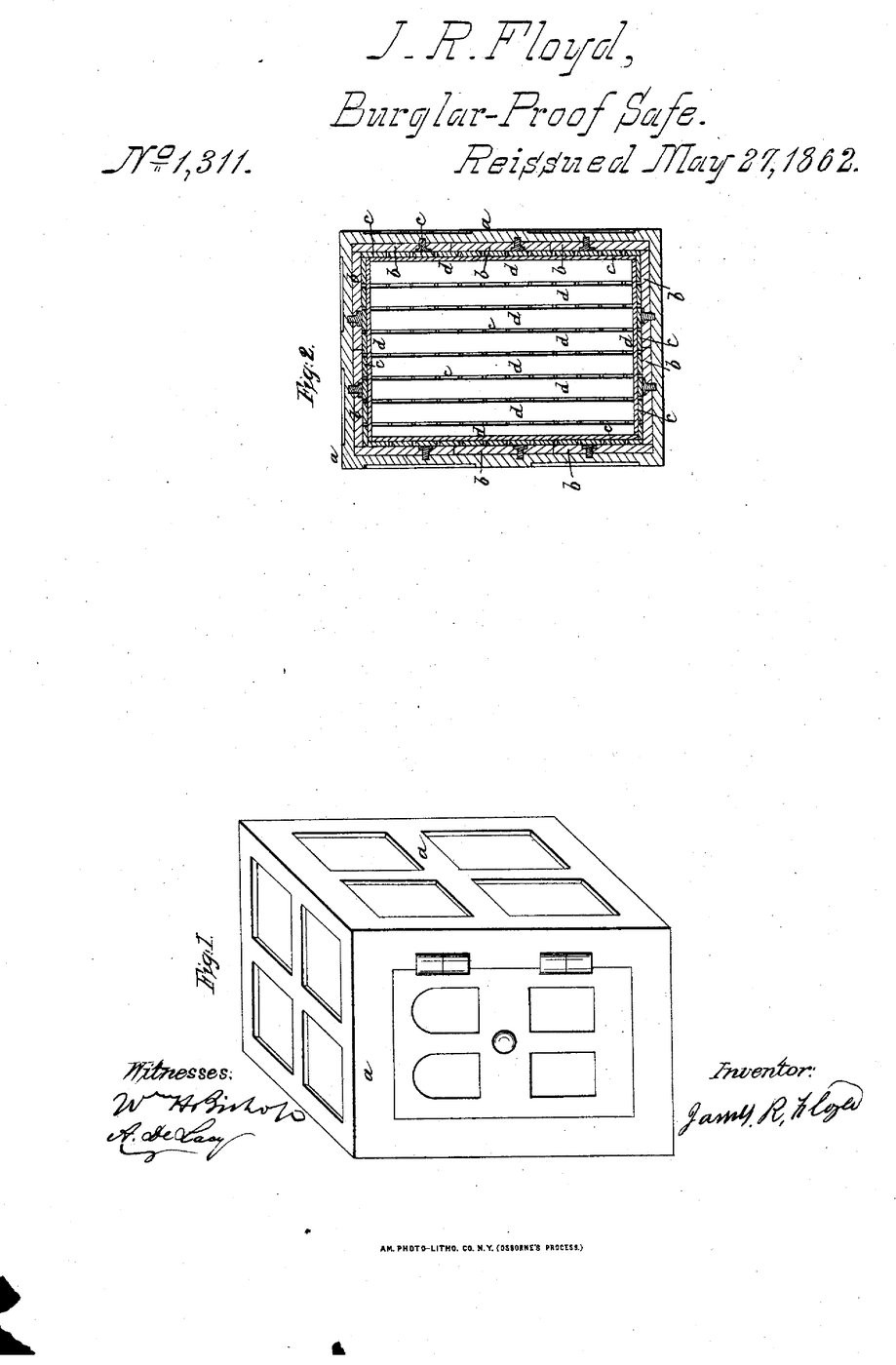
On May 27, 1862, Floyd’s patent was reissued as No. 1,311, and this time it had drawings. They show the construction Herring would advertise: a wrought-iron outer case, inside it plates of the franklinite metal cast with bolt holes, and inside those a lining of spring-steel bars crossing each other.
The reissue made a stronger claim for the metal. “I have discovered, and by the test of experiment proved,” Floyd wrote, “that the metal obtained from the smelting of the “franklinite ore,” extensively found in the State of New Jersey, and which is known to consist mainly of iron and zinc, when cast, is of a crystalline structure, and of a diamond-like hardness, which cannot be affected in the slightest degree by any of the means heretofore resorted to for cutting, drilling, filing, or otherwise affecting chilled cast-iron and hardened steel.”
The metal in fact consisted mainly of iron with manganese and carbon, not zinc; most of the zinc had gone up the flue as oxide.
The patent also explained the steel bars, and in doing so admitted the old weakness. They were there “in case holes should be drilled through the wrought-iron outer case, and an attempt should be made by a punch to break the franklinite lining.”
By the next year Herring & Co. advertised that the reissue gave them “the sole and exclusive ownership” of franklinite applied in any way to an iron safe.
1862: the Franklinite Steel Company, guns and armor
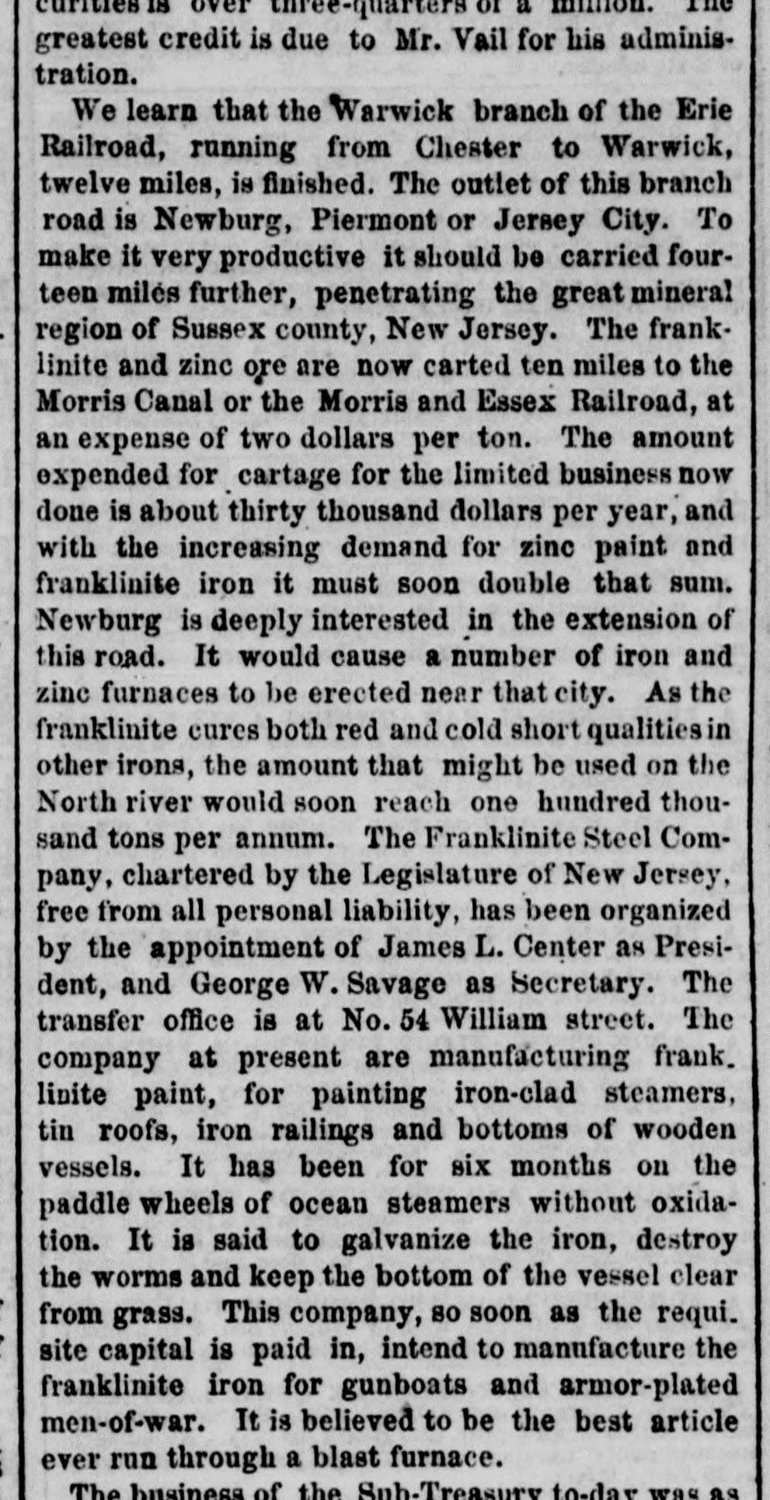
The Civil War brought larger promises. In March 1862 the money column of the New York Herald reported that a Captain Dahlgren had tried “the Franklinite metal” mixed with a charcoal pig iron and found its tensile strength increased by half.
All the franklinite pig in the market, the column said, had been bought up within a few days, so that an English order for five hundred tons could not be filled. Valentine & Butler had been coating plates with franklinite, which the paper urged the government to test against cannon balls.
Two months later the same column announced the Franklinite Steel Company. It explained the economics first: “The frank-linite and zinc ore are now carted ten miles to the Morris Canal or the Morris and Essex Railroad, at an expense of two dollars per ton.”
Then the promise: “As the franklinite cures both red and cold short qualities in other irons, the amount that might be used on the North river would soon reach one hundred thousand tons per annum.”
The company, “chartered by the Legislature of New Jersey, free from all personal liability,” had its transfer office at 54 William Street. For the present it was making franklinite paint “for painting iron-clad steamers, tin roofs, iron railings and bottoms of wooden vessels.”
But “so soon as the requisite capital is paid in,” it intended “to manufacture the franklinite iron for gunboats and armor-plated men-of-war. It is believed to be the best article ever run through a blast furnace.”
The May notice names the president as “James L. Center.” In August the Herald reported the first sale of the stock, at 5¾ on a par of $10, and gave him as “Mr. James L. Curtis, the founder of the New Jersey Zinc Company.” “Center” is probably a misprint (Daniel E. Russell, from the Sterling Hill land titles, names the president of the Franklinite Steel Co. as James Langdon Curtis); both are given here as printed.
These are the newspaper’s claims. We have found nothing to confirm Dahlgren’s trial or the English order, and no report that the company ever made armor.
January 1863: a whole page of the Herald
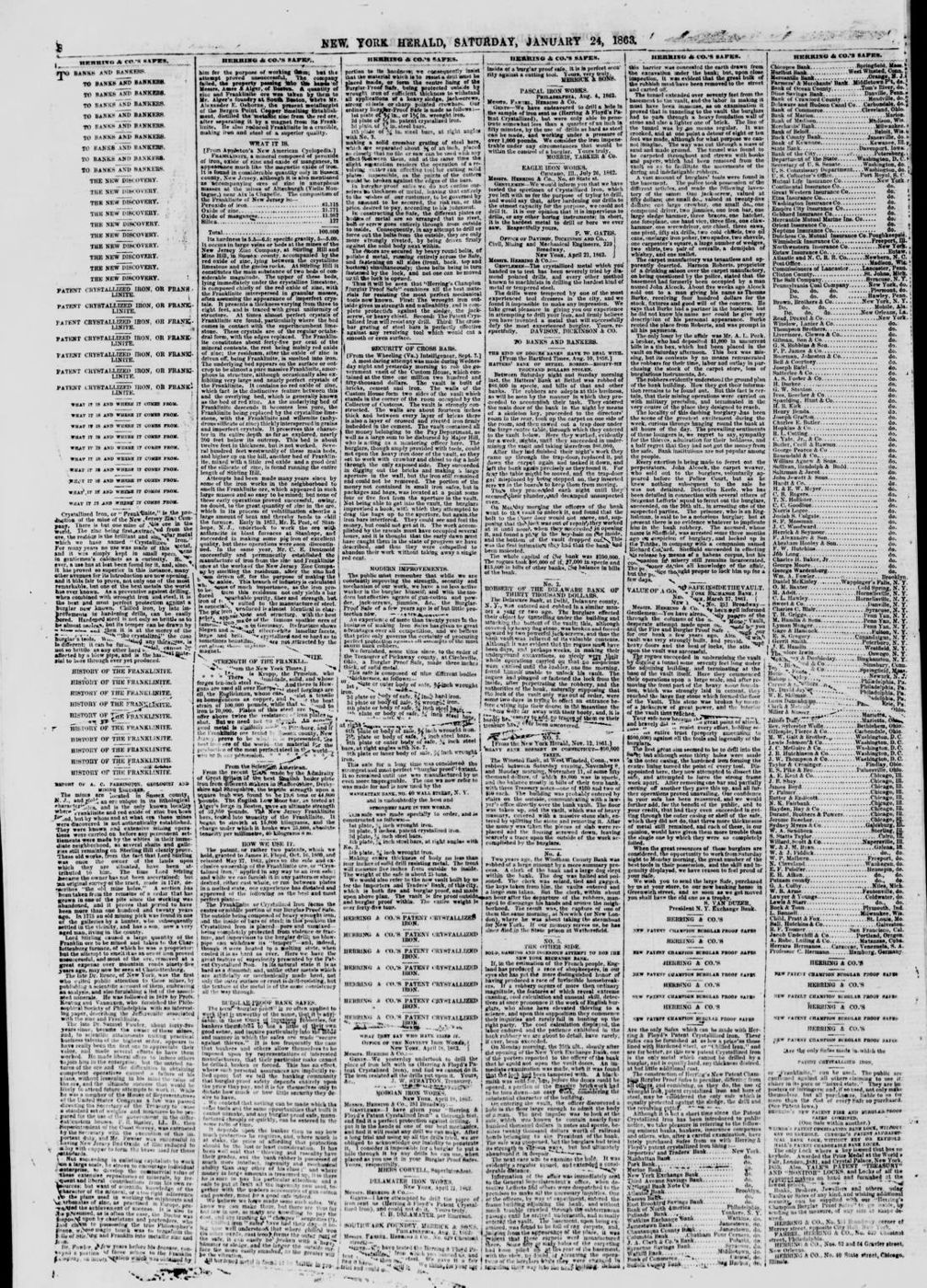
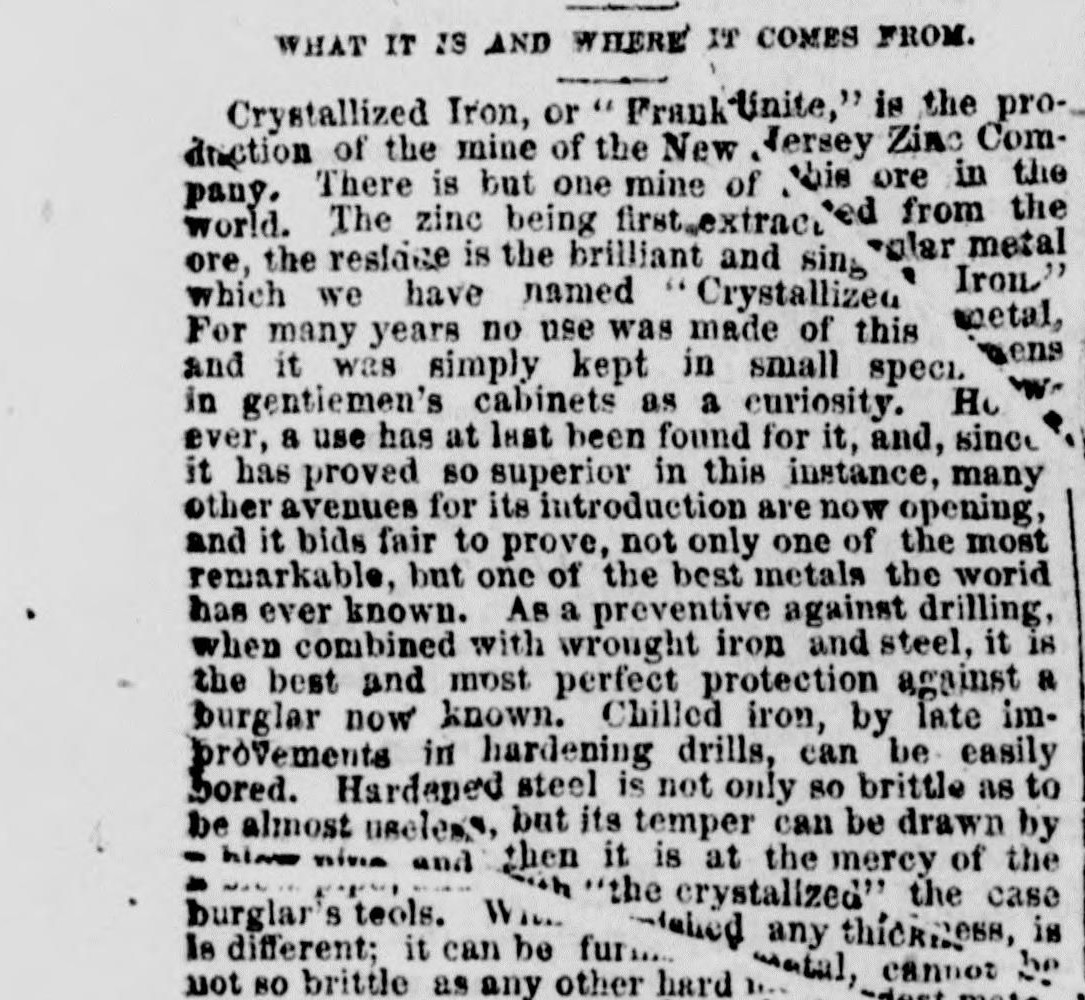
On January 24, 1863, Herring & Co. took a whole page of the New York Herald to sell it. The headings ran down the columns, each repeated again and again: “To Banks and Bankers,” “The New Discovery,” “Patent Crystallized Iron, or Franklinite,” “What It Is and Where It Comes From.”
“Crystallized iron” was Herring’s trade name for the manganese-rich white pig iron. The zinc being first extracted from the ore, the advertisement explained, “the residue is the brilliant and singular metal which we have named ‘Crystallized Iron.’”
For many years, it went on, “it was simply kept in small specimens in gentlemen’s cabinets as a curiosity.” That sentence runs the mineral and the metal together: what lay in collectors’ cabinets was the mineral franklinite, not iron smelted from it. The page also reprinted Appleton’s article on the mineral, which gave its hardness as 5.5 to 6.5, softer than quartz.
The safe was built in layers. An outer plate of wrought iron stood against the sledge, the jack-screw and the chisel. Then came a plate of the crystallized iron, against the drill. Then two layers of steel bars laid at right angles, a grating too close for a file or saw and too uneven for a revolving cutter. No rivet or bolt went straight through.
The crystallized iron, the advertisement claimed, could not have its “temper” drawn by a blowpipe (a torch), as hardened steel could, and “though it were heated to a melting state, when cooled it is as hard as ever.” In its natural state, it added, it was “as hard as a diamond.”
The page printed letters from the engineering works of New York, Philadelphia and Chicago, each reporting a sample it could not drill: the Novelty Iron Works, the Morgan Iron Works, the Delamater Iron Works, Merrick & Sons, and Morris, Tasker & Co., who managed “somewhat less than a quarter of an inch in fifty minutes” with drills “as hard as steel can be made.”
It described a safe built for the Manhattan Bank, 40 Wall Street, with a two-inch plate of crystallized iron and four inches of “solid drill resisting metal” in all, “the best and strongest safe in the world.”
And it reprinted a letter from H. Van Duzer, president of the New York Exchange Bank, whose vault burglars had reached by a tunnel some seventy feet long. Some thirty holes were drilled in the outer casing of his Herring safe, but “the hardened iron forming the centre lining turned the point of every tool.”
January 1863: the rivals drill it
Herring’s rivals answered at once. In January 1863 Lillie’s agents reprinted a certificate from the New York Journal of Commerce, headed “Herring’s Franklinite Iron Drilled.”
Three men from Brooklyn stated that a sample of the crystallized iron, left with the Manhattan Bank by Herring as drill-proof, had been “drilled readily” in their presence with a five-eighths-inch hand drill.
When a notice in the Chicago Tribune objected that the bank’s president and cashier had not been present, a rejoinder in the same paper called that “neither a contradiction nor an answer.”
Who drilled what, with which drill, before whom, cannot now be settled. What can be said is that within four months Herring’s own partner wrote that it could be done.
May 1863: Herring’s own partner concedes the drill
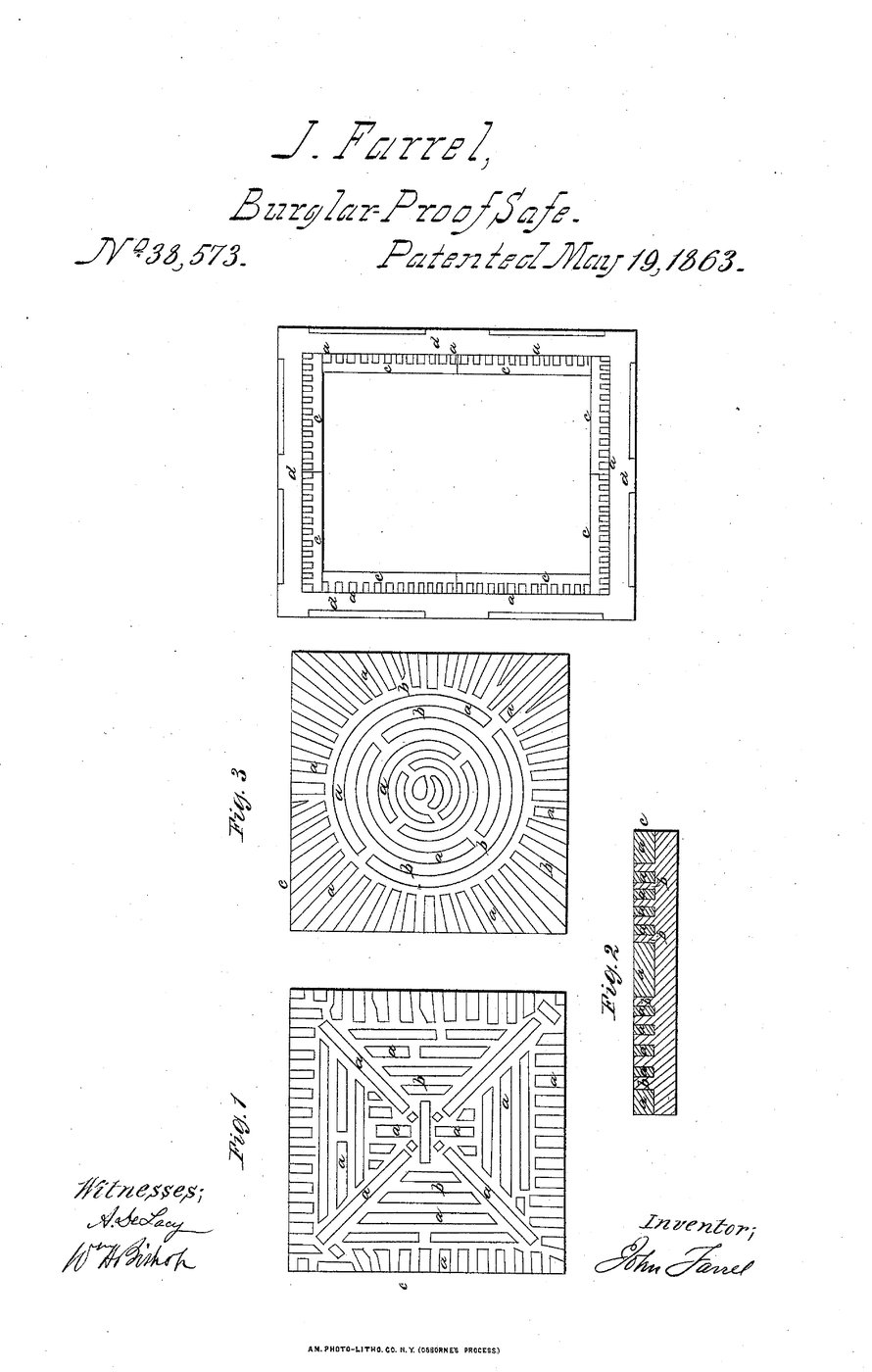
On May 19, 1863, John Farrel patented a new plate (U.S. 38,573): hard franklinite cast in a pattern with strips of soft wrought iron, so that a drill would wander and break between hard and soft.
His opening paragraph gave away what the advertisements denied. Safes, he wrote, “have heretofore been made with one or more thicknesses of cast-iron obtained from franklinite ore or chilled cast-iron; but however hard these substances may be, it is now known that drills can and have been made which can effectually cut through them.”
He did not give up on the material. About half the thickness of his plate was to be “of cast franklinite iron, which is the hardest metal known.” His answer to a better drill was not a harder metal but a confusing one.
1864: Marvin’s muffled hammer, and a vault for the Stock Exchange
A rival described another way in. Walter K. Marvin, of Marvin & Co., patented corrugated safe plates in February 1864 (U.S. 41,629), and in the specification explained how burglars beat franklinite.
“The second mode—that of employing franklinite—is much less perfect than that of steel. This is also true of chilled iron, as it is extremely brittle. Burglars have frequently overcome the apparent difficulty by cutting a disk from the outer sheet with a circular knife, and when the hard strata within are reached by fracturing the cast metal by a few blows of a hammer while the whole safe is muffled. The cast metal is thus made to crumble.”
The trade was not deterred. That June the Daily Gate City of Keokuk, Iowa, describing the new building of the New York Stock Exchange, promised a basement vault “one hundred feet in length by twenty feet in width and nine feet high.”
“It is to be constructed of Franklinite iron with steel plates, and will be absolutely burglar and fire proof. … The cost of this safe alone is estimated at $50,000.”
1856–1864: Bessemer, Mushet and the franklinite pig at Sheffield
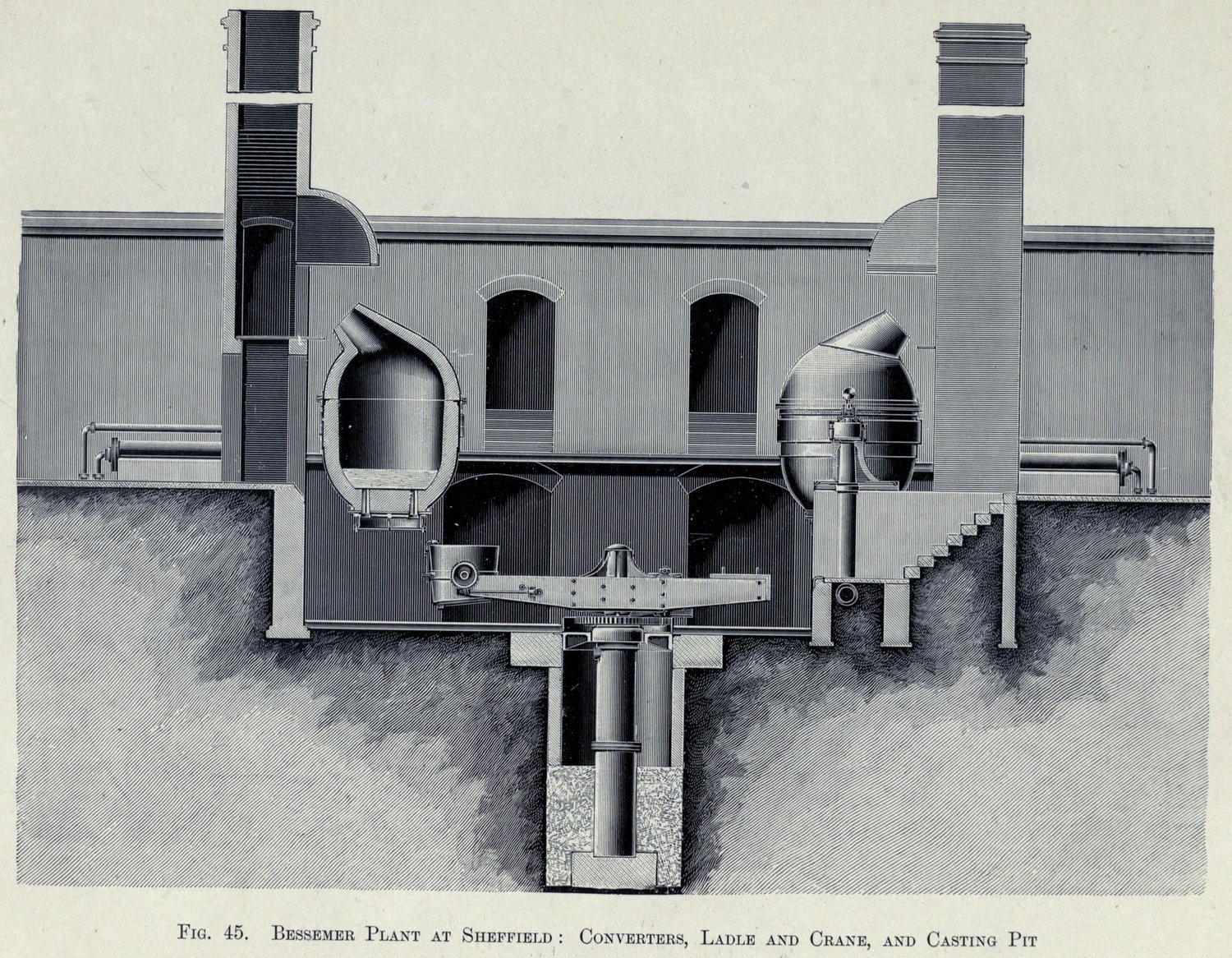
Meanwhile the iron had found its real work in England. In the Bessemer process, air blown through molten pig iron burns out its carbon, but the metal also takes up oxygen from the blast, which makes it red-short.
The cure, as the 1911 Britannica explains, was to add manganese, which takes up the oxygen, and to put back carbon. An alloy added for this was called a recarburizer, and both came together in molten spiegeleisen, usually “about 12% of manganese and 4% of carbon.”
The British steelmaker Robert Mushet patented the use of spiegel for this in September 1856. Bessemer, who disputed Mushet’s credit for the rest of his life, quoted the specification: “The triple compound or material which I prefer to use is pig or cast iron made from spathose ore, such ore and the pig or cast iron made from it containing a proportion of manganese, as well as the iron and carbon of which cast iron is usually composed.”
The Britannica credits Mushet with removing “the only remaining serious obstacle” to the spread of the process, while disputing that his part equaled Bessemer’s.
At his own Sheffield works Bessemer used the New Jersey iron. “We had also magnesian [sic] pig-iron from Germany,” he wrote, “and Franklinite pig-iron from the United States, the latter containing about 11 per cent. of manganese, which was greatly preferred for deoxydising steel derived from British coke-made iron.” He meant manganese-bearing iron; “deoxydising” is taking out the oxygen.
Elsewhere he explained: “When the zinc is driven off, in the form of vapour, there results an alloy of iron and manganese, usually containing from 11 per cent. to 11½ per cent. of manganese, which is far better adapted for the deoxydation of mild steel than spiegeleisen, containing only 8 per cent. of that metal. Consequently, “Franklinite” was much used at my works in Sheffield, pending my introduction of ferro-manganese into the trade.”
He did not think it the final answer. “Thus time rolled on,” he wrote; “we made shift with Franklinite, which was 40 per cent. richer in manganese than spiegeleisen, but it was not all we could desire.” Bessemer wrote all this in the 1890s, in a book with a quarrel to pursue, and his percentages are his own.
German readers heard of it too. In 1864 Dingler’s journal, describing Bessemer’s latest improvements, named the iron to add at the end of the blow: “Franklinite pig iron or Spiegeleisen is especially suited to this” (our translation; „Hierzu eignet sich besonders Franklinitroheisen oder Spiegeleisen“).
1864–1866: “Spiegel Eisen” and the first American steel
In America the market turned the same way. According to Stone, most of the early Newark iron had gone into safe linings, “under the name of ‘Franklinite iron,’” some into car wheels and roll shells, and from 1864–65 most of it to the new Albany & Rensselaer steelworks at Troy, New York.
The works preserved a tradition about Troy. A lot of fine-grained iron was sent there by accident; Troy wrote back that it held 16 percent manganese and asked for more. The company replied, “indignant,” that it had never sent any such iron, could not make it if it would, and did not intend to try. Only when it began to analyze its own iron did it find that it could make better iron than it had been shipping.
Bessemer’s autobiography reprints an American report written in September 1866, which describes the experimental plant at Troy, New York, where, the book adds, the first charge of Bessemer metal in the United States was run into ingots on February 16, 1865. Meanwhile, the report went on, “the Wyandotte Works were producing a good quality of steel from the Lake Superior irons. The re-carboniser at both works has been the Franklinite pig iron of New Jersey, which is slightly richer in manganese than spiegeleisen.”
The company’s own history, printed about 1924, puts it simply: with the Bessemer process, “in which an alloy of this kind is essential, came a market for all the spiegel iron the Company could produce.”
It puts the uses in a different order from Stone. Larger markets came first in car wheels, which a small admixture of the iron made stronger and longer-lived, and the iron was “also very largely used under the name of Franklinite iron for lining safes, because it had been found to be so hard that it could not be pierced by drilling.”
The safe trade followed the steelmakers’ vocabulary. In October 1865 Herring’s agents in Richmond, Virginia, ran an advertisement in the Daily Richmond Whig, beneath a testimonial letter on fire safes signed by P. T. Barnum, for “Herring & Co.’s Patent Bankers’ Safes, with Herring & Floyd’s Patent Crystallized Iron, the best security against a burglar’s drill ever manufactured.”
By November 1866 Herring’s advertisements in the New-York Tribune offered “Spiegel Eisen, produced from the ore Franklinite or Crystallized Iron,” covered “by the patent of Herring & Floyd” when used against burglars. “Steel Safes,” “Chilled Iron Safes” and “Case Hardened Safes,” it said, “have had their day.”
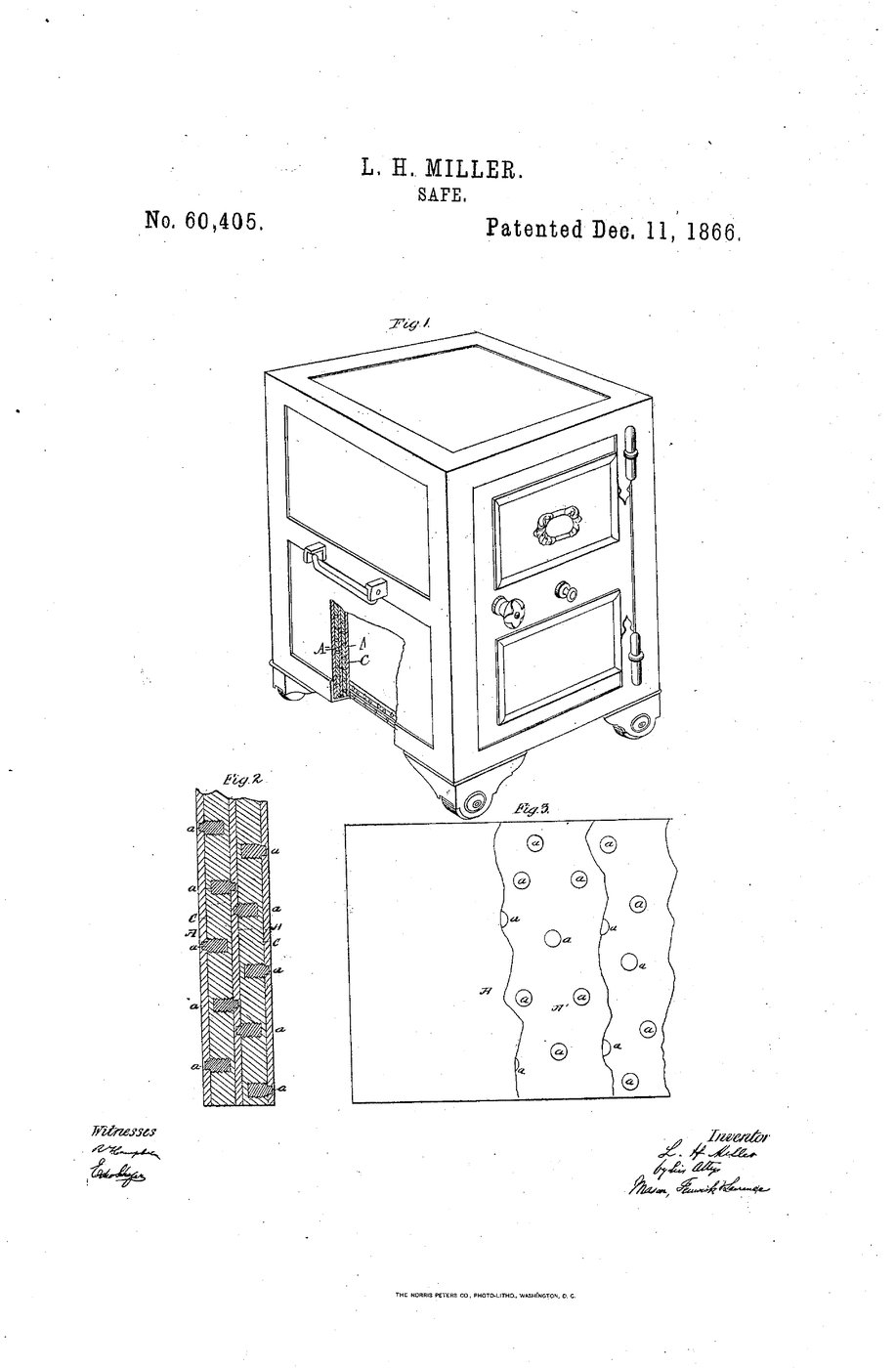
Other makers used franklinite too. In December 1866 L. H. Miller of Baltimore patented a safe (U.S. 60,405) whose inner walls were franklinite or another hard cast metal, poured between studded plates.
1867: Paris, the battle of the safes
In 1867 the safe went to Paris, to the Exposition Universelle on the Champ de Mars, and there it met an Englishman. Samuel Chatwood of Bolton, Lancashire, also showed safes.
George Augustus Sala told the story from Chatwood’s side in a London pamphlet of 1868 whose title gives its tone: The Battle of the Safes; or, British Invincibles versus Yankee Ironclads.
“In the early part of the month of June, 1867,” Sala wrote, “Mr. Chatwood and Mr. Herring, both being exhibitors of safes in the Champ de Mars, a written challenge, pasted on the outside of Herring’s Safe, appeared in the Exhibition, in which the American offered to back his safe for a specified sum against any other safe, constructed by any other manufacturer extant.”
Chatwood accepted, and the two safes were attacked by each other’s men before a committee. We have not found the committee’s own verdict.
The engineer Robert Mallet drew a lesson from it about the franklinite. His articles in the Practical Mechanic’s Journal were put into German by E. F. Dürre for Dingler’s journal in 1870.
Herring, Mallet wrote, had filled the space between the inner and outer plates of the safe wall with “the hardest franklinite pig iron,” poured in molten. “This material is so hard that it cannot be drilled in any way, but it is just as brittle as ordinary white or chilled cast iron, and apparently even more so” (our translation from the German).
To offset that, a network of round iron rods about five-sixteenths of an inch thick had been cast into it. Then came the test: “A few blows with a moderately heavy hammer showed, however, that the plates had remained just as brittle as before, and that the rods merely held the fragments loosely together” (ours; „Einige Schläge mit einem mäßig schweren Hammer bewiesen indessen …“).
Mallet’s cast-in rods differ from Floyd’s reissue and Herring’s 1863 advertisement, which put crossed steel bars inside the franklinite plates. Herring may have built the Paris safe differently; we cannot say.
1867: Paris, mirror iron from New Jersey and the Rhine
Elsewhere in the same exhibition the iron was shown for what it was. Gabriel-Auguste Daubrée, Inspector-General of Mines, wrote the jury’s report on mineral substances.
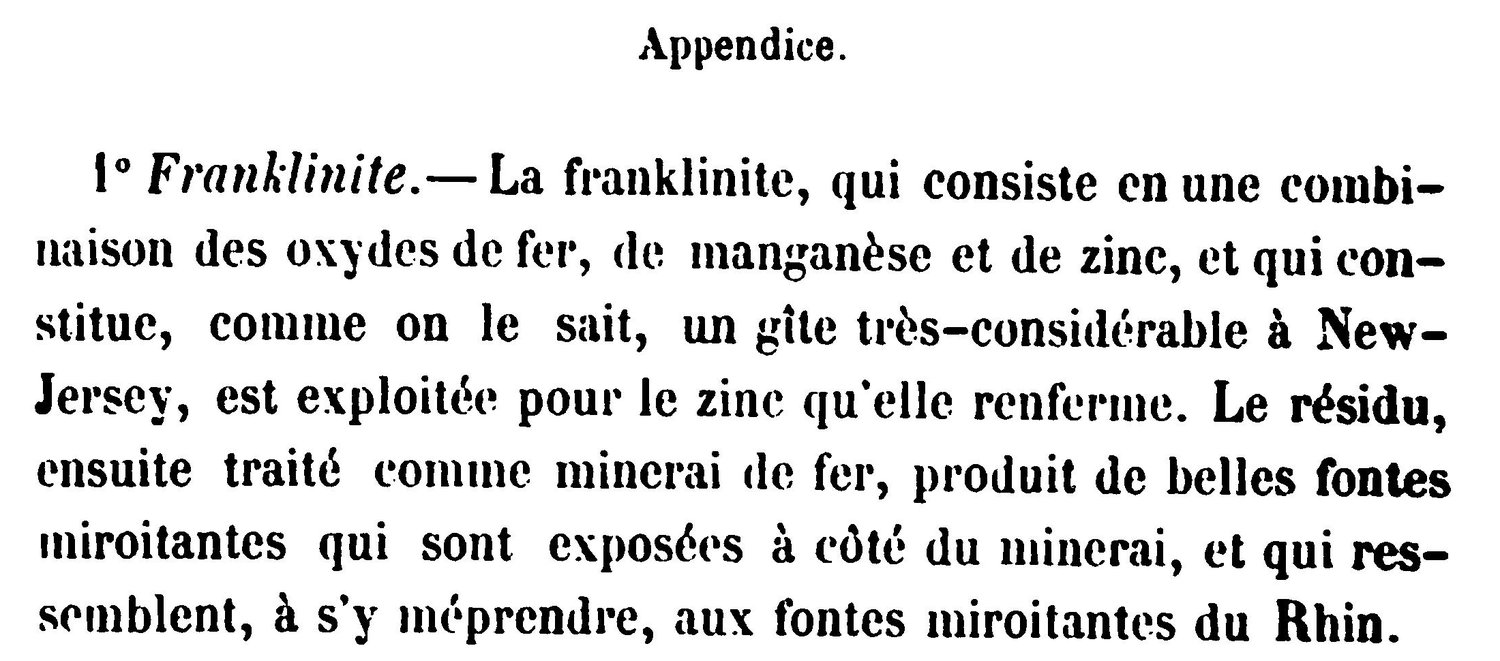
Franklinite, he wrote, was worked in New Jersey for its zinc. “The residue, afterward treated as an iron ore, yields fine mirror irons, which are exhibited beside the ore and which resemble the mirror irons of the Rhine so closely that one could mistake them” (our translation; « qui ressemblent, à s’y méprendre, aux fontes miroitantes du Rhin »). Fonte miroitante, “mirror iron,” is the French for spiegel.
The same volume shows what the German spiegel trade had become. The report on pig and wrought iron said that the making of Spiegeleisen “has grown considerably since the Bessemer process became widespread,” because its purity let it be used to recarburize the molten steel at the end of the blow (our translation).
In the ten years from 1855 to 1865, while pig iron as a whole grew by 253 percent, spiegel rose “from 7,500 to 47,000 tons, an increase of more than 600 percent” (ours). The company working the Stahlberg alone, the report added, made 15,000 tons a year of spiegel holding up to 8 and 10 percent manganese.
1868–1869: Herring, Farrel & Sherman
By 1868 the firm was Herring, Farrel & Sherman, at 251 Broadway, with its factory at Ninth Avenue and Fourteenth Street and branches in Philadelphia, Chicago and New Orleans. Its advertisements now spoke of the patent franklinite, or “Spiegel Eisen.”
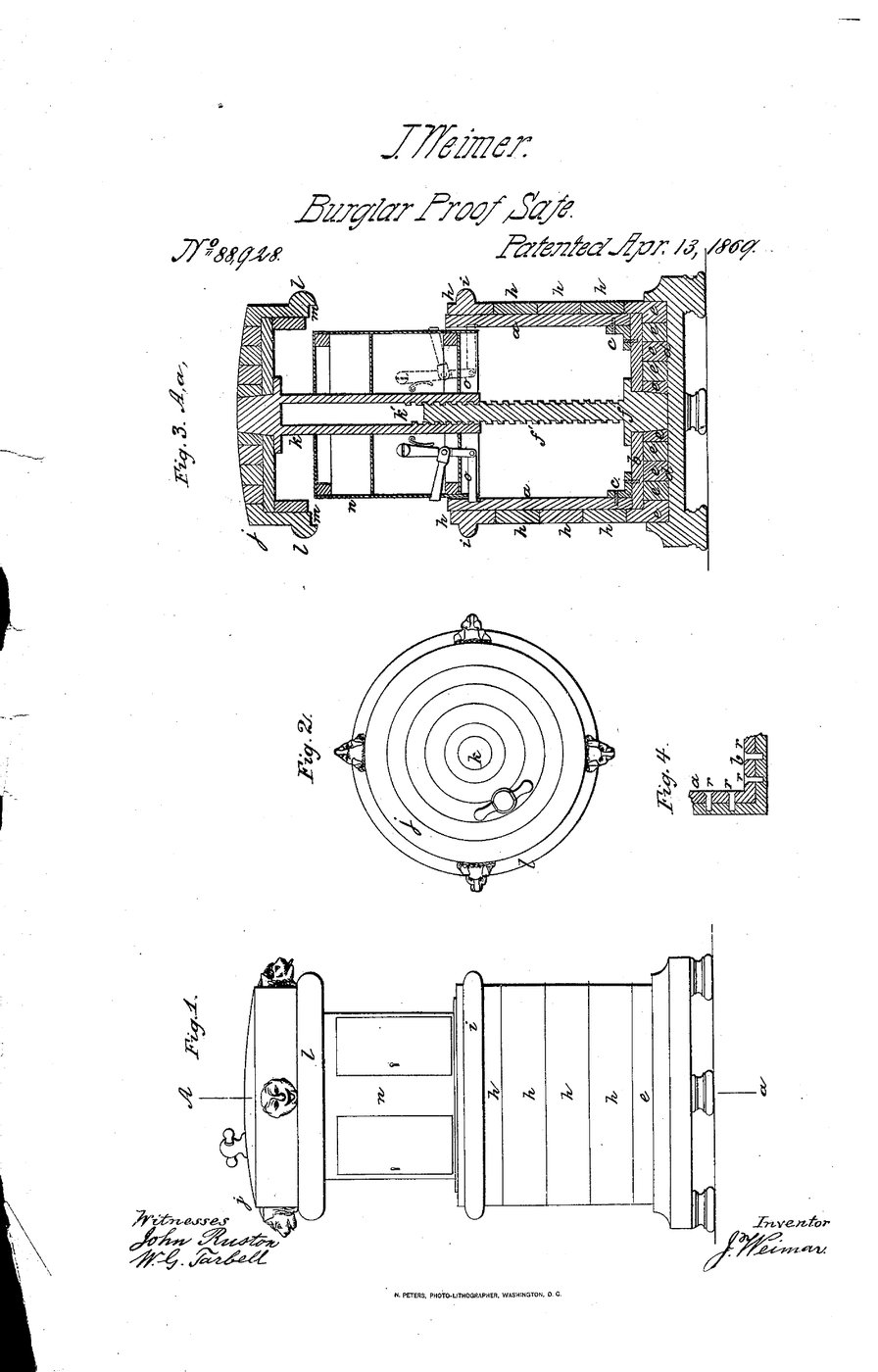
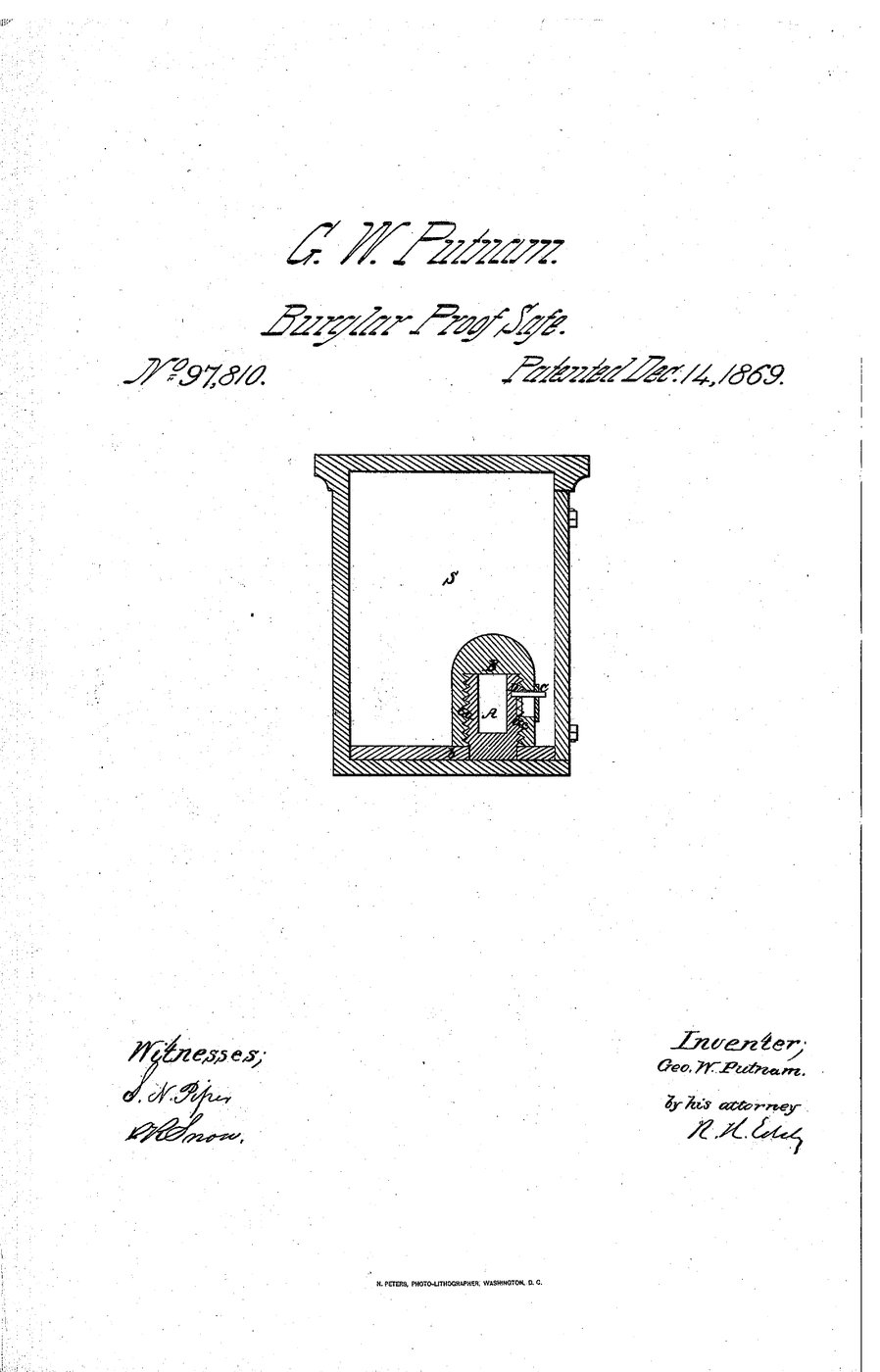
Inventors elsewhere treated franklinite as a standard material. J. Weimar of New York patented a cylindrical safe of stacked rings over a cast layer of franklinite (U.S. 88,928, April 1869). George W. Putnam of Boston allowed franklinite or hardened steel in the walls of his (U.S. 97,810, December 1869).
Herring’s testimonials kept coming. In June 1869 the agent at Perryville Station, Pennsylvania, reported that burglars had tried on two nights to drill his “Franklinite Banker’s Chest,” given up, and hammered at the lock for hours in vain.
October 1869: Norwalk, and “Mr. Hazard’s powder”
But the burglars had stopped drilling. In the autumn of 1869 the National Bank of Norwalk, Connecticut, was robbed.
The Philadelphia Evening Telegraph reported that the officers had rested their faith on “a Franklinite iron-drill and burglar-proof safe” made by Hendrickson of Brooklyn. The burglars could not wedge the door, so they blew it off with powder.
It proved, the paper wrote, “Mr. Hazard’s powder superior to the warranted Franklinite.” Hazard’s was a well-known brand of gunpowder.
A metal that turned a drill was no defense against a charge of powder, or a wedge driven into the crack of a door. The next year’s robberies would make that the whole argument.
May 1870: three blasts at White Plains
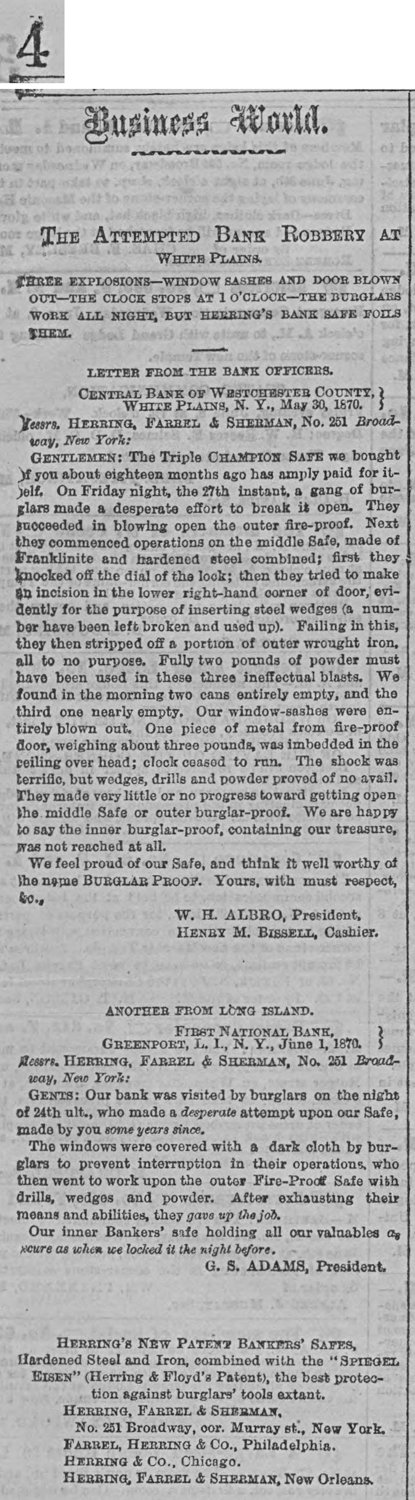
On the night of May 27, 1870, burglars went to work on the “Triple Champion” safe of the Central Bank of Westchester County at White Plains, New York. The bank’s president and cashier wrote to the makers, and Herring, Farrel & Sherman printed their letter as an advertisement in the New York Dispatch.
“They succeeded in blowing open the outer fire-proof. Next they commenced operations on the middle Safe, made of Franklinite and hardened steel combined; first they knocked off the dial of the lock; then they tried to make an incision in the lower right-hand corner of door, evidently for the purpose of inserting steel wedges (a number have been left broken and used up).”
“Failing in this, they then stripped off a portion of outer wrought iron, all to no purpose. Fully two pounds of powder must have been used in these three ineffectual blasts. We found in the morning two cans entirely empty, and the third one nearly empty.”
“Our window-sashes were entirely blown out. One piece of metal from fire-proof door, weighing about three pounds, was imbedded in the ceiling over head; clock ceased to run. The shock was terrific, but wedges, drills and powder proved of no avail.”
The letter was signed by W. H. Albro, president, and Henry M. Bissell, cashier. Beneath it the firm offered “Herring’s New Patent Bankers’ Safes, Hardened Steel and Iron, combined with the “Spiegel Eisen” (Herring & Floyd’s Patent), the best protection against burglars’ tools extant.”
Franklinite was no longer the whole defense. It was one layer among several.
September 1870: “no safe made thirteen years ago”
After a run of bank robberies, the Ocean National Bank and the Norwalk bank among them, the New York Dispatch went to the safe makers and asked why. Marvin’s son answered for the Ocean Bank’s Marvin safe.
“He said the safe was sold thirteen years ago, and was then burglar proof, as at that time safes were entered by picking the lock, such a thing as bursting or blowing it up, was not known at that time to either safe manufacturer or burglar; but the pick lock business being used up, they devoted their time to getting tools made that would wedge the safe open.”
“No safe, said Mr. Marvin, made thirteen years ago, is now burglar-proof.” Herring’s manager agreed, saying “that no safe manufactured thirteen years ago, no matter by whom made, was burglar-proof. Now they are.”
The reporter described the newest construction: “The body of the modern safes made is four inches in thickness, the doors and front five inches solid metal, and plates of hardened steel, and iron welded, are combined with the improved Franklinite steel. These three varieties of plate welded together, it is said, defy the blow pipe to take the temper out of the steel so that the drill might be brought into play.” The “Franklinite steel” was still a cast iron, whatever the reporter called it.
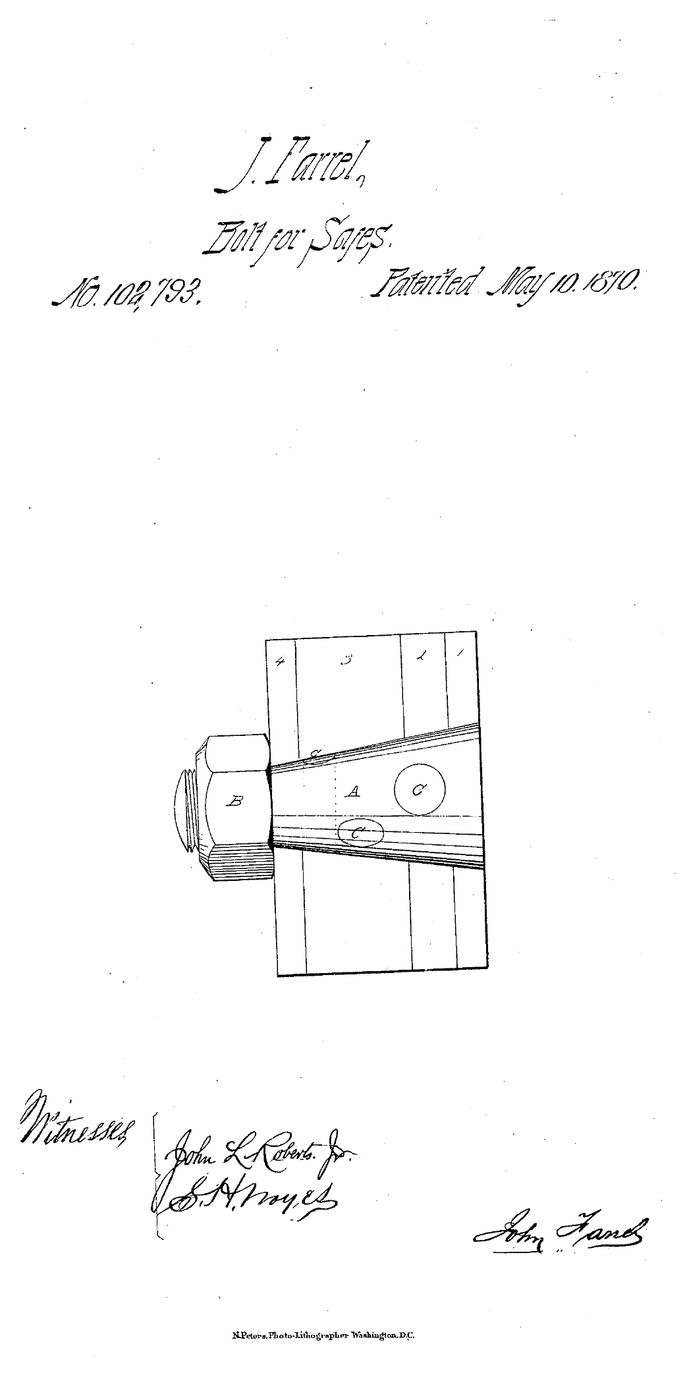
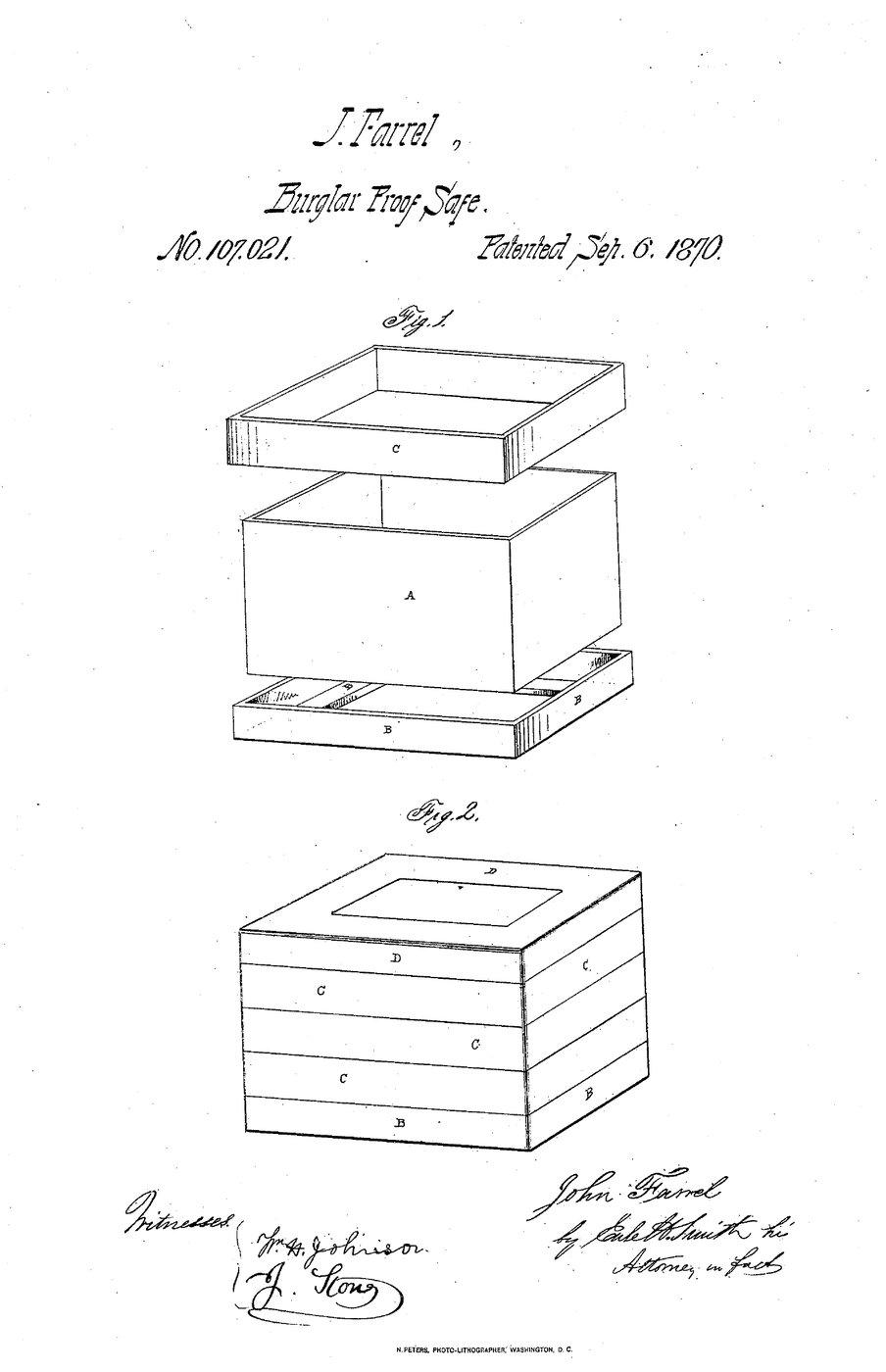
Farrel’s patents of that year show the layered wall. His safe bolt of May (U.S. 102,793) passes through wrought iron, welded iron and steel, franklinite or spiegeleisen, and wrought iron or steel. His safe of September (U.S. 107,021) is bound in welded bands against the wedge, with a back panel of franklinite or a similar hard metal.
December 1870: inside the Herring factory
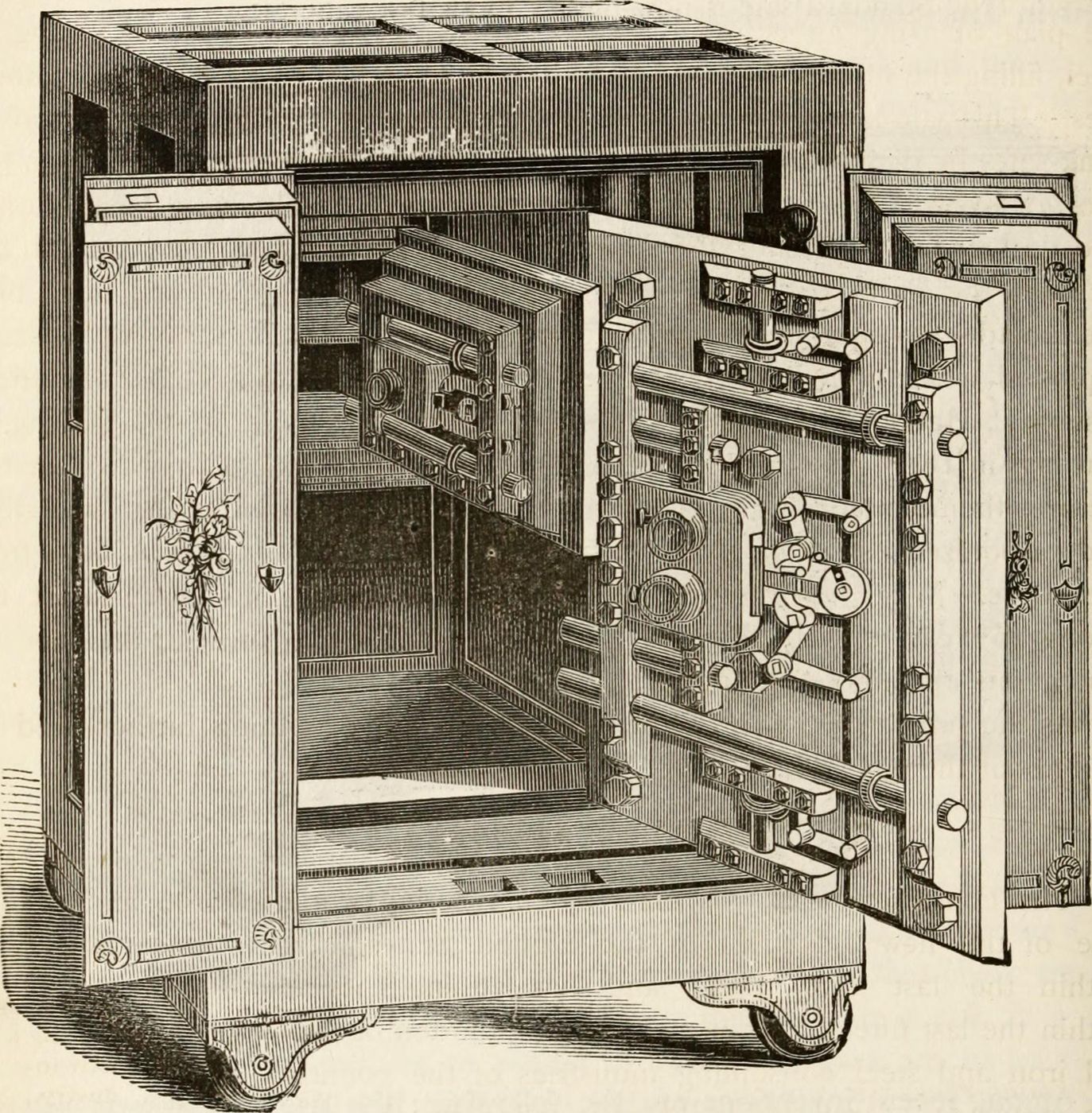
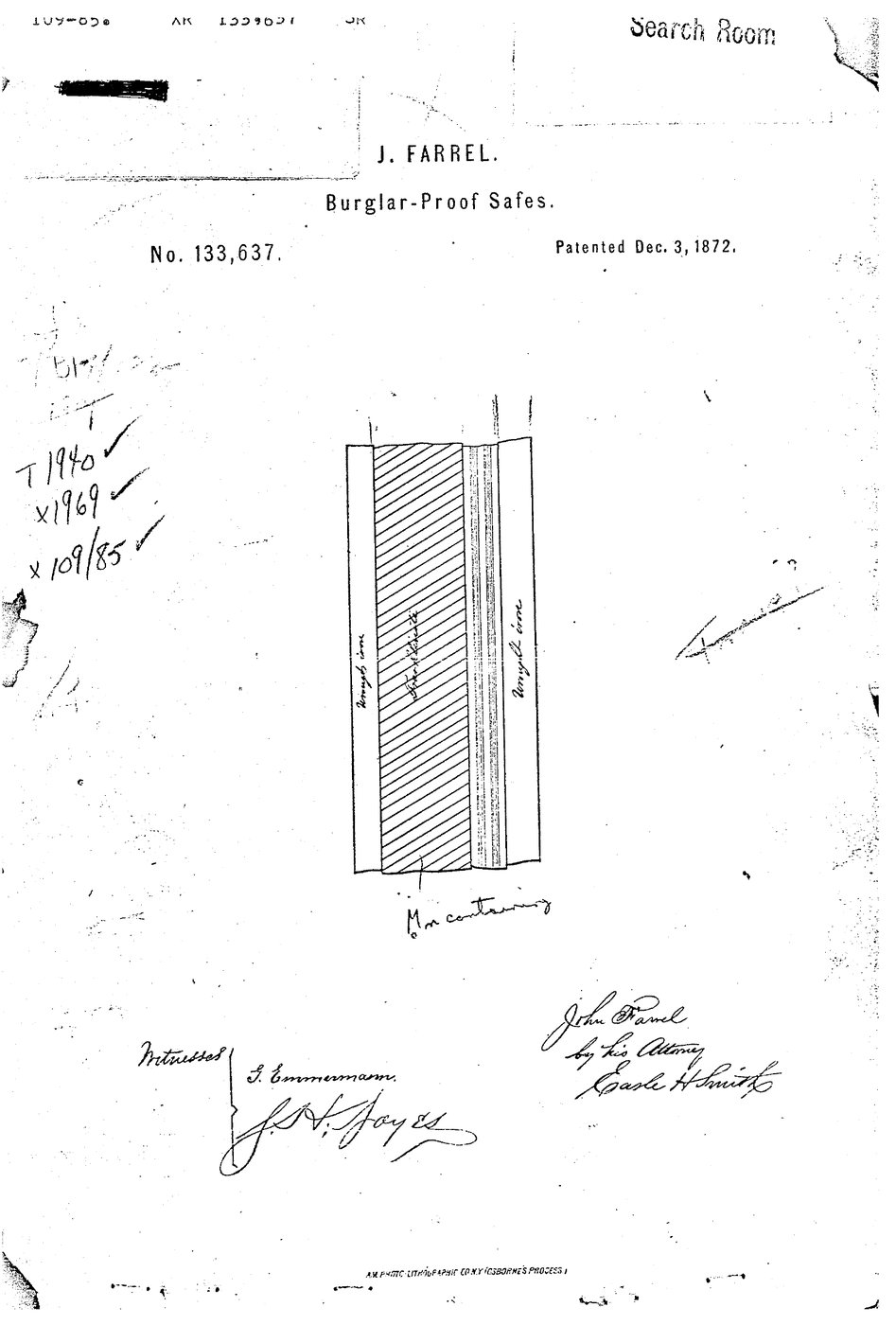
On Christmas Day 1870 the Dispatch took its readers through the works of Herring, Farrell & Sherman (as it spelled the name): a five-story building covering the block between Thirteenth and Fourteenth Streets, Hudson Street and Ninth Avenue, with two hundred mechanics.
“SAFE-MAKING, consequently, has become a great business in the city, in which a dozen companies are engaged, but the head and front of them is that of Herring, Farrell & Sherman, who claim that not a single burglar-proof safe of theirs has yet been broken open by burglars.”
The reporter watched a chest go together from the inside out. “Then the building commences from the inside with a layer of welded bands and plates of mixed steel and iron. The third layer, riveted on from the inside, consists of plates of Franklinite steel, which no drill can penetrate. Then plate by plate is fastened on until the required thickness is obtained.”
“THE OUTSIDE OF THE CHEST is steel of such a quality that no hammer can break it, and should they succeed in drilling through it, the drill, on coming to the Franklinite steel, which the hammer cannot get at, would break or make no impression.” And at the door: “even if it were possible to get a wedge in at the door, it would strike the solid Franklinite steel and bound back again.”
The franklinite was now buried inside the wall, where a hammer could not reach it. That was the answer to Marvin’s muffled hammer, and it is the arrangement of Farrel’s patent of December 1872 (U.S. 133,637): high and low steel and wrought iron in front, a mass of franklinite behind.
1870: war on the Rhine, spiegel at Ebbw Vale
In Europe the same year showed how much the steelmakers depended on spiegel. When the Franco-Prussian War broke out in July 1870, the supply of German spiegel to Britain stopped.
Professor David Forbes told the Iron and Steel Institute in 1872, in words translated in Dingler, that the importance of an easy supply of Spiegeleisen for the Bessemer process “was only fully appreciated by our British steelmakers when the outbreak of the Franco-German war cut off entirely, for some time, the supply of this article,” then made mainly east of the Rhine, in Westphalia and Nassau (our English from the German). That led, he said, to the successful attempt to make it at the Ebbw Vale works in Wales.
Ferdinand Kohn, a London engineer, had already described the German source to the Institute in September 1870: “the well-known Spiegeleisen of the Siegerland,” with 7 to 11 percent of manganese, smelted from spathic ore that “forms a powerful deposit above all at the Stahlberg near Müsen” (ours).
His paper was about the making of iron-manganese alloys for Bessemer steel. The franklinite iron, at 11 percent and more, had been richer than the German spiegel. That advantage would not last.
1871–1872: Yale’s spindle and Corliss’s spheres
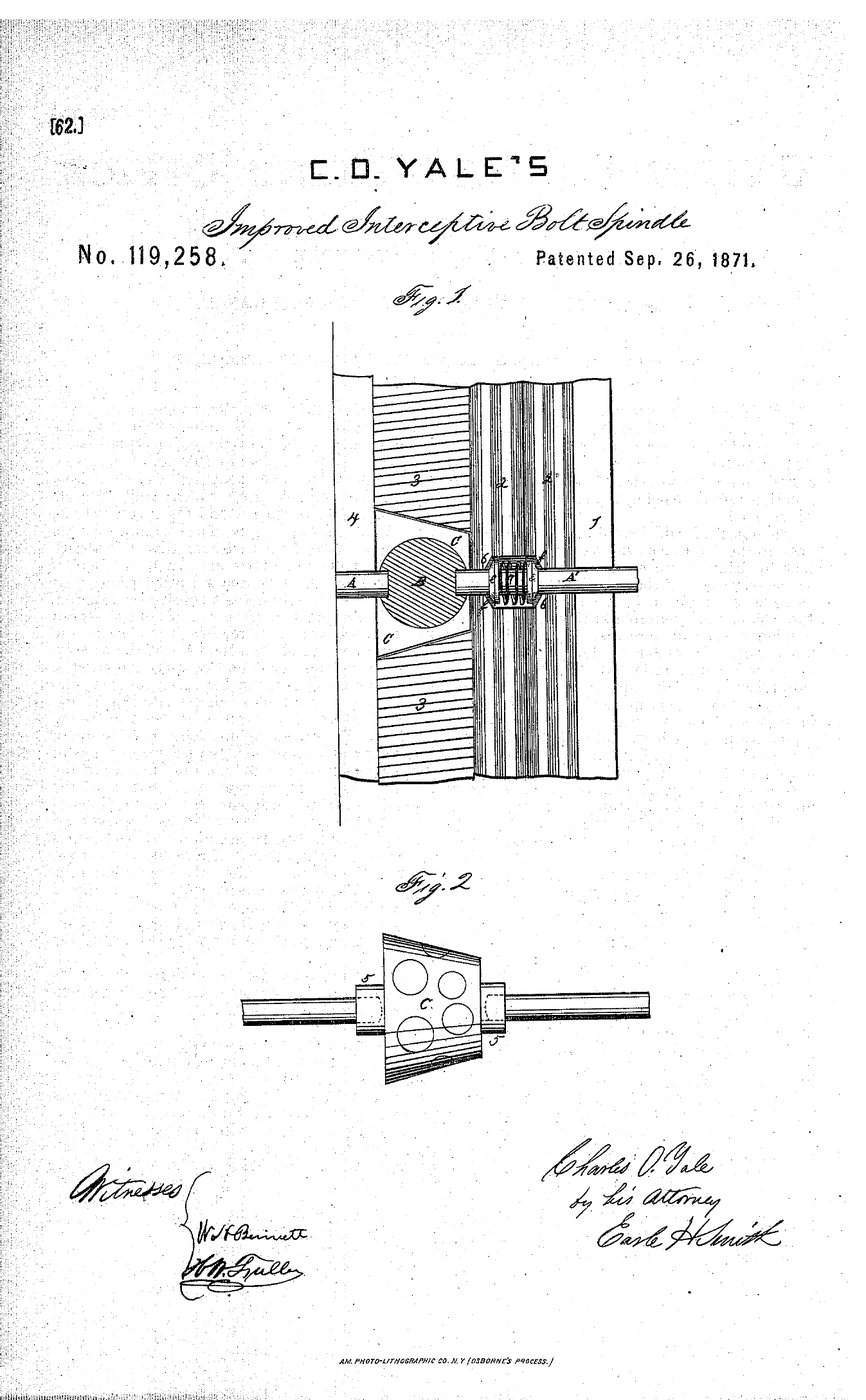
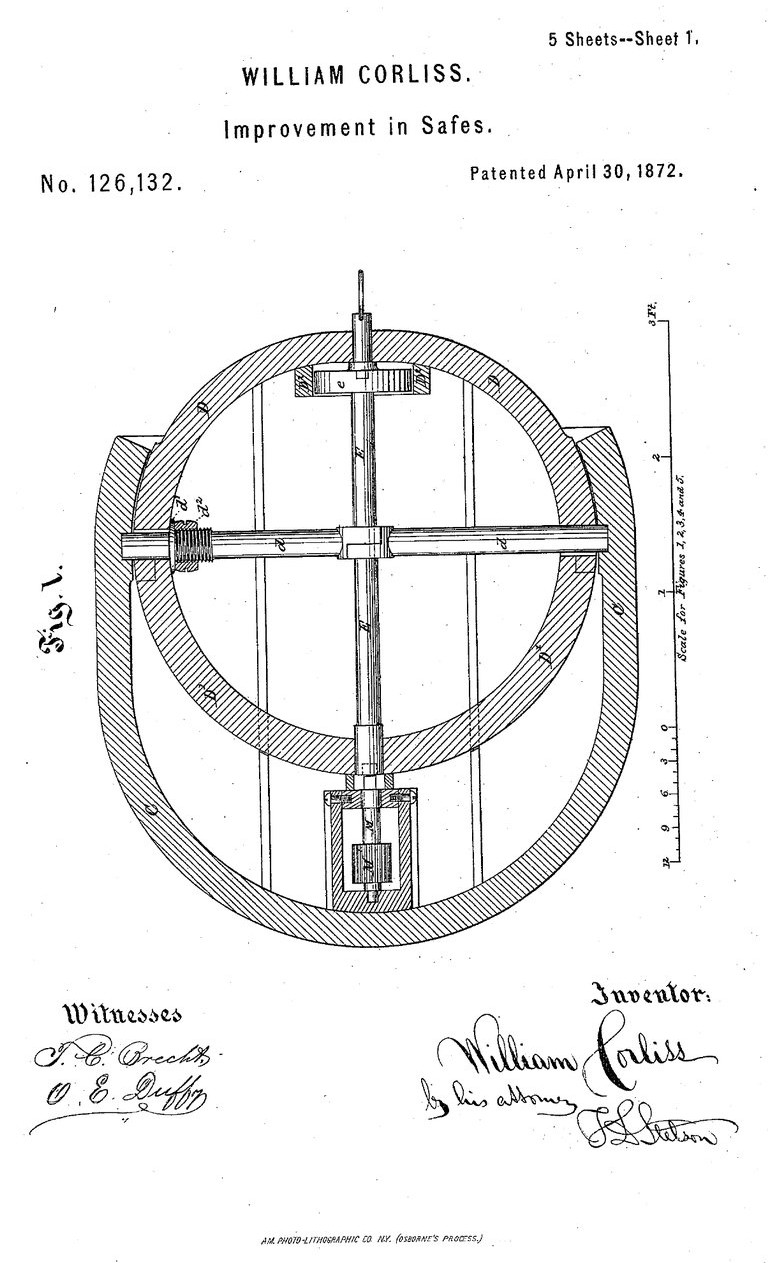
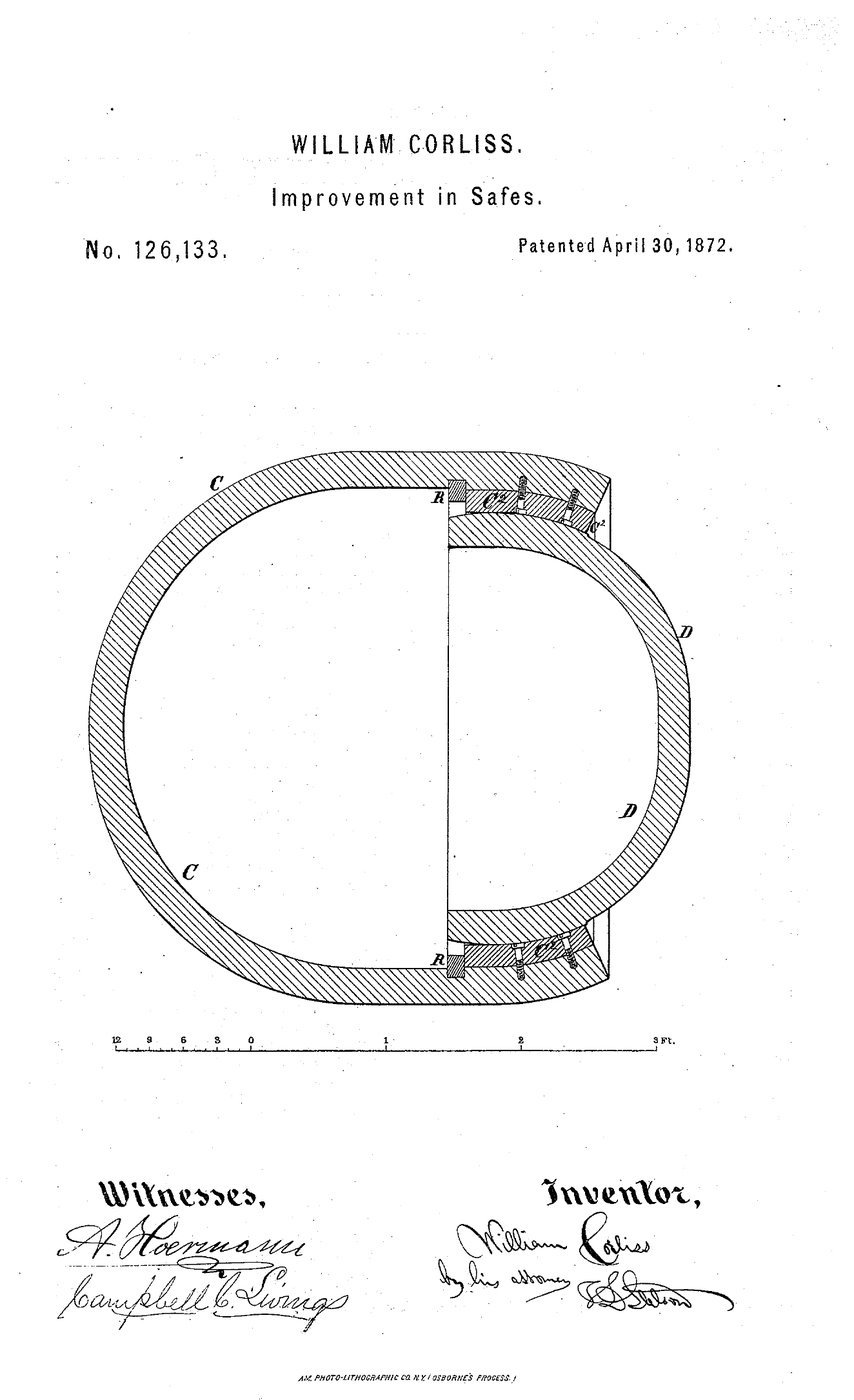
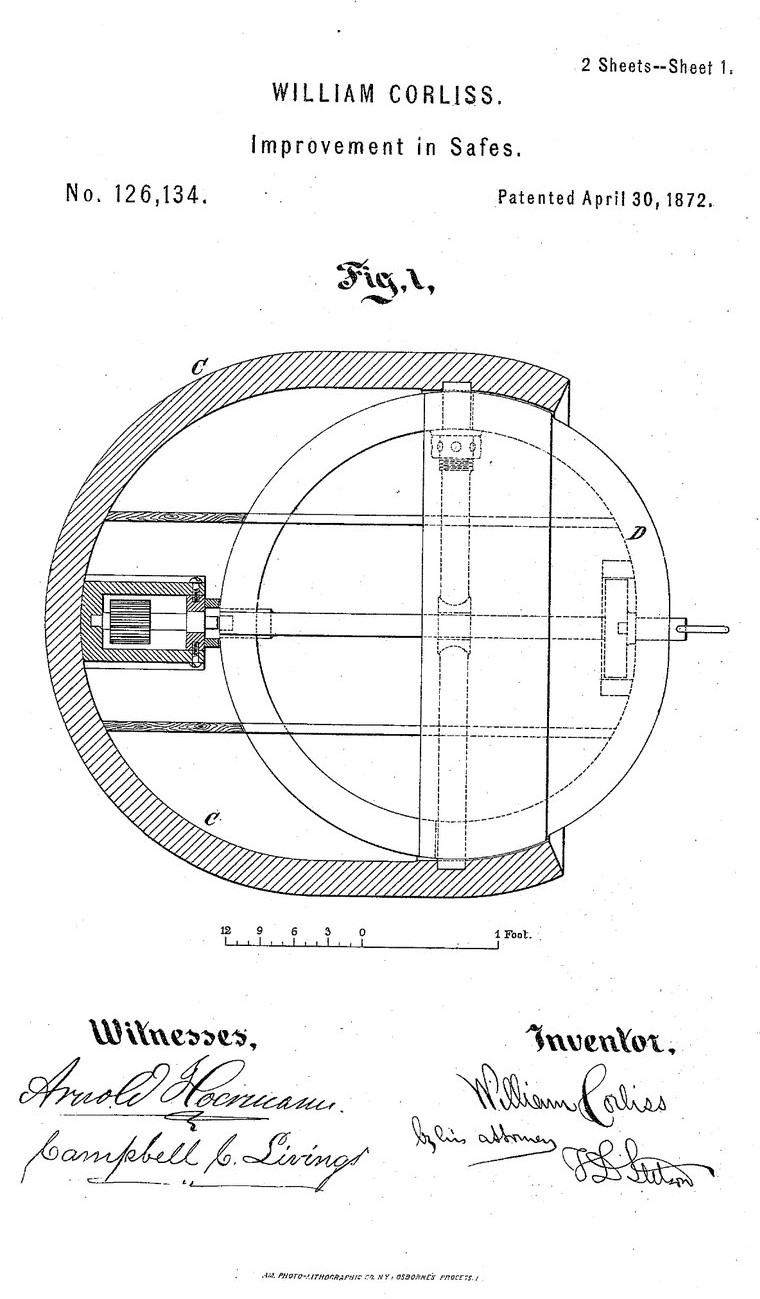
By the early 1870s “franklinite” had become an ordinary word in safe patents, usually listed beside chilled iron and hardened steel. The drawings show how many ways inventors tried to use it.
Charles O. Yale protected the weakest point of a safe, the hole through which the lock spindle passed. His patent of September 1871 (U.S. 119,258) runs the spindle through a block of franklinite or spiegeleisen, cushioned so that the brittle block would not crack.
William Corliss of Providence took three patents on April 30, 1872 (U.S. 126,132, 126,133 and 126,134) for spherical and drum-shaped safes adapted to franklinite, chilled iron or other very hard metal.
1872–1874: franklinite in everyone’s patents
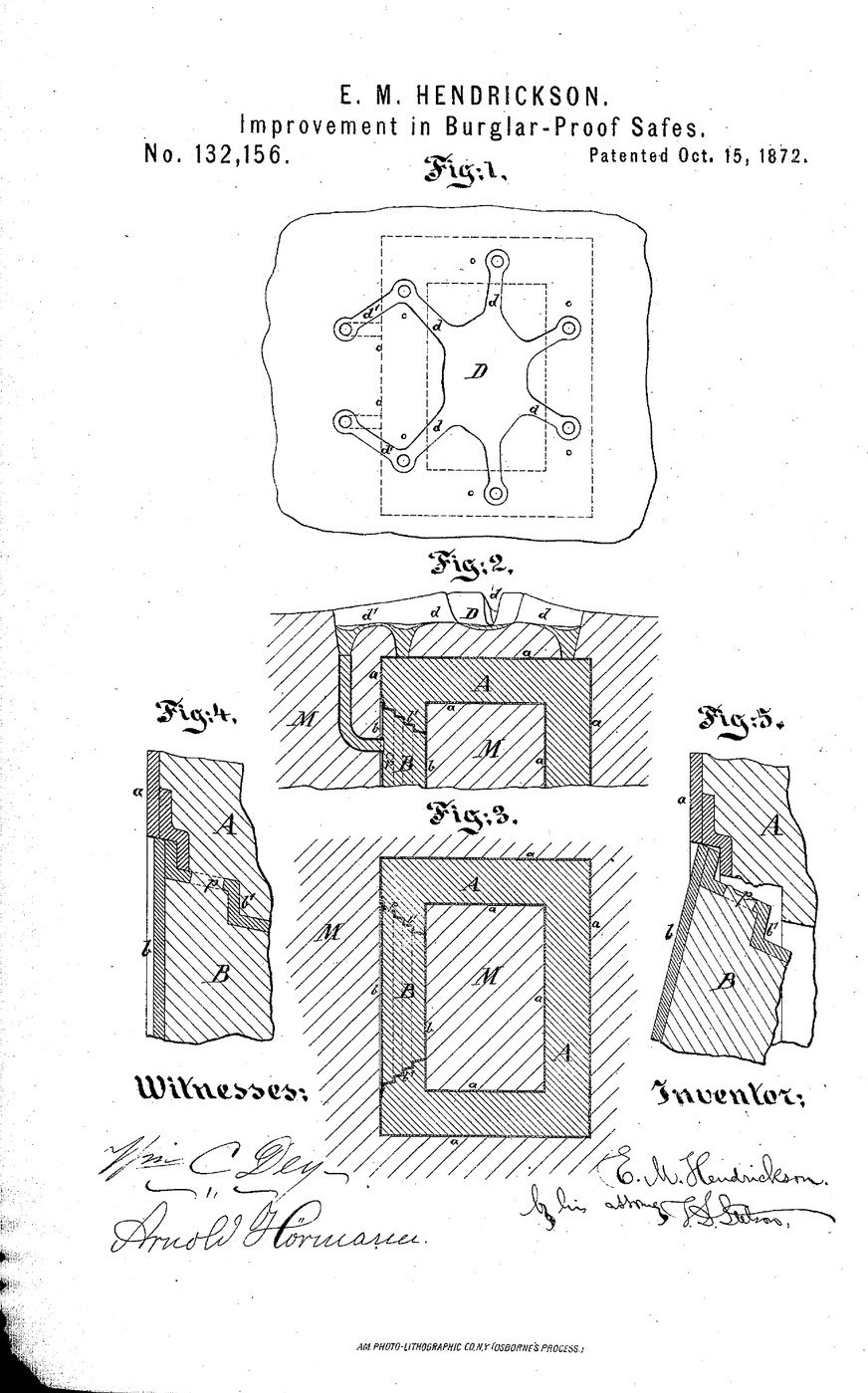
In 1872 Ezekiel M. Hendrickson of Brooklyn, whose firm had made the Norwalk safe, patented a new way of building such safes, the shell cast of “Franklinite iron or other very hard material” poured between thin sheets of wrought iron.
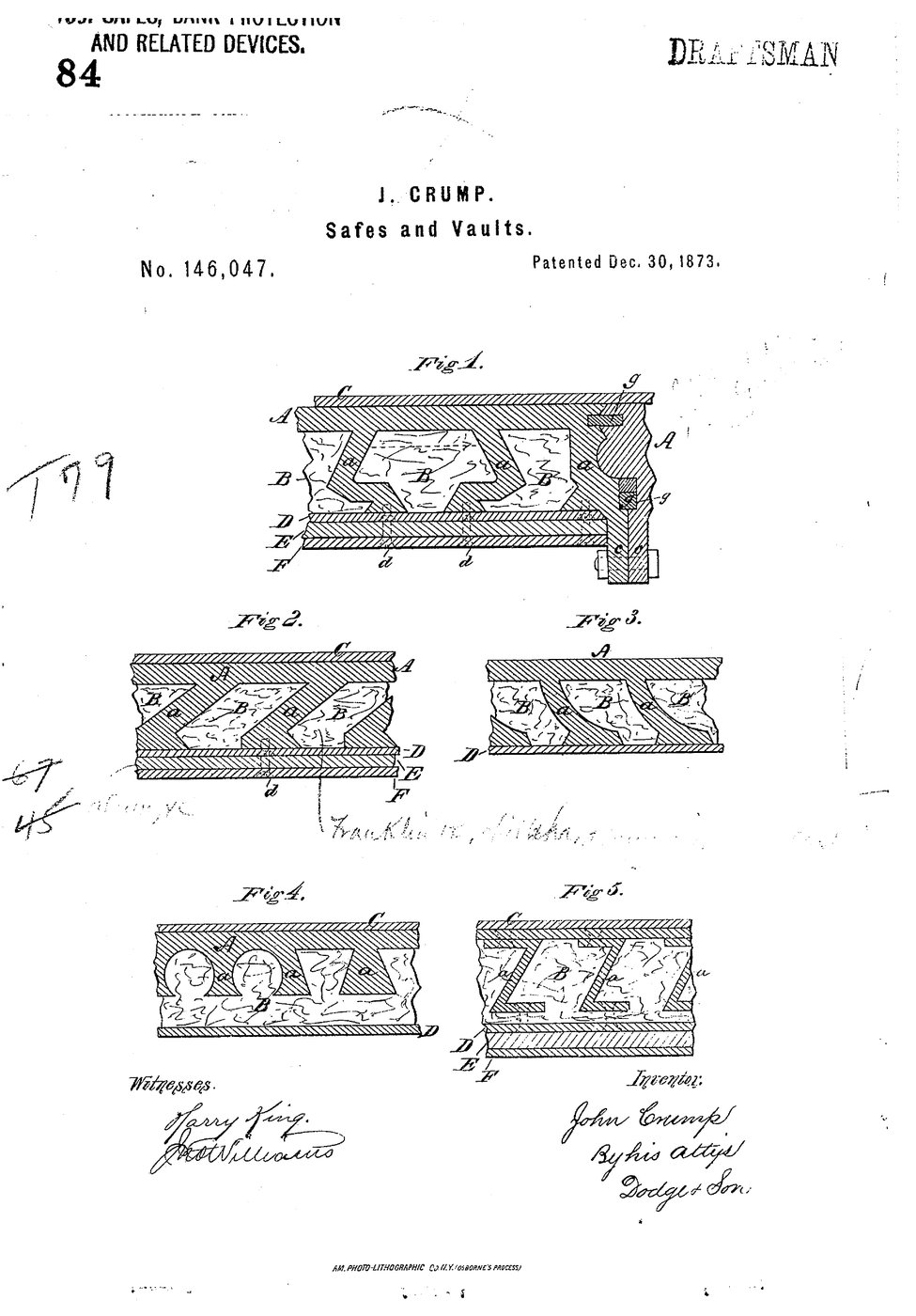
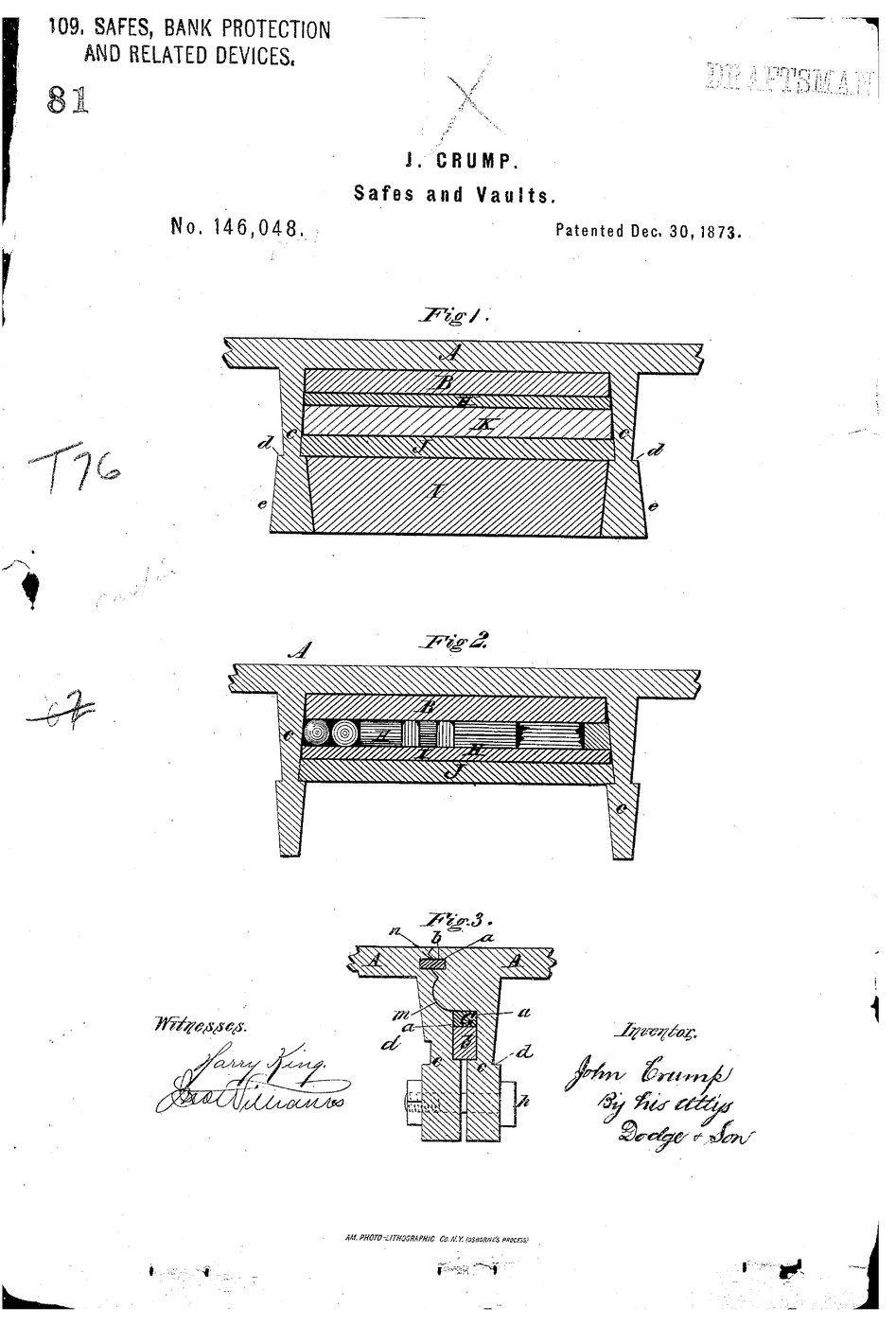
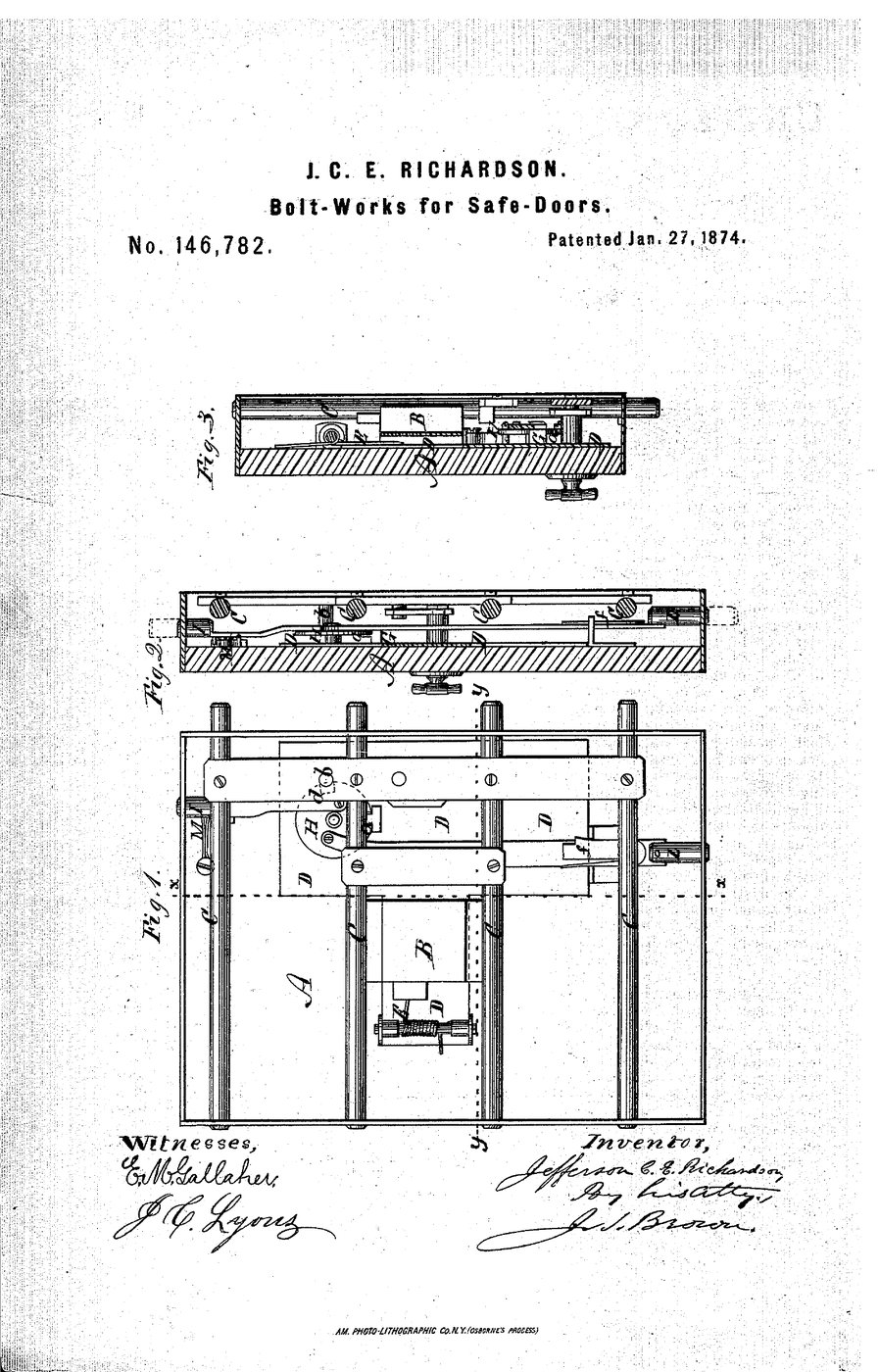
John Crump of Philadelphia patented ribbed safe walls with the ribs filled flush with franklinite, chilled iron or another drill-proof material (U.S. 146,047 and 146,048, December 1873). Jefferson C. E. Richardson of Charleston, South Carolina, covered the lock with a plate of hardened steel, case-hardened iron or franklinite (U.S. 146,782, January 1874).
In none of these is franklinite the whole wall. In each it is one hard layer, held and backed by softer, tougher metal, as Selleck and Butler had advised in 1861.
1873–1874: Baker’s patents: spiegel from Sussex County
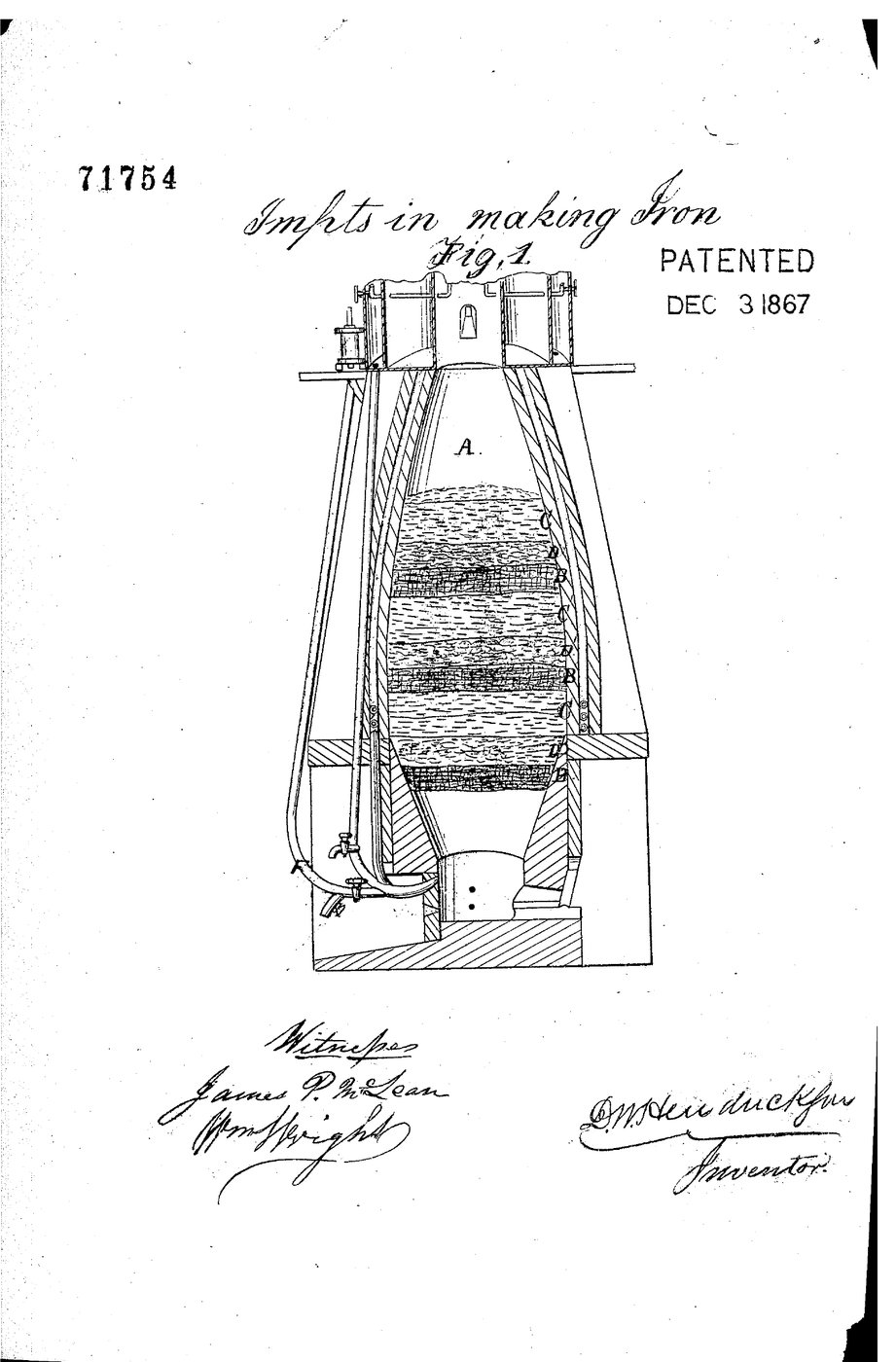
On the iron side, the zinc company was trying to stretch its supply. Inventors had long tried franklinite in the blast furnace with other ores; David W. Hendrickson of New York, for one, patented charging the franklinite ores of New Jersey with iron ore in 1867 (U.S. 71,754).
Edward Baker of Millstone, New Jersey, patented the mixing of residuum with magnetic iron ore in 1873 (U.S. 139,649). The next year he patented a second process (U.S. 153,698), assigned to the New Jersey Zinc Company, using spiegel-furnace slag as a flux with ordinary iron ore to make iron “possessing the essential qualities of spiegeleisen.”
His specification states plainly where American spiegel came from: “That quality of iron known as spiegeleisen has heretofore been produced in the United States from the residuum of the zinc ore of Sussex county, New Jersey, containing franklinite, after the ore has been treated for the production of white oxide of zinc.”
The iron of his trial analyzed 84.23 percent iron, 10.02 percent manganese and 2.55 percent carbon.
1875–1884: vaults of franklinite
From safes the material moved into whole rooms. In August 1875 the Monmouth Inquirer of Freehold, New Jersey, reported a new vault for the Mutual Benefit Life Insurance Company of Newark.
“It is built of wrought-iron, steel and iron welded and Franklinite and weighs nearly one hundred tons. It is in combinations of materials, possessing different qualities, that protection against the modern tools and appliances used by burglars is to be sought for.”
By 1878 the story had settled into the books, not quite accurately. Albert S. Bolles’s Industrial History of the United States wrote that Lillie’s chilled iron “has been penetrated with the drill, and blown up with powder,” while Herring filled the space between boiler plate and steel “with Franklinite, the hardest of all known ores,” and drove the burglars to work only on locks and doors.
The mineral franklinite is not the hardest of ores; the hard thing was the manganese-rich iron smelted from what was left of it.
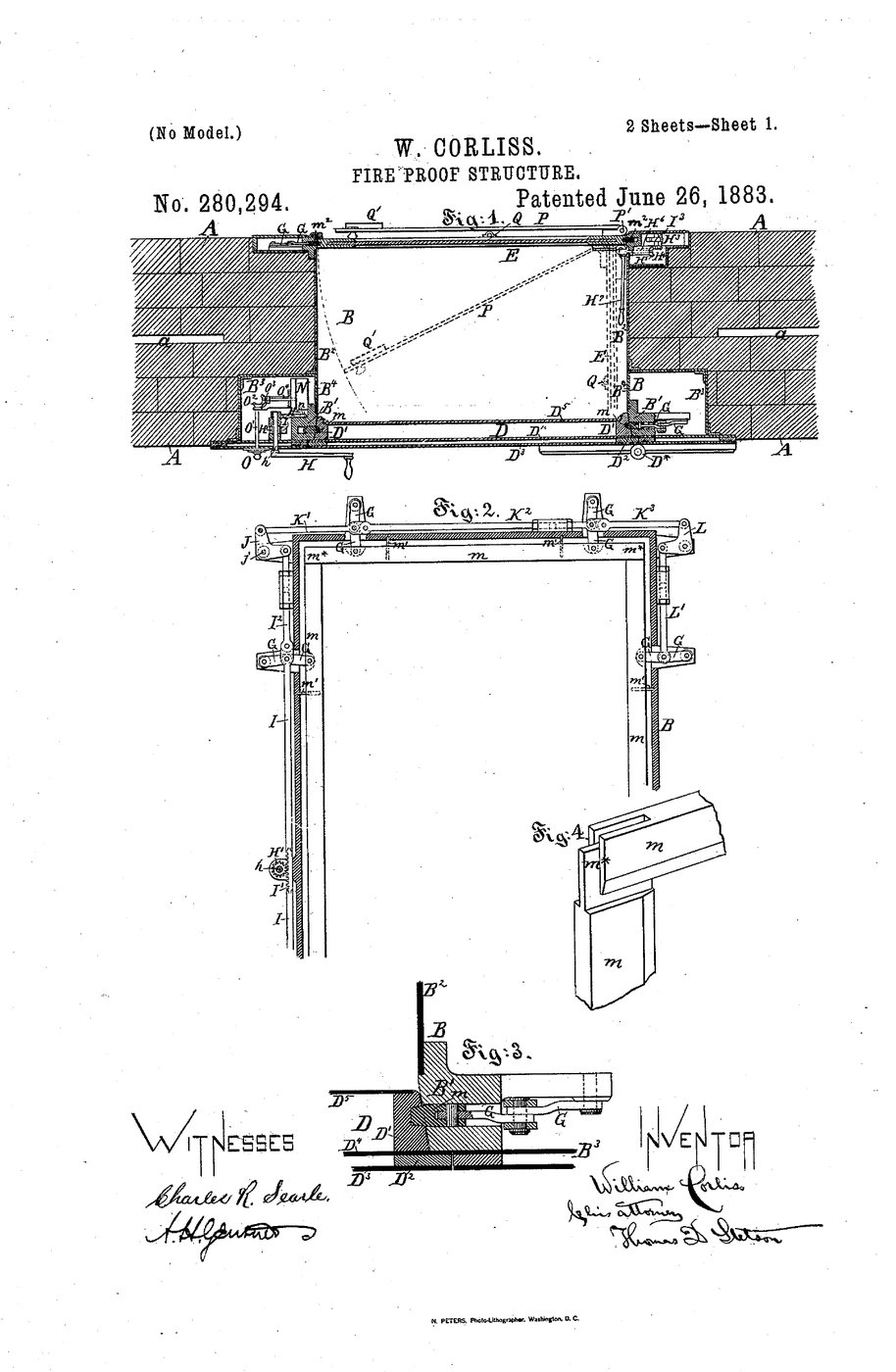
In 1883 Corliss patented vault plates that might contain franklinite, chilled iron or hardened steel (U.S. 280,294).
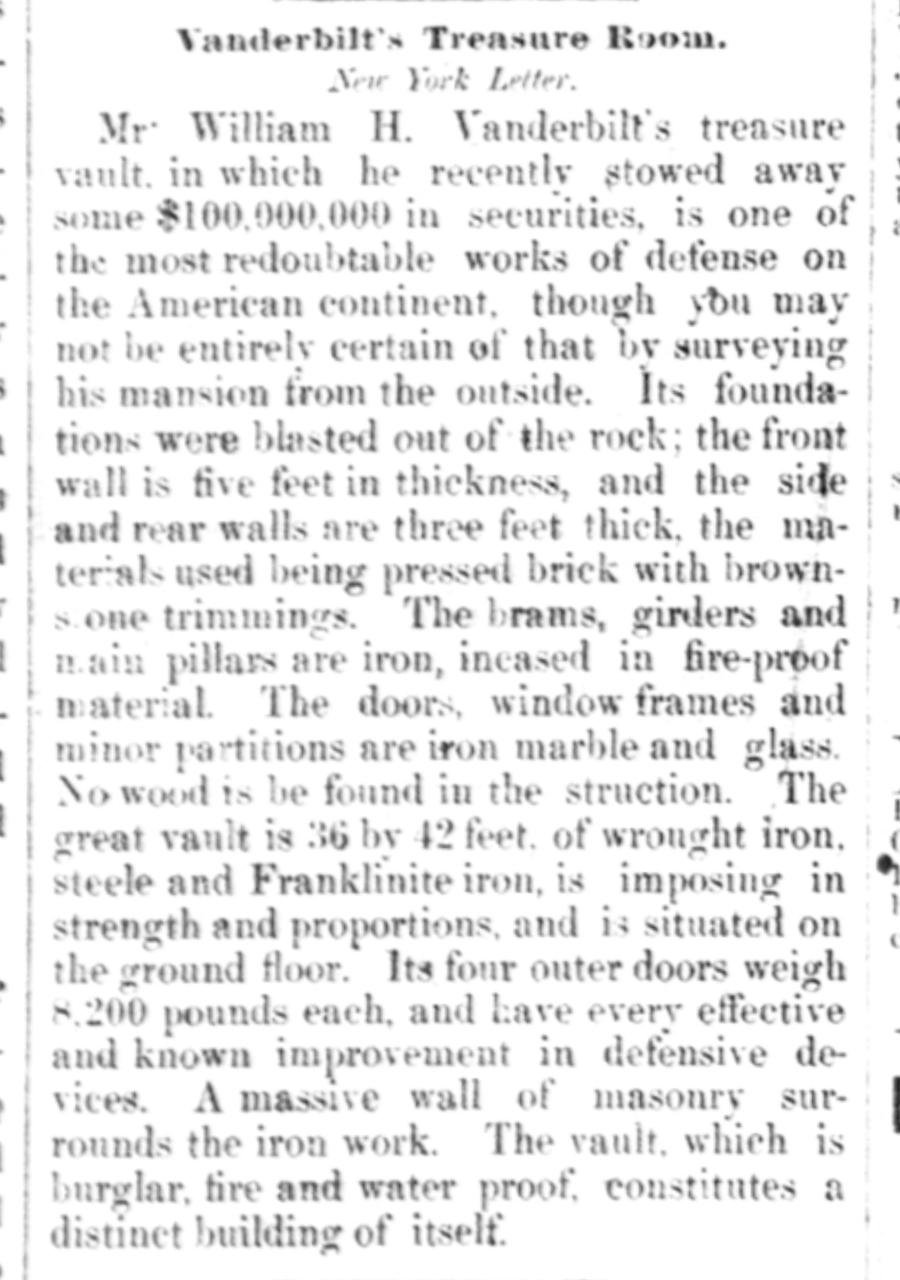
And in May 1884 a “New York Letter,” printed in papers across the country, described the vault where William H. Vanderbilt kept his securities. In the Wheeling Register: “Mr William H. Vanderbilt’s treasure vault, in which he recently stowed away some $100,000,000 in securities, is one of the most redoubtable works of defense on the American continent.”
“The great vault is 36 by 42 feet, of wrought iron, steele and Franklinite iron, is imposing in strength and proportions, and is situated on the ground floor. Its four outer doors weigh 8,200 pounds each.”
The iron that came out of a zinc furnace’s leftovers now guarded the securities of the richest man in America.
1880–1890: “unnecessary and obsolete”
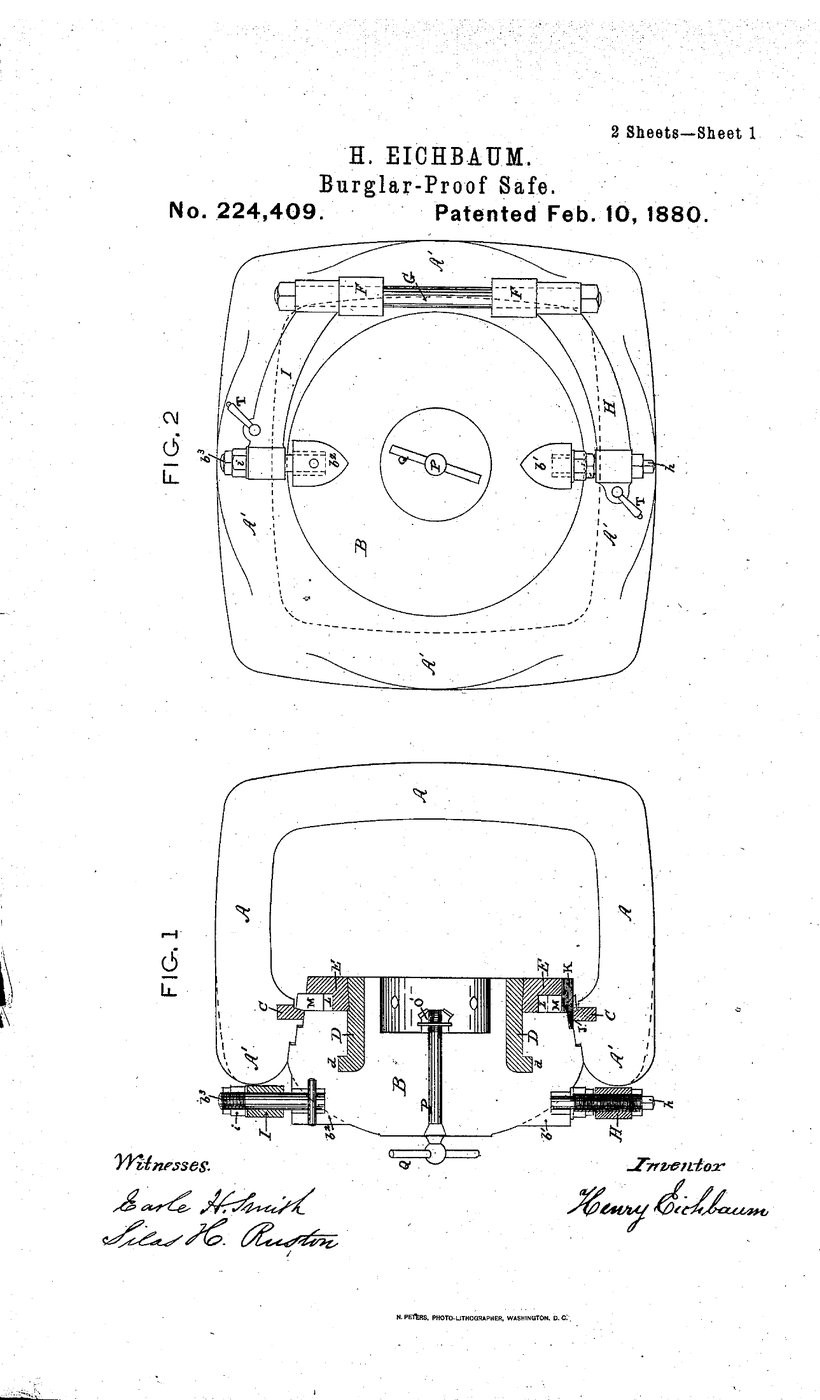
Herring’s people kept faith longest. In 1880 Henry Eichbaum patented a safe cast whole, with domed sides to throw off the sledge (U.S. 224,409); two-thirds of the patent went to Frank O. Herring, John Farrel and Elijah T. Sherman.
“The cast metal I use consists, preferably, of Franklinite or spiegeleisen,” Eichbaum wrote, “though any hard metal or alloy might be employed—such, for example, as white cast-iron, chilled iron, or cast-steel. I prefer spiegeleisen or Franklinite, as it is cheap, and has proved itself by actual tests to be proof against the drill in the hands of burglars.”
Farrel himself was having doubts. In 1884 he patented an alloy of tin-plate scrap, iron and franklinite iron (U.S. 298,365), and explained why: “The metal made from franklinite ore is one of the hardest metals known, and, being well adapted for resisting the action of drills and other cutting-tools, is extensively used by myself and others in the construction of burglar-proof safes.”
“It is, however, more or less porous and friable from the peculiarity of its crystalline structure, and this friability is a weakness, inducing the metal to pulverize under the drill when applied with great pressure.”
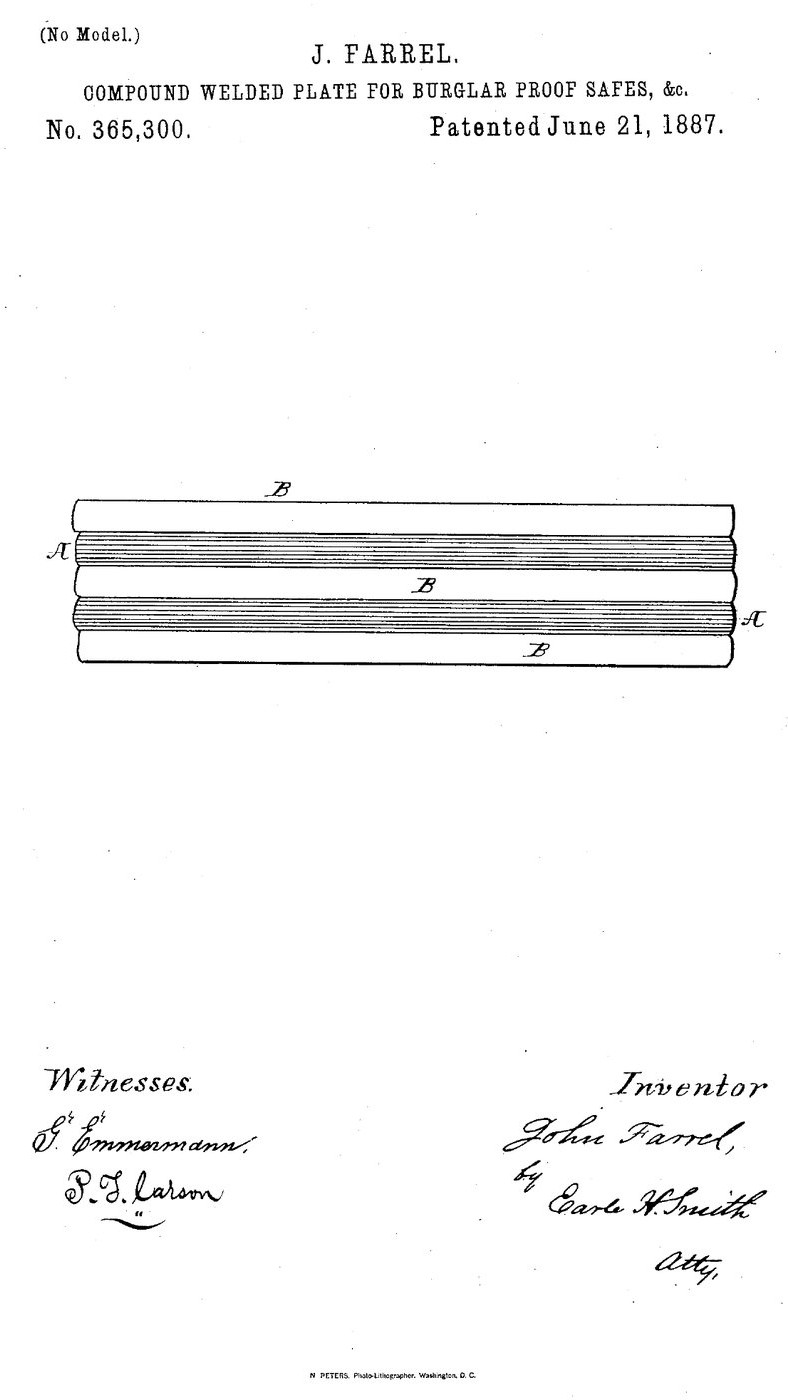
Three years later he gave it up. His compound welded plate of 1887 (U.S. 365,300) used self-hardening (“Mushet’s”) steel, a tool steel that hardens as it cools in air.
“The new plate is of special value for burglar-proof safe-walls,” he wrote, “since the protecting body of franklinite metal is thereby rendered unnecessary and obsolete, and walls of safes now made four and five inches in thickness, built up of disintegral parts or pieces riveted and bolted together, are by this new compound plate superseded in a solid wall consisting of a single plate less than half said thickness.”
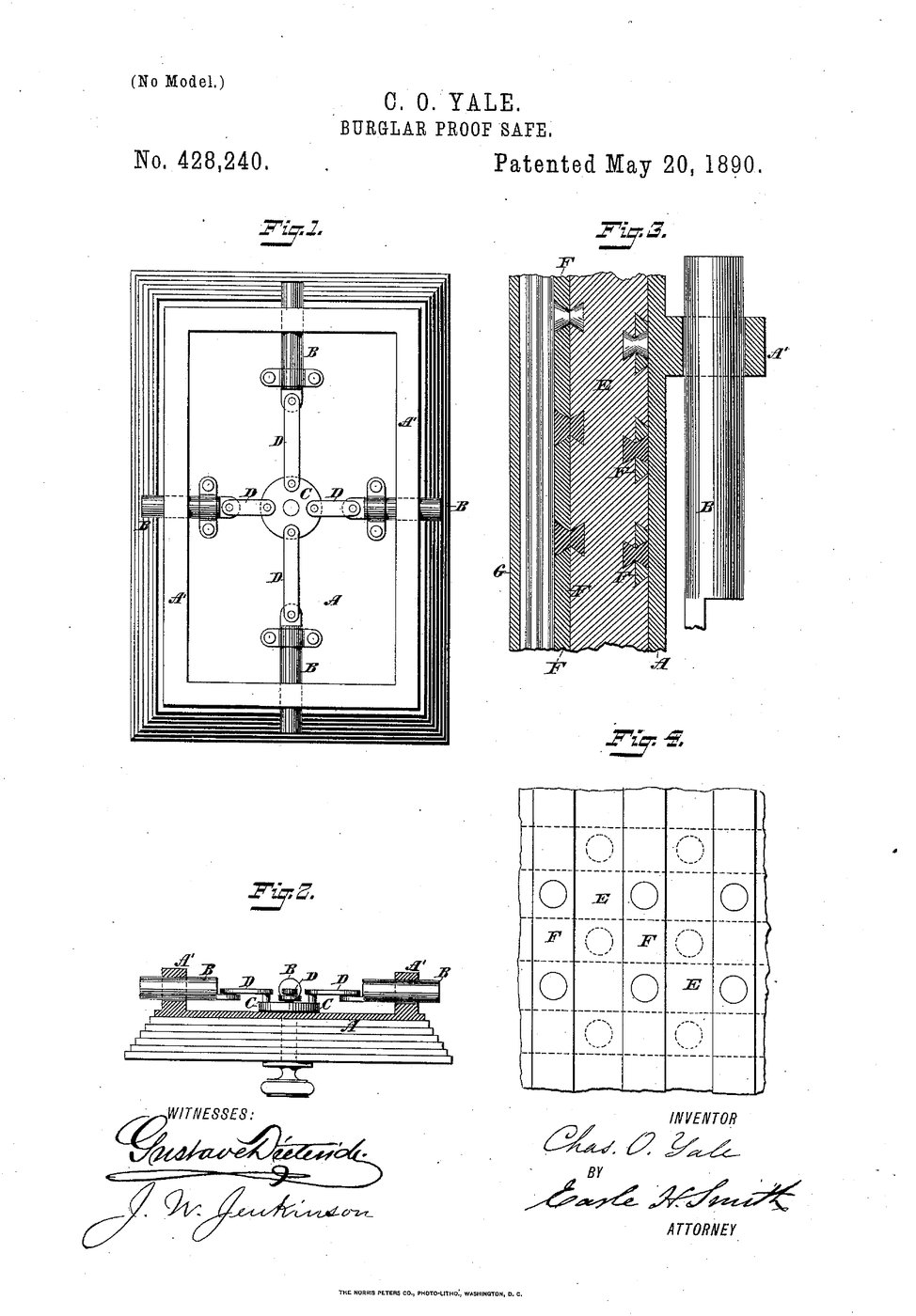
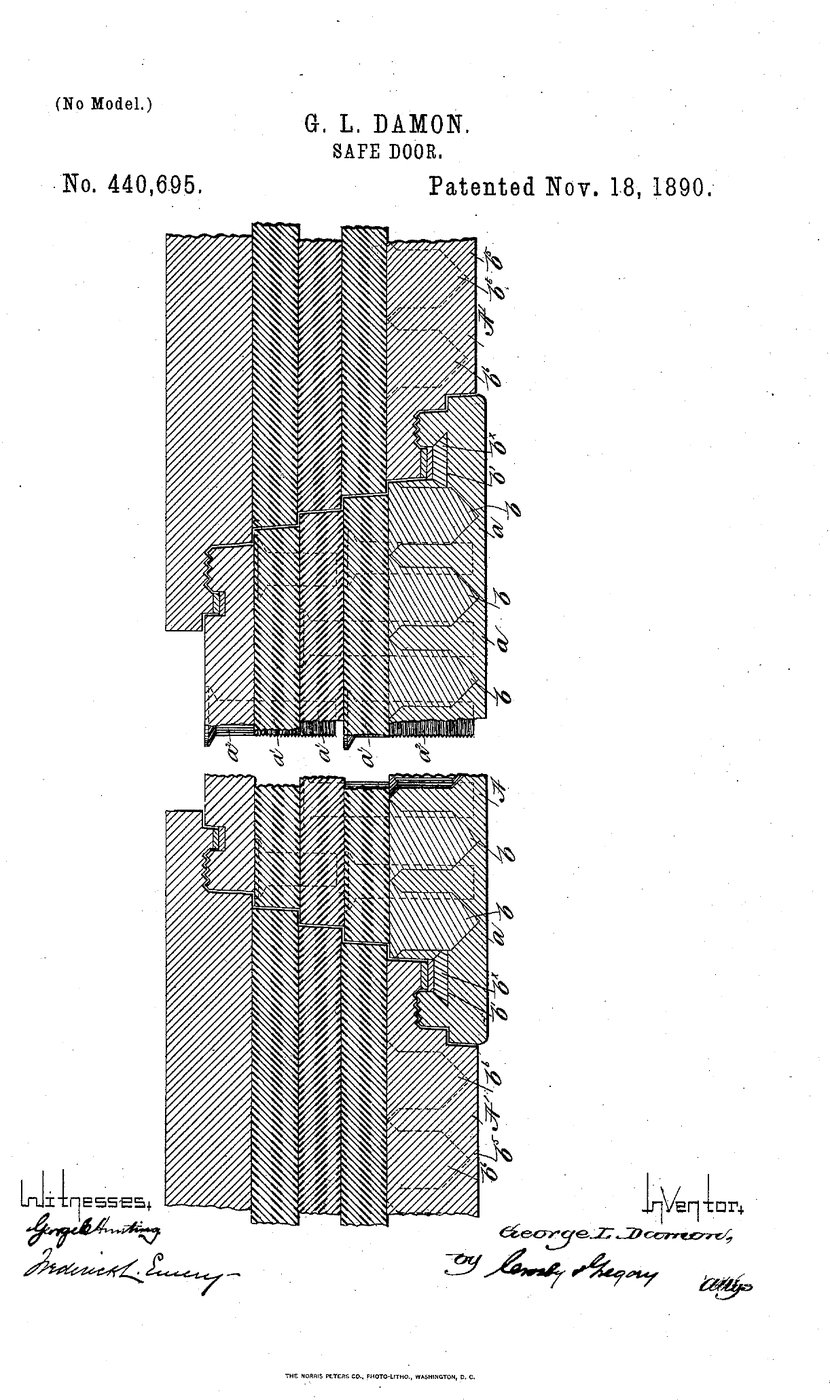
The word lingered. In 1890 Charles O. Yale patented slabs of franklinite with wrought-iron bars cast in (U.S. 428,240), and George L. Damon of Boston listed franklinite as one choice, after Mushet steel, for plugs in a safe door (U.S. 440,695). But the man who had witnessed Floyd’s patent twenty-seven years before had written its epitaph.
1855–1883: the open-topped furnaces
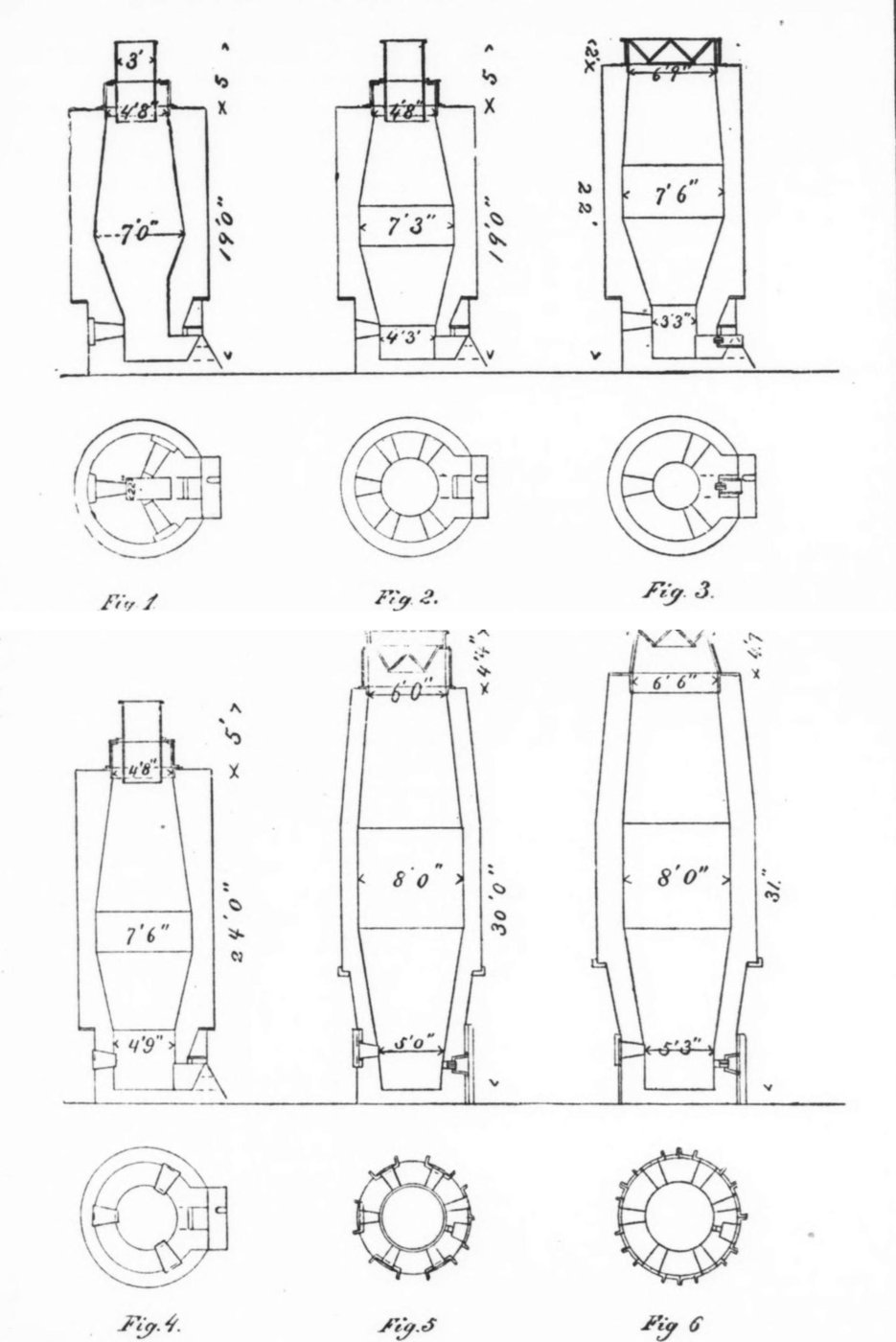
All this time, at Newark, the residuum was being smelted under conditions its engineer described without sentiment. Stone’s four articles of 1886, “The manufacture of spiegel from franklinite residuum,” are the fullest account we have of what the work was like.
The early furnaces, he wrote, “were run much more slowly, and were continually in trouble, either breaking out or chilling up. It was no uncommon thing to go two or three days without getting any iron. The blasts seldom lasted more than a few months. One celebrated blast lasted two years. To balance this, on one occasion, the furnace was relined three times in less than five months.”
“This was the last of the open-topped furnaces,” he wrote of one of them. “They were all small and badly proportioned; they required a maximum of labor and fuel to produce a very small amount of low-grade spiegel.”
“At first, the fore-hearth was cleaned every morning; and in addition to the time lost in this way, the furnace was stopped at least twice a week, for one or two hours each time, to clean the oxide from the throat, gas-flues, and condensers.” The condensers were dust-catchers: chambers that took the dust, most of it zinc oxide, out of the furnace gas.
Even the flux surprised him. Blowing out one furnace, he used Sing Sing marble, a dolomite, to keep the throat cool. “Much to my surprise, when we came to shovel out, I found that the dolomite, even that which had come down to the tuyeres, was not burnt, but was still a carbonate.”
1883–1886: “an unmitigated nuisance”
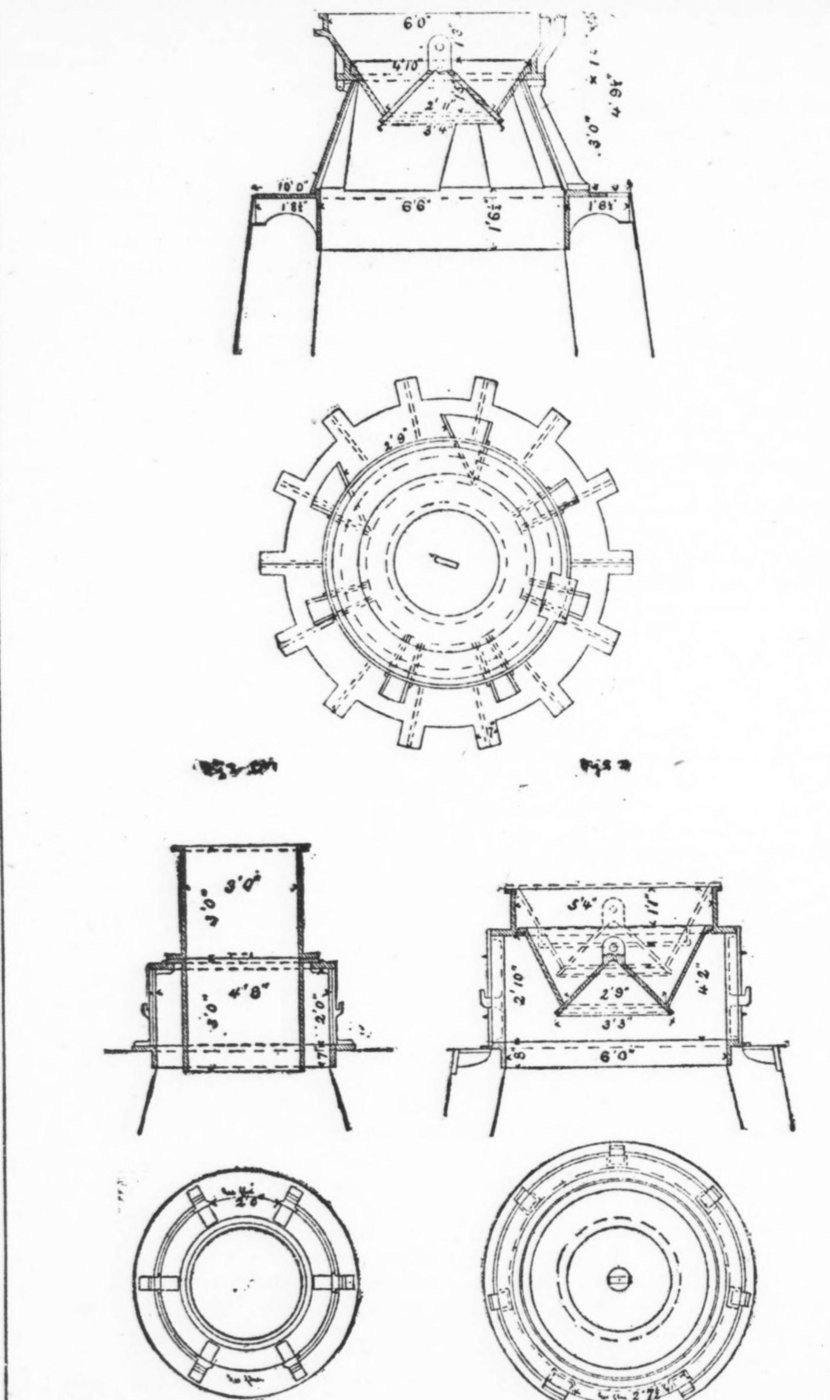
The enemy was the zinc. The oxide furnaces never took all of it out of the residuum, and in the blast furnace it came back as vapor. Stone was blunt: “The zinc oxide varies from three to eleven per cent, usually about six per cent, and is an unmitigated nuisance.”
“It is all driven off when the furnaces work regularly. Part of it condenses on the throat in a hard, dense ring, which has to be frequently chiseled off at an expenditure of much time and hard labor; part of the remainder collects in the gas-flues, condensers, ovens, and boiler settings as a loose powder; and a large part is carried off by the escaping gases and lost.”
When a furnace faltered, the zinc went down instead of up. “If the furnace is not working well, especially if it has to be stopped for any length of time, the zinc is carried down near the tuyeres and condenses in the charge, making a pasty, infusible mass, which sometimes necessitates the shoveling out of the furnace. On one such occasion, I found coke at the level of the tuyeres that was completely saturated with zinc.”
It ate the furnace itself. “This is not the only bad effect of the zinc; it penetrates the brick to the depth of six or eight inches, making it very tender.” Brick from the “B” furnace, after a fifteen months’ blast, was colored blue for about eight inches from the inner face.
In the newer closed-top furnaces it was worse. “With the open-top furnaces, the zinc seldom got hard on the walls,” Stone wrote; “but in the larger closed-top furnaces, it is harder than most stone and nearly as heavy as iron.”
The zinc set a limit on the size of the furnace. “With the furnaces 19 feet high,” Stone explained, “a ring of oxide about one foot deep would form on the throat; with the furnaces 30 feet high, the ring is 3 or 4 feet deep; with larger furnaces, it would undoubtedly be deeper and be too far down to allow of its removal, and would either close the throat so effectually that the blast could not get through, or would drop of its own weight and sink with the charge to cause trouble lower down.”
Before any stop the men sent down a “blank charge” of 1,350 pounds of coal and 1,000 pounds of cinder, and another on starting, “to take care of any zinc that may have dropped into the furnace.” And the equipment was old: “The hoists are old-fashioned water-balances without safety arrangements.”
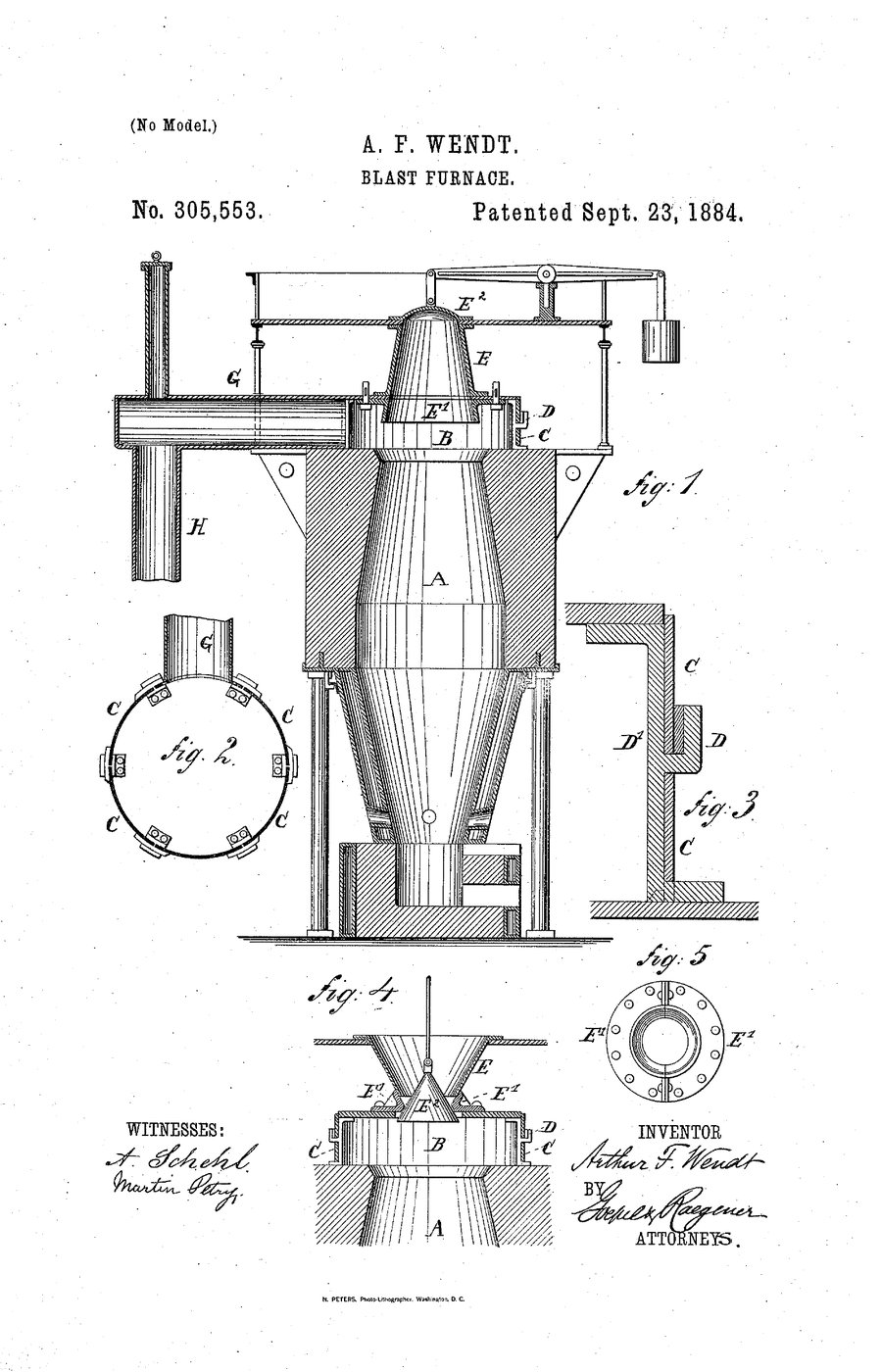
Others worked on the problem. In 1884 Arthur F. Wendt patented a closed-top blast furnace for zinc-bearing ores (U.S. 305,553), and claimed a gain in the spiegel itself: “Thus, while formerly the average of spiegeleisen made out of residuum from franklinite was fifteen to eighteen per cent., it is by the use of a closed-top furnace increased to from eighteen to twenty-one per cent.”
1886: “every thing but explosives”
The company’s new “B” furnace, blown in on October 8, 1883, stood 30 feet high and in its first blast of 453 days averaged 8 tons 927 pounds of iron a day, at 20.74 percent manganese. Nearly 90 percent of it was “20 per cent spiegel,” almost twice the manganese of the specimen Percy had analyzed twenty years before.
Then it stuck. “We stopped one morning to clean out, started at about the usual time, but the charge did not settle, and never moved again. After working over it and trying every thing but explosives (which the officers of the company would not allow), we shoveled out, and found that the charge was covered and saturated with zinc.”
“The walls were clean, with no sign of a scaffold, but the stock was so cemented together with zinc that the blast could not get through.” At the thinnest place, the mantel, “there was less than one inch of fire-brick left.”
The second blast was short, “only lasting 82 days. It was brought to an end by the breaking of a hoist-rope, which necessitated a stop of thirty-four hours, during which time the zinc in the charge chilled, and necessitated shoveling out.”
The gas was dangerous too. The furnace gas, led off through flues to the condensers, kept exploding. “The brick chambers were continually being blown to pieces by the numerous gas explosions, and were finally replaced by cast-iron boxes.”
When the new “A” furnace was blown in, the gas exploded in a space at the bottom of the tower condenser “with great violence, blowing off a piece of one of the sides about ten feet high and six feet wide, shearing the bolts and rivets (about 120 ⅜-inch diameter) without hurting the sheet.”
“We repaired damages,” Stone wrote, “and have since managed to escape any bad explosions by carefully coaxing the gas past this point whenever we start.” The “A” furnace, the best the company had had, was making more than 10 tons 1,500 pounds a day by early 1886.
The Passaic Zinc Company’s spiegel furnace, at Kearny, between Jersey City and Newark, fared worse. “The first two blasts were unsuccessful,” Stone reported; “both were prematurely ended by bad gas explosions, which wrecked the condensers.”
Passaic later gave up wet scrubbers for its gas, partly because it thought them the cause of its violent explosions, and partly because their waste water carried off oxide holding 57.21 percent zinc.
1886: “the worst that is used anywhere”
“The material we have to work with is about the worst that is used anywhere,” Stone wrote.
The average yield of iron from the clinker was only about a third. Some sixteen percent of the charge was coal ash, so that more than one percent of the spiegel came from the ash of the fuel. The works handled about ten tons of material, and made about two and a half tons of cinder, for every ton of iron. It did not pay to save more than about half the manganese.
The Lehigh Zinc and Iron Company made spiegel in the same way at South Bethlehem, Pennsylvania, from Franklin ore. There, J. A. Jardine found in 1886, only 43 percent of the manganese charged reached the spiegel, and nearly 53 percent went into the slag.
And yet the furnaces kept running, because the steel mills wanted the iron. This was the spiegel of the Bessemer converters, made by men chiseling zinc out of furnace throats.
1855–1886: how hot, how long
Stone’s articles are full of numbers, and together they show what one of these furnaces was: how hot it ran, how long it lasted and what it made.
The blast. The air blown in at the tuyeres was heated first. “The blast was at first heated in a spiral pipe oven,” Stone wrote. A Ford oven followed; it “was badly constructed, and was unsatisfactory,” and was torn down for four Wasseralfingen ovens, “giving a heat of from 600 to 700 degrees Fahr.,” easy to clean but needing “an enormous amount of repairs.” By 1886 two Cooper ovens of twenty-one pipes each gave “a steady heat of 950 degrees.”
The earliest furnaces had run cooler. Stone quoted Bauerman’s Metallurgy: “The hot blast was about 400 degrees Fahr., and a pressure of four pounds was used.” Old furnace “A” took its blast at 600 to 750 degrees; the rebuilt “C” of 1882 at about 800.
These are the temperatures of the air going in, not of the fire. Stone gives none for the inside of the furnace. In an iron blast furnace generally, the hearth, where iron and slag run liquid, is reckoned at about 1,400 to 1,500 °C (roughly 2,550 to 2,750 °F).
The brick. The firebrick lining stood that heat; it was the zinc that ate it. The zinc, Stone wrote, “penetrates the brick to the depth of six or eight inches, making it very tender.” He does not name the brickmaker. Where he mentions bricks at all, it is the head mason making a hearth smaller than planned “because it was easier to build it so with the bricks then on hand.”
When the new “B” was blown out after its first blast of 453 days, the walls had cut away “very evenly”: “The thinnest place was at the mantel, where there was less than one inch of fire-brick left.” Its walls above the tuyeres had been only 14 inches thick. The new “A” was given 21 inches, and Stone credited the thicker walls, “by preventing loss of heat by radiation,” with much of its better working.
The run. A furnace in blast ran day and night until it was blown out. Old “A” made its last blast of 259 days, losing eight days and nine and a half hours to cleaning and repairs. The rebuilt “C” of 1882 lasted forty-eight days. The relined “C” ran 266 days, and the new “B” 453, then only 82 when a broken hoist rope stopped it for thirty-four hours and the charge chilled. The last open-topped blasts averaged nine months.
Before every stop, Stone explained, “We give a blank charge of 1350 pounds of coal and 1000 pounds of cinder long enough before a stop to have it down near the tuyeres when we stop, and a second one on starting, to take care of any zinc that may have dropped into the furnace.” A blank charge was fuel and cinder with no clinker in it, to keep the hearth hot and clean.
The make. The first furnaces made “from three to six tons, usually about four tons a day,” and Bauerman put the weekly make at “about twenty-five tons,” burning “three and a quarter tons” of fuel for every ton of iron. Old “A” averaged 7 tons 922 pounds a day. The new “B” made 8 tons 927 pounds, and by early 1886 the new “A” was making “over 10 tons 1500 pounds a day, requiring less than 2·2 tons of coal to the ton of iron.” A footnote warns that Stone’s ton was not the usual one: “One ton equals 2265 pounds.”
1897–1935: Palmerton
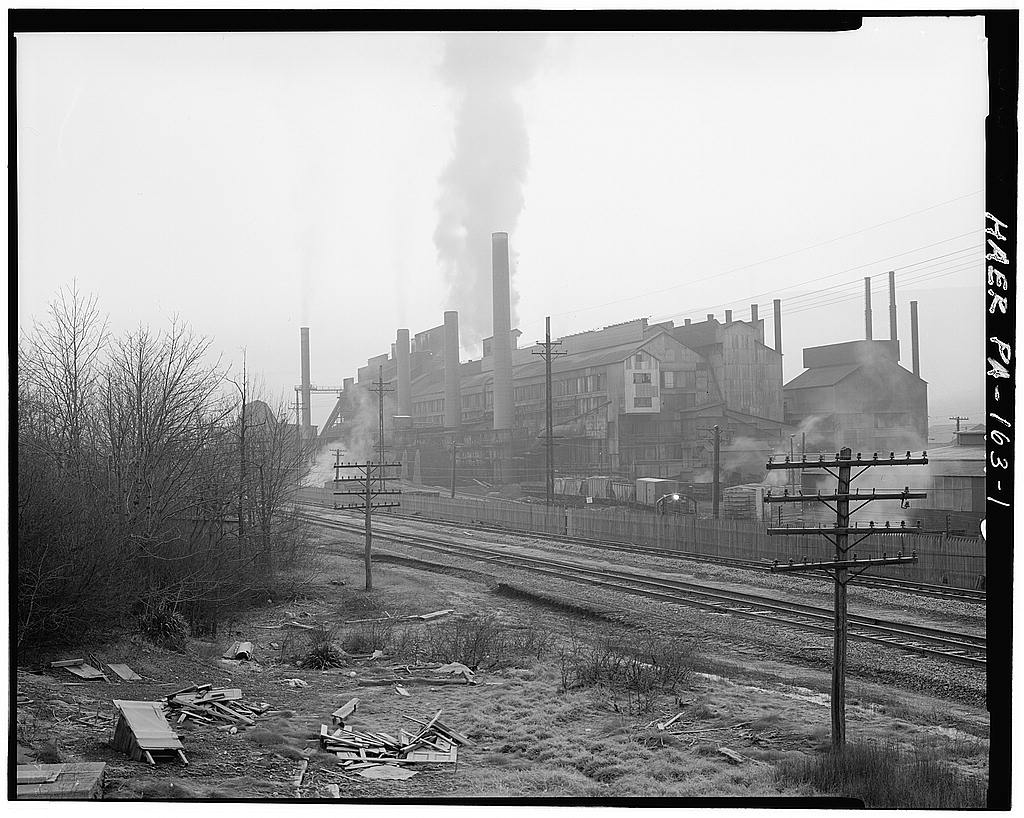
In 1897 the New Jersey Zinc Company absorbed the Passaic and Lehigh companies (see The New Jersey Zinc Company), after which, as its history records, it had three plants making spiegel iron. It then built a new smelting works at Palmerton, Pennsylvania.
A blast furnace for spiegel iron was built there in 1904 and a second in 1906. By about 1924, in the company’s words, “the two Palmerton furnaces make as much spiegel iron each day as the first furnace in Newark made in a month.” The history gives no figure. If the first furnace made Stone’s “about four tons a day,” a month was some 120 tons, so the Palmerton pair were making on the order of a hundred tons or more a day.
The company history also kept the memory of the first iron. Steel made from it was “of an excellent quality but at a rather high cost,” and “a few razors” made from it were still in use “after sixty years.”
Hewett’s figures for the Geological Survey show the scale. Shipments of manganiferous zinc residuum, all of it from the Franklin district, were 104,670 long tons in 1912 and 159,318 long tons in 1915, carrying about 13,700 and 23,000 tons of manganese. More than half of all the spiegeleisen made in the United States, he wrote, came from this residuum.
1862–1918: ferromanganese ends spiegel’s reign
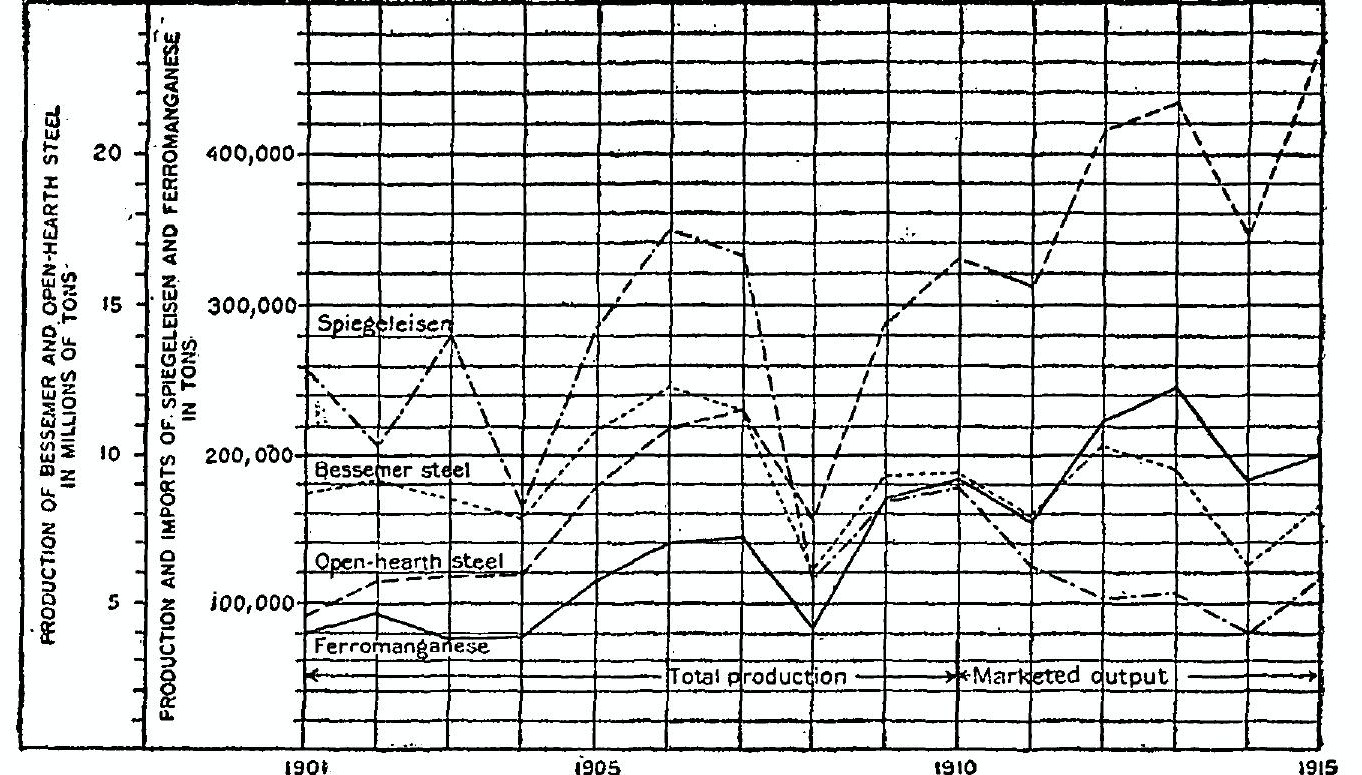
Spiegel had a successor almost from the start. Ferromanganese is an iron alloy with far more manganese than any spiegel, by the twentieth century about 80 percent. A little of it did the work of a great deal of spiegel, without bringing in so much iron and carbon.
The Geological Survey set out the difference in 1918. Spiegeleisen, “German, mirror iron,” commonly held 20 percent manganese, 75 percent iron and 5 percent carbon: “The ratio of manganese to carbon is therefore 4 to 1.” Ferromanganese held 78 to 82 percent manganese, 13 percent iron and 7 percent carbon, “about 12 to 1.” Nature drew no line between them, “but 40 per cent is commonly accepted by the steel trade.” Spiegel went into all Bessemer and open-hearth steel “until about 1875, when ferromanganese became a commercial product.”
What they looked like. Spiegel was named for its look. The 1890 Census described “a pig iron with large grains of a whitish color, with brilliant faces sometimes fully an inch square,” which the Germans called “looking-glass iron.” Broken pieces of it, made by accident half a century before, could still be found on the dumps of old charcoal furnaces in the Shenandoah valley, “no use for it being known at that time.”
Ferromanganese looked like nothing so much as steel. Its maker in Bonn, O. E. Prieger, wrote in 1865 that it was “harder than quartz and the hardest steel,” brittle but taking “an excellent polish,” its color “between steel-gray and silver-white,” and that in air it did not tarnish “even after years” (our translation).
Bessemer wrote that he induced a Glasgow firm to make it in 1862. He called the natural alloy that came before it “a makeshift alloy,” and explained: “All the difficulties in making boiler and ships’ plates of the degree of mildness necessary to ensure their safety under the severe strains to which they are subjected, arose from the excess of carbon and the deficiency of manganese in the natural alloy spiegeleisen.”
A dinner in Glasgow. Bessemer told how it began. His friend Rowan offered to introduce him to “a Mr. Henderson, who is a good chemist,” working at Tennant’s chemical works: “I will, if you wish it, ask him to come and dine with us to-morrow.” Over dinner Bessemer asked for “a manganesian alloy of iron, of not less than 50 per cent. of manganese.” William Henderson patented a gas furnace for it, but reached only “from 20 to 25 per cent. of manganese,” and supplied Bessemer’s Sheffield works “until his works were, unfortunately, closed, owing to the insolvency of the iron-founder on whose premises his furnace was erected.”
A report to Lloyd’s Register in 1878 gave Henderson the credit: his alloy “was the first production of what has since been termed ferro-manganese,” made in a furnace supplied by William Siemens “before the middle of 1863.” Kohn, in 1870, described the furnace: an open Siemens hearth whose bottom was a great crucible of coke dust, at the Phoenix Foundry in Glasgow, tended by a single worker, its slag “of a characteristically light-green colour.” Prieger made his richer alloy in graphite crucibles with charcoal and “powdered bottle glass,” a method several steelmakers tried and gave up “because of its expense” (our translation).
Kohn also recorded how it was priced: “By the rule originally laid down by Bessemer himself, ferromanganese was reckoned at £1 per ton for each percent of manganese metal it contained, so that an alloy with 25 percent manganese represented a value of £25 per ton” (our translation).
The blast-furnace method came from France. In 1878 Dingler reported that Pourcel, blast-furnace manager at the Terre-Noire works, had recently given the mining society at Saint-Étienne an account of making it, “presenting a sample of 81 percent ferromanganese” (our translation).
The French works, the Lloyd’s report added, used Henderson’s process “under a royalty.” Making it in the blast furnace turned ferromanganese into a bulk product. By 1890, the Census reported, a modern furnace made “from 34 to 36 tons of ferro-manganese of 78 to 84 per cent per 24 hours.”
America, by accident. The first American ferromanganese was made by a furnace trying to make spiegel. The Diamond Furnace on the Etowah River in Bartow County, Georgia, was put in blast “with a view of making spiegeleisen.” Its burden was lightened, the manganese climbed to 37 percent, and in January 1876 to 55 percent. A. L. Holley and Lenox Smith wrote in 1878: “The metal produced in the trials above described is believed to be the first ferro-manganese made in the United States.”
The war. In 1914 American steelmakers still bought most of their ferromanganese abroad. Independent makers, Hewett wrote of 1915, “have depended on the imported article, which has been derived largely from England.” Britain stopped its export in November 1914; the first shipment after the embargo reached the United States in March 1915. The price rose from $80 a ton to $115 over the year, and in 1916 “For the immediate delivery of a small lot $400 a ton was paid.”
American furnaces answered. In 1917 twenty-three plants made 260,225 tons, “the highest on record.” In April 1918 the American Iron and Steel Institute asked its members to stretch the manganese: that year most American ferromanganese “was reduced from 80 to 70 per cent of manganese and of spiegeleisen from 20 to 16 per cent of manganese.”
By 1917, according to the Survey’s D. F. Hewett, about fourteen pounds of manganese went into every ton of Bessemer and open-hearth steel. Spiegeleisen, with 12 to 33 percent manganese, was used mostly in Bessemer steel; open-hearth steel took mostly ferromanganese, with 77 to 80 percent.
New Jersey Zinc stayed with spiegel. The Survey’s list of makers for 1917 marks the company, at Palmerton, with an “s” for spiegeleisen, not an “f” for ferromanganese, and no source we have found says it ever made ferromanganese. Its residuum, the Survey wrote, held “from 14 to 15 per cent of manganese and 40 per cent of iron” and was smelted to spiegeleisen “containing 19 to 20 per cent of manganese,” the top of the spiegel range, and close to what Stone’s furnaces had made at Newark thirty years before.
Afterword: the mirror and the drill
As late as 1935 Palache could still write that the franklinite of Franklin went to make zinc oxide and spiegeleisen. We have not found when the last of it was smelted.
The story turns on a single element. The manganese that made the iron hard and white made it a burglar’s problem, and for more than twenty years the safe makers sold it as the hardest metal known. The same hardness came with a brittleness that a hammer, a wedge or a charge of powder could find, and in 1887 Herring’s own partner called it obsolete.
The same manganese made the iron useful to steelmakers, who needed it to take the oxygen out of Bessemer steel and put the carbon back. Bessemer used it at Sheffield, England, the first American Bessemer works used it at Troy, New York, and the zinc company went on making it for more than half a century, from a clinker its own engineer called about the worst material used anywhere.
Berthier had once said the white iron of Müsen looked so like zinc that you could hardly tell them apart. At Franklin the two came out of the same ore.
In The Picking Table
The Picking Table touches franklinite iron only in passing, but the passages are worth having. Jacob W. Miller’s address to the New Jersey Historical Society of January 1854, quoted in vol. 6, no. 1 (1965), has franklinite “producing the best of iron and the most durable of paints.” The Franklin Mineral Notes of vol. 13, no. 1 (1972) quote Irving S. Kull’s New Jersey: A History (1930) on Edwin Post’s franklinite iron from a Catalan forge at Stanhope, which the French naval works for chains and anchors found “more tenacious than any other iron they had tried.” Allen W. Pinger’s history (vol. 14, no. 2, August 1973) puts the district’s output at about 5,000,000 tons of spiegel and dates the first successful production of oxide and spiegel at Franklin to the New Jersey Franklinite Co. in 1854. The company’s own broadside, “An Important Part of Sussex County for 125 Years” (vol. 19, no. 1, March 1978), and John L. Baum’s “Early Products of the New Jersey Zinc Co.” (vol. 27, no. 2, Fall 1986) both mention the manganese iron made beside the zinc oxide. Daniel E. Russell’s “The Trotter Tunnel at Sterling Hill” (vol. 34, no. 1, Spring/Summer 1993) explains spiegeleisen as “mirror iron” and follows the Franklinite Steel Co., formed in 1854, through the Sterling Hill titles. William R. Truran’s “Franklin’s Mill No. 2 – The ‘Palmer Mill’” (vol. 56, no. 1, Spring 2015) follows the franklinite concentrate to Palmerton “for refinement into either zinc oxide or spiegeleisen,” and “An Image From the Past” (vol. 57, no. 1, Spring 2016) shows the ruined stack of Franklin Furnace, last rebuilt in 1854. No article in The Picking Table has dealt with the franklinite safes or with spiegeleisen in the steel trade.
Sources and further reading
- Anonymous, 1852, New Jersey franklinite iron. New Orleans Daily Crescent, August 30, 1852, p. 2. Library of Congress
- Anonymous, 1854, money column on franklinite steel. New York Herald, March 25, 1854, p. 3. Library of Congress
- Anonymous, 1855, Franklinite iron. West-Jersey Pioneer (Bridgeton, N.J.), February 24, 1855, p. 2. Library of Congress
- Anonymous, 1856, correction on Franklinite Steel. New York Herald, April 1, 1856, p. 2. Library of Congress
- Anonymous, 1859 (from the Mining Journal, April 16, 1859). Franklinit als Zuschlag beim Eisenschmelzen. Polytechnisches Journal 152, p. 317. Dingler online
- Anonymous, 1862, money column on franklinite iron. New York Herald, March 23, 1862, p. 2. Library of Congress
- Anonymous, 1862, money column on the Franklinite Steel Company. New York Herald, August 5, 1862, p. 2. Library of Congress
- Anonymous, 1862, money column on the Franklinite Steel Company. New York Herald, May 17, 1862, p. 5. Library of Congress
- Anonymous, 1863, rejoinder on the Manhattan Bank drilling. Chicago Tribune, February 2, 1863, p. 2. Library of Congress
- Anonymous, 1864, the new Stock Exchange building, New York. Daily Gate City (Keokuk, Iowa), June 1, 1864, p. 1. Library of Congress
- Anonymous, 1864 (from the Mining and Smelting Magazine). Bessemer’s neueste Verbesserungen seines Stahlbereitungsprocesses. Polytechnisches Journal 174, p. 402. Dingler online
- Anonymous, 1869, The Bank of Norwalk robbery. Evening Telegraph (Philadelphia), October 2, 1869, p. 8. Library of Congress
- Anonymous, 1870, Ingenious mechanism. The burglar proof safe. New York Dispatch, December 25, 1870, p. 5. Library of Congress
- Anonymous, 1870, on bank robberies and burglar-proof safes. New York Dispatch, September 18, 1870, p. 1. Library of Congress
- Anonymous, 1875, A splendid vault. Monmouth Inquirer (Freehold, N.J.), August 12, 1875, p. 3. Library of Congress
- Anonymous (Lloyd’s Register committee), 1878, Steel for shipbuilding: extended report. Engineering 25, January 4, 1878, p. 17. archive.org
- Anonymous, 1884, Vanderbilt’s treasure room. New York letter. Wheeling Register, May 27, 1884, p. 2. Library of Congress
- Baker, E., 1873, U.S. Patent 139,649, June 10, 1873. Google Patents
- Baker, E., assignor to the New Jersey Zinc Company, 1874. U.S. Patent 153,698, August 4, 1874. Google Patents
- Berthier, P., 1827 (from Annales de chimie, October 1826). Analyse einiger metallurgischen Producte. Polytechnisches Journal 23, p. 548. Dingler online
- Bessemer, H., 1905, Sir Henry Bessemer, F.R.S.: An Autobiography. London: Engineering, pp. 194, 267, 272–273, 287, 339; Plate XVII. archive.org
- Bolles, A. S., 1878, Industrial history of the United States. Norwich, Conn., p. 285 (safes). archive.org
- Corliss, W., 1872, Improvement in safes. U.S. Patent 126,132, April 30, 1872. Google Patents
- Corliss, W., 1872, Improvement in safes. U.S. Patent 126,133, April 30, 1872. Google Patents
- Corliss, W., 1872, Improvement in safes. U.S. Patent 126,134, April 30, 1872. Google Patents
- Corliss, W., 1883, Fire-proof structure. U.S. Patent 280,294, June 26, 1883. Google Patents
- Crump, J., 1873, Safes and vaults. U.S. Patent 146,047, December 30, 1873. Google Patents
- Crump, J., 1873, Safes and vaults. U.S. Patent 146,048, December 30, 1873. Google Patents
- Damon, G. L., 1890, Safe-door. U.S. Patent 440,695, November 18, 1890. Google Patents
- Dürre, E. F. (after R. Mallet, Practical Mechanic’s Journal), 1870. Mittheilungen über das Vergießen oder Umgießen fertiger Metall-Gegenstände. Polytechnisches Journal 197, pp. 220–227 (Herring and Chatwood, p. 224). Dingler online
- Eichbaum, H., 1880, Burglar-proof safe. U.S. Patent 224,409, February 10, 1880. Google Patents
- Exposition universelle de 1867 à Paris, 1868. Rapports du Jury international, Groupe V, Classe 40: Daubrée, Substances minérales, p. 100; Fuchs and Worms de Romilly, Fontes et fers, pp. 526–527. archive.org
- Farrel, J., 1863, Improvement in safes. U.S. Patent 38,573, May 19, 1863. Google Patents
- Farrel, J., 1870, Bolt for safes. U.S. Patent 102,793, May 10, 1870. Google Patents
- Farrel, J., 1870, Burglar-proof safe. U.S. Patent 107,021, September 6, 1870. Google Patents
- Farrel, J., 1872, Burglar-proof safes. U.S. Patent 133,637, December 3, 1872. Google Patents
- Farrel, J., 1884, Metallic alloy for safes. U.S. Patent 298,365, May 13, 1884. Google Patents
- Farrel, J., 1887, Compound welded plate for burglar-proof safes. U.S. Patent 365,300, June 21, 1887. Google Patents
- Floyd, J. R., 1860, Improvement in making burglar-proof safes. U.S. Patent 30,398, October 16, 1860. Google Patents
- Floyd, J. R., 1862, Burglar-proof safe. U.S. Reissue 1,311, May 27, 1862. Google Patents
- Forbes, D., 1872 (from the Journal of the Iron and Steel Institute, February 1872). Ueber Spiegeleisen-Erzeugung. Polytechnisches Journal 205, pp. 220ff. Dingler online
- Gautier, 1878, Ueber dichte Stahlgüsse (footnote on Pourcel’s ferromanganese at Terre-Noire). Polytechnisches Journal 227, pp. 271–272. Dingler online
- Grube Stahlberg um 1890 (postcard), Archiv Stahlbergmuseum Müsen. Wikimedia Commons. Wikimedia Commons
- Hendrickson, D. W., 1867, Improvement in making iron. U.S. Patent 71,754, December 3, 1867. Google Patents
- Hendrickson, E. M., 1872, Improvement in burglar-proof safes. U.S. Patent 132,156, October 15, 1872. Google Patents
- Herring & Co., 1863, full-page advertisement, “Patent Crystallized Iron, or Franklinite.” New York Herald, January 24, 1863, p. 8. Library of Congress
- Herring & Co., 1865, advertisement (Knowles & Walford, agents, Richmond). Daily Richmond Whig, October 14, 1865, p. 1. Library of Congress
- Herring, Farrel & Sherman, 1870, advertisement, the attempted bank robbery at White Plains. New York Dispatch, June 5, 1870, p. 12. Library of Congress
- Herring’s safes, 1866, advertisement, “Spiegel Eisen.” New-York Tribune, November 30, 1866, p. 4. Library of Congress
- Herring’s safes, 1869, the Perryville Station letter. Evening Telegraph (Philadelphia), June 15, 1869, p. 4. Library of Congress
- Hewett, D. F., 1916, Manganese and manganiferous ores. Mineral Resources of the United States, 1915, part I, pp. 29–37. archive.org
- Hewett, D. F., 1917, Manganese. In Our mineral supplies, U.S. Geological Survey Bulletin 666-C, pp. 23–31. PDF (USGS)
- Holley, A. L., and Smith, L., 1878, American iron and steel works, no. XIX: the Diamond Furnace; ferro-manganese manufacture in the United States. Engineering 25, March 29, 1878, p. 235. archive.org
- International Exhibition, 1862. Medals and Honourable Mentions Awarded by the International Juries, 2nd ed. London, Class I, p. 23. archive.org
- Iron and steel, 1911. Encyclopædia Britannica, 11th ed., vol. 14 (cementite, p. 804; manganese and cementite, p. 807; spiegeleisen and Mushet, pp. 819–820). Wikisource
- Jardine, J. A., 1886, The distribution of the manganese in the spiegel furnace of the Lehigh Zinc and Iron Company. Engineering and Mining Journal, vol. 41, p. 151. In Verbeek’s Franklin bibliography. archive.org
- Kohn, F., 1870 (from Engineering, September 1870). Ueber die Darstellung von Eisenmanganlegirungen und deren Anwendung zur Bessemerstahl-Fabrication. Polytechnisches Journal 198, pp. 205–211. Dingler online
- Lillie’s safes, 1863, advertisement reprinting “Herring’s Franklinite iron drilled” from the New York Journal of Commerce. Cleveland Morning Leader, January 12, 1863, p. 3. Library of Congress
- Marvin, W. K., 1864, Improved plates for constructing burglar-proof safes. U.S. Patent 41,629, February 16, 1864. Google Patents
- Miller, L. H., 1866, Safe. U.S. Patent 60,405, December 11, 1866. Google Patents
- New Jersey Zinc Company, about 1924, A record of accomplishment, 1848–1923. Science History Institute
- Palache, C., 1935, The minerals of Franklin and Sterling Hill, Sussex County, New Jersey. U.S. Geological Survey Professional Paper 180, p. 18. PDF (USGS)
- Percy, J., 1864, Metallurgy: Iron and Steel. London: John Murray, pp. 118, 199, 533–534. archive.org
- Prieger, O. E., 1865, Die Fabrication des Eisenmangans und des Kupfermangans. Polytechnisches Journal 177, pp. 303–305 (from Armengaud, Génie industriel). Dingler online
- Putnam, G. W., 1869, Burglar-proof safe. U.S. Patent 97,810, December 14, 1869. Google Patents
- Richardson, J. C. E., 1874, Bolt-works for safe-doors. U.S. Patent 146,782, January 27, 1874. Google Patents
- Sala, G. A., 1868, The Battle of the Safes; or, British Invincibles versus Yankee Ironclads. London: Tinsley Brothers, p. 12. archive.org
- The same, part 2, March 27, 1886, pp. 229–230. Part 2 (archive.org)
- The same, part 3, April 3, 1886, p. 247. Part 3 (archive.org)
- Selleck, T., 1859, U.S. Patent 24,665, July 5, 1859. Google Patents
- Selleck, T., 1860, U.S. Patent 28,107, May 1, 1860. Google Patents
- Selleck, T., and Butler, W. H., 1861, Improvement in the construction of burglar-proof safes. U.S. Patent 33,455, October 8, 1861. Google Patents
- Stone, G. C., 1886, The manufacture of spiegel from franklinite residuum. Engineering and Mining Journal, vol. 41, pp. 208–209 (March 20). In Verbeek’s Franklin bibliography. Part 1 (archive.org)
- U.S. Census Office, 1892, Manganese. In Report on mineral industries in the United States at the Eleventh Census: 1890, pp. 323–326. archive.org
- U.S. Geological Survey, 1919–1921, Manganese and manganiferous ores. Mineral Resources of the United States, 1917, part I, pp. 678–679, and 1918, part I, pp. 635–636. archive.org (1917)
- Weimar, J., 1869, Burglar-proof safe. U.S. Patent 88,928, April 13, 1869. Google Patents
- Wendt, A. F., 1884, Blast-furnace. U.S. Patent 305,553, September 23, 1884. Google Patents
- [Wilson], 1855 (from the Civil Engineer and Architect’s Journal, December 1854). Die Newark-Zinkwerke in der nordamerikanischen Provinz Jersey. Polytechnisches Journal 135, pp. 134–137. Dingler online
- Yale, C. O., 1871, Improved interceptive bolt-spindle. U.S. Patent 119,258, September 26, 1871. Google Patents
- Yale, C. O., 1890, Burglar-proof safe. U.S. Patent 428,240, May 20, 1890. Google Patents
Written with Claude, an AI model made by Anthropic, from the sources listed above, and checked against them. October 2026.