About 170 words of mining, milling and smelting that turn up in the history of Franklin and Sterling Hill, each defined in the words of the U.S. Bureau of Mines’ glossary of 1920, with the miners’ own words from The Picking Table.
The old reports, lawsuits and memoirs of these mines are written in the working language of mining: adits and winzes, jigs and retorts, spelter and salamanders. This page defines the words that come up most often on this site and in The Picking Table, in the words of a dictionary of the time, with a link to its page.
The dictionaries:
Rossiter W. Raymond, A Glossary of Mining and Metallurgical Terms (American Institute of Mining Engineers, 1881): the American words of the years of the Franklin lawsuits.
A. H. Chester, A Dictionary of the Names of Minerals (1896): who named each mineral, when and why. It is the guide to the names that did not last.
Albert H. Fay, A Glossary of the Mining and Mineral Industry (U.S. Bureau of Mines, Bulletin 95, 1920): some 750 pages, taking in Raymond and many others. Every definition below is quoted from it; the source Fay names for an entry is kept in parentheses.
Paul W. Thrush, ed., A Dictionary of Mining, Mineral, and Related Terms (U.S. Bureau of Mines, 1968): the later edition, for words of the twentieth-century mines.
From Fay’s glossary of 1920
The definitions in the next seven sections are all quoted from Fay’s Glossary of the Mining and Mineral Industry (1920), grouped by where the word belongs, each group under its own heading and A to Z within it: underground, in the rock, in the work, in the mill, at the furnace, among the metals, and in the business. The page number after each links to Fay’s page; the name in parentheses inside a definition is the earlier dictionary Fay took it from. After them come the words of these mines, from The Picking Table.
Getting into the ground
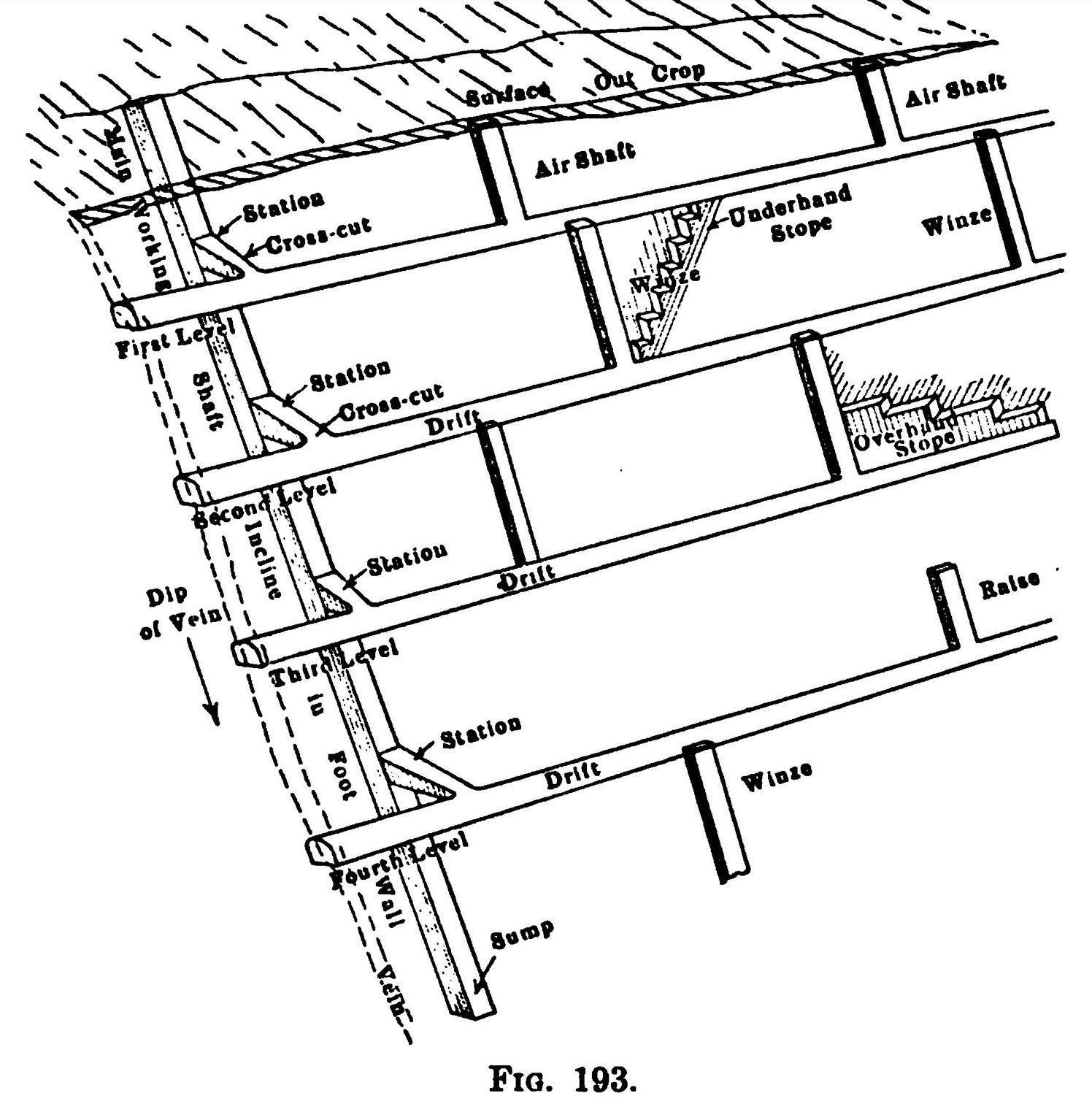
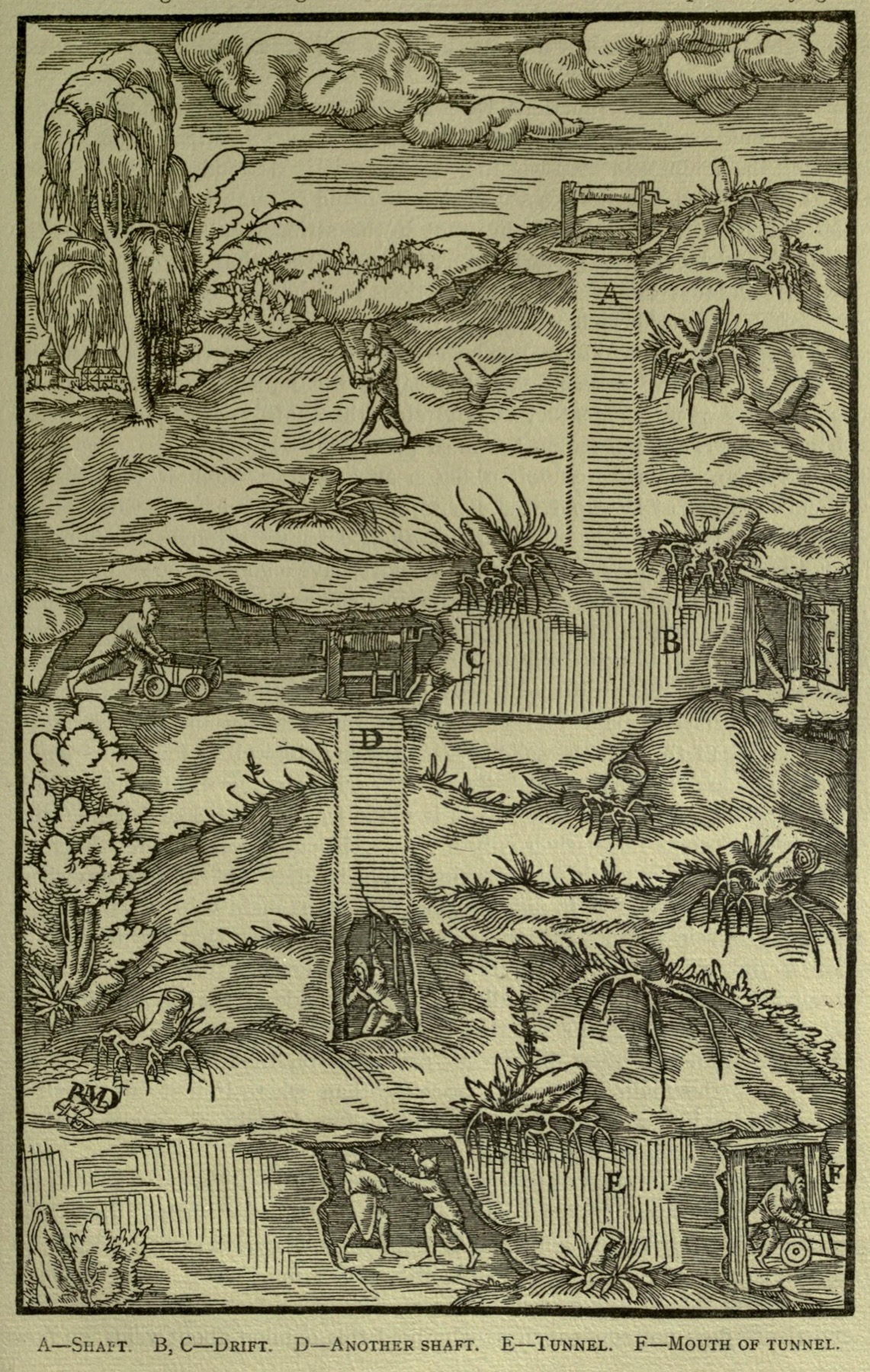
Adit. “1. A nearly horizontal passage from the surface by which a mine is entered and unwatered. In the United States an adit is usually called a tunnel, though the latter, strictly speaking, passes entirely through a hill and is open at both ends (Raymond). Frequently also called Drift, or Adit level. …” (Fay, p. 16)
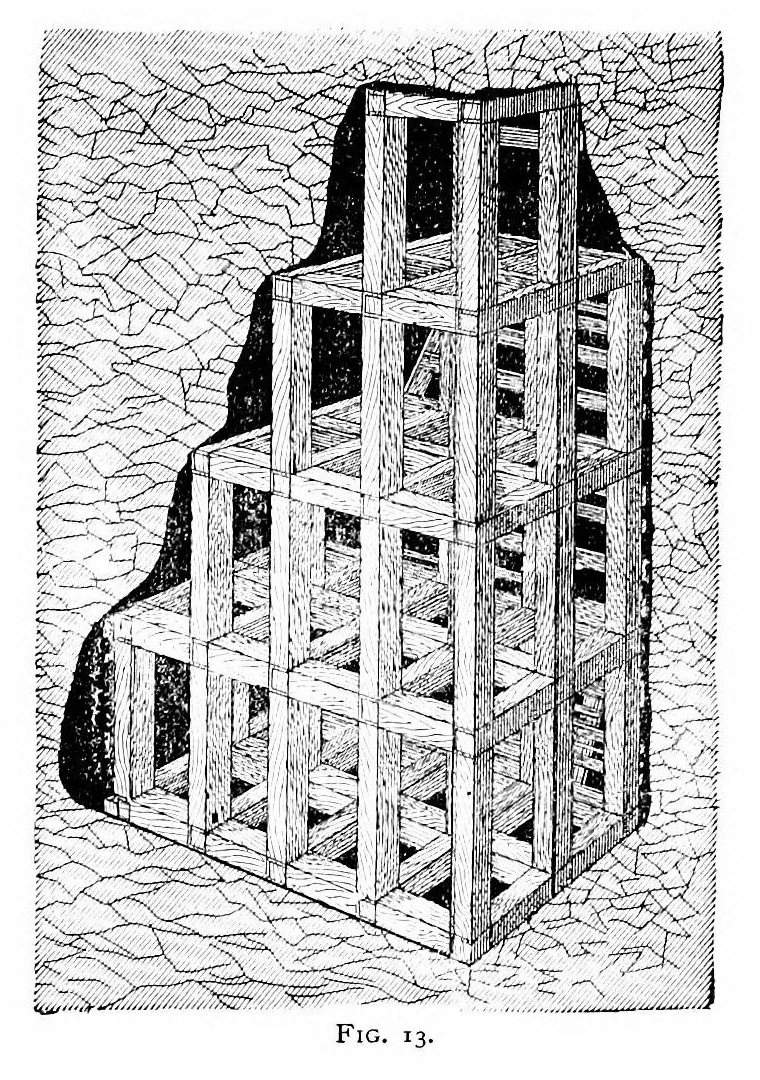
Bulkhead. “1. A tight partition or stopping in a mine for protection against water, fire, or gas. 2. The end of a flume, whence water is carried in iron pipes to hydraulic workings. (Raymond) 3. A solid crib used to support a very heavy roof. See also Cog; Chock.” (Fay, p. 114)
Chute. “(Sometimes written shoot.) 1. A channel or shaft underground, or an inclined trough above ground, through which ore falls or is "shot" by gravity from a higher to a lower level. (Raymond.) …” (Fay, p. 155)
Collar. “1. See Cap. 2. The collar of a shaft is the horizontal timbering around the mouth. (Raymond) 3. (No. of Eng.) The mouth of a mine-shaft. (Gresley) 4. The mouth or opening of a bore hole. (Du Pont) …” (Fay, p. 170)
Compartment. “A separate division or section of anything (Webster). Mining shafts usually are divided into two or more compartments or sections, separated by framed timbers and planking.” (Fay, p. 174)
Crosscut. “1. A small passageway driven at right angles to the main entry to connect it with a parallel entry or air course. Also used in Arkansas instead of "break-through." (Steel) 2. A level, driven across the course of a vein or in general across the direction of the main workings or across the "grain of coal." (Raymond)” (Fay, p. 193)
Drift. “1. A horizontal passage underground. A drift follows the vein, as distinguished from a crosscut, which intersects it, or a level or gallery, which may do either. (Raymond) 2. In coal mining, a gangway or entry above water level, driven from the surface in the seam. (Steel) …” (Fay, p. 231)
Gangway. “1. The main haulage road or level (Gresley). Frequently called Entry. 2. (Newc.) A wooden bridge. (Raymond) 3. A passageway or avenue into or out of any enclosed place, as in a mine. (Sangamon Coal Min. Co. v. Wiggerhaus, 122, Illinois, p. 283)” (Fay, p. 294)
Glory hole. “1. A large open pit from which ore is or has been extracted (Weed). See also Milling. 2. An opening through which to observe the interior of a furnace. (Standard)” (Fay, p. 307)
Heading. “1. The vein above a drift. See Back, 1. 2. An interior level or airway driven in a mine. 3. In longwall workings, a narrow passage driven upward from a gangway in starting a working in order to give a loose end. (Raymond) …” (Fay, p. 334)
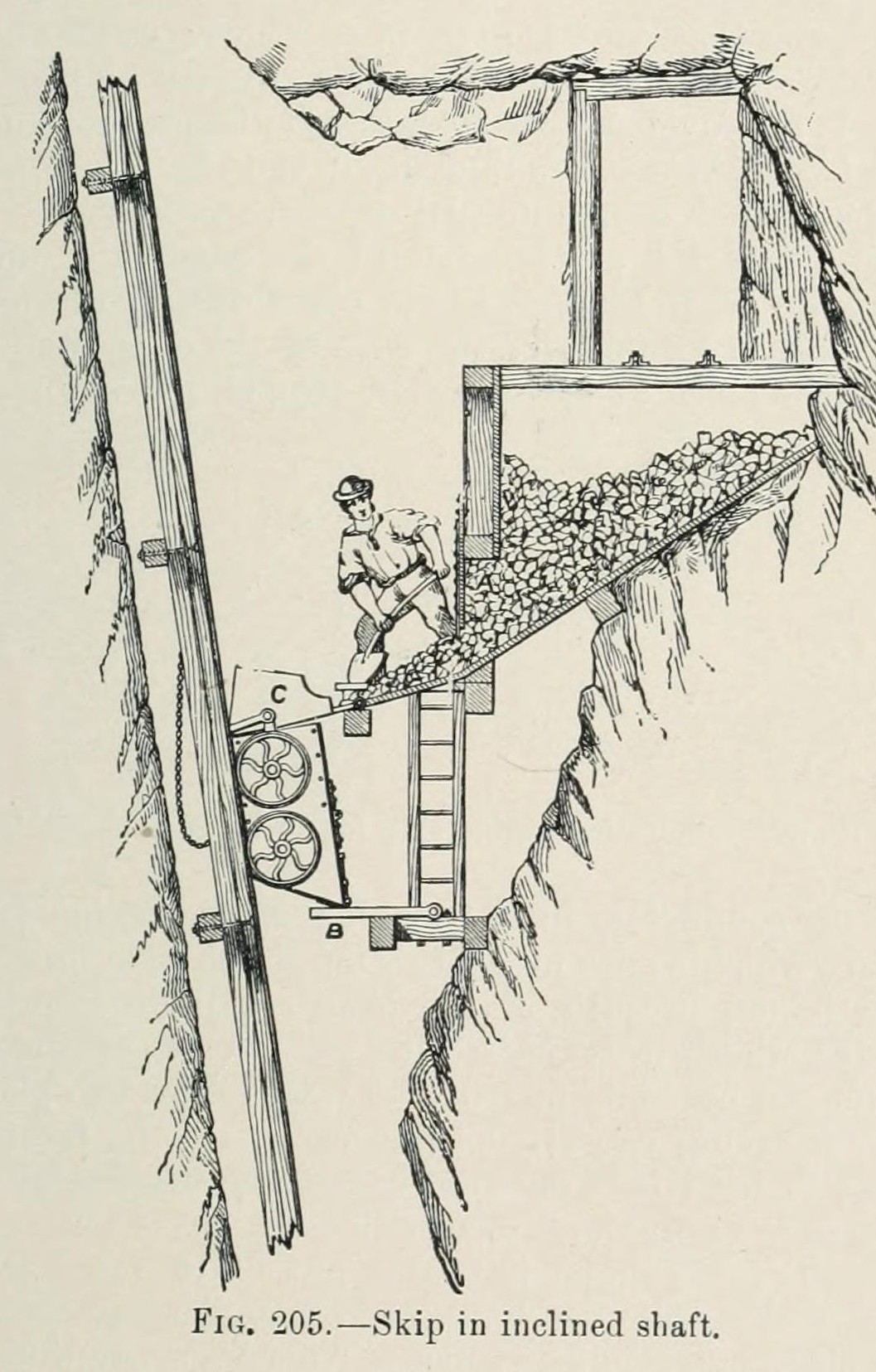
Incline. “1. A shaft not vertical; usually on the dip of a vein. See also Slope. (Raymond) 2. Any inclined plane, whether above or beneath the surface. Usually applied to self-acting planes above ground, as in the bituminous coal fields. (Steel)” (Fay, p. 357)
Level. “1. A horizontal passage or drift into or in a mine. It is customary to work mines by levels at regular intervals in depth, numbered in their order below the adit or drainage level, if there be one (Raymond). Rarely applied to coal mining. …” (Fay, p. 396)
Mine road. “Any mine track used for general haulage. (Chance)” (Fay, p. 441)
Open cut. “… 4. A surface working, open to daylight (Raymond). Also called Opencast; Open-pit.” (Fay, p. 473)
Pillar. “1. A solid block of coal, etc., varying in area from a few square yards to several acres. (Gresley) 2. A piece of ground or mass of ore left to support the roof or hanging wall in a mine. (Hanks)” (Fay, p. 510)
Prop. “A timber set upright or at right angles to the dip, to support the roof rock (Chance). A strut or post in tunnel construction work, either vertical or raking, usually of round timber, used as a support, or stay. A raking prop is sometimes called a raker.” (Fay, p. 539)
Prospect hole. “Any shaft, pit, drift, or drill hole made for the purpose of prospecting the mineral-bearing ground.” (Fay, p. 540)
Quarry. “1. An open or surface working, usually for the extraction of building-stone, as slate, limestone, etc. (Raymond) … Note: In its widest sense the term mines includes quarries, and has been sometimes so construed by the courts; but when the distinction is drawn, mine denotes underground workings and quarry denotes superficial workings. Open workings for iron ore, clay, coal, etc., are called banks or pits rather than quarries (Webster), the latter being defined as in 1 above.” (Fay, p. 549)
Raise. “… 4. A mine shaft driven from below upward; called also Upraise, Rise and Riser Webster). An opening, like a shaft, made in the back of a level to reach a level above. (Standard). The term is in general usage at mines in Western States. See Rise, 1.” (Fay, p. 555)
Scaffold. “An obstruction in a blast furnace above the tuyères caused by an accumulation or shelf of pasty, unreduced materials adhering to the lining. (Raymond)” (Fay, p. 593)
Shaft. “1. An excavation of limited area compared with its depth, made for finding or mining ore or coal, raising water, ore, rock, or coal, hoisting and lowering men and material, or ventilating underground workings. The term is often specifically applied to approximately vertical shafts, as distinguished from an incline or inclined shaft. 2. The interior of a shaft furnace above the boshes (Raymond). Compare Slop; Incline. …” (Fay, p. 606)
Slope. “An inclined passage driven from the dip of a coal vein. Compare Slant, 2. When not open at one end to the surface, it is known as an inside slope. See also Incline; Plane. Rock slope: A slope driven through rock strata. Slope air-course: A passageway parallel to the haulage slope used for the passage of the air current. (Steel)” (Fay, p. 625)
Stope. “1. An excavation from which the ore has been extracted, either above or below a level, in a series of steps. A variation of step (Standard). Usually applied to highly inclined or vertical veins. Frequently used incorrectly as a synonym of room, which is a wide working place in a flat mine. 2. To excavate ore in a vein by driving horizontally upon it a series of workings, one immediately over the other, or vice versa. Each horizontal working is called a stope (probably a corruption of step), because when a number of them are in progress, each working face being a little in advance of the next above or below, the whole face under attack assumes the shape of a flight of stairs. When the first stope is begun at a lower corner of the body of ore to be removed, and, after it has advanced a convenient distance, the next is commenced above it, and so on the process is called overhand stoping. When the first stope begins at an upper corner, and the succeeding ones are below it, it is underhand stoping. The term stoping is loosely applied to any subterranean extraction of ore except that which is incidentally performed in sinking shafts, driving levels, etc., for the purpose of opening the mine. (Raymond)” (Fay, p. 652)
Timber. “1. Any of the wooden props, posts, bars, collars, lagging, etc., used to support mine workings. 2. To set or place timbers in a mine. 3. One of the steel joists or beams, which have in some mines replaced wooden timbers. (Webster)” (Fay, p. 687)
Timbering. “1. (Eng.) The timber structure employed for supporting the faces of an excavation during the progress of construction (Simms) 2. Timber work taken collectively, as in a mine. (Standard)” (Fay, p. 687)
Vertical shaft. “A shaft sunk at an angle of 90° with the horizon, or directly downward toward the center of the earth. (Weed)” (Fay, p. 723)
Water level. “1. The level at which, by natural or artificial drainage, water is removed from a mine or mineral deposit. 2. A drift at the water level (Raymond). See Water grade.” (Fay, p. 733)
Winze. “A vertical or inclined opening, or excavation, connecting two levels in a mine, differing from a raise only in construction. A winze is sunk underhand and a raise is put up overhand. When the connection is completed, and one is standing at the top, the opening is referred to as a winze, and when at the bottom, as a raise, or rise. Compare Underground shaft.” (Fay, p. 745)
Reading the ground
Anticline. “A fold or arch of rock strata, dipping in opposite direction from an axis. (Webster)” (Fay, p. 37)
Barren. “Not containing mineral of value (Duryee). Not productive.” (Fay, p. 64)
Bed. “1. The smallest division of a stratified series, and marked by a more or less well defined divisional plane from its neighbors above and below. (Kemp) 2. A seam or deposit of mineral, later in origin than the rock below, and older than the rock above; that is to say, a regular member of the series of formations, and not an intrusion (Raymond). A deposit, as of ore (or coal), parallel to the stratification. (Standard) …” (Fay, p. 71)
Country rock. “The general mass of adjacent rock as distinguished from that of a dike, vein or lode. (Stevens v. Williams, 23 Federal Cas., p. 44)” (Fay, p. 187)
Croppings. “Portions of a vein as seen exposed at the surface. (C. and M. M. P.)” (Fay, p. 192)
Dip. “1. The angle at which beds or strata are inclined from the horizontal, while underlie is the angle formed between a vein and a vertical line. The first is a geologist's term, the second a miner's. (Roy. Com.) 2. To slope downward from the surface. …” (Fay, p. 219)
Fissure vein. “A cleft or crack in the rock material of the earth's crust, filled with mineral matter different from the walls and precipitated therein from aqueous solution, or introduced by sublimation or pneumatolysis. (Shamel, p. 136) A mineral mass, tabular in form, as a whole, although frequently irregular in detail, occupying or accompanying a fracture or set of fractures in the inclosing rock; this mineral mass has been formed later than the country rock, either through the filling of open spaces along the latter or through chemical alteration of the adjoining rock. (Lindgren, Genesis of Ore Deposits, p. 500) A fissure in the earth's crust filled with mineral (Raymond). See Fissure; Lode; and Vein. …” (Fay, p. 272)
Float. “… 4. A term much used among miners and geologists for pieces of ore or rock which have fallen from veins or strata, or have been separated from the parent vein or strata by weathering agencies. Not usually applied to stream gravels. Used also as an adjective.” (Fay, p. 276)
Fold. “Rocks or strata which have been bent into domes and basins or rolls. This structure is observed mainly in mountainous regions, and is characteristic of both the altered and unaltered sedimentary rocks (Buckley). Strictly, a strong flexure of a stratum, with steeply inclined sides. Loosely and more commonly any flexure of a stratum. (Standard)” (Fay, p. 280)
Footwall. “The wall under the vein (Raymond). Sometimes called Underlying wall.” (Fay, p. 281)
Gangue. “The non-metalliferous or non-valuable metalliferous minerals in the ore; veinstone or lode-filling (Rickard). The mineral associated with the ore in a vein. (Raymond)” (Fay, p. 294)
Gossan. “A ferruginous deposit filling the upper parts of mineral veins or forming a superficial cover on masses of pyrite. It consists principally of hydrated oxide of iron, and has resulted from the oxidation and removal of the sulphur as well as the copper, etc. (Roy. Com.). Also spelled Gozzan. Iron-hat is also a synonym.” (Fay, p. 311)
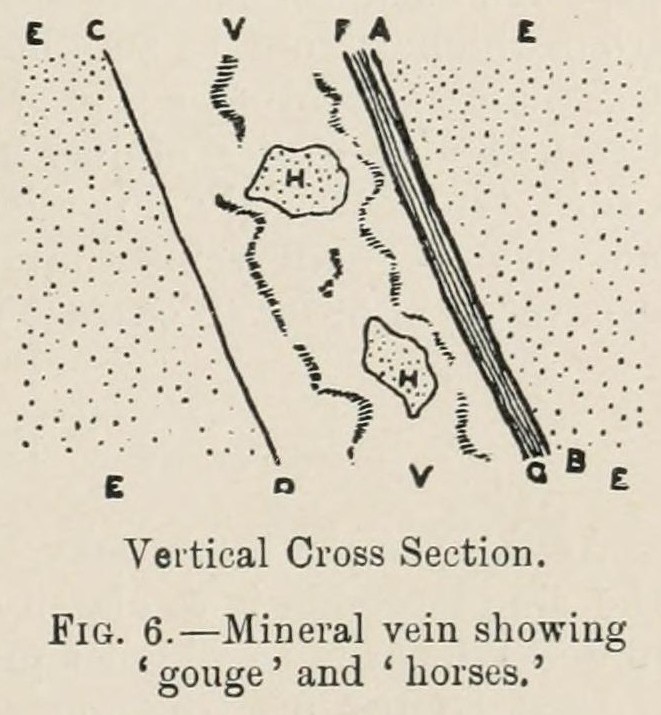
Gouge. “1. A layer of soft material along the wall of a vein, favoring the miner, by enabling him after "gouging" it out with a pick, to attack the solid vein from the side (Raymond). See Selvage, also Flucan. 2. (Nova Scotia) A narrow band of gold-bearing slate next the vein, which can be extracted by a thin, long-pointed stick. (Lock) …” (Fay, p. 311)
Grade. “1. The amount of fall or inclination in ditches, flumes, roads, etc. … 4. An ore which carries a great or comparatively small amount of valuable metal is called respectively a high- or low-grade ore. …” (Fay, p. 312)
Hade. “1. The angle of inclination of a vein measured from the vertical; dip is measured from the horizontal. See Underlay, 2. (Skinner) 2. To deviate from the vertical; said of a vein, fault, or lode. (Webster)” (Fay, p. 327)
Hanging wall. “The upper wall of an inclined vein, or that which hangs over the miner at work. (Webster)” (Fay, p. 330)
Horse. “1. A mass of country rock lying within a vein. (Book v. Justice Mining Co., 58 Fed. Rept., p. 125) 2. Any irregularity cutting out a portion of the vein. (Consol. Wyoming Gold Mining Co. v. Champion Mining Co., 63 Fed. Rept., p. 544; Barrett v. Dessy, 78 Kansas, p. 644; 97 Pacific, p. 786.) See Dirt-fault and Rock-fault. To take horse. To split into branches as a vein of ore in a mine. (Standard) …” (Fay, p. 345)
Lean. “Applied to poor ores, or those containing a lower proportion of metal than is usually worked. (Roy. Com.)” (Fay, p. 393)
Limb. “1. One of the two parts of an anticline or syncline on either side of the axis. See Legs, 1. 2. The graduated margin of an arc or circle in an instrument for measuring angles. 3. The graduated staff of a leveling rod. (Webster)” (Fay, p. 399)
Lode. “Strictly a fissure in the country-rock filled with mineral; usually applied to metalliferous lodes. In general miners' usage, a lode, vein, or ledge is a tabular deposit of valuable mineral between definite boundaries. Whether it be a fissure formation or not is not always known, and does not affect the legal title under the United States Federal and local statutes and customs relative to lodes. But it must not be a placer, i. e., it must consist of quartz or other rock in place, and bearing valuable mineral. (Raymond) … Lode, as used by miners, is nearly synonymous with the term vein, as employed by geologists. The word should not be used for a flat or stratified mass. See Ledge, 1, Lead, 1, Fissure, Fissure vein, Vein. (Additional cases are cited in U. S. Min. Stat., p. 44)” (Fay, p. 405)
Outcrop. “1. The coming out of a stratum to the surface of the ground. That part of a stratum which appears at the surface; basset. 2. To crop out; to come out to the surface of the ground, as strata (Webster) A term used in connection with a vein or lode as an essential part of the definition of apex, which see. It does not necessarily imply the visible presentation of the mineral on the surface of the earth, but includes those deposits that are so near to the surface as to be found easily by digging. (Stevens v. Williams, 1 McCrary, p. 480; 23 Federal Cas., p. 40; 1 Mo. Min., p. 566; Sloss-Sheffield Steel & Iron Co. v. Payne, 64 Southern, 617)” (Fay, p. 480)
Pinch. “1. A compression of the walls of a vein, or the roof and floor of a coal bed, which more or less completely displaces the ore or coal. Called also Pinch-out (Standard). The narrowing of a vein or deposit. A thin place in a mineral zone or where the zone itself almost or quite disappears and in other places widens out into extensive bodies of ore. (Meydenbauer v. Stevens. 78 Fed. Rept., p. 791) …” (Fay, p. 511)
Pitch. “1. The ground assigned to tributers. 2. The dip or inclination of a vein or bed; more precisely, in modern usage, the inclination of an ore body in the direction of its strike. (Webster) 3. See Pitch of fold. …” (Fay, p. 515)
Seam. “1. A stratum or bed of coal or other mineral. 2. (Corn.) A horse-load. 3. A joint, cleft, or fissure. (Raymond) …” (Fay, p. 599)
Selvage. “A layer of clay or decomposed rock along a vein-wall. See Gouge. (Raymond)” (Fay, p. 602)
Spar. “1. As used, loosely, almost any transparent or translucent, readily cleavable, crystalline mineral having a vitreous luster (La Forge), as calcspar, fluorspar, feldspar, heavy-spar, etc. 2. A Cornish name for quartz.” (Fay, p. 634)
Strike. “1. The course or bearing of the outcrop of an inclined bed or structure on a level surface; the direction or bearing of a horizontal line in the plane of an inclined stratum, joint, fault, cleavage plane, or other structural plane: it is perpendicular to the direction of the dip. (La Forge) Compare Trend. 2. To find a vein of ore; a valuable discovery. …” (Fay, p. 656)
Swell. “1. A local enlargement or thickening of an ore or coal deposit. (Webster) 2. A space in a seam from which the coal has been eroded and its place filled with clay or sand. Called also Horse, Horseback, Swineback, Want. (Standard) 3. A low dome or quaquaversal anticline of considerable areal extent. (La Forge)” (Fay, p. 667)
Synclinal axis. “In geology, the central line of a syncline, toward which the beds dip from both sides. (La Forge)” (Fay, p. 668)
Trough. “1. A hollow or undulation in a mineral field, or in a mineral working (Barrowman). In geology, synonymous with Basin and Synclinal. 2. A conduit for conveying water. 3. A buddle or other vessel in which slimes are sorted in water. 4. A fire-clay box in which iron bars are subjected to the cementation process. (Webster)” (Fay, p. 703)
Underlie. “1. (Corn.) The departure of a vein or stratum from the vertical, usually measured in horizontal feet per fathom of inclined depth. Thus a dip of 60° is an underlay of three feet per fathom. The underlay expressed in feet per fathom is six times the natural cosine of the angle of the dip (Raymond). The complement of Dip; Hade. 2. The downward extension of a vein or bed beneath the ground. Mineral bodies lying under a given tract, though not outcropping on surface. (Weed)” (Fay, p. 714)
Vein. “1. An occurrence of ore, usually disseminated through a gangue, or veinstone, and having a more or less regular development in length, width, and depth. A vein and a lode are, in common usage, essentialy the same thing, the former being rather the scientific, the latter the miners', name for it (Century). See Lode; Fissure; Fissure vein. The filling of a fissure or fault in a rock, particularly if deposited by aqueous solutions. When metalliferous it is called by miners a lode; when filled with eruption material, a dike. A bed or shoot of ore parallel with the bedding. Called also Blanket-deposit. (Standard) A crack in rock filled by mineral matter deposited from solution by underground water. A lode. (Webster) …” (Fay, p. 720)
Work and the men
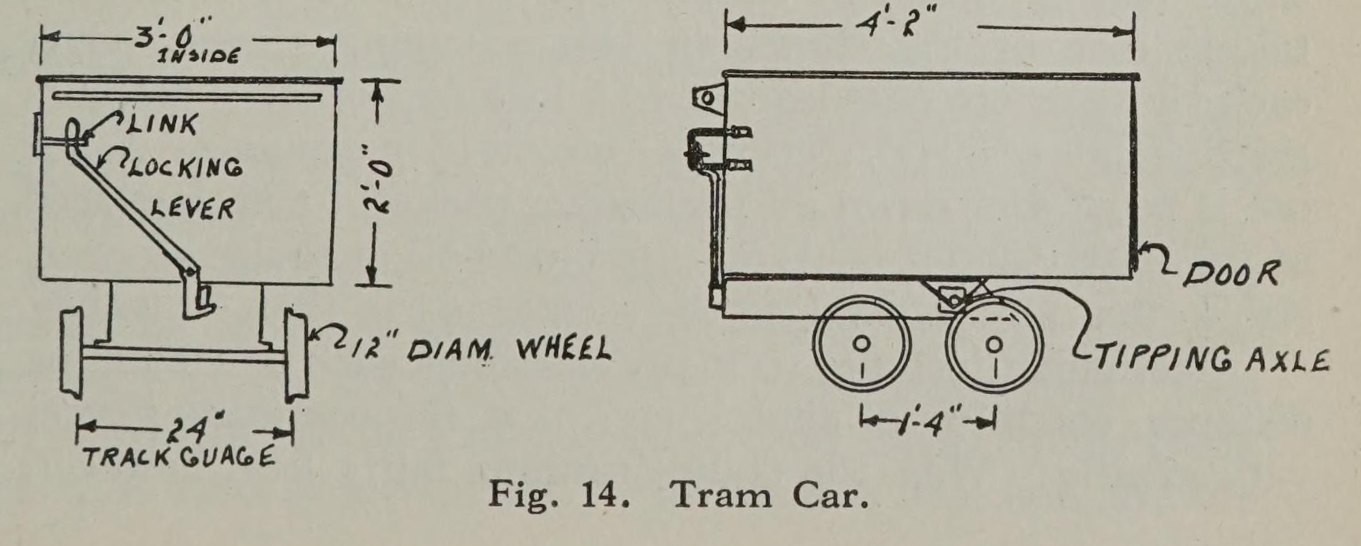
Air compressor. “A machine for compressing air to a pressure sufficient to actuate machinery. (Weed)” (Fay, p. 20)
Air hoist. “Hoisting machinery operated by compressed air. (Century)” (Fay, p. 21)
Blasting. “1. The operation of splitting rocks by gunpowder or other explosives (Century): as in mining and quarrying operations. …” (Fay, p. 84)
Boring. “1. The act or process of making a hole with a boring tool. 2. A hole so made. 3. Material removed by boring. (Standard)” (Fay, p. 97)
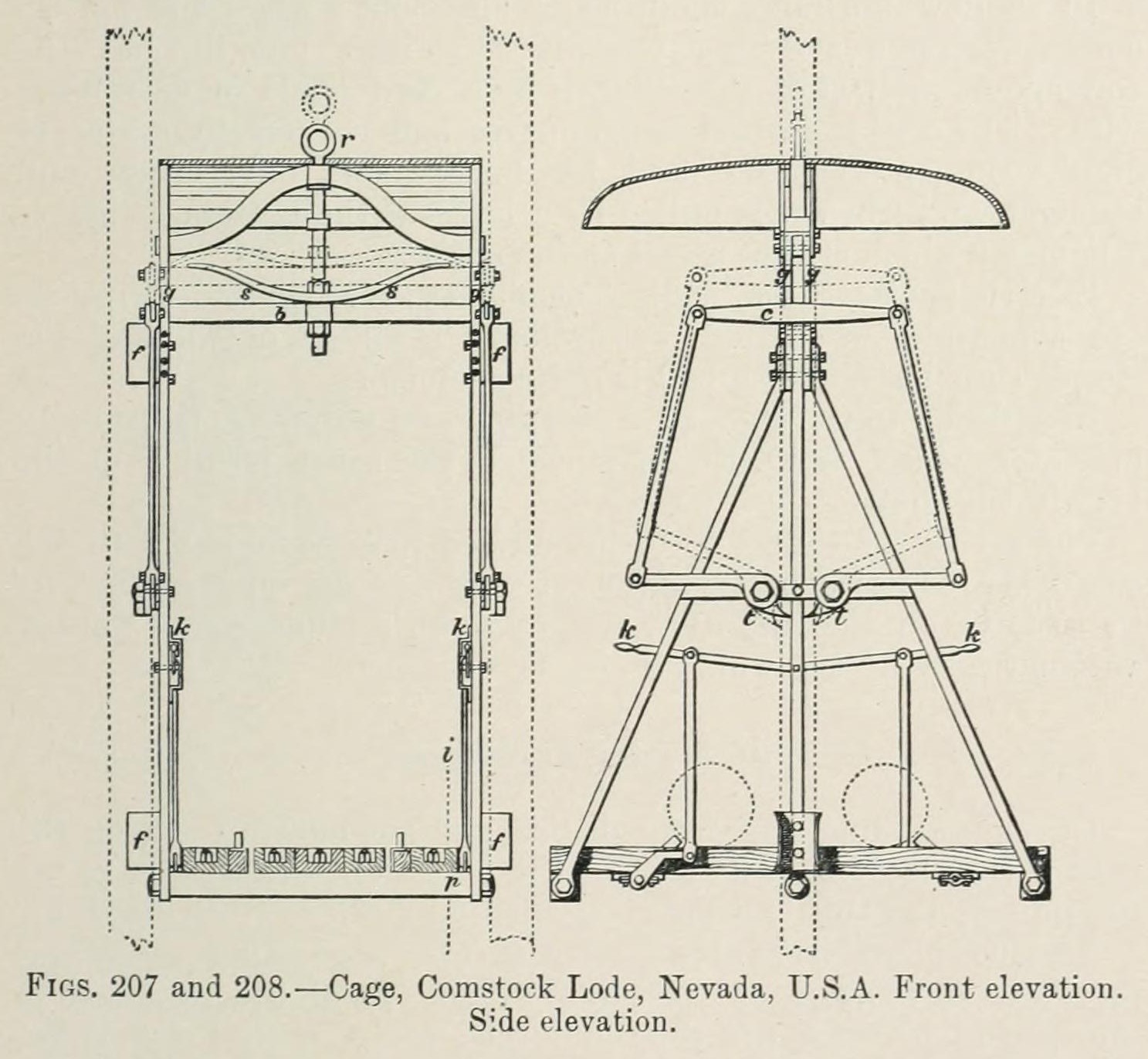
Cage. “1. A frame with one or more platforms for cars, used in hoisting in a vertical shaft. It is steadied by guides on the sides of the shaft. 2. A structure of elastic iron rods slipped into the bore-hole in rod-boring to prevent vibration of the rods. 3. The barrel or drum of a whim on which the rope is wound. (Raymond)” (Fay, p. 121)
Diamond drill. “A form of rotary rock drill in which the work is done by abrasion instead of percussion, black diamonds (borts) being set in the head of the boring tool (Raymond). Used in prospecting and development work where a core is desired.” (Fay, p. 216)
Drill. “1. A metallic tool for boring in hard material. The ordinary miner's drill is a bar of steel with a chisel-shaped end, and is struck with a hammer. See Rock drill, Diamond drill. (Raymond) 2. To make a hole with a drill or similar tool. 3. See Drilling, as applied to oil and gas wells.” (Fay, p. 232)
Drum. “1. That part of the winding machinery on which the rope or chain is coiled. (Raymond) 2. (Lanc.) A brick, iron, or wooden cylinder, used when sinking a shaft through sand. 3. See Running-the-drum. (Gresley) …” (Fay, p. 233)
Explosive. “Any mixture or chemical compound by whose decomposition or combustion gas is generated with such rapidity that it can be used for blasting or in firearms, for example, gunpowder, dynamite, etc.” (Fay, p. 256)
Haul. “1. To transport by pulling or drawing, as cars. 2. The distance over which anything is hauled as a long or a short haul. (Standard)” (Fay, p. 333)
Headframe. “A structure erected over a shaft to carry the sheaves over which the cable runs for hoisting the cage. Called in England, Gallows frame. (Chance)” (Fay, p. 334)
Helper. “A miner's assistant, who works under the direction of the miner. (Hargis)” (Fay, p. 337)
Hoist. “1. An engine for raising ore, rock, coal, etc., from a mine and for lowering and raising men and material. Also called Hoister. 2. The amount of ore, coal, etc., hoisted during a shift.” (Fay, p. 342)
Hopper. “1. A trap at the foot of a chute for regulating the contents of a wagon. 2. A place of deposit for coal or ore. (Raymond) 3. A funnel-shaped feeding trough. 4. (Derb.) A dish used by miners to measure ore. It varies from 14 to 16 pints in different localities. (Mander)” (Fay, p. 344)
Man car. “A kind of car for transporting miners up and down the steeply inclined shafts of some mines as at Lake Superior (Century). See also Man cage.” (Fay, p. 417)
Mucker. “1. (U. S.) One who loads mine cars, and, in most mines, is also a trammer pushing the cars to the shaft, tunnel or adit mouth. (Weed) 2. One who excavates earth, or muck (Webster). This term applies more especially to metal mines. See also Mullocker.” (Fay, p. 452-453)
Ore car. “A mine car for carrying ore or waste rock. (Weed)” (Fay, p. 476)
Powder. “1. Any of various solid explosives, as gunpowder used in gunnery, blasting, etc. 2. The fine particles to which any dry substance is reduced by pounding, grinding, etc.” (Fay, p. 533)
Primer. “A dynamite cartridge, or package of any explosive, which contains the detonator, whether blasting-cap or electric blasting-cap. (Du Pont)” (Fay, p. 537)
Pumping. “1. The operation of filling a sludge pump by an up-and-down motion of the rods or rope. Also called Pumping the sludger. (Gresley) 2. The act of raising or transferring a liquid or gas by means of a pump.” (Fay, p. 545)
Shift boss. “The foreman in charge of a shift of men. (Raymond)” (Fay, p. 609)
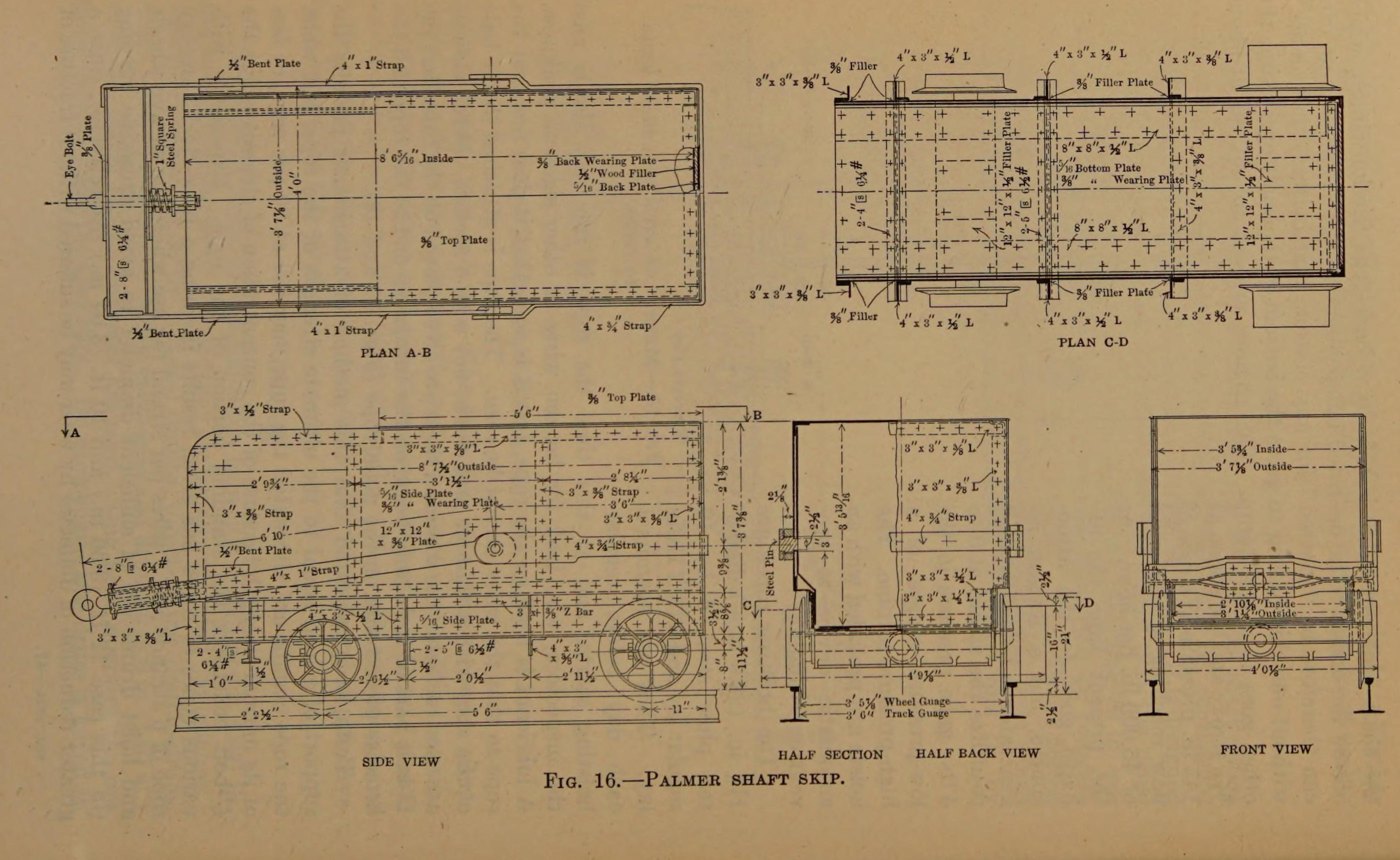
Skip. “1. A large hoisting bucket, constructed of boiler plate, which slides between guides in a shaft, the bail usually connecting at or near the bottom of the bucket so that it may be automatically dumped at the surface. 2. An open iron vehicle or car on four wheels, running on rails and used specially on inclines or in inclined shafts. Sometimes spelled Skep. 3. A thin slice taken off a breast, pillar or rib along its entire length or part of its length. Called Slab in Arkansas. (Steel)” (Fay, p. 620)
Steam shovel. “An excavating machine in which a large scoop is operated by steam power (Standard). Used for stripping purposes and in open pit mining, especially for iron and coal. A similar shovel is now operated by electricity.” (Fay, p. 646)
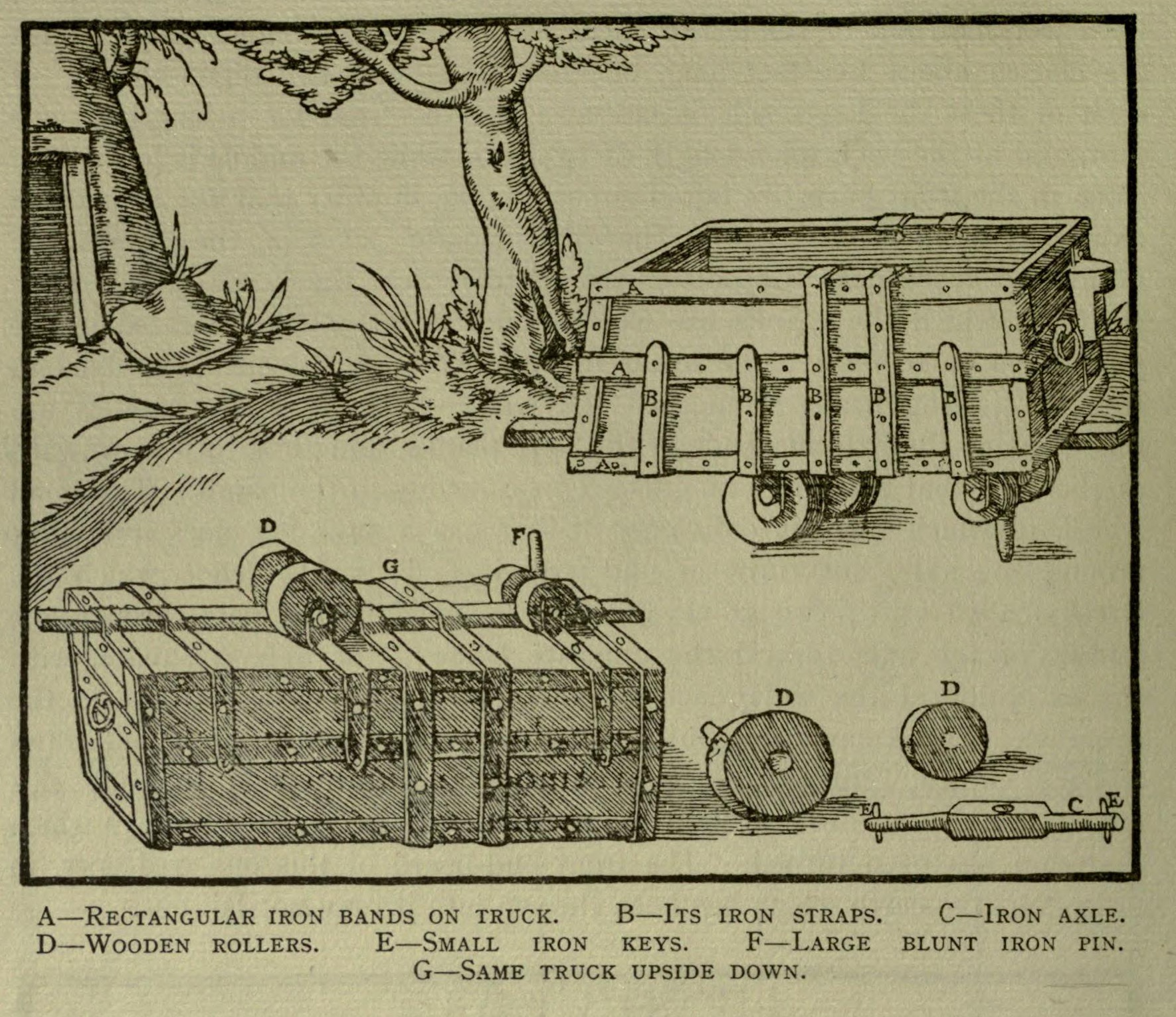
Tram. “1. A four-wheeled truck to carry a tub, corve, or hutch. 2. The rails of a tramroad or railroad (Raymond). See Tramroad. 3. A boxlike wagon, now often of steel, running on a tramway or railway in a mine, for conveying coal or ore. (Webster) 4. To haul or push trams or cars about in a mine (Gresley)” (Fay, p. 696)
Trammer. “1. One who pushes cars along the track. In Arkansas known as a pusher (Steel). Also Haulier, and Putter. 2. (Mich.) A person whose duty it is to load broken rock upon tram cars and deliver it at the shaft. (Meola v. Quincy Mining Co., 140 N. W. Rept., p. 460; Mesich v. Tamarack Mining Co., 151 N. W. Rept., p. 565)” (Fay, p. 696-697)
Winding. “Hoisting coal or ore with a rope wound on a drum; used synonymously with Hoisting. (Chance)” (Fay, p. 744)
Wire rope. “A rope whose strands are made of wires, twisted or woven together. (C. M. P.)” (Fay, p. 745)
The mill
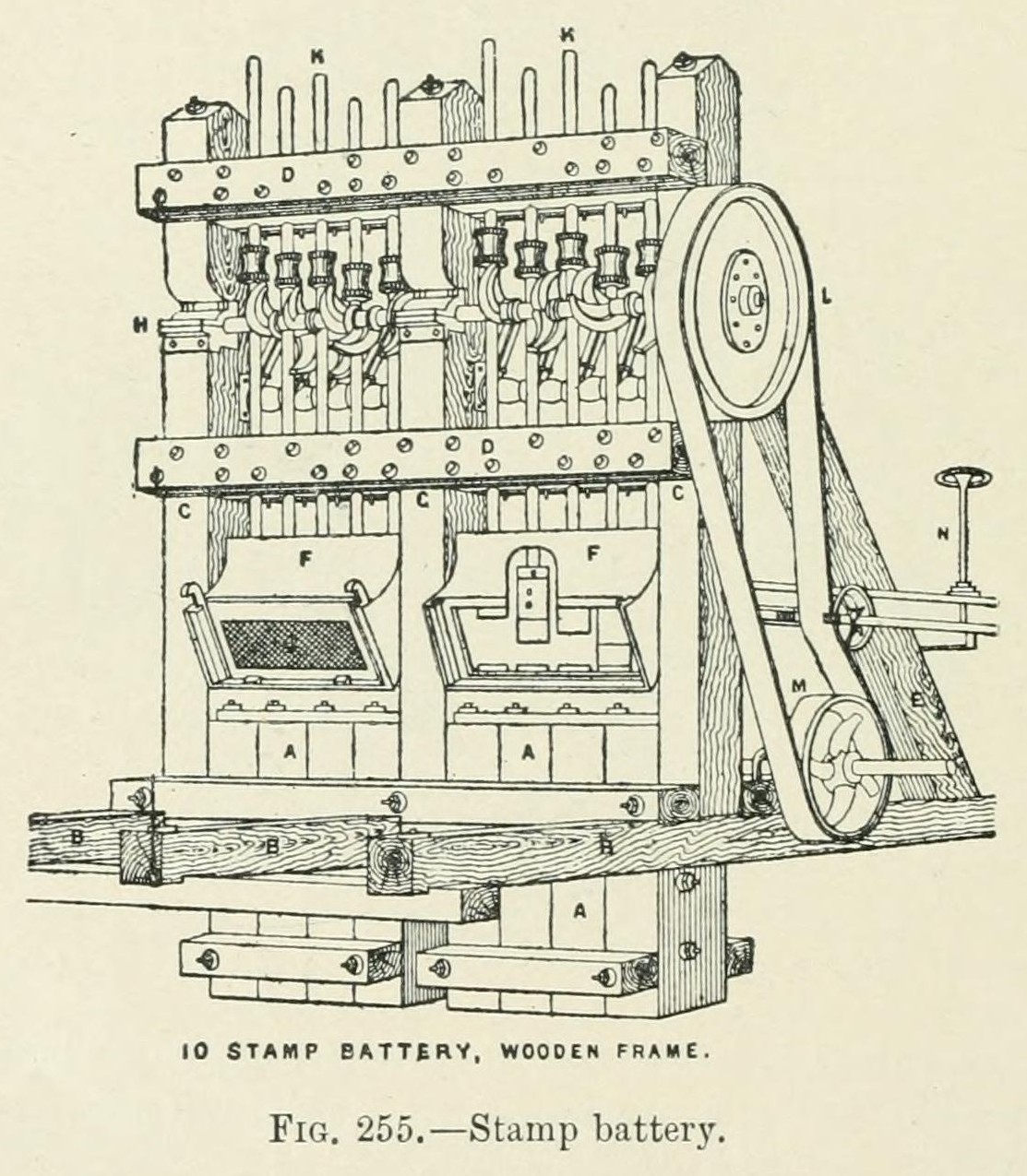
Concentrate. “1. To increase the strength by diminishing the bulk as of a liquid or an ore; to intensify or purify by getting rid of useless material (Webster). To separate metal or ore from the gangue or associated rock. (Murray's Dict.) 2. That which has been reduced to a state of purity or concentration by the removal of foreign, nonessential, or diluting matter (Century). A product of a process of concentration, as in chemistry or metallurgy (Standard). The product of concentration (in mining). Used in plural form as "arrangements for treating the concentrates were complete" (Murray). Concentrates are called "ore" at Joplin, Mo.; "mineral" at Michigan copper mines, and "tailings" at Black Hawk, Colorado.” (Fay, p. 175-176)
Crushing rolls. “A machine consisting of two heavy rolls between which ore, coal or other mineral is crushed. Sometimes the rolls are toothed or ribbed, but for ore their surface is generally smooth. (Century)” (Fay, p. 195)
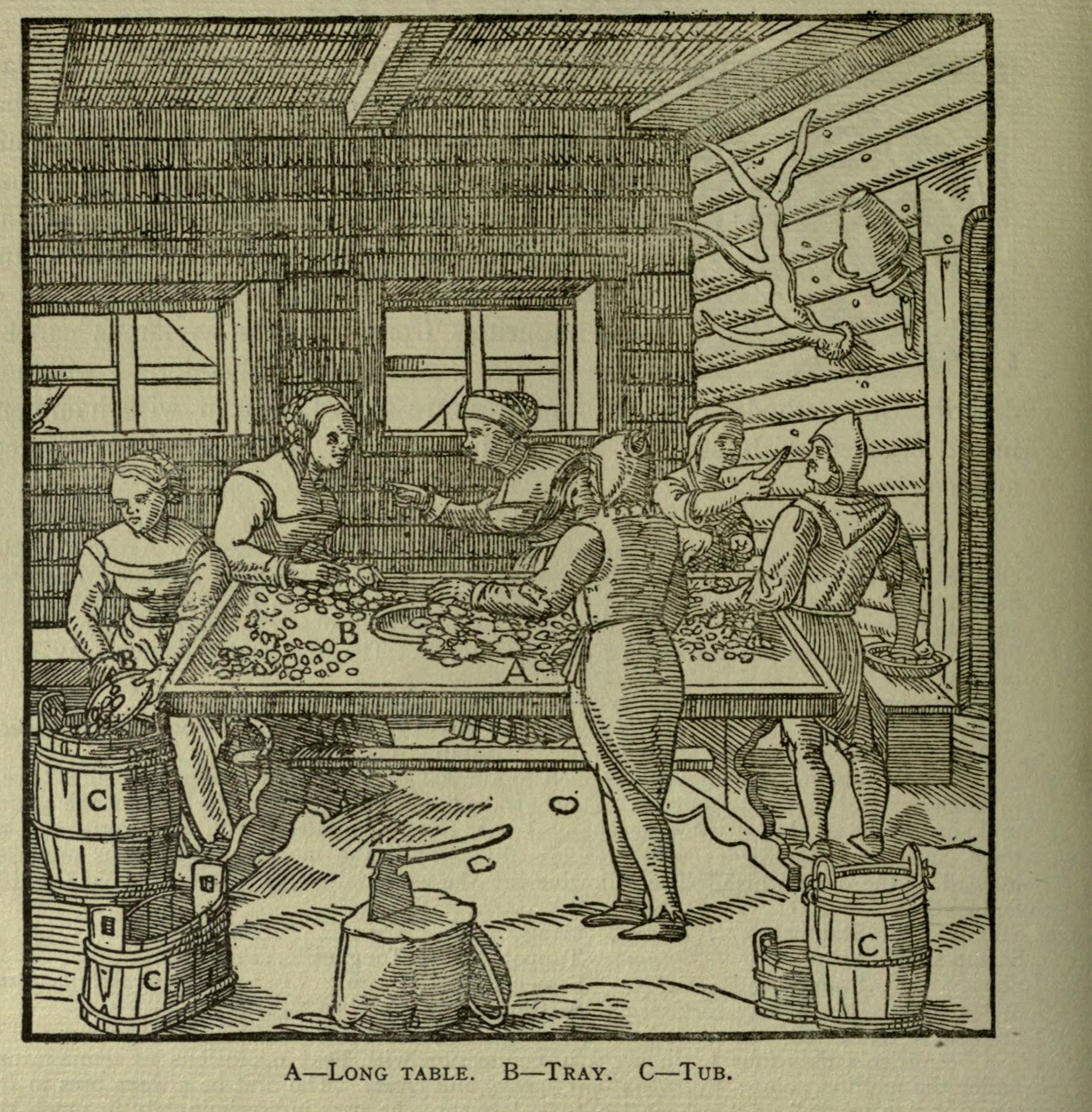
Dressing. “1. (Mid.) Trimming and cleaning up a stall face after the loaders have left off work. (Gresley) 2. (Corn.). The picking and sorting of ores, and washing, preparatory to reduction. (Raymond)” (Fay, p. 231)
Dump. “1. A pile or heap of ore, coal, culm, slate, or rock. 2. The tipple by which the cars are dumped. See Tipple. 3. To unload a car by tipping it up. (Chance) …” (Fay, p. 236)
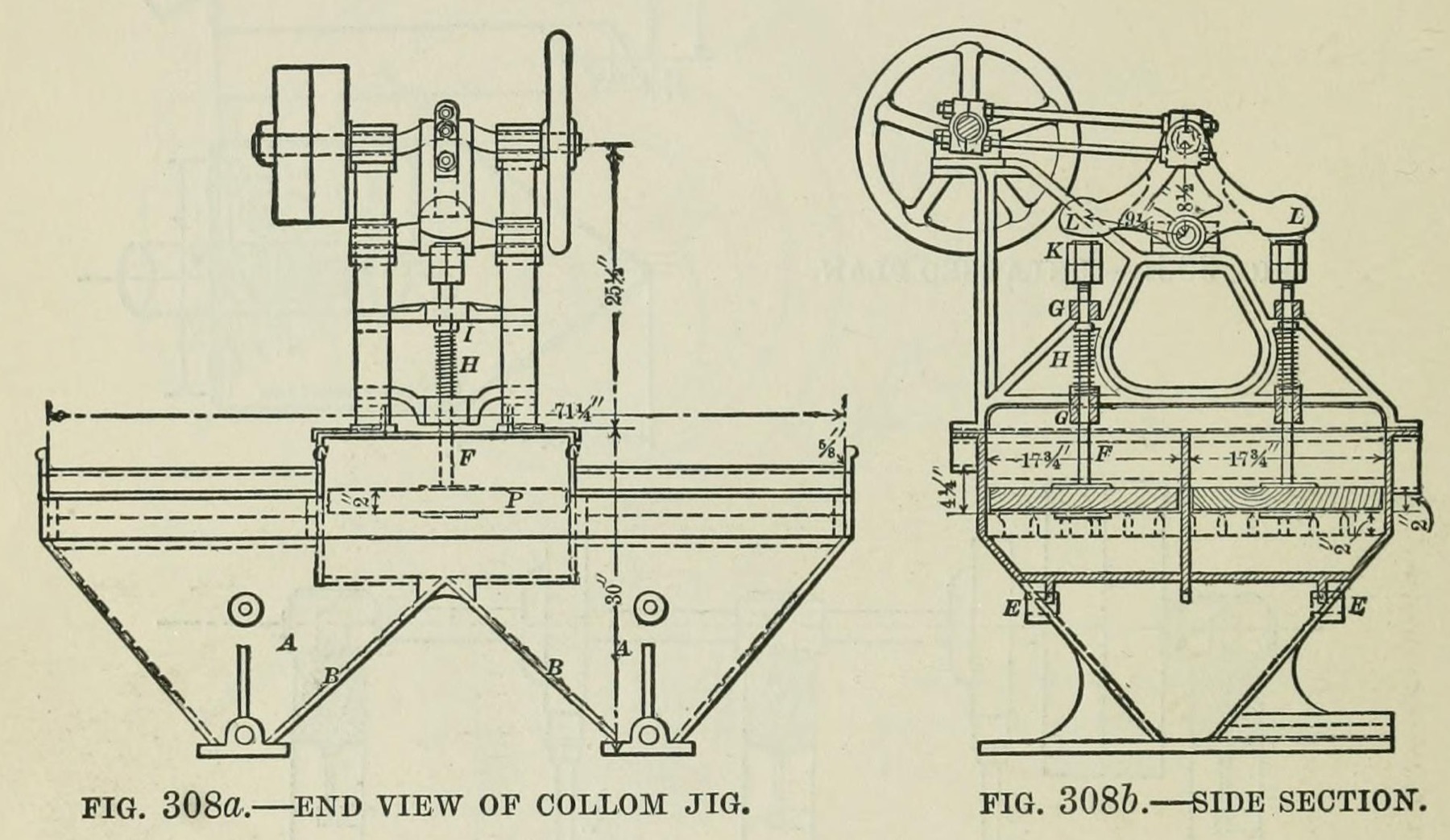
Jig. “1. A machine or apparatus in which ore is concentrated, or coal is separated from slate, on a screen or sieve in water by a reciprocating motion of the screen, or by the pulsion of water through the screen. 2. To separate heavier from lighter materials, as ore from gangue, coal from slate, by agitation in water. (Webster) …” (Fay, p. 370)
Magnetic separator. “A device in which a powerful magnet separates magnetic iron ore from sand or gangue. (Standard)” (Fay, p. 414)
Mill. “1. (Eng.) That part of an iron works where puddle-bars are converted into merchant-iron, i. e., rolled iron ready for sale in bars, rods, or sheets. See Forge. 2. By common usage, any establishment for reducing ores by other means than smelting. More strictly, a place or a machine, in which ore or rock is crushed. See Machine 4. 3. An excavation made in the country rock, by a cross-cut from the workings on a vein, to obtain waste for filling. It is left without timber so that the roof may fall in and furnish the required rock. (Raymond) …” (Fay, p. 435)
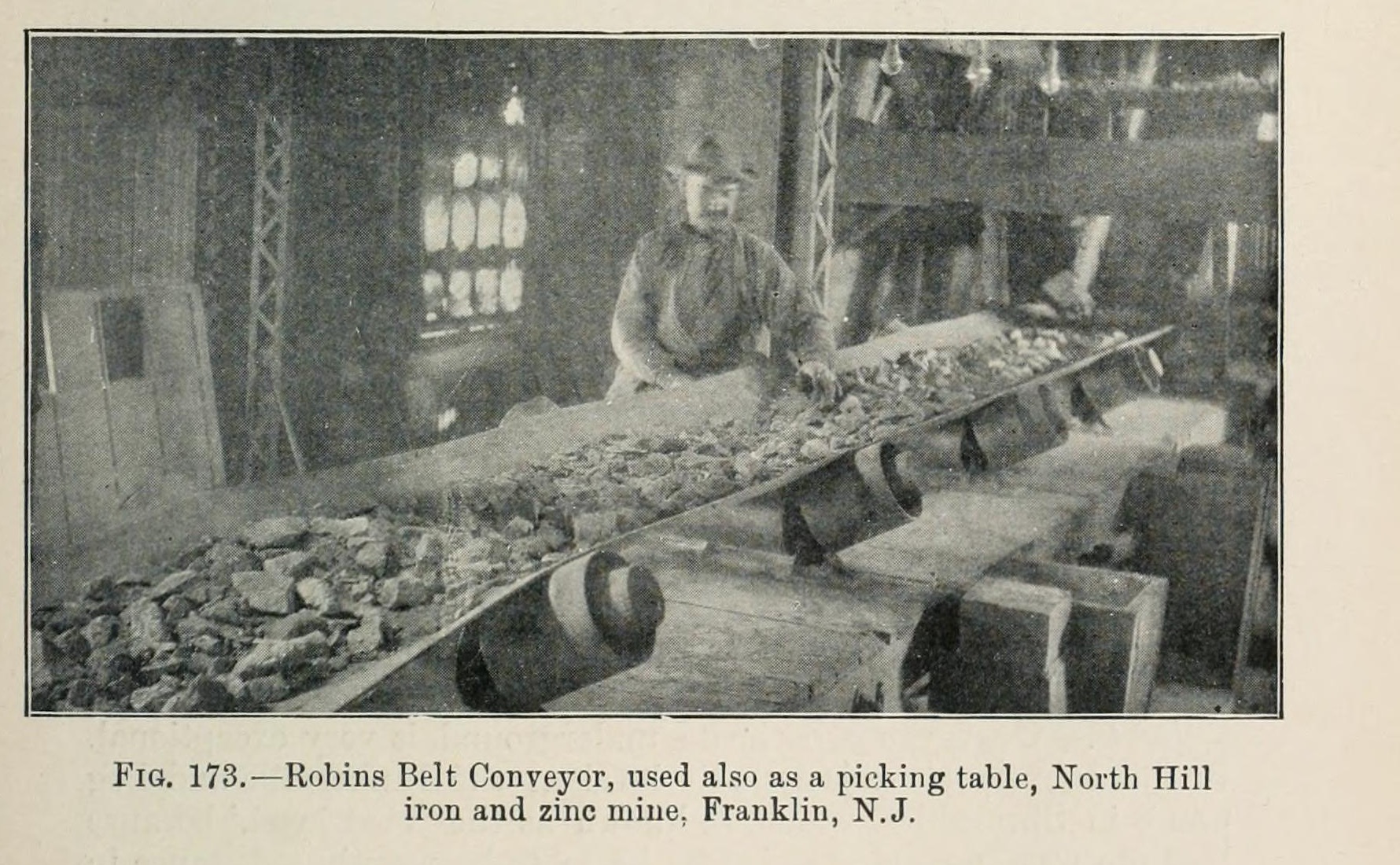
Picking table. “A flat, or slightly inclined, platform on which the coal or ore is run to be picked free from slate or gangue.” (Fay, p. 507)
Screen. “1. A sieve of wire cloth, grate-bars, or perforated sheet-iron used to sort ore and coal according to size. Stamp-mortars have screens on one or both sides, to determine the fineness of the escaping pulp. (Raymond) 2. A cloth brattice or curtain hung across a road in a mine to direct the ventilation. (Gresley) 3. (Joplin, Mo.) A grizzly near the top of a head-frame.” (Fay, p. 598)
Separator. “1. A machine for separating, with the aid of water or air, materials of different specific gravity. Strictly, a separator parts two or more ingredients, both valuable, while a concentrator saves but one and rejects the rest; but the terms are often used interchangeably. 2. Any machine for separating materials, as the magnetic separator for separating magnetite from its gangue. (Raymond) 3. A screen, especially a revolving screen for separating things like stones or coal into sizes. (Standard)” (Fay, p. 603)
Sieve. “The screen or grating fixed in a stamp-box. Any screen.” (Fay, p. 615)
Spoil. “1. Débris or waste material from a coal mine. (C. and M. M. P.) 2. (Eng.) A stratum of coal and dirt mixed. (Gresley)” (Fay, p. 639)
Stamp. “1. To break up the ore and gangue by machinery, for washing out the heavier metallic particles. (Whitney) 2. A heavy pestle raised by steam or other power for crushing ore. Those stamps in which the blow of the pestle is caused by its mere weight are called gravity stamps. See Stamp head. See Steam stamp. …” (Fay, p. 643)
Tailing. “The refuse from a metallurgical process; if the refuse from several processes or more than one mill should meet, the result could be described as "tailings" (Rickard). The material from which one of more concentrated or partly concentrated products have been removed, and which is available for further treatment. (Eng. and Min. Jour., vol. 107, p. 317) Usually used in the plural. See Tailings.” (Fay, p. 671)
Tailings. “1. The parts, or a part, of any incoherent or fluid material separated as refuse, or separately treated as inferior in quality or value; leavings; remainders; dregs. In metallurgy, the part rejected in washing an ore that has passed through the screens of a stamp-mill; the worthless slimes left after the valuable portion has been separated by dressing or concentration. The sand, gravel and cobbles which pass through the sluices in hydraulic mining were formerly generally designated as tailings, but of late years, especially in State and United States legislative documents, they have been called "mining débris" or simply "débris". (Century) The lighter or refuse ore accumulated at the lower end of a buddle, or washing apparatus, or carried away by the water. (Webster) Those portions of washed ore that are regarded as too poor to be treated further: used especially of the débris from stamp mills or other ore-dressing machinery, as distinguished from material (concentrates) that is to be smelted. (Standard) …” (Fay, p. 671)
Washing. “1. Gold dust procured by washing; also a place where this is done; a washery. 2. In ceramics, the covering of a piece with an infusible powder which prevents it from sticking to its supports while receiving the glaze. (Webster) 3. In metallurgy, that which is retained after being washed; as, a washing of ore. 4. A thin coating of metal. (Standard)” (Fay, p. 730)
Furnace and foundry
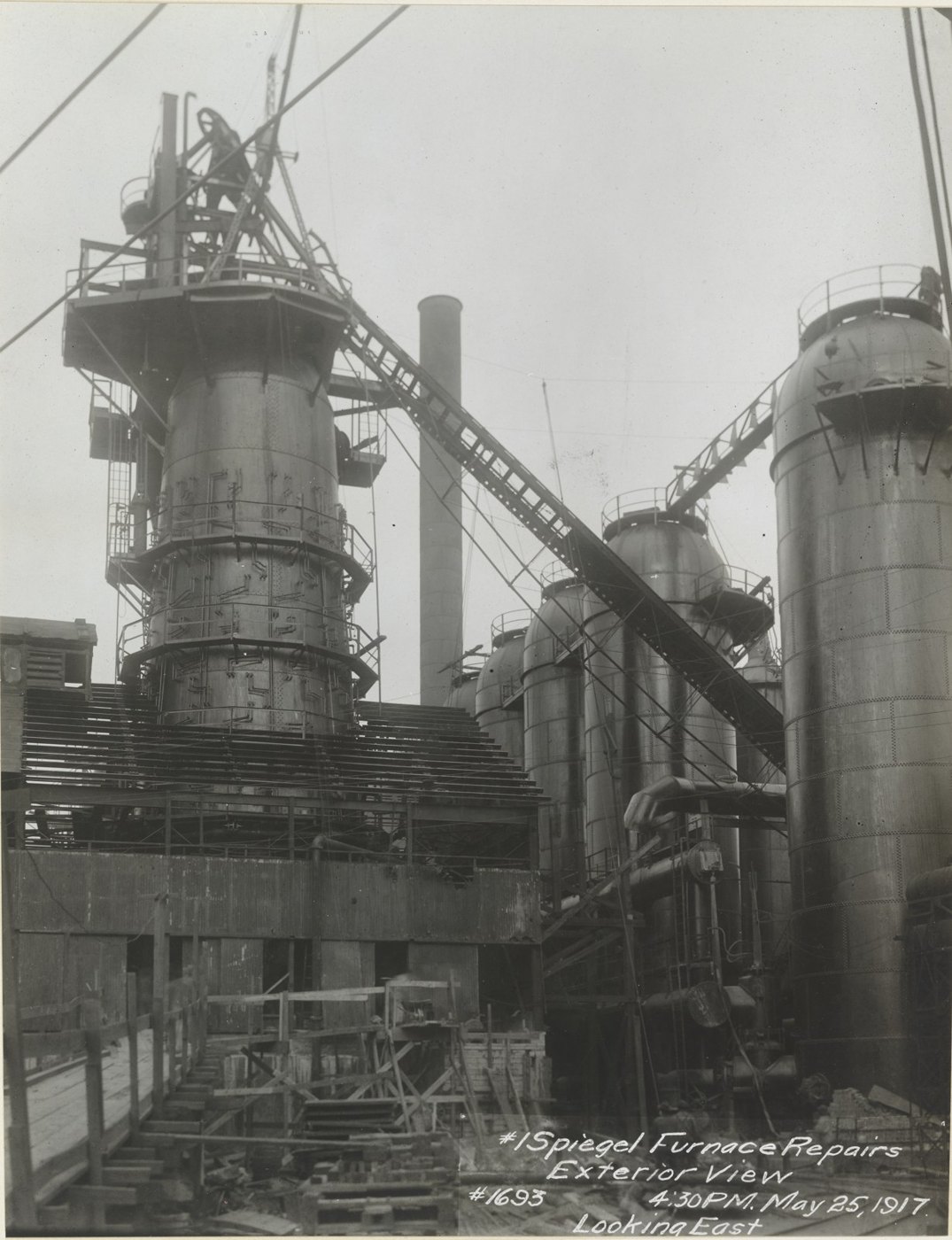
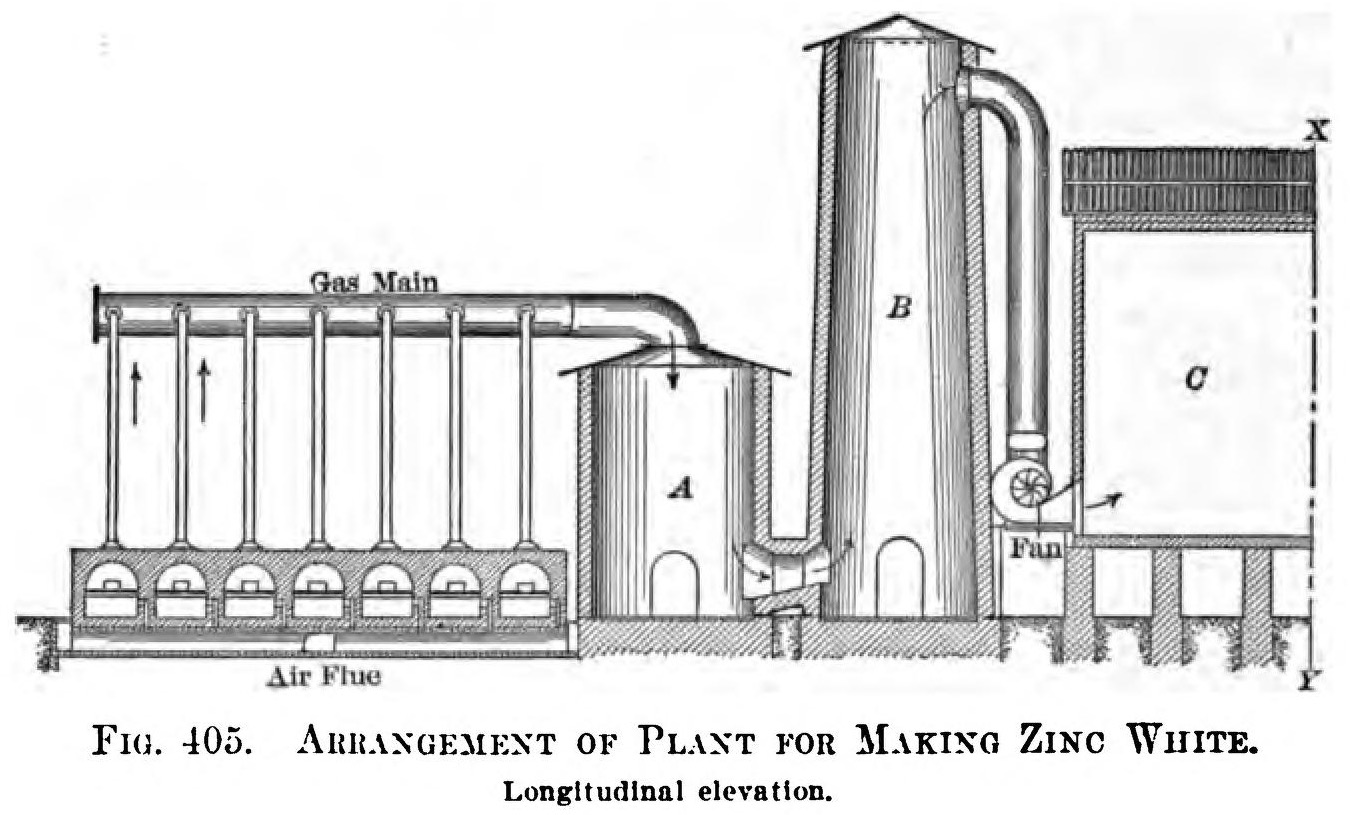
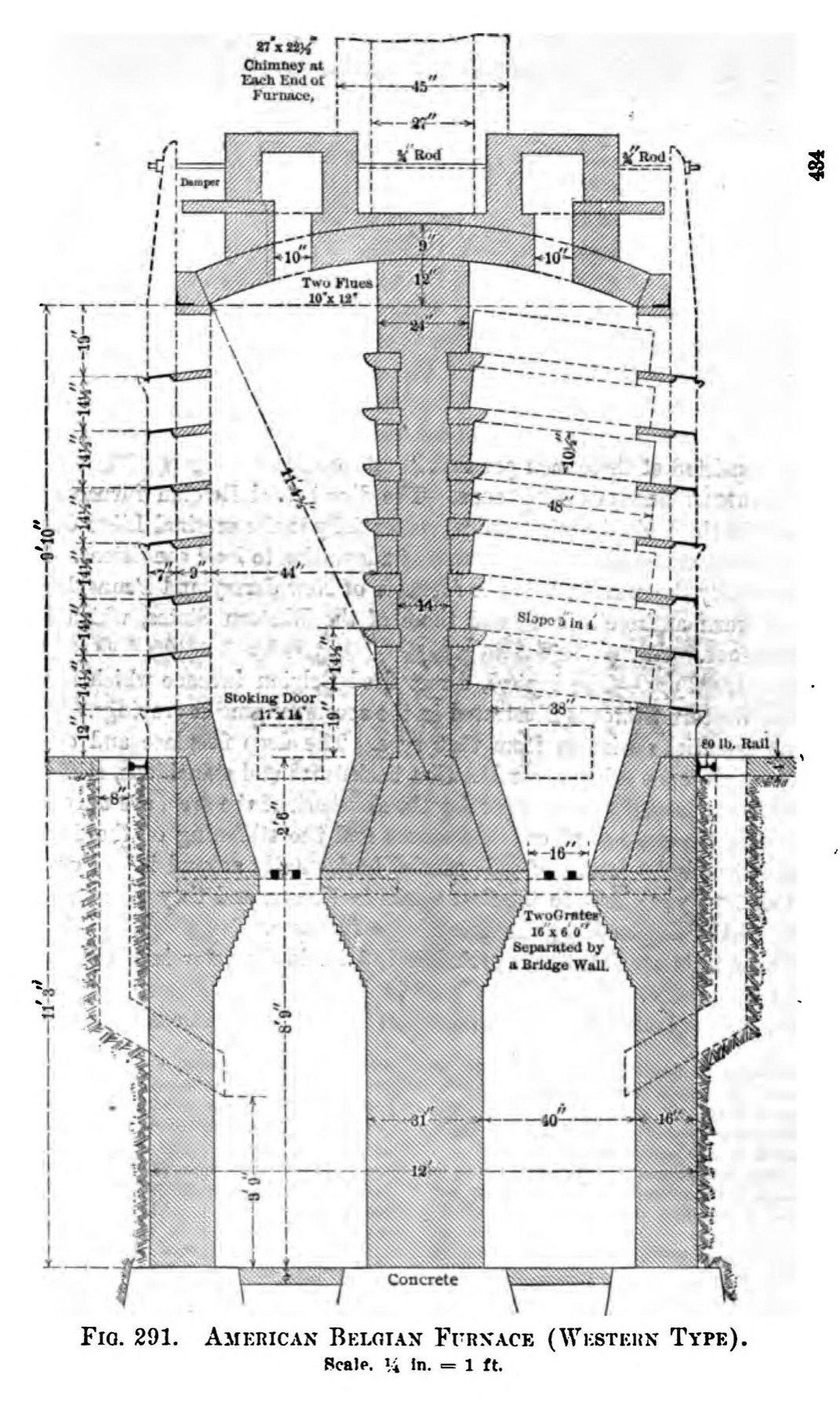
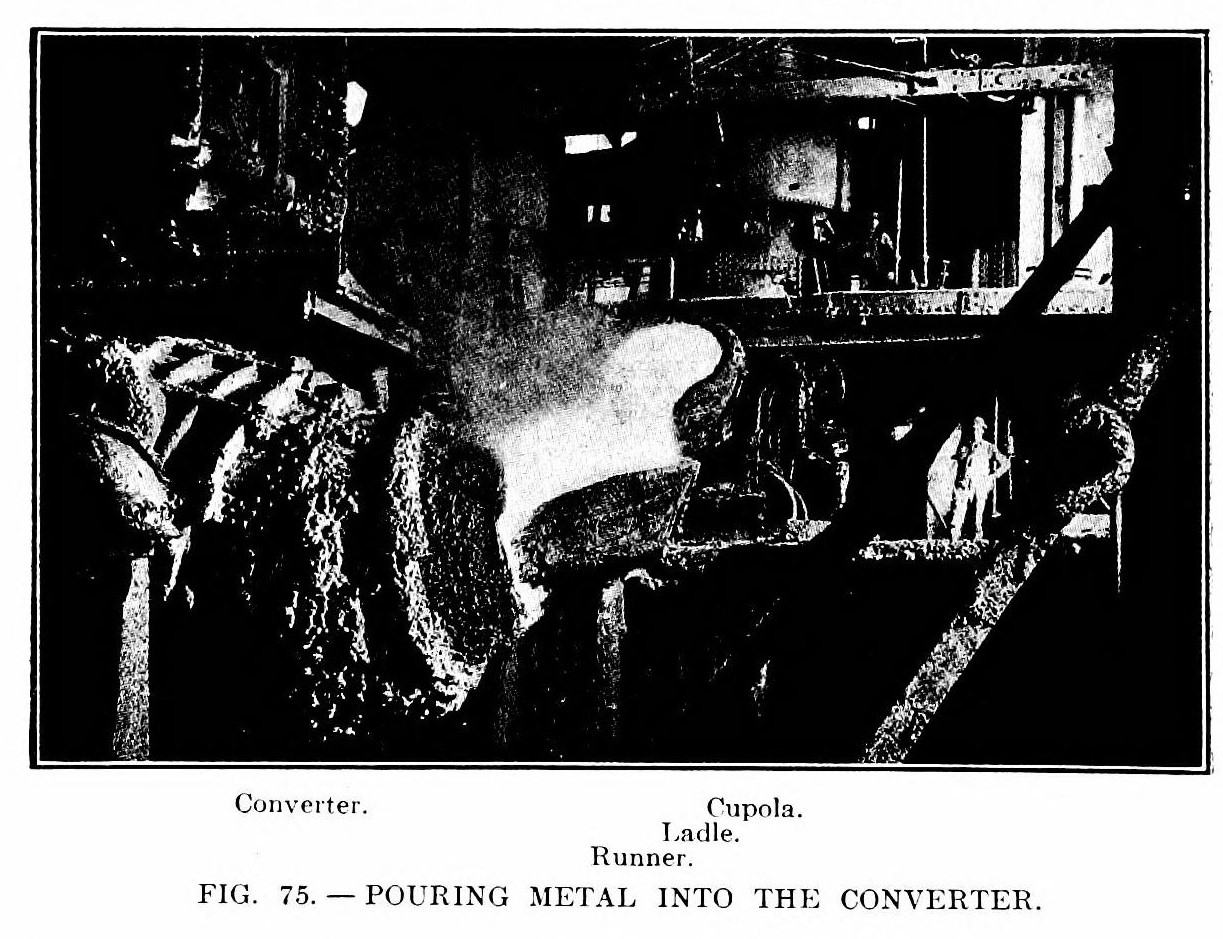
Bessemer process. “The process of decarburizing a bath of molten cast iron by blowing air through it, in a vessel called a converter (Raymond). Other impurities, in small amounts, are also eliminated. Also, by analogy, the enrichment of copper matte by blowing air through it when molten, thus oxidizing the sulphur which escapes as SO₂. The iron combines with silica, forming a slag. See also Converting.” (Fay, p. 76)
Billet. “1. Iron or steel, drawn from a pile, bloom, or ingot into a small bar for further manufacture. 2. A small bloom. (Raymond) …” (Fay, p. 78)
Blast furnace. “A furnace in which combustion is forced by a current of air under pressure, especially for smelting ores. A blast furnace is designated as hot-blast or cold-blast according to the temperature of the air used for the blast. The furnace is usually vertical, but varies greatly in size and shape (Webster)” (Fay, p. 84)
Bloom. “1. A large steel bar, drawn from an ingot for further manufacture. 2. A rough bar of iron, drawn from a Catalan or bloomery ball, for further manufacture. See also Billet. (Raymond) 3. A mass of iron or steel formed by consolidating scrap at a high temperature by hammering or rolling. …” (Fay, p. 87)
Calcine. “To expose to heat, with or without oxidation; to roast. Applied to ores for the removal of water and sulphur, and the disintegration of the mass; to limestone for the expulsion of its carbon dioxide; etc. (Raymond)” (Fay, p. 124)
Casting pit. “The space in a foundry in which the molds are placed and the castings made. In the Bessemer and open-hearth steel works it is the space utilized for casting the molten steel into the cast-iron ingot-molds. (Century)” (Fay, p. 138)
Chimney. “1. An ore shoot. Compare Chute, 2 (Raymond). 2. A steep and very narrow cleft or gully in the face of a cliff or mountain. 3. A smokestack. 4. A natural vent or opening in the earth as a volcano. (Webster) 5. (Eng.). A spout or pit in the goaf of vertical coal seams. (Gresley) 6. A term used in Virginia for limestone pinnacles bounding zinc ore deposits.” (Fay, p. 152)
Clinker. “1. The product of the fusion of the earthy impurities (ash) of coal during its combustion. (Raymond) 2. See Cinder coal, 1. 3. A partially vitrified brick or mass of bricks. … 5. A scale of black oxide of iron formed when iron is heated to redness in open air. (Century)” (Fay, p. 162)
Condenser. “A vessel or chamber in which volatile products of roasting or smelting (e. g., mercury or zinc vapors) are reduced to solid form by cooling, or in which the fumes of furnaces, containing mechanically suspended as well as volatile metallic matters, are arrested. (Raymond). …” (Fay, p. 176)
Converter. “1. An electric transformer (Standard). 2. A vessel in which metals or other materials are changed or converted from one shape or condition to another. Specifically an oval-shaped vessel or retort, hung on an axis, made of iron and lined with some refractory material, in which molten pig-iron is converted by the Bessemer process into steel (Century). Also used in converting copper matte.” (Fay, p. 180)
Cupola. “1. A shaft furnace with a blast, for remelting metals, preparatory to casting. Sometimes incorrectly pronounced and written Cupelo. (Raymond) 2. The offtake for smoke and return air erected at or near to the top of the upcast shaft. (Gresley) …” (Fay, p. 200)
Cupola furnace. “A shaft furnace built more slightly than the ordinary blast furnace, and usually of fire brick, hooped or cased with iron. It is chiefly used for remelting cast-iron for foundry purposes. (Century). See Cupola, 1.” (Fay, p. 200)
Flue. “1. A passage for air, gas, or smoke. (Raymond) 2. A British term used in the same sense as the term Tube is used in America. (Nat. Tube Co.) 3. (So. Wales). A furnace, as a large coal fire at or near the bottom of an upcast shaft for producing a current of air for ventilating the mine. (Gresley)” (Fay, p. 278)
Flux. “1. A salt or other mineral, added in smelting to assist fusion, by forming more fusible compounds. (Raymond) …” (Fay, p. 279)
Founding. “The act or process of casting metals. (Century)” (Fay, p. 285)
Foundry. “A manufacturing establishment in which articles are cast from metal: as, an iron foundry; brass foundry. (Standard)” (Fay, p. 285)
Fume. “… 2. Consists of metals or metallic compounds that have been volatilized at the high temperatures of the furnaces, condensed at lower temperatures, and carried by furnace gases into the flues. Sulphur trioxide and elemental sulphur, driven off from furnaces and condensed, are also classed as fume. (Bull. 98, U. S. Bur. Mines, p. 63) In general, all the volatile constituents of the ore charge are represented. The fume frequently contains appreciable amounts of silver, which is decidedly volatile under certain conditions. The particles of fume are very fine and are under the stress of certain physical forces, so they do not settle easily, as most of the flue dust does, but in large proportion pass through the stack with the gases and spread over the surrounding country, unless special preventive methods are used, as is now generally done. (Fulton, Bull. 84, U. S. Bur. Mines, p. 12). See Metallurgical fume.” (Fay, p. 289)
Furnace. “1. A structure in which, with the aid of heat so produced, the operation of roasting, reduction, fusion, steam-generation, desiccation, etc., are carried on, or, as in some mines, the upcast air current is heated, to facilitate its ascent and thus aid ventilation. (Raymond) 2. (Eng.) A large coal fire at or near the bottom of an upcast shaft, for producing a current of air for ventilating a mine. (Gresley)” (Fay, p. 290)
Hearth. “1. The floor or sole of a reverberatory. 2. The crucible of a blast furnace. (Raymond) 3. A bloomery. 4. A plate or table upon which cylinder glass is flattened. (Standard)” (Fay, p. 335)
Ingot. “A cast bar or block of metal. (Raymond)” (Fay, p. 360)
Kiln. “1. A furnace for the calcination of coarsely broken ore or stone; also, an oven for drying, charring, etc. (Raymond) 2. A potter's oven for baking biscuit or fictile ware. 3. A furnace for vitrifying, as bricks or porcelain. (Standard)” (Fay, p. 378)
Ladle. “1. A vessel into which molten metal is conveyed from the furnace or crucible, and from which it is poured into the molds. (Raymond) 2. In glass making, a cuvette. (Standard)” (Fay, p. 384)
Muffle. “A semi-cylindrical or long arched-oven (usually small and made of fire clay), heated from outside, in which substances may be exposed at high temperature to an oxidizing atmospheric current, and kept at the same time from contact with the gases from the fuel. Cupellation and scorification assays are performed in muffles, and on a larger scale copper ores were formerly roasted in muffle furnaces (Raymond). Used also in ceramics, for firing pottery specially decorated, as by painting or printing. (Standard)” (Fay, p. 454)
Open-hearth. “See Furnace. The form of regenerative furnace of the reverberatory type used in making steel by the Martin, Siemens, and Siemens-Martin processes. (Century)” (Fay, p. 473)
Oven. “A chamber in which substances are artificially heated for the purposes of baking, roasting, annealing, etc. Specifically: 1. A kiln; as, a coke-oven. 2. In glass-making, a leer. (Standard)” (Fay, p. 481)
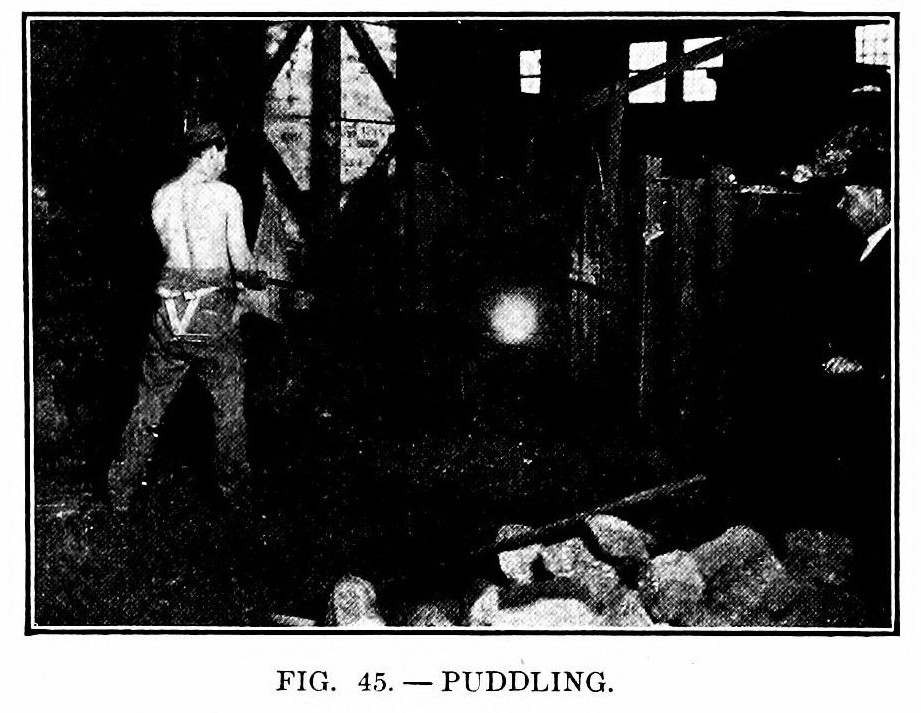
Puddling. “1. The process of decarburizing cast-iron by fusion on the hearth of a reverberatory furnace lined (fixed or fettled) with ore or other material rich in oxide of iron. The bath is stirred with a rabble to expose it to the action of the lining and of an air current. The escape of carbonic oxide causes it to boil, whence the early name of this method of puddling, viz., boiling. The term puddling, now applied in metallurgy exclusively to the above process, originally referred to the puddling of clay or clay and charcoal upon the masonry of a furnace hearth to form a lining. Ditches, reservoirs, etc., are puddled with clay to make them water-tight. 2. See Dry puddling. (Raymond)” (Fay, p. 543)
Residuum. “1. The residue obtained on the distillation of crude petroleum after the constituents boiling below 620° F. have been removed. 2. The residue left in the still after the distillation of crude oil has been completed, and not the residue from redistilled condensates. Also known as the cokings and tailings. (Bacon) 3. The material eventually resulting from the decomposition of rocks in place and consisting of the nearly …” (Fay, p. 565)
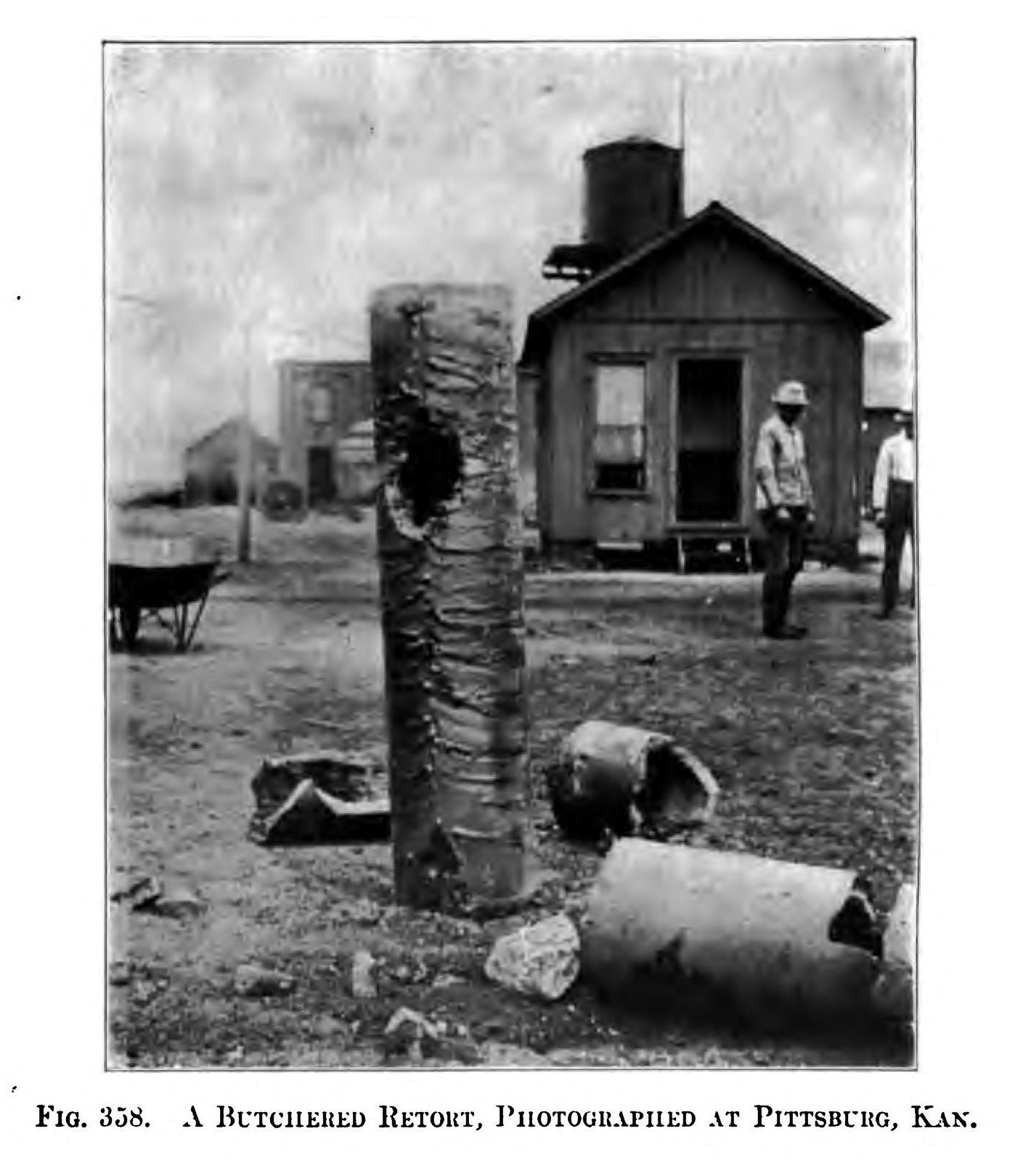
Retort. “1. A vessel with a long neck, used for distilling the quicksilver from amalgam. See Amalgam retort. 2. The vessel used in distilling zinc. (C. and M. M. P.) 3. To treat by heating in a retort, as gold amalgam, to drive off the mercury and recover the gold. (Webster)” (Fay, p. 566)
Salamander. “A mass of fused, but solidified, material in the hearth of a blast furnace, usually largely metallic iron, partly reduced ore, etc. Called also Bear, Sow, or Shadrach. In copper smelting it contains metallic copper and matte.” (Fay, p. 587)
Slab. “1. A split piece of timber from 2 to 3 inches thick, 4 to 6 feet long, and 7 to 14 inches wide, placed behind sets or frames of timber in shafts or levels. … 5. A mass of tin run into a stone mold. (Standard)” (Fay, p. 620)
Slag. “1. The vitreous mass separated from the fused metals in smelting ores. (Raymond) 2. To form a slag, or to cohere when heated so as to become a slag-like mass. (Century) 3. Volcanic scoria. (Standard)” (Fay, p. 621)
Smelter. “1. One who is engaged in smelting or who works in an establishment where ores are smelted. 2. In the United States, smelting works; an establishment where ores are smelted (Century). Also, more correctly called Smeltery.” (Fay, p. 627)
Smelting works. “An establishment in which metals are extracted from ores by furnaces. (Standard) A smeltery.” (Fay, p. 628)
Sow. “1. A tool used in sharpening machine-drill bits. (Gillette, p. 54) 2. A channel or runner which conducts the molten metal to the rows of molds in the pig bed. 3. A mass of metal solidified in such a channel or mold. (Webster) 4. An accretion that frequently forms in the hearth or crucible of a furnace. It consists mainly of iron. Also called Salamander, Bear, or Shadrach. 5. (Western U. S.) A movable shed used as a protection by miners. (Standard)” (Fay, p. 633–634)
Metals, ores and their names
Blende. “Without any qualification means zincblende or the sulphide of zinc, which has the luster and often the color of common resin, and yields a white streak and powder. The darker varieties are called blackjack by the English miners. Other minerals having this luster are also called blendes, as antimony blende, ruby blende, pitchblende, hornblende (Roy. Com.). It is often found in brown shining crystals, hence its name among the German miners, from the word blenden to dazzle.” (Fay, p. 86)
Brown iron ore. “Its approximate formula is 2Fe₂O₃.3H₂O, equivalent to about 59.8 per cent iron. Probably a mixture of hydrous iron oxides. (U. S. Geol. Surv.)” (Fay, p. 110)
Calamine. “1. A commercial, mining and metallurgical term comprising the oxidized ores of zinc, as distinguished from the sulphide ores (blendes). Used also by mineralogists as the name of mineral species, American mineralogists commonly calling the hydrous silicate of zinc, H₂O.2ZnO.SiO₂, by this name, but inasmuch as British mineralogists call the anhydrous carbonate, ZnCO₃, by the same name, some authorities advocate discontinuance of the use of the name for distinct mineral species and the confinement of its use to a class of ores, which was the original use and still is the commercial and technical use. (W. R. Ingalls, Trans. A. I. M. E., vol. 25, p. 17.) …” (Fay, p. 123)
Carbonate. “1. A salt formed by the union of carbonic acid with a base. 2. Any ore containing a large proportion of lead carbonate. See also Carbonates, 1.” (Fay, p. 132)
Cold-short. “Brittle when cold; applied chiefly to iron and steel (Raymond). Compare Red-short.” (Fay, p. 170)
Franklinite. “An iron-manganese-zinc oxide mineral, (Fe, Zn. Mn)O.(Fe, Mn)₂O₃. (U. S. Geol. Surv.)” (Fay, p. 286)
Hard metal. “An alloy of about two parts copper with one of tin, prepared in the process of making gun metal. (Century)” (Fay, p. 331)
Magnetic ore. “A black, hard ore that is magnetic, as magnetite. (Standard)” (Fay, p. 414)
Needle ore. “1. Aikinite. A lead-copper-bismuth sulphide. (Dana) 2. Iron ore of very high metallic luster, found in small quantities which may be separated in long slender filaments resembling needles. (Standard)” (Fay, p. 458)
Oxide. “A compound of the element oxygen with another element or elements, as Fe₂O₃. (Roy. Com.)” (Fay, p. 483)
Pig iron. “Crude cast-iron from the blast furnace. When the furnace is tapped the molten iron flows down a runner molded in sand, from which it enters the sows or lateral runners, flowing from these again into the pig beds, the separate parallel molds of which form the pigs. In each bed the ingots lie against the sow like suckling pigs, whence the two names. Mine pig is pig iron made from ores only; cinder pig from ores with admixture of some forge or mill cinder. (Raymond)” (Fay, p. 509)
Plumbago. “The mineral graphite chiefly used in the manufacture of pencils, etc.; more commonly known as black lead, and very often wrongly thought to be lead by its resemblance to it (Skinner). Also used as a lubricant.” (Fay, p. 523)
Protoxide. “The oxide of any metal containing the least proportion of oxygen. (Weed)” (Fay, p. 541)
Silicate. “1. A salt or ester of any of the silicic acids. In mineralogical chemistry the silicates are of great importance, forming by far the largest group of minerals. (Webster) 2. A term used in the Joplin (Mo.), district for zinc carbonate.” (Fay, p. 615)
Specular. “Mirror-like, as specular iron ore, which is a hard variety of hematite. See Specularite.” (Fay, p. 635)
Spelter. “The zinc of commerce, more or less impure, in slabs, plates or ingots cast from molten metal. It does not include zinc dust.” (Fay, p. 636)
Spiegeleisen. “Manganiferous white cast iron (Raymond). Used in the manufacture of steel by the Bessemer process. Called Spiegel; Spiegel-iron.” (Fay, p. 637)
Steel ore. “A name given to various iron ores and especially to siderite, because it was supposed to be especially adapted for making steel by the earlier and direct process. (Century). See also Stahlstein” (Fay, p. 647)
Sulphate. “1. A salt or ester of sulphuric acid. 2. To treat or impregnate with sulphuric acid or a sulphate; to convert into sulphate. … (Webster)” (Fay, p. 661)
Sulphide. “A binary compound of sulphur, or one so regarded. Formerly called Sulphuret. Excepting the sulphides of alkali and alkaline earth metals, the metallic suphides are insoluble in water, or nearly so, and many occur as minerals. (Webster)” (Fay, p. 662)
White bronze. “A light-colored variety of bronze due to increased proportion of tin. (Standard)” (Fay, p. 741)
White iron. “1. A hard crystalline cast iron containing combined carbon. 2. Tinned sheet iron. (Standard)” (Fay, p. 741)
Zinc white. “Oxide of zinc. (Raymond)” (Fay, p. 752)
Business
Assay. “1. To test ores or minerals by chemical or blowpipe examination. To determine the proportion of metals in ores by smelting in the way appropriate to each. Gold and silver require an additional process called cupelling, for the purpose of separating them from the base metals. See Fire assay. 2. An examination of a mineral, an ore, or alloy differing from a complete analysis in that it determines only certain ingredients in the substance examined, whereas an analysis determines everything it contains.” (Fay, p. 47)
Bullion. “1. Uncoined gold and silver. Base bullion is usually pig lead containing but little gold or silver. (Lawver) 2. Gold and silver coined but considered simply with reference to its commercial value as raw material. …” (Fay, p. 114)
Claim. “1. The portion of mining ground held under the Federal and local laws by one claimant or association, by virtue of one location and record (Raymond). Lode claims, maximum size 600 by 1,500 feet. Placer claims 660 by 1,320 feet. A claim is sometimes called a "location." See Mining claims. 2. (So. Afr.) The portion of land upon a goldfield to which a miner is legally entitled. …” (Fay, p. 158)
Gross ton. “The long ton of 2240 pounds avoirdupois.” (Fay, p. 320)
Lease. “1. A contract for the possession and profits of lands for a determinate period, in consideration of a recompense of rent. 2. The instrument by which such grant is made. 3. A piece of land leased for mining purposes.” (Fay, p. 393)
Long ton. “A ton of 2,240 avoirdupois pounds. Equal to 1,016.06 kilograms. (Webster)” (Fay, p. 407)
Parcel. “1. (So. Staff.) An old term for a ton; really 27 cwts. (Gresley) 2. (Corn.) A heap of dressed ore ready for sale. (Raymond)” (Fay, p. 490)
Promoter. “A person who alone or with others sets on foot, and takes the preliminary steps in, a scheme or undertaking for the organization of a company, the floating of bonds, stocks, etc., or the carrying out of any business project (Webster); e. g., a mine promoter.” (Fay, p. 539)
Royalty. “1. (Eng.). The mineral estate or area of a colliery, or a portion of such property. A field of mining operations. (Gresley) 2. A seigniorage on gold and silver coined at the mint. 3. (Eng.). A percentage paid to the crown, of gold or silver taken from mines, or a tax in lieu of such share of the product or profit (Webster). See Acreage rent. 4. The amount paid by the lessee, or operator, to the owner of the land, mineral rights or mine equipment, based on a certain amount per ton or a per cent of total mineral production.” (Fay, p. 581)
Tonnage. “The amount of ore handled per day. The amount of ore in sight.” (Fay, p. 691)
Words of these mines
Some words were local, or meant something particular here. These come from The Picking Table: from William D. Lord Jr.’s “A Study of Top-Slicing at the Franklin Mine,” with its own glossary, from Stephen Sanford’s “Franklin-Sterling Hill Mining Terms: A Primer for the Novice,” and from the memories of men who worked underground. They are grouped below by kind, A to Z within each group, and each is quoted from the page it is linked to.
Miners’ talk
10 hundred. Miners' way of saying the 1000-foot level. “The gentleman known as Deadman was my runner once on 10 hundred.” (The Picking Table, vol. 44, no. 1, Spring 2003)
10-stick bomb. Charge of ten dynamite sticks on a pole, fired to free a hung chute. “Ron and I had been putting 10-stick bombs on long wooden loading poles and firing” (The Picking Table, vol. 44, no. 1, Spring 2003)
finish miner. A fully experienced miner (about five years to become one). “it took a sharp fellow about five years to learn enough to be considered a 'finish' (i.e., experienced) miner” (The Picking Table, vol. 33, no. 2, Autumn/Winter 1992)
highgrader. Someone pocketing the best specimens for himself. “They didn't want any highgrader in there, of course; they needed to sell the best specimens to save the mine.” (The Picking Table, vol. 44, no. 1, Spring 2003)
hung up. A chute or ore pass jammed with muck. “They were, in miner's parlance, hung up.” (The Picking Table, vol. 44, no. 1, Spring 2003)
money specimen. A specimen good enough to sell (Hauck era, to save the mine). “As Richard Hauck would say, "That's a money specimen."” (The Picking Table, vol. 44, no. 1, Spring 2003)
scuz on a rock. Bob Hauck's dismissive term for microminerals. “He didn't like microminerals; he would call them "scuz on a rock."” (The Picking Table, vol. 44, no. 1, Spring 2003)
Jobs
mucker. Man who shoveled broken ore; two per pillar team in the 1920s. “a mucker (a member of a four man team of 2 muckers, a timberman and, of course, the runner)” (The Picking Table, vol. 18, no. 2, September 1977)
nipper. Underground carrier of drills and tools. “advanced to the position of drill nipper and underground tool repairman.” (The Picking Table, vol. 18, no. 2, September 1977)
runner. Lead miner of a team, in charge of drilling and firing. “The runner, who did the drilling and firing, commanded a wage of 60 cents per hour.” (The Picking Table, vol. 18, no. 2, September 1977)
timberman. Miner who set timber in the working place. “a four man team of 2 muckers, a timberman and, of course, the runner” (The Picking Table, vol. 18, no. 2, September 1977)
woodpecker. Miners' name for geologist Jack Baum and his little pointed hammer. “a "woodpecker" - a fellow with a little pointed hammer named Jack Baum - visited the sight daily” (The Picking Table, vol. 18, no. 2, September 1977)
Working the stopes
breasting. Widening a pillar slice out from the center-cut; also holding back fill with timber. “That part of the operation of extracting a pillar slice after the centercut has been completed, i.e., "breasting" to the stopes” (The Picking Table, vol. 32, no. 2, Fall 1991)
broken ore. Ore near old sand-filled workings, already fractured and spalling. “This term usually used in conjunction with sand, in areas near old workings that have been sand-filled” (The Picking Table, vol. 32, no. 2, Fall 1991)
center-cut. First cut through a pillar slice, driven foot to hanging. “The cross-cut or cuts in the center of a pillar slice driven from foot to hanging as the first step in mining a pillar.” (The Picking Table, vol. 32, no. 2, Fall 1991)
company time. Guaranteed hourly wage for work not paid on contract. “The guaranteed hourly wage-rate. Any work not performed on "contract".” (The Picking Table, vol. 32, no. 2, Fall 1991)
cracked-blocky ore. Hard fractured ore needing much secondary blasting. “Solid ore, fractured, usually quite hard, and which breaks up only along slips and cracks, requiring a substantial amount of secondary blasting.” (The Picking Table, vol. 32, no. 2, Fall 1991)
crib. Timbered or built passage through the fill that carries muck down to a chute. “is passed down an inclined passage through the fill known as a "crib," and into a chute for loading into tram cars.” (The Picking Table, vol. 33, no. 2, Autumn/Winter 1992)
footwall. The rock under the ore; underfoot once the ore is mined. “The footwall is to the left of the ore here and is underfoot when the orebody has been mined.” (The Picking Table, vol. 33, no. 2, Autumn/Winter 1992)
hanging wall. The rock above the ore; overhead once the ore is removed. “The hanging wall is the body of country rock hanging over the miners' heads after the valuable ores have been removed” (The Picking Table, vol. 33, no. 2, Autumn/Winter 1992)
mat. The timber floor laid over each pillar slice, forming the roof of the next. “That timber floor which is laid to the limits of every pillar slice and which forms the roof of the next slice.” (The Picking Table, vol. 32, no. 2, Fall 1991)
mine north. The company grid's "north", aligned with the orebody's strike, not true north. “the company chose to align mine north with the predominant strike of the orebody.” (The Picking Table, vol. 33, no. 2, Autumn/Winter 1992)
muck. Broken ore (or rock) after blasting. “Broken ore in the stope, known as "muck,"” (The Picking Table, vol. 33, no. 2, Autumn/Winter 1992)
on contract. Franklin bonus system paying miners per ton produced. “the bonus system of the Franklin Mine, whereby the miners are paid a premium on a tons-produced-per-man basis.” (The Picking Table, vol. 32, no. 2, Fall 1991)
ore pass. Large raise for storing ore and feeding it down to the underground crushers. “The latter is a large raise or steeply inclined passage for storing ore and conveying it to the underground crushers” (The Picking Table, vol. 33, no. 2, Autumn/Winter 1992)
pillar. Block of ore left between stopes for support, mined later. “A vertical section of the ore-body between footwall and hanging wall, ... left between stopes in the earlier stages of mining.” (The Picking Table, vol. 32, no. 2, Fall 1991)
pillar slice. One horizontal ten-foot layer of a pillar. “A horizontal section of the pillar extending to the limits of the pillar and usually about ten feet in height.” (The Picking Table, vol. 32, no. 2, Fall 1991)
ribs and back. The walls (ribs) and roof (back) of a tunnel. “a drift showing its "ribs" and "back" the mining equivalents of the walls and top, respectively, of a tunnel.” (The Picking Table, vol. 33, no. 2, Autumn/Winter 1992)
roof bolting. Securing the back with long steel bolts and plates. “inserting three-, six-, or eight-foot long steel bolts and plates into a specially drilled hole.” (The Picking Table, vol. 33, no. 2, Autumn/Winter 1992)
scaling / "loose". Prying down loosened rock from the back after a blast. “is scaled for "loose" with a pry bar to knock down chunks and is then roof-bolted.” (The Picking Table, vol. 33, no. 2, Autumn/Winter 1992)
soft-crushed ore. Soft ore crushed by heavy ground; hard to drill, easy to break. “relatively soft ore which has been crushed by heavy ground. Very difficult to drill but no fragmentation problem.” (The Picking Table, vol. 32, no. 2, Fall 1991)
spiling. Driving boards downward to hold back fill while breasting. “holding back the fill of the stopes by braces and downward spiling as the ore pile is removed — the timbering sense.” (The Picking Table, vol. 32, no. 2, Fall 1991)
stope/pillar numbers. Workings named by mine-grid feet north, e.g. 970 Stope, 1220 Pillar. “the 970 Stope is a stope which, on the level it was begun, had a southernmost opening some 970 feet north of mine coordinate 00.” (The Picking Table, vol. 33, no. 2, Autumn/Winter 1992)
tram / tramming. To haul ore by rail car and motor to the ore pass. “ore cars and an electric motor (locomotive) carry or "tram" it to the ore pass.” (The Picking Table, vol. 33, no. 2, Autumn/Winter 1992)
Places in the mine
Cross Member. Thickened mass of ore joined to the West Limb at Sterling Hill. “The East Branch of the West Limb connects the mass of the Cross Member to the West Limb.” (The Picking Table, vol. 33, no. 2, Autumn/Winter 1992)
East Limb / West Limb. The two limbs of the folded Sterling Hill orebody. “The uppermost band of ore to the right at any given depth is called the East Limb; West Limb ore is to the left.” (The Picking Table, vol. 33, no. 2, Autumn/Winter 1992)
keel. Bottom fold of the orebody; Main Keel where East Limb becomes West. “the Main Keel is the major fold where East Limb becomes West.” (The Picking Table, vol. 33, no. 2, Autumn/Winter 1992)
scram drift. Short dead-end passage just below a level. “a short dead-end passage known as the scram drift.” (The Picking Table, vol. 44, no. 1, Spring 2003)
shaft pillar. Ore left around a shaft to protect it, mined last. “It lies above the Palmer shaft and was not mined until the end of the Franklin mine's operation in order to protect the shaft from collapse.” (The Picking Table, vol. 33, no. 2, Autumn/Winter 1992)
Gear
picking table. Surface belt where ore was sorted by hand and waste picked out; namesake of the journal. “the picking table at the head of the mine shaft where the ores were sorted and waste material rejected.” (The Picking Table, vol. 30, no. 1, Spring 1989)
powder box. Explosives box underground; also reused to hold specimens. “he kept some and put the rest in a powder box for others stopping by.” (The Picking Table, vol. 44, no. 1, Spring 2003)
regular set / long set. Standard center-cut timber set; long set has a 7-foot cap for breasting. “The same as the "regular set" except that the cap is longer” (The Picking Table, vol. 32, no. 2, Fall 1991)
scraper / slusher. Cable winch and bucket dragging muck to the crib; "scraper" at Franklin, "slusher" at Sterling. “a scraper (Franklin parlance) or slusher (Sterling-speak) motor pulls alternately on two or three cables” (The Picking Table, vol. 33, no. 2, Autumn/Winter 1992)
skip. Ore car hoisted up the shaft. “Skips are ore cars with a seven-ton capacity (at Sterling Hill) that haul ore up the shaft” (The Picking Table, vol. 33, no. 2, Autumn/Winter 1992)
stick of powder. One stick of dynamite (DuPont Gelex No. 2). “Stick of Powder. DuPont Gelex No. 2. Stick weighs about 0.278 pounds.” (The Picking Table, vol. 32, no. 2, Fall 1991)
Ore
black willemite. Gray-to-black willemite of Sterling Hill black ore. “while "black willemite" is gray or black.” (The Picking Table, vol. 57, no. 2, Fall 2016)
red ore / black ore. Sterling Hill ore types named for the color of their willemite. “Red ore and "black ore" were terms used by miners and staff to describe the two main types of ore at Sterling Hill, based on the color of willemite” (The Picking Table, vol. 57, no. 2, Fall 2016)
Colour words
iron black. A colour term used for manganese oxides. “the brownish black to iron black mineral associated, for example, with rhodochrosite, sussexite, and mooreite.” (The Picking Table, vol. 1, no. 1, February 1960)
How mineral names end
Most mineral names end in -ite, but not all, and the exceptions are a clue to a name’s age and to who coined it. A. H. Chester put it this way in 1896: “While the large majority of them end in -ite, there are many in -ine, while -ane, -ase, -ose, and several others have been often used.” The -ite ending, he wrote, “has the sanction of antiquity, for it was used by the old Greek writers in the forms -ites or -itis,” as in αἱματίτης, “hematite,” and ἀλαβαστρίτις, “alabaster,” and by Pliny in siderites, “lodestone,” and steatitis, “soapstone” (p. vii). No ending was ever made a rule. As late as 1896 Chester could write: “It is to be regretted that the termination -ite has not been universally adopted.” Chemistry has its own endings, such as the -ide of oxide and sulphide, but these are not mineral-name endings.
Two efforts to tidy the endings bear on Franklin. J. D. Dana, in the fifth edition of what Chester called “his great work on Mineralogy,” changed many names to -ite, “particularly those ending in -ine,” so that galena became galenite and pyrrhotine pyrrhotite. And in 1876 C. U. Shepard proposed that species names end in -ite and that “the termination -ine shall as uniformly be used for all variety names, and those whose specific character is not fully settled” (p. viii). That is why his Franklin name of that year is keatingine, not keatingite (see the names that did not last). Chester added: “It is hardly necessary to say that these suggestions have not been generally or fully accepted.”
The list of species found at Franklin and Sterling Hill, as revised by the Mineral List Committee in August 2017, has 367 names. (Where each name comes from, mineral by mineral, is on What the names mean.) The sections below sort them by how they end, give the reason for each ending, and list every mineral under its ending, A to Z.
-itethe Greek -ites and -itis, in use since antiquity; now the usual ending
All 319 on the 2017 list, A to Z: Acanthite, Actinolite, Adamite, Adelite, Aegirine-augite, Akrochordite, Albite, Allactite, Allanite-(Ce), Alleghanyite, Anandite, Andradite, Anglesite, Anhydrite, Annabergite, Annite, Anorthite, Antigorite, Antlerite, Aragonite, Arakiite, Arseniosiderite, Arsenolite, Arsenopyrite, Atacamite, Augite, Aurichalcite, Aurorite, Austinite, Axinite-(Fe), Axinite-(Mn), Azurite, Bakerite, Bannisterite, Bariopharmacosiderite, Barylite, Barysilite, Bassanite, Baumhauerite, Bementite, Berthierite, Bianchite, Birnessite, Bornite, Bostwickite, Brandtite, Breithauptite, Brochantite, Brookite, Brucite, Bultfonteinite, Bustamite, Cahnite, Calcite, Canavesite, Carrollite, Caryopilite, Cerussite, Chabazite-Ca, Chalcocite, Chalcophanite, Chalcopyrite, Chamosite, Charlesite, Chlorophoenicite, Chondrodite, Cianciulliite, Clinohedrite, Clinohumite, Clinozoisite, Clintonite, Conichalcite, Connellite, Covellite, Cummingtonite, Cuprite, Cuprostibite, Cyanotrichite, Datolite, Descloizite, Digenite, Djurleite, Dolomite, Domeykite, Dravite, Duftite, Dundasite, Dypingite, Edenite, Epsomite, Erythrite, Esperite, Euchroite, Eveite, Fayalite, Feitknechtite, Ferrimolybdite, Ferro-actinolite, Flinkite, Fluckite, Fluoborite, Fluor-uvite, Fluorapatite, Fluorapophyllite-(K), Fluorapophyllite-(Na), Fluorite, Fluorophlogopite, Forsterite, Fraipontite, Franklinfurnaceite, Franklinite, Franklinphilite, Friedelite, Gageite, Gahnite, Ganomalite, Ganophyllite, Genthelvite, Gersdorffite, Gerstmannite, Glaucochroite, Goethite, Goldmanite, Graeserite, Graphite, Greenockite, Groutite, Grunerite, Guerinite, Haidingerite, Halotrichite, Hancockite, Hardystonite, Hastingsite, Hauckite, Hausmannite, Hawleyite, Hedenbergite, Hellandite-(Y), Hematite, Hemimorphite, Hendricksite, Hercynite, Hetaerolite, Heulandite-Na, Hexahydrite, Hodgkinsonite, Holdenite, Hübnerite, Humite, Hydrohetaerolite, Hydrotalcite, Hydroxyapophyllite-(K), Hydrozincite, Ilmenite, Jacobsite, Jarosewichite, Jarosite, Jerrygibbsite, Johannsenite, Johnbaumite, Junitoite, Kaolinite, Kentrolite, Kittatinnyite, Kolicite, Köttigite, Kraisslite, Kutnohorite, Larsenite, Laumontite, Lawsonbauerite, Legrandite, Lennilenapeite, Leucophoenicite, Linarite, Liroconite, Lizardite, Lollingite, Loseyite, Magnesio-riebeckite, Magnesiochlorophoenicite, Magnetite, Magnussonite, Malachite, Manganberzeliite, Manganhumite, Manganite, Manganocummingtonite, Manganohörnesite, Manganosite, Manjiroite, Marcasite, Margarite, Margarosanite, Marialite, Marsturite, Mcallisterite, McGovernite, Meionite, Meta-ankoleite, Metalodevite, Metazeunerite, Miguelromeroite, Mimetite, Minehillite, Molybdenite, Monazite-(Ce), Monohydrocalcite, Mooreite, Muscovite, Nasonite, Natrolite, Nelenite, Neotocite, Newberyite, Niahite, Nontronite, Norbergite, Ogdensburgite, Ojuelaite, Orthoserpierite, Otavite, Parabrandtite, Paragonite, Pararammelsbergite, Parasymplesite, Pargasite, Pectolite, Pennantite, Petedunnite, Pharmacolite, Pharmacosiderite, Phlogopite, Picropharmacolite, Piemontite, Pimelite, Powellite, Prehnite, Pumpellyite-(Mg), Pyrite, Pyroaurite, Pyrobelonite, Pyrochroite, Pyromorphite, Pyrophanite, Pyrosmalite-(Mn), Pyroxferroite, Pyroxmangite, Pyrrhotite, Rammelsbergite, Reinerite, Rhodochrosite, Rhodonite, Ribbeite, Richterite, Roeblingite, Roméite group, Rosasite, Rouaite, Roweite, Safflorite, Samfowlerite, Sarkinite, Sauconite, Schallerite, Scheelite, Sclarite, Scorodite, Seligmannite, Sepiolite, Serpierite, Siderite, Sillimanite, Skutterudite, Smithsonite, Sonolite, Spangolite, Sphalerite, Starkeyite, Sterlinghillite, Stibnite, Stilbite, Strontianite, Sussexite, Synadelphite, Synchysite-(Ce), Szaibelyite, Tennantite, Tenorite, Tephroite, Tetrahedrite, Thomsonite-Ca, Thorite, Thortveitite, Thorutite, Tilasite, Titanite, Todorokite, Torreyite, Tremolite, Turneaureite, Uraninite, Uranospinite, Vesuvianite, Wallkilldellite, Wawayandaite, Wendwilsonite, Willemite, Wollastonite, Woodruffite, Wulfenite, Wurtzite, Xonotlite, Yeatmanite, Yukonite, Zincite, Zinkenite, Znucalite.
-inean older ending; Dana changed many such names to -ite, and in 1876 Shepard wanted -ine kept for varieties and unsettled species
All 8 on the 2017 list, A to Z, and where each name comes from:
Aegirine. “From Ægir, the Scandinavian sea-god, as first described from Norway.” (Handbook of Mineralogy)
Almandine. “ALMANDINE. Said to be derived from Alabanda, Asia Minor. An early name for certain gems; at first for violet-colored spinel, and later for precious garnet.” (Chester, p. 7)
Celestine. “CELESTINE. See celestite. CELESTITE. A. G. Werner, 1799, Emm. Min., i, 183 (Cœlestin), f. cœlestis, 'heavenly,' because the first specimens noticed were of a "himmel-blauer Farbe," 'heavenly-blue color.' Sulphate of strontium, occurring in bluish or white prismatic crystals.” (Chester, p. 50)
Cuspidine. “From the Greek cuspis, for a spear, the characteristic shape of the twinned crystals.” (Handbook of Mineralogy)
Devilline. “DEVILLINE. F. Pisani, 1864, C. R., lix, 813, in honor of Prof. H. E. Sainte-Claire Deville. A var. of lyellite, containing gypsum as an impurity.” (Chester, p. 75)
Microcline. “From the Greek for little and inclined, for the small deviation of the cleavage planes from 90°.” (Handbook of Mineralogy)
Nickeline. “NICKELINE. See niccolite. NICCOLITE. J. D. Dana, 1868, Dana Min., 60, f. niccolum, 'nickel,' from its composition. Earlier called nickeline by F. S. Beudant, 1832, Beud. Min., ii, 586. Arsenide of nickel, from its copper color commonly called copper-nickel.” (Chester, p. 189)
Spessartine. “SPESSARTINE. See spessartite. SPESSARTITE. F. S. Beudant, 1832, Beud. Min., ii, 52 (Spessartine), f. Spessart, Germany, its locality. Manganese-aluminum garnet, usually dark red in color.” (Chester, p. 254)
-anethe tail of a Greek word, as in uranophane, from φαίνεσθαι, “to appear”
Chlorophane is not on the list, because it is a variety of fluorite, not a species, but Franklin has it too: “f. χλωρός, ‘green,’ and φαίνεσθαι, ‘to appear,’ because it emits a green light when heated. A var. of fluorite” (Chester, p. 56). Its glow is part of the story in Three glows.
All 4 on the 2017 list, A to Z, and where each name comes from:
Cryptomelane. “From the Greek for hidden and black, alluding to the mineral’s obscure identity as one of several black mineral species in “psilomelane”, the collective term for hard manganese oxides.” (Handbook of Mineralogy)
Hedyphane. “From the Greek for beautifully bright, in allusion to the typical luster of specimens.” (Handbook of Mineralogy)
Stilpnomelane. “STILPNOMELANE. E. F. Glocker, [1827, Beit. zur Min. Kenntn. d. Sudetenländer, (1), 68], 1831, Glock. Min., 572 (Stilpnomelan), f. στιλπνός, 'shining,' and μέλᾱς, -ᾰνος, 'black,' in allusion to its appearance. Hydrous silicate of iron and aluminum, occurring in black plates or a velvety-bronze coating.” (Chester, p. 259)
Uranophane. “URANOPHANE. M. Websky, 1853, Zt. Geol., v, 427 (Uranophan), f. Uran, 'uranium,' alluding to its composition, and φαίνεσθαι, 'to appear.' Hydrous silicate of uranium and calcium, found in yellow, fibrous masses.” (Chester, p. 278)
-asethe tail of a Greek word, as in anatase, from ἀνάτασις, “extension”
All 4 on the 2017 list, A to Z, and where each name comes from:
Anatase. “ANATASE. R. J. Haüy, 1801, Haüy Min., iii, 91, f. ἀνάτασις, 'extension,' because its common octahedron is longer than that of certain other minerals. A syn. of octahedrite.” (Chester, p. 11)
Anorthoclase. “ANORTHOCLASE. H. Rosenbusch, 1886, Rosen. Mik. Phys., 550. A triclinic, soda-potash feldspar, resembling orthoclase.” (Chester, p. 12)
Clinoclase. “From the Greek for to incline and to break, remarking the oblique basal cleavage.” (Handbook of Mineralogy)
Orthoclase. “From the Greek for straight and fracture, in allusion to the cleavage angle.” (Handbook of Mineralogy)
-ide, -ote and -oidtails of Greek words, as in diopside, from ὄψις, “view”; not the chemist’s -ide
All 3 on the 2017 list, A to Z, and where each name comes from:
Chloritoid. “CHLORITOID. G. Rosé, 1837, Rosé Reise, i, 252. So named on account of its resemblance to chlorite. A hydrous silicate of magnesium and iron, of a greenish or gray color.” (Chester, p. 56)
Diopside. “DIOPSIDE. B. J. d'Andrada, 1800, All. Jour. Chem., iv, 31, f. δίς, 'two,' and ὄψις, 'view,' because two views can be taken of its prismatic form. One of the many names given to pyroxene, now confined to the transparent varieties.” (Chester, p. 77)
Epidote. “EPIDOTE. R. J. Haüy, 1801, Haüy Min., iii, 72, f. ἐπίδοσις, 'increase,' because the base of the prism has one side longer than the other. Silicate of aluminum, iron and calcium, usually found in dark green crystals.” (Chester, p. 86)
-iana person’s name made into a mineral name
All 3 on the 2017 list, A to Z, and where each name comes from:
Celsian. “To honor the Swedish astronomer and naturalist, Anders Celsius (1701–1744).” (Handbook of Mineralogy)
Retzian-(La). “RETZIAN. H. Sjögren, [1894], 1895, Sjög. Cont. Min., (2), 80, in honor of Prof. A. J. Retzius. Arsenate of manganese and calcium, near flinkite.” (Chester, p. 231)
Retzian-(Nd). “RETZIAN. H. Sjögren, [1894], 1895, Sjög. Cont. Min., (2), 80, in honor of Prof. A. J. Retzius. Arsenate of manganese and calcium, near flinkite.” (Chester, p. 231)
No standard endingolder words kept whole, from Latin, Greek, German and Arabic
These keep the shape of an older word, Latin, Greek or German, without a naming ending added. Galena is “the name used by Pliny” for lead ore (p. 100); its -a is simply the end of the Latin word. Pliny the Elder used it in his Natural History of about AD 77, in the book on gold and silver: silver could be smelted only with lead “or with galena, this last being the name given to the vein of lead that is mostly found running near the veins of the silver ore” (book 33, chapter 31, in the translation of John Bostock and H. T. Riley, vol. 6, 1857, p. 112). The translators’ note adds: “Native sulphurate of lead is now known as ‘galena.’” A word written down by a Roman naturalist nineteen centuries ago is the name on the Franklin species list today. Dana gave it the standard ending as galenite, but the change did not hold, and the 2017 list has galena. Likewise quartz, “An old German word of uncertain derivation” (p. 226).
All 26 on the 2017 list, A to Z, and where each name comes from:
Analcime. “From the Greek for weak, alluding to the weak electrostatic charge developed when heated or rubbed.” (Handbook of Mineralogy)
Arsenic. “ARSENIC. From ἀρσενικόν, 'orpiment.' The element as a mineral, usually called native arsenic.” (Chester, p. 19)
Chrysocolla. “From the Greek for gold and glue, for a substance used in the soldering of gold, including chrysocolla as well as other blue and green minerals.” (Handbook of Mineralogy)
Chrysotile. “CHRYSOTILE. F. v. Kobell, 1834, Jour. Pk. Ch., ii, 297, f. χρῡσός, 'gold,' and τίλος, 'fibre.' A fibrous var. of serpentine often with a metallic lustre.” (Chester, p. 59)
Clinochlore. “For its inclined optic axes and the Greek chloros, for green, its common color.” (Handbook of Mineralogy)
Copper. “COPPER. Natural metallic copper, usually called native copper.” (Chester, p. 64)
Corundum. “CORUNDUM. From kurund, its Indian name. Oxide of aluminum, in several varieties, including ruby, sapphire and the less pure emery.” (Chester, p. 65)
Ferrohornblende. “For its ferrous iron content and from the German for horn and to deceive, in allusion to its similarity to valuable minerals in ores.” (Handbook of Mineralogy)
Galena. “GALENA. See galenite. GALENITE. From galena, 'lead ore,' the name used by Pliny, 77, Bk. xxxiii, 31. Lead sulphide, occurring in brilliant, cubical crystals, and massive.” (Chester, p. 100)
Glaucodot. “GLAUCODOT. A. Breithaupt and K. F. Plattner, 1849, Pogg. Ann., lxvii, 127 (Glaukodot), f. γλαυκός, 'greenish-blue,' for 'blue,' and δοτήρ, 'a giver,' because used in the manufacture of smalt. Sulph-arsenide of cobalt and iron, occurring in tin-white octahedrons.” (Chester, p. 105)

Gold. “GOLD. The native metal as a mineral, usually called native gold.” (Chester, p. 106)
Grossular. “GROSSULAR. A. G. Werner, 1811, Hoff. Min., i, 479, f. Ribes grossularium, 'the gooseberry,' alluding to its color. A pale green var. of garnet, often called gooseberry-garnet.” (Chester, p. 109-110)
Gypsum. “GYPSUM. An old name, f. γύψος, 'plaster.' Hydrous sulphate of calcium, a soft mineral of various colors, made into plaster of Paris by burning.” (Chester, p. 111)
Lavendulan. “LAVENDULAN. A. Breithaupt, 1837, Jour. Pk. Ch., x, 505, f. lavendula, 'lavender,' alluding to its color. An amorphous arsenate of copper colored with cobalt, of lavender-blue color.” (Chester, p. 151)
Lead. “LEAD. The metal as a mineral, usually called native lead.” (Chester, p. 152)
Magnesio-hornblende. “For its high magnesium content and from the German for horn and to deceive, in allusion to its similarity to valuable minerals in ores.” (Handbook of Mineralogy)
Opal. “OPAL. From opalus, the ancient name of the gem. Amorphous silica, containing a small percentage of water.” (Chester, p. 195)

Pararealgar. “In allusion to its chemical identity with realgar.” (Handbook of Mineralogy)
Quartz. “QUARTZ. G. Agricola, 1529, Agric., 451 (Quartzum). An old German word of uncertain derivation. Silicic acid in its various forms, including rock crystal, amethyst, agate, etc.” (Chester, p. 226)
Realgar. “REALGAR. From rahj al ghar, 'powder of the mine,' because it came from a silver mine. Red sulphide of arsenic, often found in monoclinic prisms.” (Chester, p. 228)
Rutile. “RUTILE. A. G. Werner, 1803, Ludw. Min., i, 55, f. rutilus, 'red,' in allusion to its color. Oxide of titanium, usually found in red or brownish-red prismatic crystals.” (Chester, p. 237)
Schorl. “SCHORL. J. G. Wallerius, 1747, Wall. Min., 139 (Schorl), the derivation of which is unknown. This name at first included many dark-colored species, found in prismatic crystals. Romé de L'Isle, 1772, De L. Cryst., 267, shows schorl to be indentical with tourmaline, of which it has since been a synonym. As shown by J. D. Dana, 1868, Dana Min., 206, it was used by Gesner in 1565 (Schrul), by Erker in 1595 (Shurl), and by Brückmann in 1727 (Schirl), and was applied to the 'black, little stones' which were rejected in the washing of gold and tin ores.” (Chester, p. 242)
Silver. “SILVER. The native metal as a mineral, usually called native silver.” (Chester, p. 249)
Spinel. “SPINEL. A word of obscure origin, but perhaps a diminutive from spina, 'a spine,' because at first applied to a mineral occurring in spine-shaped crystals. The name of a group of minerals crystallizing in octahedrons, but particularly applied to the aluminate of magnesium, sometimes with iron, manganese or chromium.” (Chester, p. 254)
Talc. “Probably from the Arabic talq.” (Handbook of Mineralogy)
Zircon. “ZIRCON. Of obscure origin, perhaps from the same source as jargon, which it has often been called. Silicate of zirconium, found in tetragonal crystals of various colors.” (Chester, p. 295)
Sources and further reading
- Chester, A. H., 1896, A dictionary of the names of minerals, including their history and etymology. New York: John Wiley & Sons. archive.org
- Fay, A. H., 1920, A glossary of the mining and mineral industry. U.S. Bureau of Mines Bulletin 95. archive.org
- Lord, W. D., Jr., A study of top-slicing at the Franklin mine (part 1 of 2). The Picking Table, vol. 32, no. 2, p. 17–23. The Picking Table (PDF)
- Mineral species found at Franklin–Sterling Hill, NJ, revised by the Mineral List Committee, August 2017. In the 2017 Franklin-Sterling Gem and Mineral Show booklet, Franklin-Ogdensburg Mineralogical Society, pp. 3–5. PDF
- Pliny the Elder, The natural history of Pliny, translated by J. Bostock and H. T. Riley, vol. 6 (books 32–37). London: Henry G. Bohn, 1857. Galena, book 33, chapter 31, p. 112. archive.org
- Raymond, R. W., 1881, A glossary of mining and metallurgical terms. American Institute of Mining Engineers. archive.org
- Sanford, S., Franklin-Sterling Hill mining terms: a primer for the novice. The Picking Table, vol. 33, no. 2, p. 14–19. The Picking Table (PDF)
- Thrush, P. W., ed., 1968, A dictionary of mining, mineral, and related terms. U.S. Bureau of Mines. archive.org
Written with Claude, an AI model made by Anthropic, from the sources listed above, and checked against them. October 2026.