The deeply weathered body of rock in the core of the Sterling Hill orebody: a local name for a kind of feature found over many zinc deposits in carbonate rock.
One mud zone
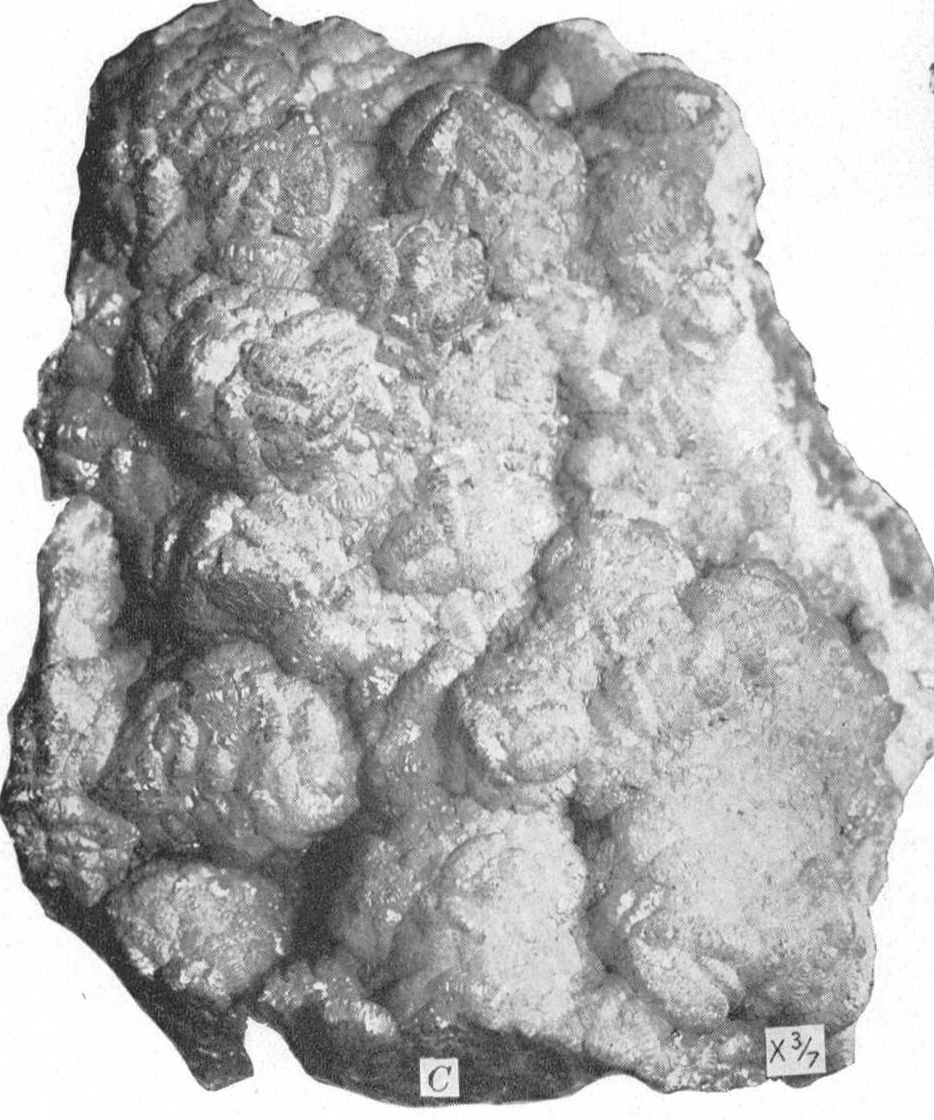
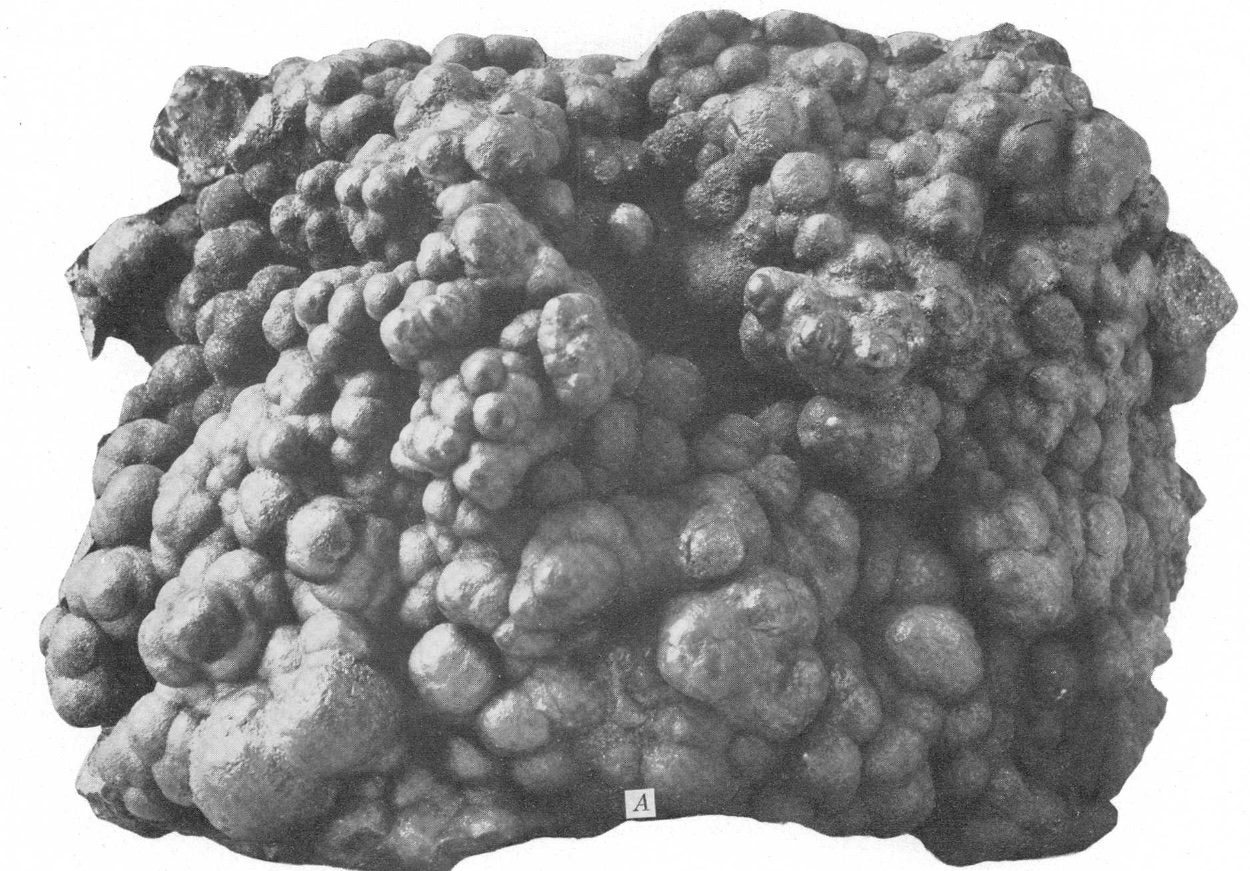
“The mud zone” is the name used at the Sterling Hill mine at Ogdensburg for a single body of deeply weathered rock in the core of the orebody, between its two limbs. At the surface it was worked from the 1860s to the 1890s in two open pits, the Noble and the Passaic, for calamine (hemimorphite). Charles Palache, writing in 1935 from the recollections of the Noble mine’s superintendent of 1878, described what the pits had shown: limestone walls that were clearly solution surfaces; a layer of calamine six to twelve inches thick lying on the limestone; a filling of sand, clay, limestone fragments and loose crystals of franklinite, willemite and garnet; and on one side a layer of “greasy black mud, rich in manganese,” up to four inches thick, which caused dangerous slides. He concluded that the deposit had formed by weathering of the outcropping ore, the dissolved zinc, iron and manganese being carried down to replace the limestone.
In 1962 The Picking Table printed “The Sterling Hill Mud Zone,” with a report by John L. Baum, the New Jersey Zinc Company’s resident geologist. Baum wrote that the zone had been known since 1870, but that its continuous extent downward, to a point just above the 700-foot level, was recognized only when the mine geologist R. W. Metsger had it tested by drilling on several levels. In plan it was an irregular oval; at the surface, a dumbbell whose two ends were the Noble and Passaic pits. A 1994 article on the copper minerals of the mine summarizes Metsger (1990): a large saprolite body that partly replaces the core of the orebody from the surface to a depth of about 207 meters, formed within the last two or three million years; Metsger’s own account (1998) gives 675 feet. Stephen Sanford, in “The Breakdown of Franklinite” (2021), describes it as an elongate, steeply inclined, roughly cylindrical mass of breccia of mixed, generally highly weathered rock fragments, whose origin “remain[s] unclear and largely unstudied.”
Baum’s 1962 list of minerals from the mud zone includes chalcophanite, hydrohetaerolite, goethite, cryptomelane, todorokite, woodruffite, nontronite and calamine, with residual crystals of jeffersonite, garnet, apatite and hornblende, “most of them found floating in the mud.” Several of Baum’s names have since changed: hydrohetaerolite is no longer on the International Mineralogical Association’s list and is now generally treated as a hetaerolite, jeffersonite was discarded as a name in 1988 (zincian manganoan diopside or augite), and hornblende is now a group name rather than a single species. Later issues describe aragonite and secondary calcite from it.
Seen from the surface: the calamine pits
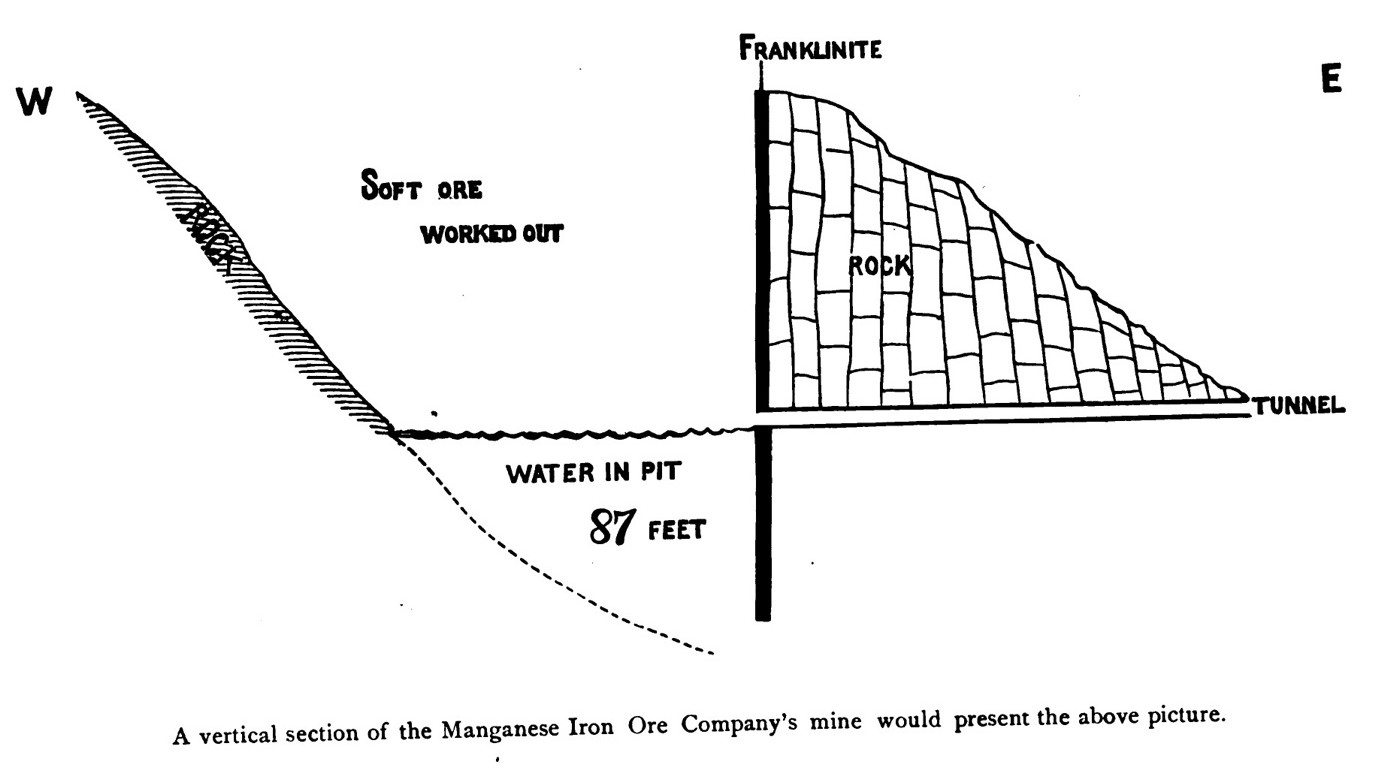
The pits were already deep holes by 1881. Franklin and W. G. Platt, examining Lot 10 at the south end of the hill, where the Noble mine was, described “two large deposits of soft decomposed ore, chiefly willemite (hydrous silicate of zinc), situated in deep cavities in the rock between the franklinite beds. They represent areas of irregular contour from which the limestone has been dissolved, while the ore particles impregnated through it, resisting the chemical action, remained behind in a medley of clay and sand” (Baker, 1881, p. 78). Their “hydrous silicate of zinc” is calamine, now hemimorphite. The company’s soft ore had been dug out down to a pit “said to be eighty-seven feet deep,” full of water (p. 81); its photograph is in the photo gallery.
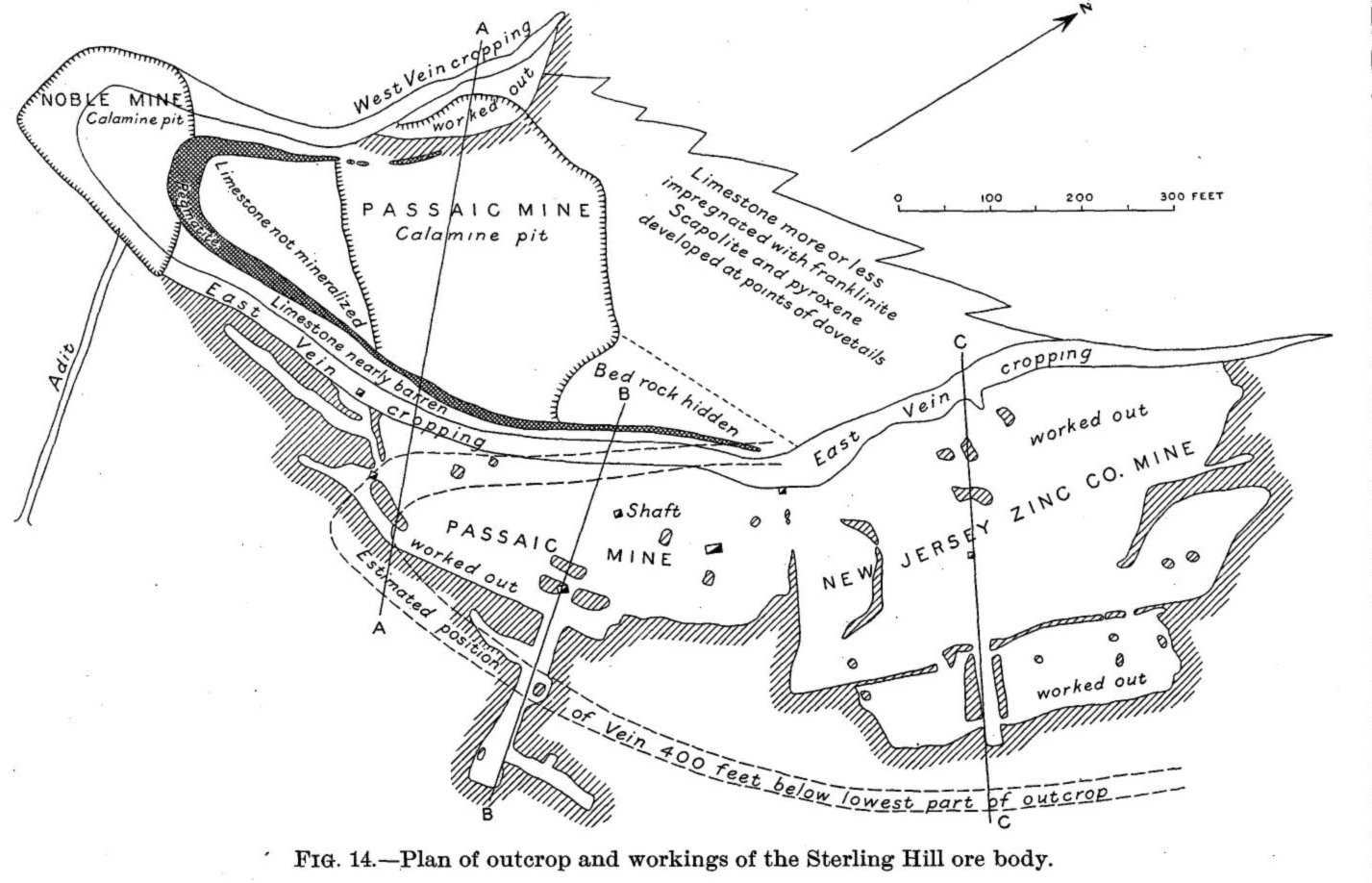
The 1908 survey’s plan shows the two pits, the Noble and the Passaic, in the middle of the fold, between the outcrops of the east and west veins: the surface of the body that Baum and Metsger later followed down to the 700-foot level.
Is it a common thing?
At Sterling Hill there is one mud zone. Franklin had nothing on the same scale: Earl R. Verbeek mentions only a smaller body of extensively weathered rock near the top of the northern part of the west limb of the Franklin orebody, and Palache wrote that, apart from this one “notable exception” at Sterling Hill, the minerals formed by surface alteration were of minor interest in the district.
Elsewhere the feature is common, under other names. Where zinc deposits in limestone or dolomite are weathered, the zinc is often redeposited near the surface as “calamine” ores of smithsonite, hemimorphite and zinc clays. The British Columbia Geological Survey’s profile of supergene nonsulphide zinc–lead deposits (Paradis and Simandl, 2011), which lists La Calamine in Belgium among its examples, divides them into direct replacement and wallrock replacement deposits and the less common “residual and karst-fill” deposits: accumulations of ferruginous, earthy material and hemimorphite–clay mixtures in karst cavities that cut through the ore. “Mud zone” is the Sterling Hill name for a body of this kind of weathering. What sets it apart is its parent ore. Most such deposits form from zinc sulfides; the Sterling Hill mud zone formed, as Palache noted, from an orebody of franklinite and willemite, and its minerals are correspondingly rich in manganese.
In The Picking Table
The mud zone has its own article, “The Sterling Hill Mud Zone” (vol. 3, no. 2, July 1962), which reprints Palache’s account of the calamine pits and adds John L. Baum’s report and mineral list. Frank Z. Edwards’s “The Minerals of Sterling Hill 1962–65” (vol. 7, no. 2, August 1966) lists the Sterling Hill minerals of those years, many of them from mud zone material, and Richard C. Bostwick’s survey of the fluorescent minerals (vol. 18, no. 1, March 1977) describes its aragonite. Robert E. Jenkins II and Steven C. Misiur, in “A Complex Base-Metal Assemblage from the Sterling Mine, New Jersey” (vol. 35, no. 2, Autumn/Winter 1994), summarize Metsger’s account of its age. Robert W. Metsger’s “The Geology and Mining of the Sterling Hill Zinc Deposit” (vol. 39, no. 2, Fall/Winter 1998) describes both the great saprolite-filled depression over the mine and the smaller saprolite of the mud zone. Earl R. Verbeek’s “Fluid Flow in Metamorphic Rocks, Part 3” (vol. 56, no. 2, Fall 2015) sets it among the solution features of the district, and William H. Peck, Matthew F. Shramko and Verbeek’s “Carbon and Oxygen Isotopes of Secondary Carbonates at Franklin and Sterling Hill” (vol. 57, no. 2, Fall 2016) analyze aragonite, calcite and azurite from in and around it. Two pieces of 2021 close the list: Paul Shizume’s “A Sterling Hill Mud Zone Calcite” (vol. 62, no. 1) and Stephen Sanford’s “The Breakdown of Franklinite” (vol. 62, no. 2). No article in The Picking Table has set the mud zone beside the weathered zinc deposits of other districts.
Sources and further reading
- Aragonite (on its occurrence in the mud zone). The Picking Table, vol. 18, no. 1 (March 1977). The Picking Table (PDF)
- Article on the oxidized copper minerals of the Chalcopyrite Room, Sterling Hill, citing Metsger (1990) on the Mud Zone. The Picking Table, vol. 35, no. 2 (Autumn/Winter 1994). The Picking Table (PDF)
- Edwards, F. Z., 1962, The Sterling Hill Mud Zone (with a report by J. L. Baum). The Picking Table, vol. 3, no. 2 (July 1962), p. 7–10. The Picking Table (PDF)
- Palache, C., 1935, The minerals of Franklin and Sterling Hill, Sussex County, New Jersey. U.S. Geological Survey Professional Paper 180. The calamine deposits of Sterling Hill, p. 22–23; plate 16. PDF
- Paradis, S., and Simandl, G. J., 2011, Carbonate-hosted, nonsulphide Zn–Pb (supergene), mineral deposit profile B09. British Columbia Geological Survey, Geological Fieldwork 2010, Paper 2011-1. PDF
- Sanford, S., 2021, The breakdown of franklinite. The Picking Table, vol. 62, no. 2 (Fall 2021), p. 9 ff. The Picking Table (PDF)
- Shizume, P., 2021, A Sterling Hill Mud Zone calcite. The Picking Table, vol. 62, no. 1 (Spring 2021), p. 21. The Picking Table (PDF)
- Verbeek, E. R., 2015, Fluid flow in metamorphic rocks, part 3. The Picking Table, vol. 56, no. 2 (Fall 2015), p. 9 ff. The Picking Table (PDF)
Written with Claude, an AI model made by Anthropic, from the sources listed above, and checked against them. October 2026.