Histories › The mines and their history
How a Pennsylvania zinc man found a way to lift franklinite away from willemite, and changed what the Franklin ore was worth.
A stubborn ore
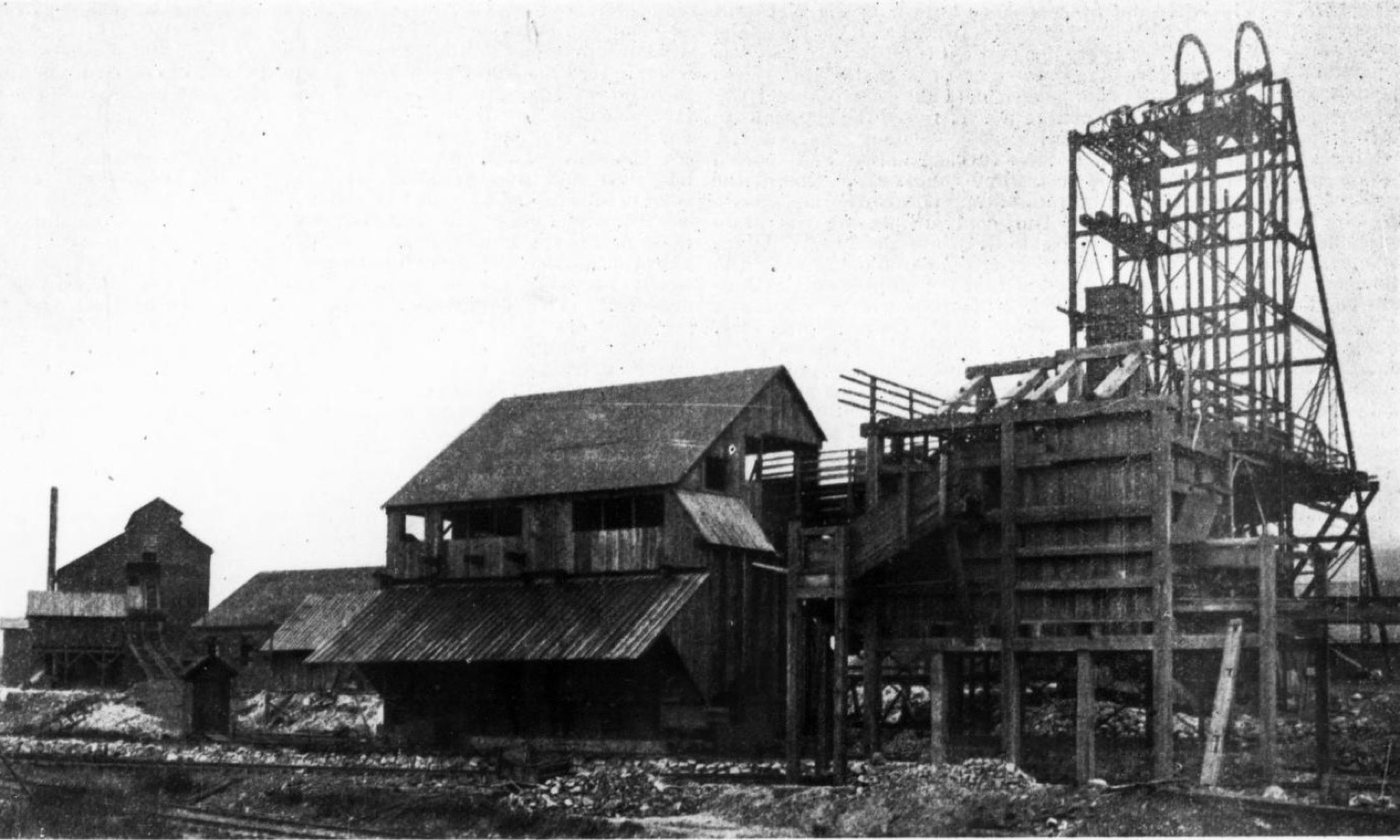
Franklin ore is a mixture: black franklinite, green and brown willemite, red zincite, all in white calcite. Each zinc mineral wanted different treatment, and the franklinite, heavy with iron and manganese, got in the way. Put into a zinc furnace, the iron and manganese made a slag that ate the retorts.
From the 1850s the answer was Samuel Wetherill’s furnace, first used at Newark, which roasted the ore with anthracite coal and drove the zinc off as zinc oxide, the white pigment. What was left could be smelted into spiegeleisen, an iron rich in manganese, but there was little market for it until the Bessemer steel process made one. Earlier magnetic separators had been tried and failed: franklinite is only weakly magnetic, and an ordinary magnet left much of it behind.
The Wetherill separator
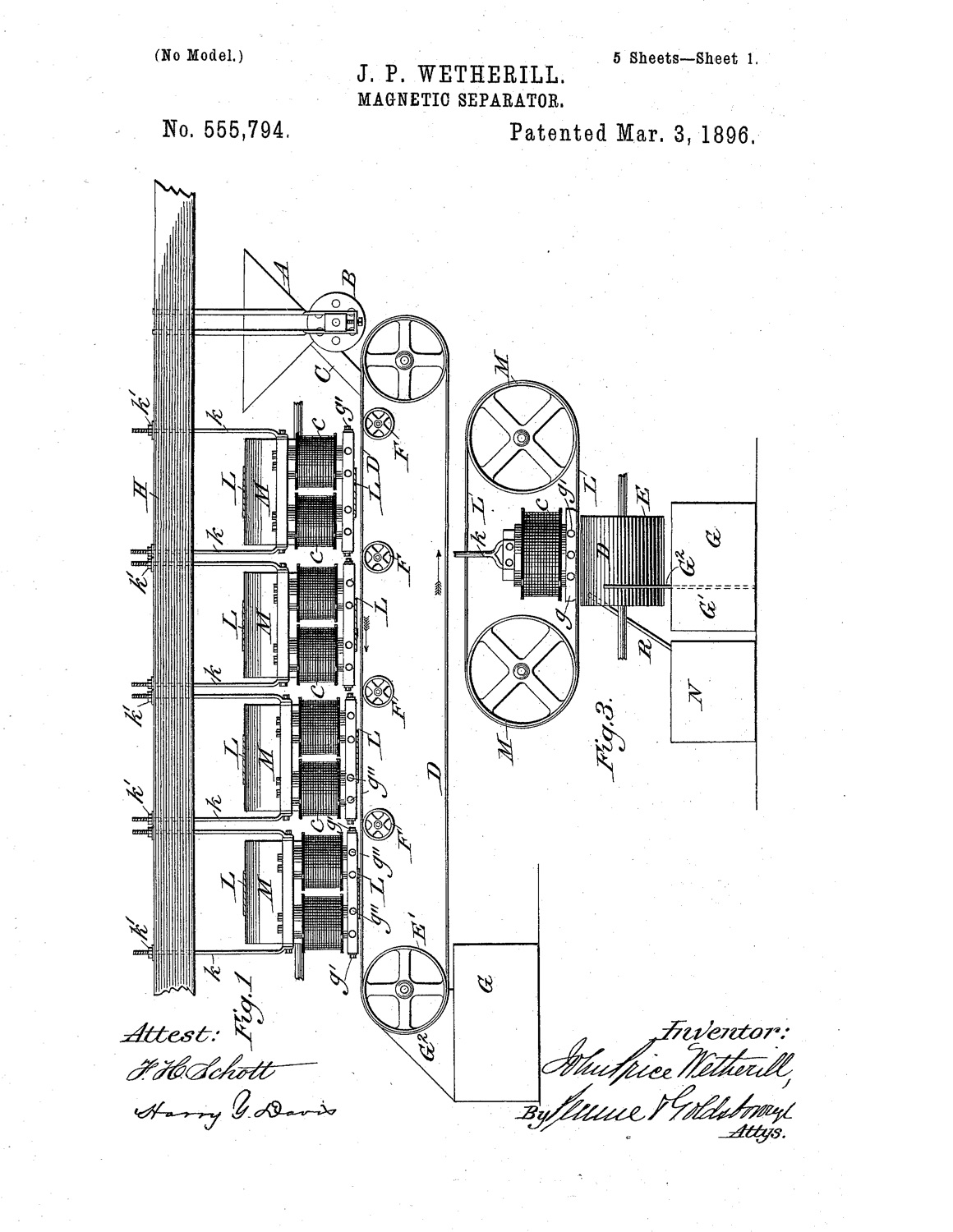
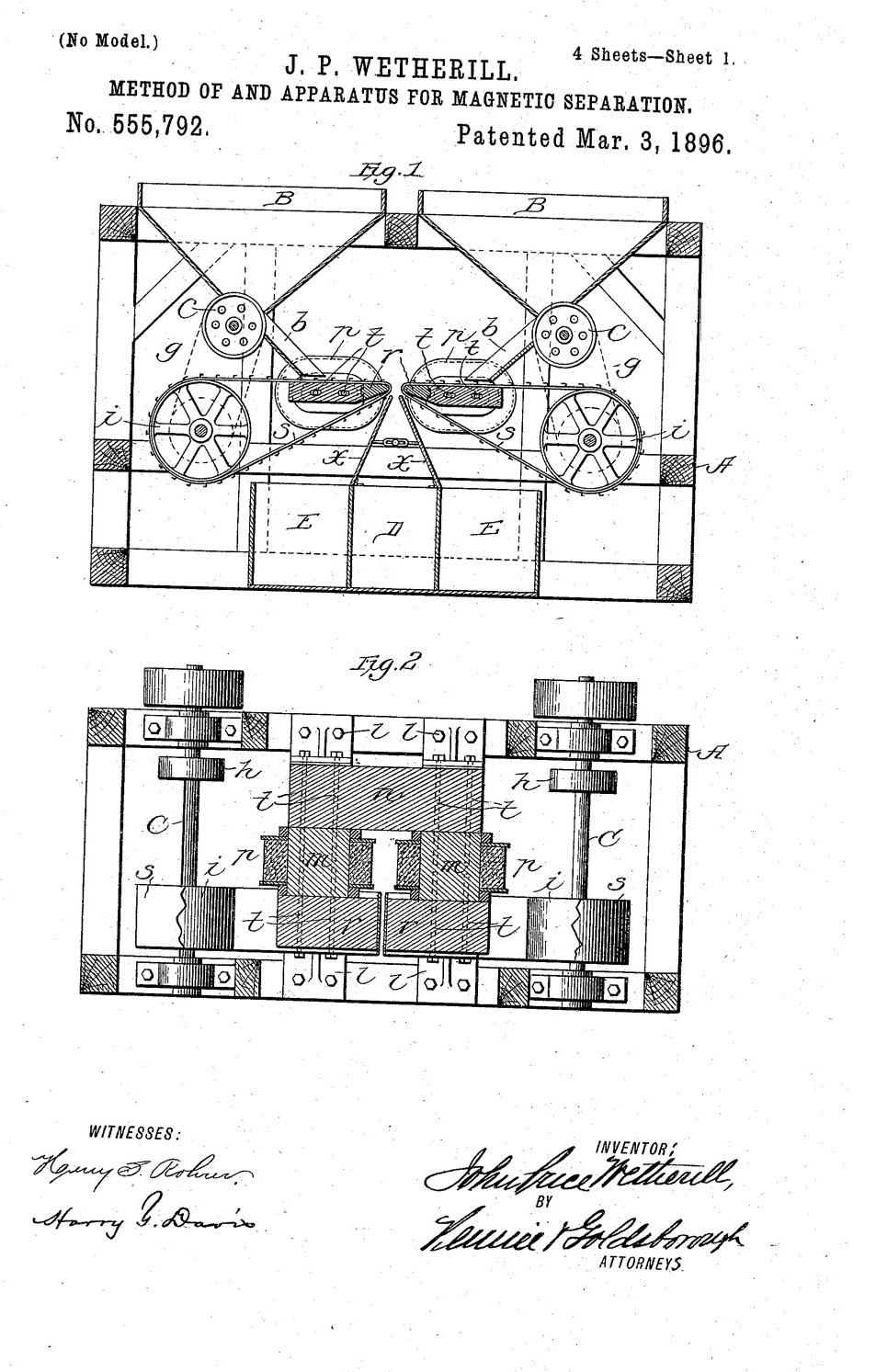
John Price Wetherill, Samuel’s son and general manager of the Lehigh Zinc and Iron Company at South Bethlehem, Pennsylvania, solved it late in 1895. On March 3, 1896 he was granted three patents, one of them for the “separation of franklinite ore and metallurgy thereof.”
The machine was simple to watch. A thin band of dry, crushed ore rode along a belt beneath a powerful electromagnet. A second belt ran crosswise between the magnet and the ore; franklinite grains jumped up against it and were carried off to one side, while the willemite and calcite rode on. The magnets lifted grains that “the strongest hand magnet” could not.
The Lehigh company proved it on Mine Hill at Franklin, at 200 tons of ore a day. In 1897 the long lawsuits between the companies at Mine Hill ended in their merger into the New Jersey Zinc Company, and the process went with them.
The concentrating plant at Franklin, 1897
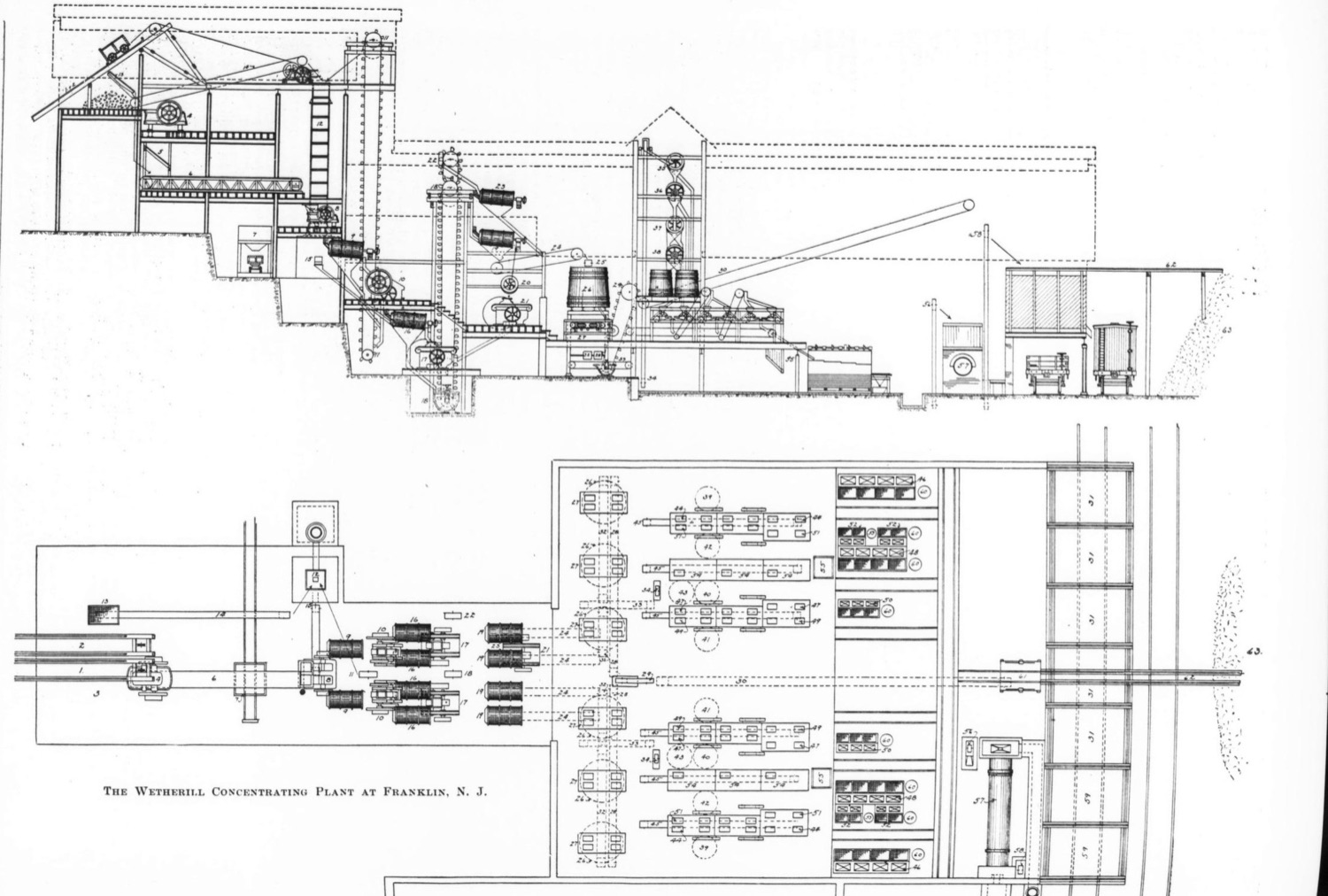
In July 1897 J. P. Wetherill described the new plant himself, in two articles for the Engineering and Mining Journal. Ore came up the shaft in two-ton cars, was weighed and dumped, crushed in a Blake crusher, dried, and screened into sizes. Each size passed under the magnets: the franklinite was lifted off and carried away, and what was left, willemite, zincite and calcite, went on to finishing separators and then to jigs, which washed out the calcite. The plan shows the whole sequence, from the crushers at the top of the slope to the storage bins at the bottom.
Inside the plant
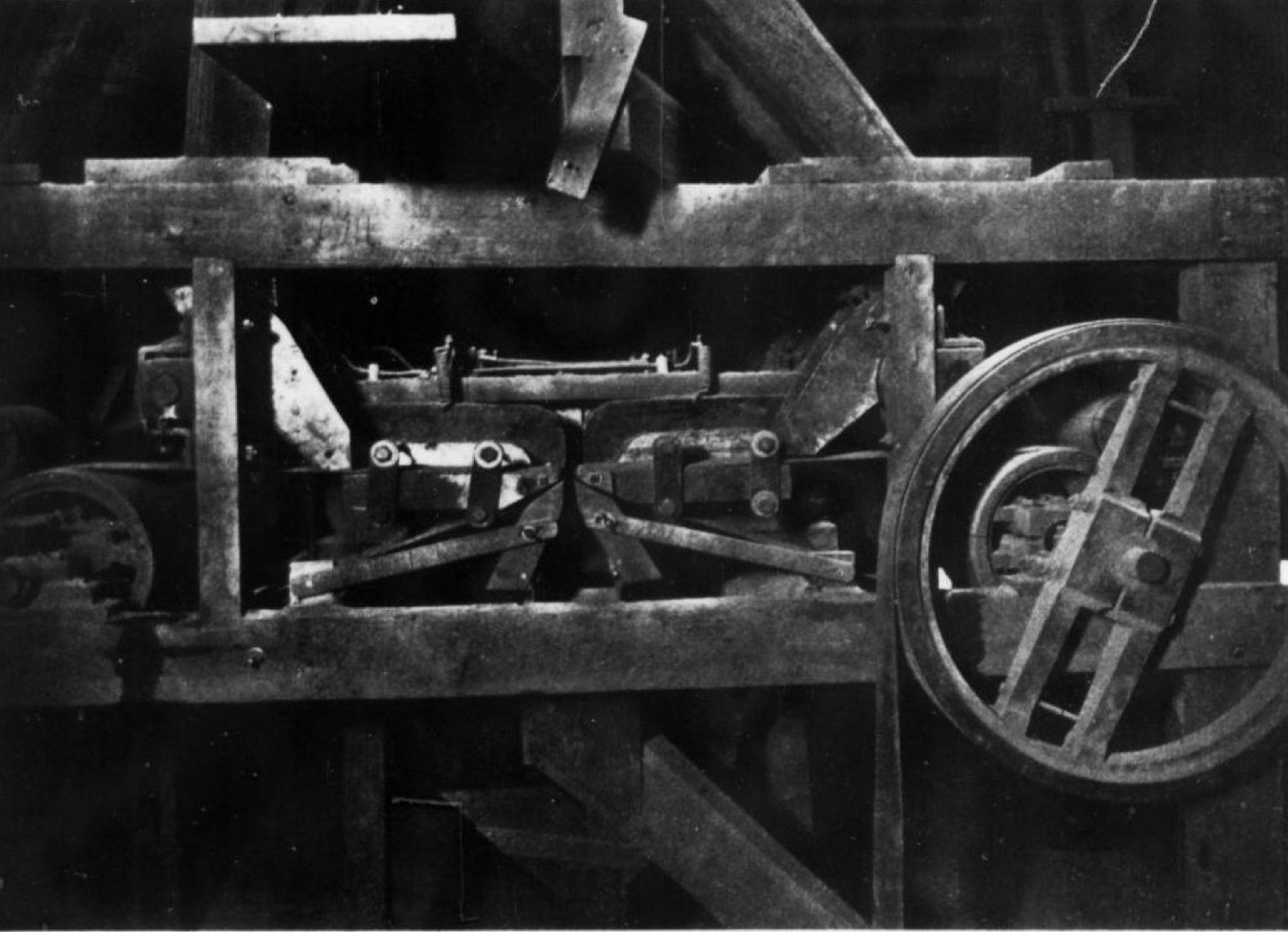
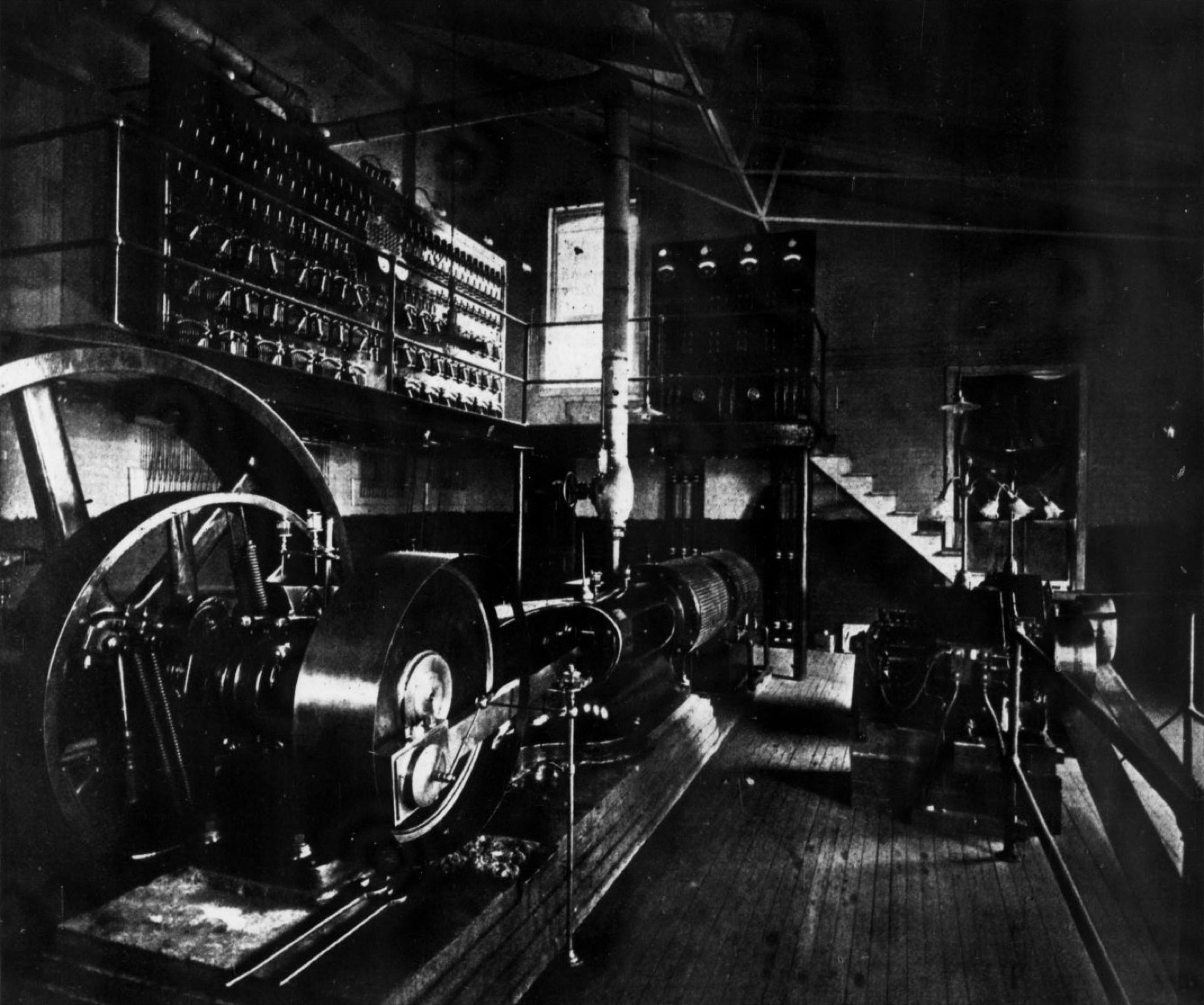
The magnets needed a great deal of electric current, so the plant had its own power house, with a steam engine driving the generators and a switchboard to feed each separator. The switchboard was designed by Lewis G. Rowand, who went on to work for the New Jersey Zinc Company for thirty-eight years.
Three products from one rock
By 1908, according to the USGS Franklin Furnace folio, the Franklin mill split the ore three ways: franklinite, a mixed “half-and-half,” and willemite. The franklinite went to make zinc white, and what was left went to the blast furnace for spiegeleisen. The half-and-half also went to zinc white. The willemite and zincite, cleaned on jigs and tables, went to make high-grade metallic zinc, spelter. Writing in the Engineering and Mining Journal in 1897, Wetherill said separation had “practically revolutionized” the treatment of the ore.
Inside the mill the separators worked in series, the ore screened into sizes between them, and they stayed the heart of Franklin milling for decades, at Franklin and at the Sterling mill in Ogdensburg.
In The Picking Table
Allen W. Pinger’s “A review of mineralogical, geological and mining activities in the Franklin area” (vol. 14, no. 2, August 1973) lists the earlier attempts at magnetic separation, from H. D. Rogers’s suggestion of 1840 to Thomas A. Edison’s separator at the Ogden mines. F. J. Stephens’s “Separation of franklinite ore and some of its early metallurgical problems” (vol. 19, no. 2, September 1978), a chapter from an unpublished book, explains why the ore could not go to the spelter furnaces before Wetherill. John L. Baum’s “The Parker mine” (vol. 24, no. 1, Spring 1983) dates the first separator house and sketches J. P. Wetherill, and his “The development of Franklin ore concentration” (vol. 29, no. 1, Spring 1988) follows the Wetherills, Rowand and the Pellett classifier; the same issue prints photographs of separators at the Franklin mill in 1918 and the Sterling mill in 1938. William R. Truran’s “Franklin’s Mill No. 2 – the ‘Palmer Mill’” (vol. 56, no. 1, Spring 2015) describes the later mill and its separator houses. Wetherill’s own 1897 account of the plant, with its drawings, has not been reprinted in The Picking Table.
Sources and further reading
- Baum, J. L., 1988, The development of Franklin ore concentration. The Picking Table, vol. 29, no. 1, p. 4–6. The Picking Table (PDF)
- Gunther, C. G., 1909, Electro-magnetic ore separation. New York. Full text (archive.org)
- Nitze, H. B. C., 1897, The Wetherill magnetic concentrating process. Journal of the Franklin Institute, April 1897. Full text (Zenodo)
- The same, part 2, July 24, 1897. Part 2 (archive.org)
- Spencer, A. C., and others, 1908, Franklin Furnace folio. U.S. Geological Survey, Geologic Atlas Folio 161. Text (PDF)
- Wetherill, J. P., 1896, U.S. Patent 555,793: Separation of franklinite ore and metallurgy thereof. Google Patents
- Wetherill, J. P., 1896, U.S. Patent 555,794: Magnetic separator. Google Patents
- Wetherill, J. P., 1897, The Mine Hill ore deposits of New Jersey and the Wetherill concentrating plant. Engineering and Mining Journal, vol. 64, July 17, 1897, p. 65–66, and July 24, 1897, p. 98–101. All the 1897 pictures on this page are from it. Part 1 (archive.org)
Written with Claude, an AI model made by Anthropic, from the sources listed above, and checked against them. October 2026.