Histories › The mines and their history
From a 1750 land grant to the founding of the New Jersey Zinc Company in 1897: Sharpsborough iron works, Dr. Fowler’s experiments, zinc for the national standard weights, wagons to the canal, forty years in the courts, Charles W. Trotter’s mine, and water at 580 feet. Told mainly from Elwood Shuster’s pamphlet of 1927.
A pamphlet from Franklin, 1927
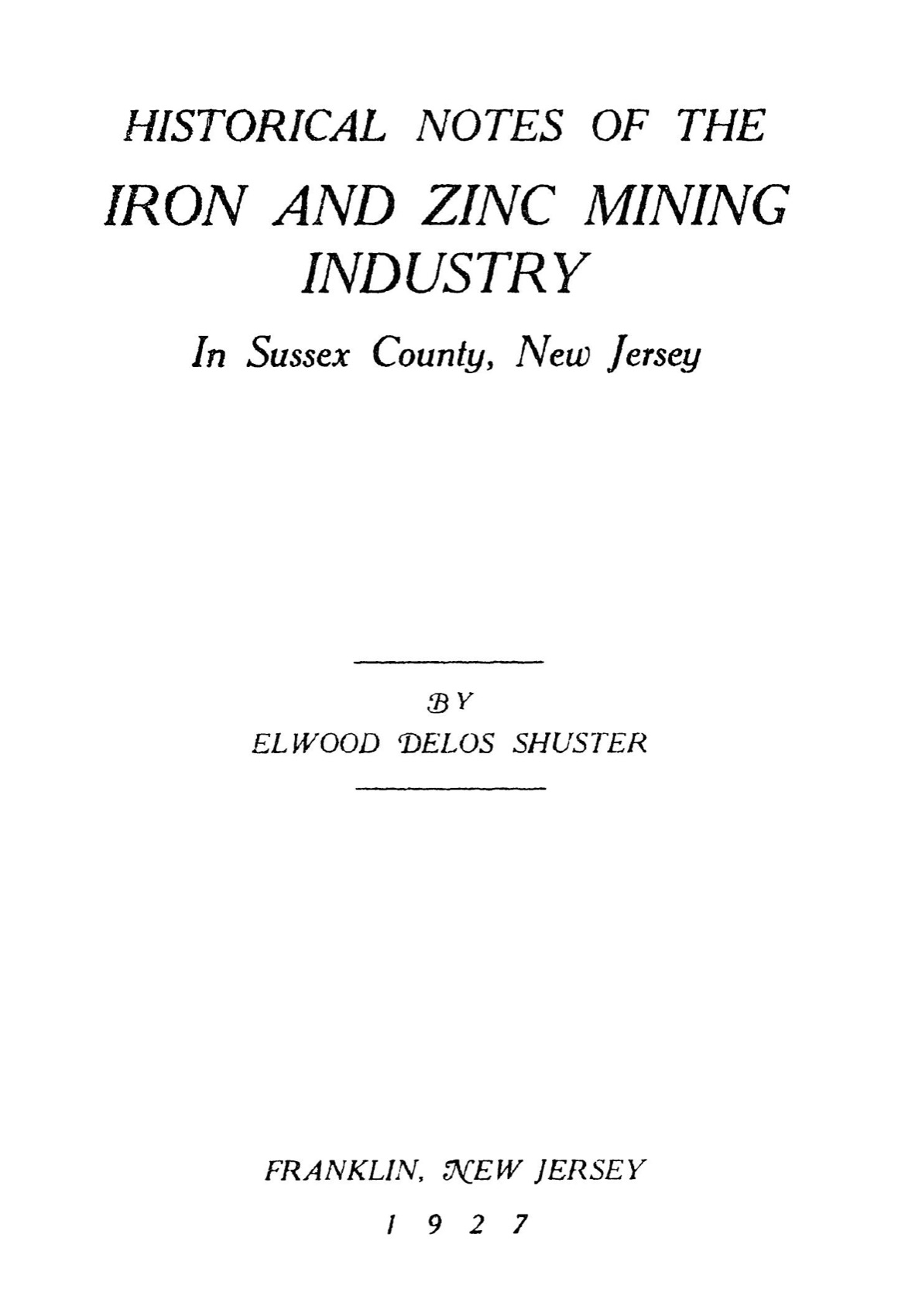
When Charles Palache wrote the history of the district for his great monograph of 1935, he gave it a page and a half and then sent his readers elsewhere: “Further details of the early history of the mines may be found in the pamphlet by Shuster” (Professional Paper 180, p. 15). The pamphlet is Elwood Delos Shuster’s Historical Notes of the Iron and Zinc Mining Industry in Sussex County, New Jersey, printed at Franklin in 1927. Shuster was not a historian. His preface calls the book “a brief outline of interesting data that have come to the attention of the writer during many years’ service with the mining companies operating at Mine Hill and Sterling Hill,” gathered from “conversation and interviews with old inhabitants and employees; searches of title records; reports of legal decisions.” He made, he said, “no claim to literary talent,” and he hoped the book would “serve as a record when the activities of this great mining district shall have been terminated.”
That last hope has come true. This page follows Shuster from the first land grant to the consolidation of 1897, quoting him where his own words carry the story and setting him beside Palache where the two differ. The earliest chapter of all, the copper prospectors and Lord Stirling’s “old mine holes,” is told in Copper before zinc; the company after 1897 in The New Jersey Zinc Company.
Sharpsborough and an “inexhaustable fund” of ore, 1750–1774
The deeds begin with the Proprietors of East Jersey. Mine Hill lies within a farm of 93 and 16/100ths acres that the proprietors “returned” (granted by survey) to the heirs of Anthony Sharp on June 6, 1750, so that, Shuster reasoned, ore was known there before that date (p. 7). One of the first settlers he could name was Michael Rorick, who in 1765 bought a large tract on the west bank of the Wallkill and built his house “upon a clearing that had been made by the Indians, which was near an old Indian trail” (p. 4).
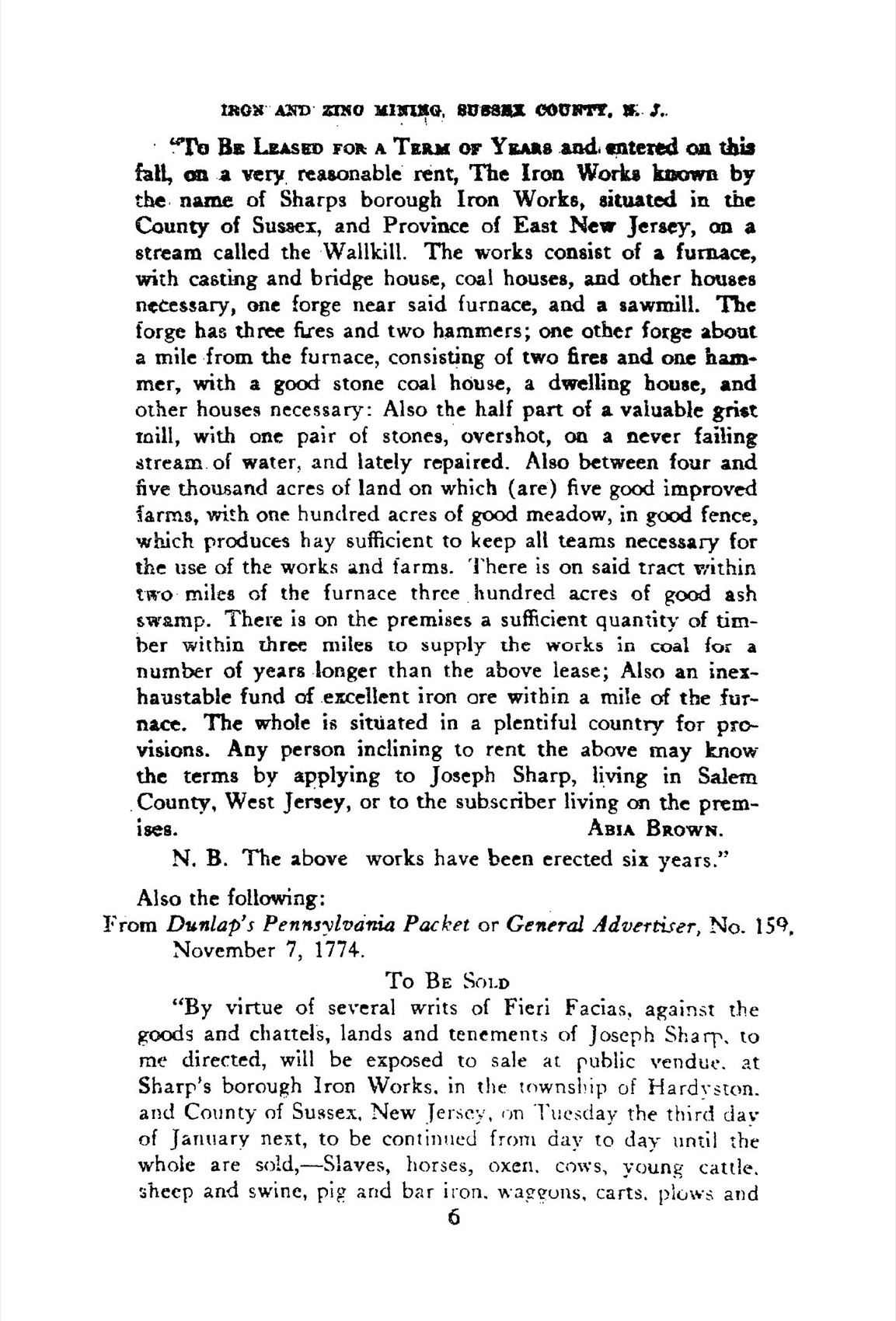
The most important early iron works in the valley, Shuster wrote, was Sharpsborough, “at or near the present mill of the Union Waxed and Parchment Paper Company at Hamburg.” Shuster printed two newspaper notices of 1774 in full. The first, from the New York Gazette and Weekly Mercury of October 31, offered the works for lease: a furnace, two forges, a sawmill, four or five thousand acres, and “an inexhaustable fund of excellent iron ore within a mile of the furnace” (p. 6). The second, from Dunlap’s Pennsylvania Packet of November 7, was a sheriff’s sale of Joseph Sharp’s property at Sharpsborough, to begin on January 3. Its list of goods opens: “Slaves, horses, oxen, cows, young cattle, sheep and swine, pig and bar iron.” Enslaved people head the list of what was to be sold, ahead of the livestock.
Shuster believed that the “inexhaustible fund” was Mine Hill itself, then “regarded as an iron ore deposit,” since there was no other large iron mine within a mile of the works (p. 7). “Little did they dream,” he wrote, that the black franklinite of the outcrop would prove “one of the greatest zinc ore deposits known to the mining world.” He doubted, though, that the zinc vein ever fed the works, “because we learn that Dr. Samuel Fowler forty or fifty years later failed to produce pig iron from the Franklinite at Mine Hill,” and thought the iron more likely came from a small magnetite vein beside it; “the scarcity of iron ore,” he concluded, “might have been the cause of the financial difficulties of Joseph Sharp” (p. 8).
Dr. Fowler buys Mine Hill
“One of the interesting traditions among the older people of Franklin,” Shuster wrote, “is to the effect that Dr. Samuel Fowler at one time offered to a laborer as compensation for a year’s work, his Mine Hill farm. This is not a fact. The records of purchases contradict it.” The records he had searched show that on October 31, 1810, Fowler and John Odell Ford bought nine tracts, some four thousand acres, from Edward Sharp for eleven thousand dollars, the Mine Hill farm among them. By a deed of September 28, 1817, Fowler paid Ford nine thousand dollars for his half interest. Palache dates the property’s coming “into the hands of Dr. Samuel Fowler” to 1816 (p. 15); the two accounts agree if 1816–1817 is when Fowler bought Ford out, as Allen W. Pinger’s review of the district has it.
Fowler’s difficulty was the ore itself. The three valuable minerals, franklinite, willemite and zincite, were “mechanically mixed and interlocked with each other in every conceivable combination,” and smelted together they would “produce a salamander of zinc, iron, and manganese that would be of no practical utility or commercial value” (p. 11). A salamander, in the furnace trade, is the mass of unreduced metal that freezes in the hearth. Fowler first tried the ore for iron, since franklinite dominated the west vein. It had also, Shuster heard, been tried with electric magnets, though “we have no knowledge of the method or form of this separator or of the success of its application.” The magnetic separation that finally solved the problem came sixty years later (see Magnetic separation).
Fowler described the trouble himself, in the catalogue of minerals that H. D. Rogers printed in 1840: “Various attempts have been made to work this ore in a blast furnace, but without success. It frequently congeals in the hearth before time is allowed to get it out in a liquid state, in consequence of a combination of the iron with manganese. All this difficulty, I apprehend, might be overcome, if a method could be discovered of smelting iron ore in a blast furnace with anthracite coal” (Rogers, 1840, p. 63–64). G. W. Baker, writing in 1881, told what became of one of those attempts: “All who had gone before, in attempting to smelt franklinite, used charcoal, in high old-fashioned blast furnaces. The result at Franklin was a salamander. The whole hearth had to be removed at great cost, and the metal in a solid mass (as no chisel could cut it) drawn out by several yoke of oxen, and it now lies buried somewhere near Franklin Pond” (Baker, 1881, p. 10). Baker gives no date and no source for the story.
House paint and the standard weights
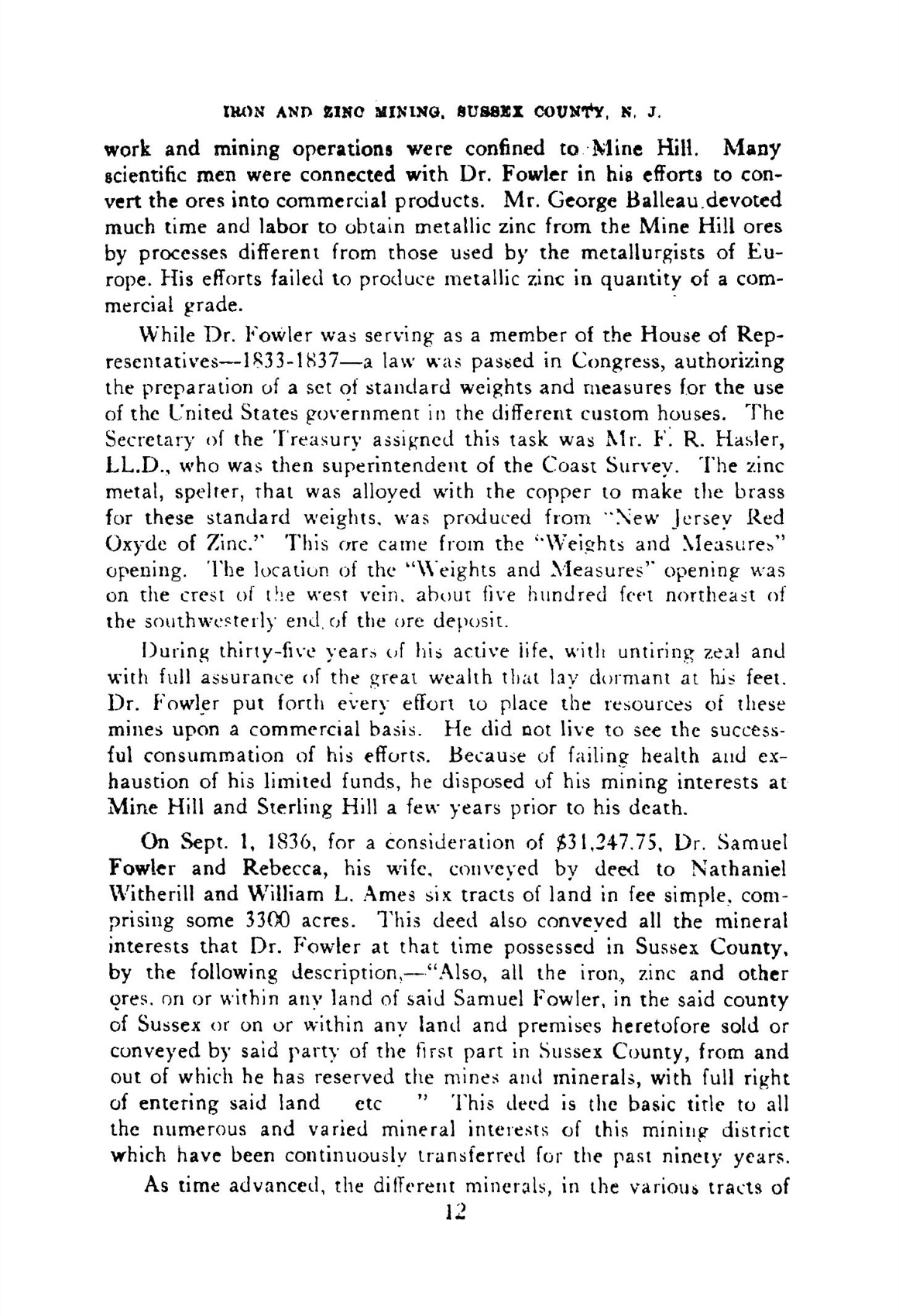
Two small successes came out of Fowler’s years. “About the year 1830,” Shuster wrote, “Dr. Fowler produced a ‘bluish-white powder’ that he used as a substitute for white lead with which he painted his house. This perhaps, is the first time that oxide of zinc from the ores of an American mine was used for house painting.” Palache gives the credit to one of Fowler’s associates: “Ballou, one of his associates, was able to prepare white zinc oxide directly from zincite and, grinding it in oil, to make paint that was used on the Fowler house at Franklin some years before that pigment was developed in Europe” (p. 15). The zinc company’s report of 1852, as John L. Baum quoted it, also names George Ballou as the maker of that paint. Shuster names a “Mr. George Balleau” who tried to make metallic zinc from the Mine Hill ores by methods of his own and failed to make it in commercial quantity (p. 12); Ballou and Balleau are presumably the same man. The later history of zinc white is told in What the zinc was for.
The second success was a matter of national standards. While Fowler sat in the House of Representatives, from 1833 to 1837, Congress authorized a set of standard weights and measures for the customs houses, and the work went to F. R. Hassler, superintendent of the Coast Survey. “The zinc metal, spelter, that was alloyed with the copper to make the brass for these standard weights, was produced from ‘New Jersey Red Oxyde of Zinc’,” Shuster wrote, and the ore came from a pit on the crest of the west vein about five hundred feet northeast of the southwest end of the deposit, known ever after as the “Weights and Measures” opening. Palache tells it a little differently: “In 1838 metallic zinc was reduced from zincite on a small scale, at Colonel Fowler’s suggestion, to make brass for a new set of standard weights and measures for the United States Government” (p. 15). Shuster ties the episode to the father’s years in Congress, Palache to the son’s suggestion and the year 1838. Both agree on the ore.
One deed, and then dozens
Fowler did not live to see his ore pay. “Because of failing health and exhaustion of his limited funds,” Shuster wrote, he sold out a few years before his death. On September 1, 1836, for $31,247.75, Samuel and Rebecca Fowler conveyed some 3,300 acres to Nathaniel Witherill and William L. Ames, together with “all the iron, zinc and other ores” on any land Fowler held or had sold in Sussex County with the minerals reserved. “This deed,” Shuster wrote, “is the basic title to all the numerous and varied mineral interests of this mining district which have been continuously transferred for the past ninety years.”
From then on the minerals in a single parcel could be sold separately from one another and from the land. “When one contemplates the large land holdings of Dr. Fowler in 1836, and the fact that any single parcel of land may have from one to four subdivisions of title—zinc, Franklinite, iron, and surface—it is to be believed that a more complicated ownership does not exist in any mining district in the world” (p. 13). The son, Colonel Samuel Fowler, who recovered the mineral rights, was reported to hold interests in as many as fifteen companies, “all of which passed into oblivion on account of financial failure or were absorbed into other consolidations” (p. 31).
G. W. Baker’s promoter’s report of 1881 tells the sale differently. “Somewhere about the year 1830,” he wrote, “Dr. Fowler sold his blast furnace at Franklin and his mineral rights in many thousands of acres of land in his neighborhood, to Wetherell and Ames, who conveyed the property in question to a chartered company, called The Franklinite Manufacturing Company. This company became insolvent, and in 1836 was sold out by the Sheriff of the County to Oakes Ames, of Taunton, Massachusetts, who reserving the blast furnace and furnaces, sold one half of all the zinc in the aforesaid premises to Cyrus Alger, of Boston. Alger had several experiments made with the franklinite ore in Boston, and produced a fine quality of steel” (Baker, 1881, p. 9–10). Shuster, who searched the deeds, gives September 1, 1836, as the date of Fowler’s own conveyance to Witherill and Ames; Baker cites no deeds. Baker also says that Fowler named franklinite, “after the great philosopher and statesman—Dr. Benjamin Franklin.” The name was in fact given in 1819 by the French chemist Pierre Berthier, from specimens William Maclure had sent to Europe (see Archibald Bruce and the red oxide of zinc).
Baker named some of the companies that came and went: “The Sussex Zinc and Copper Mining and Manufacturing Company, The New Jersey Exploring and Mining Company, The New Jersey Zinc Company, The Jersey Franklinite Company, The Boston Franklinite Company, The Franklinite Steel and Zinc Company, The Passaic Zinc Company, and others.” Of the two that lasted, the New Jersey Zinc and the Passaic, he wrote: “Many millions in dividends have been divided in the shares of these two companies” (p. 10).
By wagon to the canal
Until 1870 the ore left the hills by road. “The ores of Sterling Hill and Mine Hill prior to 1870 were hauled by wagon from the mines to Woodport, located at the north end of Lake Hopatcong. From this point the ore was shipped via the lake and Morris and Essex canal to Jersey City and Newark” (p. 21). Newton, on the Sussex Railroad, was a second shipping point, and Shuster had it from “Mr. Clark Day, an old resident of Franklin, now deceased,” that he had been hired to haul ore from the Buckwheat mine to Newton in 1865. The Buckwheat mine, he added, took its name from the buckwheat field in which its outcrop, the east vein, was first found.
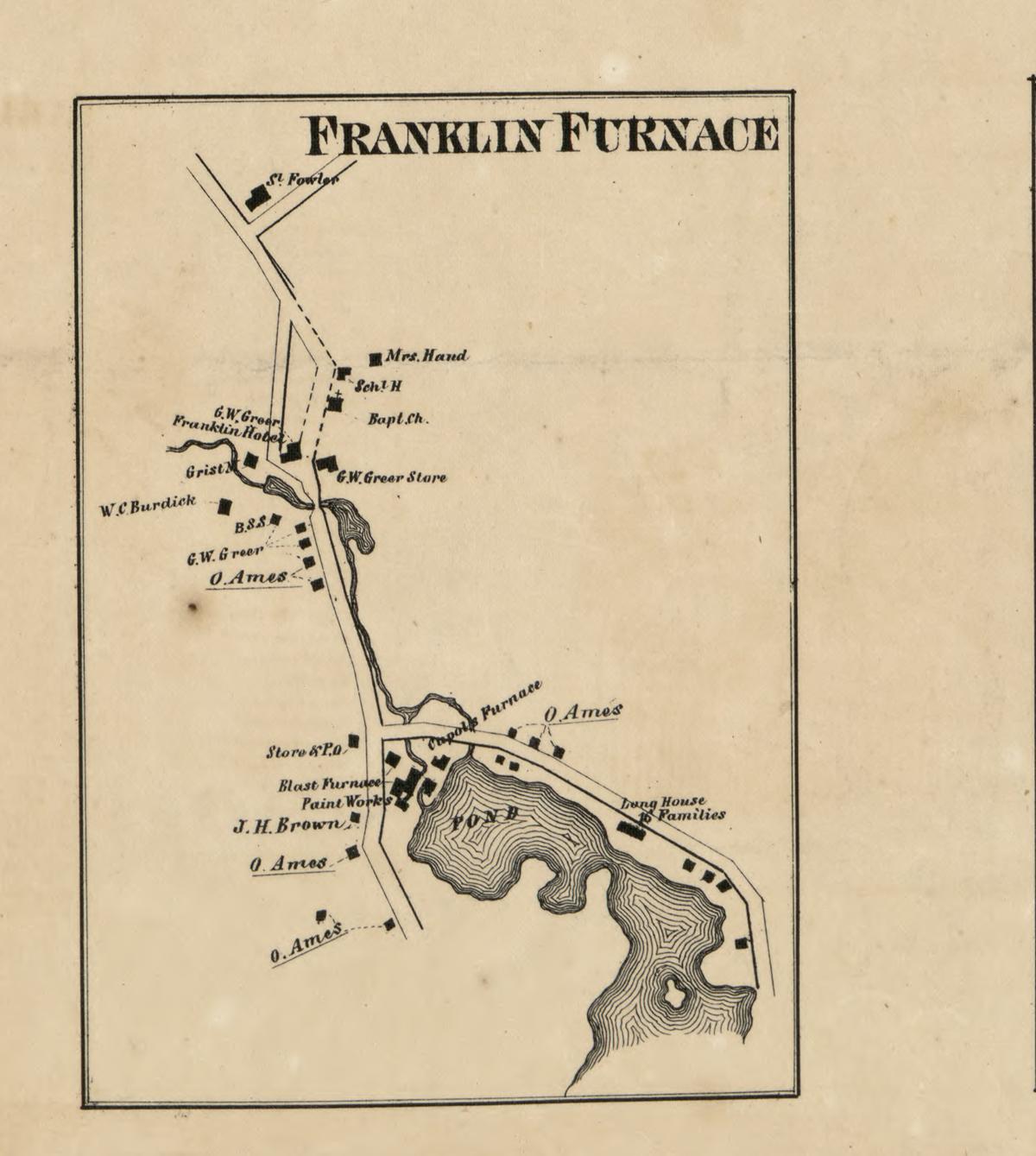
The railroads came in 1870 and 1871: the Sussex Railroad from Newton to Franklin in 1870, the first line into the Wallkill valley, and the New Jersey Midland from Deckertown, whose first train ran on June 19, 1871 (p. 22). With rails at hand, the Franklin Iron Company (in 1927 a subsidiary of the Lackawanna Steel Company) built a new blast furnace at Franklin Furnace to smelt the magnetite of a separate vein west of the zinc ore. It was first put in blast about February 1, 1874, for some 2,500 tons a month, ran in good years and stood cold in bad ones, and “was finally dismantled in 1906” (p. 23).
Forty years in the courts, 1857–1896
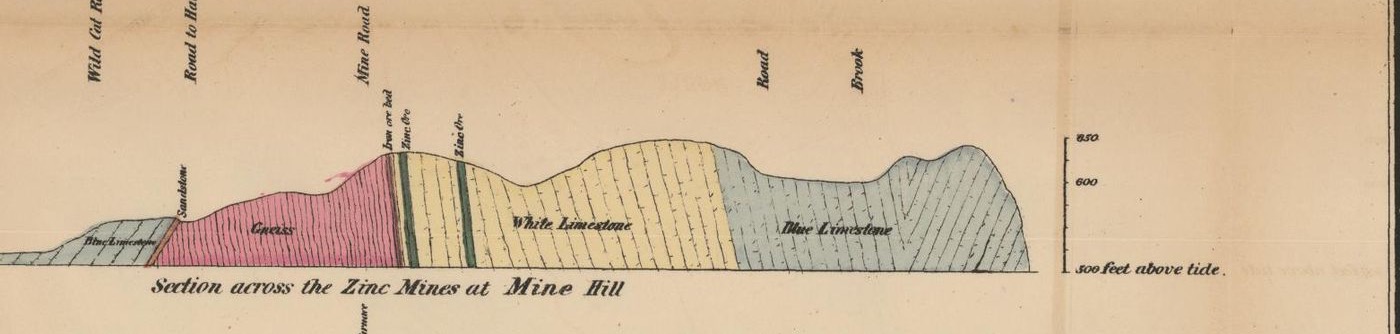
The lawsuits began with a misunderstanding of the ore body. In the 1840s the outcrop seemed to show two veins side by side, a “zinc vein” rich in zincite and willemite and a “Franklinite vein” beneath it, and the Mine Hill titles were divided on that belief (p. 16). On March 10, 1848, Colonel Fowler deeded to the Sussex Zinc and Copper Mining and Manufacturing Company “all the zinc, lead, copper, silver and gold ores, and also all other metals or ores containing metals, except the metal called Franklinite, and iron ores when it exists separate from the zinc.” On December 13, 1850, he deeded to the Franklinite Mining Company “all the reserved iron ore called Franklinite.” “Thus we find,” Shuster wrote, “that two distinct mineral titles to the same vein of ore were made to rest in two different corporations.” Deeper mining showed that the minerals were mixed through the whole body in every proportion, so that every ton of ore belonged, arguably, to both.
The main contest began in 1857, when the New Jersey Zinc Company sued the New Jersey Franklinite Company in Chancery. Oakes Ames, who had lent the Franklinite company fifty thousand dollars, bought its property at a sheriff’s sale on January 26, 1860, and passed it to his new Boston Franklinite Company (p. 28). Henry W. Green, hearing the case in Chancery, held that “zinc ore” meant the veins in which zinc ore predominated and “Franklinite” the veins in which franklinite did, and gave the mine to the Boston company; the Court of Errors and Appeals reversed him (p. 29). After a second sheriff’s sale Ames owned the franklinite title again, “the second time in five years,” and in 1867 he sold it to Moses Taylor, whose suit in the federal court won him the south half of Mine Hill. Taylor and the zinc company settled by merging, as the New Jersey Zinc and Iron Company, in 1880 (p. 30). The testimony of 1861 was printed as The Franklinite Case, which, Palache noted, “gives many facts about the early workings of the mines” (bibliography no. 84).
The last case was decided in June 1896, on appeal, between the zinc company and the Lehigh Zinc and Iron Company, over the north half of Mine Hill. Among the questions, Shuster wrote, were “whether books of science are admissible as evidence to prove opinions contained in them; who is to be considered an expert; and whether his interest affects the legality and weight of his testimony.” The court left the mine with the Lehigh company. “This was the last legal contest that related to the conflicting mineral titles of Mine Hill.” The next year every interest at both hills was united in the New Jersey Zinc Company.
Charles W. Trotter and the Trotter mine
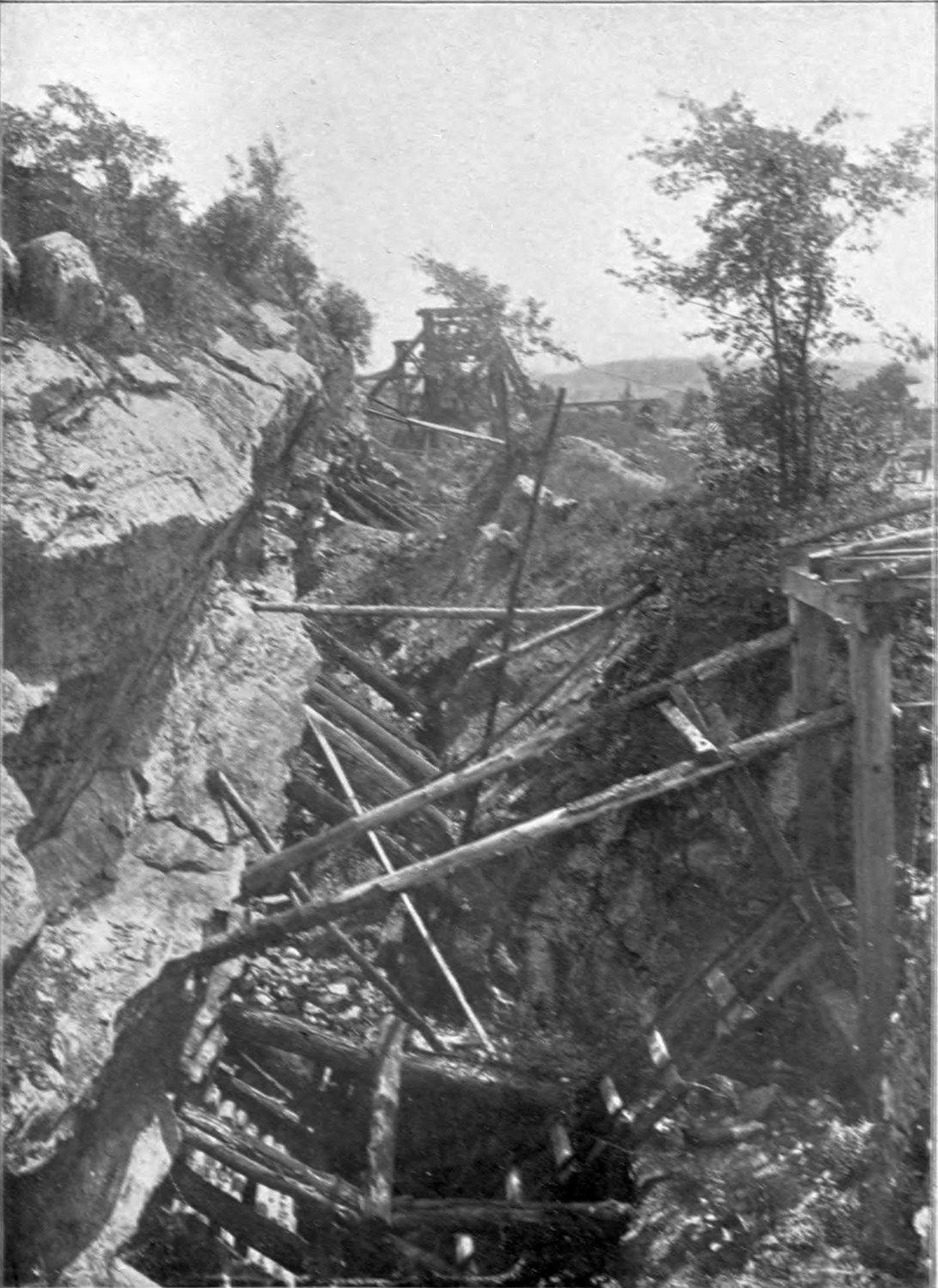
The Trotter mine, whose shaft Palache credits with renewing scientific interest in the deposit after 1880 (p. 15), takes its name from Charles W. Trotter. On March 6, 1877, Trotter took a thirty-year lease on the southern part of the north half of Mine Hill from James L. Curtis, surviving trustee of the Franklinite Mining Company, and on April 10, 1879, a second lease running north to the Hamburg Road: about 1,070 feet of the outcrop in all (p. 31). The New Jersey Zinc and Iron Company went to court against him at once, and went on mining part of the ground he had leased, claiming it under an old deed for a six-and-a-half-acre “parallelogram.” A jury found that deed’s description “so indefinite and ambiguous that they could not identify the boundaries,” and gave Trotter the verdict (p. 32). By an agreement of May 2, 1884, the boundary was fixed by arbitration and Trotter was paid $26,680 to drop his claims against the company.
In 1888 the Lehigh Zinc and Iron Company acquired “the Lehigh, or Trotter, mine”; its principals were August Heckscher and John Price Wetherill, and it was there, Shuster wrote, that Wetherill “conceived the idea of magnetic separation in the treatment of the ore of Mine Hill.” Daniel E. Russell gives Trotter’s father as Jonathan Trotter, third mayor of Brooklyn and one of the founding officers of the New Jersey Zinc Company, and the son as a maker of zinc white at Elizabethport before he came to Sterling Hill. Whether that Jonathan Trotter was the Jonathan G. Trotter of Newark who patented a zinc-white furnace in 1854 (see What the zinc was for), is not known.
Edison at the Ogden mines
The magnetite of the Ogden mines, on the mountain about two miles southeast of Ogdensburg, drew a famous inventor. In 1889 the New Jersey and Pennsylvania Concentrating Company bought a large tract containing the Ogden group, and “Thomas A. Edison was the moving spirit in this corporation” (p. 23). Steam shovels stripped the mountain, a large mill crushed the rock, magnetic separators drew out the magnetite, and briquetting machines pressed it into lumps a blast furnace could use. The ore averaged, it was said, only 8 per cent iron, and the briquets about 68 per cent. The machinery worked, but the product did not pay; the plant was closed and dismantled, and by 1927 “nothing remains on the site to remind one of the unsuccessful but heroic effort.” Many of Edison’s machines, Shuster added, went on to serve the new cement plants of New Jersey and eastern Pennsylvania (p. 24).
Water at 580 feet (or 560)
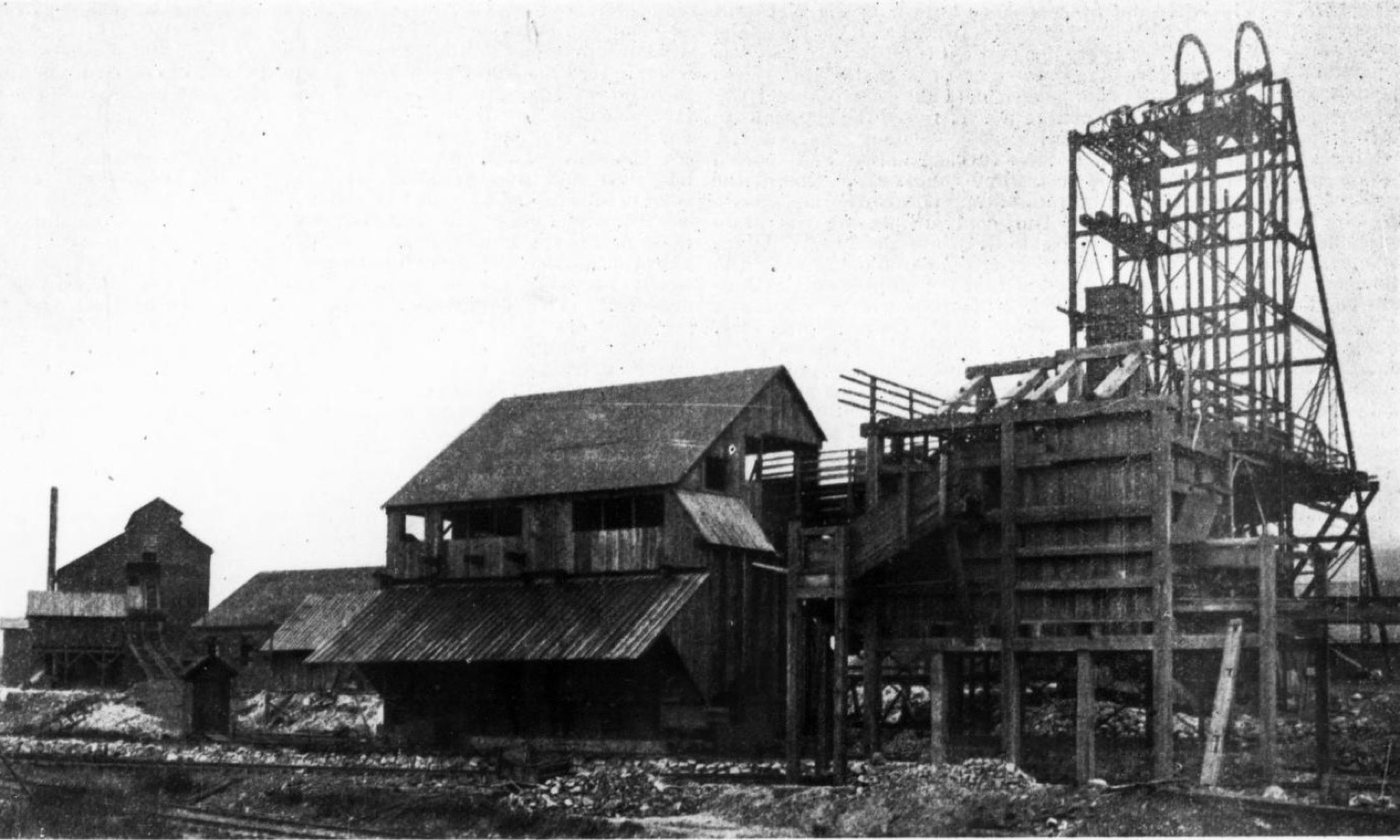
In 1889 the Lehigh company sent diamond drills into the Rutherfurd farm northeast of Mine Hill, and within two years eight holes, nine hundred to thirteen hundred feet deep, had proved the ore body ran on under it (p. 43; see Machines underground). In 1891 the Sterling Iron and Zinc Company began sinking the Parker shaft, a vertical three-compartment shaft, to reach it. At 580 feet, Shuster says, the miners struck “a large open seam.” John L. Baum, writing in 1982 and listing among his references a paper by J. A. Van Mater, who sank the shaft, puts the seam at 560 feet and the flooding at 24 hours, not 30; the two figures stand side by side here until a better source settles them. “When the miners drilled into this seam a rush of water compelled them to abandon the shaft as quickly as possible to save their lives. Within thirty hours this shaft was filled with water to within forty feet from the surface of the ground.”
The company called in the geologist Frank L. Nason (see Frank Nason, geologist and novelist), who studied the country around and estimated how much water would have to be pumped to bring the level down to the seam. “After fourteen months constant pumping the water was lowered to the water seam and held at this elevation.” A pump room was cut into the side of the shaft for a triple-expansion Worthington pump, and the shaft went on to 950 feet (Baum: 975 feet, timbered by April 1894). When the seam was drained, Shuster added, “the springs and wells in the adjacent territory ceased to flow.”
Franklin in 1927
Shuster ended with the town the mines had made. In 1895, he wrote, Franklin Furnace “was a village of about 500 people,” clustered by the lake and the iron furnace. It became the borough of Franklin in 1913. By 1927 it had about 4,500 people, a vocational school with fifty teachers and about 1,100 pupils, and a Community House, a hospital, a park, a swimming pool and an athletic field kept by the New Jersey Zinc Company: “a thriving, contented and happy community that is sometimes called the model mining town of America.” He was writing for the company town, as a man who had worked for its companies for many years, and the page reads that way. His hope that the pamphlet would outlast the mines was better founded than he could know.
In The Picking Table
In 1969 the journal reprinted the part of Charles H. Shamel’s “Laws relating to minerals” (1905) that deals with the Franklin litigation, with long quotations from the opinions of the courts (vol. 10, no. 2). Allen W. Pinger’s “A review of mineralogical, geological and mining activities in the Franklin area” (vol. 14, no. 2, August 1973), a talk of 1961, runs from the Lenape and the Dutch prospectors through the lawsuits to the consolidation. In 1975 John L. Baum contributed “The Weights and Measures opening” and “The Trotter mine”, the second built on J. A. Van Mater’s own account of his years at the mine from 1882 (vol. 16, no. 1). Shuster’s own short “History of the Franklin and Sterling ore deposits” was printed after his death (vol. 20, no. 2, September 1979). Baum’s “The sinking of the Parker shaft” (vol. 23, no. 2, Fall 1982) tells the flood from the shaft’s side: water struck at 560 feet on August 12, 1892, the wells of the basin dry within a day, and the shaft finished to 975 feet in 1894, figures that differ from Shuster’s. Baum followed with “The Taylor mine” (vol. 24, no. 2, Autumn 1983) and “Early products of the New Jersey Zinc Co.” (vol. 27, no. 2, Fall 1986). Daniel E. Russell’s “The Trotter tunnel at Sterling Hill: its construction and litigation” (vol. 34, no. 1, Spring/Summer 1993) follows Charles W. Trotter to Sterling Hill. Maureen Verbeek’s interview with Pete J. Dunn about his three-volume history, Mine Hill in Franklin and Sterling Hill in Ogdensburg … 1765–1900 (2002–2003), appeared in two parts, part I (vol. 44, no. 2, Fall 2003) and part II (vol. 45, no. 1, Spring 2004), the second with his sketches of Oakes Ames, Moses Taylor, August Heckscher and Trotter. Dunn’s “The Kemble family and William I. J. Kemble” (vol. 46, 2005) quotes the testimony of the Kembles on Fowler’s visitors, the Ames furnace and Ballou’s experiments. William R. Truran’s “From furnace to borough—Franklin’s transformation” (vol. 54, no. 1, Spring 2013) carries the town from Rorick’s forge to the borough of 1913, and Mark Boyer’s “Letters from the past” (vol. 56, no. 2, Fall 2015) prints Samuel Fowler’s letter of 1826 to Berzelius asking how to work his ores. Shuster’s pamphlet is cited throughout these articles, but no article on Shuster himself has appeared in The Picking Table.
Sources and further reading
- Baker, G. W., 1881, Geological report. The mineral belt of Sussex County, New Jersey. Philadelphia. The salamander, p. 10. HathiTrust
- Palache, C., 1935, The minerals of Franklin and Sterling Hill, Sussex County, New Jersey. U.S. Geological Survey Professional Paper 180. History, p. 15–16. USGS
- Rogers, H. D., 1840, Description of the geology of the State of New Jersey. Philadelphia. Dr. Fowler’s catalogue of minerals, p. 63–65. archive.org
- Shuster, E. D., 1927, Historical notes of the iron and zinc mining industry in Sussex County, New Jersey. Franklin, N.J.: privately published. Complete scan, 47 pages. PDF
Written with Claude, an AI model made by Anthropic, from the sources listed above, and checked against them. October 2026.