Histories › The mines and their history
How rock was drilled and how ore, men and water were moved in the two zinc mines, from hand drills, mules and steam to compressed air, electric trolley lines and battery locomotives.
Hand, mule, steam, air and electricity
For most of a century and a half the ore of Mine Hill at Franklin and of Sterling Hill at Ogdensburg was broken by drilling and blasting, moved in small cars on narrow track, and hoisted up inclined shafts. What changed was the power behind each step. A writer in Compressed Air Magazine in 1950 put it in one sentence: the deposits had seen “practically every major advance in the art of mining,” from the steam and then the air-powered rock drill to “the introduction of electrified haulage systems.”
This page follows those machines through the sources that describe them: the company engineers’ own papers of 1918 and 1923, mine reports printed by the Franklin-Ogdensburg Mineralogical Society in The Picking Table, the trade press, and the U.S. Geological Survey. Where a source gives a date or a number, it is given here; where we found nothing, that is said too. For the timbering and stoping that went with these machines, see The Franklin mine in 1918.
The diamond drill: finding the ore at depth
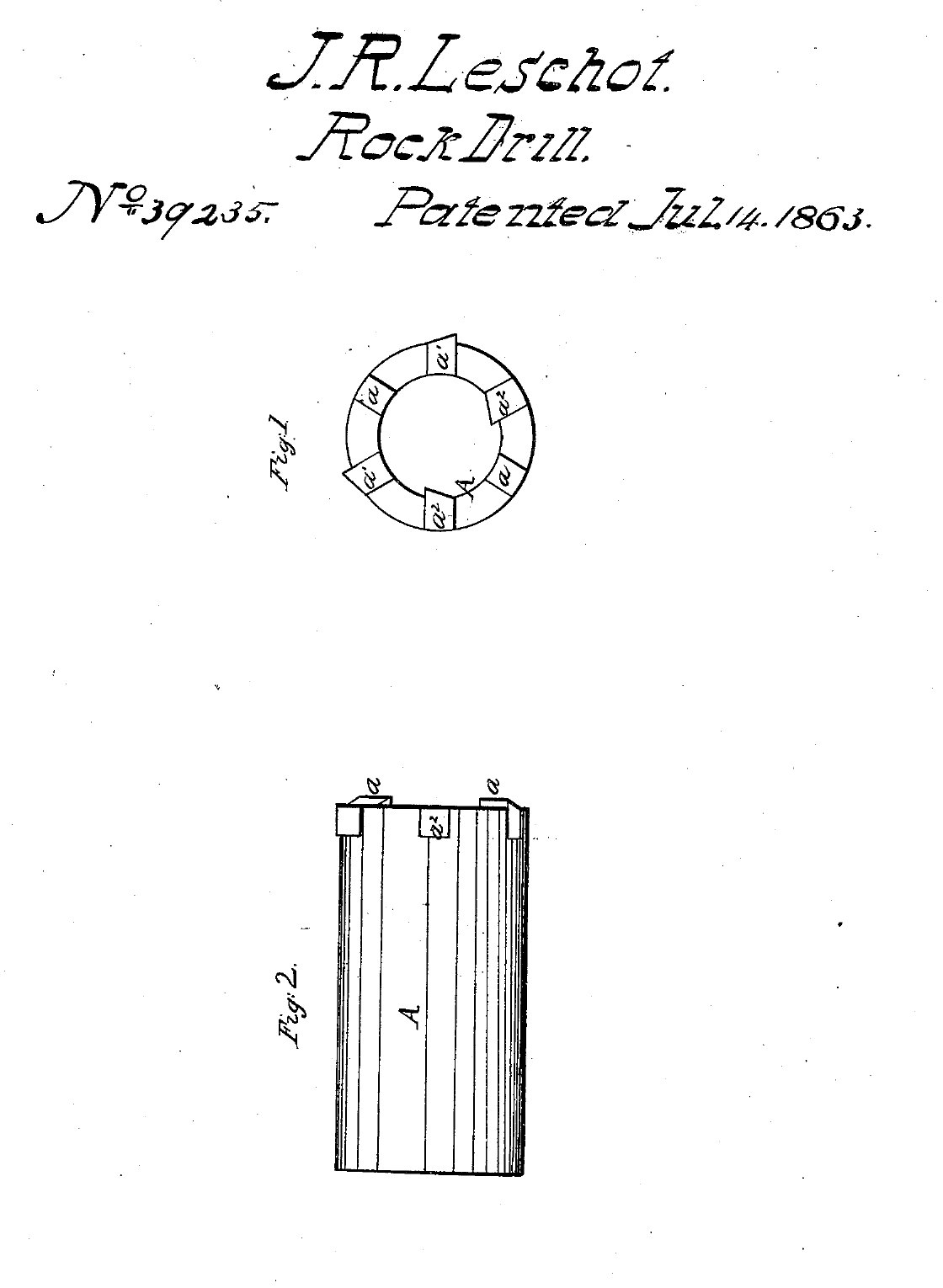
A diamond drill, or core drill, does not hammer. It turns a hollow crown set with diamonds against the rock and cuts a ring, leaving a solid cylinder of rock, the core, inside the tube to be pulled up and read. The Paris engineer Rodolphe Leschot patented the tool in the United States in 1863. His specification describes a crown armed with diamonds that cuts “an annular groove or hole, leaving a central core or kernel,” cooled and cleared by a stream of water pumped down the hollow rods. The stones he wanted were the cheap ones: “These diamonds are such as from their color are least valuable for jewelry.” Miners later used the black, non-cleaving diamond called carbonado (in mine talk, “carbons”) and the crushed diamond called bort.
At Franklin the drill made its name in 1889–91, when J. A. Van Mater of the Lehigh Zinc and Iron Company bored for the plunging north end of the Mine Hill ore body. That test, and what it showed about the fold, is told in Drawing the folds. The company engineers C. M. Haight and B. F. Tillson summed it up in 1918: “About 1888–92, diamond-drill prospecting proved the extension of this orebody northward,” and the Parker shaft was sunk to work it.
The drill also taught a lesson. John L. Baum, the Franklin Mineral Museum’s curator and a former company geologist, wrote in The Picking Table (1982) that there were eight holes, 900 to 1,300 feet deep, and that “vertical drill holes at Franklin tend to drift to the south and west.” A hole that wanders reports the ore at the wrong place: a core that reached ore at some depth along a bent hole was not where a straight hole of that length would have ended. Van Mater, “assuming his drill holes were truly vertical,” “located his shaft too far east, and he missed the ore by several hundred feet.” Later crews, Baum wrote, “learned to incline our holes to the east in order to avoid hitting the gneiss footwall to the west at too shallow a depth, because of this drift.”
After 1897 the New Jersey Zinc Company drilled from inside the mine. In 1905 the Geological Survey reported that “Test holes from the lower levels prove that the ore body is entirely surrounded by barren rock,” and printed the log of a 71-foot vertical hole in the bottom of the Parker mine. In his report for 1910, Tillson noted a workroom for “the diamond drill man” and chambers cut at the north ends of the 800 and 1100 levels, the second “suitable to accommodate a diamond drill which will prospect the country to the east and west.”
In an interview recorded for The Picking Table (2012), Baum recalled that the early crews “used big bits with carbons in addition. Big diamonds, eight to ten of them,” where “Today we use little dust ones.” He remembered a hole at Franklin Pond “that is 6,000 feet deep,” drilled from a tower and angled so that the turning rods would carry it under Cork Hill, and holes at Sterling from the 1850 level “looking for the severed segment of the orebody.” He logged and quartered the cores himself with a two-bladed splitter. These are recollections, not records, and are given as his.
At Sterling Hill the late drilling went deepest. Robert W. Metsger, the company’s chief geologist, wrote that the fault bounding the ore on the northwest had been “investigated extensively in the course of mining and by diamond drilling to as much as seven thousand feet” (in context, the number may be a depth or a hole length). His 1975 cross section through the mine rests on five cores drilled from deep underground; the guidebook’s table lists Sterling holes up to 4,784 feet long. A diamond drill now stands on the tour route of the Sterling Hill Mining Museum (GANJ 2025, stop 8). We found no record of outside drilling contractors at either mine.
Rock drills: from the hand drill to the hammer drill
Before power drills, a hole for blasting was made by hand: one man held and turned a steel bit while one or two others struck it with hammers. The open cuts of Mine Hill were worked that way. A photograph of about 1870, printed with the 1950 Compressed Air Magazine article, shows “workmen engaged in breaking the ore by hand and shoveling it into horse-drawn wagons.”
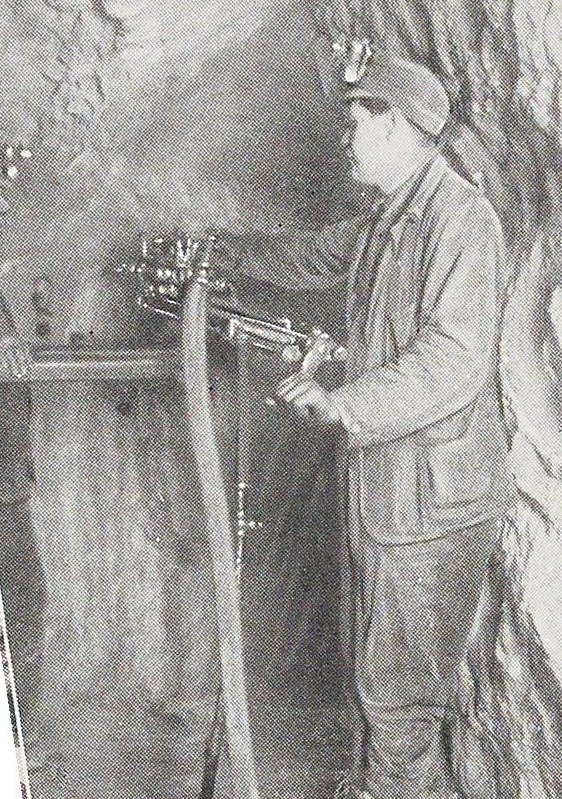
By 1891 compressed air had arrived. When Van Mater sank the Parker shaft, Baum wrote, the plant “consisted of a double cylinder reversible hoisting engine, an air compressor, a 110 horsepower steam boiler to drive the other machines, a 7 kilowatt dynamo,” and a blacksmith and carpenter shop; “Four air drills operating from two horizontal bars” drilled the shaft bottom. These were piston drills, heavy reciprocating machines in which the steel was fixed to the piston and struck the rock with it, mounted on a bar or column (a steel post jacked tight across the opening) or, in the quarries, on a tripod.
The change after 1905 was to the hammer drill, a lighter machine in which a free piston strikes the end of the steel. Tillson’s inventory of 1 January 1911 lists 74 Ingersoll-Rand piston drills, 52 hammer drills of several makes, and 27 “block-holers” for breaking oversize chunks; in the stopes, he wrote, seven or eight hammer drills were now used for every piston drill. The company tested every machine. In 1913 Compressed Air Magazine reported that each drill was trialled underground in a crosscut of uniform calcite and then followed for life: “They are, in effect, on the mine payroll, the number of shifts they work is credited to them and the repairs are charged. It would appear that after a few years of this, the New Jersey Zinc Co. should know something about machine drills.”
By 1918 Franklin drove its drifts with water Leyner-type hammer drills (Sullivan, Ingersoll-Rand and Waugh models) on column clamps, with water fed through hollow steel to lay the dust. In the surface quarries that supplied fill, Haight and Tillson wrote, piston machines on tripods had needed a crew a shift or more for a 30-foot hole, but “with the hammer machines one man can generally drill close to 100 ft. of holes in a shift.” At Sterling Hill in 1923, G. H. Salton reported that the column-mounted Waugh “Turbro,” whose steel was turned by a small air turbine, “has been found to excel all others for working the ground in this mine.” By the 1970s a Sterling miner drilled from a “jumbo,” a tracked carriage carrying three drills on booms (below).
Mules
Mules did pull ore cars underground at Franklin, at least in the Parker and Taylor mines around 1900. Baum wrote of the Parker mine in 1899 that all the work was done “with mules for haulage power. The mules were taken out each evening and released at the shaft, upon which they bolted for the stable without any further encouragement.” Van Mater, inspecting the mine on 15 December 1900, described ore drawn from the North Raise “into tram cars to be hauled to the shaft by mules and hoisted to the surface.” In the Taylor mine, Baum wrote, “The tunnel was used for mule haulage of Taylor mine ore,” and a photograph of the Buckwheat open cut in 1906 shows mule wagons on the floor of the pit. Collectors digging old mine fill at the Franklin Mill Site later turned up mule shoes.
Electric locomotives ended it. In his report for 1910 Tillson wrote that the new electric haulage had brought a saving “by doing away with the mule haulage on the 950 level,” and that the year’s last tramming costs carried “the expense of maintaining the mules which are no longer needed.” His inventory of mine cars lists twelve “30 Cu.ft. cars, 36″ gauge, for Mule Haulage,” all scrapped. The same report mentions stables at the open cut, on the surface. How many mules there were, and when they first went underground, we have not found. Nor have we found any mention of mules underground at Sterling Hill, where the company began large-scale work only in 1912–13, after the change to electricity.
No free picture of the Franklin mules has been found. The photographs in The Picking Table are not ours to reproduce.
Track, trolley wire and battery locomotives
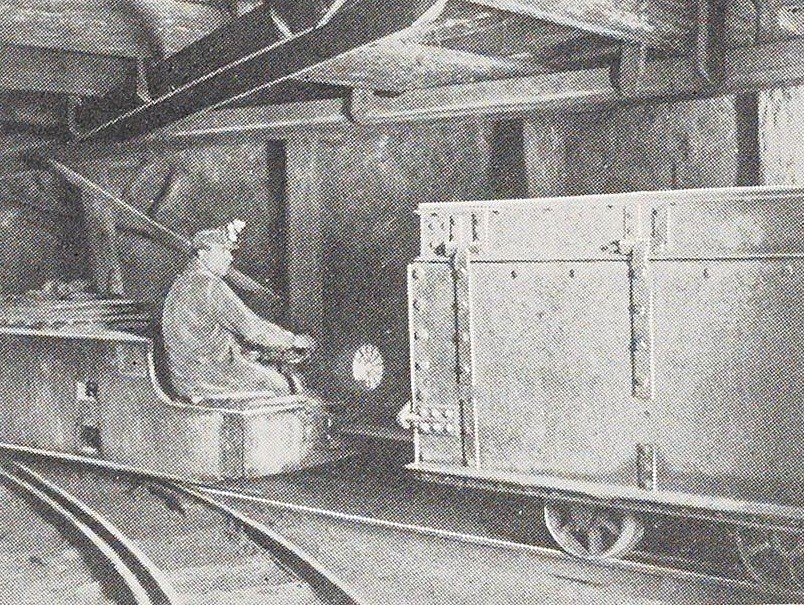
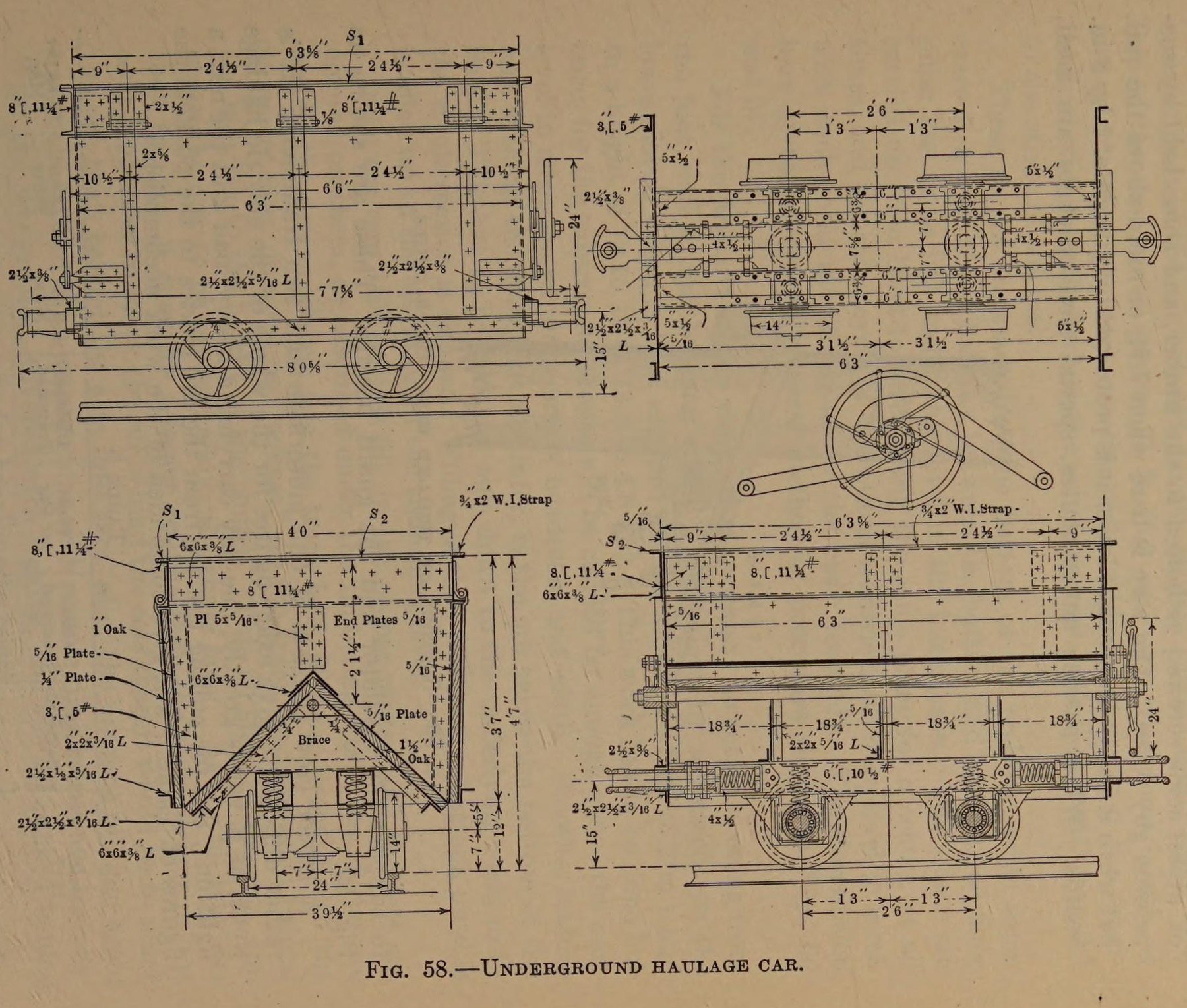
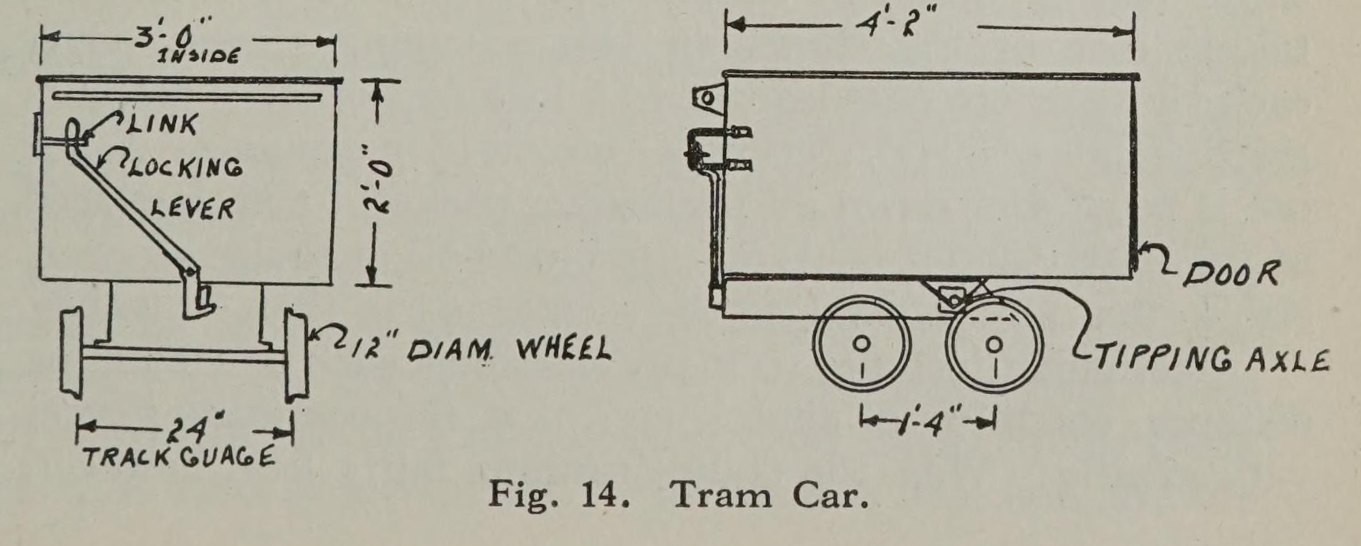
Underground track at both mines was narrow: 24 inches between the rails for the cars men pushed, which held 1.4 tons and weighed about a ton empty. Pushing them was called hand-tramming. In 1918 Haight and Tillson summed up Franklin’s system: “Transportation is by hand-tramming, in the main, for short distances to ore passes from which on certain levels the ore is collected by electric haulage and conveyed to the chutes leading to the loading pockets.”
The tram car. Salton described the hand car at Sterling Hill in 1923: inside it measured 50 by 36 inches and 24 inches deep, and “They weigh complete approximately 2000 pounds and have an average capacity of 1.4 tons of ore.” The wheels were 12 inches across, on Hyatt roller bearings. Track was laid without fishplates, the rail ends spiked to a shared tie, and the switch points were simple: “A kick of the foot serves to throw them.” The cars dumped over the end. A trammer threw the locking lever just before the car struck a rail laid across the track at the chute, and “the impact is usually sufficient to tip the body of the car about a tipping axle, the contents of the car sliding out into the chute.” With the chutes running freely, “two men can be expected to tram about 40 to 45 cars per 8 hour shift” over 300 feet.
How many cars? Tillson counted the tram cars in the Franklin mines on 1 January 1911 (The Picking Table, vol. 59, no. 1, p. 17): 31 Ernest Weiner cars, 14 Wonham-Magor and 27 of the New Jersey Zinc Company’s own make, all of 24 cubic feet on 24-inch gauge; 4 Koppel cars of 16 cubic feet on 22-inch gauge; 30 of the company’s 60-cubic-foot electric haulage cars (8 on the 300 level, 10 on the 750, 6 on the 950 and 6 on the 1150); and 12 cars of 30 cubic feet on 36-inch gauge, built for mule haulage and by then scrapped.
The electric haulage had begun in 1910, with the new Palmer shaft. Tillson recorded that trolley haulage started on the 300 level in late March, on the 750 in April, and that “On the 1150 level the electric locomotive assumed its duties in October,” with the 950 level following on 1 November. By 1917 the locomotives were General Electric machines of 6 to 7½ tons, “using 250 volts direct current and giving 2500 lb. drawbar pull at 7½ miles per hour,” running on 30- and 40-pound rail and drawing current from a bare copper trolley wire hung at least seven feet up, boxed in with boards where it came lower. A crew was a motorman and two trammers; a train of ten cars could be dumped in 60 to 90 seconds. The trolley wire was a hazard. A trammer killed in 1910 had been riding the 300-level train for the first time, and Tillson thought “he might have received a shock from the trolley wire.”
How much track? The only figure we have found is Tillson’s. On 1 January 1911, “the footage of rails on the property was” 56,920 feet of 20-pound rail, 7,070 of 30-pound and 17,340 of 40-pound: 81,330 feet in all, of which 78,250 feet were in the Parker and Taylor mines and 3,080 at the open cut. That is about 15.4 miles of rail, 14.8 of them underground. Tillson counts feet of rail, and a track needs two rails, so the length of track was probably about half that, roughly 7½ miles underground (our arithmetic, not his). We have found no track figure for Sterling Hill, or for Franklin after 1911. Modern accounts give lengths of tunnels, not of track: the 2025 geological guidebook’s model of the Sterling mine “includes over 35 miles of tunnels.”
At Sterling Hill the change came later. In 1923 Salton reported that “Transportation is accomplished by hand tramming, as there are no long distances to ore pockets in any part of the present workings of the mine.” Later the mine used battery locomotives, which carry their own power and need no wire. In 1991 collectors dug through the floor of the “motor shanty” on the Sterling 340 level, “the room where mine locomotives recharged their batteries at night”. At Franklin, a study of 1946 has ore on the haulage levels “trammed by trolley or battery motors to the shaft ore pockets,” and the 1950 magazine article has the ore “loaded by slushers or muckers into mine cars pulled by battery locomotives to chutes which dump it into electric trains for haulage to large bins.” A slusher (at Franklin, a scraper) is a scraper bucket dragged by cable from an air or electric hoist; a mucker is a mechanical shovel.
Shafts, skips and man-cars
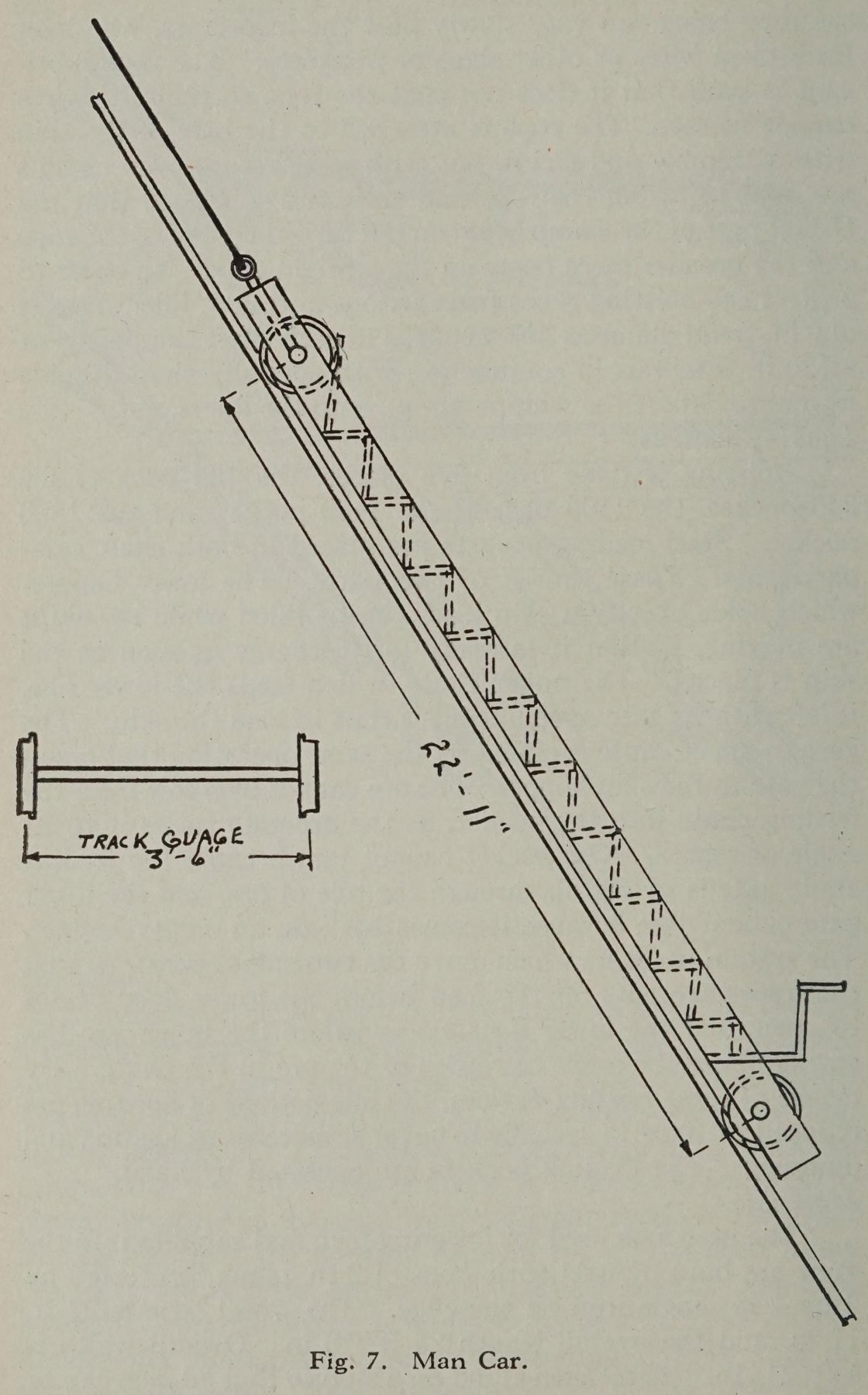
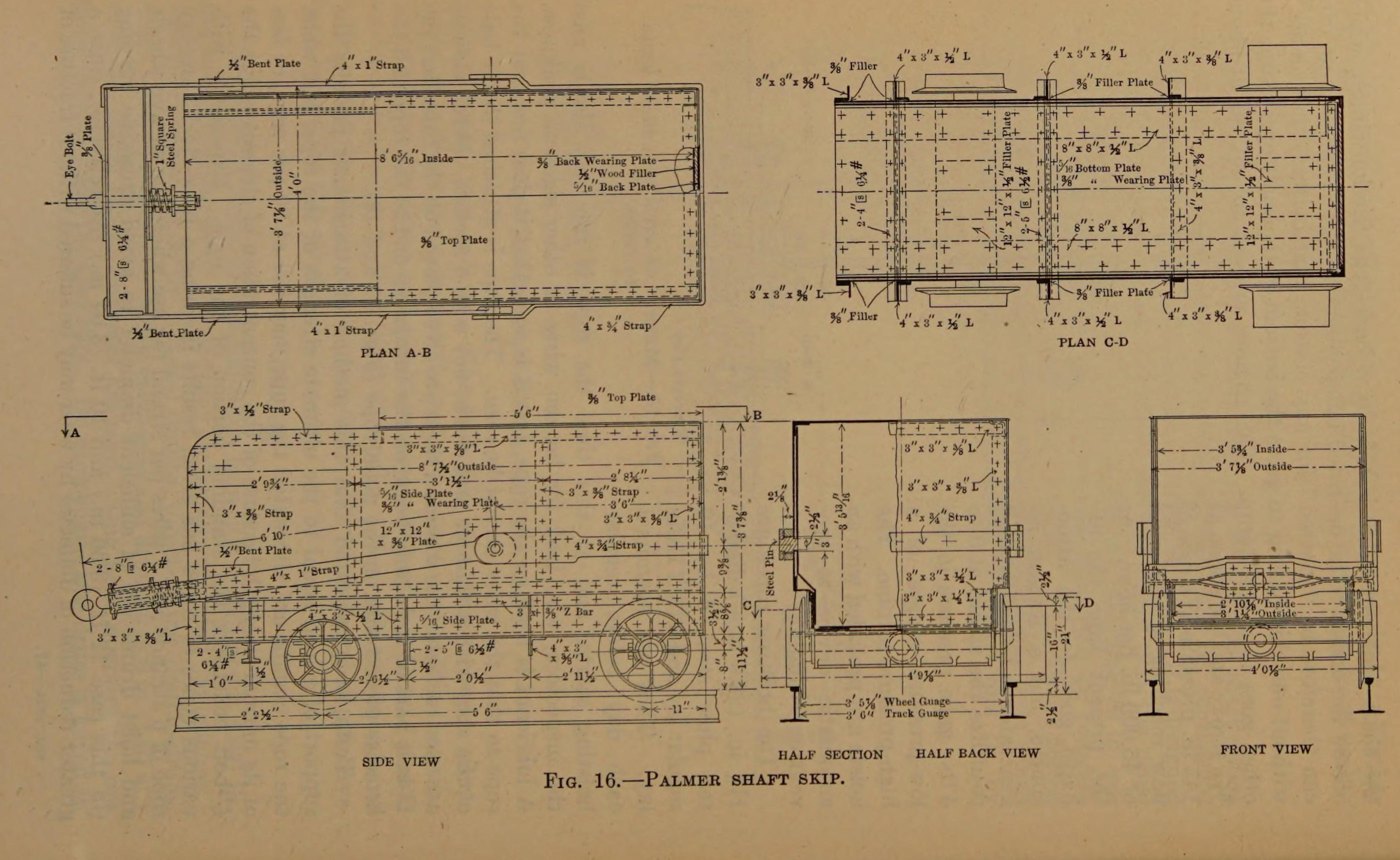
Both main shafts followed the dip of the ore down an incline, not straight down, so the hoisted vehicles ran on rails. Ore rode in skips, steel boxes on wheels that tipped themselves at the top; men rode in man-cars, long cars built as a flight of steps. At Franklin’s Palmer shaft (47½ degrees, opened 1910) the skips held six tons and were wound by two Allis Chalmers double-drum hoisting engines with Corliss valve gear, one for the ore skips and one for the man-cars, each drum free to be set for a different level. Haight and Tillson give the skip’s own weight twice, and not the same: the skips “weigh about 4500 lb.” (p. 736), but the ropes “support a skip weighing empty about 2¾ tons, with an average ore load of about 6 tons extra” (p. 743). The 1950 article calls them “Steam-driven hoists,” pulling a skip from the bottom “in a matter of about 30 seconds, the hoisting speed being 3000 feet per minute.”
At Sterling Hill in 1923 the shaft ran at 57 degrees, the hoist was a 250-horsepower electric Vulcan, and the skips held three tons; ore was hoisted only at night, when the man-car was swapped for a skip in twelve minutes. The man-cars there, as at Franklin, were steel with plank steps edged in angle iron: “Three men stand on a step so that 30 men can be loaded at once.” A man-car like these stands today at the portal of the Sterling Hill Mining Museum (GANJ 2025).
Sterling Hill got a new shaft, mill and shops in 1958. By the 1970s, according to a company broadside reprinted in The Picking Table, the main shaft dropped at 52 degrees to a vertical depth of about 2,000 feet, with five compartments for the cages and two for the skips; a winze (an underground shaft) from the 1850 level reached 2,700 feet. Underground crushers on the 1100 and 1920 levels fed seven-ton skips, hoisted “at speeds of up to 1920 feet per minute.”
Air and water pressure
Did ore cars at Franklin or Sterling Hill run on compressed air or water pressure? We have found no source that says so. Compressed-air locomotives, which carry a tank of air at high pressure, were built and used in other mines in these years, but no paper on either mine mentions one, and the sources that name the locomotives call them electric: trolley, then battery.
Air and water did drive a great deal else, and the memory may come from one of these. Compressed air ran every rock drill, the small Lidgerwood hoists that lowered timber down the slides, and in 1910 even the old Parker hoisting engines, which Tillson planned to run “by compressed air brought up Parker Shaft from underground” so the boilers could be shut down. Where a filled stope sloped the wrong way, Haight and Tillson wrote, “an engine of the ‘puffer type’ is used to pull the car up grade.” At Sterling in the 1970s the drill jumbo “is propelled by a compressed air motor and the drills are positioned for drilling by hydraulic controls.”
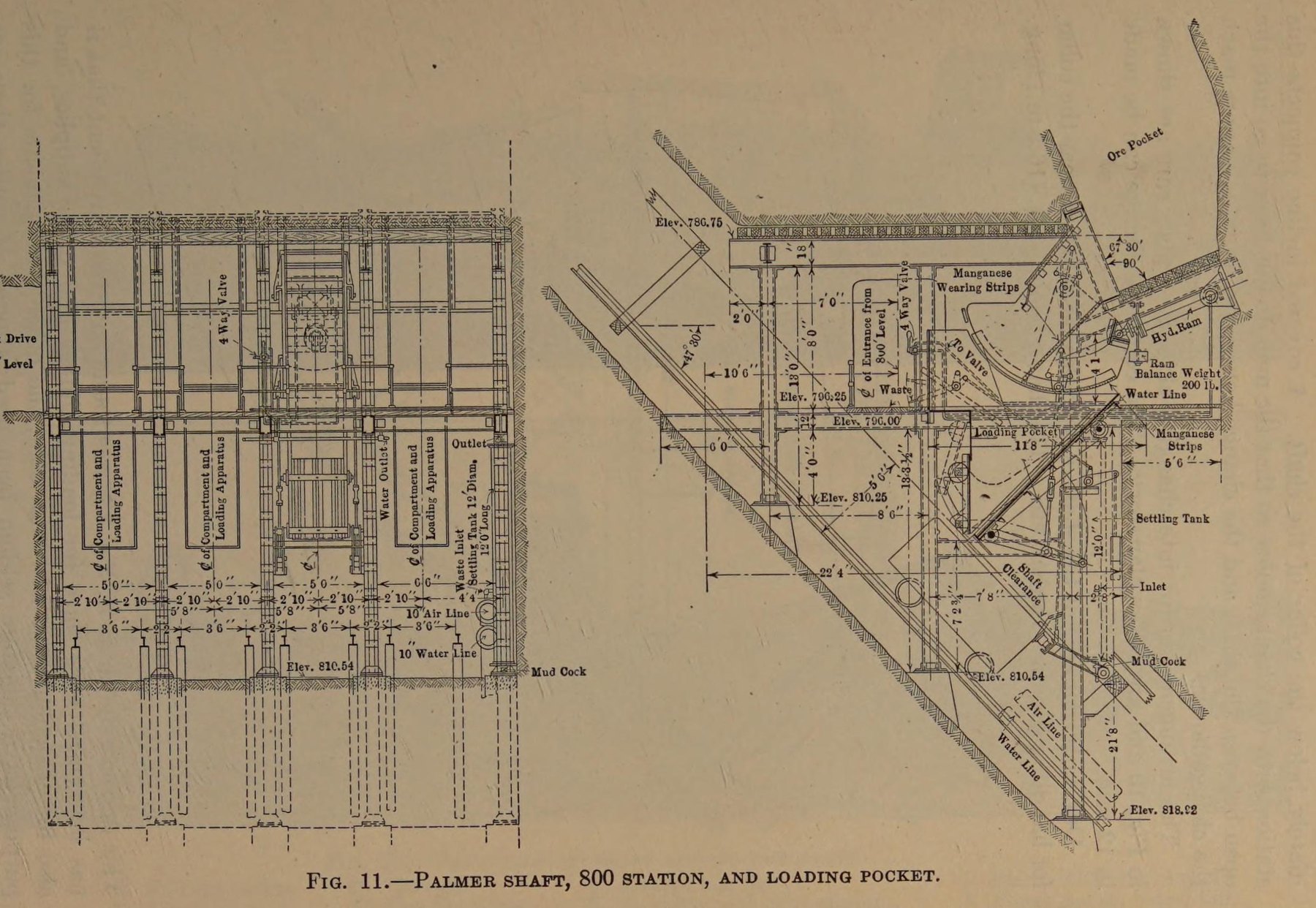
Water pressure worked the loading pockets at the Palmer shaft, the bins where ore was measured into the skips. “A hydraulic ram, deriving its power from the water column in the shaft, operates the gate levers,” Haight and Tillson wrote; the mine water pumped up from the 1050 level went to “a tank at the surface which provides storage for the operation of the hydraulic rams of the loading pockets.” Sterling Hill’s pockets in 1923 were worked by hand. And at Sterling, fill was carried by water: sand, slag and cement mixed into a slurry ran by gravity down pipes to the stopes, “Filling is accomplished hydraulically,” and an inclined tunnel called the Gravity Tram ran from a surface fill quarry, the “glory hole,” down through the marble.
Pumps
Water was the constant enemy. On 12 August 1892, at 560 feet in the new Parker shaft (580 by Shuster’s account of 1927), a blast opened a water-filled seam, and “a stream of water, sand, clay, and stones shot up the shaft over 150 feet high. Before the men could get out, they were up to their waists in water.” In a day the water stood 400 feet deep in the shaft, and wells across the valley went dry. Baum tells how three steam sinking pumps, each of several tons, hung on block and tackle and fed by a seven-inch steam line, were lowered after the falling water, drowned when a boiler failed, and were raised and restarted; the flood delayed the shaft more than a year.
Steam and air pumps gave way to electric ones. By 1918 the main Franklin pumps on the 1050 level were three Worthington eight-stage turbine pumps on 250-horsepower motors, any one of which “can pump 450 gal. (1703 l.) per minute” against a head of 1,000 feet. At Sterling Hill in 1923 the water below the 500 level ran to a sump on the 1850 level and was pumped up in two lifts by electric pumps, and all the water used in the mill came from the mine.
The last years
Franklin closed in 1954. At Sterling Hill, the company broadside of the 1970s describes a mine that a miner of 1910 would hardly have known: drill jumbos, ammonium-nitrate explosive fired electrically, a diesel load-haul-dump vehicle (a small front-end loader) to clear the stopes, and “Battery powered mine locomotives drawing as many as ten or eleven cars, each holding about two tons,” to the ore passes. In the hoist house stood “four large air compressors for supplying compressed air for the drills and miscellaneous machines underground.” Mining at Sterling Hill ended in 1986. The museum keeps track, cars, a man-car and a diamond drill on its tour.
For the shape of the ore these machines followed, see Drawing the folds; for the timber that held the stopes up, Wawayanda and the timber for the mines; for more pictures, the picture gallery.
In The Picking Table
Most of what The Picking Table holds on mine machinery comes inside histories, company papers and miners’ memories. In issue order: the New Jersey Zinc Company’s broadside “An Important Part of Sussex County for 125 Years” (vol. 19, no. 1, March 1978), on Sterling Hill in the 1970s; John L. Baum’s “The Sinking of the Parker Shaft” (vol. 23, no. 2, Fall 1982) and his accounts of the Parker mine and the Taylor mine (vol. 24, 1983); J. A. Van Mater’s report of December 1900 (vol. 30, no. 2, Fall 1989); William D. Lord, Jr.’s “A Study of Top-Slicing at the Franklin Mine” in two parts (vol. 32, no. 2, Fall 1991, and vol. 33, no. 1, 1992), with the scraper hoists and drills of the 1940s pillars; Pete J. Dunn and Bernard T. Kozykowski’s “The Resurrection of Sterling Hill” (vol. 33, no. 2, Autumn/Winter 1992), whose short glossary of drift, stope, slusher, skip and tram is a good introduction; John Kolic and Stephen Sanford on the motor shanty and the Gravity Tram (vol. 34, no. 2, Autumn/Winter 1993); and Robert W. Metsger’s “The Geology and Mining of the Sterling Hill Zinc Deposit” (vol. 39, no. 2, Fall/Winter 1998).
Later issues add the men and machines of the last years at Sterling Hill: Steven Sanford’s “Underground Journal” and Robert Hauck’s history of the museum’s collecting dump, which tells of salvaging an Ingersoll-Rand air hoist of about 1915 and three Eimco loaders (vol. 41, no. 1, Spring 2000); Sanford’s “Jersey Troglodyte Trails” (vol. 44, no. 1, Spring 2003), with slushers, Gardner-Denver drills and Eimcos; Mark Boyer’s “An Evening with Jack Baum” (vol. 53, no. 1, Spring 2012); and B. F. Tillson’s report on the Franklin mine for 1910, edited by Boyer (vol. 59, no. 1, Spring 2018), the richest single source for the electric haulage and the rock drills. No article in The Picking Table has been given to the mine machinery as such; there is no history of the hoists, compressors, locomotives or pumps of either mine.
Sources and further reading
- Baum, J. L., 1982, The sinking of the Parker shaft. The Picking Table, vol. 23, no. 2, p. 6–8. PDF
- Baum, J. L., 1983, The Parker mine. The Picking Table, vol. 24, no. 1, p. 10; and The Taylor mine, vol. 24, no. 2, p. 6–7. PDF
- Boyer, M., 2012, An evening with Jack Baum. The Picking Table, vol. 53, no. 1, p. 30. PDF
- Di Maio, M. P., Herman, G. C., and Verbeek, E. R., eds., 2025, Revisiting the Sterling Hill orebody. Geological Association of New Jersey, 41st annual conference. Pp. 62, 73–74 and the field-trip stops. PDF
- Gillingham, W. P., 1950, Red, green, and black zinc ore. Compressed Air Magazine, vol. 55, no. 4 (April), p. 88–94. archive.org
- Haight, C. M., and Tillson, B. F., 1918, Zinc mining at Franklin, N. J. Transactions of the American Institute of Mining Engineers, vol. 57, p. 720–829. Figs. 11 and 58 and pp. 726–727, 736, 744, 753, 785–786, 793–794. archive.org
- Kolic, J., and Sanford, S., 1993, Recent mineral finds from the Sterling mine. The Picking Table, vol. 34, no. 2, p. 21. PDF
- Leschot, R., 1863, Tool for boring rock. U.S. Patent 39,235, July 14, 1863. Patent (PDF)
- Lord, W. D., Jr., 1947, A study of top-slicing at the Franklin mine (part 1). The Picking Table, vol. 32, no. 2 (1991), p. 18. PDF
- Metsger, R. W., 1998, The geology and mining of the Sterling Hill zinc deposit (reprinted from the 1997 GANJ guidebook). The Picking Table, vol. 39, no. 2, p. 23. PDF
- New Jersey Zinc Company, c. 1924, A record of accomplishment, 1848–1923. Plate “The Franklin Mine and Surface Operations.” Science History Institute
- The New Jersey Zinc Company: an important part of Sussex County for 125 years (company broadside, author unknown). The Picking Table, vol. 19, no. 1 (1978), p. 4–6. PDF
- Salton, G. H., 1923, Mining practice at Sterling Hill mine, New Jersey Zinc Company. Transactions of the Canadian Institute of Mining and Metallurgy, vol. 26, p. 416–440. Fig. 7. archive.org
- Spencer, A. C., and others, 1908, Franklin Furnace folio, New Jersey. U.S. Geological Survey, Geologic Atlas of the United States, folio 161. Spencer, “Zinc mines,” p. 24. Text (PDF)
- Testing rock drills. Compressed Air Magazine, vol. 18, no. 8 (August 1913), p. 6931–6932. archive.org
- Tillson, B. F., 1911, A report on the operations of the Franklin mine during 1910 (excerpts, ed. M. Boyer). The Picking Table, vol. 59, no. 1 (2018), p. 12–20. PDF
- Van Mater, J. A., 1900, report to S. S. Palmer and A. Heckscher, December 29, 1900. The Picking Table, vol. 30, no. 2 (1989), p. 11–13. PDF
Written with Claude, an AI model made by Anthropic, from the sources listed above, and checked against them. October 2026.