Histories › The mines and their history
Why Sterling Hill was once called the Copper Tract: Dutch prospecting, red zincite taken for copper ore, and the real copper minerals later found in the two mines.
Introduction: a zinc district with a copper shadow
Franklin and Sterling Hill are not copper mines. Their fame rests on zinc, manganese and iron, and on a mineral diversity almost unmatched in the world. Albert S. Wilkerson, in New Jersey Geological Survey Bulletin 65 (1962), wrote that the number of mineral species and varieties found there was greater than at any other known deposit, “with the probable exception of the famous mines at Langban, Sweden” (Långban); he judged the two totals nearly the same. Yet the earliest story attached to Sterling Hill is not a zinc story at all. It is a copper story: part observation, part misunderstanding, part genuine mineral occurrence, and part later historical reconstruction.
The central point is simple but important. Early observers were wrong to regard Sterling Hill as a copper mine, but they were not irrational in thinking about copper. Copper was being sought in the region. Copper was mined at Pahaquarry, on the Delaware. An eighteenth-century tradition connected copper with the Native people of the region. Sterling Hill bore the documentary name “Copper Tract.” Its bright red zincite could be mistaken for cuprite, the red oxide of copper. Later, real copper minerals were documented at both mines. And in 1973 The Picking Table described a copper alteration zone at Sterling Hill adjacent to the Mud Zone, where minerals had formed by the action of surface waters or solutions on the original ones.
The result is a story in which geology and history continually correct each other. Documents explain why copper was expected. Mineralogy explains why copper was misunderstood. The copper minerals later found in the mines explain why the old expectation was not wholly imaginary.
Native American copper: a cautious beginning
The earliest copper thread in the story is also the least certain. Allen W. Pinger, for many years chief geologist of the New Jersey Zinc Company, gave a review of the district’s history at the Franklin-Ogdensburg Mineralogical Society’s symposium in June 1961; The Picking Table printed it in 1973. When the first Europeans came, Pinger wrote, the area was sparsely inhabited by the Lenni Lenape, “roving hunters having few villages,” and the artifacts suggested that their use of minerals was small: flint, jasper, slate and quartz for points and knives; granite, trap and gneiss for tomahawks; clay for pottery; crystalline limestone and specular hematite for ornaments; and iron ore for war-paint. Among the foreign materials found, with soapstone pots and obsidian points, “a single copper ornament has been reported.”
This is not evidence of copper mining at Franklin or Sterling Hill. Pinger counted the ornament among materials brought from elsewhere; it shows only that copper belonged, however marginally, to the material world of the region’s earlier inhabitants.
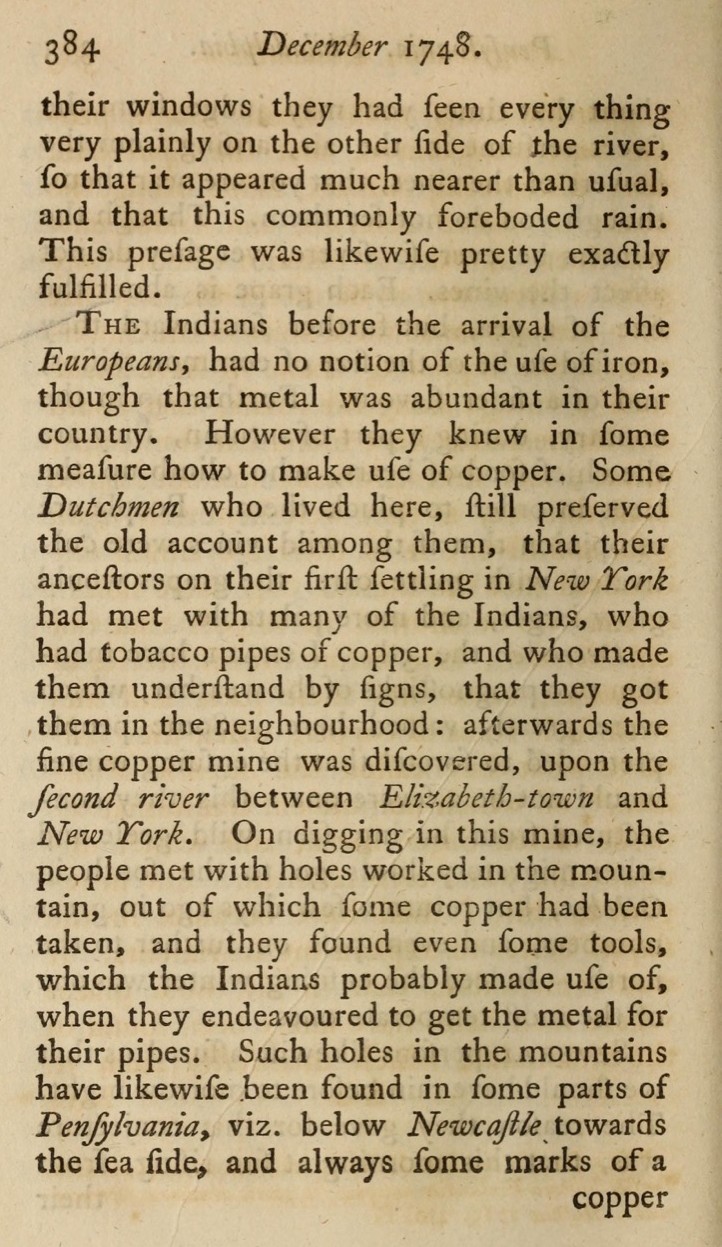
A stronger and more evocative passage was written by Peter Kalm, the Swedish naturalist who traveled in North America from 1748 to 1751. In the English translation of his Travels into North America, under December 1748 at Philadelphia, he wrote that the Indians had known nothing of iron before the Europeans came, but “knew in some measure how to make use of copper.” Some Dutchmen living there preserved the account that their ancestors, on first settling in New York, had met Indians “who had tobacco pipes of copper,” and who made them understand by signs that they got them nearby. “Afterwards the fine copper mine was discovered, upon the second river between Elizabeth-town and New York. On digging in this mine, the people met with holes worked in the mountain, out of which some copper had been taken, and they found even some tools, which the Indians probably made use of, when they endeavoured to get the metal for their pipes.” Kalm himself thought it “almost undoubted that the Indians dug these holes.”
Herbert P. Woodward quotes the passage, in a slightly different wording, in New Jersey Geological Survey Bulletin 57, Copper Mines and Mining in New Jersey (1944). Kalm’s mine on the Second River is the Schuyler mine at Arlington, but Woodward notes that the account “obviously does not fit the description, there being no ‘mountain’ at Arlington,” and elsewhere suggests that it refers to the Pahaquarry mine, worked by the Dutch about 1660; Kalm, “who was in America for only a short period, may well be excused for confusing locations.”
Thus the passage supports a cautious statement: there was an eighteenth-century tradition, recorded by Kalm, that Native people had worked a copper occurrence in a mountain before Dutch miners came. It does not prove organized Native American mining in the modern sense, and it does not touch Sterling Hill. But it does give the copper story a pre-European horizon. In the Lenape language itself, copper is màxkahsën, “red stone.”
Dutch prospectors, Pahaquarry, and Esopus

The documented European copper story begins with Dutch exploration. Woodward writes that “there is considerable legendary lore and a little direct evidence” to indicate that the “Mine Holes of Pahaquarry” are the oldest copper mines in New Jersey, if not in the United States, and that the diggings seem to have been first excavated by the Dutch during the middle of the seventeenth century. He cites a report written from New Netherland in October 1644 by Hendrick van der Capellen to the Dutch West India Company: “Mines of copper and lead have been discovered in these countries,” and a private individual “has brought here copper ore that is very rich, and hath also some silver in it.”
Pinger gives the more familiar Franklin–Sterling Hill version of this history. A few years after the founding of New Amsterdam in 1624, he wrote, the Dutch governor sent scouts to search for valuable minerals. About 1640 these miners reached the Wallkill valley, and “old prospect holes at Sterling Hill are ascribed to them.” Those workings were on the red oxide vein, and were probably opened in the mistaken belief that the red oxide was an ore of copper. The prospectors settled near the present site of Port Jervis, worked the copper mines in Pahaquarry township, and hauled the ore over the “old mine road” to Esopus, now Kingston, on the Hudson. Woodward, too, writes that the road from Esopus to Minisink, near Port Jervis, was known as the Old Mine Road “because it was used for the hauling of ore.”
Here the sources differ in emphasis and certainty. Pinger writes a broad regional narrative and connects it directly to Sterling Hill. Woodward is more cautious and concerned only with Pahaquarry. He has the Dutch discovering the Pahaquarry deposits “some time before 1659,” judges that the mining epoch lasted “only a few years, probably less than ten,” before the English took the colony in 1664, and writes that “little is known about these ancient mining activities.” The differences are not contradictions; they reflect different purposes. Pinger was writing the history of Franklin and Sterling Hill; Woodward was writing a statewide study of copper mining.
What the sources together support is this: Dutch copper prospecting and mining were active in the region by the middle of the seventeenth century, Pahaquarry was a real early copper locality, and later writers on Franklin and Sterling Hill held that the same prospectors also opened the old holes at Sterling Hill.
Sterling Hill as the Copper Tract
The strongest evidence tying Sterling Hill to early copper expectations is documentary. Pinger states that a deed of 1730 from the Anthony Rutgers estate mentions the “Copper Tract,” sold about ten years later to the father of William Alexander, the Lord Stirling for whom Sterling Hill is named, and that the deed “refers to old mine holes.” Wilkerson gives the same point: when the heirs of Anthony Rutgers owned a portion of the land in 1730 it was known as “the copper tract,” and an original land survey made in 1749 mentions “the old mine holes.” Charles Palache, in The Minerals of Franklin and Sterling Hill (1935), writes that old deeds call Sterling Hill, “then known as the ‘Stirling tract,’” the “copper tract” when it was returned to the heirs of Anthony Rutgers in 1730.
This agreement matters. The phrase “Copper Tract” is not a romantic afterthought; it belongs to the land-title history. The three writers may not be independent of one another, and Palache names his source for the early workings: A. C. Farrington, mining engineer to the first New Jersey Zinc Company, according to whom the locality was probably first worked by Dutch miners from the Hudson valley. Palache adds that the workings were “already ancient when Lord Stirling owned the property about 1770,” but that “what ore they sought at Sterling Hill is not certain.” What remains uncertain, then, is who dug the old holes, whether Dutch prospectors, Native people, early English settlers or later colonial explorers, and when. The deed of 1730 and the survey of 1749 establish only that they were there before the middle of the eighteenth century.
Elwood Shuster, who worked for the mining companies for many years and searched the title records himself, adds two details in his Historical Notes of the Iron and Zinc Mining Industry in Sussex County (1927). “In the records at Perth Amboy,” he writes, this tract is referred to as the “Copper tract,” and “one of the old deeds also recites that the ‘Stirling’ tract was given the name ‘Mocksaw’ by the Indians.” He also preserves Farrington’s own attempt to date the old pits. In his report of 1852 Farrington wrote that he had a cedar stump that grew in one of the pits sawn off and planed so the rings could be counted: there were ninety-three, and the tree was said to have been cut twenty years before, “this would carry the age of the tree back one hundred thirteen years.” From this, Shuster concludes, “these pits were opened as early as 1739.” The ring count gives only a latest date: a tree cannot grow in a pit until the pit exists, so the pits are at least that old, and may be much older.
Zincite mistaken for cuprite


The mineralogical source of the confusion was zincite. Wilkerson states the point directly: “It is evident that these men mistook zincite for cuprite.” Cuprite is a red copper oxide; zincite is a red zinc oxide. To a prospector seeking copper before modern mineral chemistry, the resemblance could be compelling. Pinger put the whole problem of the early years in one sentence: the deposits “resembled iron ore, but could not be smelted to produce iron; the red oxide looked like good copper ore, but would not yield copper.”
Lord Stirling’s experience shows both misunderstandings at work, and it is easiest to follow as two separate stories, one for each ore. William Alexander (1726–1783), who called himself Lord Stirling on the strength of a claim to a Scottish earldom, inherited the Sterling Hill property from his father. (Pinger calls the father “James Stirling” and dates the inheritance to 1761; the father was James Alexander, who died in 1756.)
The black ore: franklinite at the furnace. Sterling Hill is full of franklinite, a heavy black oxide that looks like iron ore and is attracted by a magnet. Lord Stirling, an ironmaster, tried to use it as one. Palache writes that he sent “a large amount of it to his furnace at Charlottesburg at great expense, but the unsuspected zinc and manganese in the ore prevented its successful smelting, and for years it lay on the ground unused.” Pinger dates the attempt to 1770. This was a failure of iron-making, not of copper-hunting: the ore was right about the iron and wrong about everything else in it.
The red ore: zincite to England. The second story concerns the red mineral of the Sterling Hill veins, zincite. Taking it for a copper ore, Lord Stirling, “about 1772,” Palache writes, “shipped some tons of it to England for smelting as an ore of copper,” and the ore “seems neither to have been smelted nor to have been recognized as really a zinc ore.” Pinger gives “1772 or ’74” and says the ore went “presumably as copper ore”; Wilkerson gives 1774 and says only that it was sent “for smelting,” the nature of the red mineral being still unknown; Pete J. Dunn names the port as Swansea, later an early zinc-smelting center. All three report the same sequel: pieces of the shipment reached English mineral collections, where, their origin forgotten, they were later credited to localities where zincite does not occur.
Why the two are often run together. Pinger’s short account puts them in one sentence: in 1770 Lord Stirling “attempted unsuccessfully to smelt ore from Sterling Hill at his iron furnace at Charlotte’s Borough, and in 1772 or ’74, shipped several tons of red oxide ore to England.” Read quickly, “ore from Sterling Hill” sounds like the red ore. Palache, who names the furnace ore as franklinite, separates them. Both failures came from the same cause: each ore held a metal no one yet suspected. The black ore would not make iron because it carried zinc and manganese; the red ore would not make copper because it was zinc.
The sources agree on the substance and differ only on the date of the shipment. There is a quiet coincidence here, though no source connects the two: the colonists took a red mineral for copper, while their Lenape neighbors called copper “red stone.”
From confusion to zinc mineralogy
The nineteenth century turned a misunderstood copper prospect into a landmark of zinc mineralogy. In 1810 Archibald Bruce of New York published the first analysis and description of the “red oxide of zinc,” one of the first mineralogical papers in American scientific literature. Wilkerson’s history says that Bruce “named” the mineral zincite, but his own entry for zincite gives the fuller account: Bruce called it “red oxide of zinc”; Francis Alger proposed “sterlingite” in 1844; and the name zincite, proposed by Haidinger in 1845, is the one that was accepted.
In 1819 the French chemist Pierre Berthier described and named franklinite from specimens sent to Europe by William Maclure. In 1824 Lardner Vanuxem and W. H. Keating, probably while guests of the Fowlers, first described and analyzed the zinc silicate they called “siliceous oxide of zinc”; the name willemite was given by Armand Lévy in 1830 to the same mineral from Belgium (see Willemite, named for a king).
This history explains why copper should not be treated merely as a stray curiosity. Copper was part of the frame through which early observers tried to understand the district. That they were wrong about Sterling Hill as a copper deposit does not make the copper story irrelevant. It marks the passage from prospecting by appearance to mineralogy by analysis.
Real copper minerals at Franklin and Sterling Hill
The second half of the story is that copper was not entirely imaginary. Bulletin 65 lists among the other species found at Franklin or Sterling Hill aurichalcite, azurite, bornite, chalcocite, chalcopyrite, native copper, cuprite and malachite, and also tennantite; chrysocolla it marks as “reported but not verified.”
Palache describes them one by one, and his accounts show how small their part was. Chalcocite is “very rare at Franklin”; bornite is uncommon and chalcopyrite found very rarely, though Farrington had described a seven-inch vein of chalcopyrite, galena and sphalerite near the ore at Sterling Hill; tennantite was found in a narrow vein on the 900-foot level at Sterling Hill in 1927; malachite and azurite are rarities at both mines, azurite in one find with aurichalcite in thoroughly oxidized vein material.
In 1973 The Picking Table reported tenorite, a copper oxide new to the district, verified at Harvard by David Cook. The current species list, in the Franklin-Sterling Gem and Mineral Show booklet of 2017, gives copper and cuprite, among many other copper minerals, from both Franklin and Ogdensburg. None of these minerals is economically important, but their presence keeps the story from becoming a simple tale of error.
Native copper is the most striking of them, and it is not a weathering product. Palache writes that it was first noted by J. E. Wolff in specimens from a depth of about 800 feet in the Parker shaft, where it was “apparently fairly common,” “some pieces weighing a pound having been found in the crushed ore after it had passed through the rolls.” It occurs “in irregular hackly masses, films, wires, or spangles,” with willemite, hancockite, roeblingite, datolite, axinite, cyprine, garnet, caswellite or barite. (These are Palache’s names: cyprine is a copper-blue variety of vesuvianite, and caswellite, an altered mica of Franklin, is no longer on the list of mineral species.) Crystals are very rare: W. M. Foote described minute distorted dodecahedrons, and E. D. Shuster had two crystals a quarter of an inch across that were “but thin shells of copper enclosing cores of granular datolite.”
Wolff regarded the copper as later than the zinc ore, brought in by solutions along shear zones; Palache found some of it embedded in clear crystalline willemite, and so of the same age as that mineral, and took the associated minerals to show an origin connected with the intrusive pegmatite.
In July 1933 John C. Haff found on the picking table at Franklin a mass of native copper 10¾ inches long, weighing 3,056.5 grams, with two octahedral crystals about 15 mm across, encrusted in part with willemite-franklinite ore and accompanied by barite, hodgkinsonite and a green copper carbonate. Another fine piece, 10½ by 4½ by 4½ inches, taken in late 1945 from veins just above the 800-foot level near the Palmer shaft pillar, is described by John L. Baum in The Picking Table. The irony is plain: real cuprite does occur in the district, though Palache saw only one specimen, while the colonial “copper” was zincite.
Bulletin 57 helps place these minerals in a broader New Jersey context. Woodward lists the copper minerals of the state as “at least” native copper, chalcopyrite, chalcocite, covellite, bornite, cuprite, hydrocuprite, tenorite, chrysocolla, brochantite, malachite and azurite, and possibly conichalcite and pseudomalachite. He repeatedly emphasizes secondary, or supergene, processes. Chalcocite, he writes, is “secondary at most if not all localities” and is found “mainly in fractures, crevices, joint-planes and bedding-planes.” Cuprite is “clearly of supergene origin, probably being derived from native copper by surficial meteoric waters in the zone of oxidation.”
Woodward was writing chiefly about the copper deposits in the Triassic rocks, and mentions the Franklin zinc deposits only in passing, among Highlands deposits whose copper minerals are “accessory minerals of no economic value.” His observations do not prove a particular origin for any Franklin or Sterling Hill specimen, but they give the vocabulary needed to understand late copper alteration.
Mud Zone, copper alteration, and secondary minerals
The Mud Zone and the alteration areas around it connect the old copper story to modern Sterling Hill mineralogy. In 1966 Frank Z. Edwards, reporting on the minerals of Sterling Hill since the mine reopened, described a partially altered or intermediate zone, five to ten feet wide, between the Mud Zone and the unaltered ore body, which had produced “copper alteration products such as azurite, malachite, chrysocolla, covellite and others still not identified.” “Native copper has not been found,” he added, “and the source for these copper alteration minerals is not known.” (A minute blob of it was found at Sterling Hill in 1972.)
In 1973 The Picking Table reported “The Arsenate Area,” a slip surface exposed by a blast in July 1972 in stope 960, about 20 feet below the 340-foot level of the Sterling mine. It had produced the arsenates symplesite, köttigite, pharmacosiderite, legrandite, adamite and pharmacolite, with scorodite, arseniosiderite and a new arsenic chlorite tentatively identified. The writer called it “another unusual mineralized area or zone in the natural crucible that is Sterling Hill.”
Most important for the copper story, the same report noted that a piece showing heavily etched arsenopyrite beneath a reddish coating of arsenates suggested, “pending further investigation,” that “it would appear that the arsenates result from the leaching of arsenopyrite by surface waters or solutions.” The writer added that the arsenate area was only a few feet from the copper alteration zone, “which, in turn, is adjacent to the Mud Zone,” and that both areas had produced a goodly number of alteration minerals “as a result of the action of surface water or solutions upon the original minerals.”
The copper story, then, is not only an early colonial misunderstanding; it is also a story of secondary minerals. Surface waters and solutions altered original minerals, moved elements about, and produced late assemblages in the arsenate area, the copper alteration zone and the Mud Zone.
In the same issue, a specimen from the copper alteration zone in stope 960 was described as consisting almost entirely of radiating white to light green balls or clusters on remnants of corroded franklinite; Dr. Warren Miller identified it as prehnite, the first find of the common type of that mineral in the area.
Later work tied the copper minerals to the Mud Zone more firmly. In 1994 Robert E. Jenkins II and Steven C. Misiur described the “Chalcopyrite Room,” a copper-zinc-lead occurrence found in 1990 at depths of 770 to 870 feet in the Sterling mine, where the oxidation of bornite, chalcopyrite and other sulfides had produced brochantite, devilline, malachite, rosasite and aurichalcite. They judged oxidation “probably a relatively recent phenomenon,” and summarized R. W. Metsger (1990), who described oxidized copper minerals associated with the Mud Zone, a large saprolite body reaching from the surface to a depth of about 207 meters, and showed that the saprolite and the oxidized copper minerals had formed within the last two or three million years.
These observations show that Sterling Hill’s late alteration zones were not incidental. They produced new specimens, new mineralogical puzzles and local zones of secondary mineral formation. The Mud Zone and the copper alteration zone belong to the same historical continuum as the old prospect holes: early prospectors were drawn by visible signs and familiar colors, while modern collectors and mineralogists recognize such signs as products of complex alteration in a zinc-manganese-iron district.
Conclusion: the right correction
It is not enough to say that early miners confused zinc and copper. That is true, but incomplete. The fuller statement is this: early miners were wrong about Sterling Hill being a copper deposit, but they were responding to real regional copper history, to the real appearance of a red oxide mineral and, in a limited way, to real copper minerals and alteration zones.
The sources, taken together, support a layered interpretation. Kalm preserves a tradition of Native copper working, but its location and meaning are uncertain. Woodward gives the most cautious history of Pahaquarry and early New Jersey copper mining. Pinger and Palache, the latter following Farrington, connect that history to Sterling Hill and the Copper Tract. Wilkerson gives the plain mineralogical summary: zincite was mistaken for cuprite. Palache and later collectors document real copper, some of it native copper formed with the late veins in the ore. The Picking Table’s reports on the arsenate area and the copper alteration zone, and the later work on the Mud Zone, add the modern coda: surface waters and solutions made alteration minerals, copper minerals among them, in and beside the Mud Zone.
Copper belongs in the Franklin–Sterling Hill story not as the main ore but as a persistent interpretive thread. It links Native tradition, Dutch prospecting, colonial deeds, Lord Stirling’s failed hopes, nineteenth-century mineralogy and the secondary minerals of Sterling Hill. In a district famous for zinc, copper remains a small but revealing witness to how mineral localities are first seen, then misunderstood, and finally understood more fully.
In The Picking Table
The Picking Table has come back to copper many times. Frank Z. Edwards’s “The Minerals of Sterling Hill 1962–65” (vol. 7, no. 2, August 1966) first described the copper alteration zone beside the Mud Zone. The Franklin Mineral Notes in vol. 13, no. 1 (1972) record brochantite, devilline and linarite from that area and chalcotrichite, the hair-like cuprite, from Franklin; vol. 13, no. 2 (1972) reports George Pigeon’s first native copper from Sterling Hill. Vol. 14, no. 2 (1973) holds both Allen W. Pinger’s review of the district’s history, with the Dutch prospectors and the Copper Tract, and the unsigned “The Arsenate Area,” with the note on tenorite. John L. Baum’s story of the finest Franklin native copper is in vol. 16, no. 1 (1975), reprinted with a note by Peter Chin in vol. 42, no. 1 (2001), and Stephen Sanford’s “Recent Mineral Occurrences at Sterling Hill” reports native copper crystals from below the 1200-foot level (vol. 19, no. 2, September 1978). Robert E. Jenkins II and Steven C. Misiur describe the Chalcopyrite Room in vol. 35, no. 2 (1994), and Earl Verbeek’s “The 2006 find of secondary copper minerals at Sterling Hill” (vol. 67, no. 1, 2026) is not yet online.
The early history is retold in the New Jersey Zinc Company’s “An Important Part of Sussex County for 125 Years” (vol. 19, no. 1, March 1978); in Elwood D. Shuster’s “History of the Franklin and Sterling Ore Deposits,” printed after his death (vol. 20, no. 2, September 1979); in Pete J. Dunn’s “Short Notes” on Swansea (vol. 32, no. 2, Fall 1991); in Dunn and Bernard T. Kozykowski’s “The Resurrection of Sterling Hill” (vol. 33, no. 2, Autumn/Winter 1992); and in Daniel E. Russell’s “The Trotter Tunnel at Sterling Hill” (vol. 34, no. 1, Spring/Summer 1993), which offers a second reading of the name “Copper tract”: surface stains of malachite or azurite from weathered copper sulfides. No article in The Picking Table has dealt with Pahaquarry, with Kalm’s tradition of Native copper, or with Lord Stirling himself.
Sources and further reading
- The Arsenate Area; Recent Sterling Mine Specimens; Mineral Notes (tenorite). The Picking Table, vol. 14, no. 2 (1973), p. 7–9. Unsigned. The Picking Table (PDF)
- Baum, J. L., 2001, A classic native copper from Franklin, New Jersey (with a note by Peter Chin; reprinting Baum’s account from The Picking Table, vol. 16, no. 1, February 1975, p. 9). The Picking Table, vol. 42, no. 1, p. 25. The Picking Table (PDF)
- Edwards, F. Z., 1966, The minerals of Sterling Hill 1962–65. The Picking Table, vol. 7, no. 2 (August 1966), p. 3 ff.; the intermediate zone and its copper minerals, p. 5–11. The Picking Table (PDF)
- Haff, J. C., 1934, Crystallized native copper from Franklin, New Jersey. American Mineralogist, vol. 19, p. 480–482. PDF
- Jenkins, R. E., II, and Misiur, S. C., 1994, A complex base-metal assemblage from the Sterling mine, New Jersey. The Picking Table, vol. 35, no. 2, p. 16–24 (reprinted from the Mineralogical Record). The Picking Table (PDF)
- Kalm, P., 1770, Travels into North America, translated by J. R. Forster, vol. 1. The copper passage, p. 384–385. archive.org
- Mineral species found at Franklin–Sterling Hill, NJ (Mineral List Committee, August 2017). Franklin-Sterling Gem & Mineral Show booklet, 2017. PDF
- Palache, C., 1935, The minerals of Franklin and Sterling Hill, Sussex County, New Jersey. U.S. Geological Survey Professional Paper 180. History, p. 14–15; copper, p. 26; cuprite, p. 36. PDF
- Pinger, A. W., 1973, A review of mineralogical, geological and mining activities in the Franklin area, Sussex County, New Jersey (part 1; paper read at the F.O.M.S. symposium, June 1961). The Picking Table, vol. 14, no. 2, p. 11–16. The Picking Table (PDF)
- Shuster, E., 1927, Historical notes of the iron and zinc mining industry in Sussex County, New Jersey. Franklin, N.J. Complete scan, 47 pages. PDF
- Wilkerson, A. S., 1962, The minerals of Franklin and Sterling Hill, New Jersey. New Jersey Geological Survey Bulletin 65. History, p. 6–8; mineral list, p. 14–16; corrections, p. 23; willemite, p. 73; zincite, p. 76. Archived copy of the Survey’s PDF. PDF
- William Alexander, Lord Stirling; James Alexander. Wikipedia
- Woodward, H. P., 1944, Copper mines and mining in New Jersey. New Jersey Geological Survey Bulletin 57. Copper minerals, p. 13–19; Kalm and the Schuyler mine, p. 44; Pahaquarry, p. 127–129. Archived copy of the Survey’s PDF. PDF
A synthetic document. David (Dave) Kaminski gathered the notes and sources and shaped the article with ChatGPT; Claude, an AI model made by Anthropic, then checked it against the sources listed above and revised it. October 2026.