Histories › The people behind the minerals
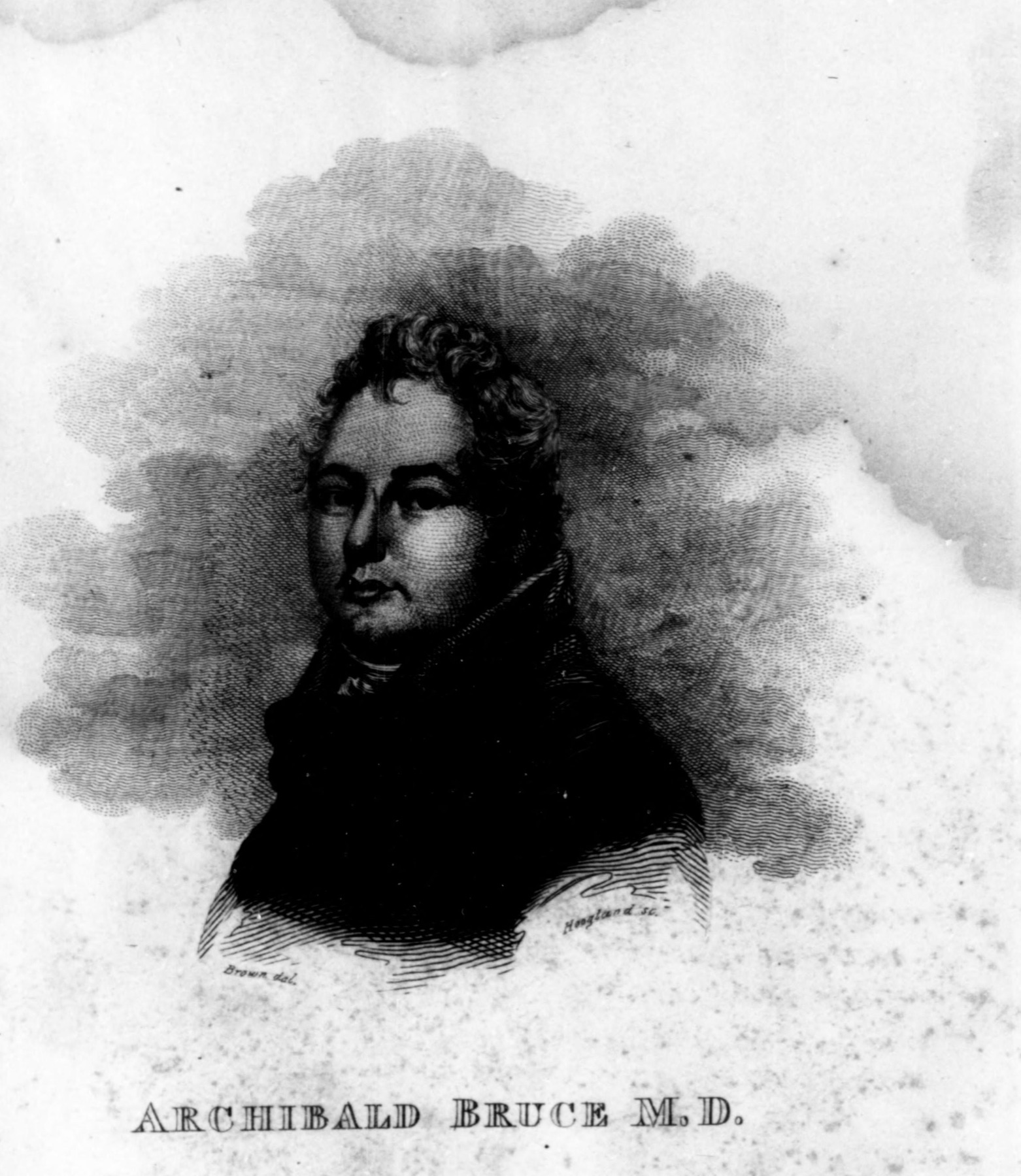
Archibald Bruce, a New York physician and mineral collector, founded the first American journal of mineralogy in 1810 and in it described the “red oxide of zinc” of Franklin and Sterling, now zincite, the paper with which Palache dated the start of scientific knowledge of the Franklin minerals; the mineral brucite is named for him.
Where Franklin science begins
Charles Palache, writing the history of the Franklin district for the U.S. Geological Survey in 1935, put a date and a name on its beginning: “Scientific knowledge of the Franklin minerals began with the discovery of zincite by Bruce in 1810” (Professional Paper 180, p. 14). A page later he explained what he meant. “The paper of Dr. Bruce, an enthusiastic mineralogist of New York City, describing the zincite and calling attention to its abundance and value as a zinc ore, was the first step toward a right understanding of its chemical composition” (p. 15).
Archibald Bruce was a physician, a professor of materia medica (the study of drugs) and mineralogy, a collector who brought one of the first fine mineral cabinets to America, and the founder and editor of the first American journal given over to mineralogy. He died at forty, in 1818. This page follows his whole life, and links rather than retells the parts of the Franklin story already told elsewhere on this site: the red ore taken for copper (Copper before zinc), the naming of franklinite in Paris (Franklin, Sterling Hill and Ogdensburg in mineral names), and his notice of the Franklin fluorite that glowed on hot coals (Three glows).
A physician’s son from New York
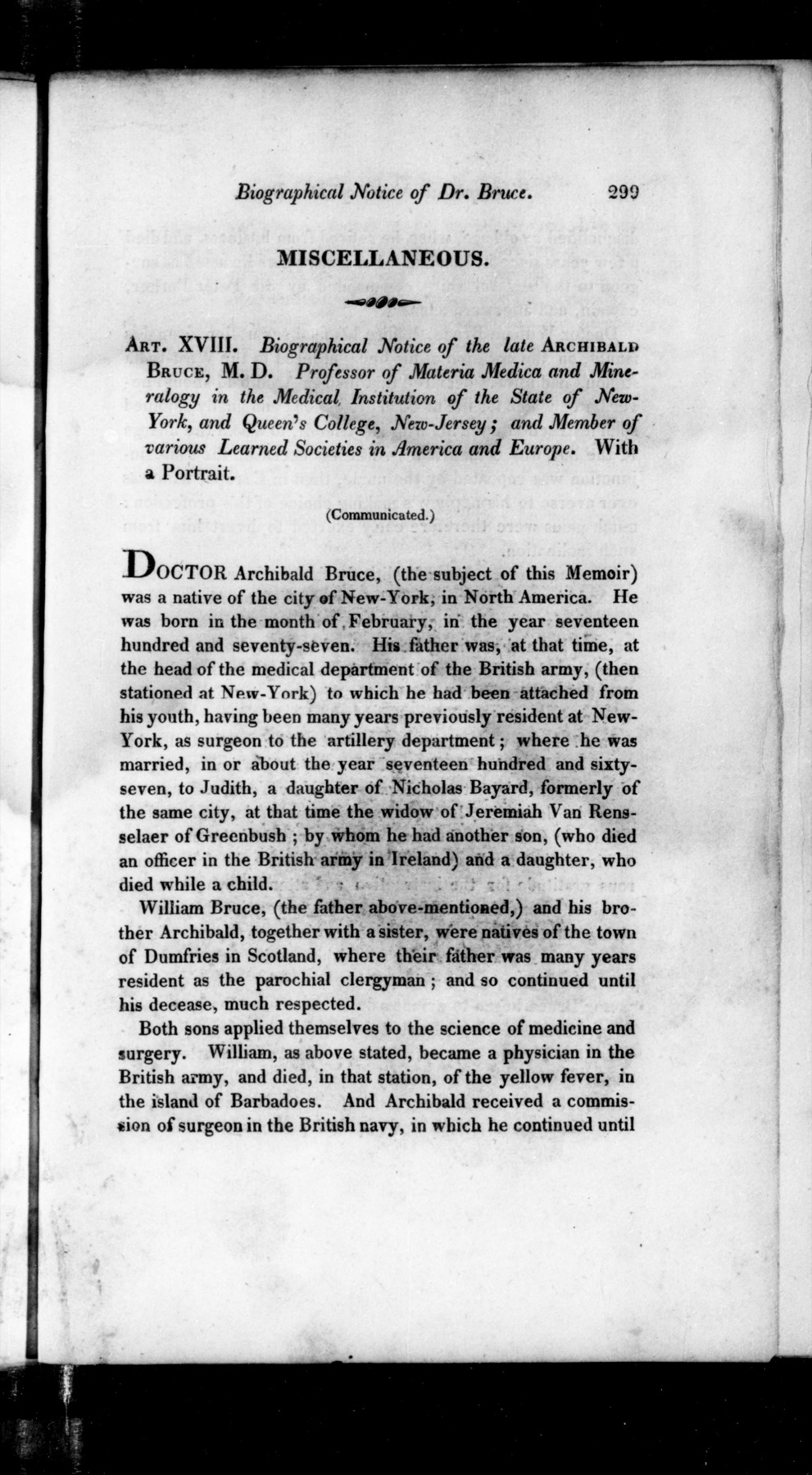
The fullest account of his life is an unsigned notice printed soon after his death in Benjamin Silliman’s new American Journal of Science. Bruce, it begins, “was a native of the city of New-York, in North America. He was born in the month of February, in the year seventeen hundred and seventy-seven,” while the city was held by the British. His father, William Bruce, “was, at that time, at the head of the medical department of the British army,” and had married Judith, a daughter of Nicholas Bayard of New York and widow of Jeremiah Van Rensselaer of Greenbush. William and his brother Archibald were natives of Dumfries in Scotland, where their father was the parish minister. Both became medical men: William died of yellow fever in Barbados as an army physician, and the uncle served many years as a naval surgeon on the ships of Sir Peter Parker, a British captain and later admiral (p. 300).
The father had decided that his son should not be a doctor, and the uncle repeated the injunction. During the war the boy was sent to Halifax in the care of William Almon, a physician and friend of his father, then brought back to a boarding school at Flatbush, Long Island, kept by Peter Wilson, a teacher of the classical languages. He entered Columbia College in 1791. There, against his family’s wishes, he began to attend the medical lectures of Nicholas Romayne, a leading New York physician who had studied under the elder Bruce, and later continued with Samuel Bard, another of the city’s senior physicians (p. 300–301). Appletons’ Cyclopaedia gives his Columbia graduation as 1797 (vol. 1, p. 418).
Minerals came early. “The collection and examination of minerals, a pursuit not then at all attended to in this country, was his particular relief from other studies” (p. 301). The notice missed one source of the interest, as David Hosack pointed out four years later. Hosack, a New York physician and professor of botany at Columbia who had brought back from Europe in 1790 what George Brown Goode called “the first cabinet of minerals ever seen in the United States” (Goode 1897, p. 403), wrote that “with the assistance of the late Dr. Bruce, who was then my private pupil in medicine, I arranged and marked the several specimens in that collection. This exercise first awakened Dr. Bruce to this subject,” adding in a footnote that the biography in Silliman’s journal had not known it (American Journal of Science, vol. 4, p. 398).
In 1798 Bruce left for Europe, and in 1800 he took the degree of doctor of medicine at Edinburgh with a thesis De Variola Vaccina, on cowpox, the material of the new smallpox vaccination (p. 301).
Europe, a cabinet, and a chair
After Edinburgh, “during a tour of two years, he visited France, Switzerland, and Italy; and collected a mineralogical cabinet of great value and extent.” He married in London and came back to New York “in the autumn of 1803, to enter on the active duties of a practitioner of medicine” (p. 301; Appletons says the summer). In England he had been intimate with Charles Greville of Paddington Green, “the possessor of one of the finest private cabinets in Europe,” and with Count Bournon, a French émigré who lived almost as one of Greville’s household and was “hardly second to any man in mineralogical, and particularly in crystallographical knowledge” (p. 302). He was at home at the house of Sir Joseph Banks, the president of the Royal Society, and “the learned and estimable Abbé Haüy,” the founder of crystallography (see Gerard Troost and troostite), “was among his personal friends and correspondents” (p. 303).
His cabinet mattered at home. A reviewer in the first volume of Silliman’s journal remembered that only fifteen years earlier it had been hard to find anyone in America who could name “even the names of the most common stones and minerals” (American Journal of Science, vol. 1, p. 36), and counted among the events that “totally changed the face of this science in the United States” “the return of the late Benjamin D. Perkins, and of the late Dr. A. Bruce, from Europe, in 1802 and 3, with their beautiful collections, then the most complete that this country had ever seen” (p. 37). Perkins was a New York bookseller whose collection went to Yale (Goode, p. 431). Both cabinets, the notice says, “were freely shown to the curious” (p. 302).
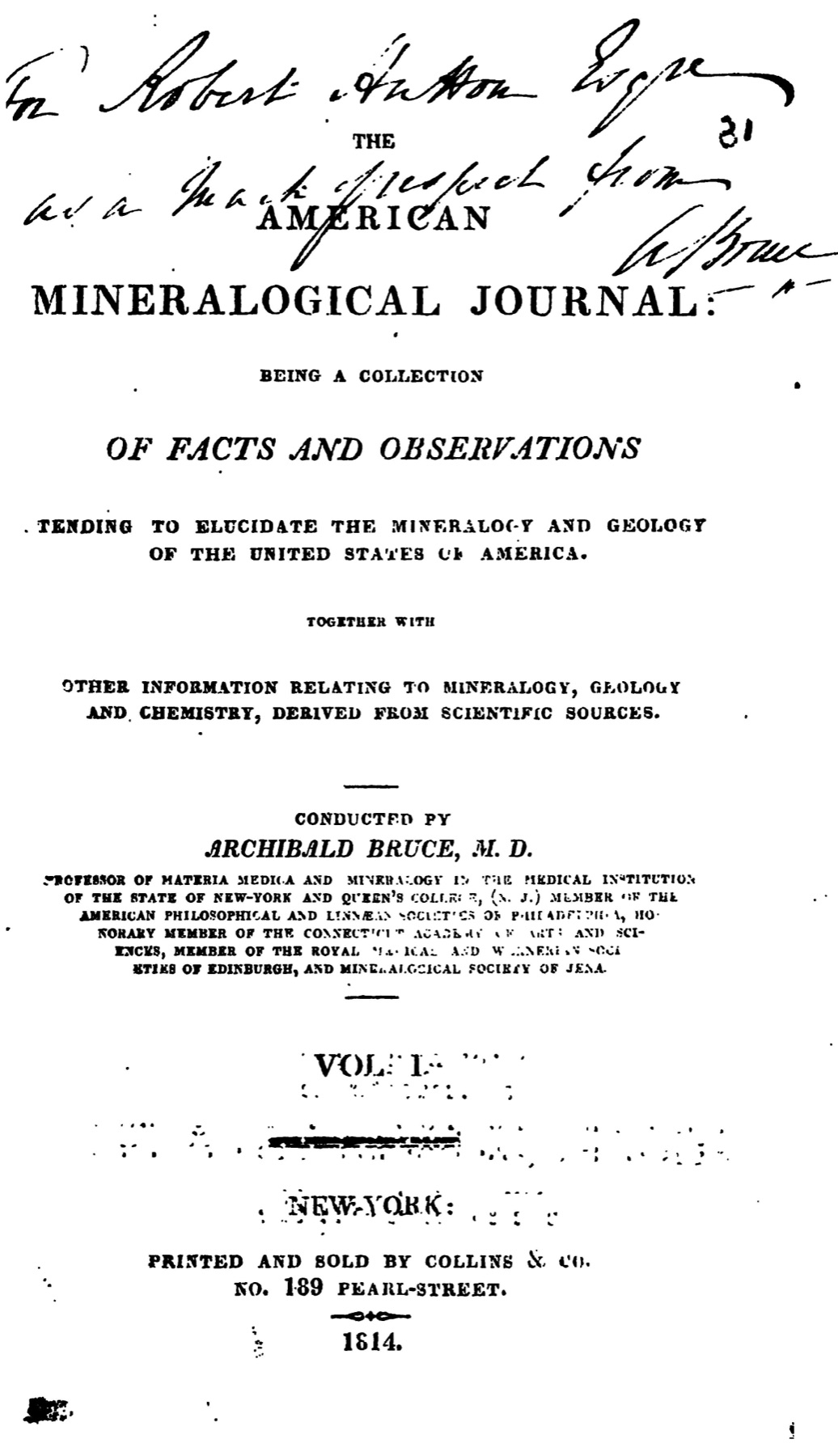
Bruce worked with Romayne to set up the state and county medical societies, before which, the notice says, the practice of physic in New York “was regulated by no public authority,” and when the College of Physicians and Surgeons of New York was chartered he became its professor of materia medica and mineralogy (p. 301–302). Appletons dates the appointment 1807 and calls him “the first to fill such a chair in the United States”; on the reorganization of the college in 1811 “he was superseded on account of some disagreement with the management, and after 1812 filled the same chair in Queen’s, now Rutgers, college, New Jersey” (vol. 1, p. 418). The title page of his journal lists both posts, the “Medical Institution of the State of New-York and Queen’s College, (N. J.),” with his memberships in the American Philosophical Society, the Linnæan Society of Philadelphia, the Connecticut Academy, the Royal Medical and Wernerian Societies of Edinburgh and the Mineralogical Society of Jena (title page). Appletons adds that he was one of the original members of the New-York Historical Society.
The American Mineralogical Journal
Bruce, the notice says, “often expressed a wish to see a journal of American mineralogy upon the plan of that of the School of Mines at Paris” (the Journal des Mines), and “in 1810, published the first number of this work” (p. 303). The first page is headed “January, 1810” (vol. 1, p. 1). The preface set out the aim: “to collect and record such information as may serve to elucidate the Mineralogy of the United States, than which there is no part of the habitable globe which presents to the mineralogist a richer or more extensive field for investigation,” on the model of “the periodical works on the continent of Europe, particularly those in Germany and France,” and with an eye to American manufactures (preface). It asked for papers on districts, mines, metallurgy, specimens and mineral waters.
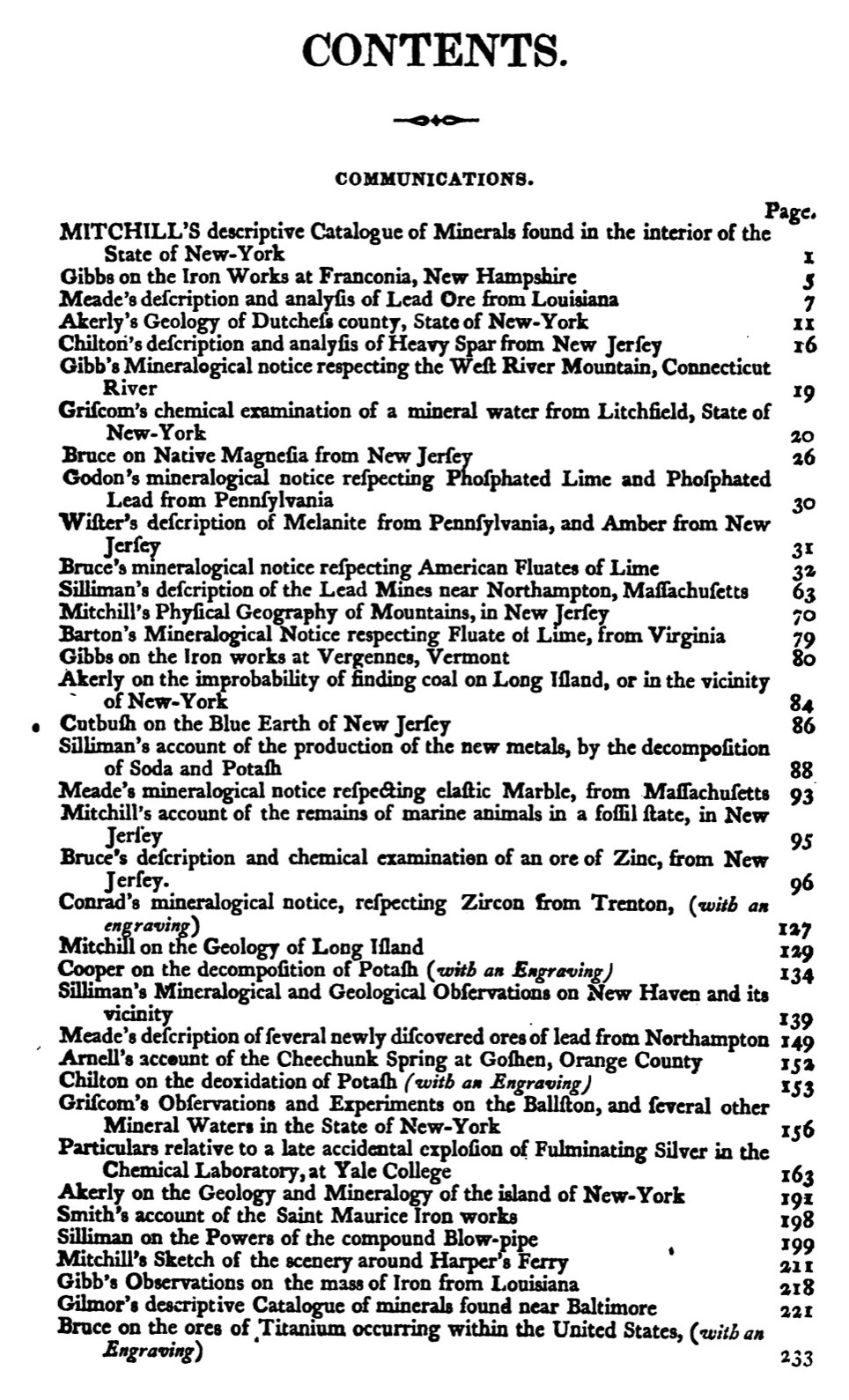
The contributors were the small scientific circle of the young republic. The first article is a catalogue of minerals from Niagara “presented to the Editor by his colleague, S. L. Mitchill” (p. 1). Samuel Latham Mitchill (1764–1831) was the first professor of natural history at Columbia, a zoologist, mineralogist and chemist, and had founded the Medical Repository in 1798 (Goode, p. 402). George Gibbs, the “Colonel Gibbs” of the journal, had brought home in 1805 “the magnificent collection which was long in the custody of the American Geological Society” (Goode, p. 431). Benjamin Silliman, born in 1779, had been professor of chemistry at Yale since 1802 (Goode, p. 426). Samuel Akerly, Mitchill’s brother-in-law, wrote on geology, and John Griscom, “one of the earliest teachers of chemistry,” on mineral waters (Goode, p. 424). Bruce’s own papers were on native magnesia, on American fluorite, on the New Jersey zinc ore and on the ores of titanium (contents).
It came slowly. Silliman wrote in 1818 that it “appeared only at distant intervals, and, after the lapse of several years, never proceeded beyond the fourth number” (American Journal of Science, vol. 1, p. 3). The four numbers make one volume, whose title page is dated 1814; Palache accordingly cites Bruce’s papers as of 1810, “vol. pub. 1814” (bibliography, p. 2). What it meant was put by Silliman in the same place: “No future historian of American science will fail to commemorate this work as our earliest purely scientific Journal, supported by original American communications.” Goode, in 1897, called it “the earliest of American scientific periodicals,” though on another page he gave that honor to Mitchill’s Medical Repository (p. 441; p. 402). Silliman’s qualification, purely scientific, is the safer claim.
The red oxide of zinc
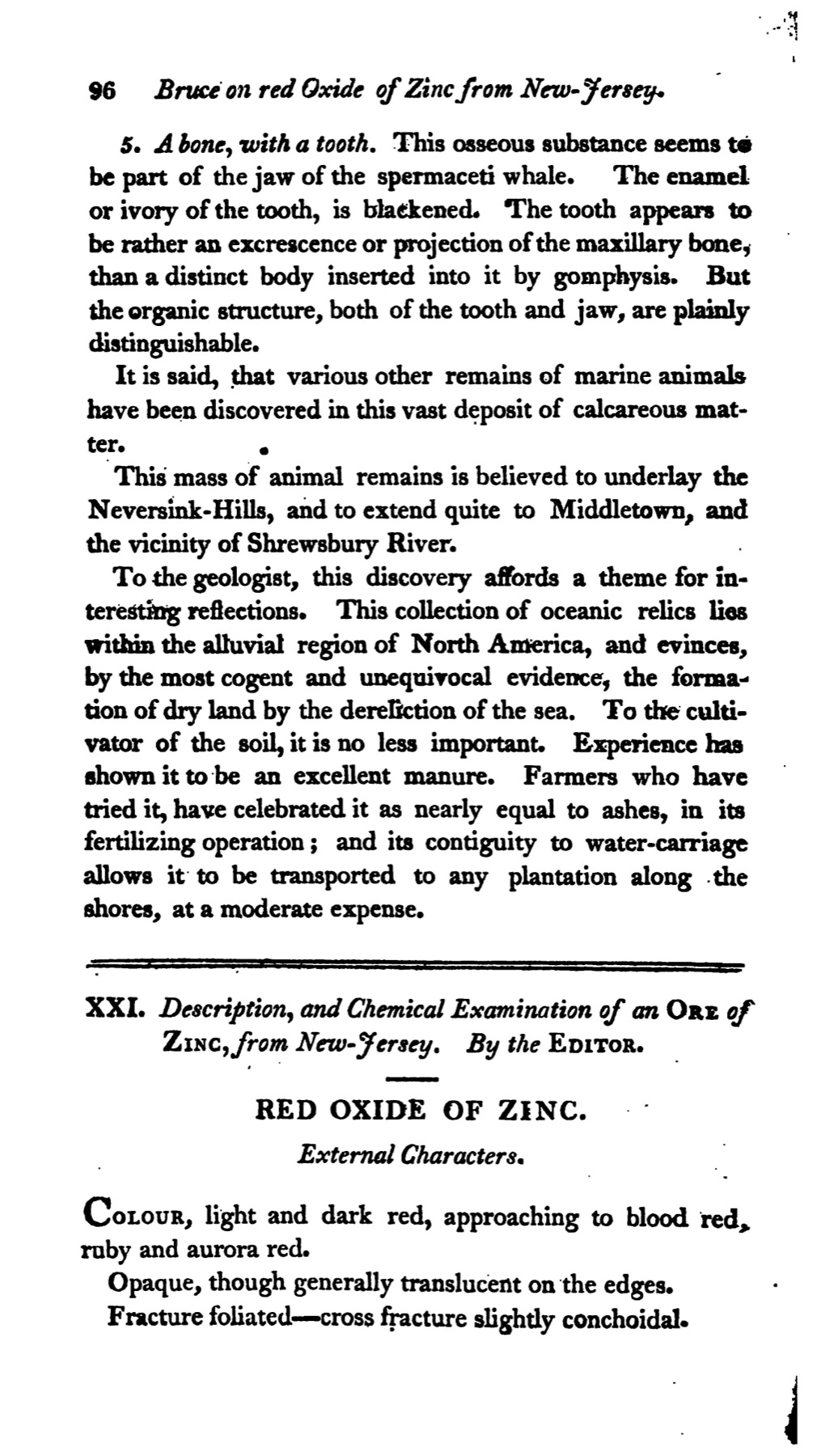
The paper is article XXI, “Description, and Chemical Examination of an Ore of Zinc, from New-Jersey. By the Editor,” headed “Red Oxide of Zinc” (p. 96). The mineral is zincite, zinc oxide (ZnO). Bruce described it character by character: “Colour, light and dark red, approaching to blood red, ruby and aurora red. Opaque, though generally translucent on the edges. Fracture foliated—cross fracture slightly conchoidal.” Its lustre on a fresh fracture was “shining: after long exposure to the atmosphere, dull: the surface in time becoming covered with a pearl white crust”; the powder “brownish yellow, approaching to orange”; it was “readily scratched by steel”; and its “Specific gravity, 6.22” (p. 97).
Under the ordinary blowpipe it would not melt, but “when exposed to the united flames of oxygene and hydrogene, it sublimes, attended with a brilliant white light.” A footnote credits that instrument to “Robert Hare, Jun. Esq. Professor of Natural Philosophy in the University of Pennsylvania,” the inventor of the oxy-hydrogen blowpipe (p. 97). Bruce then told the red ore apart from the other red minerals a collector might confuse it with. From “the ruby red oxide of copper,” cuprite, “it differs in weight, being nearly twice as heavy,” and its solution in acids is colorless, where that of the copper ore is bright green (p. 97–98). His figures for weight were off: the specific gravity of zincite is now given as about 5.66 and that of cuprite as about 6.14 (Handbook of Mineralogy, zincite; cuprite), so the two weigh nearly the same and cuprite is the heavier. The colorless solution was the sound test, and it answered, in a line, the old error of taking the Sterling ore for copper (see Copper before zinc).
The analysis followed. “Twenty-five grains of the ore, in fine powder, were dissolved in diluted nitric acid: the solution was colourless”; oxalic acid threw down the zinc as oxalate, and the residue gave him manganese and, with prussiate of potash, iron (p. 98–99). Calcining the oxalate and relying on “the experiments of Desormes and Clements” (Charles Desormes and Nicolas Clément, French chemists) for the composition of the oxide, he concluded that “one hundred parts of the ore contain Zinc 76, Oxigene 16, Oxides of Manganese and Iron 8” (p. 99). Palache, a century later, judged that Bruce “called it ‘red oxide of zinc’ and gave a correct characterization of the substance,” though he did not determine its cleavage or crystal form (p. 40).
Franklin, Stirling, and the octahedral iron
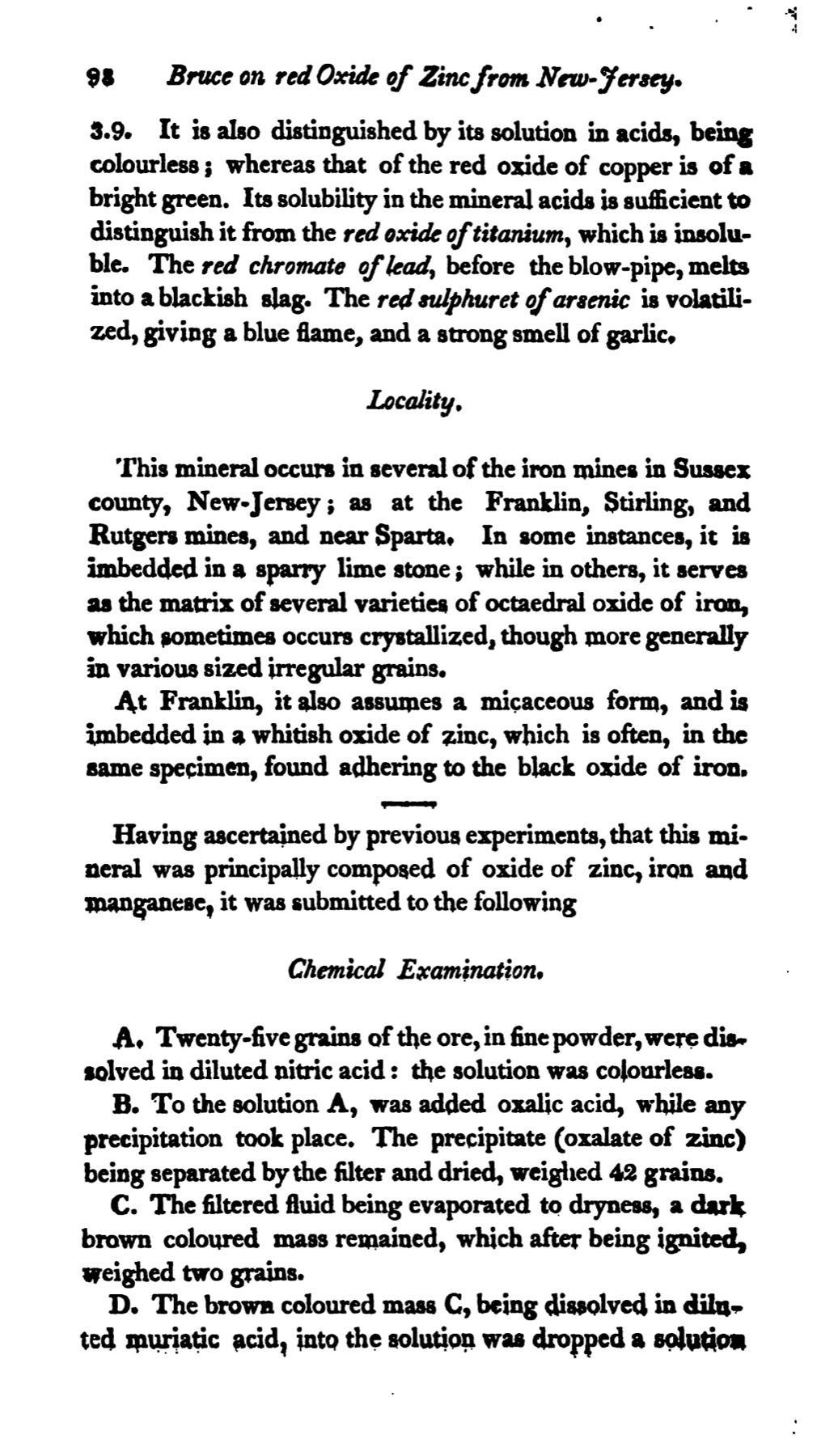
Bruce’s specimens came from the iron mines of Sussex County. “This mineral occurs in several of the iron mines in Sussex county, New-Jersey; as at the Franklin, Stirling, and Rutgers mines, and near Sparta. In some instances, it is imbedded in a sparry lime stone; while in others, it serves as the matrix of several varieties of octaedral oxide of iron, which sometimes occurs crystallized, though more generally in various sized irregular grains. At Franklin, it also assumes a micaceous form, and is imbedded in a whitish oxide of zinc, which is often, in the same specimen, found adhering to the black oxide of iron” (p. 98). “Stirling” is Sterling Hill; the “sparry lime stone” is the white Franklin marble.
The “octaedral oxide of iron” is the point where Bruce stopped short. Those black octahedral grains were franklinite, the zinc-iron-manganese oxide of the spinel group, and Bruce, like everyone before him, took them for magnetite. Palache: “He did not, however, discover the true character of the more abundant franklinite, which he mistook for magnetite, as all before him had done” (p. 15); and again, “Bruce, who discovered the zinciferous nature of zincite, considered the black mineral associated with it to be magnetite. This it was generally supposed to be, and several unsuccessful efforts were made to work this refractory material as an ore of iron” (p. 48). Bruce had in fact found manganese and iron in the red ore; Vanuxem and Keating later put his iron down to franklinite mixed with it (see Gerard Troost and troostite).
He closed with a note on value. “The recently discovered property of the malleability of Zinc, at a temperature of 300° of Farenheit, has greatly enhanced its value,” and “the mineral just described will prove a source from which this metal may be procured in abundance” (p. 99). In brass making the ore “affords with copper a compound possessing a high degree of malleability, a fine colour and every requisite of the best kind of brass,” equal to brass made with imported spelter, “which being imported, bears an exorbitant price.” It could also make white vitriol (zinc sulfate) and zinc oxide, and “the oxide of zinc has of late been recommended as a substitute for white lead as a pigment.” His last sentence: “This red oxide of zinc from its abundance, and the many uses to which it may be applied, promises to be a valuable acquisition to the manufacturing interest of the United States” (p. 100). Brass and zinc white were in fact what the New Jersey ores came to be used for (see What zinc was for).
From Bruce to Berthier
Palache traced what followed to the paper: “Still, Bruce’s description of zincite caused the geologist Maclure to send abroad specimens of it, which contained franklinite. Some of these reached the French chemist Berthier, by whom that mineral was properly described as an oxide of iron, manganese, and zinc” (p. 15). William Maclure was the Scottish-born geologist of the United States; Pierre Berthier, an engineer of the French Corps of Mines, named franklinite in 1819. That chain is told on Franklin, Sterling Hill and Ogdensburg in mineral names.
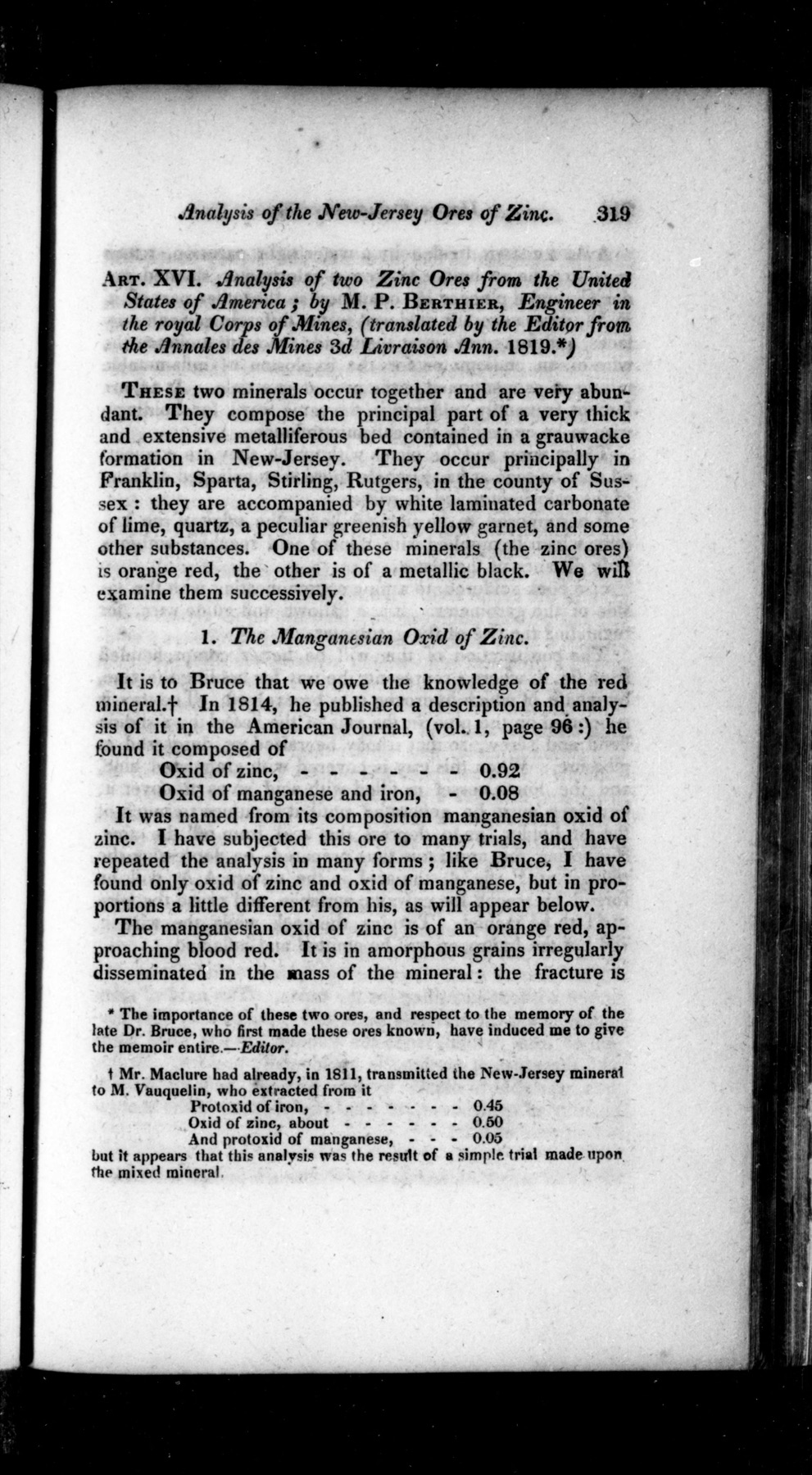
Silliman printed Berthier’s paper in English in 1820, explaining in a footnote that “the importance of these two ores, and respect to the memory of the late Dr. Bruce, who first made these ores known, have induced me to give the memoir entire.” Berthier began with the red ore: “It is to Bruce that we owe the knowledge of the red mineral,” and, “like Bruce, I have found only oxid of zinc and oxid of manganese, but in proportions a little different from his.” A second footnote gives the first link of the chain: “Mr. Maclure had already, in 1811, transmitted the New-Jersey mineral to M. Vauquelin,” the Paris chemist Louis-Nicolas Vauquelin, whose figures were 45 parts protoxide of iron, about 50 oxide of zinc and 5 protoxide of manganese; but “it appears that this analysis was the result of a simple trial made upon the mixed mineral” (vol. 2, p. 319).
By then Bruce’s priority was taken for granted in America: John Torrey, the New York chemist and botanist, wrote in 1822 of “the red oxyd of zinc of New-Jersey, discovered by Bruce” (American Journal of Science, vol. 5, p. 238; see John Torrey and torreyite). Berthier repeated Bruce’s method and found its weak point. Bruce “regarded the calcined precipitate as pure oxid of zinc; but I have remarked, that it always retains a very notable quantity of manganese, and that this is the reason why it always retains a foul yellow colour, more or less deep—a fact which Bruce observed without searching for the cause” (p. 320). The name he gave the red ore, manganesian oxide of zinc, did not last either. Palache records that the name zincite was given by Wilhelm Haidinger in 1845, preceded by “sterlingite,” proposed by Francis Alger, the Boston mineralogist who became part owner of the Franklin property about 1844 (p. 40; p. 15).
Native magnesia: brucite
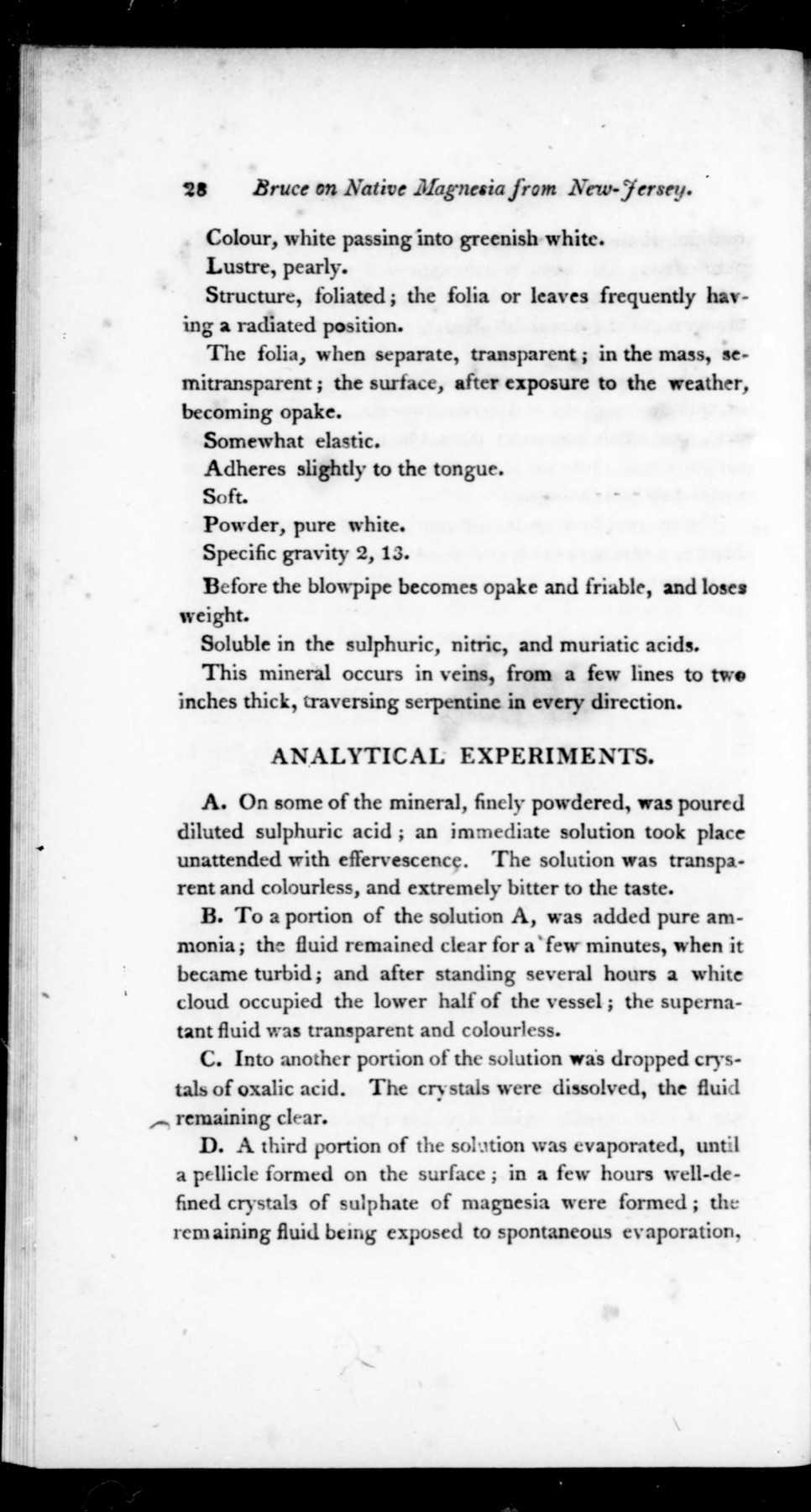
Bruce’s other discovery is the one that carries his name, and it has nothing to do with zinc. In the first number of his journal he wrote “On Native Magnesia from New-Jersey” (p. 26). After reviewing the European “magnesites” that were said to be pure magnesia, he turned to a mineral found “at Hoboken, in New-Jersey, on the estate of Mr. John Stevens” (p. 27), across the Hudson from New York. Its characters were “Colour, white passing into greenish white. Lustre, pearly. Structure, foliated,” the leaves “somewhat elastic”; it “occurs in veins, from a few lines to two inches thick, traversing serpentine in every direction.” It dissolved in sulfuric acid “unattended with effervescence,” so it held no carbonic acid, and gave crystals of Epsom salt (p. 28). His result was “Magnesia 70, Water of Crystallisation 30” (p. 29–30). The mineral is brucite, magnesium hydroxide (Mg(OH)2).
Silliman’s journal in 1818 recalled that “in the rocks at Hoboken, Dr. Bruce discovered the hydrate of magnesia, or magnesia combined with nothing but water,” and that “this discovery gave a new and interesting species to mineralogy” (vol. 1, p. 55). The name followed his death. A note headed “Brucite” in the same volume announced “a new Species in Mineralogy, discovered by the late Dr. Bruce” (p. 439). A. H. Chester’s Dictionary of the Names of Minerals (1896) sorts out what happened to the word: the 1819 brucite, which Chester credits to George Gibbs, is an obsolete synonym of chondrodite; François-Sulpice Beudant, the French mineralogist, used the name in 1824 “for hydrate of magnesium,” which is the sense that lasted; and in 1847 Armand Dufrénoy used “brucite” for zincite, briefly giving the red zinc ore its describer’s name (Chester, p. 41). In the second edition of Beudant’s Traité élémentaire de minéralogie (1837), brucite stands alone as the “espèce unique” of his magnesium family: “La Brucite se trouve en veines dans la serpentine de Hoboken, dans le New-Jersey” (vol. 2, p. 637–638).
Hoboken’s serpentine yielded one more relative. In 1822 Thomas Nuttall, the English-born naturalist who also worked at Franklin, described from it a fibrous mineral that looked like asbestos but dissolved in acid without effervescence and named it nemalite (American Journal of Science, vol. 4, p. 19); Chester calls it “a fibrous var. of brucite” (p. 187). Brucite itself has a small place at Franklin: Palache lists it among the species known there only through a variety, manganbrucite, found in a single specimen “as a thin veinlet cutting the franklinite-willemite ore at Franklin” (p. 25; p. 52).
Bruce also left a notice of American fluorite, in which the purple fluorite from near Franklin Furnace was “phosphorescent when thrown on ignited coal” (told on Three glows), and a paper on the ores of titanium found in the United States (contents).
Death, and Silliman’s Journal
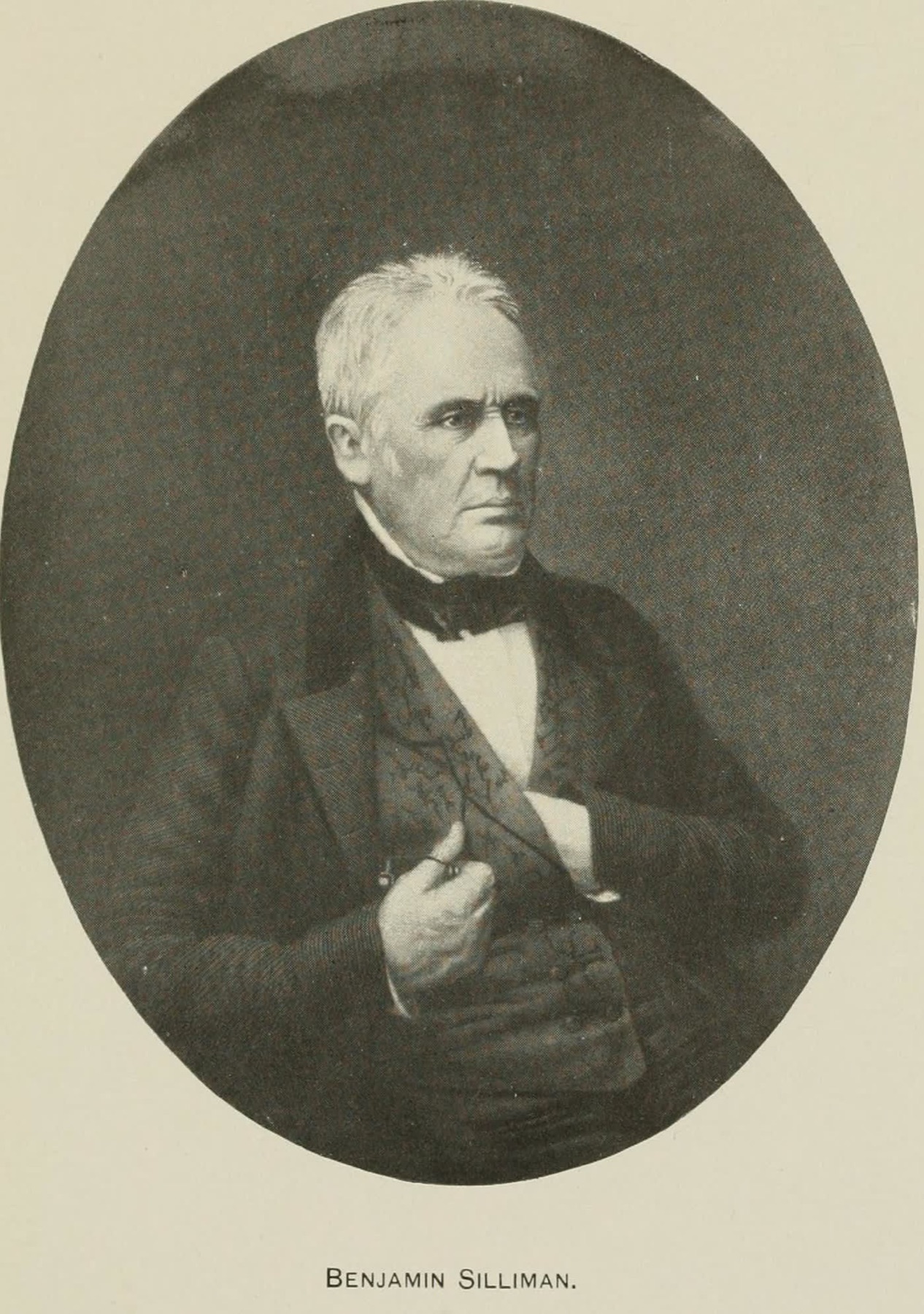
In his last years, the notice says, Bruce “seems to have been less interested in science. His journal had been so long suspended, that it was considered as virtually relinquished; his health was undermined by repeated attacks of illness.” “He died in his native place on the 22d of February, 1818, of an apoplexy, in the 41st year of his age” (p. 304). His cabinet, the editor added, “has, since his death, been purchased by a gentleman in New-York, for 5000 dollars” (p. 302).
His journal led directly to its successor. Silliman explained in a footnote to the opening of the American Journal of Science that friends had pressed him to start a journal but that “considerations of personal friendship prevented me from listening to such proposals till the decline of Dr. Bruce’s health.” “Towards the close of last November,” that is, late in 1817, he told Bruce of his plan and offered to drop it if Bruce meant to resume his own; Bruce “expressed his warm approbation of my undertaking, authorized me to consider him as a contributor, and to make public use of his name as a patron.” The new journal, Silliman wrote, would not have appeared “had not all hope of the resumption of Dr. Bruce’s Journal been completely cut off,” and “American science has much to lament in the death of Dr. Bruce” (American Journal of Science, vol. 1, p. 4). Goode, eighty years on, said that Silliman’s journal “succeeded, and far more than replaced,” Bruce’s (p. 441).
The notice’s own verdict is that his journal “demonstrated the possibility of sustaining such a work in the United States, and will always be mentioned in the history of American science, as the earliest original purely scientific journal of America” (p. 303). For Franklin and Sterling Hill his monument is smaller and more exact: five pages on a red ore from the Sussex County iron mines, which named the metal in it, measured its weight, told it from copper, and said, correctly, that it would be worth mining for zinc.
In The Picking Table
The Picking Table has reprinted Bruce rather than written about him. In 1964 it printed his paper on the red oxide of zinc under the heading “First description of zincite” (vol. 5, no. 2), calling it “one of the first mineralogical papers in American scientific literature,” and quoted its characters and locality at length. Old accounts reprinted in the journal give him the same place. Notes from the Annual of Scientific Discovery for 1850, in “Data from 1850” (vol. 4, no. 1, February 1963), say the red oxide “was first noticed and analyzed by Dr. Bruce,” with his figures; a newspaper letter of 1849, “A visit to the Franklin mine” (vol. 36, no. 1, Spring/Summer 1995), says the ore “is shown by Bruce to contain 92 per cent of the oxide of zinc”; and A. C. Farrington’s “History of the Franklinite” of 1862, reprinted in vol. 39, no. 2 (1998), calls him “the first who called public attention to these mines.” Allen W. Pinger’s review of the district’s history, printed in vol. 14, no. 2 (1973), credits him with “the first analysis and description of the ‘red oxide of zinc.’” No account of Bruce’s life has appeared in the journal.
Sources and further reading
- American Journal of Science, 1st series, vol. 1: remarks on Pierce’s carbonate of magnesia, p. 55; “Brucite,” p. 439. archive.org
- Anonymous, 1818–19, Biographical notice of the late Archibald Bruce, M.D. American Journal of Science, 1st series, vol. 1, p. 299–304, with portrait. archive.org
- Anonymous, 1818, Review of Cleaveland’s Mineralogy. American Journal of Science, 1st series, vol. 1, p. 35 ff. Quoted from p. 36–37. archive.org
- Berthier, P., 1820, Analysis of two zinc ores from the United States of America, translated by B. Silliman from the Annales des Mines (1819). American Journal of Science, 1st series, vol. 2, p. 319–326. Quoted from p. 319–320. archive.org
- Beudant, F. S., 1837, Traité élémentaire de minéralogie, 2nd ed., vol. 2. Paris: Carilian jeune. Brucite, p. 637–638. archive.org
- Bruce, A., 1810, Description, and chemical examination of an ore of zinc, from New-Jersey. American Mineralogical Journal, vol. 1, p. 96–100 (volume completed 1814). archive.org
- Bruce, A., 1810, On native magnesia from New-Jersey. American Mineralogical Journal, vol. 1, p. 26–30. archive.org
- Bruce, A., ed., 1810–1814, The American Mineralogical Journal, vol. 1. New York: Collins and Co. Title page, preface and contents. archive.org
- Chester, A. H., 1896, A dictionary of the names of minerals including their history and etymology. New York: Wiley. Brucite, p. 41; nemalite, p. 187. archive.org
- Goode, G. B., 1901, The beginnings of natural history in America; The beginnings of American science: the third century. Report of the U.S. National Museum for 1897, part II. Quoted from p. 402–403, 424, 426, 431, 441; plate 86. archive.org
- Hosack, D., 1822, extract of a letter to Prof. Green. American Journal of Science, 1st series, vol. 4, p. 397–398. archive.org
- Nuttall, T., 1822, On the serpentine rocks of Hoboken, N. J. American Journal of Science, 1st series, vol. 4. Nemalite, p. 19. archive.org
- Palache, C., 1935, The minerals of Franklin and Sterling Hill, Sussex County, New Jersey. U.S. Geological Survey Professional Paper 180. Bibliography, p. 2; history, p. 14–15; list, p. 25; zincite, p. 40; franklinite, p. 48; manganbrucite, p. 52. PDF (USGS)
- Silliman, B., 1818, Introductory remarks. American Journal of Science, 1st series, vol. 1, p. 1–8. Bruce, p. 3–4. archive.org
- Wilson, J. G., and Fiske, J., eds., 1887, Appletons’ cyclopaedia of American biography, vol. 1. New York: D. Appleton. Bruce, Archibald, p. 418. archive.org
As far as we can find, this life has not been written up in The Picking Table. Written with Claude, an AI model made by Anthropic, from the sources listed above, and checked against them. October 2026.