Histories › The mines and their history
In 1810 Franklin fluorite was called “phosphorescent” because it glowed on hot coals. How that one word was split into thermoluminescence, phosphorescence, fluorescence and triboluminescence, and how Franklin willemite and calcite came into the story under ultraviolet light.
“Phosphorescent when thrown on ignited coal”
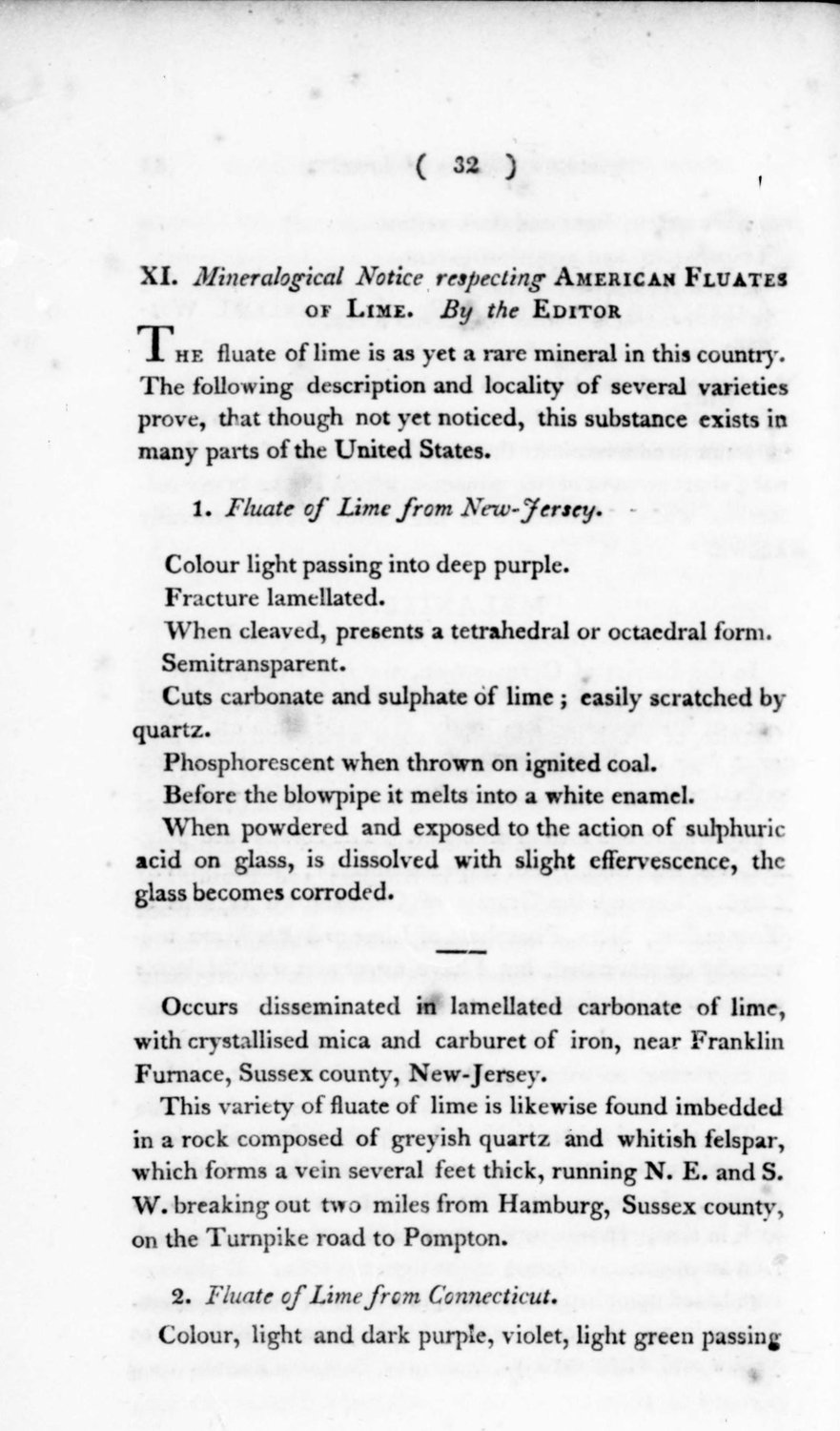
In the first number of the American Mineralogical Journal, dated 1810, its editor, Archibald Bruce, printed a short notice of American “fluates of lime.” Fluate of lime is fluorite, calcium fluoride (CaF2). His first specimen came from New Jersey, and he listed its characters line by line: “Colour light passing into deep purple. Fracture lamellated. … Phosphorescent when thrown on ignited coal. Before the blowpipe it melts into a white enamel.” It occurred, he wrote, “disseminated in lamellated carbonate of lime, with crystallised mica and carburet of iron, near Franklin Furnace, Sussex county, New-Jersey.” In modern words: fluorite scattered through coarse white calcite marble (the Franklin Marble), with mica and graphite.
Charles Palache, in his monograph of 1935 on the minerals of Franklin and Sterling Hill, wrote that Bruce’s mention “is of historic interest as the first recorded observation of this mineral in America.” He dated the bound volume 1814, the year it was completed. Palache did not remark on the glow, and his own entry for fluorite says nothing of luminescence.
The word Bruce used is the trap. To a mineralogist of 1810, “phosphorescent” meant a stone that gave off a faint light without burning, however that light was called up. What Bruce saw on the coals is what is now called thermoluminescence: light released by heating, not the red glow of a hot body. The same word then also covered the afterglow of a stone that had been in the sun, now phosphorescence, and the light given off when a stone is rubbed or struck, now triboluminescence. A fourth glow, light given off only while light falls on a mineral, had no name at all until 1852, when it was called fluorescence. All of them are kinds of luminescence, and the last two, together with phosphorescence, are kinds of photoluminescence, light excited by light.
This page follows how one word became several, and where the minerals of the Franklin and Sterling Hill mines fit. Most of the early experimenters worked with material from elsewhere. Where a mineral they used is also found at Franklin, that is said; where a source says Franklin, it is quoted.
A routine test
Bruce was not reporting a curiosity. He was running a test. On p. 30 of the same number, S. Godon’s note on a bluish-green “phosphated lime” (apatite) from near Philadelphia records the opposite result: “It presents no sensible phosphorescence on burning coals.” The test sat in the list beside hardness, fracture and the blowpipe, and a negative was worth printing.
The textbooks of the time explained how to do it. Parker Cleaveland’s Elementary Treatise on Mineralogy and Geology (2nd ed., 1822) said that some minerals “must be reduced to a coarse powder, and projected, in a darkened room, on a shovel or other body, heated but very little below redness.” He gave the standard examples: “Sulphuret of zinc may be examined, as an example of phosphorescence by friction, and the fluate or phosphate of lime, by heat.” Sulphuret of zinc is sphalerite, zinc sulfide (ZnS), and fluate and phosphate of lime are fluorite and apatite. All three are found at Franklin (sphalerite, fluorite, fluorapatite).
Richard Kirwan’s Elements of Mineralogy (1794) had already noted the property that made the test work once only. Fluor, he wrote, “if pulverized, phosphoresces, particularly the blue or purple coloured; but, if heated to redness, it will never after phosphoresce.” Bruce’s Franklin fluorite was purple, “light passing into deep purple” in his words. He knew the word violet, and used it on the same page, but only for a fluorite from Connecticut (“light and dark purple, violet, light green”). Two centuries later the same one-time behavior is the first thing collectors notice about the fluorite variety called chlorophane (below).
Heat glow: thermoluminescence, 1663–1680
One of the first careful reports of a stone glowing from mild heat came from Robert Boyle, in observations on a borrowed diamond dated 27 October 1663 and printed the next year in his Experiments and Considerations Touching Colours. Rubbing made it shine most. But it also shone when held near a candle flame, over iron “well Heated, but not to that Degree as to be Visibly so,” and, in his eleventh observation, “by taking it into Bed with me, and holding it a good while upon a warm part of my Naked Body.” Diamond is not a Franklin mineral; the method is the point. Boyle had separated a glow called up by gentle warmth from the glow of a heated body.
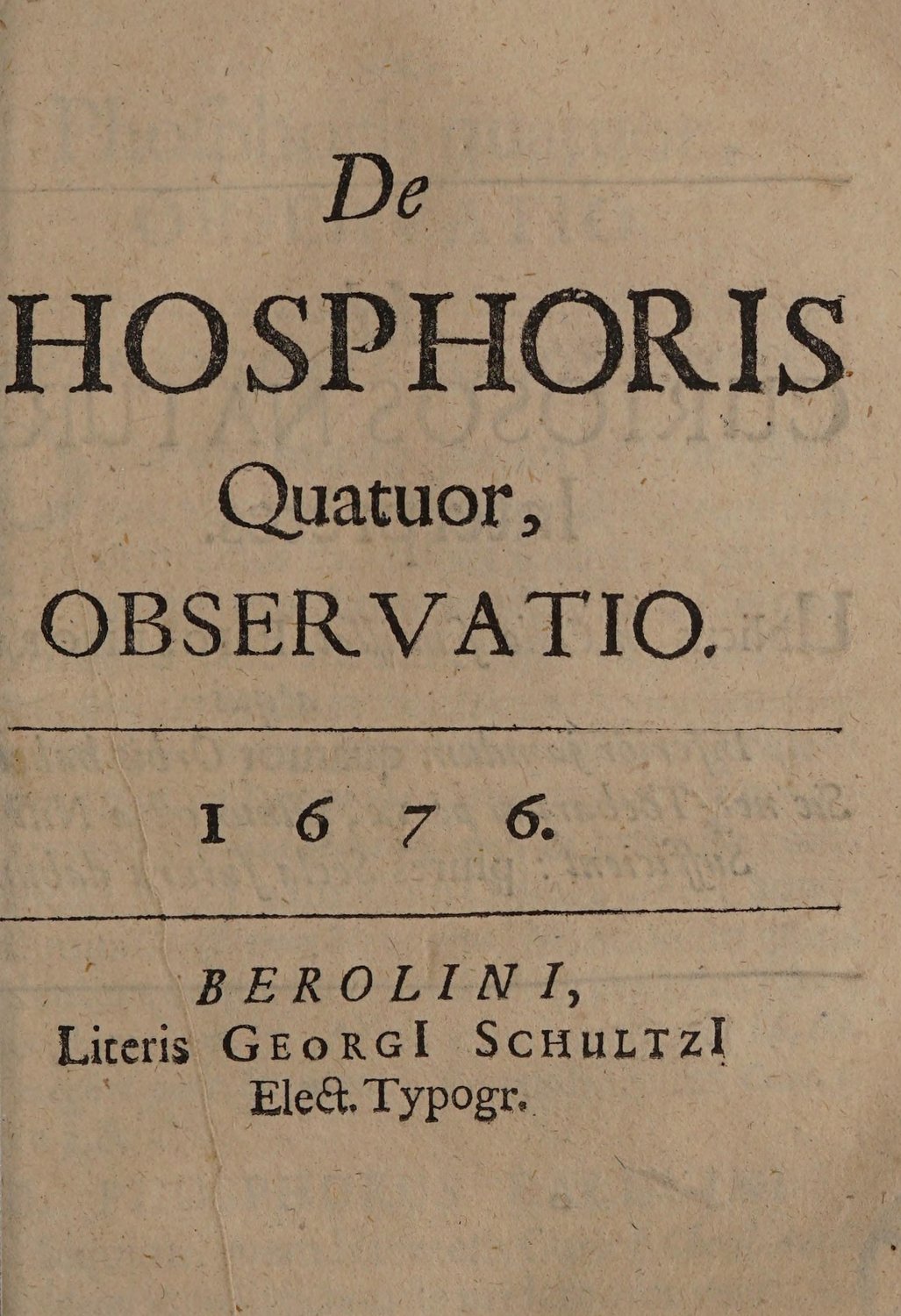
In 1676 Johann Sigismund Elsholtz at Berlin published an observatio on four “phosphori,” the word then used for anything that carried light (Greek phōsphoros, “light-bearer,” also the morning star). Two of his four drew their light from the sun or from bright air. The third, which he called Phosphorus smaragdinus, “emerald phosphorus,” drew it, he wrote, not so much from the sun’s rays as “ex Igne,” from fire. The Royal Society’s Philosophical Transactions gave his account in English the next year (vol. 12, p. 867):
The one is by the Germans called Phosphorus Smaragdinus, said to be of this nature, that it collects its light not so much from the Sun-beams, or the illuminated Air, as from the Fire it self; seeing that, if some of it be laid upon a Silver or Copper-plate, under which are put some live coals, or a lighted Taper, it will presently shine, and if the same matter be shaped into Letters, one is able to read it.
Elsholtz’s Latin ends the same way: a reader could “legere rutilantem commode scripturam,” comfortably read the glowing writing (our translation). He promised to say on another occasion how the substance was prepared. In 1680 Georg Kaspar Kirchmaier gave a recipe in De phosphoris et natura lucis: “Recipe q. v. mineralis viridis, Smaragdum penè referentis; contere in pulverem, aquâ madefac communi”; then paint letters with a brush on a copper plate and set it over glowing coals. “Phaenomenon spectabis in obscuro amoenissimum, sine fumo & odore lucens.” In our translation: “Take a sufficient quantity of a green mineral nearly resembling emerald; grind it to powder, wet it with common water. … In the dark you will see a most delightful phenomenon, shining without smoke or smell.” He added that the mineral had been found only a few years before.
Neither author named the mineral. A green stone, cheap enough to grind, that glows on a warm plate fits fluorite, but the seventeenth-century texts do not say so, and this page does not assume it. By 1792 the general fact was settled. Thomas Wedgwood opened his paper on light from heat and attrition in the Philosophical Transactions with a short history, and wrote simply: “Fluor has been long known to give a fine bright light when heated.”
Chlorophane, the green-light fluorite
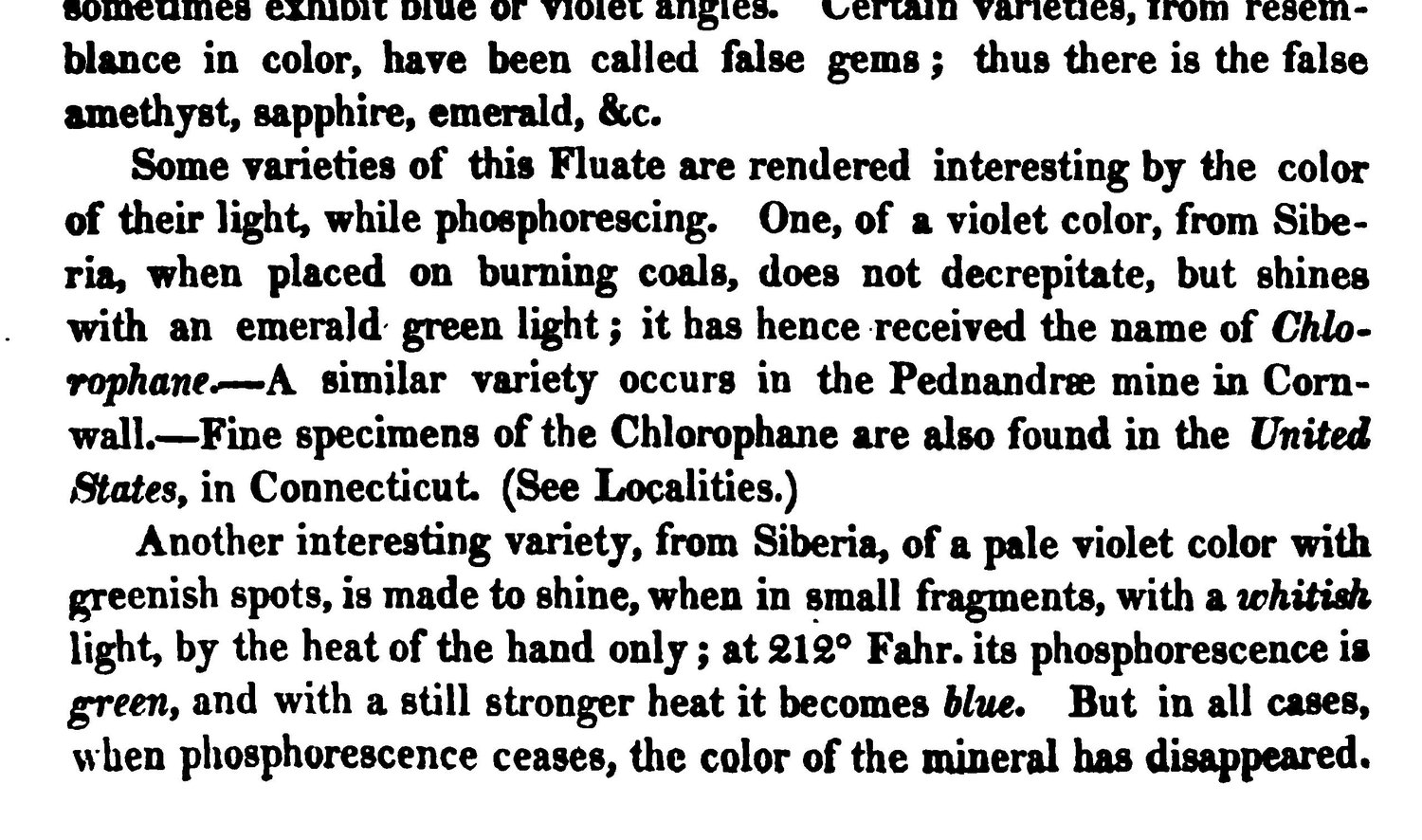
Some fluorite glowed far more readily than the rest, and it was given a name. Cleaveland described it in 1822: a variety “of a violet color, from Siberia, when placed on burning coals, does not decrepitate, but shines with an emerald green light; it has hence received the name of Chlorophane.” The name is Greek for “showing pale green” (chlōros, phainein). It refers to the color of the light, not the color of the stone. Another Siberian variety, he went on, could be made to shine “by the heat of the hand only”; at 212° Fahrenheit its phosphorescence was green, and with stronger heat blue. “But in all cases, when phosphorescence ceases, the color of the mineral has disappeared.” Who first used the name, and when, we have not found.
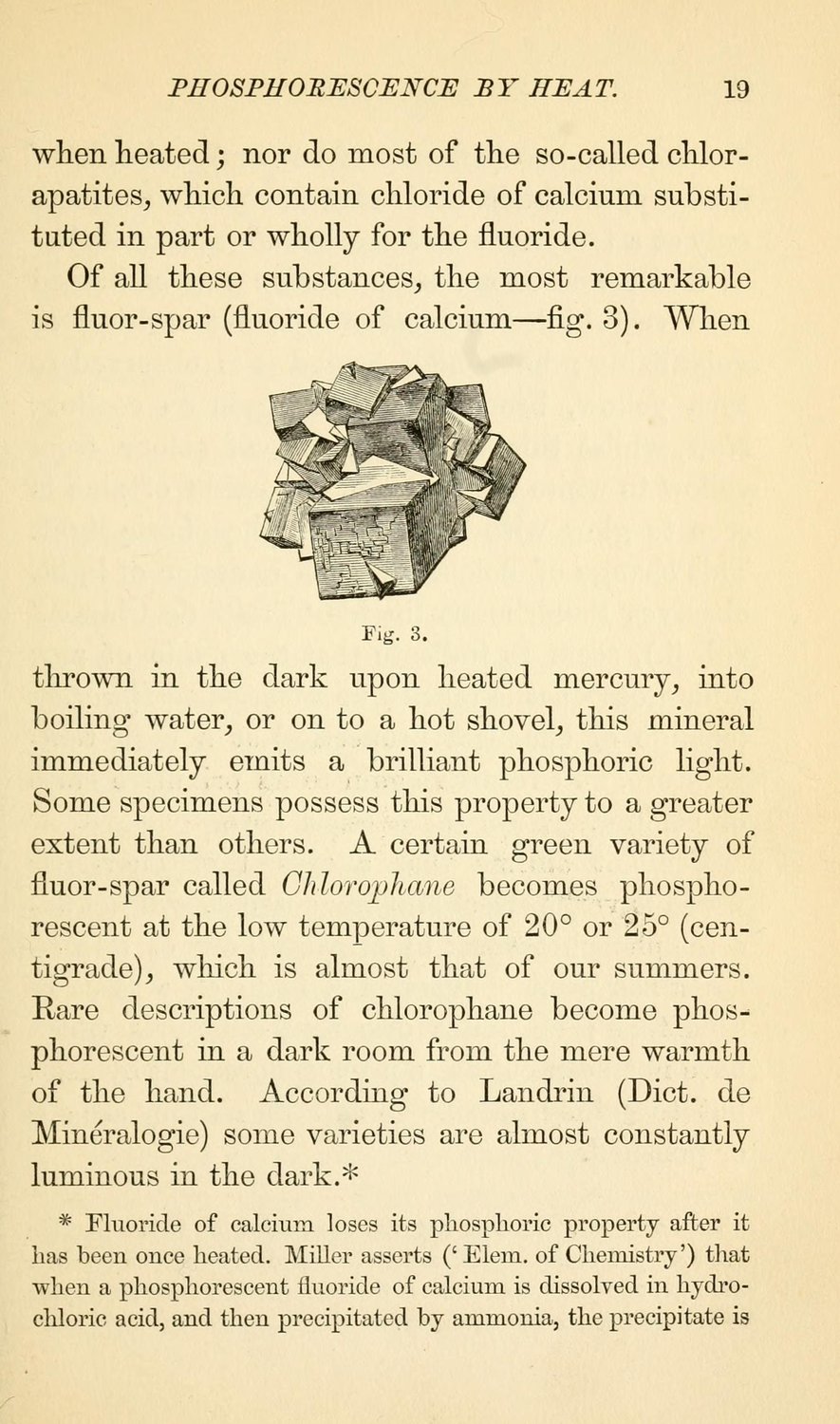
T. L. Phipson’s Phosphorescence (1862) gave the chapter a heading that is very nearly the modern term: “Phosphorescence by Heat.” Fluor-spar thrown “upon heated mercury, into boiling water, or on to a hot shovel” immediately gives a brilliant light; chlorophane does so “at the low temperature of 20° or 25° (centigrade),” and rare specimens “from the mere warmth of the hand.” In a footnote he recorded what Kirwan had seen: “Fluoride of calcium loses its phosphoric property after it has been once heated.”
Chlorophane is a Franklin and Sterling Hill mineral. Richard C. Bostwick’s survey of the district’s fluorescent minerals in The Picking Table (2016) calls it the best-known fluorite of the district, relatively abundant in both orebodies and on the Buckwheat Dump. It is “sherry-colored” in daylight, glows blue-green under shortwave, midwave and longwave ultraviolet light when freshly broken, and goes on glowing afterward. It quickly loses that response in light. It also “thermoluminesces blue-green, but after heating it loses that property as well,” and when freshly exposed in the Sterling Hill ore it can phosphoresce after a brief exposure to a miner’s cap-lamp. Philip M. Persson, describing a find at the Taylor Road site in The Picking Table (2009), found chlorophane there that was deep red when freshly exposed and faded to colorless in sunlight, glowed green when heated to several hundred degrees, and then lost the property: “irreversible thermoluminescence.” On night digs, he wrote, it “reveals itself through showers of green sparks from hammering it.”
Whether Bruce’s purple fluorite of 1810 was chlorophane cannot be known from his few lines. What can be said is that the test he ran, and the property he recorded, belong to a mineral that collectors still hammer out of the Franklin dumps.
Afterglow: phosphorescence
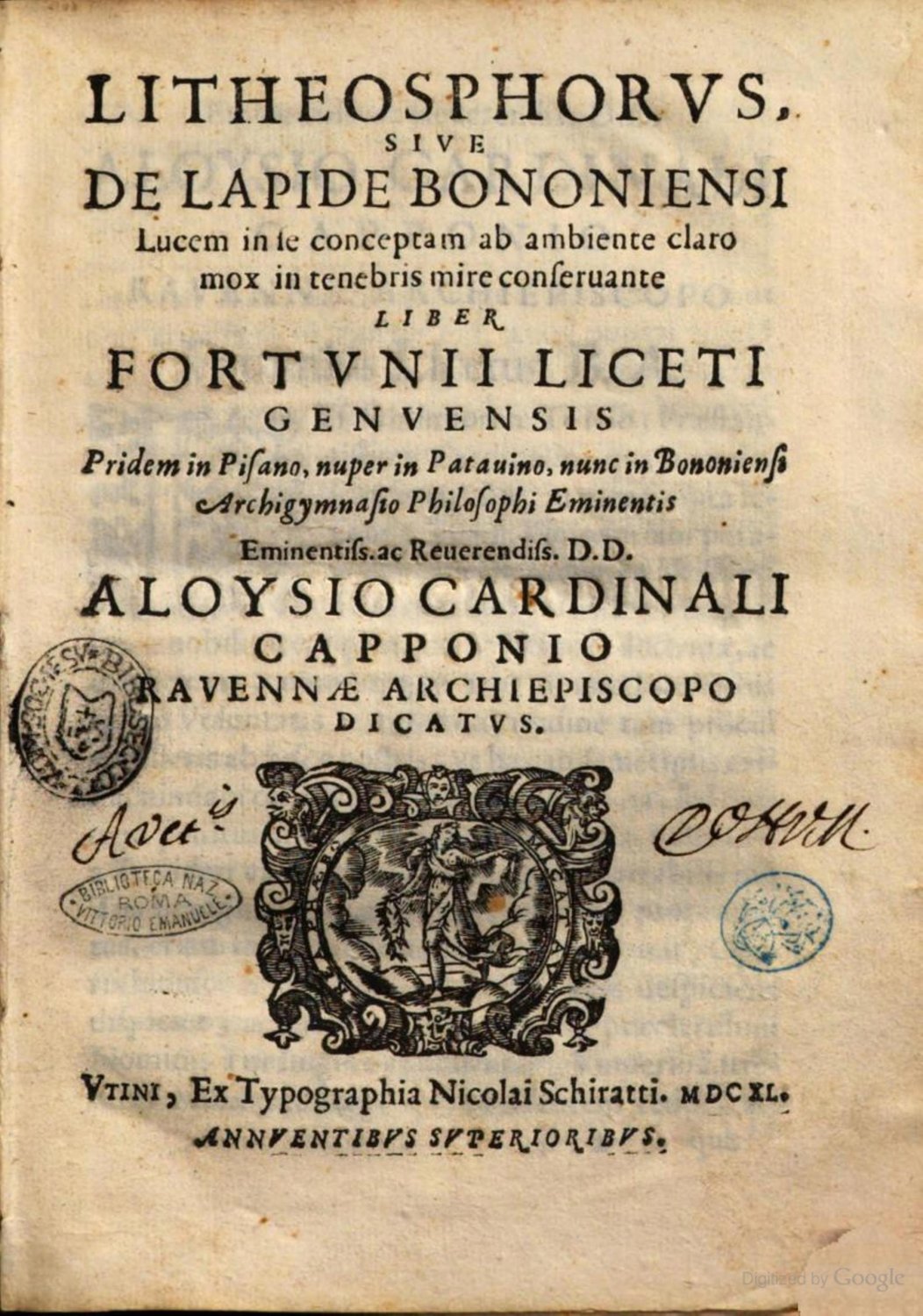
The glow that gave phosphorescence its name was an afterglow. Early in the seventeenth century a Bolognese shoemaker and alchemist heated a heavy stone from near Bologna with charcoal and found that the product shone in the dark after it had been in the sun; the story, and its sources, are told on the page Phosphorescence. The stone was barite, barium sulfate, and the glowing product barium sulfide. Fortunio Liceti gave it a book, Litheosphorus (1640), whose title page describes the Bologna stone as “Lucem in se conceptam ab ambiente claro mox in tenebris mire conservante,” in our translation “taking into itself light from bright surroundings and then marvelously keeping it in the dark.” Barite is also a Franklin mineral, but the glowing Bologna stone was a product of the furnace, not of the mine.
In 1768 John Canton gave the Royal Society “An easy Method of making a Phosphorus, that will imbibe and emit Light, like the Bolognian Stone”: calcined oyster shells and sulfur, kept red hot for an hour. The light of a little of it, brought into a dark room after a few seconds at a window, “is sufficient to discover the time by a watch,” if the eyes have first been kept in the dark. Canton’s phosphorus is calcium sulfide.
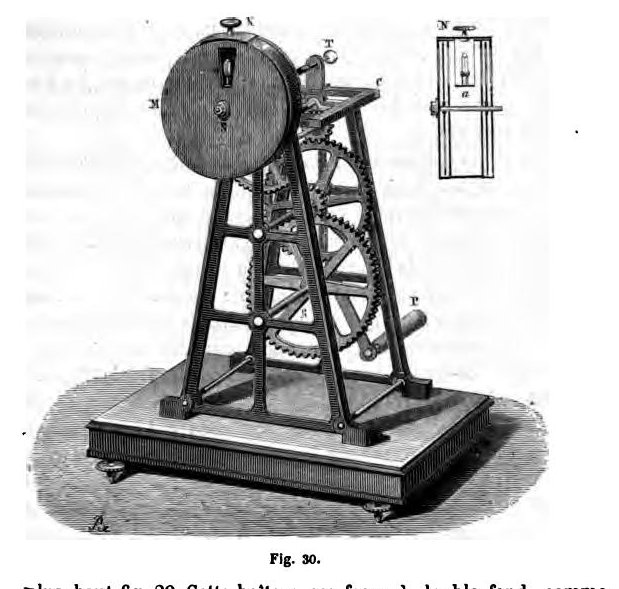
To separate an afterglow from the light that causes it, Edmond Becquerel built the phosphoroscope, described in his La Lumière, ses causes et ses effets (vol. 1, 1867). Two disks with offset openings turned together on one axle, so that the specimen between them was lit through one disk and seen through the other, never both at once. The apparatus, he wrote (p. 248), “permet de voir les corps d’une manière continue après l’impression de la lumière et en vertu de leur action propre, en éliminant toute trace de lumière incidente, même quand la durée de l’impression de la lumière n’est que de 1/3000 de seconde” (in our translation: “makes it possible to see bodies continuously after the impression of light and by virtue of their own action, eliminating every trace of the incident light, even when the impression of light lasts only 1/3000 of a second”). With it, glows too brief for the eye were shown to be afterglows too.
One substance in Becquerel’s chapter leads back toward Franklin. He described (p. 241) a strongly phosphorescent hexagonal zinc sulfide made, “d’après M. Sidot,” by heating in a current of sulfurous gas “des cristaux de sulfure de zinc soit de blende naturelle” (“crystals of zinc sulfide, either of natural blende” or of sulfide first made in the laboratory). Natural blende is sphalerite. Sidot’s blende will reappear below, in the first radium screens.
Franklin’s own great afterglow is willemite’s. Palache recorded in 1935 that some specimens of the fibrous white willemite “remain phosphorescent 15 minutes or more after exposure to the iron-arc spark or to the light of burning magnesium,” and suggested that the small amount of manganese in it was the cause, since “many compounds that are not phosphorescent if either absolutely pure or very impure are strongly excited if they contain but a trace of impurity.” The site’s Phosphorescence page gives his 1928 observations.
Glow under light: fluorescence, 1565–1852
The third glow was seen first in a wood, not a stone. In 1565 the Seville physician Nicolás Monardes described a wood brought from New Spain for diseases of the kidneys and urine, the lignum nephriticum of later writers. Thin slices were left in clear spring water, and he wrote: “dentro de media hora se comiença el agua a poner con vn color azul muy claro, & quanto mas va, mas azul se torna, con ser el palo de color blanco.” In our translation: “within half an hour the water begins to take on a very clear blue color, and the longer it goes, the bluer it turns, though the wood is white.” John Frampton’s English version of 1577 has “within halfe an hower the water doeth beginne to chaunge it self into a blewe couller verie cleare.” Neither knew that the blue was light given off by the infusion.
Fluorite was there at the next step. In 1845 John Herschel opened a paper in the Philosophical Transactions with it: “A certain variety of fluor spar [fluorite], of a green colour, from Alston Moor, is well known to mineralogists by its curious property of exhibiting a superficial colour, differing much from its transmitted tint, being a fine blue of a peculiar and delicate aspect like the bloom on a plum.” He mentioned the infusion of lignum nephriticum, and then described a solution of sulphate of quinine, colorless by transmitted light, which showed “an extremely vivid and beautiful celestial blue colour” where the light entered it. In a second paper he named the effect “epipolic dispersion,” from a Greek word for “surface”: what is now called fluorescence.
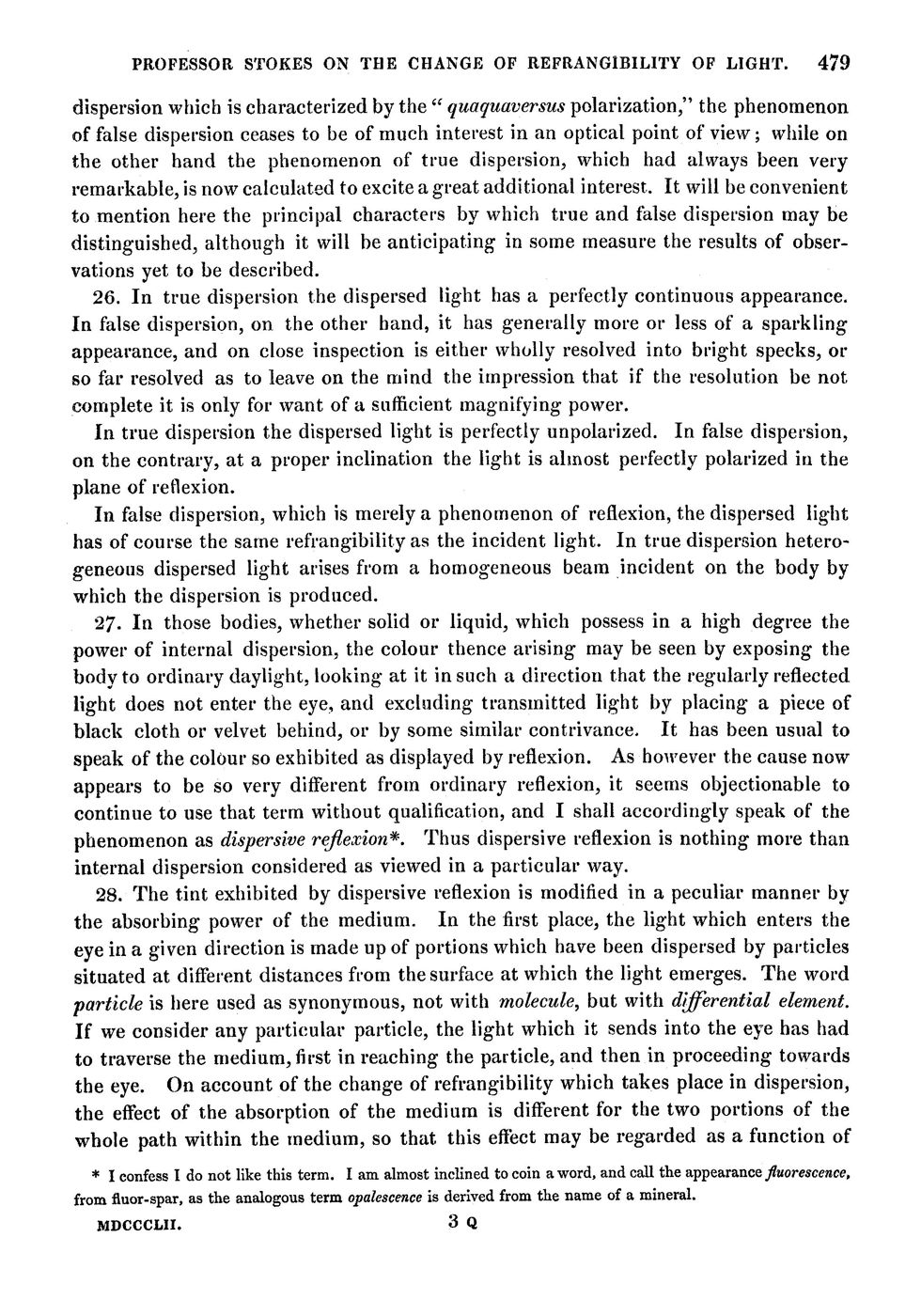
George Gabriel Stokes showed in 1852 that the blue was new light, of a different refrangibility (in modern terms, a longer wavelength) from the light that caused it. He first called it “dispersive reflexion” (fluorescence again), and then, in a footnote on p. 479, wrote: “I confess I do not like this term. I am almost inclined to coin a word, and call the appearance fluorescence, from fluor-spar, as the analogous term opalescence is derived from the name of a mineral.” Fluorite thus gave its name to the glow as well as to the flux: Bruce had noted in 1810 that it was used “to promote the fusion of refractory ores, hence it has obtained its name of Fluor” (p. 33; Latin fluere, to flow). The paper, Stokes’s rule that the emitted light is always of longer wavelength, and why that lets invisible ultraviolet light make a mineral glow in color, are treated on Seeing fluorescence.
Ultraviolet, X-rays and radium: Franklin under the lamp
Franklin enters the published history of fluorescence by name in 1903. George F. Kunz of Tiffany’s and the chemist Charles Baskerville examined the gems and minerals of the American Museum of Natural History, including the Morgan-Bement collection (see Clarence Bement and the finest collection), under X-rays (“Roentgen rays”), radium and ultraviolet light. Their ultraviolet came from “a triple spark through quadruple iron terminals” and a Piffard lamp, wheeled through the aisles on 200 feet of cable; “about 13,000 minerals were thus examined by night” (p. 774).
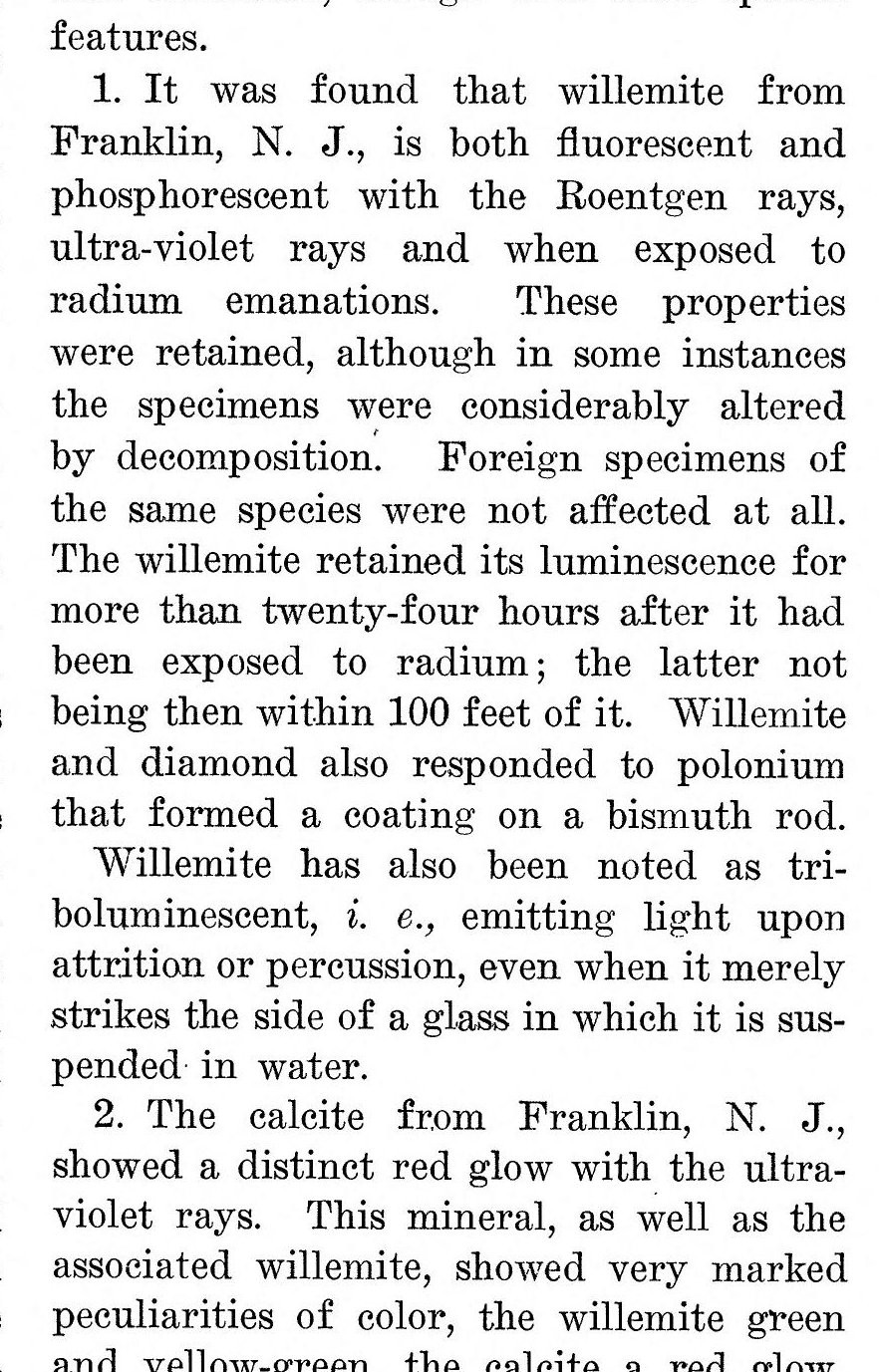
Their first numbered result was Franklin’s: “It was found that willemite from Franklin, N. J., is both fluorescent and phosphorescent with the Roentgen rays, ultra-violet rays and when exposed to radium emanations [radiation from radium]. … Foreign specimens of the same species were not affected at all.” The second: “The calcite from Franklin, N. J., showed a distinct red glow with the ultra-violet rays,” and the colors, green and yellow-green willemite and red calcite, “were so characteristic that it required but a moment to identify the specimens in various parts of the collection as being from Franklin, N. J.” The Franklin willemite, they wrote later (p. 779), “becomes luminous at the approach of radium as if it were a fairy wand.” Of chlorophane they noted (p. 776) that it “has long been known as a mineral very easily rendered luminous by heat,” and that a specimen from Amelia Court House, Virginia, “became suddenly luminous from the heat of the hand.”
This paper is the best-known early study of the subject, and The Picking Table has told its Franklin part before. Richard V. Gaines and Richard C. Bostwick, in a brief history of mineral fluorescence and ultraviolet sources within their 1993 article on barylite, quote the calcite passage, and record the local tradition that fluorescence at Franklin was first noticed around the turn of the century, when sparks from direct-current motors or broken contacts made nearby willemite glow, a discovery whose details, they note, “do not appear to have been recorded.” They go on to the General Electric iron-arc unit of about 1915 and the mercury-vapor lamps of the 1930s (see W. S. Andrews and artificial willemite and Ultraviolet lights). Palache’s paper of 1928 gave the first list of Franklin minerals under the iron spark.
The same year as Kunz and Baskerville, William Crookes reported to the Royal Society (printed in Nature, April 2, 1903) on a screen of “Sidot’s hexagonal blende (zinc sulphide),” Becquerel’s phosphorescent zinc sulfide. Near radium it glowed, and under a lens its surface showed separate flashes; brought closer, “the flashes follow each other so quickly that the surface looks like a turbulent luminous sea” (p. 523). Crookes’s blende was a laboratory preparation, not Franklin sphalerite, but it is the same compound, and willemite took the same role: Palache noted in 1935 that the fibrous willemite of the Buckwheat open cut “is prized for its high sensitiveness as a luminous screen for ultraviolet rays” (p. 87). How willemite screens served physics is told on Green light.
Rubbing and striking: triboluminescence
The glow from friction was part of the same old word, and it runs through the same sources. Boyle got most light from his diamond by rubbing it. Wedgwood’s history of 1792 records that “D. Hoffman discovered that red blende and feldspat were luminous when pieces of either were rubbed together.” Red blende is a red sphalerite, and Cleaveland’s textbook of 1822 used “sulphuret of zinc” as its standard example of “phosphorescence by friction.” Crookes found his blende screen “sensitive to mechanical shocks. A tap with the tip of a penknife will produce a sudden spark of light” (p. 523). And Kunz and Baskerville, in the paragraph on Franklin willemite, added that “Willemite has also been noted as triboluminescent, i. e., emitting light upon attrition or percussion.”
At Franklin and Sterling Hill the friction glow is a field observation. Bostwick, in the second part of his survey (The Picking Table, 2017), writes that some local sphalerite “is triboluminescent, a phenomenon most likely to be noticed on night digs when a rock containing sphalerite is hammered,” and that it can be called up less destructively by stroking the mineral “with hard plastic, such as a credit card, or with a paper clip.” Persson’s green sparks from chlorophane are the same phenomenon in fluorite.
What the old word held
Read with modern terms beside it, Bruce’s single line of 1810 is a thermoluminescence test, carried out on fluorite, a mineral that would later lend its name to fluorescence, from a district whose willemite and calcite would become the standard examples of fluorescence and phosphorescence under ultraviolet light. The early literature does not connect these. Bruce had no word for fluorescence; Stokes did not mention New Jersey; Kunz and Baskerville did not mention Bruce. The brief history in The Picking Table begins with the Bologna stone, Boyle and Stokes. The heat glow, the oldest of the three in the mineral books and the one recorded first at Franklin, is mostly left out.
Today the glows are named by what excites them, not by how they look. Fluorescence is light emitted while the exciting radiation, here ultraviolet light, falls on the mineral; phosphorescence is light that continues after it stops; both are photoluminescence. Thermoluminescence is light released by heating a mineral that has stored energy, and once released it does not return without fresh exposure to radiation, which is why Kirwan’s fluor “will never after phosphoresce,” and why Kunz and Baskerville could restore the glow of heated chlorophane only “in a measure,” with X-rays (p. 776). Triboluminescence is light from rubbing, scratching or breaking. Collectors’ lamps are described by band: shortwave (about 254 nm), midwave (about 302–312 nm) and longwave (about 365 nm) ultraviolet, abbreviated SW, MW and LW. Why Franklin minerals respond to them is set out on Manganese and lead and Seeing fluorescence.
Old names and modern terms
Phosphorescent (before about 1850): any mineral that gave off a faint light without burning, whether from heat, sunlight or friction. Today: luminescent; specifically thermoluminescent, phosphorescent or triboluminescent as the case may be.
“Phosphorescent when thrown on ignited coal,” “phosphorescence by heat”: thermoluminescence.
Phosphorescence by friction, by attrition: triboluminescence.
Phosphorus, phosphori (seventeenth and eighteenth centuries): any light-bearing substance, natural or made, such as the Bologna stone or Canton’s phosphorus. Not the element phosphorus.
Phosphorus smaragdinus (Elsholtz, 1676): “emerald phosphorus,” a green mineral that glowed when warmed. Its identity is not given in the sources.
Bologna stone, Bononian stone, lapis Bononiensis, solar phosphorus: barite (barium sulfate) heated with charcoal, giving phosphorescent barium sulfide.
Canton’s phosphorus: calcium sulfide, made from oyster shells and sulfur.
Fluate of lime, fluor, fluor-spar: fluorite, calcium fluoride (CaF2).
Chlorophane: a variety of fluorite notable for thermoluminescence, and at Franklin and Sterling Hill also for fluorescence, phosphorescence and triboluminescence that fade with light or heat. The name refers to the green light, not the stone’s color.
Phosphate of lime, phosphated lime: apatite (at Franklin, chiefly fluorapatite).
Sulphuret of zinc, blende, red blende: sphalerite, zinc sulfide (ZnS). Sidot’s hexagonal blende: laboratory-made phosphorescent zinc sulfide in the hexagonal form, which in nature is the mineral wurtzite (sphalerite is the cubic form).
Lamellated carbonate of lime: coarse calcite, here the Franklin Marble. Carburet of iron: graphite.
Superficial colour, epipolic dispersion (Herschel, 1845), dispersive reflexion (Stokes, 1852): fluorescence.
Change of refrangibility: change of wavelength (Stokes shift).
Ultra-violet rays: ultraviolet light (UV). Roentgen rays: X-rays. Radium emanations (as Kunz and Baskerville used it): the radiation from radium preparations.
Iron-arc spark, iron spark, sparker: an ultraviolet source made by an electric spark between iron electrodes, used at Franklin before mercury-vapor lamps.
In The Picking Table
Fluorescence is one of The Picking Table’s standing subjects, and its articles give the Franklin side of this page. Richard C. Bostwick’s “The Check List of Franklin-Sterling Hill Fluorescent Minerals: Discussion and Update” (vol. 33, no. 2, Autumn/Winter 1992) traces the local lists back to Palache’s of 1928 and notes under fluorite that its thermoluminescence, like its fluorescence, disappears on repeated heating. Richard V. Gaines and Bostwick’s article on barylite (vol. 34, no. 2, Autumn/Winter 1993) carries a brief history of mineral fluorescence and ultraviolet sources. Philip M. Persson’s notes on the Taylor Road site (vol. 50, no. 2, Fall 2009) describe chlorophane that is both triboluminescent and thermoluminescent. Mark Boyer’s “Flash and BIP” (vol. 52, no. 1, Spring 2011), the first of a series on collectors’ jargon, traces the collector’s “flash” to Kunz and Baskerville’s definitions of fluorescence and phosphorescence. Bostwick’s two-part “Fluorescent Minerals of Franklin and Sterling Hill, N.J.” opens with a historical overview beginning with Kunz and Baskerville and has chlorophane under fluorite (vol. 57, no. 2, Fall 2016); part 2 (vol. 58, no. 1, Spring 2017) has triboluminescent sphalerite and the long phosphorescence of radiating willemite. No article in The Picking Table has dealt with Bruce’s fluorite of 1810 or with the older history of the heat glow; his notice appears there only as an entry in a bibliography (vol. 11, no. 2, August 1970).
Sources and further reading
- Anonymous, 1677, An account of four sorts of factitious shining substances. Philosophical Transactions, vol. 12, p. 867. archive.org
- Becquerel, E., 1867, La lumière, ses causes et ses effets, vol. 1. Paris. Sidot’s blende, p. 241; the phosphoroscope, p. 247–249. archive.org
- Bostwick, R. C., 2016, Fluorescent minerals of Franklin and Sterling Hill, N.J., part 1. The Picking Table, vol. 57, no. 2; fluorite, p. 18. The Picking Table (PDF)
- Bostwick, R. C., 2017, Fluorescent minerals of Franklin and Sterling Hill, N.J., part 2. The Picking Table, vol. 58, no. 1; sphalerite, p. 18. The Picking Table (PDF)
- Boyle, R., 1664, Experiments and considerations touching colours. London. Observations of 27 October 1663 on Mr. Clayton’s diamond, p. 414–416. archive.org
- Bruce, A., 1810, Mineralogical notice respecting American fluates of lime. American Mineralogical Journal, vol. 1, no. 1, p. 32–33 (volume completed 1814). archive.org
- Canton, J., 1768, An easy method of making a phosphorus, that will imbibe and emit light, like the Bolognian stone. Philosophical Transactions, vol. 58, p. 337–344. archive.org
- Cleaveland, P., 1822, An elementary treatise on mineralogy and geology, 2nd ed. Boston: Cummings and Hilliard. Phosphorescence, p. 68–69; fluate of lime, p. 200–203. archive.org
- Crookes, W., 1903, The emanations of radium. Nature, vol. 67, p. 522–523. archive.org
- Elsholtz, J. S., 1676, De phosphoris quatuor observatio. Berlin: Georg Schultz. Wellcome Collection copy. archive.org
- Gaines, R. V., and Bostwick, R. C., 1993, The fluorescence of barylite from Franklin, New Jersey (with a brief history of mineral fluorescence and ultraviolet light sources). The Picking Table, vol. 34, no. 2, p. 21 ff. The Picking Table (PDF)
- Godon, S., 1810, Mineralogical note respecting phosphated lime, and phosphated lead, from Pennsylvania. American Mineralogical Journal, vol. 1, no. 1, p. 30. archive.org
- Herschel, J. F. W., 1845, On a case of superficial colour presented by a homogeneous liquid internally colourless. Philosophical Transactions, vol. 135, p. 143 ff. archive.org
- Herschel, J. F. W., 1845, On the epipolic dispersion of light. Philosophical Transactions, vol. 135, p. 147 ff. archive.org
- Kirchmaier, G. K., 1680, De phosphoris et natura lucis, nec non de igne, commentatio epistolica. Wellcome Collection copy. archive.org
- Kirwan, R., 1794, Elements of mineralogy, 2nd ed., vol. 1. London: J. Nichols. Fluor, p. 125. archive.org
- Kunz, G. F., and Baskerville, C., 1903, The action of radium, Roentgen rays and ultra-violet light on minerals and gems. Science, new series, vol. 18, p. 769–783. archive.org
- Liceti, F., 1640, Litheosphorus, sive De lapide Bononiensi. Udine: Nicolai Schiratti. archive.org
- Mindat.org: Franklin Mine and Sterling Mine localities. Mindat
- Monardes, N., 1565, Dos libros. El uno trata de todas las cosas que traen de nuestras Indias Occidentales. Seville. Chapter on the wood for diseases of the kidneys and urine. archive.org
- Monardes, N., 1577, Joyfull newes out of the newe founde worlde, translated by John Frampton. London. Fol. 20. archive.org
- Palache, C., 1928, The phosphorescence and fluorescence of Franklin minerals. American Mineralogist, vol. 13, p. 330–333. PDF
- Palache, C., 1935, The minerals of Franklin and Sterling Hill, Sussex County, New Jersey. U.S. Geological Survey Professional Paper 180. Fluorite, p. 36; willemite, p. 83, 87. PDF (USGS)
- Persson, P. M., 2009, Some notes on the rediscovery of a novel fluorescent mineral assemblage from the Franklin Mine. The Picking Table, vol. 50, no. 2, p. 29 ff.; fluorite (chlorophane), p. 30. The Picking Table (PDF)
- Phipson, T. L., 1862, Phosphorescence, or the emission of light by minerals, plants, and animals. London: Lovell Reeve. Chapter II, Phosphorescence by heat, p. 18–23. archive.org
- Stokes, G. G., 1852, On the change of refrangibility of light. Philosophical Transactions, vol. 142, p. 463 ff.; footnote on p. 479. archive.org
- Wedgwood, T., 1792, Experiments and observations on the production of light from different bodies, by heat and by attrition. Philosophical Transactions, vol. 82, p. 28 ff.; history of the subject, p. 28–30. archive.org
Written with Claude, an AI model made by Anthropic, from the sources listed above, and checked against them. October 2026.