The green fluorescence of Franklin willemite, and how it became a tool: in mill tailings, in radium experiments, in laboratory screens and in the synthetic phosphors modeled on it.
One specimen, two colors
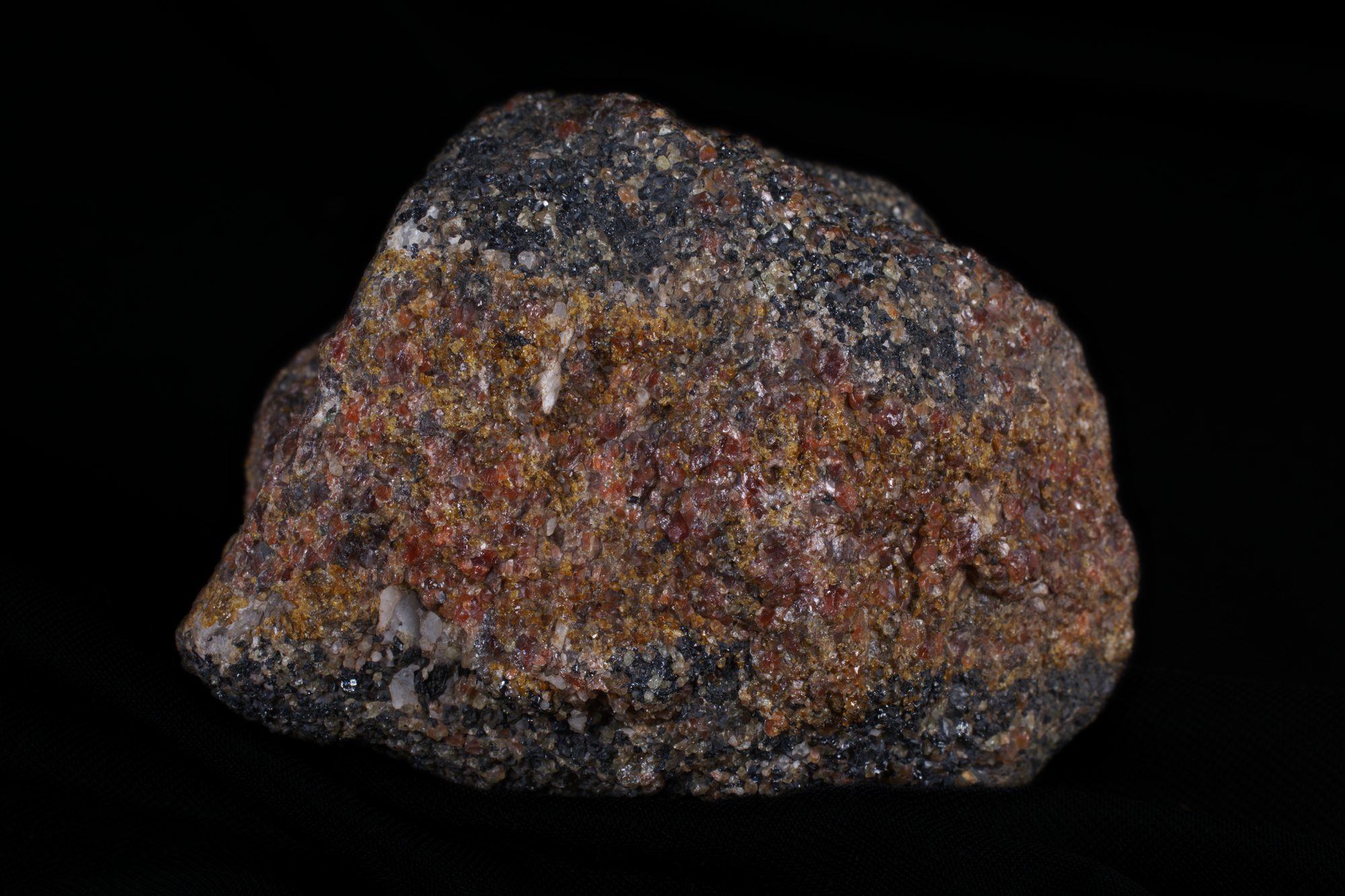
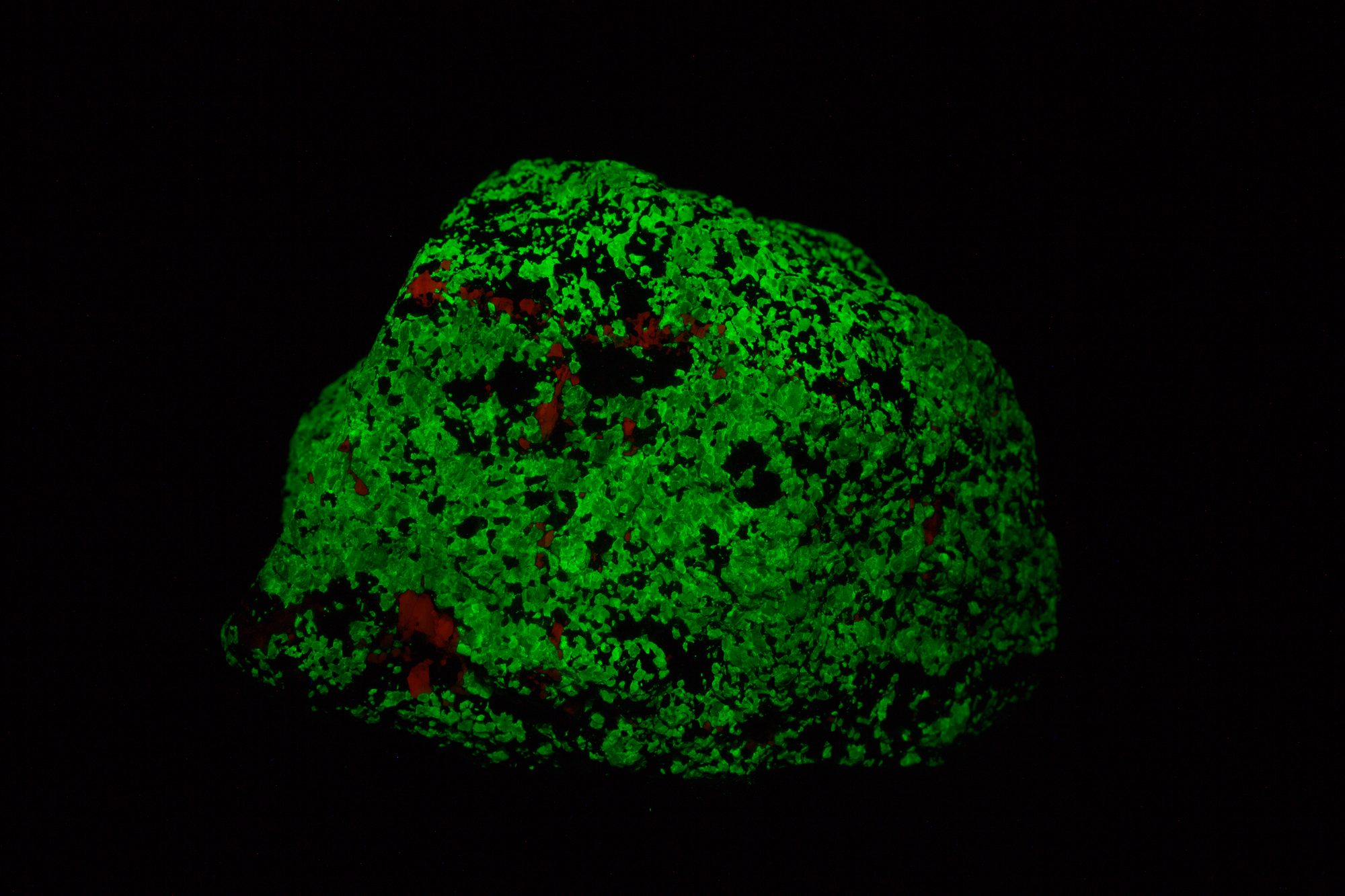
In daylight Franklin willemite may be white, brown, green or nearly colorless. Under shortwave ultraviolet light much of it glows an intense green, and some of it goes on glowing for a while after the light is turned off. The two photographs above are of a single specimen. Which of these is the color of willemite is not a trivial question, and it is why this section treats daylight color and fluorescent color separately.
A working tool at Franklin
The glow was useful long before it was collected for its beauty. Charles Palache, in “The phosphorescence and fluorescence of Franklin minerals” (1928), wrote that using the ultraviolet light of an iron-arc spark-gap “to determine the presence of willemite in mill-tailings” had long been an important practice at Franklin. A lamp in the mill showed at a glance how much ore was being lost.
Radium and willemite
In 1903, soon after radium became available, George F. Kunz of Tiffany’s and the chemist Charles Baskerville mixed radium with powdered natural willemite and reported that the glow was greatly strengthened. Their results appeared in the Electrical World and Engineer in September 1903 and in the American Journal of Science in 1904, and were widely reported in the press. They stand at the beginning of the luminous paints of the following decades, though those were made mostly with zinc sulfide.
Screens that made the invisible visible
Because willemite glows under cathode rays and X-rays as well as ultraviolet light, physicists coated glass with it to see beams they could not otherwise see. J. J. Thomson, in Rays of Positive Electricity (1913), recorded his rays on “a flat glass plate uniformly covered with powdered willemite.” “Willemite screens” were advertised to laboratories in Nature in 1905, and the cathode-ray tube manuals of RCA in the 1930s and 1940s still discuss willemite screens. Whether the earliest screens used natural Franklin willemite or a manufactured one is not settled; by the RCA years they were synthetic.
Making willemite
In 1922 W. S. Andrews of the General Electric Company published a recipe for artificial willemite. “Pure zinc orthosilicate has no luminescent properties,” he wrote, “but the addition of a minute amount of manganese causes it to show a bright green fluorescence when exposed to ultra violet light, cathode rays, or X-rays.” Natural fluorescent willemite, he noted, “is found in the zinc mines of Franklin Furnace, N. J.,” but is not common and is usually dulled by other minerals. His synthetic compound showed a green that “resembles very closely that of the best natural willemite,” and could be ground and mixed with gum arabic for use as a paint.
Manganese-activated zinc silicate, the compound Andrews described, went on to become one of the phosphors of the first fluorescent lamps and of cathode-ray screens. The green of the Franklin mineral was, in that sense, the model for a manufactured light.
Sources and further reading
- Andrews, W. S., 1922, Notes on the preparation of some fluorescent and phosphorescent compounds. American Mineralogist, vol. 7, p. 19–20. PDF
- Baskerville, C., and Kunz, G. F., 1904. American Journal of Science, 4th series, vol. 17, p. 79–80. Internet Archive
- CAMEO (Museum of Fine Arts, Boston): willemite. CAMEO
- Electrical World and Engineer, vol. 42, no. 13, September 26, 1903 (Kunz and Baskerville on radium and willemite). Internet Archive
- Palache, C., 1928, The phosphorescence and fluorescence of Franklin minerals. American Mineralogist, vol. 13, p. 330–333. PDF
- RCA, 1940, Vacuum tube design. Internet Archive
- Thomson, J. J., 1913, Rays of positive electricity and their application to chemical analyses. London: Longmans, Green. Internet Archive
Written with Claude, an AI model made by Anthropic, from the sources listed above, and checked against them. October 2026.