Histories › The people behind the minerals
An Edison pioneer, scarred by early X-ray work, who brought the ultraviolet lamp to Franklin and in 1922 published how to make willemite’s green glow in a crucible.
From Menlo Park to Schenectady
William Symes Andrews was born at Saltford, Somerset, in England, on September 10, 1847, and came to America in 1875. On December 4, 1879 he went to work for Thomas A. Edison at Menlo Park, New Jersey, where he helped design parts of the early carbon incandescent lamps and the machines that made them. He moved with the Edison electrical businesses until, in 1894, he settled in Schenectady with the General Electric Company, where he stayed for the rest of his life.
From 1897 to 1903 he experimented with X-ray tubes and patented ways of regulating them. The danger of X-rays was not yet known. Charles Palache, who wrote his biographical notice, recorded that Andrews suffered severe burns to his left hand and face, and that the injuries later cost him his hearing and his sight. “He may well be said,” Palache wrote, “to have died a martyr to the progress of scientific knowledge in this field.” He died in Schenectady on July 1, 1929, in his eighty-second year.
Cold light at Franklin
About 1900 Andrews took up fluorescence and phosphorescence, what he called “cold light.” He designed a practical, portable iron-spark lamp that gave ultraviolet light from an ordinary electric supply, and he was one of the engineers who put ultraviolet light to work at the New Jersey Zinc Company’s mill at Franklin. A workman held the lamp over a car of wet tailings from the jigs; the points of green light showed how much willemite was being lost, and whether the jigs were set right. From the mill the lamp went to the company’s chemists, and from them, Palache wrote, knowledge of fluorescence in minerals “has now become widespread.” The General Electric unit itself is described in The Picking Table, vol. 34, no. 2.
Willemite in a crucible
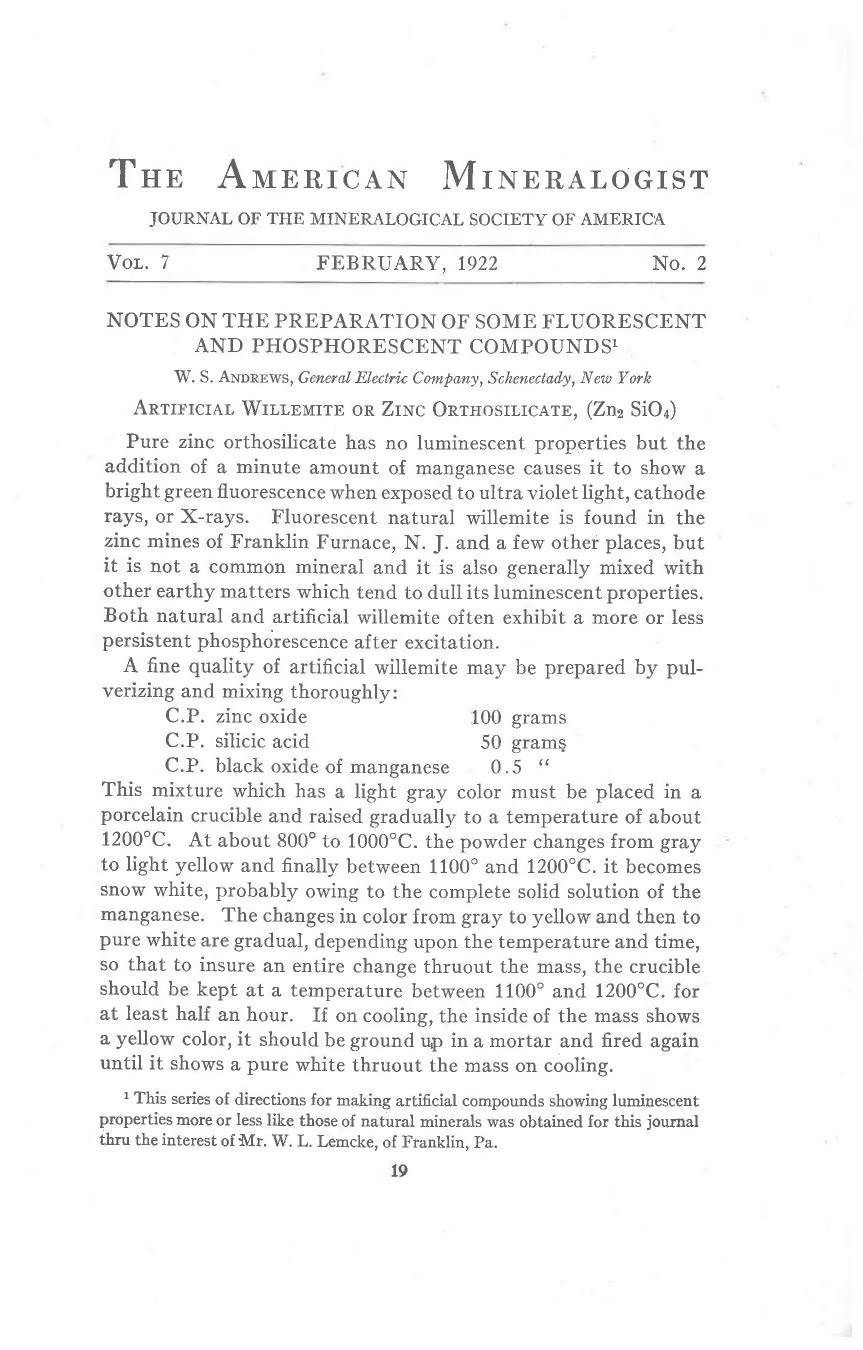
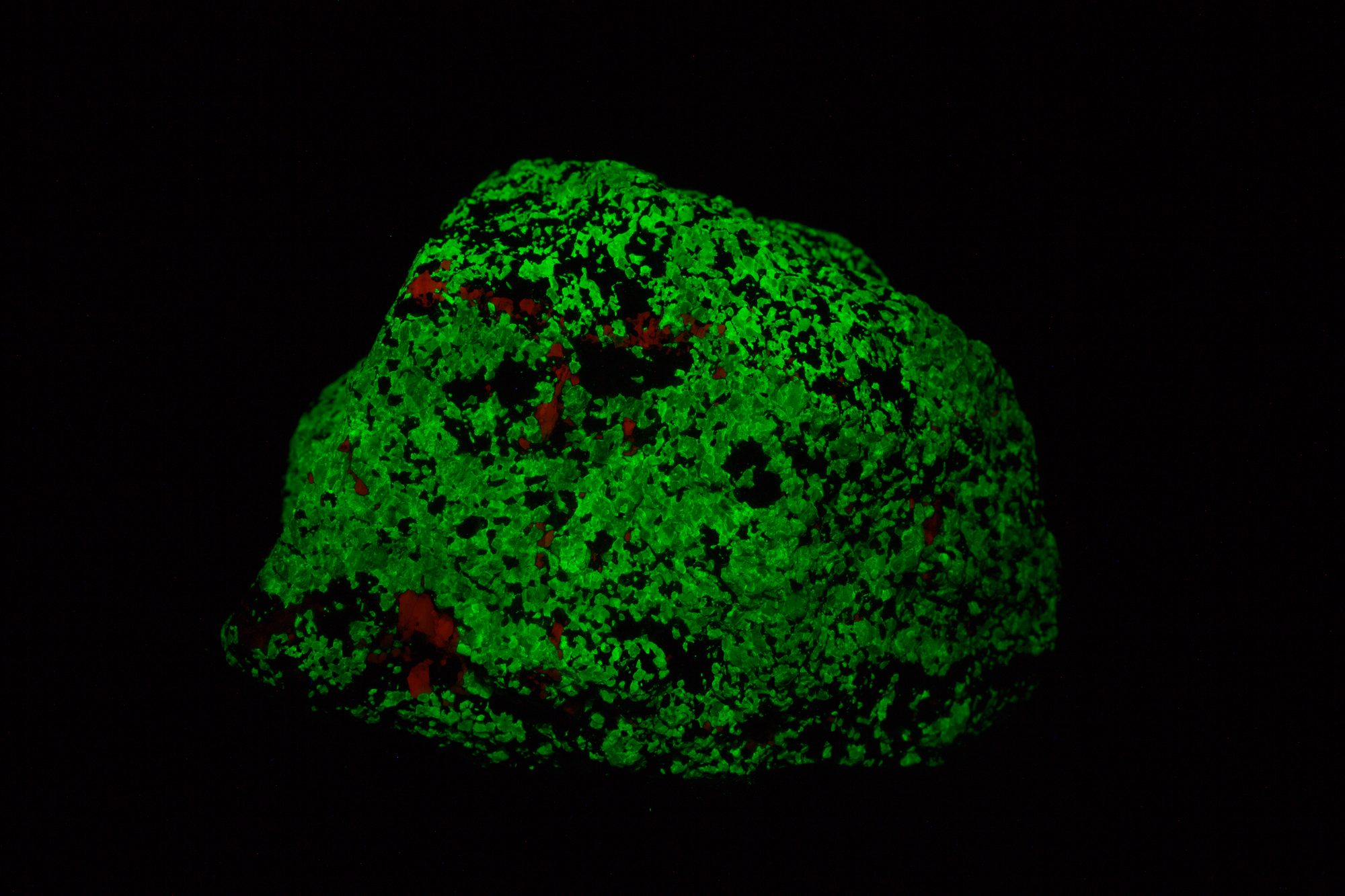
In February 1922 the American Mineralogist printed Andrews’s notes on preparing fluorescent and phosphorescent compounds, obtained for the journal through W. L. Lemcke of Franklin. The first was artificial willemite. “Pure zinc orthosilicate has no luminescent properties,” he wrote, “but the addition of a minute amount of manganese causes it to show a bright green fluorescence.”
The recipe was simple: 100 grams of pure zinc oxide, 50 grams of silicic acid and half a gram of black oxide of manganese, finely sieved and mixed, heated slowly in a covered porcelain crucible to about 1200 °C and held there for half an hour. The gray powder turned light yellow, then snow white. By varying the manganese and the heat, the glow could be shifted “from dark olive to light greenish yellow,” but made as directed it resembled “very closely that of the best natural willemite.” Ground fine and mixed with gum arabic, it could be used as a paint.
Andrews also gave a recipe for a red-fluorescing cadmium phosphate, made, he said, because so few natural minerals glow red, apart from a variety of calcite from Franklin Furnace, of which good specimens were rare. The willemite he made in a crucible is the compound, manganese-activated zinc silicate, that later served as a phosphor in fluorescent lamps and cathode-ray screens (see Green light).
In The Picking Table
Andrews appears in The Picking Table once, as an author cited. Richard V. Gaines and Richard C. Bostwick open “The fluorescence of barylite from Franklin, New Jersey” (vol. 34, no. 2, Autumn/Winter 1993) with a short history of ultraviolet sources, in which the New Jersey Zinc Company’s request to General Electric for a portable iron arc and the unit GE marketed about 1915 are given from Andrews’s description of 1916; a later page tells how the company’s own iron arcs were used in the Franklin mill on the tailings from the jigs, on the sand tables and at the picking table. No article on Andrews or on his artificial willemite has appeared in the journal.
Sources and further reading
- Andrews, W. S., 1922, Notes on the preparation of some fluorescent and phosphorescent compounds. American Mineralogist, vol. 7, p. 19–20. PDF
- Gaines, R. V., and Bostwick, R. C., 1993, The fluorescence of barylite from Franklin, New Jersey. The Picking Table, vol. 34, no. 2, p. 22 ff.; the General Electric iron-arc unit (about 1915), p. 23; the iron arc in the Franklin mill, p. 25. The Picking Table (PDF)
- Palache, C., 1928, The phosphorescence and fluorescence of Franklin minerals. American Mineralogist, vol. 13, p. 330–333. PDF
- Palache, C., 1932, Biographical notice of W. S. Andrews, a pioneer in the study of the luminescence of minerals. American Mineralogist, vol. 17, p. 78–79. PDF
- William Symes Andrews. Wikipedia
As far as we can find, this life has not been written up in The Picking Table. Written with Claude, an AI model made by Anthropic, from the sources listed above, and checked against them. October 2026.