How fluorescence was named, why Franklin and Sterling Hill minerals glow, and why the glow is so hard to describe in words or to photograph.
Stokes and the naming of fluorescence
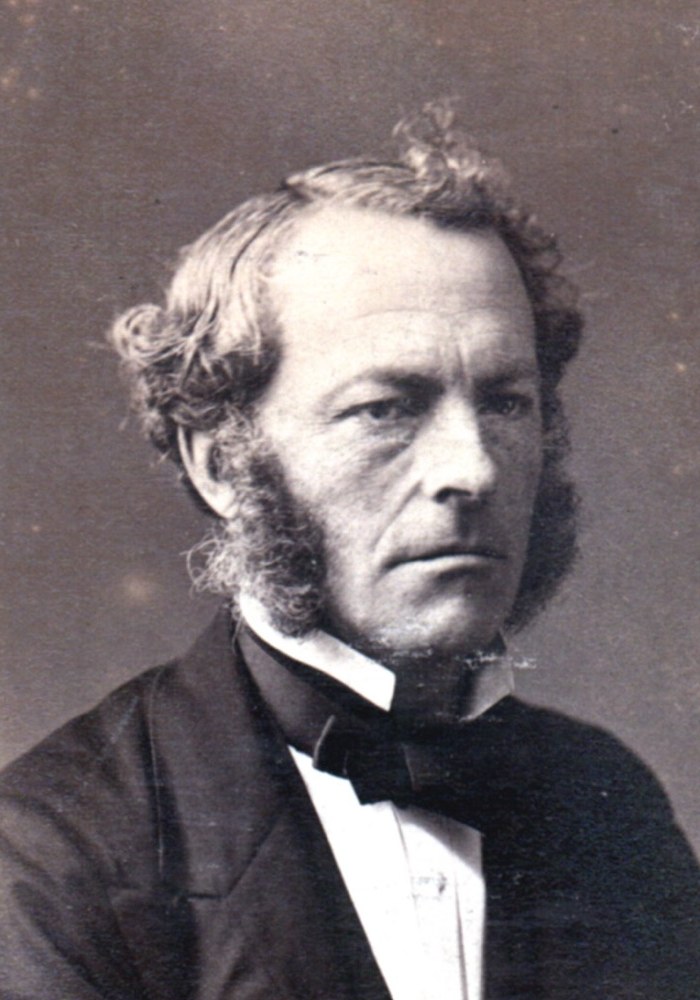

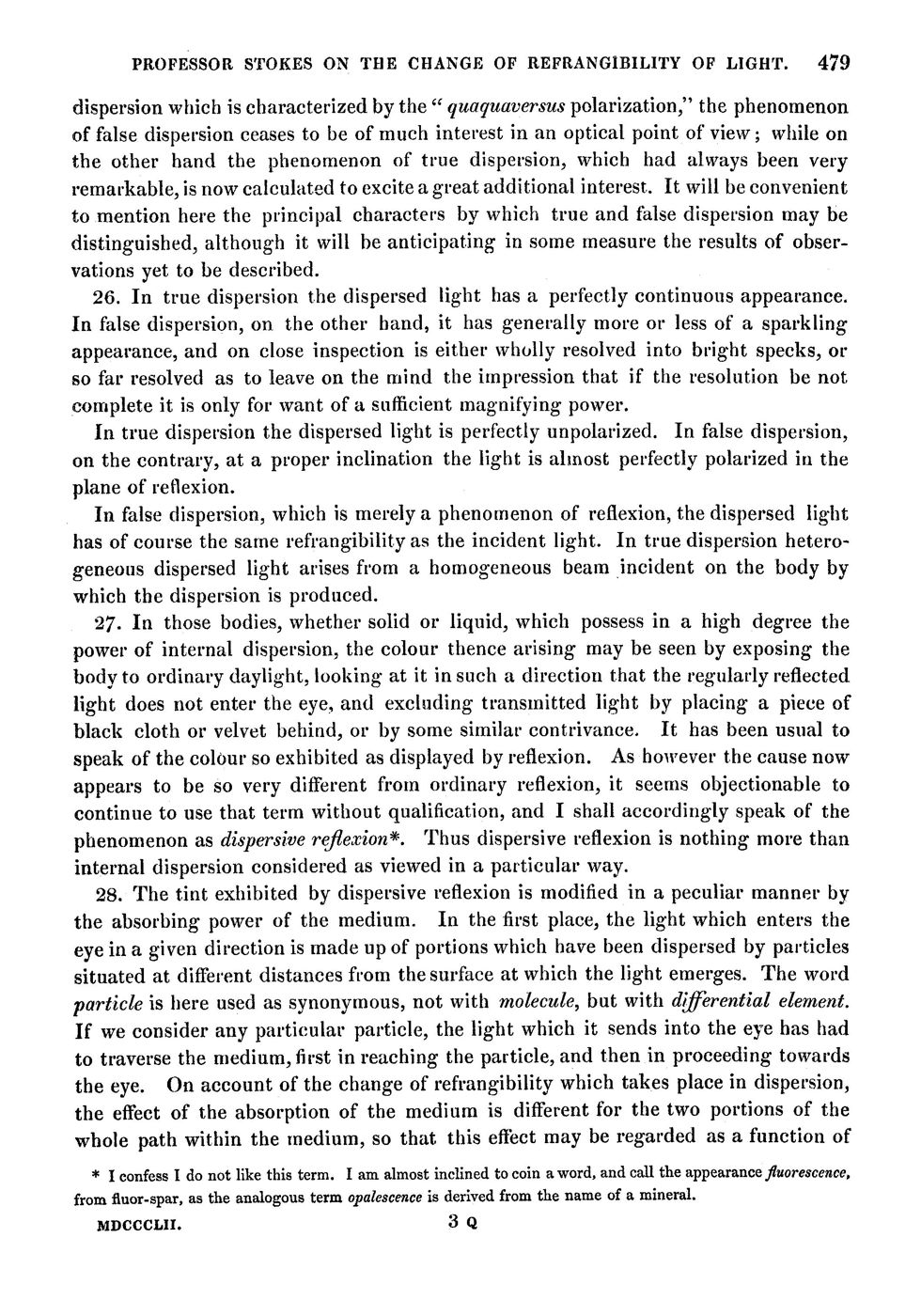
The word was coined by a mathematical physicist at Cambridge. George Gabriel Stokes’s paper “On the change of refrangibility of light” was received by the Royal Society on 11 May 1852 and published in the Philosophical Transactions (vol. 142, p. 463). Working with a solution of sulphate of quinine and other substances that show a blue glow in sunlight, Stokes showed that the glow was light of a different refrangibility, and so a different color, from the light that caused it. He at first called the effect “dispersive reflexion,” and then added a footnote:
I confess I do not like this term. I am almost inclined to coin a word, and call the appearance fluorescence, from fluor-spar, as the analogous term opalescence is derived from the name of a mineral.
Fluorescence is therefore named for a mineral, fluor-spar (fluorite). In the same paper (§80, p. 499) Stokes stated the rule that bears his name: “when the refrangibility of light is changed by dispersion it is always lowered. I have examined a great many media … and I have not met with a single exception to this rule.” In modern terms, the light given off has a longer wavelength than the light absorbed. That is why invisible ultraviolet light can make a mineral glow in visible colors.
Why Franklin minerals glow
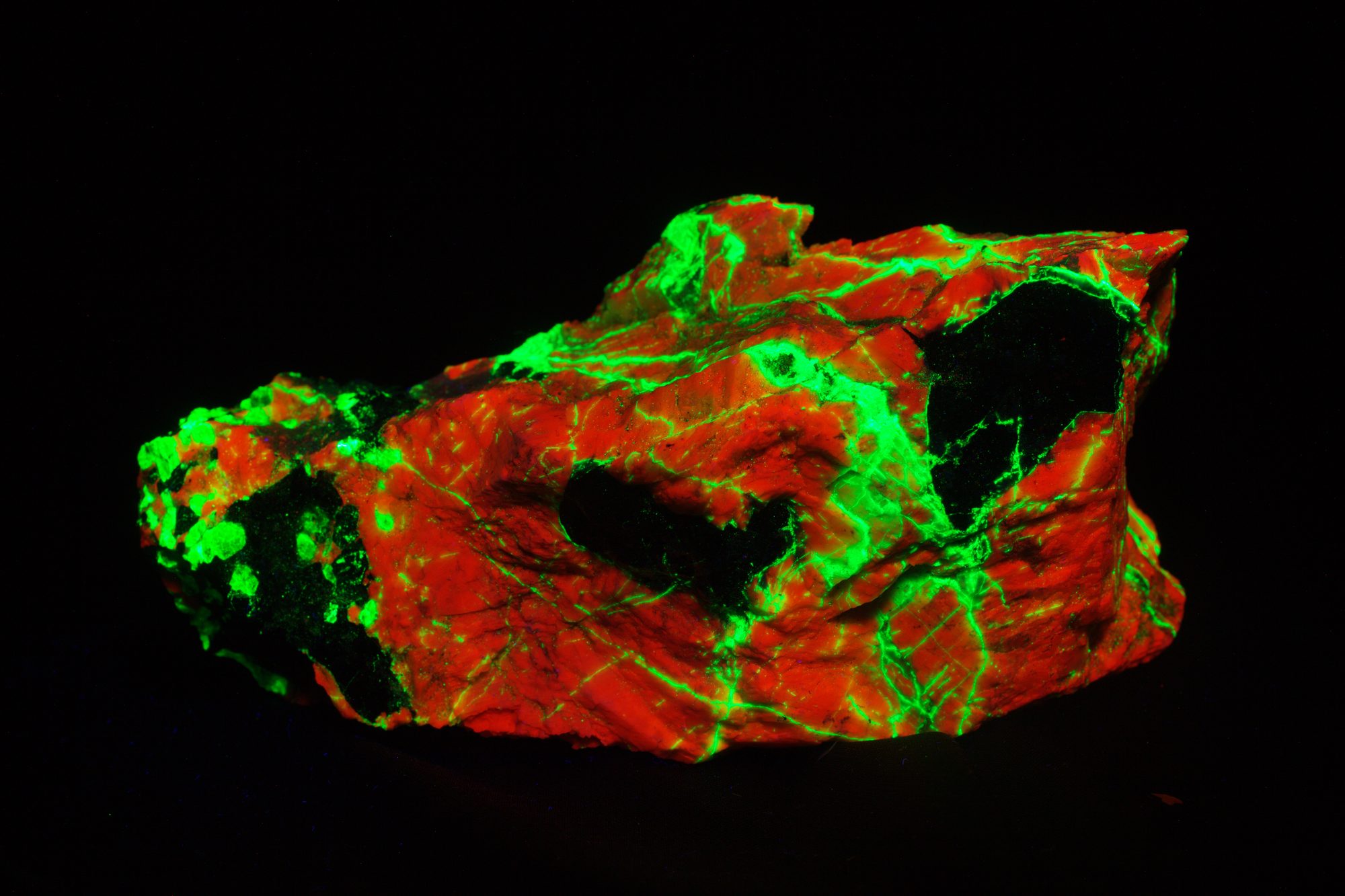
Most fluorescent minerals glow not because of what they are made of but because of what they contain in small amounts. Charles Palache, in his paper of 1928 on the Franklin minerals, put it so: “these phenomena are rarely given by pure materials but are caused by the presence of impurities of some sort generally in very small amounts.” The impurity that gives off the light is called an activator.
At Franklin and Sterling Hill the chief activator is manganese. The Fluorescent Mineral Society’s database records, for a Franklin specimen of calcite, esperite and willemite, that their visible shortwave fluorescence “is activated by manganese,” with the willemite emitting at a peak of 521 nm (green) and the calcite at 614 nm (orange-red). For another Franklin calcite it records a broad peak with a maximum around 620 nm, and a lead activator producing a further peak at 310 nm, in the ultraviolet and so invisible.
Manganese in calcite does not readily absorb shortwave ultraviolet light by itself. In 1947 J. H. Schulman, L. W. Evans, R. J. Ginther and K. J. Murata showed, in “The sensitized luminescence of manganese-activated calcite” (Journal of Applied Physics, vol. 18, p. 732–739), that synthetic calcite containing manganese alone is practically inert to ultraviolet light between 2000 and 3500 Å, and that adding lead, thallium or cerium makes it respond. Lead, they concluded, accounts for the strong response of natural calcites at 2537 Å, the shortwave mercury line. An impurity of this kind, which absorbs the energy and passes it to the activator, is called a sensitizer. How the bands of ultraviolet light differ is described on the page Ultraviolet lights.
Describing the glow
Palache, who knew these specimens well, doubted that ordinary color words could describe them (p. 333):
The description of these fluorescent colors in ordinary color terminology is apt to be misleading. No one who has not seen it can realize the peculiar quality of the color in a strongly fluorescent mineral. Its whole mass seems to glow more like a molten metal than a solid.
Color names and color charts were made for surfaces seen in reflected light. A fluorescing mineral is a source of light in a dark room, seen by eyes adapted to the dark. An emission peak in nanometers, like the figures above, describes it more exactly than a name, though it does not say how the color looks. The green of willemite and its history are treated on Green light and Green.
Photographing the glow
A camera meets the same difficulty in another form. Mark Cole’s guide to fluorescent mineral photography, published by the Fluorescent Mineral Society, sets out the main problems. Ultraviolet lamps leak some visible light, which turns white areas blue or purple; “the white balance is probably the best tool used to get rid of the dreaded ‘blue bleed’.” “Some camera lenses will fluoresce upon exposure to UV causing foggy/blue cast pictures,” and a filter in front of the lens helps only if the filter does not itself fluoresce. When a glow is mostly one color, it is recorded by only a fraction of the sensor’s color elements. “Cameras just aren’t designed to do this.”
Every photograph of fluorescence, including those on this site, is therefore an interpretation shaped by the lamp, the filter, the lens and the camera’s settings. It shows that a mineral glows and roughly in what color; it is not a measurement of the color.
Sources and further reading
- Cole, M., Fluorescent mineral photography. Fluorescent Mineral Society. FMS
- Fluorescent Mineral Society, Fluorescent Mineral Database, specimen 153 (calcite, esperite, willemite, Franklin). FMS
- Fluorescent Mineral Society, Fluorescent Mineral Database, specimen 221 (calcite, Franklin). FMS
- Palache, C., 1928, The phosphorescence and fluorescence of Franklin minerals. American Mineralogist, vol. 13, p. 330–333. PDF
- Schulman, J. H., Evans, L. W., Ginther, R. J., and Murata, K. J., 1947, The sensitized luminescence of manganese-activated calcite. Journal of Applied Physics, vol. 18, p. 732–739. DOI
- Stokes, G. G., 1852, On the change of refrangibility of light. Philosophical Transactions of the Royal Society of London, vol. 142, p. 463 ff. DOI 10.1098/rstl.1852.0022. Full scan (Internet Archive)
Written with Claude, an AI model made by Anthropic, from the sources listed above, and checked against them. October 2026.