Why a Franklin mineral can glow one color under one ultraviolet lamp and another color, or not at all, under the next.
Three kinds of invisible light
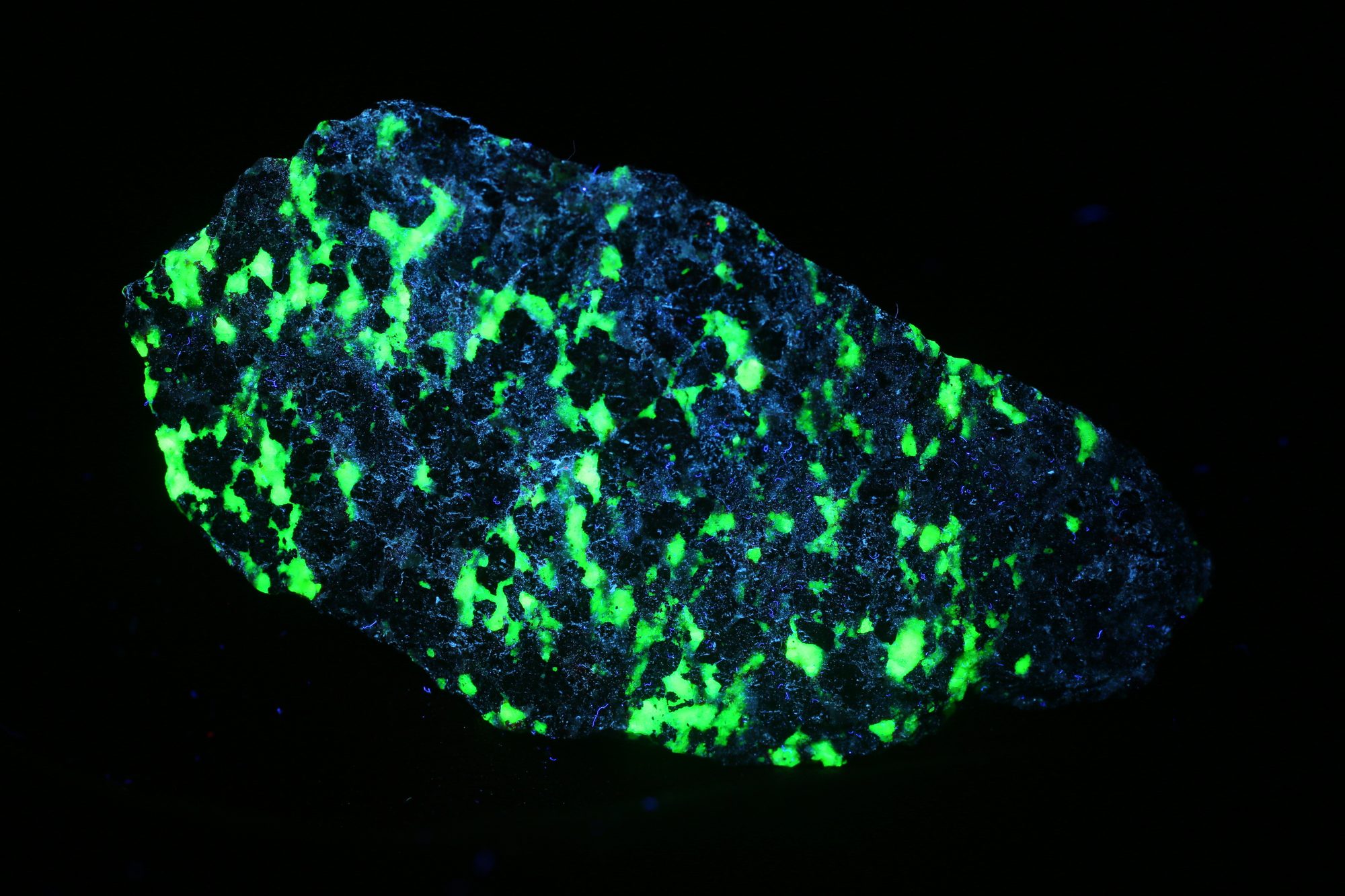
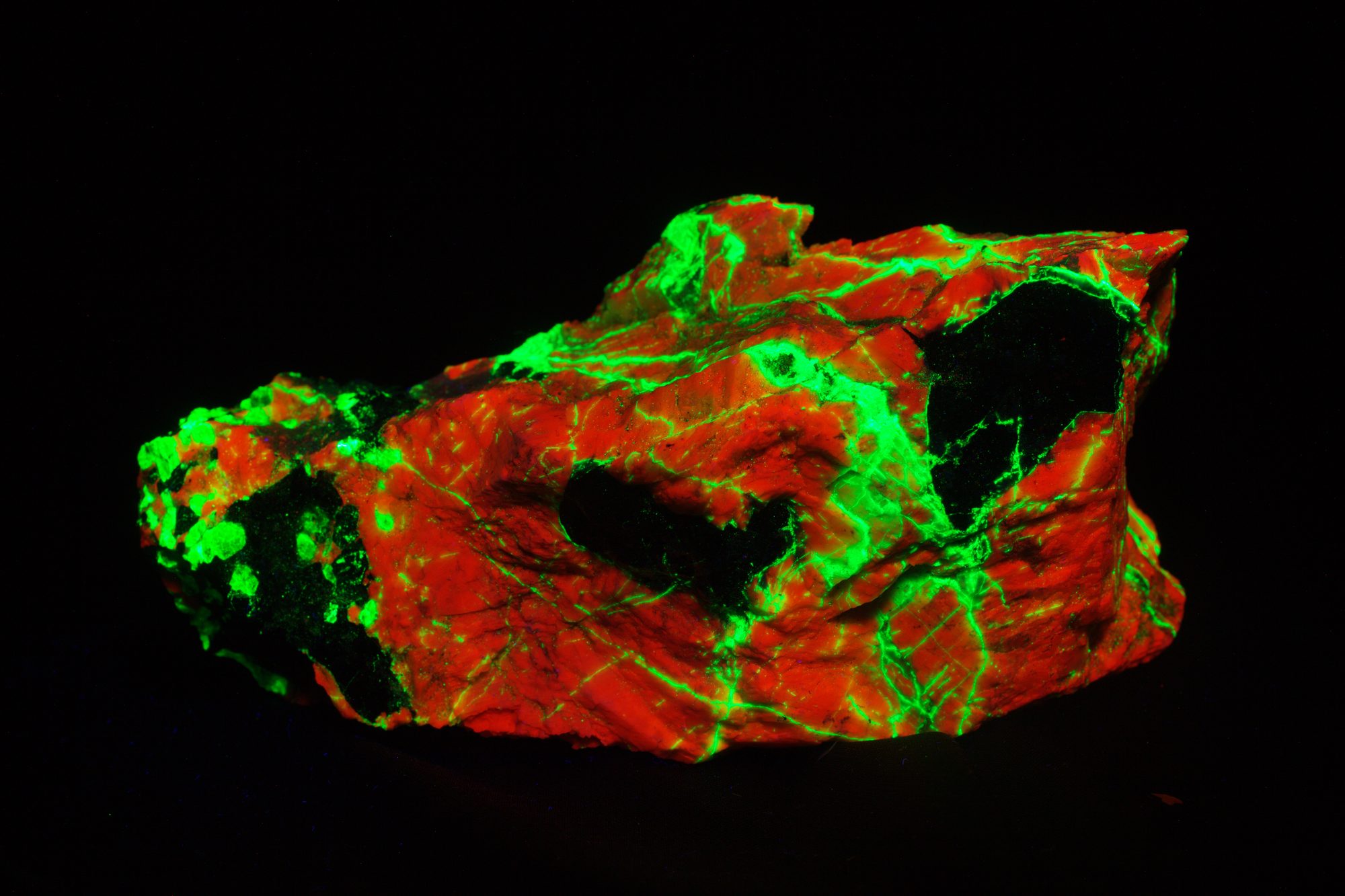
Ultraviolet light lies just beyond violet, too short in wavelength for the eye to see. Collectors use three bands of it. Shortwave lamps give light centered near 254 nanometers, the strong line of mercury vapor; midwave lamps give light near 302–312 nanometers; longwave lamps give light near 365 nanometers. A mineral may fluoresce under one band and not another, or in different colors under different bands, and the Quarries pages on this site show specimens under each.
Shortwave ultraviolet light is harmful to eyes and skin; lamps are used with eye protection.
The iron spark
The lamp used at Franklin in the early years was not a mercury lamp but an electric spark between iron terminals, rich in shortwave ultraviolet light. About 1915 the General Electric Company built a portable iron-spark unit, designed by W. S. Andrews, which the New Jersey Zinc Company used to check its mill tailings for lost willemite; the unit is described in The Picking Table, vol. 34, no. 2, and its use in the mill by Palache in 1928 and in his notice of Andrews (1932). Under the iron spark, Andrews noted in 1922, willemite glows green and “a variety of calcite that is found at Franklin Furnace, N. J. exhibits a light red or pink color.”
Filtering the visible light
A lamp that gives ultraviolet light also gives visible light, which would drown a faint glow. In 1903 the physicist Robert W. Wood described a glass that passes ultraviolet light and blocks most visible light, and filters of this kind have been part of ultraviolet lamps ever since. Every photograph of fluorescence depends on what the filter lets through as well as on the lamp.
Why the band matters
Fluorescence happens when a mineral absorbs light of one wavelength and gives off light of a longer one. Whether a mineral responds, and how, depends on the small amounts of other elements in it, such as manganese in willemite and calcite, and on whether those elements can absorb the particular band of ultraviolet light offered. That is why the same specimen can look so different under shortwave, midwave and longwave lamps, and why a description of a mineral’s fluorescence is incomplete unless it names the band.
Sources and further reading
- Andrews, W. S., 1922, Notes on the preparation of some fluorescent and phosphorescent compounds. American Mineralogist, vol. 7, p. 19–20. PDF
- Palache, C., 1928, The phosphorescence and fluorescence of Franklin minerals. American Mineralogist, vol. 13, p. 330–333. PDF
- Palache, C., 1932, Biographical notice of W. S. Andrews. American Mineralogist, vol. 17, p. 78–79. PDF
- The Picking Table, vol. 34, no. 2 (on the General Electric iron-arc unit). The Picking Table (PDF)
- Wood’s glass. Wikipedia
Written with Claude, an AI model made by Anthropic, from the sources listed above, and checked against them. October 2026.