Histories › The people behind the minerals
Gerard Troost, Haüy’s pupil and the first president of the Academy of Natural Sciences, studied the zinc ores of Franklin and Sterling in the 1820s; the name troostite, given in 1832 on the strength of a wrong analysis, survives for the manganese-bearing willemite of Sterling Hill.
A Dutch crystallographer at the zinc mines
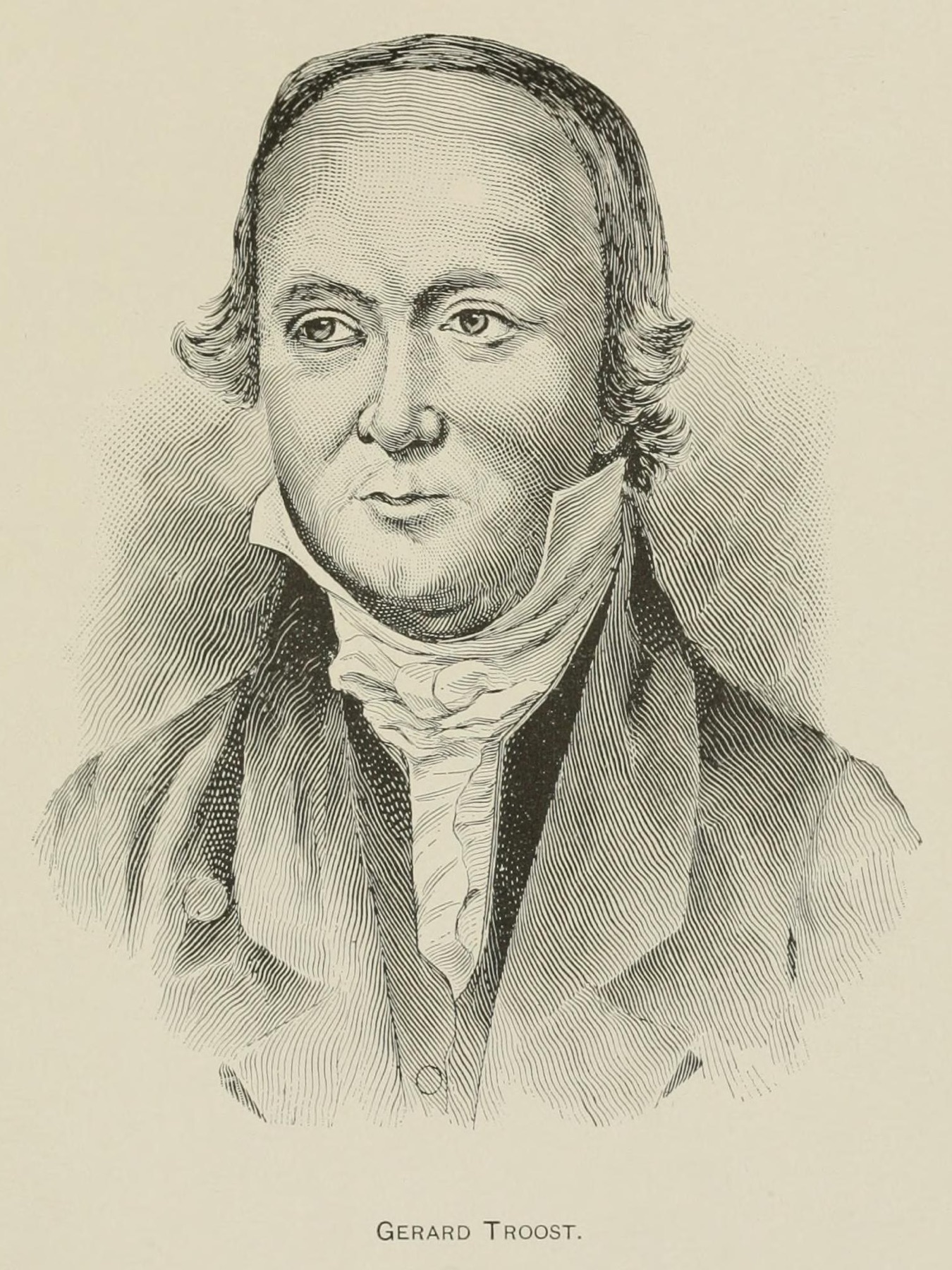
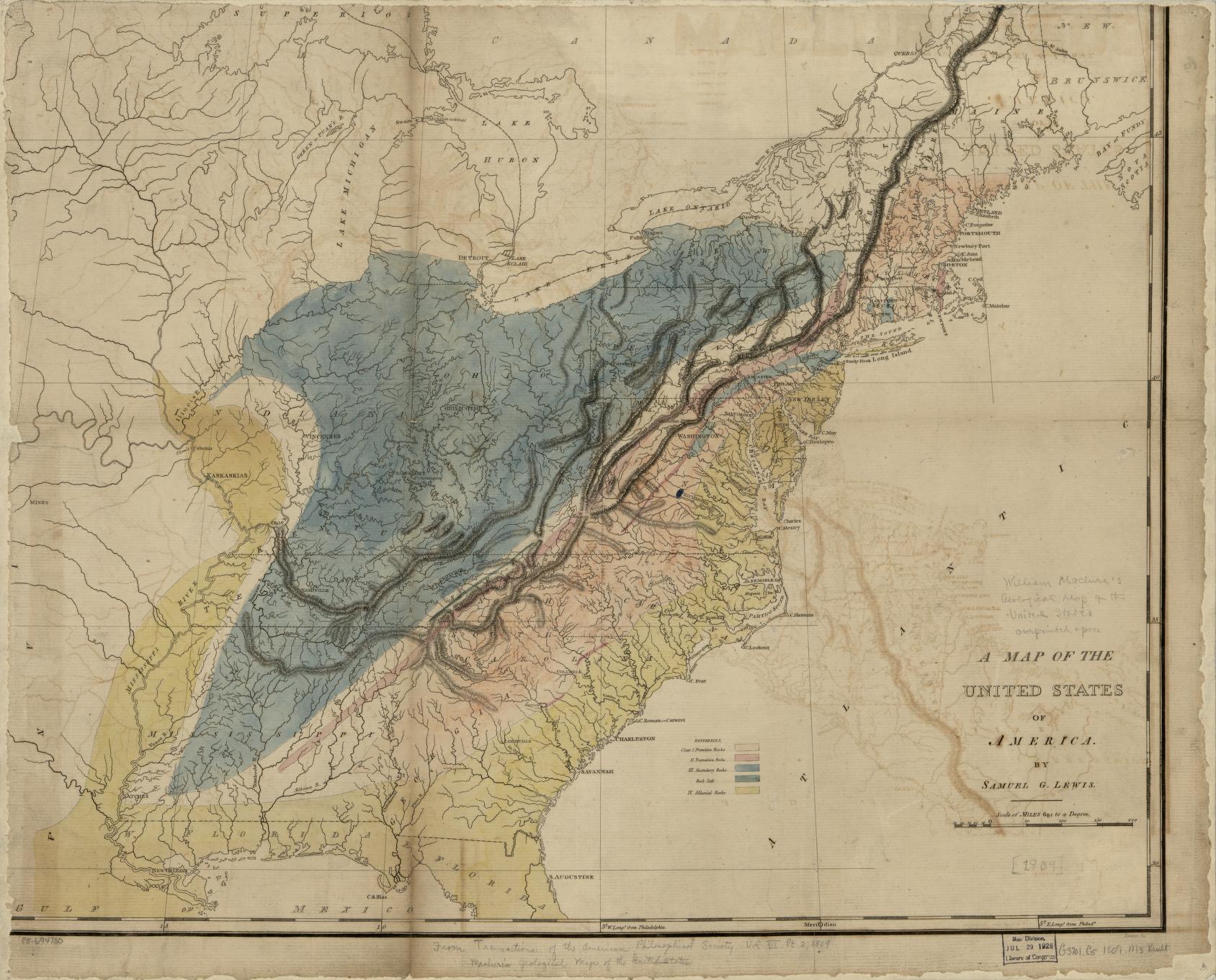
In the early 1820s the mineral deposits on Samuel Fowler’s land at Franklin and at Sterling, near Sparta, drew the Philadelphia mineralogists one after another. Charles Palache, writing the history of the district in 1935, listed Troost among the men who made “the pilgrimage” to the Fowlers’ house between 1820 and 1844 (Professional Paper 180, p. 15), and Troost’s biographer L. C. Glenn wrote that during his last years in Philadelphia he made frequent excursions “to the zinc mines of Sussex County, N. J.,” sometimes with Maclure, Say, Lesueur and Jackson (Glenn 1905, p. 75). William Maclure was the Scottish-born merchant whose geological map of the United States, published in 1809, George Brown Goode called “the first of the kind ever attempted for an entire country”; he was the Academy’s great patron and for twenty-two years its president (Goode 1897, p. 439). Thomas Say was the Academy’s zoologist, the founder of American conchology and entomology, who slept in the Academy’s hall “beneath the skeleton of a horse” (p. 447–448). Charles-Alexandre Lesueur was a French naturalist who had sailed with the Baudin expedition to Australia and was, in Goode’s words, “above all, an artist” (p. 448). Glenn gives the fourth companion only as “Jackson.” He was probably Charles T. Jackson of Boston, “an eminent geologist and chemist” who, Elwood Shuster wrote, “visited the mines at different times from 1825 to 1852” (Shuster 1927, p. 16), and whom Palache lists among the visitors of those years (PP 180, p. 15); Glenn does not say so himself. Fowler himself supplied him with specimens. In a note read to the Academy of Natural Sciences in November 1823 Troost thanked “Dr. Samuel Fowler, proprietor of the Franklin Iron Works, which have of late become so interesting to mineralogists,” for a large piece of chondrodite with green spinel and for octahedral sphalerite, beryl and apatite, “all these minerals” from near Franklin.
Troost came to these ores as a crystallographer, trained in Paris by René-Just Haüy, and he worked by Haüy’s method of cleavage and primitive forms. He published two papers that bear on Franklin, both in the Journal of the Academy of Natural Sciences of Philadelphia, and both answering work by his younger colleagues Lardner Vanuxem and William H. Keating.
Haüy and the primitive form
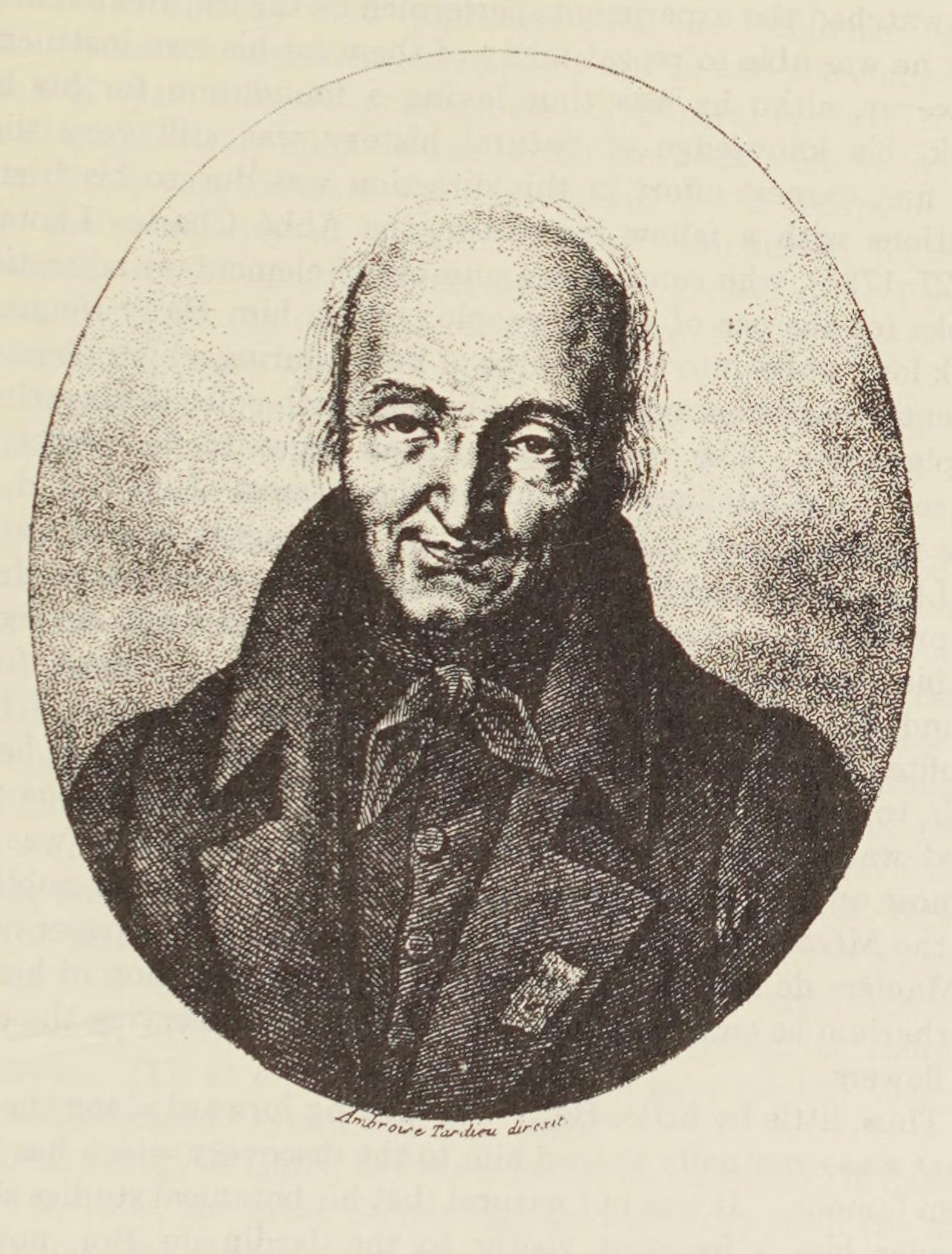
René-Just Haüy told the story of his discovery himself, in the first volume of his Traité de minéralogie of 1801. The collector Defrance, showing him a group of calcite crystals, gave him a six-sided prism that had just come away from it, broken only along one edge of its base. “Au lieu de le placer dans ma collection alors naissante,” Haüy wrote, “je me mis à essayer de le diviser dans d’autres sens” (instead of putting it in my collection, then just begun, I set about trying to divide it in other directions), and after some fumbling he drew out its rhomb-shaped core, “son noyau rhomboïdal,” to his surprise and with “l’espérance de ne point en rester à ce premier pas” (the hope of not stopping at this first step). The observation, he wrote, had been “comme la clef de la théorie,” the key to the theory. In Haüy’s own telling nothing was dropped. The familiar version, in which he lets the group fall, is Georges Cuvier’s, from the eulogy he read to the Academy of Sciences on June 2, 1823; as George F. Kunz retold it in 1918, Cuvier had Haüy break the crystal off “by a fortunate awkwardness” (American Mineralogist, 1918, p. 65).
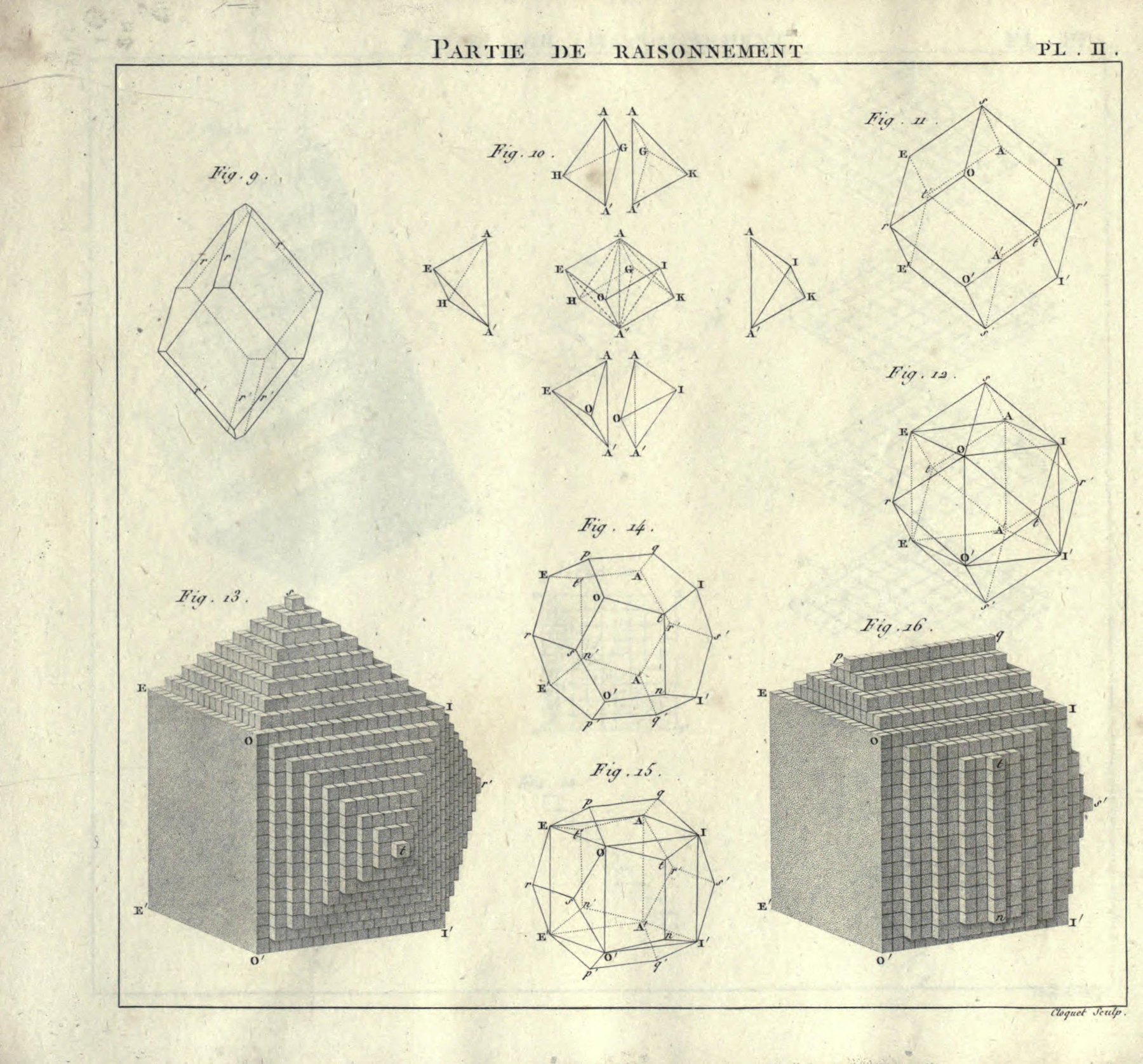
From that core Haüy built a geometry of crystals. Each species, in his theory, had a “forme primitive” or nucleus, reached by splitting a crystal along its natural joints, and the nucleus was itself a stack of minute “molécules intégrantes” (integrant molecules) of fixed shape. The faces actually seen on crystals came from layers laid over the nucleus that lost rows of molecules at a regular rate. His first example (p. 35–37) was the twelve-sided solid with rhombic faces built on a cube. Each face of the cube carries a series of layers, each falling short of the one below it by a single row of molecules along all four edges, so that the layers rise in six four-sided pyramids, “semblables en quelque sorte à des escaliers à quatre côtés” (rather like four-sided staircases). Their twenty-four triangular faces lie two by two in one plane and make twelve rhombs. His drawing, fig. 13 of the plate shown here, assumes a cube seventeen molecules on a side and eight layers whose edges measure 15, 13, 11, 9, 7, 5, 3 and 1 molecules. In nature, he explained, the molecules are imperceptibly small and the steps vanish, so that for “cette espèce de maçonnerie grossière” (this kind of rough masonry) one must substitute “l’architecture infiniment délicate de la nature.” These regular losses of rows were his “décroissemens,” the decrements.
The whole edifice rested on cleavage, and Haüy’s followers gave the cleavage solid great authority in deciding what was a species. Vanuxem and Keating put it plainly in 1824: “the solid given by cleavage has, since the period of the publication of the Traité de Mineralogie, been considered next to composition, and faces deduced from the secondary forms, of paramount importance, and sufficient of itself, in the absence of the above named characters, to constitute or determine the formation of a species” (J. Acad. vol. 4, p. 4). That was where the method could mislead. A mineral that did not cleave cleanly, or that parted along planes that were not true cleavages, could yield a false nucleus, and every face derived from it would inherit the error. The lamellar parting of jeffersonite had led Vanuxem and Keating to think it a new species; willemite, in which they could find no cleavage at all, yielded Troost a cube.
Haüy on the New Jersey ores (1822)
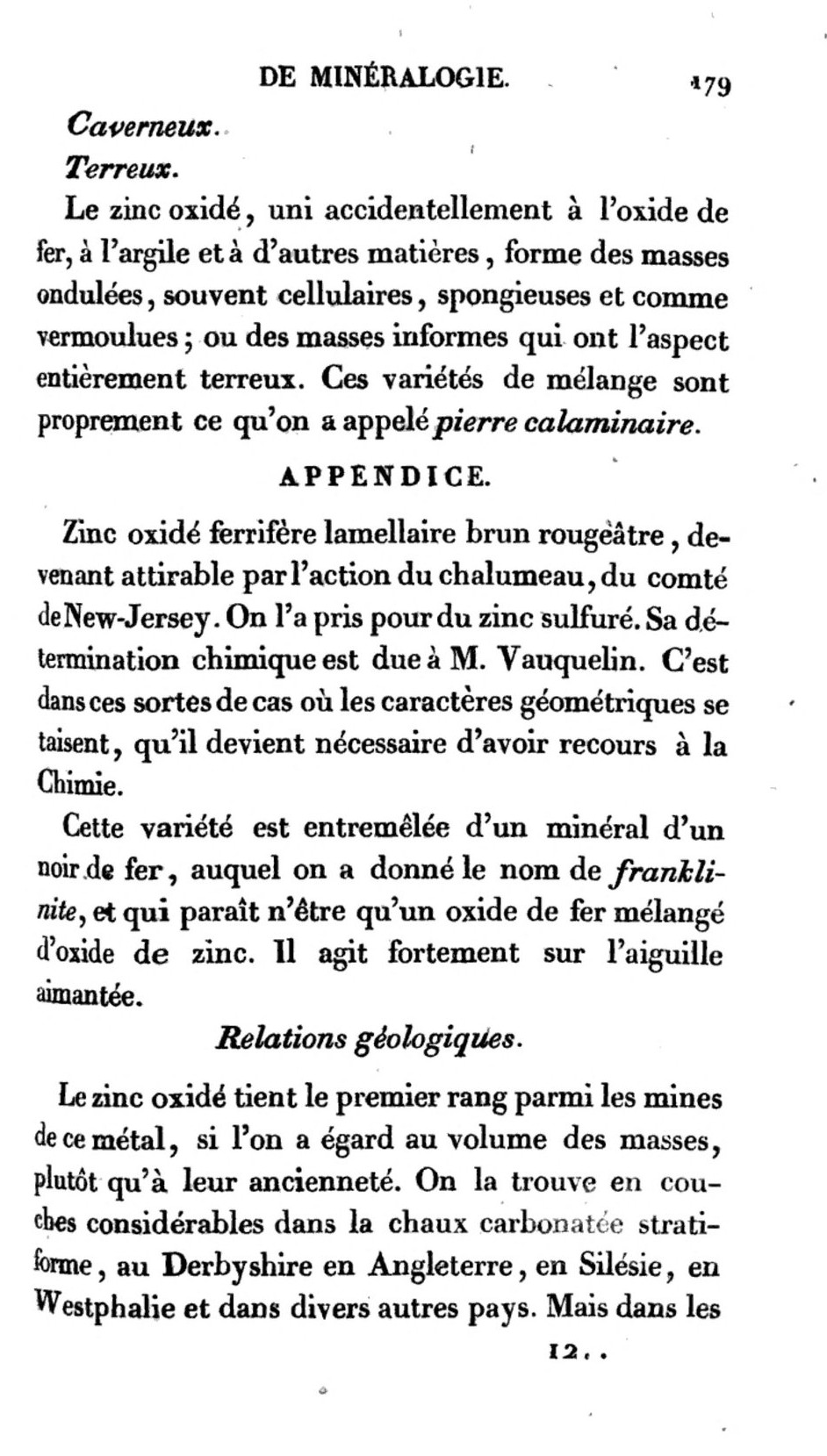
Haüy did write about the New Jersey minerals, at the end of his life. In the second edition of the Traité, whose fourth volume is dated 1822, the zinc ores open with a species he called “zinc oxidé silicifère,” siliceous oxide of zinc, Werner’s Galmei (vol. 4, p. 175). He gave it a primitive form of a rectangular octahedron, an integrant molecule shaped as a tetrahedron, and a specific gravity of 3.424, after Smithson; its crystals became electric when heated, and it dissolved to a jelly in nitric acid (p. 176). The first analysis he quoted, Pelletier’s of the mineral from the Breisgau, found 12 parts of water in 100 (p. 177). A hydrous zinc silicate whose crystals turn electric when warmed is the mineral now called hemimorphite. It was a different mineral from the New Jersey one, which is why Troost’s crystals, in 1825, would not fit Haüy’s account of the species.
On the same page Haüy took account of the American zinc ore. He printed the French chemist Pierre Berthier’s analysis of the “zinc oxidé brun lamellaire et ferrifère des États-Unis,” 88 parts oxide of zinc to 12 of oxides of iron and manganese, and drew the conclusion. If Smithson and Berzelius were right that silica belonged to the European calamines, “la nouvelle variété des États-Unis formera une espèce à part, et devra être considérée comme le véritable oxide de zinc” (the new variety from the United States will form a species of its own, and must be considered the true oxide of zinc). That is, in effect, zincite. In the descriptive part, though, he left it in an appendix to the siliceous species: “Zinc oxidé ferrifère lamellaire brun rougeâtre,” reddish brown and turning magnetic under the blowpipe, “du comté de New-Jersey” (from the county of New Jersey). “On l’a pris pour du zinc sulfuré,” it had been taken for zinc sulfide, and its chemical determination was due to Vauquelin. Then came a sentence that marks the limit of his own method: “C’est dans ces sortes de cas où les caractères géométriques se taisent, qu’il devient nécessaire d’avoir recours à la Chimie” (it is in cases like these, where the geometrical characters are silent, that one must have recourse to chemistry).
Franklinite got a single sentence. The red ore, Haüy wrote, was mixed with “un minéral d’un noir de fer, auquel on a donné le nom de franklinite,” an iron-black mineral that seemed to be no more than an oxide of iron mixed with oxide of zinc, and that acted strongly on the magnetic needle. The name was Berthier’s, as Palache later noted (PP 180, p. 15). On the next page Haüy credited William Maclure, “savant minéralogiste américain,” with finding the rock that holds the brown ore in beds “dans les montagnes primitives de New-Jersey.” The Traité gives no primitive form for either mineral. For the New Jersey ores it offers chemistry and locality, not geometry; the geometry was left to Troost, Vanuxem and Keating.
The Academy and its Journal
When the Academy of Natural Sciences named its first officers on May 7, 1812, Troost headed the list as president, with Thomas Say as conservator of the collections. Its first considerable property was a mineral cabinet, bought from Dr. Seybert by John Speakman, which passed formally to the society that August; “soon after the Seybert cabinet was added to the Museum,” the Academy’s historian W. S. W. Ruschenberger wrote, “Dr. Troost delivered a course of lectures on mineralogy before the Academy” (Ruschenberger 1852, p. 51). Troost remained president until 1817, when he resigned and Maclure succeeded him (p. 56).
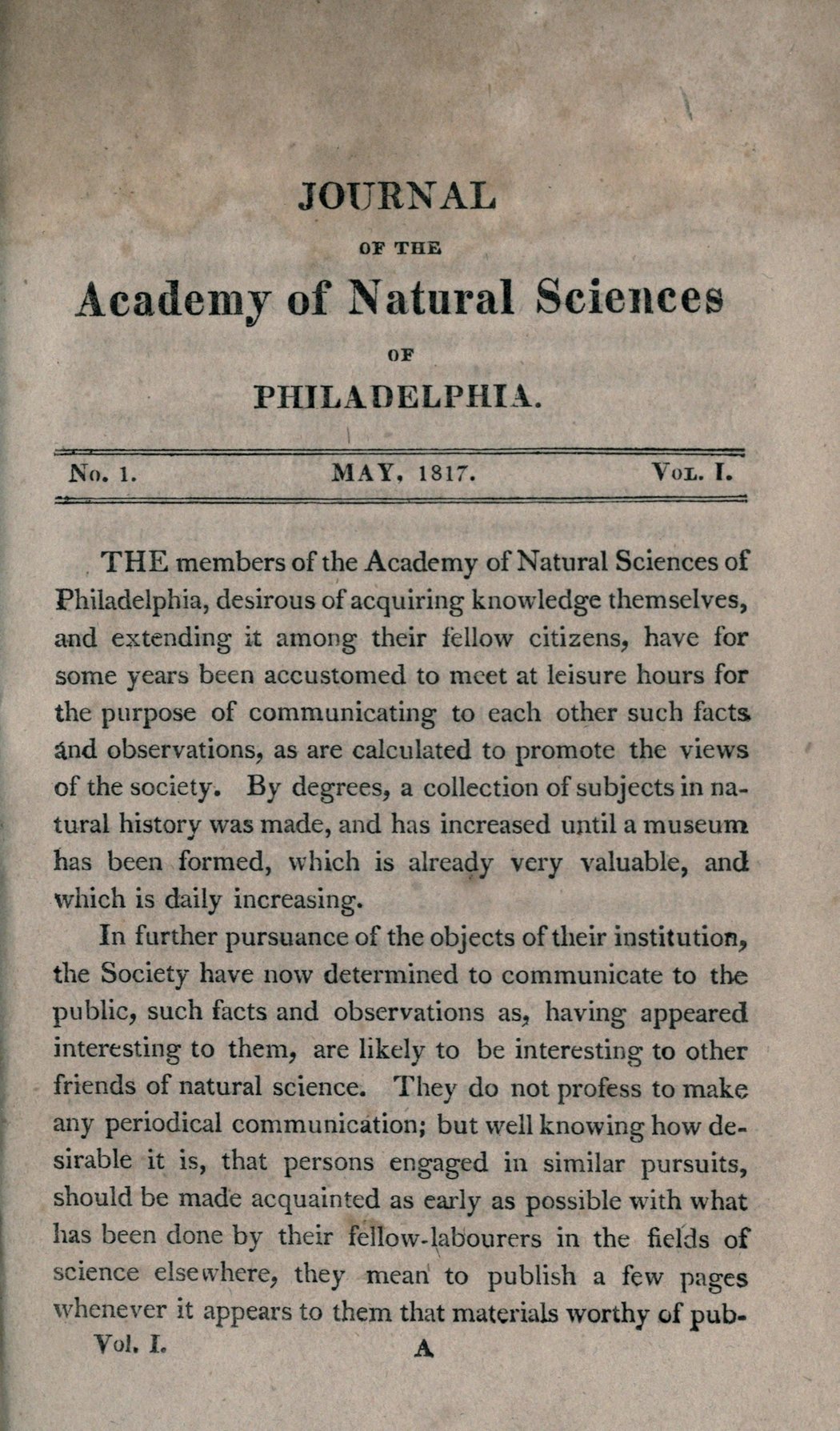
The Journal was Maclure’s project. He pressed the advantages of a publication that would make the members’ discoveries known when others feared it would empty the treasury, and the first number was laid before the society on May 20, 1817 (p. 62). Its Introduction set the terms. The members meant “to publish a few pages whenever it appears to them that materials worthy of publication have been put in their possession. In so doing, they propose to exclude entirely all papers of mere theory,—to confine their communications as much as possible to facts—and by abridging papers too long for publication in their original state, to present the facts thus published, clothed in as few words as are consistent with perspicuous description” (vol. 1, p. 1–2).
The early numbers were made by hand and on very little money. After the first half-volume, Maclure supplied type and “a much worn printing press” and room in his own house, and members of the committee helped the young compositor and pressman; “it is traditionary that Mr. Say attempted on several occasions to set types, but with very moderate success” (p. 63–64). The Journal stopped for want of money before the end of 1818 and was “not again resumed until 1821, when Dr. Isaac Hays undertook its management,” and under him it ran on to the close of 1825, printed in the office of Jesper Harding (p. 64). From 1823 to 1826 the committee of publication included William H. Keating, who in 1824 was also the Academy’s recording secretary (J. Acad. vol. 4, list of officers; committee).
That revival explains why the Franklin papers cluster where they do. The revived Journal was the publication of the society to which Troost, Vanuxem and Keating all belonged, it was appearing again after its pause, and its rule of facts over theory suited descriptions of new minerals from a nearby locality. Vanuxem and Keating’s jeffersonite and their geology of Franklin went into volume 2 (1822), Troost’s pyroxene paper into volume 3 (1823), and in volume 4 Vanuxem and Keating’s notes on the Franklin minerals stand first in the contents (vol. 4, contents), with Troost’s reply later in the same volume. Each paper was read at a meeting before it was printed, so the exchange ran in the Academy’s rooms as well as in print.
Vanuxem and Keating
The two men Troost was answering were a generation younger than he. Lardner Vanuxem (1792–1848) was born in Philadelphia and graduated from the École des Mines in Paris in 1819; soon after his return he took the chair of chemistry and mineralogy at South Carolina College, which he left in 1826 to work as a geologist. He later had charge of the third district of the New York geological survey, wrote its report, Geology of New York, 3d District (Albany, 1842), and helped arrange the state cabinet from which the New York State Museum grew (Appletons’ Cyclopaedia, vol. 6, p. 256). William H. Keating (1799–about 1844), born in Wilmington, Delaware, graduated from the University of Pennsylvania in 1816 and “received his scientific training in polytechnic and mining schools of France and Switzerland.” He held the new chair of chemistry and mineralogy at Pennsylvania from 1822 to 1827, helped found the Franklin Institute in 1824, and went as geologist and historian on Major Stephen H. Long’s second expedition in 1823, which he described in his Narrative of an Expedition to the Source of St. Peter’s River (1824). He later turned to law and died in London (vol. 3, p. 498).
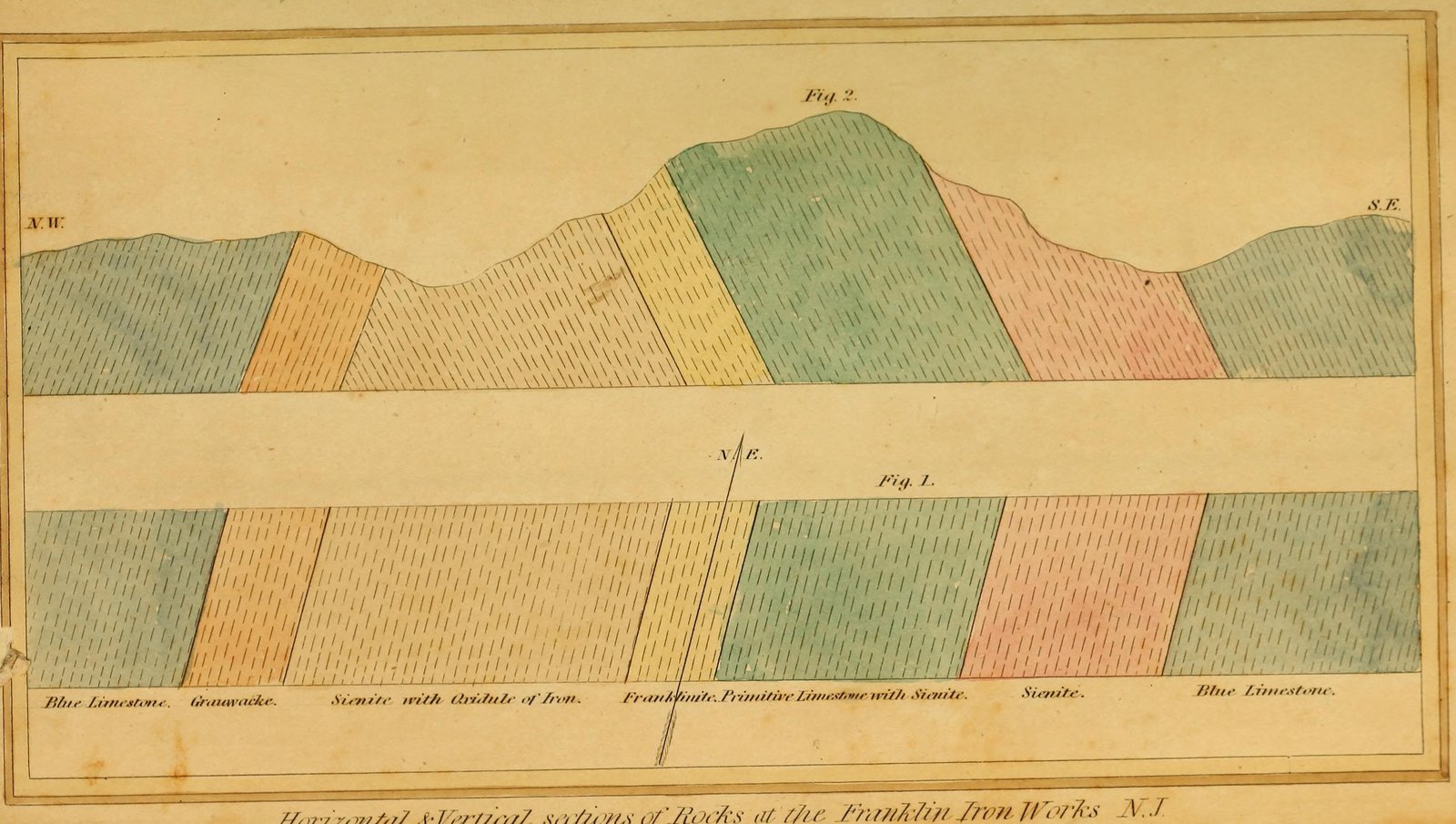
They first went to Franklin together in August 1821. Their jeffersonite paper, read on June 4, 1822, is told on the Jeffersonite page. Two months later, on August 6, they read “On the Geology and Mineralogy of Franklin,” which recalled that they had found two minerals on the first visit: jeffersonite, “quite new,” and “a new variety of the Automalite (Spinelle Zincifere, Haüy,) a mineral which had not yet been found on this side of the Atlantic.” The name in parentheses was Haüy’s. Automalite is now called gahnite, the zinc spinel ZnAl2O4, and the dysluite they went on to study proved, by Palache’s account, an iron- and manganese-bearing gahnite. The plate of that paper is the first geological drawing of Franklin (see Drawing the folds).
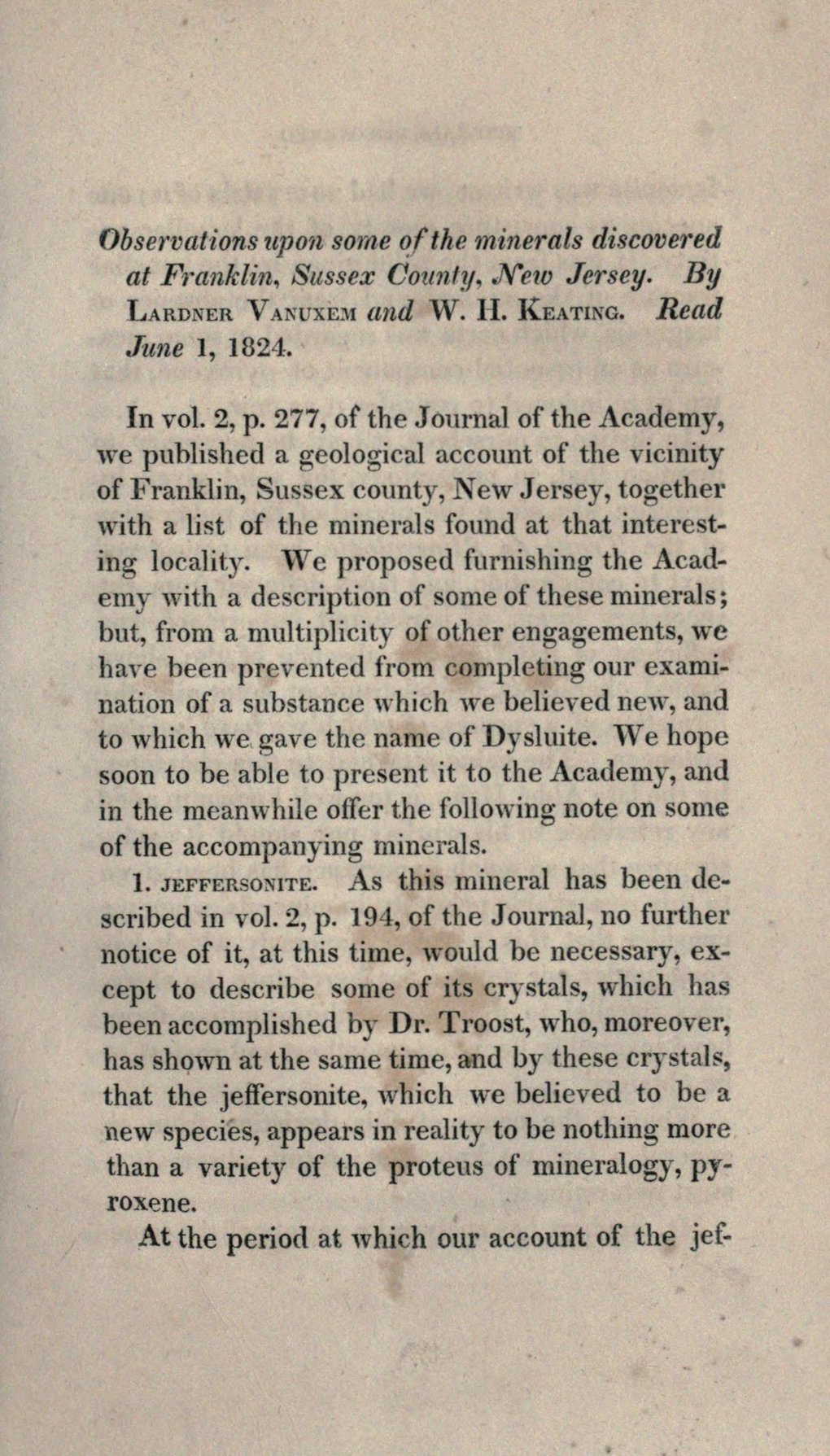
Their second paper on the minerals, “Observations upon some of the minerals discovered at Franklin,” was read on June 1, 1824, and printed as the opening article of volume 4. It was short, nine pages, offered as a note while they finished their study of a mineral they called dysluite. It began by giving way on jeffersonite: Troost, they wrote, had described its crystals and shown “that the jeffersonite, which we believed to be a new species, appears in reality to be nothing more than a variety of the proteus of mineralogy, pyroxene.” They had had no crystals, only the lamellar variety, and the cleavage of that variety had been, they said, “the first anomaly which has come under our notice” among the cleavages of the late Abbé Haüy’s primitive forms (p. 4). Franklinite they described as a regular octahedron with deeply bevelled edges passing toward the rhombic dodecahedron, the smallest crystals at Franklin and the largest at Stirling, black, opaque and “without any indication of cleavage” (p. 6). For the red oxide of zinc, now zincite, they preferred the name “red zinc ore (improperly called red oxide of zinc),” found purest and most abundant at Sterling, where “it will at no distant period be worked for zinc”; following Berthier, “of the School of Mines,” they took it for a compound of the oxides of zinc and manganese, and put the iron Archibald Bruce had found in it down to mixed-in franklinite (p. 6–7).
The core of the paper was the “siliceous oxide or silicate of zinc,” now willemite. Its crystals, they wrote, were six-sided prisms whose faces met at 120°, capped by faces meeting at “about 118°(?),” “of course leading to a rhombohedron for the primitive form.” They hedged at once: “we cannot positively affirm that the terminal faces are those of a rhombohedron; particularly as we have not been able to observe in the crystals any evident marks of cleavages parallel to these faces, nor, in fact, in any other direction” (p. 9). Without a cleavage, Haüy’s method had no nucleus to work from. Troost, who did claim a cleavage, found a cube. On chemistry they were sure of their ground. The mineral lost nothing on heating, “consequently anhydrous,” and their analysis of the flesh-colored variety gave silex 25.44, oxides of iron and manganese 6.50 and oxide of zinc 68.06, Vanuxem’s of lighter crystals silex 25.00 and oxide of zinc 71.33, with 2.66 oxide of manganese (p. 10). A closing note suggested that “there are two species, one hydrous, the other anhydrous” among the combinations of zinc oxide and silica, which is how the matter was finally settled, with willemite separated from the hydrous hemimorphite.
Palache gave them the credit a century later: “Vanuxem and Keating discovered willemite, the third important ore mineral, and they and Troost described jeffersonite and other new minerals” (PP 180, p. 15). The second half of his sentence needs a gloss. Troost did not describe jeffersonite as a new mineral; his contribution was to show, from its crystals, that it was not new but pyroxene, a point Vanuxem and Keating conceded in the paper above.
Jeffersonite is pyroxene (1823)
The first, “Account of the Pyroxene of the United States,” was read on June 10, 1823. Its subject was the protean pyroxene family, and its argument was aimed at Franklin. “Who would have supposed,” Troost asked, “the crystals lately brought from Franklin, New Jersey, by Mr. Jessup, for siliceous oxide of Zinc, and some other crystals, not yet named, from the same place, to belong to the same family?” In 1821, he wrote, John P. Wetherill and Benjamin Say had given him crystals collected near Sparta that he took at once for pyroxene, and when he later saw Keating’s description of jeffersonite, the mineral Vanuxem and Keating had named for Thomas Jefferson in 1822 (see Jeffersonite), he found that it was the same thing. He measured the crystals and drew them, and named the Sparta material a “foliated pyroxene” for its easy parting across the prism.
On the zinc that Keating had found in jeffersonite, Troost took a local view: it was “probably ascribable to the red oxide of Zinc, which is abundant in that vicinity; it seems all the minerals from that locality are more or less impregnated with zinc” (p. 112). He was right about the species. Palache credited Troost’s paper with proving the pyroxene nature of jeffersonite, which Vanuxem and Keating had suspected but could not show without crystals, and called it one of the first American papers on descriptive crystallography (p. 64; bibliography no. 13). For a century and a half after that, jeffersonite was usually called a zinc- and manganese-bearing variety of augite. In 1988 the International Mineralogical Association’s report on pyroxene names formally discarded the name, equating jeffersonite with “zincian manganoan diopside or augite” (Morimoto 1988, table 6); it is not a species today.
The zinc ores of Franklin and Sterling (1825)
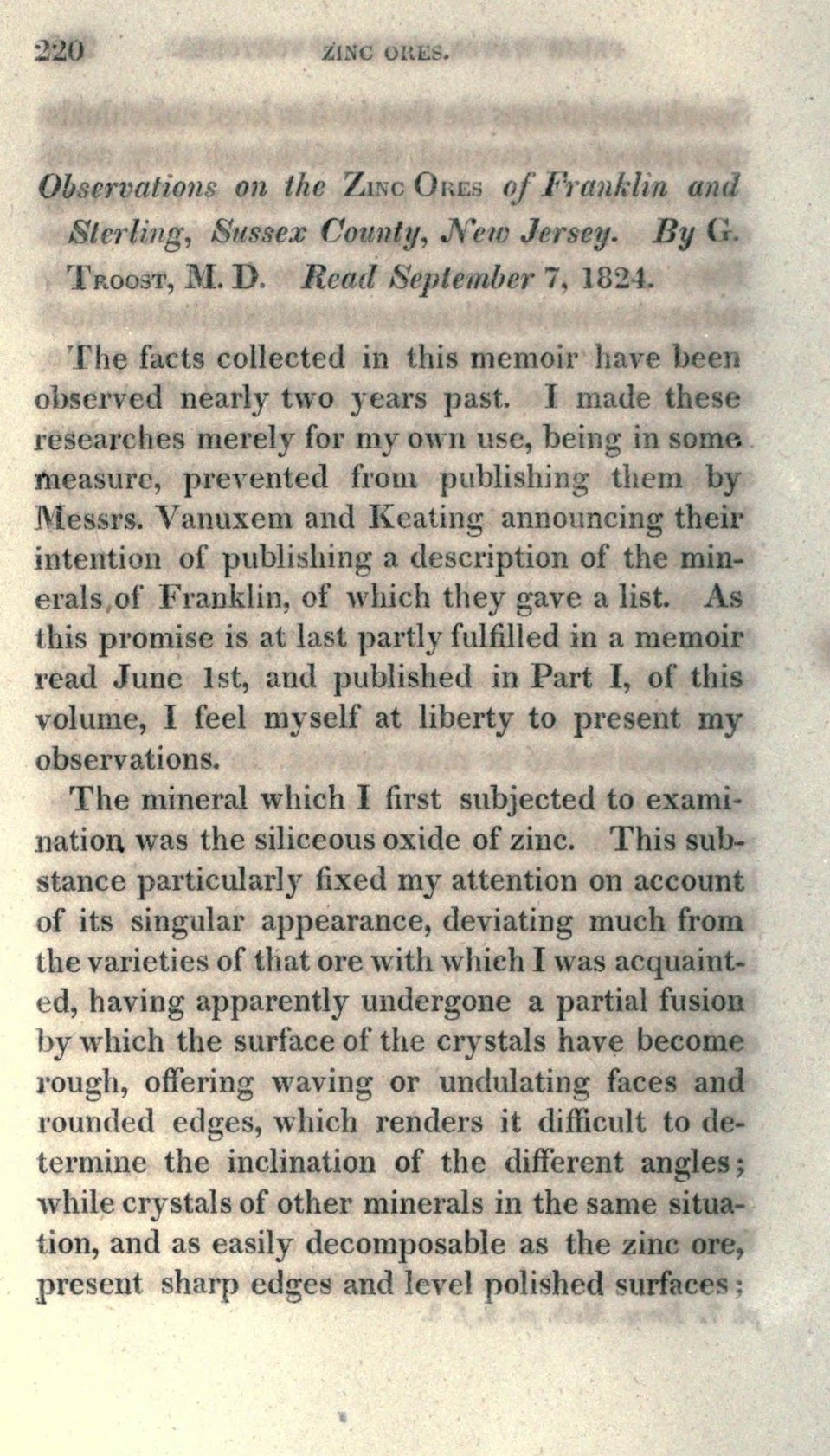
The second paper, “Observations on the Zinc Ores of Franklin and Sterling, Sussex County, New Jersey,” was read on September 7, 1824, and printed in January 1825. Troost opened with a matter of priority: “The facts collected in this memoir have been observed nearly two years past.” He had held them back, he explained, because Vanuxem and Keating had announced a description of the Franklin minerals; now that their memoir had appeared, in the first part of the same volume, he felt free to publish.
His main subject was the “siliceous oxide of zinc,” the mineral now called willemite (Zn2SiO4). He was struck by its look, as if it had “undergone a partial fusion,” its crystals with “waving or undulating faces and rounded edges.” By cleaving it, he reported, he had found its primitive form to be “a straight four-sided prism, with a square base or cube.” “This was an unexpected discovery,” he wrote, since Haüy had given the European mineral of that name a quite different form. He asked whether “a small proportion of manganese, which the mineral in question contains,” could change the whole arrangement of its particles, and answered his own doubts firmly: the cube was “beyond the reach of doubt.” The usual crystals, he wrote, were six-sided prisms capped by a low three-faced pyramid, with faces meeting at 120°.
He saw clearly what made the New Jersey mineral different in chemistry. It agreed with the European analyses, he wrote, “except that our ore contains upwards of 5 per Ct. of oxide of manganese,” which colored it, and he gave its colors as running “from gray passing through every shade to black, also pale greenish-yellow, and the different shades of rose and peach blossom-red,” with “the exterior of the masses or crystals being generally black while the interior part is red.” His specific gravity, 3.98 to 4.15, agreed with Vanuxem and Keating’s and was well above the European figures. The difference in form, he concluded, made it probable “that the nature of the siliceous oxide of zinc is not perfectly understood.”
The paper went on to the red oxide of zinc, now zincite (ZnO). Troost claimed to have cleaved from it “a straight rhomboidal prism whose angles are 100° and 80°,” and corrected the German mineralogist Friedrich Mohs, who had given angles “upwards of 120°.” Then he set out his differences with Vanuxem and Keating, who had derived a rhombohedron from the same willemite crystals, and asked for an independent judge: “I therefore submit this memoir to our mineralogists, and wish some other would undertake the examination of these minerals with the view of establishing the correctness or fallacy of my investigations.” Of jeffersonite, since its authors now admitted it was pyroxene, he wrote that “the name given by them to this substance is inadmissible, and must henceforth be relinquished.” He also defended Archibald Bruce’s old name, “red oxide of zinc,” against Vanuxem and Keating’s “red zinc ore.”
What he got right and wrong
Time sided with Vanuxem and Keating on the crystals. Willemite is trigonal, as S. L. Penfield showed in 1894 partly from Franklin crystals, and its forms derive from a rhombohedron, not a cube; zincite is hexagonal, with a prismatic cleavage whose faces meet at 60° and 120°, so Mohs was closer than Troost. Palache’s bibliography disposes of the 1825 paper in a line: “Erroneous description of the crystal form of willemite and of zincite” (PP 180, p. 3). His six-sided prisms with three-faced summits, on the other hand, are a fair description of the willemite crystals of Sterling Hill.
On the substance he did better than his geometry. He was right that the New Jersey mineral was heavier than the European “siliceous oxide of zinc,” and right to sense that it was not the same thing; the European mineral of that name, the electric calamine, is now known as hemimorphite, a hydrous zinc silicate with crystals of another system. And he was the first to dwell on the manganese, the few per cent of it that turns the crystals rose and brown and black. That manganese is exactly what the name troostite came to mean.
A name built on a wrong analysis
The name came out of a mistake made in Glasgow. Thomas Thomson, professor of chemistry at Glasgow, had received from John Torrey a Franklin specimen “under the name of silicate of zinc,” and in 1828 he reported that it held no zinc at all: silica 30.650, protoxide of manganese 46.215, peroxide of iron 15.450, loss by heat 7.300. He called it “ferruginous silicate of manganese.” His own figures gave him a warning. He found its specific gravity to be 3.014 to 3.034, and added in a footnote, “Professor Vanuxem and Dr. Troost state it to be about 4.” The note printed after his description, one of the notes Torrey supplied to the paper (see John Torrey and torreyite), recalled Troost’s cube: “Dr. Troost, so justly distinguished for his attainments in crystallography, states that the nucleus of this mineral is a cube. He proposed to consider it as a distinct species.”
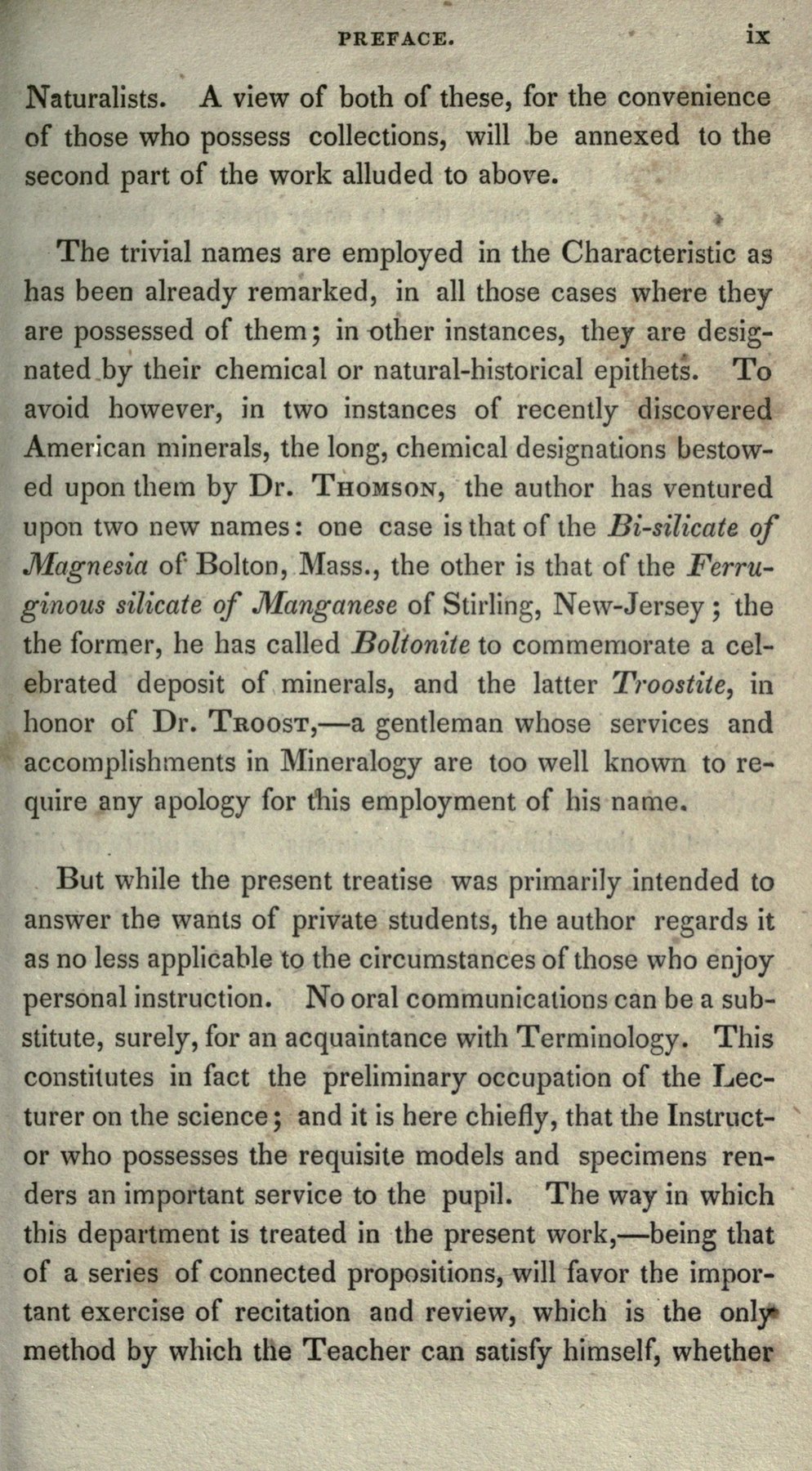
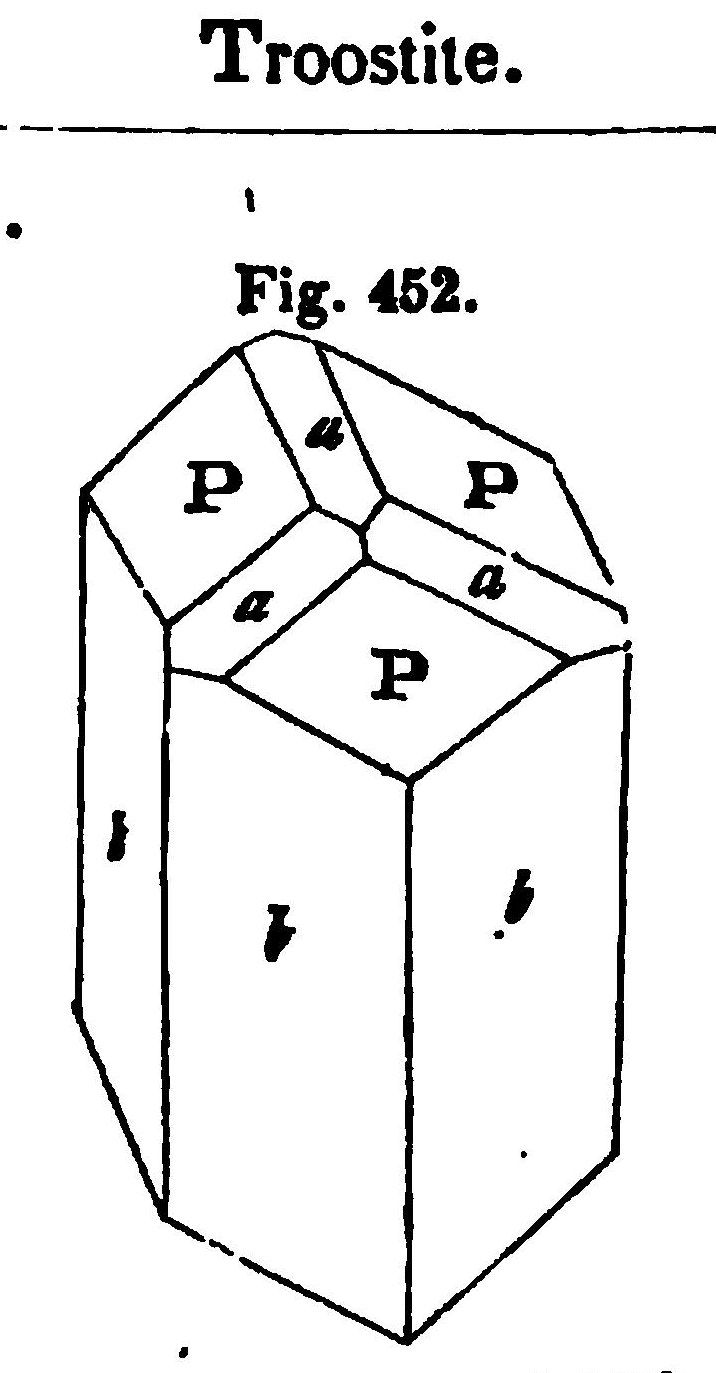
Thomson’s analysis is what Charles Upham Shepard took up. In the preface to his Treatise on Mineralogy of 1832 he explained that, “to avoid however, in two instances of recently discovered American minerals, the long, chemical designations bestowed upon them by Dr. Thomson,” he had ventured on two new names: boltonite for a magnesium silicate from Bolton, Massachusetts, and, for “the Ferruginous silicate of Manganese of Stirling, New-Jersey,” “Troostite, in honor of Dr. Troost,—a gentleman whose services and accomplishments in Mineralogy are too well known to require any apology for this employment of his name” (p. ix). When the descriptive second part of the Treatise appeared in 1835, troostite had its own entry and figure, a rhombohedral mineral of “pale asparagus-green, yellow, grey, and reddish-brown” color, with Thomson’s analysis printed beneath it, and a note that “it is found at Sterling, (N. J.) associated with Franklinite. Its crystals are sometimes above an inch in length” (p. 249).
So the mineral Troost had studied came to carry his name, but the name rested on an analysis that contradicted his own. Troost had found the mineral to be a zinc silicate with a little manganese; troostite, as Shepard defined it, was a manganese silicate with no zinc.
Undone in 1849 and 1850
The error lasted some seventeen years. In 1849 Rudolph Hermann analyzed the “so-called Troostite” afresh and published the result in the Journal für praktische Chemie. In May 1850 James D. Dana reviewed his findings in the American Journal of Science. Vanuxem and Keating, Dana wrote, had given “a full and accurate description both physical and chemical” of the anhydrous silicate of zinc in 1824; Thomson’s analysis had then turned it into a silicate of manganese. “Dr. Thomson’s reputation at that time served to put the blunder on Vanuxem and Keating. The mineral was named Troostite, and Thomson’s analysis assumed as the correct one” (p. 409). Hermann’s figures, he wrote, “confirmed the original analyses,” and gave the composition of willemite, the zinc silicate that Armand Lévy had named in Belgium in 1830 (see Willemite, named for a king). Dana set Hermann’s analysis of the Stirling mineral in a table beside Lévy’s and others of willemite from Moresnet, Silesia and Stolberg. Palache, eighty-five years later, kept Dana’s phrase almost word for word: Thomson’s “reputation as a chemist served to fix the blunder on the discoverers” (p. 87).
The New York chemist Henry Wurtz closed the matter at the meeting of the American Association for the Advancement of Science in New Haven in August 1850. Dana’s article, he began, “leaves nothing more to be said with regard to the history of the mineral Troostite,” and its identity with Vanuxem and Keating’s siliceous oxide of zinc and with willemite “is now fully recognized.” His own analysis, of a sample “taken from the centre of a large crystal having the ordinary hexagonal form of Willemite, from Stirling, N. J.,” dark brown in the mass, gave 59.93 per cent zinc oxide and 27.91 silica, with 3.73 manganese oxide, 5.35 iron oxide and small amounts of magnesia and lime. “My results confirm those of the original discoverers, Vanuxem and Keating, and those of Hermann,” he wrote, “in opposition to those of Thomson, who made it out to be a tribasic silicate of manganese without zinc.” Wurtz’s specific gravity, 3.986, was the figure Troost had given a quarter century before.
Two details in his second page reach past the dispute. He put the brown color down to “a trace of intermixed black oxide of manganese,” betrayed by a whiff of chlorine when the powder was treated with hydrochloric acid. And he read his figures as “exactly the formula” of willemite, “a portion of the zinc being replaced by manganese, iron, &c.” That is very nearly the modern definition of troostite: willemite in which manganese stands in for part of the zinc. There was a small irony in the setting, too. In the printed Proceedings his paper follows directly on a discussion in which Dr. Torrey had spoken, the same John Torrey whose specimen, sent to Glasgow twenty-odd years before, had started the error.
Troostite today
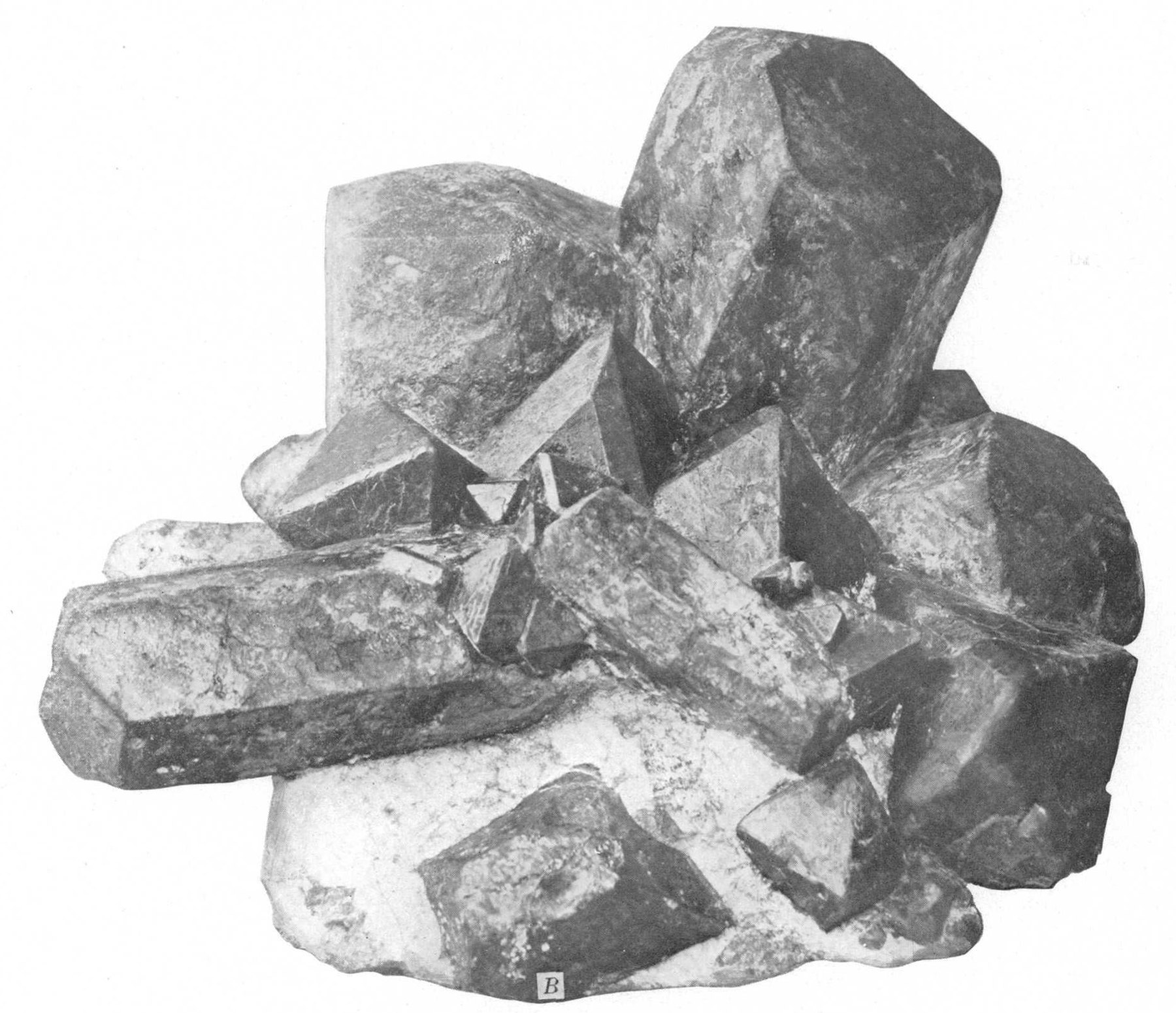
The name survived its chemistry. “The name ‘troostite’ continued to be used, however,” Palache wrote, “for the dark manganiferous varieties, especially the stout crystals from Sterling Hill that were supposed to have a different cleavage from that of willemite.” Carl Hintze’s German Handbuch der Mineralogie kept the two apart; Dana’s System of Mineralogy, in Palache’s words, “has quite properly merged the two,” and Palache himself treated tephrowillemite, a later name for brown manganese-bearing willemite, as one more synonym. At Sterling Hill, he wrote, the name had been given to the “reddish or flesh-colored” crystals isolated in the limestone or mixed with franklinite, prisms that reached ten inches in length and four or more in diameter.
Today troostite is not a mineral species but a variety name for manganese-bearing willemite, (Zn,Mn)2SiO4, and it is used above all for the stout, brown to reddish-brown crystals of Sterling Hill, often in pink calcite. Collectors still prize them, and The Picking Table has pictured them repeatedly, as in the caption to an equant hexagonal crystal of brownish-red willemite, 2.5 by 3 inches, from the Sterling Hill mine, called “a classic example of the manganoan variety of willemite known since 1832 as ‘troostite.’” Under shortwave ultraviolet light the manganese that darkens them also governs their glow (see Willemite, named for a king and Willemite leaves the mine).
Gerard Troost
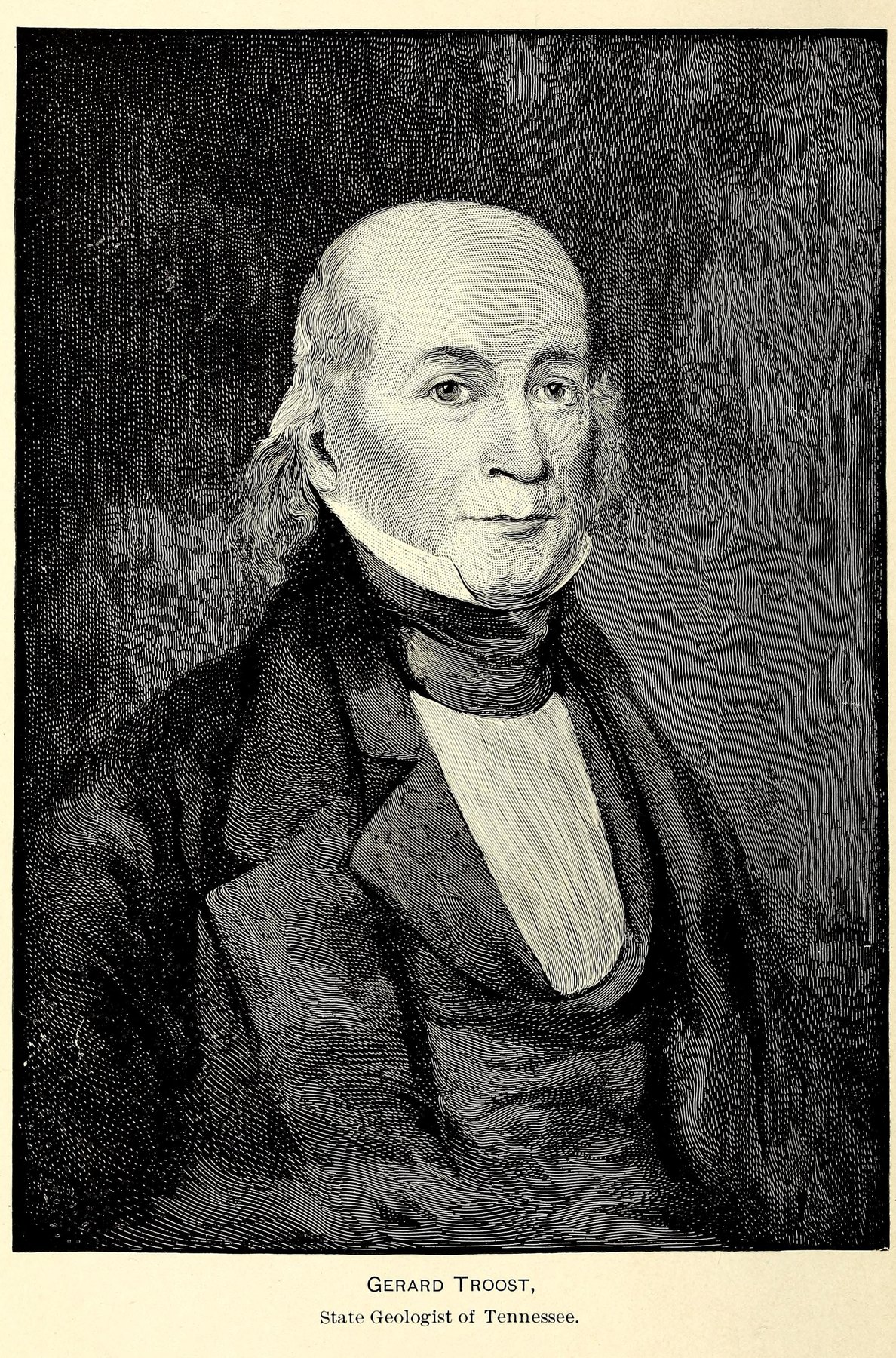
Gerard Troost was born at ’s-Hertogenbosch (Bois-le-Duc) in the Netherlands in March 1776; the sources disagree on the day, Glenn and Appletons’ Cyclopaedia giving the 15th and the Popular Science Monthly the 5th. He took a medical degree at Leiden and, in 1801, a master’s degree in pharmacy at Amsterdam, practiced as a pharmacist at Amsterdam and The Hague, and served in the Dutch army, first as a private and later as a medical officer, being wounded in the head and the thigh. Louis Bonaparte, the king Napoleon had set over Holland, sent him to Paris in 1807, where he became Haüy’s pupil, and on the king’s commission he traveled through France, Italy, Switzerland and Germany buying minerals for a royal cabinet. Glenn thought it likely that in Germany he also heard Abraham Gottlob Werner at Freiberg (see Werner’s nomenclature of colours). In Paris he translated Alexander von Humboldt’s Ansichten der Natur (Aspects of Nature) into Dutch.
About the end of 1809 the king named him to a scientific commission that was to sail with a naval expedition to Java. The British blockade kept the Dutch fleet in port, and Troost tried to reach the East Indies by way of the United States in an American ship; it was taken by a French privateer, and he was held at Dunkirk until his identity was established. Released, he was made a correspondent of the Paris Muséum d’histoire naturelle in March 1810 and sailed from La Rochelle for Philadelphia. In July 1810 Louis Bonaparte abdicated and Holland was annexed to France, and in 1811 Java fell to the British. Troost stayed in America (Glenn, p. 73–74). Appletons’ Cyclopaedia tells the capture differently: appointed by Louis Bonaparte “scientific attaché of a naval expedition to Java,” he “was captured by an English privateer, and, after confinement in Dunkirk, returned to Paris,” and only then “made his way on an American sailing vessel from La Rochelle to Philadelphia, hoping thence to reach Java.”
In Philadelphia he set up as a manufacturing chemist. He was one of the six men who met at John Speakman’s house on January 25, 1812, to found the society that became the Academy of Natural Sciences, and on May 7, 1812, he was elected its first president, an office he held until 1817 (Popular Science Monthly, p. 259–260). He started the first alum works in the United States, on the Magothy River in Maryland, lost money when it failed, and returned to Philadelphia, where in 1821 he became professor of mineralogy at the Philadelphia Museum and the first professor of chemistry at the Philadelphia College of Pharmacy. These were the years of his Franklin papers. The same years tie him to John Torrey, the New York chemist and botanist: a letter from Troost to Torrey dated May 28, 1824, survives among Torrey’s papers at the New York Botanical Garden and has been scanned.
In 1825 Troost went west with William Maclure, Thomas Say and Charles-Alexandre Lesueur to Robert Owen’s community at New Harmony, Indiana, the venture whose scientists New Harmony remembers by the keelboat that carried most of them, the “Boatload of Knowledge.” He soon tired of Owen’s social schemes, but from New Harmony he went with Lesueur to the lead and zinc mines of southeastern Missouri, where, Glenn says, he showed the miners that the “calamine” they had been throwing away was zinc ore. In 1827 he moved to Nashville with his family and his collections; on February 9, 1828, he was elected professor of geology and mineralogy in the University of Nashville, later of chemistry too, and held the chair until his death. On December 21, 1831, Tennessee appointed him its geologist, mineralogist and assayer, the first state geologist of Tennessee. His reports mapped the coal of the Cumberland Plateau and the iron ores of Middle and East Tennessee; the ninth, for 1847, dealt chiefly with zinc ores and the making of zinc and brass. Sources differ on when the office ended: Glenn gives February 4, 1850, when the legislature abolished it.
His last work was a monograph on the fossil crinoids (sea lilies) of Tennessee, describing more than a hundred species. Tennessee would not print it; he sent it to the Smithsonian Institution, which received it on July 18, 1850. He died in Nashville on August 14, 1850. The manuscript and specimens went to Louis Agassiz and then to James Hall, who kept them for more than forty years while describing several of Troost’s species under his own name; they came back to Washington only in 1898, and Elvira Wood published a revision in 1909, with the portrait shown here (Wood 1909, p. v–vi). The trustees of the University of Nashville recorded at his death that “he could not make an enemy—he had none” (Popular Science Monthly, p. 264).
The cabinet
Troost’s collection was famous in its day; Appletons’ Cyclopaedia called it “the finest in the possession of a single individual in the United States.” At his death, by Glenn’s count, it held 13,582 mineral specimens, 2,851 fossils, two to three thousand rocks, shells, and a large ethnological collection, including relics from Tennessee mounds; Appletons gives a rounder count, “about 15,000 specimens, as well as more than 5,000 geological specimens and various other articles.” Attempts to sell it to the University of Nashville, the city and the state all failed. “It was finally sold in 1874 to the trustees of the public library of Kentucky,” at Louisville, Glenn wrote, “after examination and recommendation by Dr. J. Lawrence Smith and Dr. Yandell. The $20,500 paid for it was raised by five lottery drawings.” In 1905 it was housed in the library building in Louisville, and Glenn understood that Smith, the Louisville chemist and meteorite collector, had later obtained the meteorites from it. Troost’s library, he added, had vanished; it was not bought by Louisville, and one story held that it was burned by Federal troops clearing the basement of the Tennessee capitol during the Civil War.
The minerals stayed in Louisville for well over a century, with the library’s museum and its successor, now the Kentucky Science Center. The Ohio River flood of 1937 reached them; specimens were lost, and labels were lost or mixed up. In 2024 the Indiana State Museum and Historic Sites announced that it had completed a years-long acquisition of the collection from the Kentucky Science Center, more than 6,500 pieces, to help interpret the New Harmony State Historic Site, and that Troost’s surviving catalogues would let staff re-identify specimens separated from their numbers. Cataloguing was expected to take several years more. Whether Franklin and Sterling specimens, perhaps some that Troost cleaved for his 1825 paper, are among them is not yet known.
In The Picking Table
Troost’s name runs all through the Franklin literature as the “troostite” on specimen labels, but he has had no article of his own in the Society’s journal. A search of every issue of The Picking Table available online finds him only as the author of two papers listed in a bibliography printed in vol. 13, no. 1, and troostite only in mineral lists, specimen notes and captions. This page is the first account of the man behind the name.
Sources and further reading
- Academy of Natural Sciences of Philadelphia, 1817, Introduction. Journal of the Academy of Natural Sciences of Philadelphia, vol. 1, no. 1 (May 1817), p. 1–2. archive.org
- Anonymous, 1894, Sketch of Gerard Troost. Popular Science Monthly, vol. 45, p. 258–264. archive.org
- Dana, J. D., 1850, On some minerals recently investigated by M. Hermann. American Journal of Science, 2nd series, vol. 9, p. 408–412. Willemite, p. 408–410. archive.org
- Glenn, L. C., 1905, Gerard Troost. American Geologist, vol. 35, p. 72–94. archive.org
- Haüy, R.-J., 1801, Traité de minéralogie, vol. 1. Paris: Louis. The Defrance crystal, p. 23–24; decrements on the edges, p. 35–37. Vol. 5 (atlas), pl. II. archive.org
- Haüy, R.-J., 1822, Traité de minéralogie, 2nd ed., vol. 4. Paris: Bachelier. Zinc oxidé silicifère and the New Jersey appendix, p. 175–180. archive.org
- Indiana State Museum and Historic Sites, 2024, The Troost collection (June 26, 2024). indianamuseum.org
- Kunz, G. F., 1918, The life and work of Haüy. American Mineralogist, vol. 3, no. 6. Quoted from p. 65; portrait, plate 7. archive.org
- Palache, C., 1935, The minerals of Franklin and Sterling Hill, Sussex County, New Jersey. U.S. Geological Survey Professional Paper 180. Bibliography, p. 3–4; history, p. 15; jeffersonite, p. 64; willemite and troostite, p. 87–88 and plate 13. PDF (USGS)
- Ruschenberger, W. S. W., 1852, A notice of the origin, progress, and present condition of the Academy of Natural Sciences of Philadelphia. Philadelphia: T. K. and P. G. Collins. Quoted from p. 47–64. archive.org
- Shepard, C. U., 1832, Treatise on mineralogy [first part]. New Haven: Hezekiah Howe. Preface, p. ix. archive.org
- Shepard, C. U., 1835, Treatise on mineralogy, second part. New Haven: Hezekiah Howe. Troostite, p. 247–249. archive.org
- Thomson, T., 1828, Chemical examination of some minerals, chiefly from America, with notes by John Torrey. Annals of the Lyceum of Natural History of New-York, vol. 3, p. 9–86. Ferruginous silicate of manganese, p. 30–32. archive.org
- Troost, G., 1823, Account of the pyroxene of the United States, and descriptions of some new varieties of its crystalline forms. Journal of the Academy of Natural Sciences of Philadelphia, vol. 3, p. 105–124. archive.org
- Troost, G., 1823, Notice of the yenite of Rhode Island, and several other American minerals. Journal of the Academy of Natural Sciences of Philadelphia, vol. 3, p. 222–224. archive.org
- Troost, G., 1824, letter to John Torrey, May 28, 1824. John Torrey Papers, LuEsther T. Mertz Library, New York Botanical Garden. archive.org
- Troost, G., 1825, Observations on the zinc ores of Franklin and Sterling, Sussex County, New Jersey. Journal of the Academy of Natural Sciences of Philadelphia, vol. 4, p. 220–231 (read September 7, 1824). archive.org
- Vanuxem, L., and Keating, W. H., 1822, Account of the jeffersonite, a new mineral discovered at the Franklin Iron Works, near Sparta in New-Jersey. Journal of the Academy of Natural Sciences of Philadelphia, vol. 2, p. 194 ff. (read June 4, 1822). archive.org
- Vanuxem, L., and Keating, W. H., 1822, On the geology and mineralogy of Franklin, in Sussex County, New Jersey. Journal of the Academy of Natural Sciences of Philadelphia, vol. 2, p. 277 ff. (read August 6, 1822). archive.org
- Vanuxem, L., and Keating, W. H., 1824, Observations upon some of the minerals discovered at Franklin, Sussex County, New Jersey. Journal of the Academy of Natural Sciences of Philadelphia, vol. 4, p. 3–11 (read June 1, 1824). archive.org
- Willemite, the chameleon of minerals (photographs by Gary Grenier). The Picking Table, vol. 40, combined issue (1999), p. 42, fig. 8. The Picking Table (PDF)
- Wilson, J. G., and Fiske, J., eds., 1887, Appletons’ cyclopaedia of American biography, vol. 3. New York: D. Appleton. Keating, William Hypolitus, p. 498. archive.org
- Wilson, J. G., and Fiske, J., eds., 1889, Appletons’ cyclopaedia of American biography, vol. 6. New York: D. Appleton. Troost, Gerard, p. 162. archive.org
- Wilson, J. G., and Fiske, J., eds., 1889, Appletons’ cyclopaedia of American biography, vol. 6. New York: D. Appleton. Vanuxem, Lardner, p. 256. archive.org
- Wood, E., 1909, A critical summary of Troost’s unpublished manuscript on the crinoids of Tennessee. U.S. National Museum Bulletin 64. archive.org
- Wurtz, H., 1851, On the troostite of New Jersey. Proceedings of the American Association for the Advancement of Science, 4th meeting (New Haven, 1850), p. 146–147. archive.org
As far as we can find, this life has not been written up in The Picking Table. Written with Claude, an AI model made by Anthropic, from the sources listed above, and checked against them. October 2026.