Histories › The people behind the minerals
A bluish-white Sterling Hill sulfate, first called delta-mooreite, was renamed in 1949 for John Torrey, the New York botanist and chemist who wrote on Franklin minerals in 1822 and sent them abroad for analysis.
Delta-mooreite
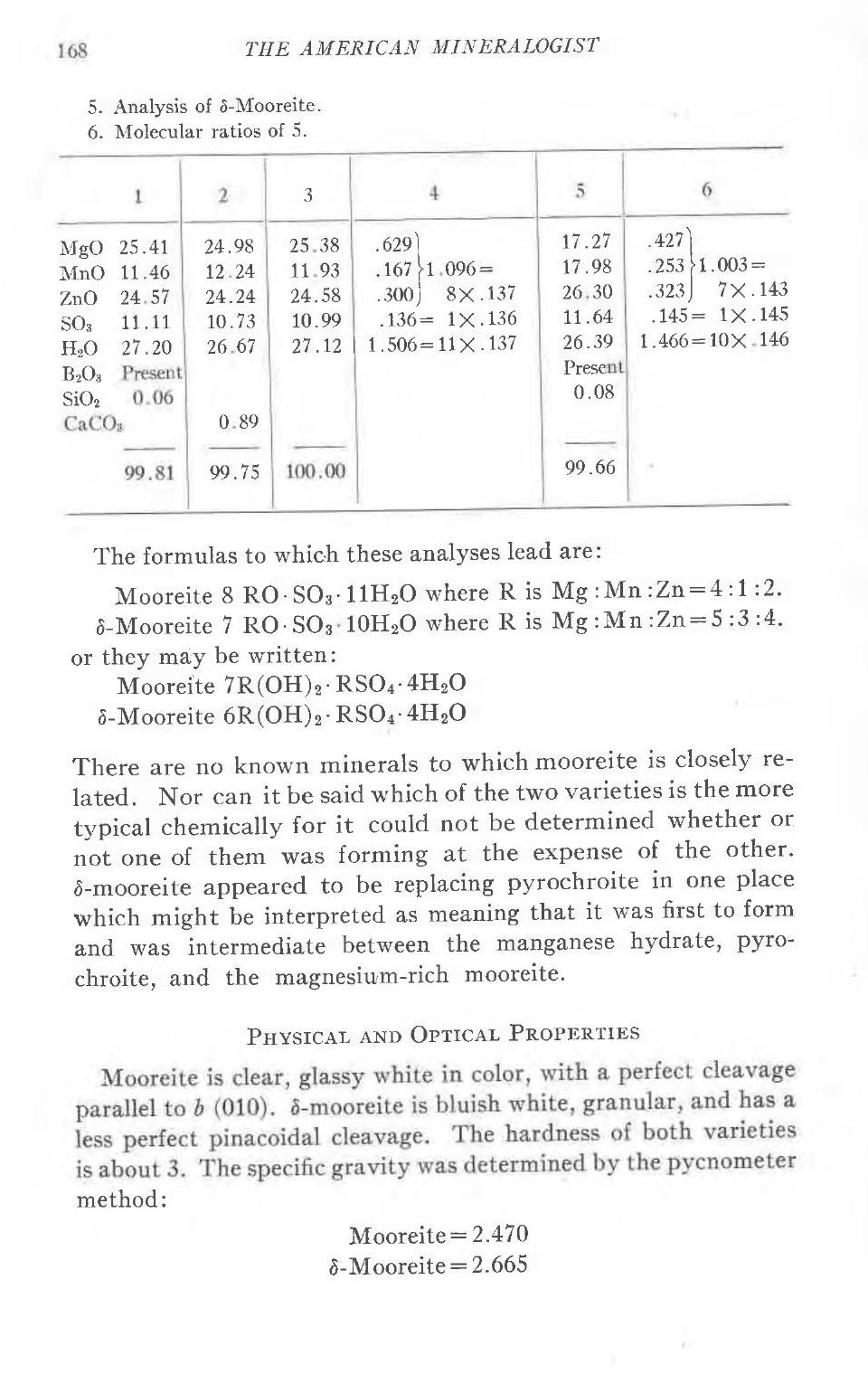
Torreyite began life under another mineral’s name. In May 1929 L. H. Bauer, chemist of the New Jersey Zinc Company at Franklin, and Harry Berman of Harvard described a vein in the ordinary calcite-franklinite-willemite ore of the Sterling Hill mine at Ogdensburg, where pyrochroite, a manganese hydroxide, had been altered and was lined with new minerals. The glassy white tabular crystals in its cavities they named mooreite, for Gideon Moore (see Gideon Moore, the chemist who could not hear). Beside them, they wrote, “a closely related bluish-white mineral filling some of the crevices in the pyrochroite is termed here δ-mooreite.”
Bauer analyzed both. As analyzed, each is a basic, hydrous sulfate of magnesium, manganese and zinc; his figures for δ-mooreite were 17.27 per cent magnesia (MgO), 17.98 manganese oxide (MnO), 26.30 zinc oxide (ZnO), 11.64 sulfur trioxide (SO3) and 26.39 water, with boron present but not measured. No crystals of it were found. It was, the authors noted, “bluish white, granular, and has a less perfect pinacoidal cleavage,” and heavier than mooreite. They could not say which of the two was the more typical, and treated them as two varieties of one mineral.
A new name in 1949
Twenty years later Joan Prewitt-Hopkins of Radcliffe College took X-ray powder photographs of both, from Bauer’s type specimens, in the same short paper in which she studied holdenite (see Albert Holden and the specimen that waited). The patterns did not match. “Thus,” she wrote, “the two minerals are structurally unlike and are distinct species.” She proposed the name torreyite “to replace the name delta-mooreite,” and gave her reason: “Naming the mineral for him seems appropriate as he was one of the earliest workers at Franklin, publishing a paper on franklinite, willemite, and rhodonite in 1822.” She also found, under the polarizing microscope, fine repeated (polysynthetic) twinning that Berman had not reported.
Her account of Torrey rests on two sources she names in a footnote: the 1929 Encyclopaedia Britannica and the memoir of him that Asa Gray printed in 1873. The 1822 paper she cites is real, and it is about Franklin, but it does not quite say what she says it does (see below).
Torreyite since
In 1979 Pete J. Dunn, Donald R. Peacor and B. Darko Sturman described lawsonbauerite, a new Sterling Hill mineral brought to light by the miner John Kolic, and named it for Lawson H. Bauer (1889–1954), “describer of torreyite.” It proved to be the manganese-rich counterpart of torreyite, with the same structure. The same paper gave new X-ray data from the torreyite type specimen at Harvard (no. 113732), confirmed Bauer’s water content, and confirmed torreyite as a valid species. When A. H. Treiman and Peacor solved the structure of lawsonbauerite in 1982, the formula of torreyite was revised with it, to (Mg,Mn)9Zn4(SO4)2(OH)22·8H2O, the formula the Handbook of Mineralogy still gives; the International Mineralogical Association’s list writes the ideal formula without manganese, Mg9Zn4(SO4)2(OH)22·8H2O (IMA list, 2026). The Handbook of Mineralogy lists it as very rare and known only from Sterling Hill, in veinlets cutting the ore, with mooreite, fluoborite, pyrochroite, sussexite, rhodochrosite and zincite.
Of the mineral’s short notices in The Picking Table (listed below), two say most about it. In 1974 John L. Baum wrote that torreyite “is rare, but is probably more abundant than the collector realizes because it does not attract attention to itself by occurring in coarse crystals, or being glass clear, or of an attractive color,” and told collectors to look for milky blue-white, dull patches in pyrochroite specimens. In 1976 Frank Z. Edwards, in his series on the minerals found after Palache, reviewed it again, quoting Prewitt-Hopkins on the name and warning that sky-blue crystals from the 2,350-foot level, found in 1964 and claimed as torreyite, had darkened by the next summer and a year after that were black pyrochroite. Neither notice tells Torrey’s story.
John Torrey
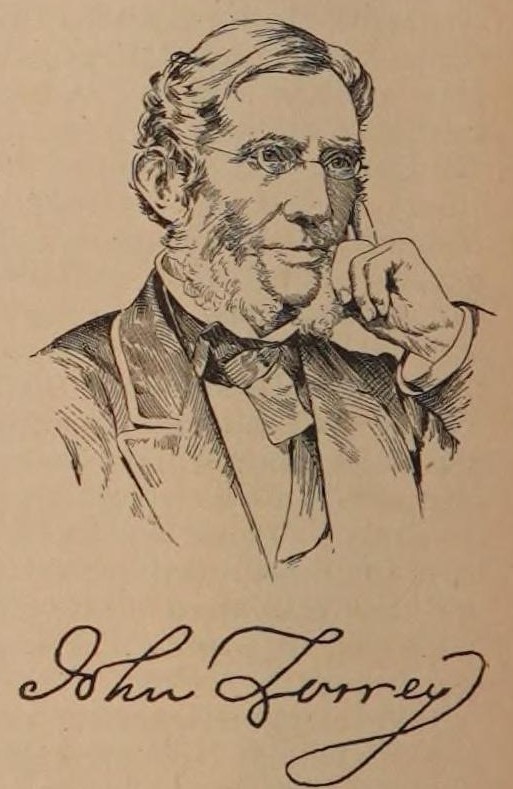
John Torrey was born in New York on 15 August 1796 and died there on 10 March 1873. When he died, Asa Gray wrote in his memoir, “He has long been the chief of American botanists.” As a boy he met Amos Eaton, the naturalist and teacher, who “taught young Torrey the structure of flowers and the rudiments of botany,” and the interest spread to mineralogy and chemistry. He took his medical degree at the College of Physicians and Surgeons in New York in 1818 and practiced for a few years with what Gray called “moderate success.” He was one of the founders of the Lyceum of Natural History of New York, and his earliest papers in the American Journal of Science, two of them in its first volume, were on minerals.
His living came from chemistry. From 1824 he taught chemistry, mineralogy and geology at the U.S. Military Academy at West Point; from 1827 he was professor of chemistry and botany at the College of Physicians and Surgeons, and from 1830 to 1854 professor of chemistry at Princeton as well (Appletons’ Cyclopaedia). His botany was done, Gray said, “in the intervals of a busy professional life.” It was large all the same: a flora of the northern states (1824), the botany of the western surveys from Long’s expedition onward, a two-volume flora of New York State (1843), and, with Gray as his junior partner, the Flora of North America, published in parts from 1838 to 1843 and never finished. His herbarium went to Columbia College.
The assayer, and his mountain
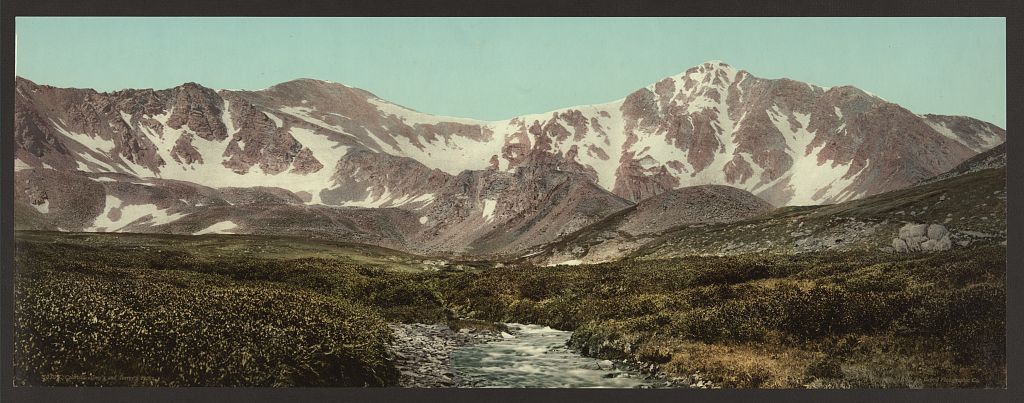
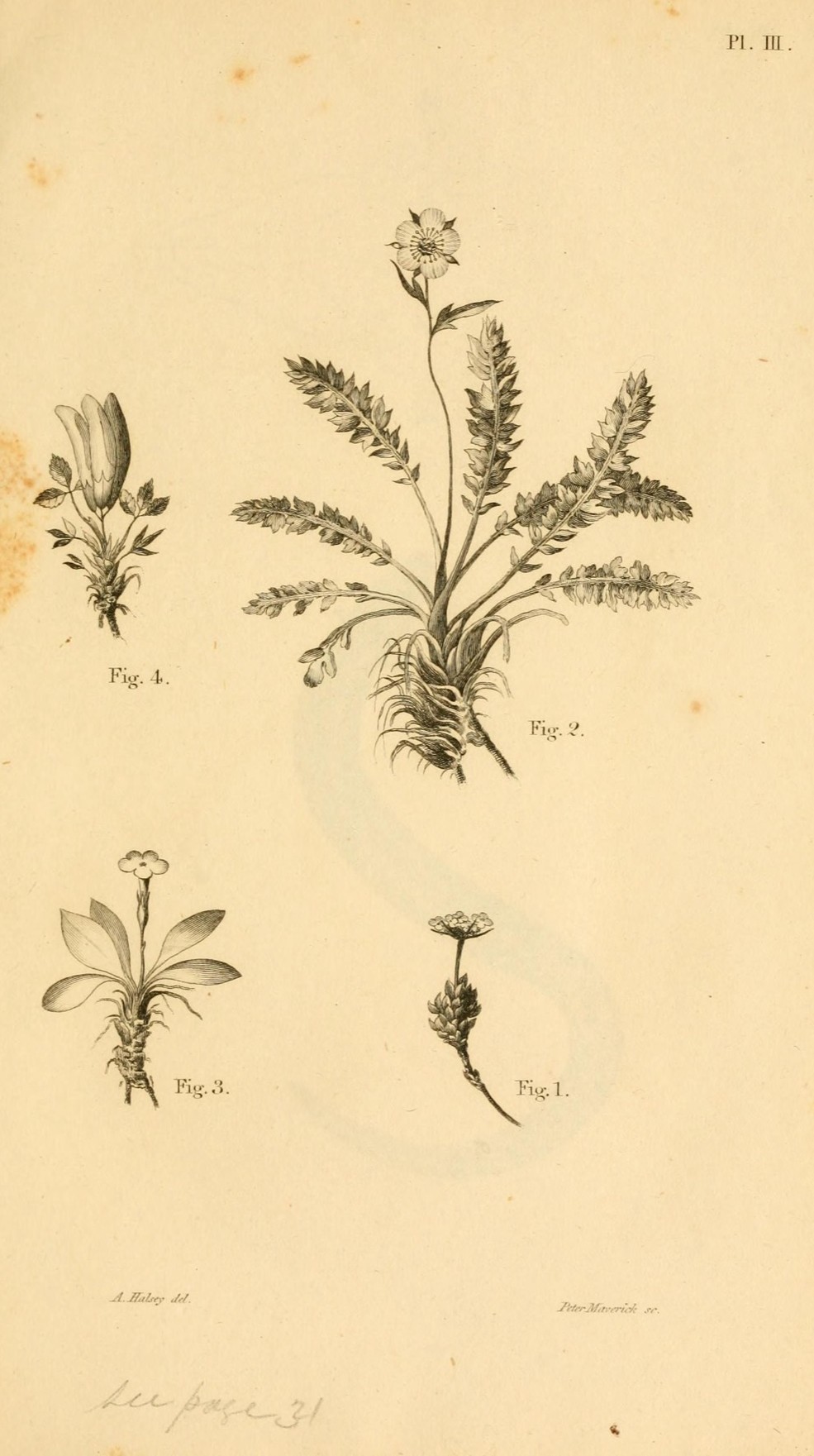
When the federal Assay Office opened in New York, Torrey became its assayer; Appletons gives the year as 1853, Gray as 1857, when he gave up part of his teaching for it. Gray adds in a footnote that the Secretary of the Treasury offered him the better-paid post of superintendent and that he refused it, “simply because he was unwilling to accept the care and responsibility of treasure.” He signed his daily reports to the end, and his son succeeded him. The Treasury also sent him on confidential errands, including problems of counterfeiting, and on two of these trips west he saw growing many plants he had named from dried specimens, among them, in 1872, the alpine plants on the Colorado peak that a former pupil had named for him. Gray wrote that he “gathered charming alpine plants which he had himself named forty years before, when the botany of the Colorado Rocky Mountains was first opened.” Those first names came from the dried plants that Edwin James, botanist to Major Long’s expedition, brought down from the summit of the Rocky Mountains in July 1820. Torrey began describing them in 1823, among them the little alpine primrose he called Primula angustifolia, still its name today. Gray does not say which plants Torrey picked on the mountain in 1872.
Torrey at Franklin
In 1822 Torrey published two things that touch the zinc ores of Sussex County. The first was the analysis of a heavy green stone found built into the wall of the old furnace at Ancram, New York, which he made out to be nearly pure oxide of zinc and called “green oxyd of zinc.” He compared it at once with the ore from New Jersey: “The red oxyd of zinc of New-Jersey, discovered by Bruce,” that is, zincite (ZnO), was always, he wrote, “intimately mixed with more than half its weight of Franklinite, from which it is impossible to separate it by mechanical means.” Later in the same volume he noted that most specimens of the Ancram mineral “have evidently undergone the action of fire, so that some have supposed it to be an artificial substance,” though he thought one specimen at Columbia College proved it native.
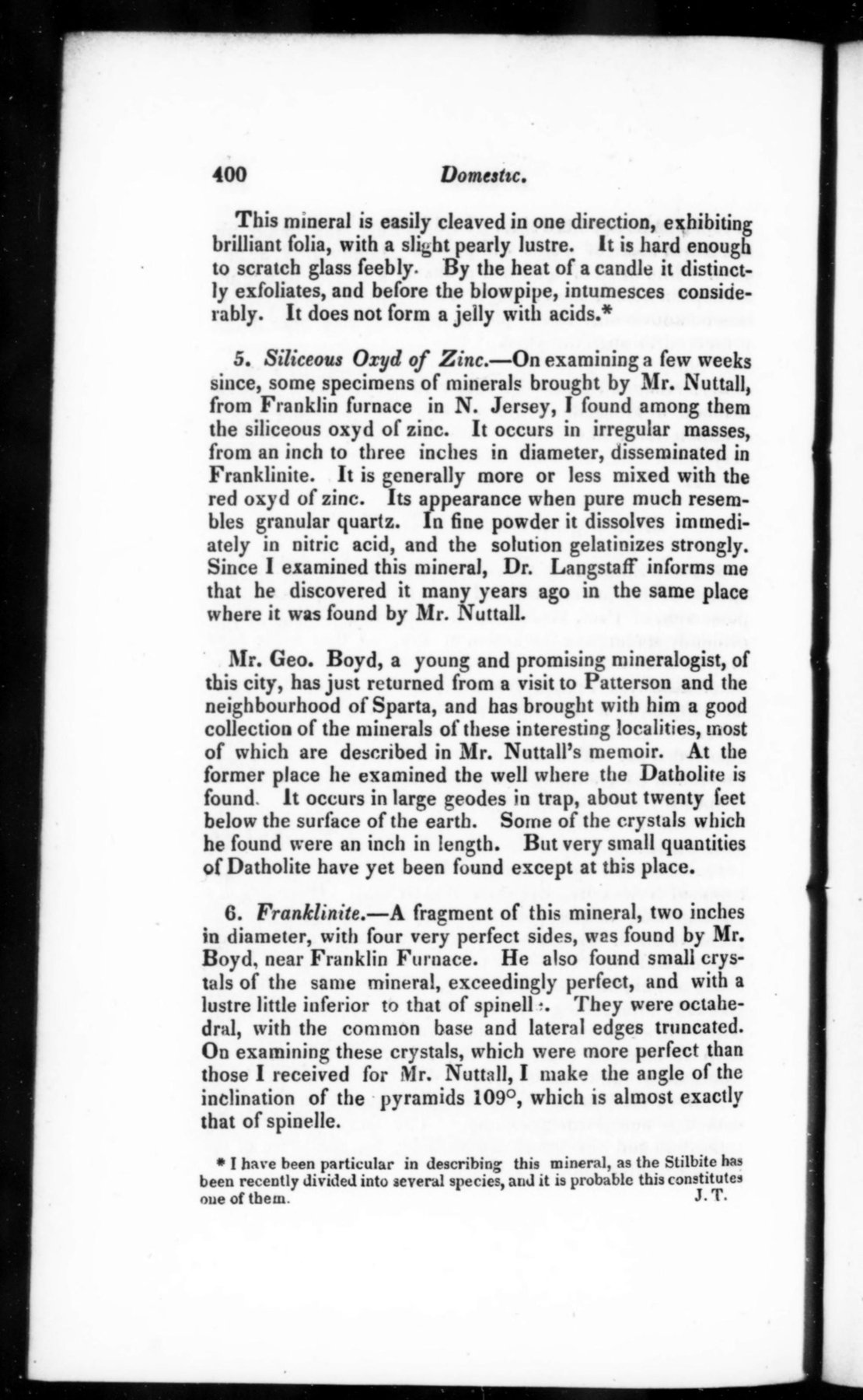
The second was a page of “Mineralogical Notices” in the same volume. Under “Siliceous Oxyd of Zinc” he wrote: “On examining a few weeks since, some specimens of minerals brought by Mr. Nuttall, from Franklin furnace in N. Jersey, I found among them the siliceous oxyd of zinc.” It lay in masses an inch to three inches across in franklinite, mixed with the red oxide, and in powder it dissolved in nitric acid and “the solution gelatinizes strongly.” Palache identified this as willemite (Zn2SiO4), though the mineral was not properly described until Vanuxem and Keating’s paper of 1824, and not recognized as the same as the willemite of Belgium, named in 1830, until later still. Under “Franklinite,” Torrey described octahedral crystals collected near Franklin Furnace by George Boyd and measured them: “I make the angle of the inclination of the pyramids 109°, which is almost exactly that of spinelle.” Franklinite, a zinc-manganese-iron oxide, is in fact a member of the spinel group.
That is the paper Prewitt-Hopkins meant. It has franklinite and, by Palache’s reading, willemite; it does not have rhodonite. The “manganesian feldspar” that Palache’s bibliography places in it turns up instead in a later paper, described next.
Specimens for Glasgow
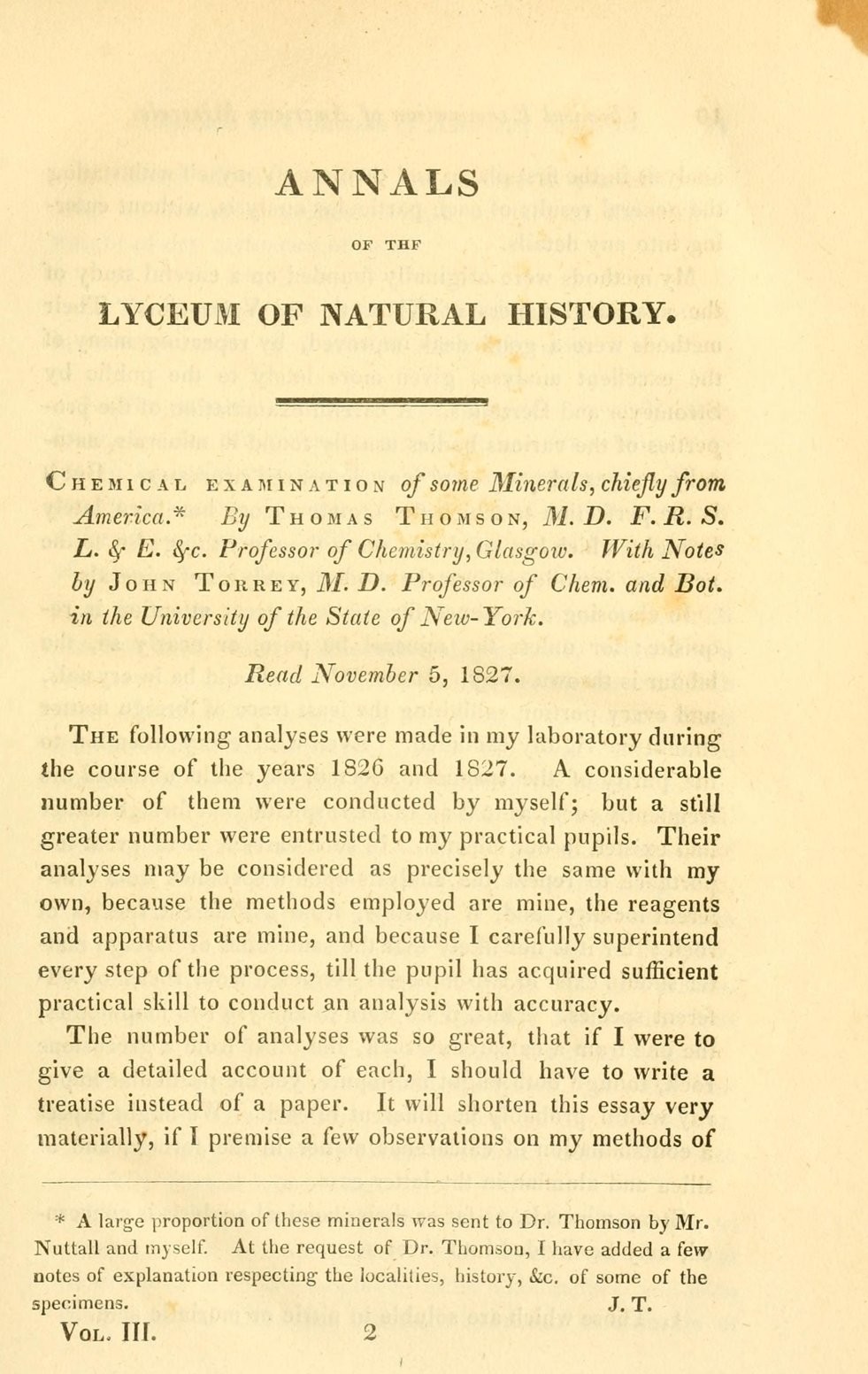
Charles Palache, writing the history of the district in 1935, named Torrey among the scientists who came to the Fowlers’ house at Franklin between 1820 and 1844, and singled out two: “Nuttall and Torrey, especially, were deeply interested, visited the area frequently, and sent many specimens abroad, which were studied by European mineralogists and added much to our knowledge of the minerals” (Professional Paper 180, p. 15). The chief place this can be seen is a long paper by Thomas Thomson, professor of chemistry at Glasgow, read to the New York Lyceum in November 1827. In a footnote Torrey explained that “a large proportion of these minerals was sent to Dr. Thomson by Mr. Nuttall and myself,” and that at Thomson’s request he had added notes on their localities and history.
Several were from Franklin. Thomson wrote that he had a light brownish-red mineral “from Dr. Torrey, under the name of rhomboidal silicate of zinc. It was found at Franklin, in New-Jersey.” Thomson found no zinc in it and called it silicate of manganese; this was the first analysis of what is now tephroite (Mn2SiO4). Torrey’s note added: “This mineral is not scarce at Franklin. It is generally associated with the red zinc ore and massive Franklinite.” Next came a mineral Torrey had sent as “Manganesian feldspar,” which Thomson named ferro-silicate of manganese; Palache identified it as rhodonite, which he and his contemporaries wrote as MnSiO3; since 2019 the International Mineralogical Association’s list gives rhodonite as CaMn3Mn(Si5O15), with calcium essential to it (IMA list, 2026). A third Franklin specimen, received from Torrey “under the name of silicate of zinc,” Thomson reported as a ferruginous silicate of manganese. Not every result was sound: Palache judged that Thomson’s analysis of willemite “made it out to be a silicate of manganese, and his reputation as a chemist served to fix the blunder on the discoverers” (p. 87).
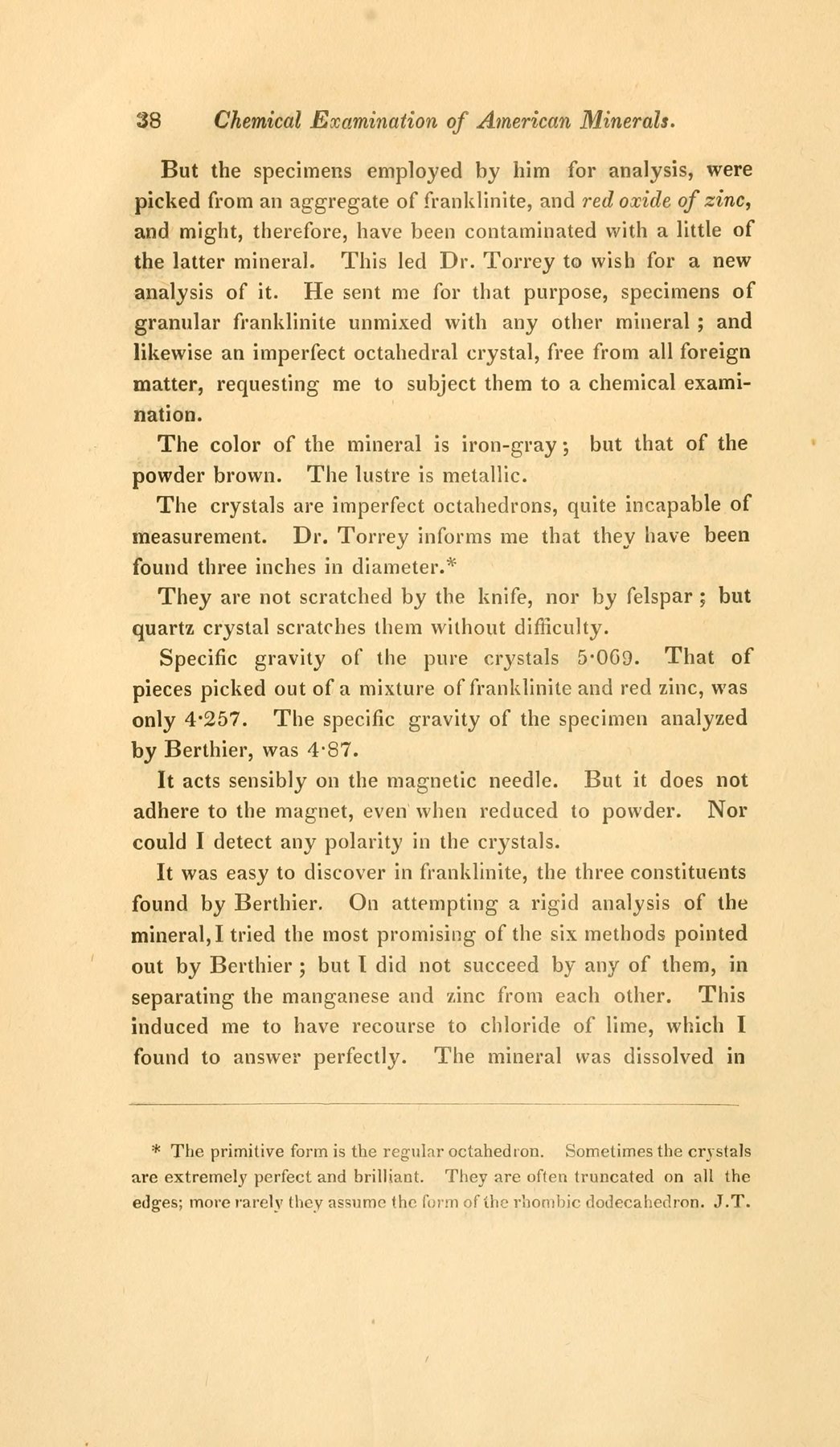
Franklinite went better. Berthier’s analysis had been made on grains picked from a mixture with zincite, and, Thomson wrote, “this led Dr. Torrey to wish for a new analysis of it. He sent me for that purpose, specimens of granular franklinite unmixed with any other mineral.” Thomson’s result, about 66 per cent iron oxide, 15 manganese oxide and 17 zinc oxide, “agrees very nearly with that of Berthier, and serves to confirm it.” Torrey’s footnote on the crystals reads: “Sometimes the crystals are extremely perfect and brilliant.”
So Prewitt-Hopkins was right in substance. Torrey was among the first to write about the Franklin minerals, and he supplied the specimens behind the first analyses of tephroite and rhodonite and a confirming analysis of franklinite. Her date and her list are slightly off: franklinite and willemite are in his notice of 1822; rhodonite is in his notes of 1828. Beyond these papers and Palache’s general account of his visits, no record of any dealing between Torrey and Samuel Fowler or the zinc companies has been found for this page.
Torreya
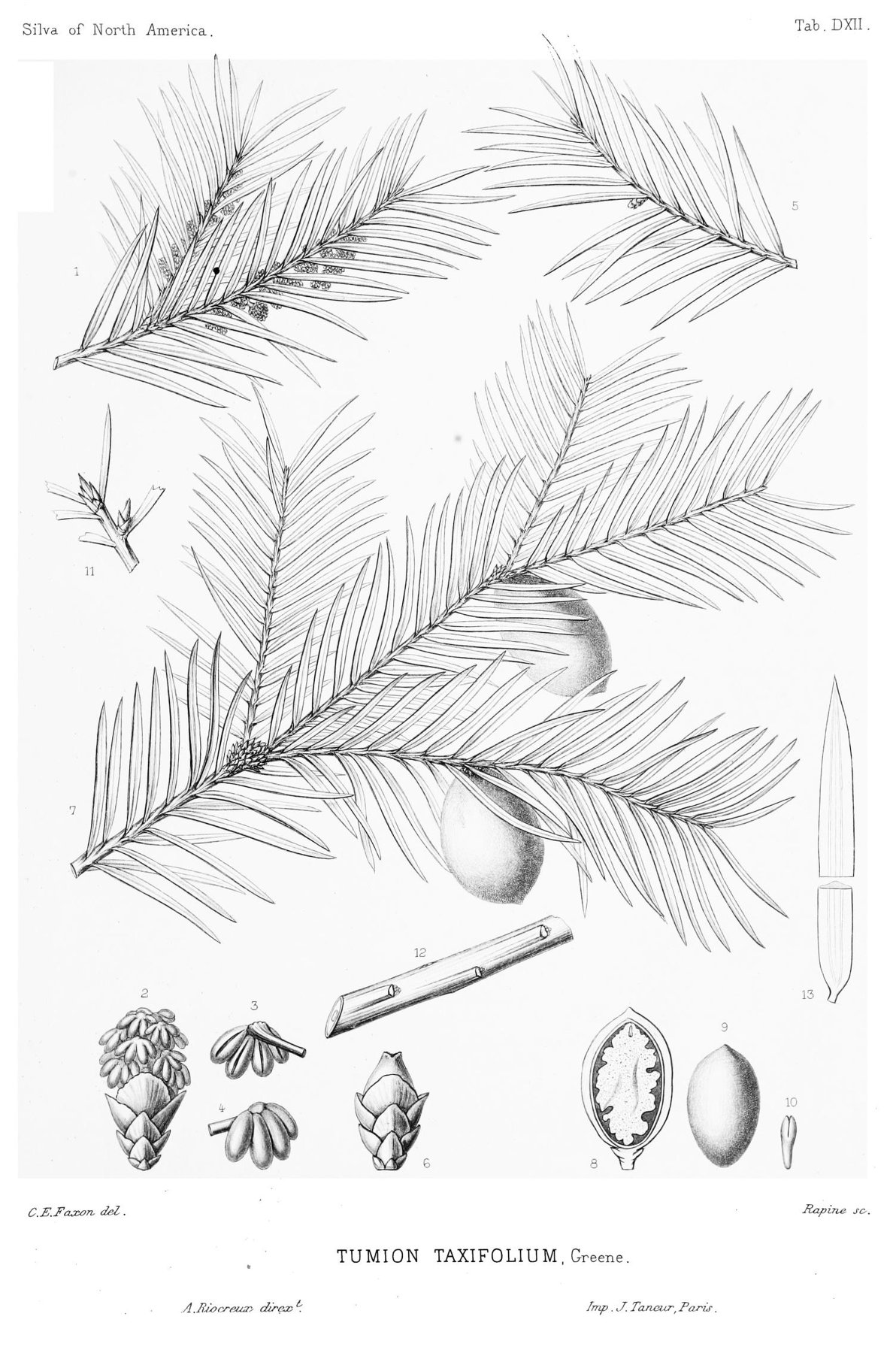
Botanists honored him first, and Gray told the story with some satisfaction. A genus named for Torrey by Sprengel turned out to be a plant already known, and one proposed by Rafinesque did not stand. So “the ground was clear,” Gray wrote, when a new evergreen tree was found in the South. H. B. Croom found it in 1833 on the bluffs of the Apalachicola River in Florida, and Arnott named it Torreya taxifolia in 1838 (Sargent, who used the rival name Tumion, gives both). By 1873 there were four species, in Florida, California, Japan and China, and Gray hoped they would “keep our associate’s memory as green as their own perpetual verdure.”
The mineral came seventy-six years after his death. It honors one of the first men of science to look closely at the Franklin ores, measure their crystals and send them away to be analyzed, a generation before the zinc deposits were worked with success, which Palache dates to 1850.
In The Picking Table
Torreyite has had a run of short notices in The Picking Table. A survey of the minerals found at Sterling Hill in 1962–65 (vol. 7, no. 2, August 1966) reports no substantiated finds, only specimens of pyrochroite so labeled; a 1968 review of the minerals then known only from Franklin and Sterling Hill (vol. 9, no. 1) records the renaming of delta-mooreite and keeps torreyite on that list. John L. Baum’s “Torreyite” (vol. 15, no. 2, August 1974) and Frank Z. Edwards’s review (vol. 17, no. 2, September 1976) are described above. The journal announced lawsonbauerite, “the manganese analog of torreyite,” in vol. 20, no. 2 (1979), abstracted the paper by Dunn, Peacor and Sturman that described it and gave new data for torreyite (vol. 21, no. 1, March 1980), and abstracted Treiman and Peacor’s structure, with the revised formula of torreyite (vol. 25, no. 1, Spring 1984). John Torrey himself appears only in passing, in bibliographies and in Allen W. Pinger’s review of the district’s history (vol. 14, no. 2, August 1973), which credits him with first reporting the “siliceous oxide of zinc” (the year is misprinted there as 1882); no article on his life has appeared in the journal.
Sources and further reading
- Anthony, J. W., Bideaux, R. A., Bladh, K. W., and Nichols, M. C., eds., Handbook of Mineralogy: Torreyite. Mineralogical Society of America. PDF
- Bauer, L. H., and Berman, H., 1929, Mooreite, a new mineral, and fluoborite from Sterling Hill, New Jersey. American Mineralogist, vol. 14, p. 165–172. δ-mooreite, p. 165, 167–168. PDF
- Baum, J. L., 1974, Torreyite. The Picking Table, vol. 15, no. 2, p. 13–14. The Picking Table (PDF)
- Dunn, P. J., Peacor, D. R., and Sturman, B. D., 1979, Lawsonbauerite, a new mineral from the Sterling Hill mine, New Jersey, and new data for torreyite. American Mineralogist, vol. 64, p. 949–952. PDF
- Edwards, F. Z., 1976, The post Palache minerals: torreyite. The Picking Table, vol. 17, no. 2, p. 9–10. The Picking Table (PDF)
- Gray, A., 1873, John Torrey: a biographical notice. American Journal of Science, 3rd series, vol. 5, p. 411–421. archive.org
- Palache, C., 1935, The minerals of Franklin and Sterling Hill, Sussex County, New Jersey. U.S. Geological Survey Professional Paper 180. Bibliography, p. 3; history, p. 15; willemite, p. 87. PDF (USGS)
- Prewitt-Hopkins, J., 1949, X-ray study of holdenite, mooreite, and torreyite. American Mineralogist, vol. 34, p. 589–595. Torreyite, p. 593–595. PDF
- Sargent, C. S., 1896, The silva of North America, vol. 10. Boston: Houghton, Mifflin. Tumion taxifolium, p. 57–58 and plate DXII. archive.org
- Thomson, T., 1828, Chemical examination of some minerals, chiefly from America, with notes by John Torrey. Annals of the Lyceum of Natural History of New-York, vol. 3, p. 9–86. Franklin minerals, p. 26–30, 37–40. archive.org
- Torrey, J., 1822, Description and analysis of a new ore of zinc. American Journal of Science, 1st series, vol. 5, p. 235–238 (from the New-York Medical and Physical Journal). archive.org
- Torrey, J., 1822, Mineralogical notices. American Journal of Science, 1st series, vol. 5, p. 399–402. Siliceous oxyd of zinc and franklinite, p. 400. archive.org
- Treiman, A. H., and Peacor, D. R., 1982, The crystal structure of lawsonbauerite, (Mn,Mg)9Zn4(SO4)2(OH)22·8H2O, and its relation to mooreite. American Mineralogist, vol. 67, p. 1029–1034. PDF
- Wilson, J. G., and Fiske, J., eds., 1889, Appletons’ cyclopaedia of American biography, vol. 6. New York: D. Appleton. Torrey, John, p. 138–139. archive.org
As far as we can find, this life has not been written up in The Picking Table. Written with Claude, an AI model made by Anthropic, from the sources listed above, and checked against them. October 2026.