Histories › A map written in minerals
Five minerals carry the names of the mines and towns themselves, from franklinite, named in Paris in 1819, to four species described between 1981 and 1992, three of which have since been reported from Wales, Japan, Mexico and Germany; one of the four, franklinphilite, was discredited in 2026.
Five names from one valley
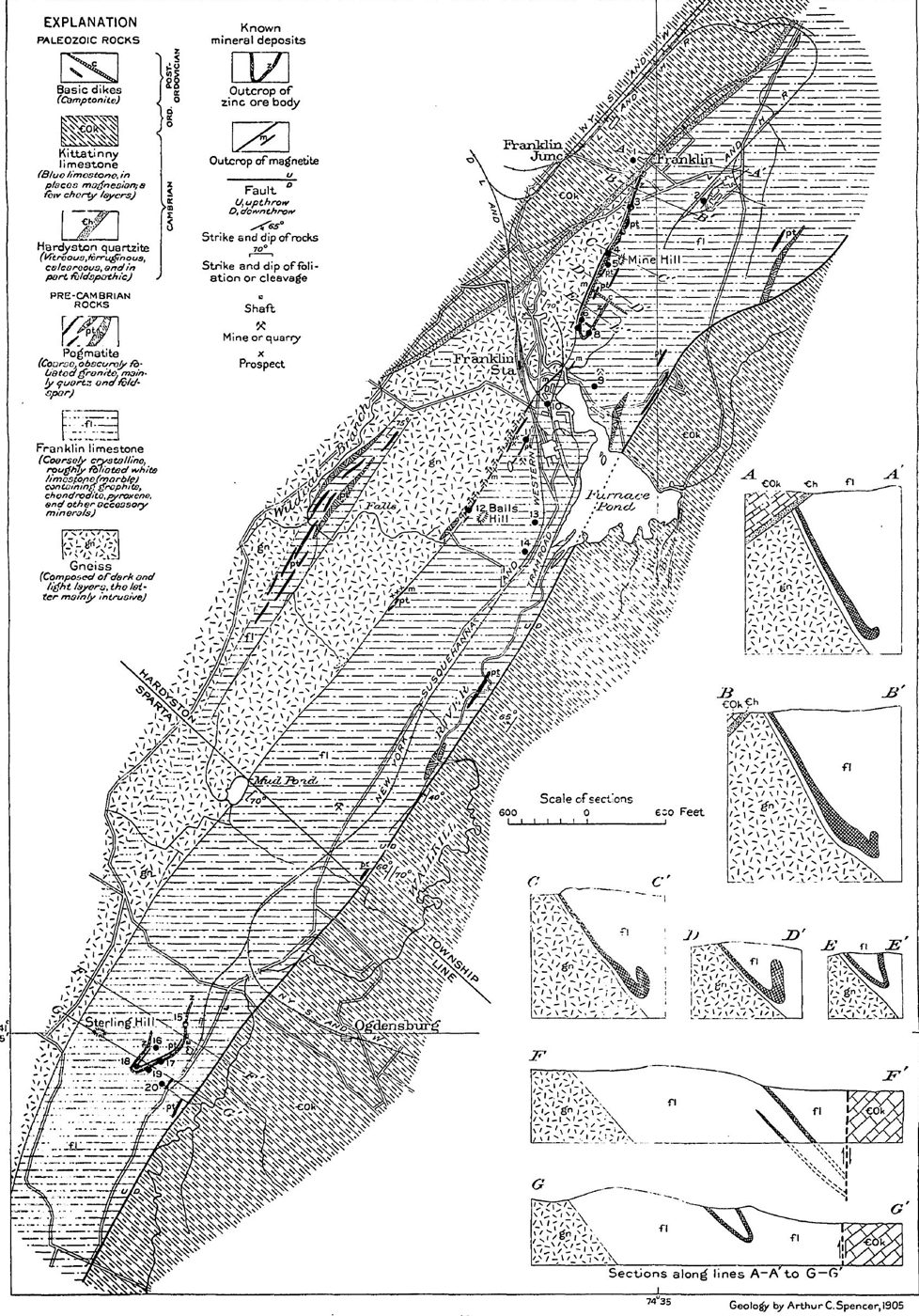
Two zinc mines in the valley of the Wallkill have given their own names to five minerals. The northern mine stood at Franklin, a village long known as Franklin Furnace, which became a borough, carved out of Hardyston Township, in 1913. The southern mine was Sterling Hill, at Ogdensburg, a borough set off from Sparta Township in 1914 and named for an early settler, Robert Ogden. The map above, drawn for the U.S. Geological Survey, shows the whole district: the outcrop of the Franklin ore at Mine Hill, Furnace Pond, and the hook-shaped ore body of Sterling Hill beside Ogdensburg.
The five names span almost two centuries. Franklinite was named in Paris in 1819 by a French chemist who never saw New Jersey. The other four, franklinfurnaceite, franklinphilite, sterlinghillite and ogdensburgite, were described between 1981 and 1992, all with Pete J. Dunn of the Smithsonian Institution as an author, one of them from a single specimen that held only a few milligrams of the new mineral. Their first announcements and abstracts were printed for collectors in The Picking Table, the journal of the Franklin-Ogdensburg Mineralogical Society (FOMS), and those articles are linked below.
Unlike the ridge, river, lake and people named on the sister pages of this group (Kittatinny and the Wallkill, Wawayanda, the Lenape and Mine Hill), which reach into New York and Pennsylvania, these five names stay inside Sussex County. Four of the minerals do not: franklinite has been found on four continents, franklinphilite in Wales, sterlinghillite in Japan, and ogdensburgite in Mexico and Germany. One of them, franklinphilite, has since lost its standing as a species (see below).
Franklinite, 1819: the black ore named in Paris
For most of the eighteenth century the heavy black mineral of the Franklin ore was taken for magnetite, and the attempts to smelt it as iron failed; an iron furnace built at Franklin about 1770 had fallen into ruin by 1820. Archibald Bruce of New York described the red zinc oxide of the deposit, the mineral now called zincite, but he too took the black grains beside it for magnetite. Charles Palache, in his history of the district, records what followed: the geologist William Maclure sent specimens abroad, and some reached Pierre Berthier, an engineer of the French Corps royal des Mines.
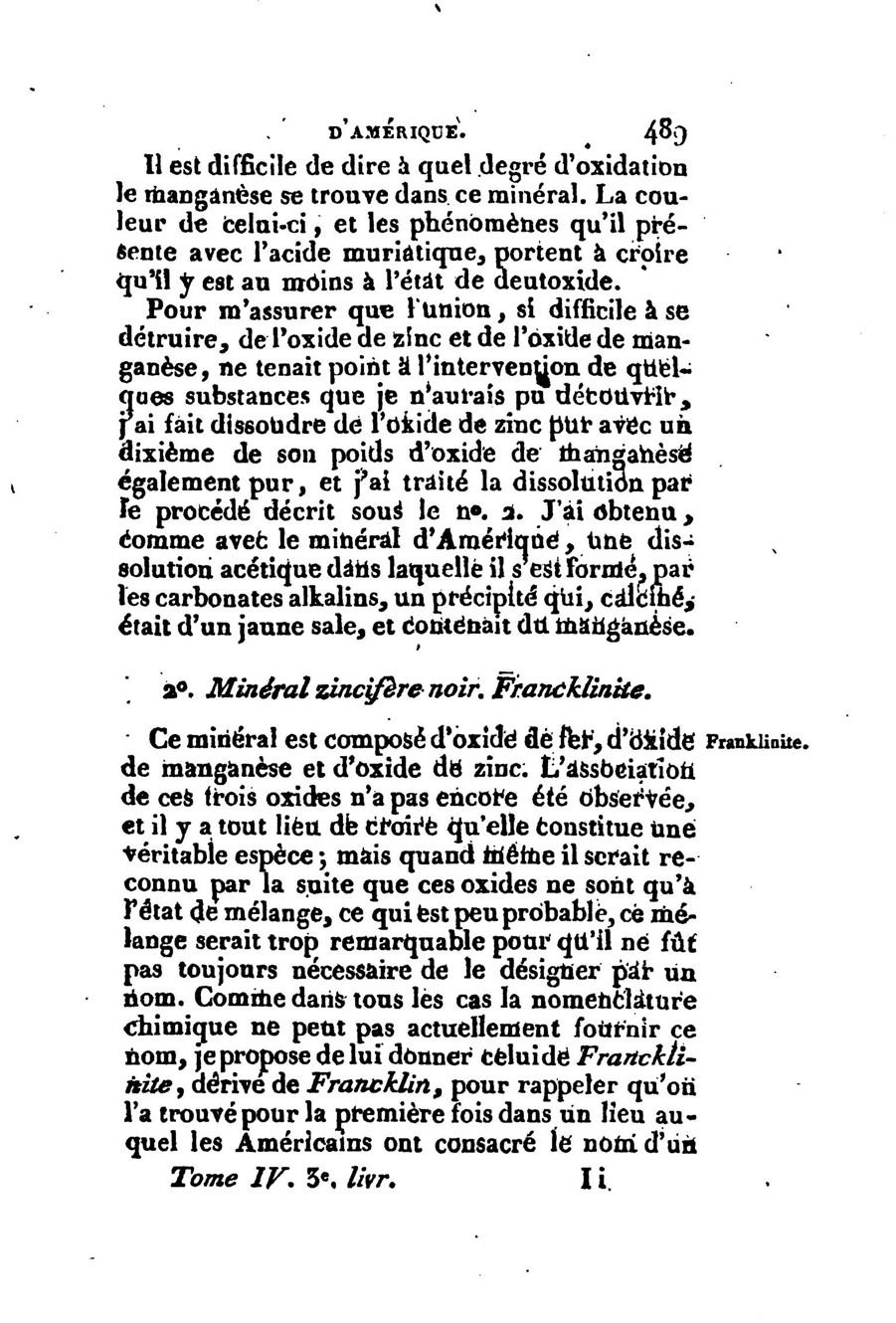
In 1819 Berthier published his analysis of two zinc-bearing minerals from the United States in the Annales des Mines (vol. 4, p. 483–494). The two minerals, he wrote, occurred together in a thick and extensive metal-bearing bed in New Jersey, “principalement à Franklin, à Sparte, à Stirling”; one was orange-red, the other “noir métalloïde,” black with a metallic look. The black one proved to be an oxide of iron, manganese and zinc, a combination not observed before, which very probably formed a true species. Since chemical nomenclature could not supply a name, he proposed one: “Francklinite, dérivé de Francklin, pour rappeler qu’on l’a trouvé pour la première fois dans un lieu auquel les Américains ont consacré le nom d’un grand homme dont la mémoire est vénérée, en Europe comme dans le Nouveau-Monde, par tous les amis des sciences et de l’humanité.” That is: to recall that it was first found in a place to which the Americans had given the name of a great man, whose memory is venerated in Europe as in the New World by all friends of science and of humanity. The great man was Benjamin Franklin, and the Handbook of Mineralogy gives the name as both for Franklin Furnace and in his honor. Berthier also gave a simple test that separates the two black minerals: the powder of franklinite is dark reddish brown, that of magnetite black.
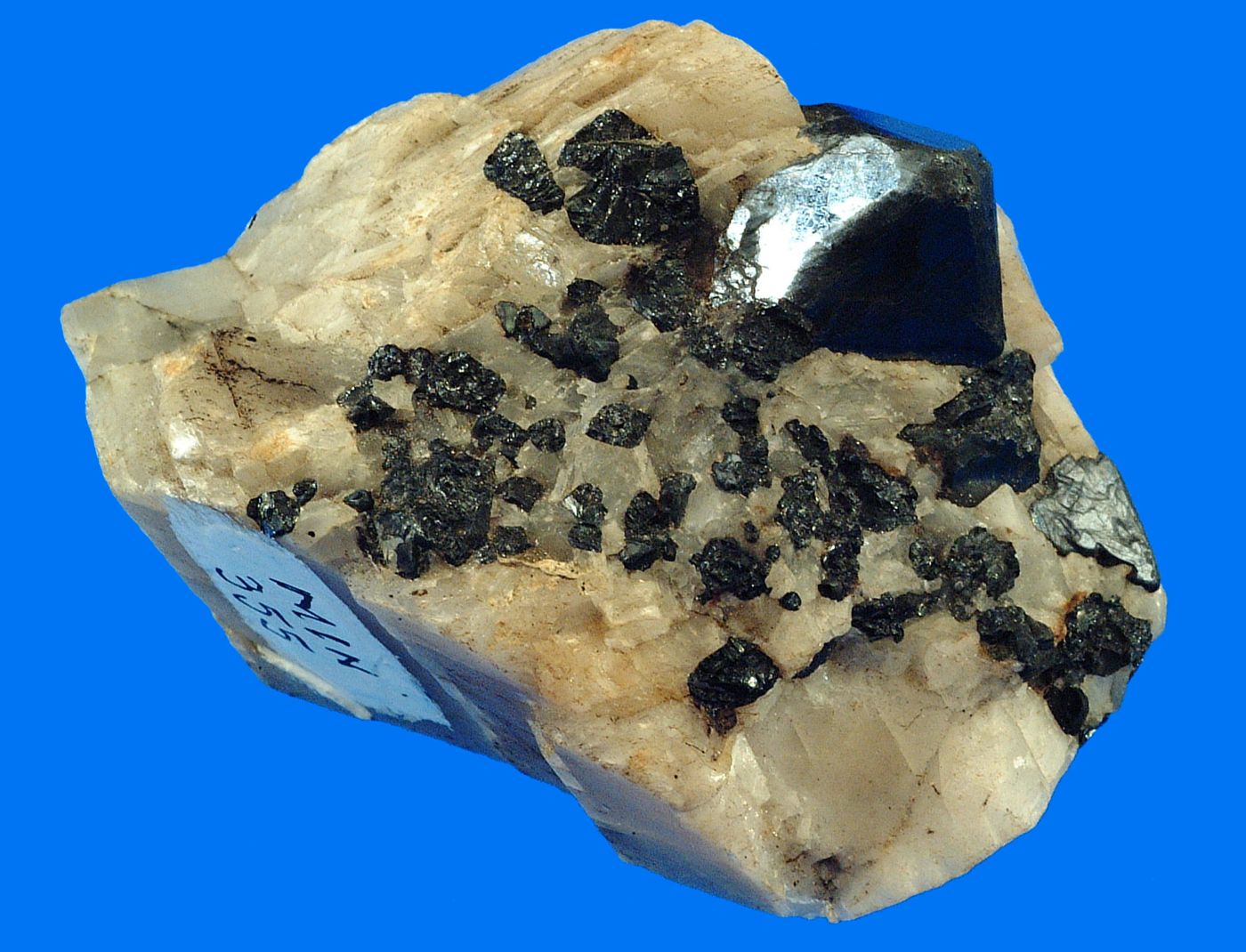
Franklinite is the zinc-iron member of the spinel group, ideally ZnFe3+2O4. Natural crystals always carry manganese and some ferrous iron as well, and the FOMS mineral notes describe it as a complex solid solution whose pure end-member is unknown in nature. It is black and magnetic, usually granular, and octahedral where it had room to grow.
Franklinite: ore, giant crystals and a state mineral
Berthier pointed out that the mineral held three useful metals, but for decades it was ignored as an ore of zinc. Palache explains that because franklinite was persistently treated as an iron ore, the mineral rights at Franklin were divided into rights to the zinc ores and rights to the iron ores, a division that led to long lawsuits and held back the mines for years. An account printed in an 1862 New York Times advertisement for “Patent Crystalized Iron, or Franklinite,” reprinted in The Picking Table as A. C. Farrington’s “History of the Franklinite,” tells how Lord Stirling had the ore hauled over the mountain roads to his Charlottenburg furnace, where it could not be smelted. The turn came, Palache wrote, with Samuel Wetherill’s furnace, which roasted the zinc out of franklinite as zinc white (zinc oxide), and with the magnetic separator, which drew franklinite out of the crushed ore and made it the chief zinc ore of the district. By Palache’s time the franklinite concentrate made up about 36 percent of the crude ore milled at Franklin and assayed 14 to 18 percent zinc, 34 to 40 percent iron and 12 to 16 percent manganese. It was used to make zinc oxide and spiegeleisen, a manganese-rich pig iron.
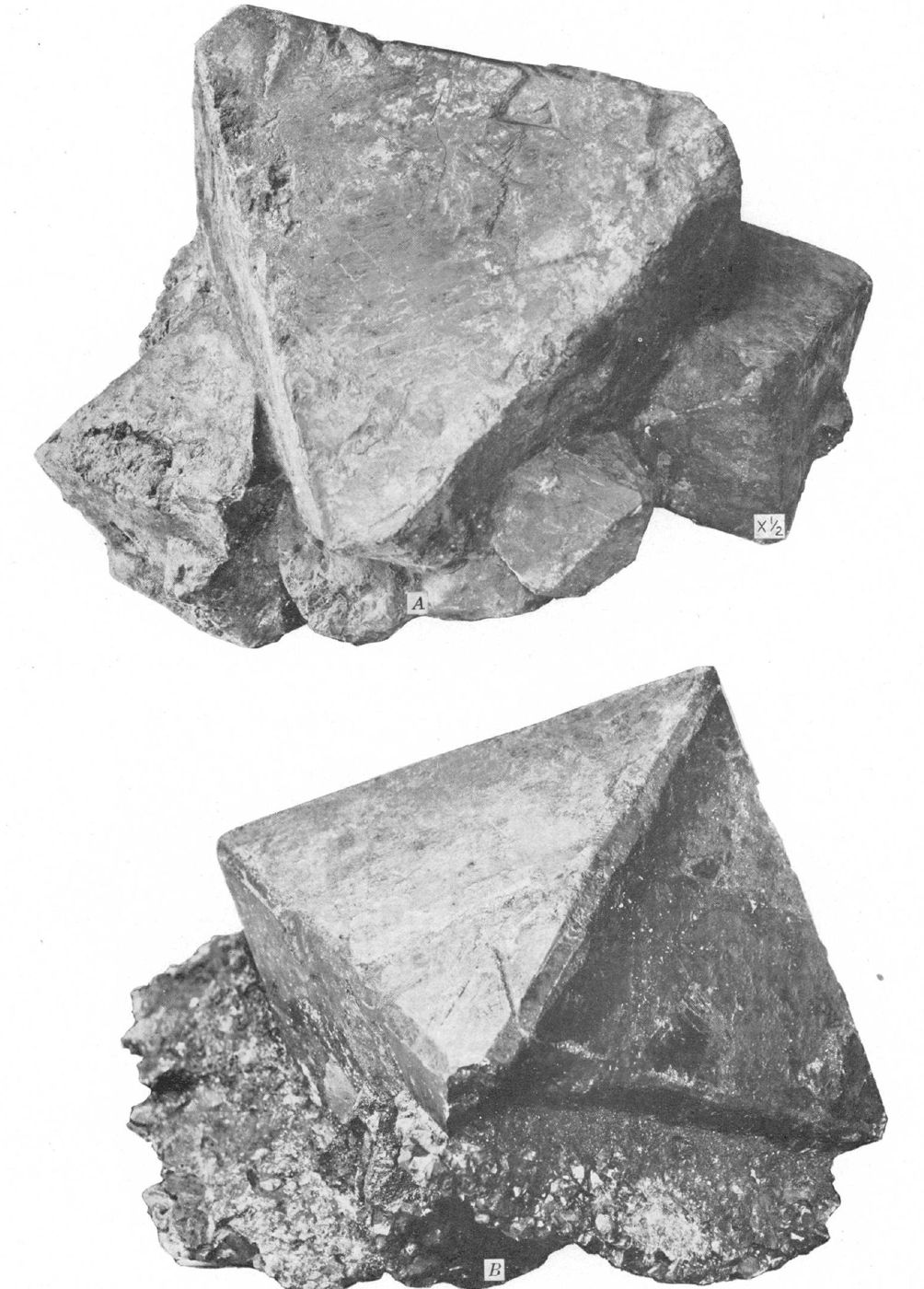
Most franklinite is granular. The great exception was the outcrop of Sterling Hill, where, Palache wrote, “at the very surface, crystals of extraordinary dimensions were found”: octahedrons measuring up to 7 inches on an edge, embedded in a dark claylike material, the best of them preserved in the collection of Frederick A. Canfield. The Handbook of Mineralogy gives the largest known octahedra as 22 cm.
Franklinite is not confined to New Jersey, although nowhere else has it been mined as an ore. The Handbook lists it at Långban in Värmland, Sweden (first reported there by E. A. J. Burke and C. Kieft in 1972), at Hraničná in the Czech Republic, at several manganese deposits in Kazakhstan, at the Pereval marble quarry near Slyudyanka in the Sayan Mountains of Siberia, at the Koduru manganese mine in Andhra Pradesh, India, and at the Bonnie prospect near Mukinbudin, Western Australia.
On July 19, 2023, Governor Phil Murphy signed the law (P.L.2023, chapter 110) making franklinite the state mineral of New Jersey. The Sterling Hill Mining Museum reported that the bill passed both houses unanimously, 36–0 in the Senate and 73–0 in the Assembly. The Picking Table marked the occasion in its Fall 2023 issue (vol. 64, no. 2) with Bailey Lawrence’s “Franklinite – New Jersey State Mineral” and Pete J. Dunn’s “Franklinite – a Photographic Introduction.” Mindat: franklinite.
Franklinfurnaceite, 1987: the old name of the village
In 1987 Pete J. Dunn, Donald R. Peacor, Robert A. Ramik, Shu-Chun Su and Roland C. Rouse described a new zinc silicate from Franklin (American Mineralogist, vol. 72, p. 812–815). They had found it during petrographic studies of zinc silicate assemblages; it resembled bannisterite but had distinct differences. “We have named this new mineral franklinfurnaceite,” they wrote, “after the old name for the community (Franklin, New Jersey) in which the Franklin mine is located.” The type specimen is in the National Mineral Collection at the Smithsonian, catalogue no. C6309. The Handbook of Mineralogy gives the formula as Ca2(Fe3+,Al)Mn3+Mn2+3Zn2Si2O10(OH)8: dark brown, very thin platy crystals up to 0.3 mm with serrated edges, extremely brittle, in vugs with willemite, clinohedrite, hodgkinsonite, hetaerolite and franklinite.
Its structure was the surprise. In 1950 the Soviet crystallographer N. V. Belov had proposed that calcium might occupy the vacant sites in the chlorite structure, but the evidence for it remained inconclusive. In 1988 Peacor, Rouse and Sturges W. Bailey solved the structure of franklinfurnaceite and found calcium in just such sites. They described it as the first example of a tri-dioctahedral chlorite and of a structure with calcium in octahedral sites between the tetrahedral sheets and the octahedral interlayer, “intermediate between those of the brittle micas and chlorite.” The title of their first report, abstracted in The Picking Table 29(2), p. 12, put it more plainly: “the missing link between chlorites and micas.”
The original paper said nothing about where in the mine the mineral was found. After it went to press, Dunn wrote to the editor of The Picking Table (29(2), p. 2) that a note in the catalogue of the collector Lawson Bauer placed one specimen in the 436 pillar, third slice below the 700 level of the Franklin mine; Bauer had obtained it from Charles Davidowsky in April 1949. In 1989 Herb Yeates examined crystals from the Kraissl collection under a scanning electron microscope and described their habits (30(2), p. 7): at low magnification the druses look like reddish-brown velvet; the crystals broke at the slightest touch of a needle, and some showed what may be twinning.
Franklinfurnaceite has kept to its birthplace. The Handbook of Mineralogy and Dunn’s 1995 monograph, as quoted in the FOMS mineral notes, record it from Franklin alone, and we have found no published report of it anywhere else. The Picking Table printed the abstract of the original description in 29(1), p. 13 and a note on the 1988 structure paper in 30(2), p. 18. Mindat: franklinfurnaceite.
Franklinphilite, 1992–2026: a friend of Franklin, found in Wales
Franklinphilite is the manganese member of the stilpnomelane group of layer silicates, (K,Na)4(Mn2+,Mg,Zn)48(Si,Al)72(O,OH)216·6H2O in the Handbook of Mineralogy: very dark brown to black platy crystals, up to 0.5 mm, in fine tangled radial aggregates. It forms a series with lennilenapeite, the magnesium member, named for the Lenape (see the Lenape and Mine Hill).
Its naming waited eight years. In 1984 Dunn, Peacor and William B. Simmons had reported a stilpnomelane from Franklin in which manganese led the other metals, but with only 35 mole percent of the manganese end-member, so they deferred naming it. Richer material, with 54 percent, turned up later, and in 1992 Dunn, Peacor and Shu-Chun Su described it in the Mineralogical Record (vol. 23, p. 465–468; abstract in American Mineralogist, 1993). The partial reprint in The Picking Table (34(1), Spring 1993, p. 30) gives the reasoning in the authors’ words: the locality root Franklin and the Greek philos, “friend,” in allusion to its composition, which contains the elements that make the chemistry of Franklin and Sterling Hill unique. “The name also honors the many geologists, mineralogists and collectors who have been friends of Franklin and who have contributed to our understanding of the deposit.” The holotype is at the Smithsonian, NMNH 167390.
The type material came from the Buckwheat dump, with nothing known of its original place in the mine. It was a mass about 30 cm across, a breccia of calcite, aegirine and other silicates cut by a centimeter-wide vein of franklinphilite with friedelite. The same mass had earlier supplied the type specimen of baumite, described by Clifford Frondel and Jun Ito in 1975 and discredited in 1989–1990 by Stephen Guggenheim and Sturges W. Bailey, who showed it to be an intergrowth of layer silicates rather than a single species.
For twenty years franklinphilite was known only from Franklin. In 2013 T. F. Cotterell and N. Hubbard reported it in thin veinlets cutting the Lower Cambrian manganese ore bed at the Llyn Du Bach mine, near Harlech in Gwynedd, Wales (Journal of the Russell Society, vol. 16, p. 51–59). Amgueddfa Cymru – Museum Wales, which verified it by X-ray diffraction and electron microscopy, lists it as the first record of the mineral in the United Kingdom. Mindat: franklinphilite.
Franklinphilite stood as a species for thirty-four years. In March 2026 the commission on new minerals of the International Mineralogical Association accepted a new scheme for the stilpnomelane group. It redefined lennilenapeite, which had been the magnesium member, as the manganese member, K4Mn48[Si64Al8]O164(OH)52·nH2O, and found that “franklinphilite is a mixture of lennilenapeite and nelenite”; franklinphilite, with the Swedish ekmanite, was “consequently discredited” (CNMNC Newsletter 91, p. 349). The name no longer appears on the IMA list. The account above is kept as it was written, because it is the history of the mineral as it was understood from 1992 to 2026; the Franklin type material and the Welsh specimens now await description under the new definitions.
Sterlinghillite, 1981: a few milligrams from the 340 level
Sterlinghillite was found by a miner, reportedly on the 340-foot level of the Sterling Hill mine, and brought to Pete Dunn’s attention by Fred Parker of South River, New Jersey. In his description (American Mineralogist, vol. 66, p. 182–184, 1981) Dunn reported that only one specimen, with a few milligrams of the mineral, had been found. It is a hydrated manganese arsenate, tentatively Mn3(AsO4)2·4H2O (the International Mineralogical Association’s list now gives it as Mn3(AsO4)2·3H2O, citing a later study of 2000; IMA list, 2026), white to light pink, in two habits on the same specimen: sparse bundles of soft, pearly crystals that at first glance resemble laumontite, and hemispherical clusters, 0.1 mm across, of platy crystals. It lay on seams in franklinite-sphalerite ore beside loellingite and calcite, and Dunn suggested that it formed when loellingite, an iron arsenide, oxidized in the presence of manganese-bearing solutions. No crystals were fit for single-crystal study, and the Handbook of Mineralogy still lists its crystal system as not determined.
The name, Dunn wrote, “is for the locality, one of the most remarkable mineral deposits on earth.” The Picking Table announced the new mineral in 22(1), March 1981, p. 3 and printed the abstract of the description in 22(2), September 1981, p. 5.
For fourteen years the type specimen was the only one. In 1995 John Cianciulli of the Franklin Mineral Museum reported a second (36(1), p. 27), confirmed by Dunn: a specimen that Lee Lowell had acquired as an unknown from Ewald Gerstmann in the mid-1980s, with white to pale-pink hemispheres about 0.2 mm across on a seam in franklinite, willemite and loellingite ore much like the matrix of the 340-level arsenates. The Handbook gives Sterling Hill as the only locality, and the FOMS notes add that it has not been found at Franklin. Alfredo Petrov, writing in The Picking Table in 2009, reported it from the Gozaisho mine in Fukushima, Japan, a metamorphosed manganese deposit with some Franklin-like arsenates. Mindat: sterlinghillite.
Ogdensburgite, 1981: from a Sterling Hill stope to Mexico
Ogdensburgite came from the same weathered arsenate zone near the 340 level. According to its description, by Dunn in the Mineralogical Record (vol. 12, p. 369–370, 1981; abstract in American Mineralogist, vol. 67, p. 858), it was found in 1972 in the 960 stope, as crusts about 0.1 mm thick on severely weathered willemite-franklinite-calcite-sphalerite ore, with koettigite, parasymplesite and other secondary arsenates. In hand specimen, Dunn wrote, it “resembles dark red velvet”; the dark surface was likely oxidation, and the true color is a very bright reddish orange. At least a dozen specimens were thought to survive in collections. The Picking Table announced it in 22(2), September 1981, p. 5, “named ogdensburgite for the town in which the mine is located,” and quoted the description in 23(1), Spring 1982, p. 7.
The Sterling Hill material was too poor for a full study, and Dunn called his formula tentative. The answer came from Mexico. In 1987 Anthony R. Kampf of the Natural History Museum of Los Angeles County and Dunn reported ogdensburgite from the Ojuela mine at Mapimí, Durango, as dark brownish-red blades up to 1 mm long with arseniosiderite, adamite, chalcophanite and villyaellenite, on a specimen provided by John Whitmire. This second occurrence, they wrote, “has yielded material superior to that found at the type locality.” It gave the first unit-cell dimensions and a new ideal formula, Ca2Fe3+4(Zn,Mn)(AsO4)4(OH)6·6H2O, and showed that the optical properties and specific gravity first reported differed significantly from those of the Mexican crystals. The Handbook of Mineralogy adds a third locality, the Clara mine near Oberwolfach in the Black Forest of Germany.
The FOMS notes, drawing on Dunn’s 1995 monograph, add a warning for collectors: in the 1980s many specimens of other minerals were sold mislabeled as ogdensburgite, and X-ray methods are the best way to verify it. Mindat: ogdensburgite.
Sauconite, 1875: the rival valley’s name
One place-named mineral of Sterling Hill comes from a rival mining district. Sauconite is a zinc clay named for the Saucon Valley in Lehigh County, Pennsylvania, where the Pennsylvania and Lehigh Zinc Company’s mines at Friedensville competed with New Jersey from 1853 (see What the ore was worth).
“A zinc-bearing clay from the Uberroth Mine, Saucon Valley, near Friedensville, Pennsylvania, was analyzed and named sauconite by Roepper and described by Genth,” in F. A. Genth’s Mineralogy of Pennsylvania of 1875 (Ross, 1946, p. 412). Zinc clays, “commonly called tallow clays,” had long been taken for “mixtures of kaolin and hemimorphite,” Ross wrote. He studied a sample of Roepper’s own material lent by Lehigh University, found it a true clay mineral of the montmorillonite group, the zinc counterpart of saponite, and concluded that “the name sauconite proposed by Roepper and Genth for the mineral from Friedensville, Pennsylvania, seems most suitable for the zinc-bearing clay mineral” (p. 413).
At Sterling Hill, The Picking Table reported in 1971, “Dr. Frondel accepts sauconite as a validated mineral, although he feels much work must be done on the clays from Sterling Hill” (vol. 12, no. 2, August 1971, p. 7). It is on the FOMS list of Sterling Hill minerals today. The Roepper who named it was evidently W. T. Roepper of hydrofranklinite (see Names that did not last): specimens of both came to light again in the collection of Lehigh University.
In The Picking Table
Frank Z. Edwards (vol. 9, no. 1, February 1968) still counted franklinite among the minerals found only in the district in January 1968; a year later the journal removed it from that list on a report from the Ushkatyn deposit in central Kazakhstan (vol. 10, no. 1, February 1969). Allen W. Pinger’s review of the district, a talk of 1961 printed in 1973 (vol. 14, no. 2), gives local origins for the place names, Sharp’s Borough for Sharp’s forge, Ogdensburg for Ogden’s forge and Sterling Hill for Lord Stirling, and credits Berthier with naming franklinite in 1819. Pete J. Dunn and Bernard T. Kozykowski’s “The resurrection of Sterling Hill” (vol. 33, no. 2, Autumn/Winter 1992) counts these names among the species “with names drawn from the local area.” Alfredo Petrov’s survey of the Japanese manganese deposits (vol. 50, no. 1, Spring 2009) reports sterlinghillite from the Gozaisho mine. In 2010 Lee Lowell’s Franklin Mineral Museum news (vol. 51, no. 1) urged collectors to press their legislators for franklinite as the state mineral, thirteen years before the law passed. William R. Truran’s “From furnace to borough—Franklin’s transformation” (vol. 54, no. 1, Spring 2013) gives the local belief that the settlement was named for Governor William Franklin, Benjamin Franklin’s son, rather than for Benjamin himself. Mark Boyer’s “Letters from the past” (vol. 56, no. 2, Fall 2015) prints Samuel Fowler’s letter of 1826 to Berzelius, complaining that Berthier “did not apprehend the difficulty we experience in reducing the ore,” and Stephen Sanford’s “The breakdown of franklinite” (vol. 62, no. 2, Fall 2021) follows what became of the mineral in the weathered zones of Sterling Hill. The new-mineral notes, abstracts and letters on the four modern species are linked in the sections above. No article on Pierre Berthier himself, or on the naming of Ogdensburg and Sterling Hill beyond these passing notes, has appeared in The Picking Table.
Sources and further reading
- Anthony, J. W., Bideaux, R. A., Bladh, K. W., and Nichols, M. C., Handbook of Mineralogy (Mineralogical Society of America): franklinite, franklinfurnaceite, franklinphilite, sterlinghillite and ogdensburgite, each linked in the text. Franklinite (PDF)
- Berthier, P., 1819, Analyse de deux minéraux zincifères des États-Unis d’Amérique. Annales des Mines, vol. 4, p. 483–494. Franklinite (“Francklinite”) is named on p. 489–490. archive.org
- Cotterell, T. F., and Hubbard, N., 2013, Franklinphilite in veinlets in the Lower Cambrian manganese ore bed, Harlech, Merionethshire, Wales. Journal of the Russell Society, vol. 16, p. 51–59; as recorded in the Amgueddfa Cymru – Museum Wales mineral database. Museum Wales
- Dunn, P. J., 1981, Ogdensburgite, a new calcium-zinc-ferric iron arsenate mineral from Sterling Hill, New Jersey. Mineralogical Record, vol. 12, p. 369–370; abstracted in American Mineralogist, vol. 67, p. 858 (1982). Abstract (PDF)
- Dunn, P. J., 1981, Sterlinghillite, a new hydrated manganese arsenate mineral from Ogdensburg, New Jersey. American Mineralogist, vol. 66, p. 182–184. PDF
- Dunn, P. J., Peacor, D. R., and Su, S.-C., 1992, Franklinphilite, the manganese analog of stilpnomelane, from Franklin, New Jersey. Mineralogical Record, vol. 23, p. 465–468; partly reprinted in The Picking Table, vol. 34, no. 1 (Spring 1993), p. 30–32. The Picking Table (PDF)
- Dunn, P. J., Peacor, D. R., Ramik, R. A., Su, S.-C., and Rouse, R. C., 1987, Franklinfurnaceite, a Ca-Fe3+-Mn3+-Mn2+ zincosilicate isotypic with chlorite, from Franklin, New Jersey. American Mineralogist, vol. 72, p. 812–815. PDF
- Farrington, A. C., History of the Franklinite, from a New York Times advertisement of November 10, 1862. Reprinted in The Picking Table, vol. 39, no. 2 (Fall 1998), p. 34. The Picking Table (PDF)
- Franklin-Ogdensburg Mineralogical Society, Franklin mineral notes, after Dunn, P. J., 1995, Franklin and Sterling Hill, New Jersey: the world’s most magnificent mineral deposits. Each mineral is linked in the text. FOMS
- Franklin, New Jersey, and Ogdensburg, New Jersey: borough histories. Wikipedia
- Jambor, J. L., et al., 1993, New mineral names: franklinphilite. American Mineralogist, vol. 78, p. 672–673. PDF
- Kampf, A. R., and Dunn, P. J., 1987, Ogdensburgite from Mapimi and new data for the species. American Mineralogist, vol. 72, p. 409–412. PDF
- Lawrence, B., Franklinite – New Jersey State Mineral; Dunn, P. J., Franklinite – a Photographic Introduction. The Picking Table, vol. 64, no. 2 (Fall 2023), p. 41–42.
- Osowski, J., 2023, Franklinite: the New Jersey State Mineral! Sterling Hill Mining Museum newsletter, Fall 2023. PDF
- Palache, C., 1935, The minerals of Franklin and Sterling Hill, Sussex County, New Jersey. U.S. Geological Survey Professional Paper 180. History, p. 15; ore treatment, p. 18; franklinite, p. 47–48; plates 1 and 6. PDF
- Peacor, D. R., Rouse, R. C., and Bailey, S. W., 1988, Crystal structure of franklinfurnaceite: a tri-dioctahedral zincosilicate intermediate between chlorite and mica. American Mineralogist, vol. 73, p. 876–887. PDF
- The Picking Table on franklinfurnaceite: abstract of the description, vol. 29, no. 1 (Spring 1988), p. 13; Dunn’s letter on the find, vol. 29, no. 2 (Fall 1988), p. 2; abstract of the structure, same issue, p. 12. PT 29(1)
- The Picking Table on ogdensburgite: announcement, vol. 22, no. 2 (September 1981), p. 5; the description quoted, vol. 23, no. 1 (Spring 1982), p. 7–8. PT 23(1)
- The Picking Table on sterlinghillite: announcement, vol. 22, no. 1 (March 1981), p. 3; abstract, vol. 22, no. 2 (September 1981), p. 5; Cianciulli, J., Sterlinghillite, vol. 36, no. 1 (Spring 1995), p. 27. PT 36(1)
- Ross, C. S., 1946, Sauconite—a clay mineral of the montmorillonite group. American Mineralogist, 31, 411–424. PDF (MSA)
- Verbeek, E. R., 2008, Why are our mineral names changing? The Picking Table (Journal of the Franklin-Ogdensburg Mineralogical Society), vols. 48–49 (combined issue 2007–2008), p. 14–15. PT 48–49
- Yeates, H., 1989, Observations of habits for franklinfurnaceite crystals. The Picking Table, vol. 30, no. 2 (Fall 1989), p. 7–9; note on the structure paper, same issue, p. 18. The Picking Table (PDF)
Written with Claude, an AI model made by Anthropic, from the sources listed above, and checked against them. October 2026.