Histories › The mines and their history
What the world made of zinc orthosilicate, the mineral willemite, beyond ore and specimens: the crystals grown in art-pottery glazes, and the manganese-activated phosphor of fluorescent lamps, oscilloscopes and early television, with what can and cannot be traced back to Franklin.
Crystals in the glaze
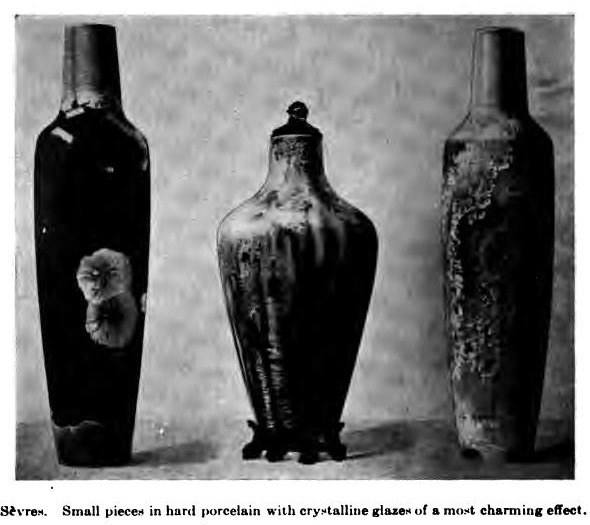
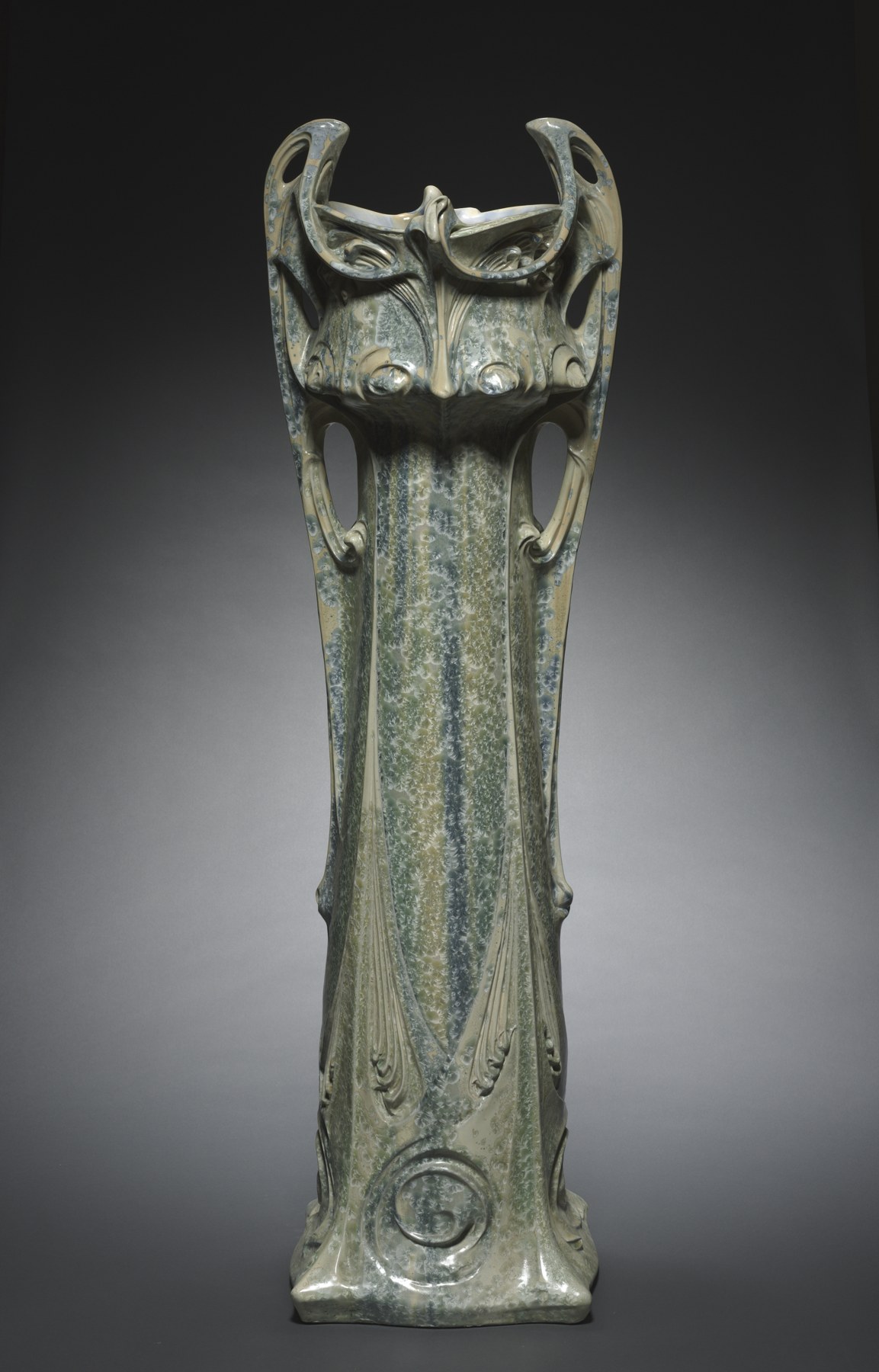
A glaze is a thin layer of glass, and glass will crystallize if it is given the chance. Load a glaze with zinc oxide, keep alumina low, fire it hot and let it cool slowly, and zinc orthosilicate, the compound that occurs in nature as the mineral willemite, can grow out of the melt in fans and rosettes of needles, some of them centimeters across. Potters call these crystalline glazes. Their history runs parallel to the mines at Franklin for half a century before the two are ever said in the same sentence.
The French national porcelain works at Sèvres showed them first. Taxile Doat, who worked there, recalled in Grand Feu Ceramics that at the exposition of 1884, beside the new copper-red flambé glazes, “a neighboring case contained the first white crystallization, the result of new experiments on glazes, especially on zinc glazes.” Writing in 1902, William H. Zimmer gave the credit to the chemists Charles Lauth and Georges Dutailly, who placed a cup and a paper on the subject in the Sèvres museum in September 1885, and cited a later statement by G. Vogt of Sèvres that the first crystallized glazes were made there in 1884 (Transactions of the American Ceramic Society, vol. 4, p. 40–42).
Copenhagen took the idea further. Doat wrote that the Royal Porcelain Manufactory there showed small vases with “unexpected and scintillating crystallizations” and that “the Copenhagen chemists had produced these glazes without any knowledge of the former discovery at Sèvres,” crediting them with first applying the glazes to vases. He named Bing & Grøndahl, the other Copenhagen house, as following the Royal Manufactory’s lead. By 1902, Zimmer counted Sèvres, Copenhagen, Rörstrand of Stockholm, the Berlin royal factory and Rookwood of Cincinnati among the makers of crystallized glazes.
Doat’s own recipe is typical. He fused carbonate of potash, zinc oxide and quartz sand into two frits, mixed them, laid the glaze on thick, and fired it at about 1310 °C, Seger cone 9, in a strictly oxidizing kiln. “A slow cooling favors the development of crystals,” he wrote. A little rutile turned the crystals yellow; pure titanium oxide gave a colorless crystalline glaze “of great beauty.”
Naming the crystals
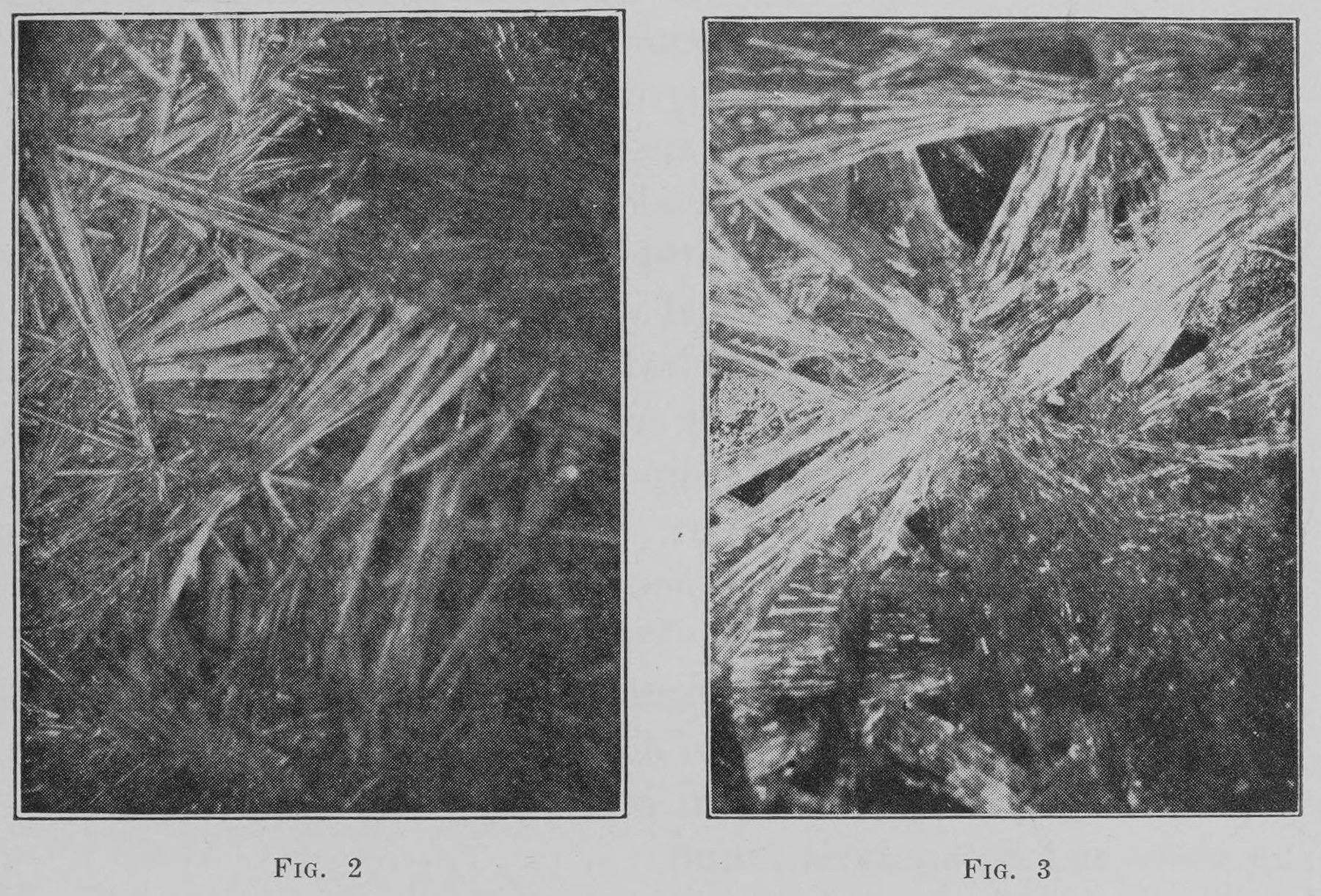
What the crystals were took longer to settle than how to grow them. Lauth and Dutailly, in Zimmer’s English, thought zinc oxide made it possible to obtain glazes “which form during the process of cooling small crystals of silicates or more likely of oxide.” The first person found here to call them willemite is a chemist Zimmer names only as Clement of Copenhagen, who brushed a heavy coat of silica and zinc oxide over glazed Royal Copenhagen porcelain and refired it. In a short paper read at the International Congress for Applied Chemistry in Vienna in 1898, Zimmer reports, he described crystals “which he claims to be crystals of the natural silicate zinc, Willemite, Zn2SiO4.” Summing up the literature, Zimmer concluded that “the silicate of zinc was the essential substance,” dissolved in the melted glaze and separating again on slow cooling.
American potters then tried the obvious shortcut. When Ray T. Stull spoke on crystalline glazes in 1904, Samuel Geijsbeek answered that it “has been stated several times in recent literature that this mineral is a good material for producing crystalline effects, but in making some experiments along this line, I have not found this mineral to be of any great value.” The mineral was willemite itself, ground and added to the glaze; it worked better, he found, to let the zinc silicate form in the glaze and crystallize out. He did not say where his willemite came from.
Proof under the microscope came from the Bureau of Standards. In 1915 A. A. Klein and G. H. Brown made a series of soda–zinc oxide–silica melts, the base of many crystalline glazes, and measured the needles that grew in them with a petrographic microscope. “The optical constants of this compound,” they wrote, “are practically identical with those of willemite, whose composition is 2 ZnO.SiO2.” In their summary: “In the mat and crystalline melts, with one exception, the compound to separate out appears to be zinc orthosilicate. This closely resembles the mineral willemite in optical constants.”
Doat and Robineau in America
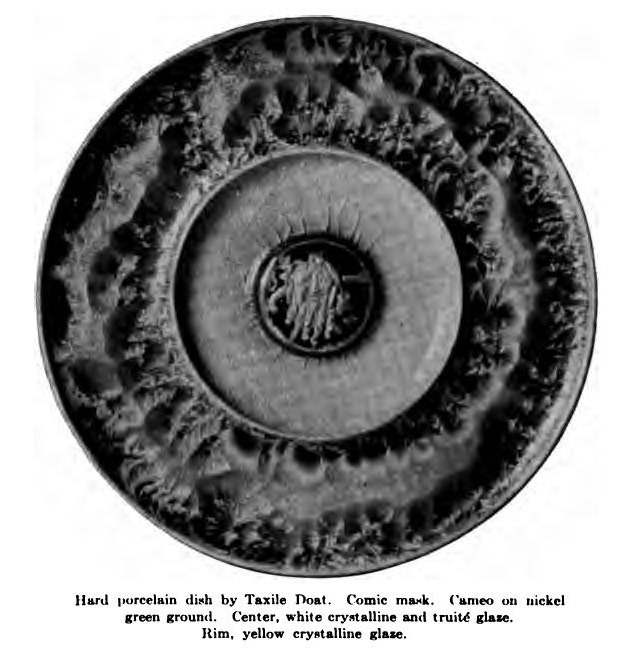
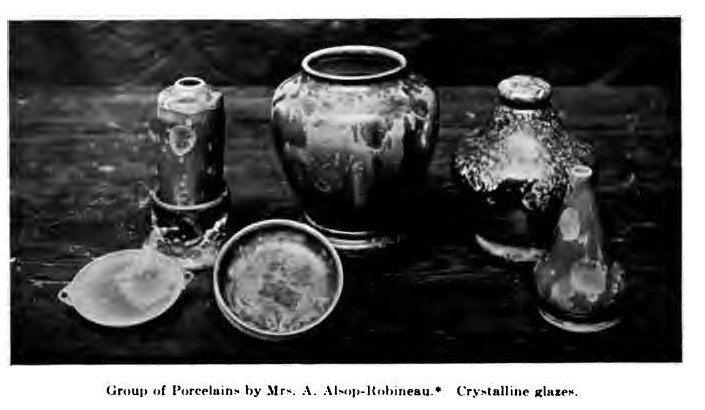
Doat’s treatise reached Americans through a magazine, Keramic Studio, which printed it in installments. The Keramic Studio Publishing Company of Syracuse, New York, then issued it as a book, Grand Feu Ceramics, in 1905, translated by Samuel E. Robineau, with notes on the use of American clays by Charles F. Binns of the School of Ceramics at Alfred, New York.
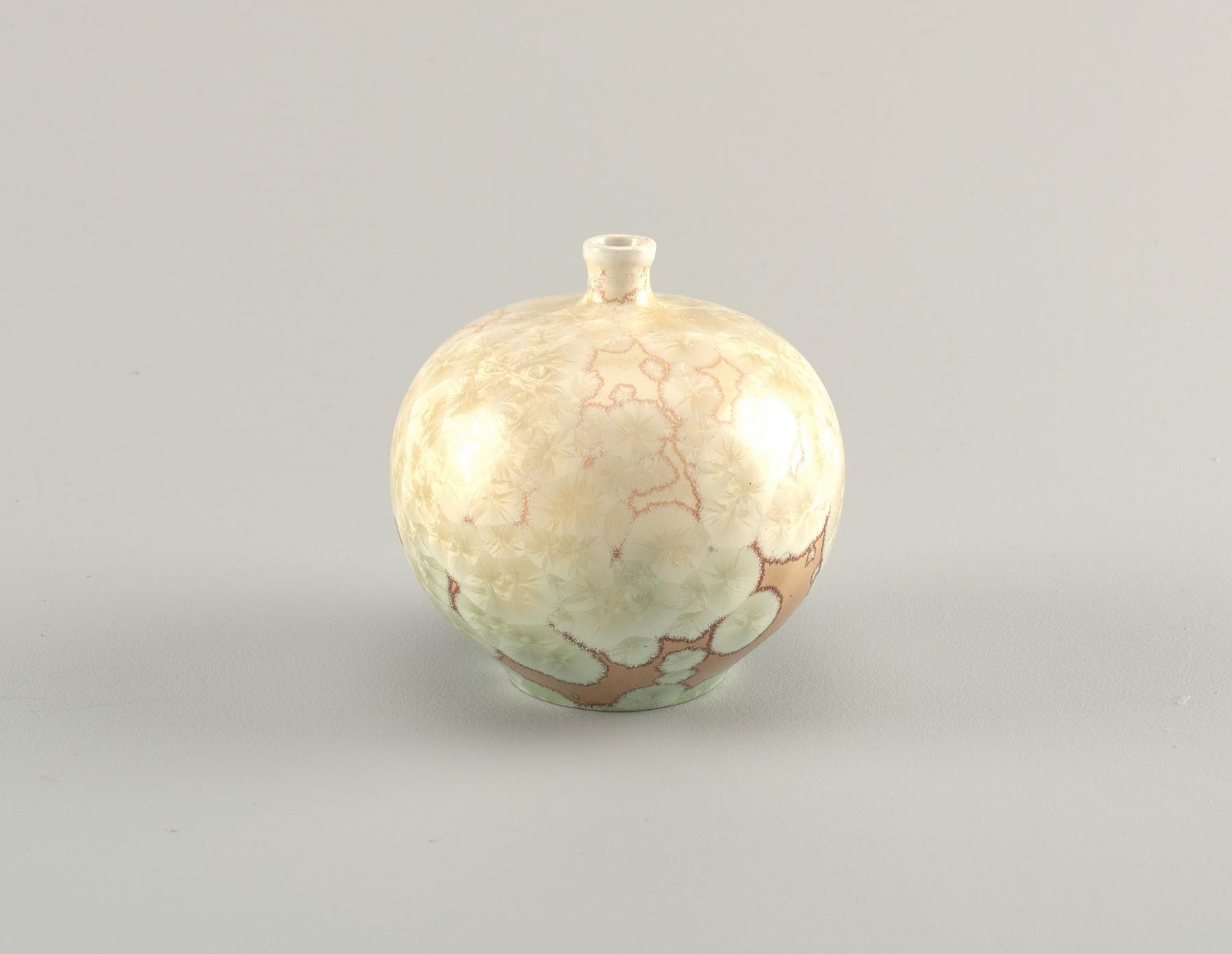
Adelaide Robineau learned high-fired porcelain from it. A footnote in the book says that her porcelains “are the result of experiments made during the publication in Keramic Studio of M. Doat’s treatise,” made of American clays and fired with oil at cone 9. The book pictures a group of them, all with crystalline glazes. A crystalline-glazed vase made at University City, Missouri, in 1913, now in the Cooper Hewitt, is catalogued as possibly Doat’s own work.
Nothing found in these sources ties the glazes to Franklin. The recipes call for zinc oxide, which the New Jersey Zinc Company made in quantity, but no glaze writer read here names a supplier, and the one recorded trial of natural willemite in a glaze does not give its source.
Making willemite glow
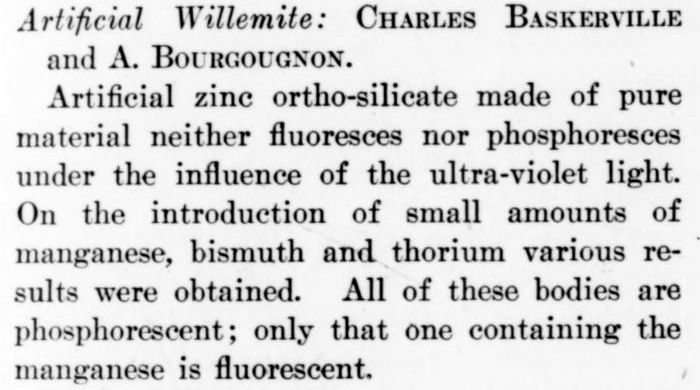
The second life of willemite began with its glow, which is told on the earlier page Willemite, named for a king. Pure zinc orthosilicate does not glow. In June 1905 Charles Baskerville of the College of the City of New York and his assistant A. Bourgougnon reported to the New York Section of the American Chemical Society that “artificial zinc ortho-silicate made of pure material neither fluoresces nor phosphoresces under the influence of the ultra-violet light,” but that with small amounts of manganese, bismuth or thorium added it did, and “only that one containing the manganese is fluorescent.” The glow of the Franklin mineral, in other words, came from its manganese, and could be put into a synthetic powder on purpose. In modern terms the compound is manganese-activated zinc orthosilicate, Zn2SiO4:Mn.
Baskerville repeated the point in a lecture to the American Electrochemical Society in 1906: with manganese and other metallic oxides, “splendid artificial willemite has been made.” He showed willemite screens, and in the discussion William J. Hammer rose to say that “my friend, Mr. W. S. Andrews, made such screens, employing both natural and artificial willemite, a long time ago.” Andrews, a General Electric engineer, published a full recipe in 1922 (see W. S. Andrews and artificial willemite and the original paper). Baskerville and Bourgougnon are the earliest synthesis of the glowing compound found in this research; who made it first is not settled here.
Franklin specimens remained the yardstick. In the Carnegie Institution’s study of cathodo-luminescence of 1928, T. Tanaka compared four willemites under electron bombardment: one of unknown origin, two from Franklin, and one made by Andrews. “Willemite II—This sample came from Franklin Furnace, New Jersey,” he wrote, and of Andrews’s powder, that its spectrum curve “was quite similar in form to those of the natural willemites studied, but the intensity of luminescence was somewhat greater.”
A lamp made of Franklin willemite
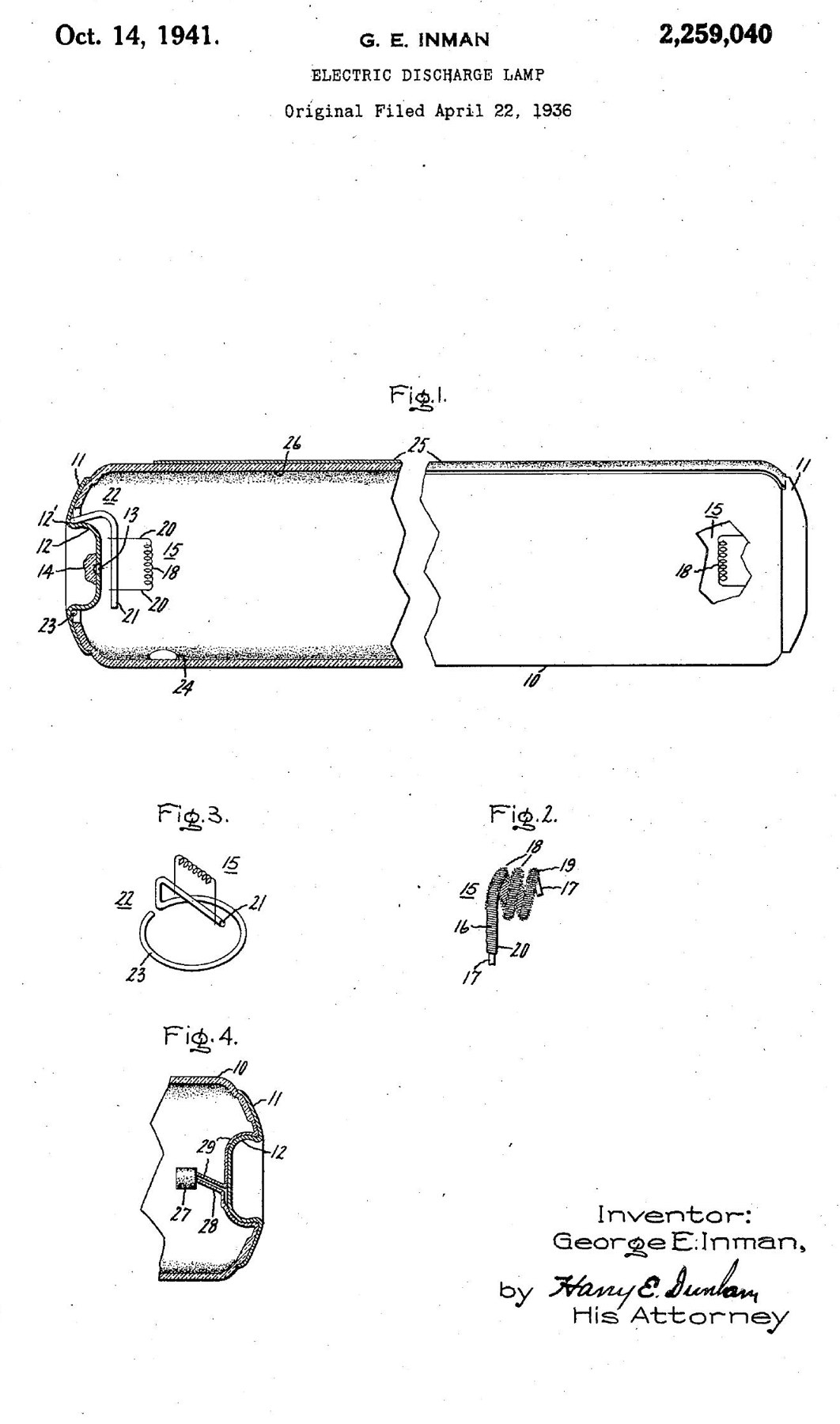
The modern fluorescent lamp is a low-pressure mercury discharge whose invisible ultraviolet light, chiefly at 2537 ångströms (253.7 nm), strikes a powder coated on the inside of the tube. George E. Inman of East Cleveland, Ohio, filed for a patent on such a lamp in April 1936 and assigned it to General Electric; it names zinc silicate among the coating materials (U.S. Patent 2,259,040).
Here Franklin enters by name. In 1941 W. E. Forsythe, B. T. Barnes and E. Q. Adams, writing of the work of the engineers in the Nela Park laboratory, told how it began, citing Inman and R. N. Thayer’s paper of 1938: “When the engineers first started to work on this problem, they obtained some natural willemite from Franklin, N. J., ground it to a powder, and used the resulting powder to make a fluorescent lamp.” That 15-watt lamp gave about 30 lumens per watt, some two and a half times the efficiency of an incandescent lamp of the same light output, though its light was green. Synthetic zinc orthosilicate activated with manganese, made in the laboratory from purified materials, then raised the same lamp to about 65 lumens per watt.
The natural mineral had served its turn. The U.S. Bureau of Mines, surveying fluorescent minerals in 1944, noted that willemite “is mined in quantity only in New Jersey,” but that “minerals for use in fluorescent lighting are mostly synthetic, and it is not expected that any substantial tonnage of natural minerals will be mined and consumed directly for this purpose.”
Green screens
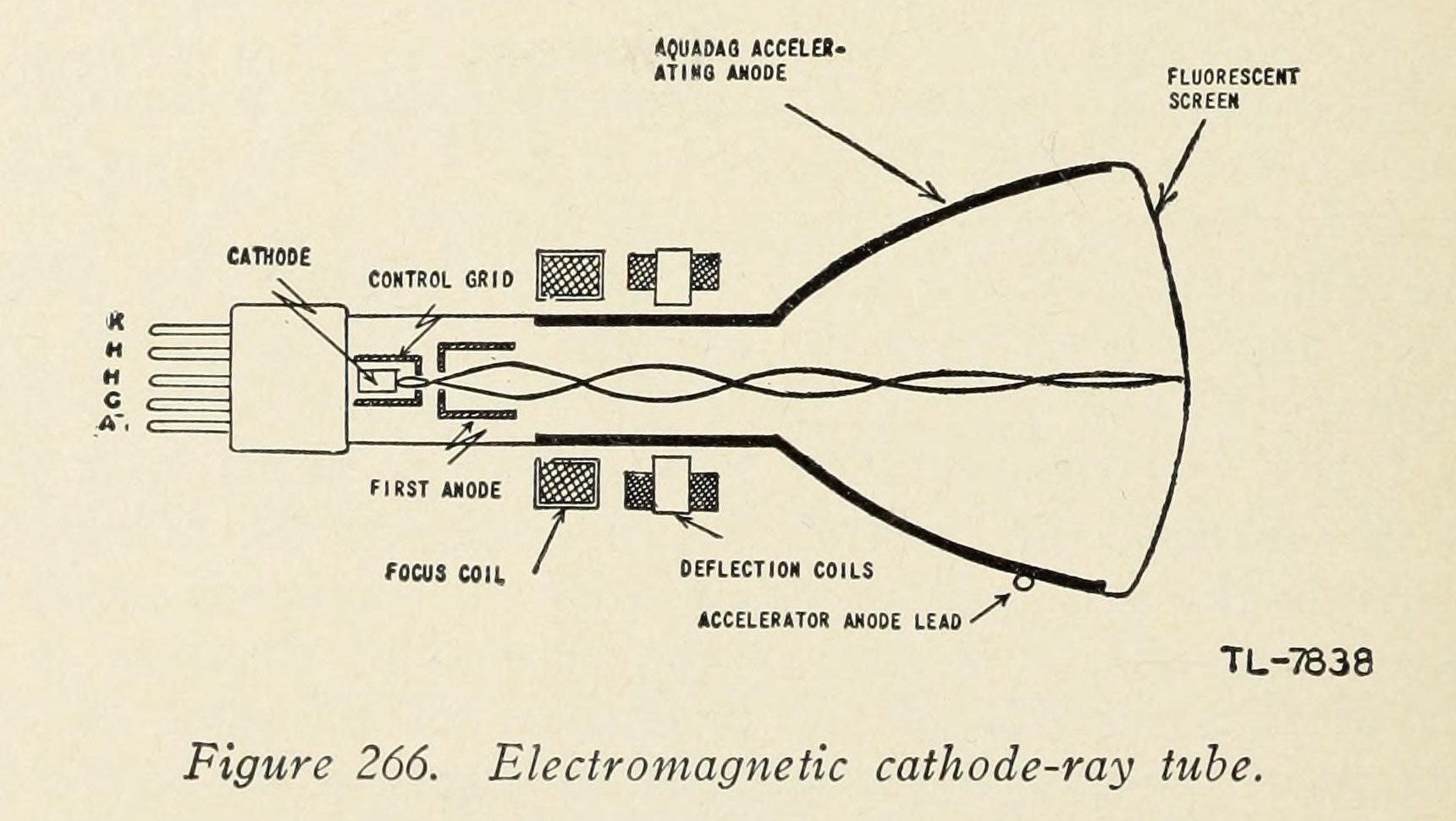
A cathode-ray tube draws its picture with an electron beam on a phosphor screen, and for decades the standard screen was willemite. Early television had to use the natural mineral. V. K. Zworykin and G. A. Morton of RCA wrote in 1940 that “the earlier television workers had to content themselves with the green and black reproduction characteristic of natural willemite,” adding that its fairly high efficiency was fortunate, for “otherwise the acceptance of the electronic system would have been greatly delayed.” By 1934 Zworykin’s own kinescope used “a synthetic zinc ortho-silicate phosphor almost identical with natural Willemite,” chosen for its efficiency, its short lag and its resistance to “burning” by the beam. Neither source says where the natural willemite came from.
In laboratory oscilloscopes and military displays the synthetic form became standard. A U.S. Navy radar textbook of 1944 states that “Willemite, which emits a green light, has been used generally for coating cathode-ray tube screens,” and the Bureau of Mines the same year that zinc silicate “with a medium persistence green luminescence is used commonly in oscillograph tubes.” After the war the MIT Radiation Laboratory’s volume on radar displays described “the familiar green willemite phosphor used in ordinary oscilloscopes and known as type P1 (phosphor number one).” The same volume makes a distinction worth keeping: P1, with a decay of a few milliseconds, suited displays that repeat quickly, such as the range trace of an A-scope, while the slow-sweeping plan-position radar scope needed long-persistence “cascade” screens such as P7, which are sulfide phosphors, not willemite.
Manganese-activated zinc silicate outlived the vacuum tube. In plasma display panels it served as a green phosphor, excited by ultraviolet light from a xenon discharge in each cell; a Samsung patent of 2010 describes Zn2SiO4:Mn as commonly used for its luminance and color purity, while working around its loss of brightness under ion bombardment (U.S. Patent 7,728,521).
What Franklin had to do with it
The direct links are few and specific. Franklin willemite was the natural standard against which artificial willemite was measured, as in Tanaka’s comparison of 1928. Ground Franklin willemite was the phosphor of General Electric’s first experimental fluorescent lamp, by the account of Forsythe, Barnes and Adams. Natural willemite coated the earliest television screens and some early laboratory screens, and New Jersey was the only place it was mined in quantity, but no source read here names Franklin or Sterling Hill as the source of those screens. W. J. Hammer said in 1906 that he had been given permission to visit the Franklin mine to collect willemite specimens for his own work with ultraviolet light.
The New Jersey Zinc Company itself did go into luminescent materials, though not, on the evidence found, into willemite phosphors. It built a plant at the start of the Second World War to make luminescent pigments and looked for civilian markets for them afterward (Sales Management, February 1, 1949); its Palmerton laboratory patented zinc oxide–magnesium oxide luminous pigments activated with bismuth in 1951 (U.S. Patent 2,544,236); and in 1956 the United States Radium Corporation agreed to take over its luminescent pigment business (Paint and Varnish Production, June 1956). Whether the company ever made zinc silicate phosphors, or sold zinc oxide to the lamp and tube makers who did, was not established.
Willemite today
Two newer uses keep the crystal structure and change the guest atom or the purpose. Cobalt in place of some zinc turns willemite into a blue ceramic pigment, (Co,Zn)2SiO4, studied as a way to get a strong blue in glazes with less of the scarce and toxic cobalt (Forés and others, 2000; Ozel and others, 2010). And because zinc and silicon both take part in bone growth, synthetic willemite has been tried as a bioceramic, for example as nanoparticles in 3D-printed polymer scaffolds tested in rabbit bone defects (Karimzadeh Bardeei and others, 2021).
A third use is in every chemistry teaching lab. In thin-layer chromatography, a mixture is spotted near the bottom of a glass, aluminum or plastic plate coated with silica gel, and a solvent creeping up the plate carries each compound a different distance. Most plates have a little synthetic willemite mixed into the silica: the makers list the indicator as “manganese-activated zinc silicate” with green fluorescence under short-wave ultraviolet light, 254 nanometers, which is why such plates are labeled F254 or UV254 (Macherey-Nagel plate description). Under the lamp the whole plate glows green, and many compounds, which absorb that ultraviolet, show up as dark spots where they sit, so a chemist sees the separation without any stain. Noah Horwitz, a Franklin collector who works with these plates, pointed this use out to us.
One name invites confusion. The “inorganic zinc silicate” primers painted on steel bridges are not willemite: they are metallic zinc dust held in a silicate binder, and they protect the steel because the zinc corrodes first (Iowa Department of Transportation, painting inspection manual).
In The Picking Table
The Picking Table is a collectors’ journal and has said little about what was made of willemite, but a few notes bear on this page. In February 1965 (vol. 6, no. 1) it reported a new zinc primer “produced from inorganic zinc silicate (willemite?),” the confusion described above. Alfred L. Standfast, M.D., a radiologist, wrote in “The Photography of Minerals – Ultraviolet Fluorescence” (vol. 21, no. 2, September 1980) that “Fluoroscope screens originally were willemite,” and repeated it in a note to his “Remembrances of Franklin Half a Century Ago” (vol. 32, no. 2, Fall 1991). Richard V. Gaines and Richard C. Bostwick tell how the Franklin mine management asked General Electric for a portable iron-arc ultraviolet unit, marketed about 1915, described by W. S. Andrews (vol. 34, no. 2, Autumn/Winter 1993), and Bostwick compares the rosettes of Franklin’s radiating willemite to “the rosettes in willemite glaze used by potters” (vol. 58, no. 1, Spring 2017). No article in The Picking Table has dealt with crystalline glazes, with willemite phosphors in lamps and cathode-ray tubes, or with the New Jersey Zinc Company’s luminescent pigments.
Sources and further reading
- Andrews, W. S., 1922, Notes on the preparation of some fluorescent and phosphorescent compounds. American Mineralogist, vol. 7, p. 19–20. PDF
- Baskerville, C., 1906, Ultra-violet light in the laboratory and in practice, with discussion by W. J. Hammer. Transactions of the American Electrochemical Society, vol. 10, p. 123–128. archive.org
- Baskerville, C., and Bourgougnon, A., 1905, Artificial willemite (abstract). Science, new series, vol. 22, p. 87. archive.org
- Cleveland Museum of Art, Vase des Binelles, Sèvres, 1903 (1994.107). Cleveland Museum of Art
- Cooper Hewitt, Smithsonian Design Museum, vase, University City Pottery, 1913 (1984-84-50). Cooper Hewitt
- Doat, T., 1905, Grand feu ceramics: a practical treatise on the making of fine porcelain and grès, translated by S. E. Robineau, with notes on American clays by C. F. Binns. Syracuse, N.Y.: Keramic Studio Publishing Co.; crystalline glazes, p. 180–181. archive.org
- Forés, A., Llusar, M., Badenes, J. A., Calbo, J., Tena, M. A., and Monrós, G., 2000, Cobalt minimisation in willemite (CoxZn2−xSiO4) ceramic pigments. Green Chemistry, vol. 2, p. 93–100. DOI
- Forsythe, W. E., Barnes, B. T., and Adams, E. Q., 1941, Fluorescence and fluorescent lamps. Journal of the Scientific Laboratories, Denison University, vol. 36, p. 13–46; Franklin willemite, p. 27. archive.org
- Inman, G. E., 1941, Electric discharge lamp. U.S. Patent 2,259,040 (filed 1936), assigned to General Electric Co. PDF
- Iowa Department of Transportation, Materials I.M. 567, Painting inspection: zinc-silicate primer. Iowa DOT
- Karimzadeh Bardeei, L., and others, 2021, Regeneration of bone defects in a rabbit femoral osteonecrosis model using 3D-printed poly(epsilon-caprolactone)/nanoparticulate willemite composite scaffolds. International Journal of Molecular Sciences, vol. 22, 10332. PMC (open access)
- Kim, Y.-K., and Kurai, T., 2010, Green phosphor for plasma display panel. U.S. Patent 7,728,521, assigned to Samsung SDI Co. Google Patents
- Klein, A. A., and Brown, G. H., 1915, Microscopic investigation of some compounds noted in the systems soda–zinc oxide–silica and soda–zinc oxide–titanic oxide–silica. Transactions of the American Ceramic Society, vol. 17, p. 745–759. archive.org
- Neumann, R. M., 1949, How New Jersey Zinc locates civilian markets for a “war baby.” Sales Management, February 1, 1949. archive.org
- Nichols, E. L., Howes, H. L., and Wilber, D. T., 1928, Cathodo-luminescence and the luminescence of incandescent solids. Carnegie Institution of Washington Publication 384; willemites (T. Tanaka), p. 85–87. archive.org
- Ozel, E., Yurdakul, H., Turan, S., Ardit, M., Cruciani, G., and Dondi, M., 2010, Co-doped willemite ceramic pigments: technological behaviour, crystal structure and optical properties. Journal of the European Ceramic Society, vol. 30, p. 3319–3329. DOI
- Paint and Varnish Production, June 1956, news: United States Radium Corp. to take over New Jersey Zinc Co. luminescent pigment business. archive.org
- Ralston, O. C., and Stern, A. G., 1944, Fluorescent minerals used in lighting and elsewhere. U.S. Bureau of Mines Information Circular 7276. archive.org
- Reimert, L. J., and Fatzinger, E. A., 1951, Zinc oxide–magnesium oxide luminous pigments activated by bismuth or bismuth and iron. U.S. Patent 2,544,236, assigned to The New Jersey Zinc Co. PDF
- Soller, T., Starr, M. A., and Valley, G. E., Jr., eds., 1948, Cathode ray tube displays. MIT Radiation Laboratory Series, vol. 22. New York: McGraw-Hill; screens, p. 4–6. archive.org
- Stull, R. T., 1904, Notes on the production of crystalline glazes, with discussion by S. Geijsbeek. Transactions of the American Ceramic Society, vol. 6, p. 186–193. archive.org
- U.S. Navy, Bureau of Ships, 1944, Radar electronic fundamentals (NAVSHIPS 900,016); fluorescent screens, p. 239. archive.org
- Zimmer, W. H., 1902, Crystallized glazes. Transactions of the American Ceramic Society, vol. 4, p. 38–48; Lauth and Dutailly, Clement, and Vogt on p. 40–42. archive.org
- Zworykin, V. K., 1934, Television. Journal of the Franklin Institute, vol. 217, p. 1 ff.; the screen, p. 25. archive.org
- Zworykin, V. K., and Morton, G. A., 1940, Television: the electronics of image transmission. New York: Wiley; p. 260. archive.org
Written with Claude, an AI model made by Anthropic, from the sources listed above, and checked against them. October 2026.