Histories › The people behind the minerals
In 1822 two young Philadelphia scientists named a Franklin mineral for Thomas Jefferson, and he wrote back to thank them.
A gift to Monticello
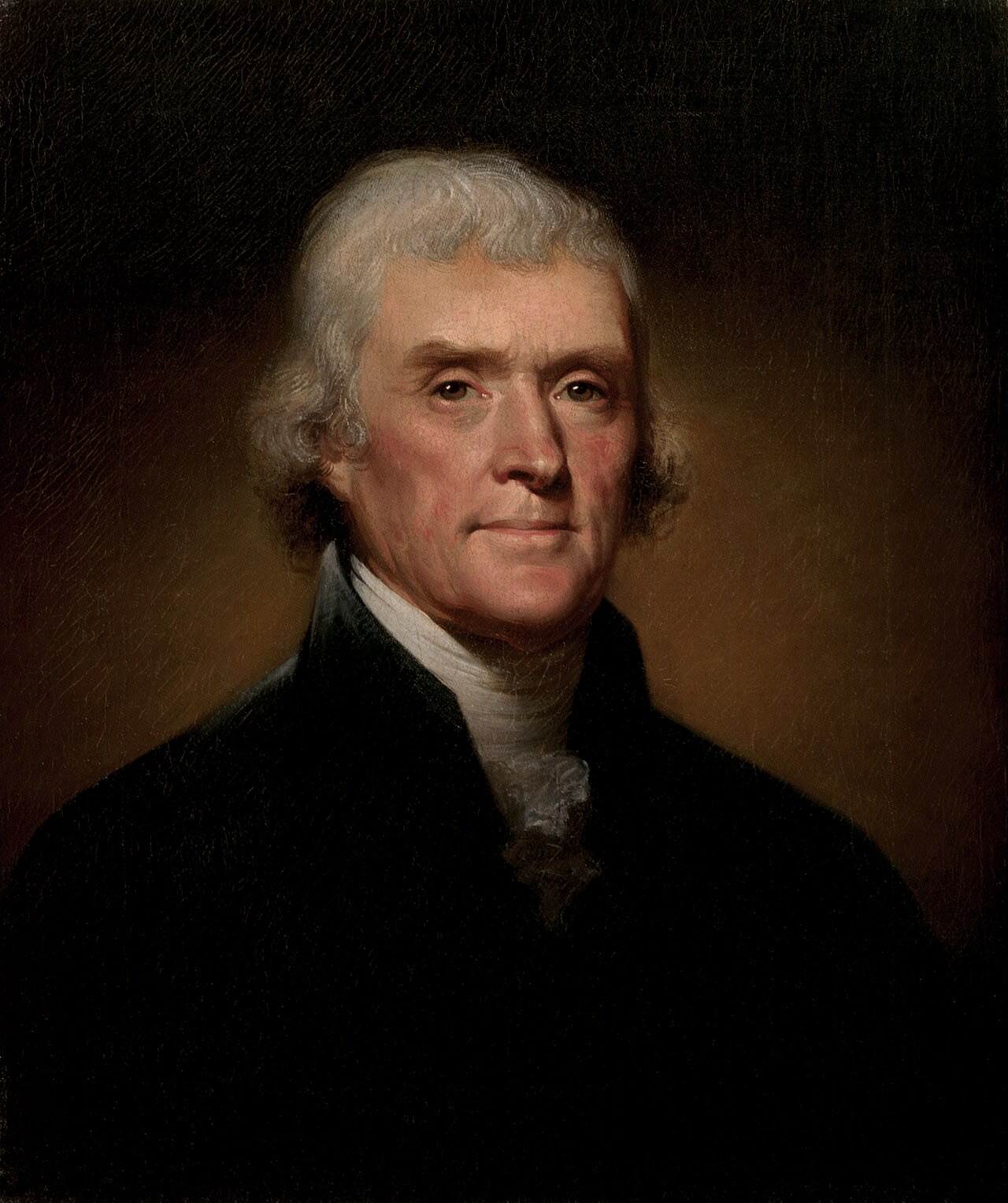
In 1822 Lardner Vanuxem and William H. Keating, two young Philadelphia mineralogists, described a new mineral from the Franklin iron mines in the Journal of the Academy of Natural Sciences of Philadelphia, and named it jeffersonite (the pamphlet). They printed their account as a pamphlet and dedicated it to Thomas Jefferson. On July 1, 1822 Keating, then professor of mineralogy and chemistry at the University of Pennsylvania, sent him a copy. It held, he wrote, “I believe, the description of the first new American mineral, discovered and described by Americans.”
Jefferson was seventy-nine and had long been a student of nature; he had been president of the American Philosophical Society for nearly twenty years. On July 18 he wrote back from Monticello to thank Keating for the account of the new mineral and for “the honor done my name.” In other words, he was pleased, and said so. He added, a little sadly, that age and a failing memory had taken his attention from the physical sciences, though not his affection for them.
Keating’s letter
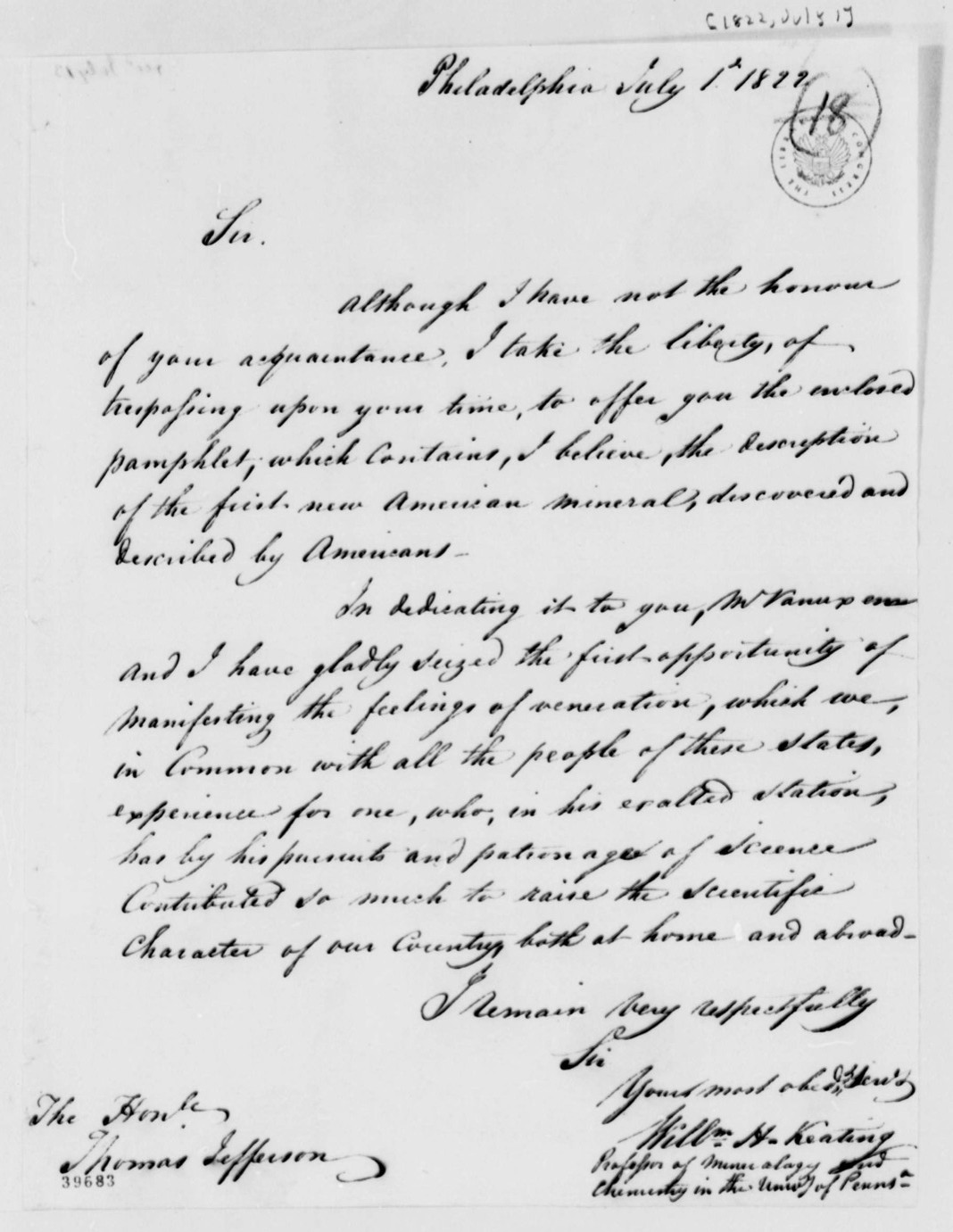
The letter that went with the pamphlet, in Keating’s own spelling and capitals:
Philadelphia July 1st 1822
Sir.
Although I have not the honour of your acquaintance, I take the liberty, of trespassing upon your time, to offer you the enclosed pamphlet, which Contains, I believe, the description of the first new American mineral, discovered and described by Americans–
In dedicating it to you, Mr Vanuxem and I have gladly seized the first opportunity of manifesting the feelings of veneration, which we, in Common with all the people of these States, experience for one, who, in his exalted station, has by his pursuits and patronage of Science Contributed so much to raise the Scientific Character of our Country both at home and abroad–
I remain very respectfully
Sir
Your most obedt Servt
Willm. H. Keating
Professor of Mineralogy and Chemistry in the Univ. of Penna.
The Honble Thomas Jefferson
In plain words: we have not met, but I am sending you our pamphlet on what I believe is the first new mineral found and described by Americans; Mr. Vanuxem and I dedicated it to you, glad of the chance to honor a man who has done so much for American science.
On the back of the sheet is the note of when it was received. Jefferson answered on July 18.
Jefferson’s letter
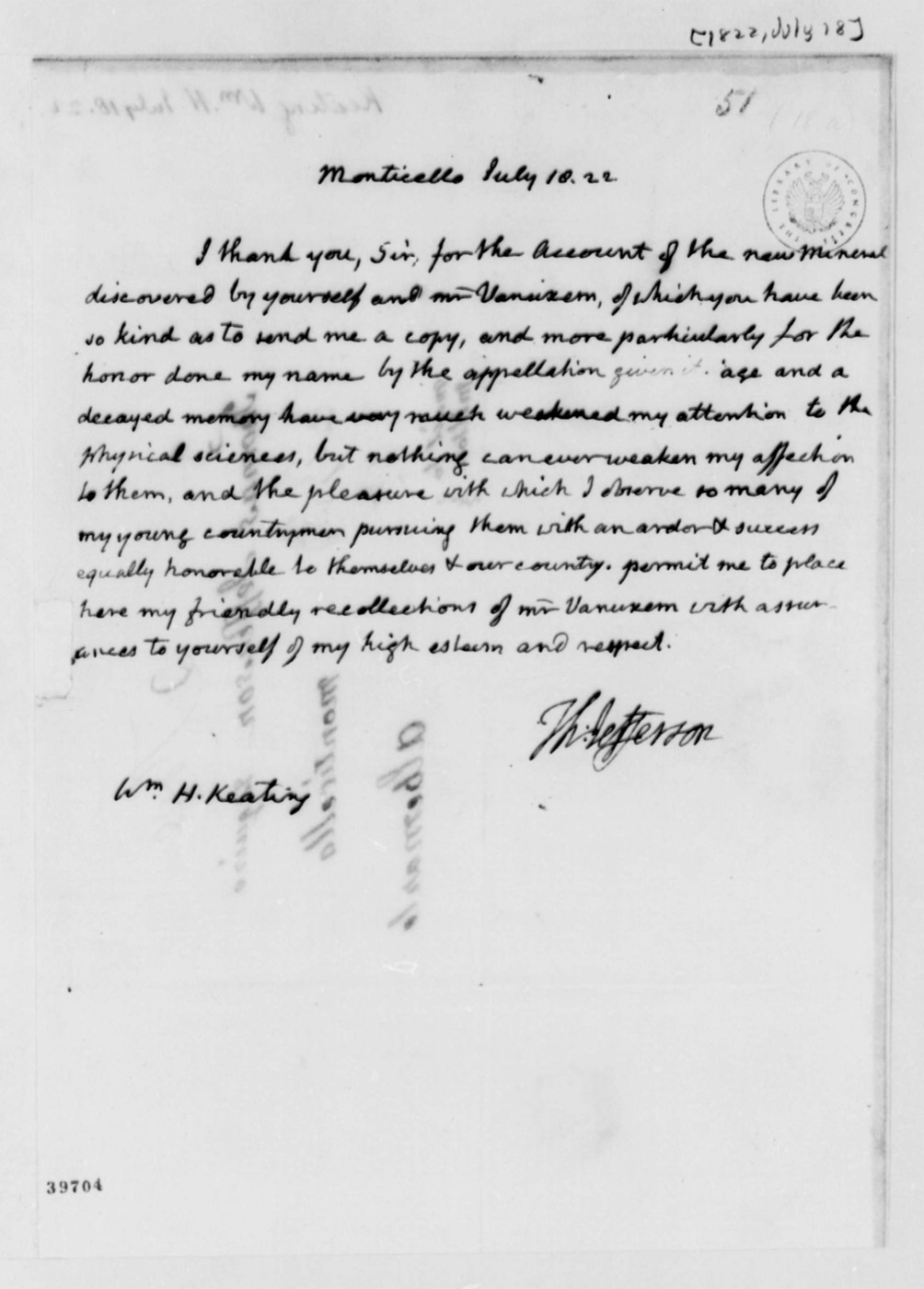
His reply, in his own spelling and punctuation:
Monticello July 18. 22.
I thank you, Sir, for the Account of the new Mineral discovered by yourself and mr Vanuxem, of which you have been so kind as to send me a copy, and more particularly for the honor done my name by the appellation given it. age and a decayed memory have very much weakened my attention to the physical sciences, but nothing can ever weaken my affection to them, and the pleasure with which I observe so many of my young countrymen pursuing them with an ardor & success equally honorable to themselves & our country. permit me to place here my friendly recollections of mr Vanuxem with assurances to yourself of my high esteem and respect.
Th: Jefferson
Wm. H. Keating
In plain words: thank you for the account and for naming the mineral after me; I am old and my memory is going, so I follow the sciences less than I did, but I love them still, and I am glad to see young Americans doing such good work in them. My regards to Mr. Vanuxem.
A name that did not last
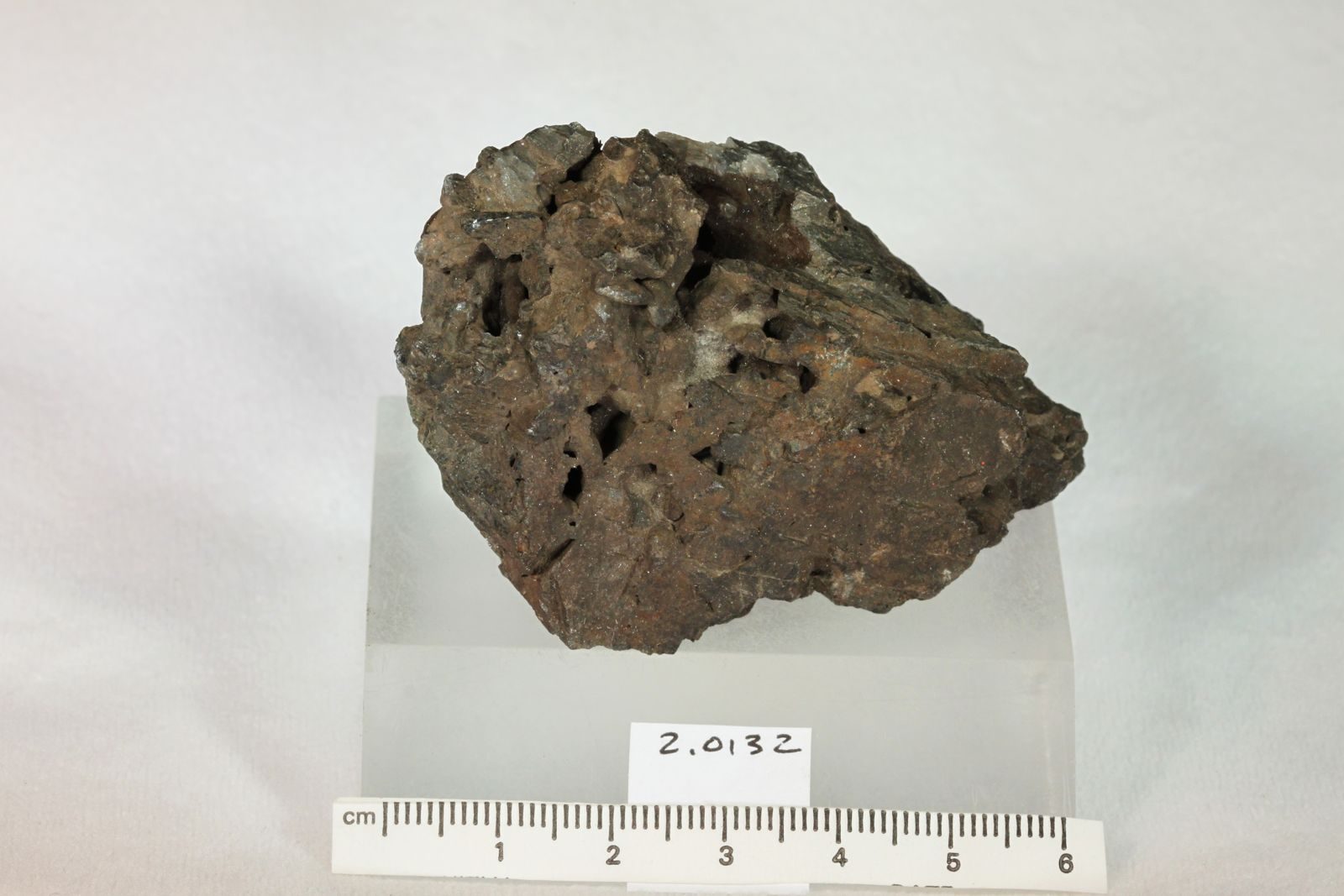
Monticello’s historians note that Jefferson is the only American president to have had a mineral named for him. But jeffersonite did not hold up as a species. Later study showed it to be a pyroxene, a variety of augite rich in zinc and manganese, and today the name survives only as a variety name, used by collectors for the dark crystals of Franklin. The International Mineralogical Association’s pyroxene report of 1988 formally discarded the name, equating jeffersonite with “zincian manganoan diopside or augite” (Morimoto 1988, table 6).
The letters do survive, in the Jefferson papers at the Library of Congress, and with them a small moment in the history of American science: two young men from Philadelphia, a mineral from a New Jersey iron mine, and a former president writing to say thank you.
In The Picking Table
The journal’s jeffersonite is the mineral, not the president. In 1967 it abstracted Clifford Frondel and Jun Ito’s “Zincian aegirine-augite and jeffersonite from Franklin, New Jersey,” which proposed that the name be set aside (vol. 8, no. 1, February 1967), and later that year it printed Frondel’s talk to the Society, “Franklin minerals, past and present,” in which he says he had searched the big collections in vain for an original specimen and learned only that day that the Noble Pit wall where members had been digging was where Vanuxem and his partner had collected (vol. 8, no. 2, August 1967). Frank Z. Edwards’s “The exclusive minerals of Franklin/Ogdensburg, N.J.” keeps jeffersonite on the list with a question mark (vol. 9, no. 1, February 1968); an editor’s note on obsolete pyroxenes records that under the 1988 pyroxene nomenclature jeffersonite becomes zincian manganoan diopside or augite (vol. 30, no. 2, Fall 1989). An 1862 account of the Franklin mines by A. C. Farrington, reprinted in vol. 39, no. 2 (Fall/Winter 1998), credits “Profs. Keating and Vannuxen” with the paper describing jeffersonite, and Fred J. Parker’s “Three collector’s tales” (vol. 40, 1999) remembers digging for “jeffersonite” crystals in the Mud Zone in 1967. No article on Vanuxem, Keating, or Jefferson’s letter has appeared in The Picking Table.
Sources and further reading
- Palache, C., 1935, The minerals of Franklin and Sterling Hill. U.S. Geological Survey Professional Paper 180 (on jeffersonite as a pyroxene). PDF
- Thomas Jefferson Encyclopedia: jeffersonite. Monticello. Monticello
- Thomas Jefferson to William H. Keating, July 18, 1822. Founders Online, National Archives (transcription). Founders Online
- Thomas Jefferson to William H. Keating, July 18, 1822. The letter itself, Thomas Jefferson Papers, Library of Congress. Library of Congress (scan)
- Vanuxem, L., and Keating, W. H., 1822, Account of the jeffersonite, a new mineral discovered at the Franklin iron works. Journal of the Academy of Natural Sciences of Philadelphia, vol. 2, p. 194–204. The pamphlet itself, at the American Philosophical Society. APS (scan)
- William H. Keating to Thomas Jefferson, July 1, 1822. Founders Online, National Archives. Founders Online
- William H. Keating to Thomas Jefferson, July 1, 1822. The letter itself, Thomas Jefferson Papers, Library of Congress. Library of Congress (scan)
As far as we can find, this life has not been written up in The Picking Table. Written with Claude, an AI model made by Anthropic, from the sources listed above, and checked against them. October 2026.