Histories › A map written in minerals
A curving Franklin mineral named in the Lenape language, an old iron furnace, and the forest the zinc company bought to hold its mines up.
Many windings
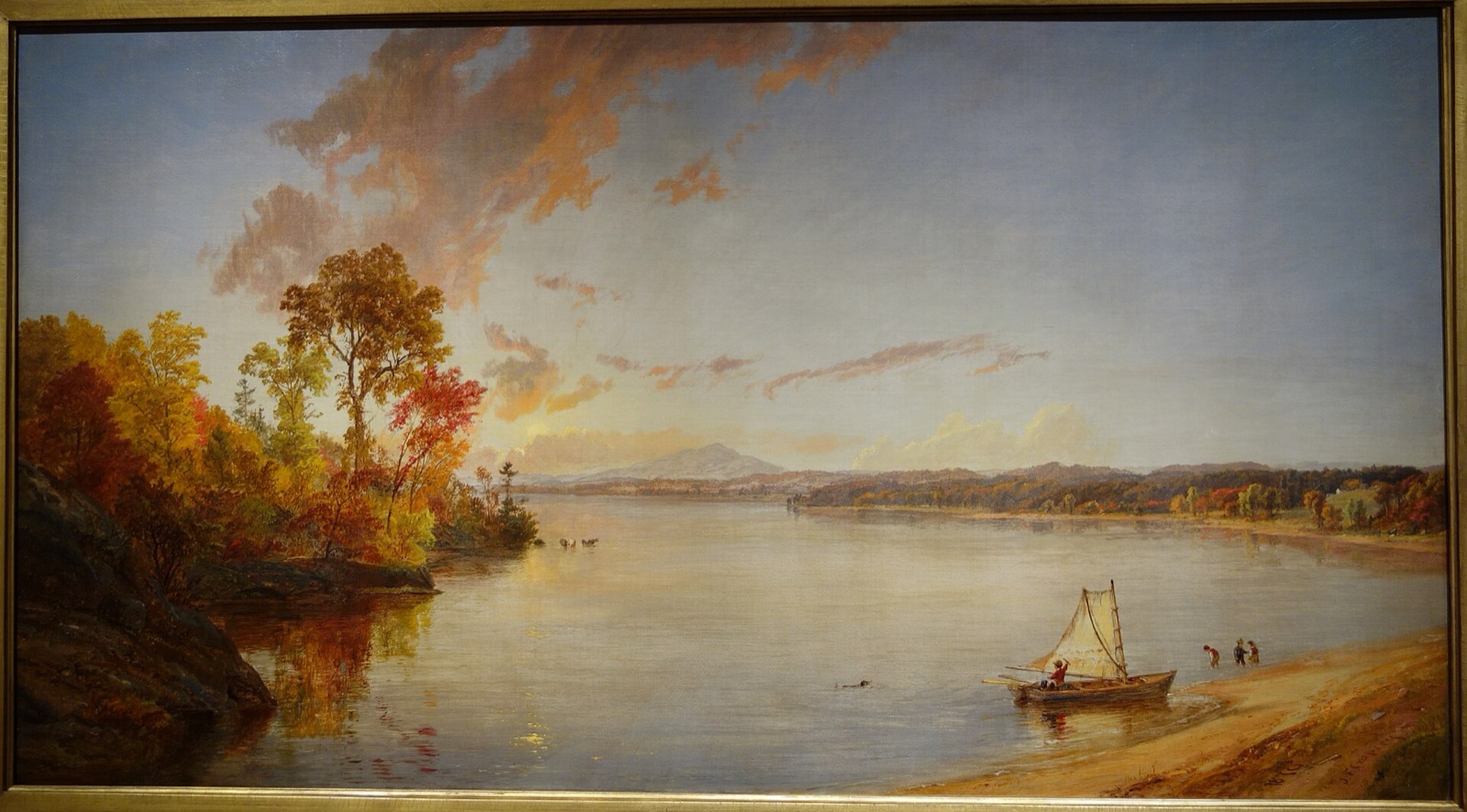
Wawayanda is the name of a mountain and a lake in the Highlands north-east of Franklin, now Wawayanda State Park. The word comes from the Lenape, the people of the region (the local branch were the Minsi, or Munsee), but no one agrees on what it meant. A 1785 affidavit, quoted in Ruttenber’s Indian Geographical Names, says it signified “egg-shaped.” Later writers give “winding, winding water,” and local lore “way of the wild goose.”
In 1990 Pete Dunn and his colleagues used the “winding” reading for a new Franklin mineral. They named it wawayandaite, they wrote, “in allusion to the grossly curved and winding habit of the preponderance of its crystals.” It is a calcium manganese beryllium boron silicate, colorless and pearly, in tiny plates that curl and bend, so soft and fine that some of it is like clay. It does not glow under ultraviolet light.
It had been hiding in plain sight. It sits on a vein surface of andradite over willemite and franklinite ore, beside “superb, 6 × 1 mm, prismatic willemite crystals, the best ever found at Franklin,” with hodgkinsonite, cahnite and friedelite. Those specimens were in collectors’ hands by 1923, kept for their willemite. The new mineral was, in the authors’ words, “preserved by serendipity.” The type specimens are at the Smithsonian.
A name that crosses the line
The mineral was found at Franklin, but the name it carries runs well beyond Sussex County. Wawayanda State Park, some 34,000 acres, lies in Vernon Township on the Sussex side and in West Milford on the Passaic County side. North of the state line the name keeps going. In 1703 Lord Cornbury, governor of both New York and New Jersey, granted John Bridges and eleven associates the Wawayanda Patent, about 150,000 acres in what is now Orange County, New York, confirmed by Queen Anne. A town in Orange County, Wawayanda, still has the name.
So a Lenape word for this stretch of the Highlands became a lake and a park in New Jersey, a colonial land grant and a town in New York, and, in 1990, a mineral that the Handbook of Mineralogy knows from Franklin alone.
Charcoal iron at the lake
Long before the zinc company came, Wawayanda was iron country. In the mid-1840s (sources say 1845 or 1846) the Ames family of Massachusetts, the shovel makers, built a charcoal blast furnace at the outlet of the lake. It burned the woods for charcoal, thousands of acres of them, and smelted ore from nearby mines, chiefly the Acker mine; the pig iron went by mule team to the Morris Canal at Lake Hopatcong. The furnace was out of blast by the 1850s or 1860s, and its stone stack still stands in the park.
A forest for mine props
In 1918 the New Jersey Zinc Company bought about five thousand acres of forest around the lake. A local historian writing in 1933 gave the reason plainly: the company “bought the land because of its rich woodlands, needing timber to use for mine props, in its Franklin, New Jersey mines.” Company people built cabins along the shore, and the company’s magazine, Zinc, ran articles on Wawayanda Lake in 1919 and 1920. The zinc company held the land until the State of New Jersey bought it in the 1960s for the park.
How timber held up the Franklin mine
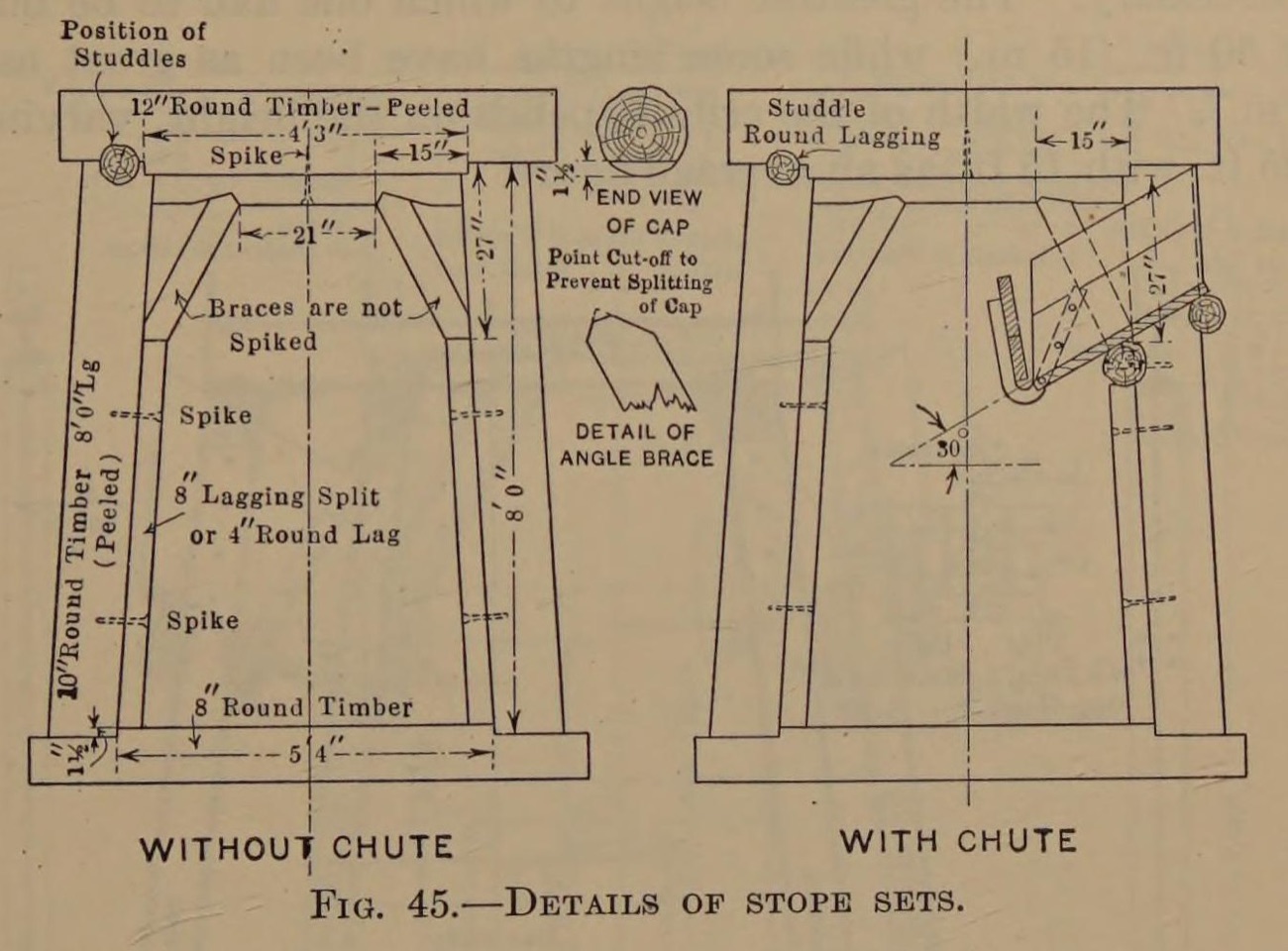
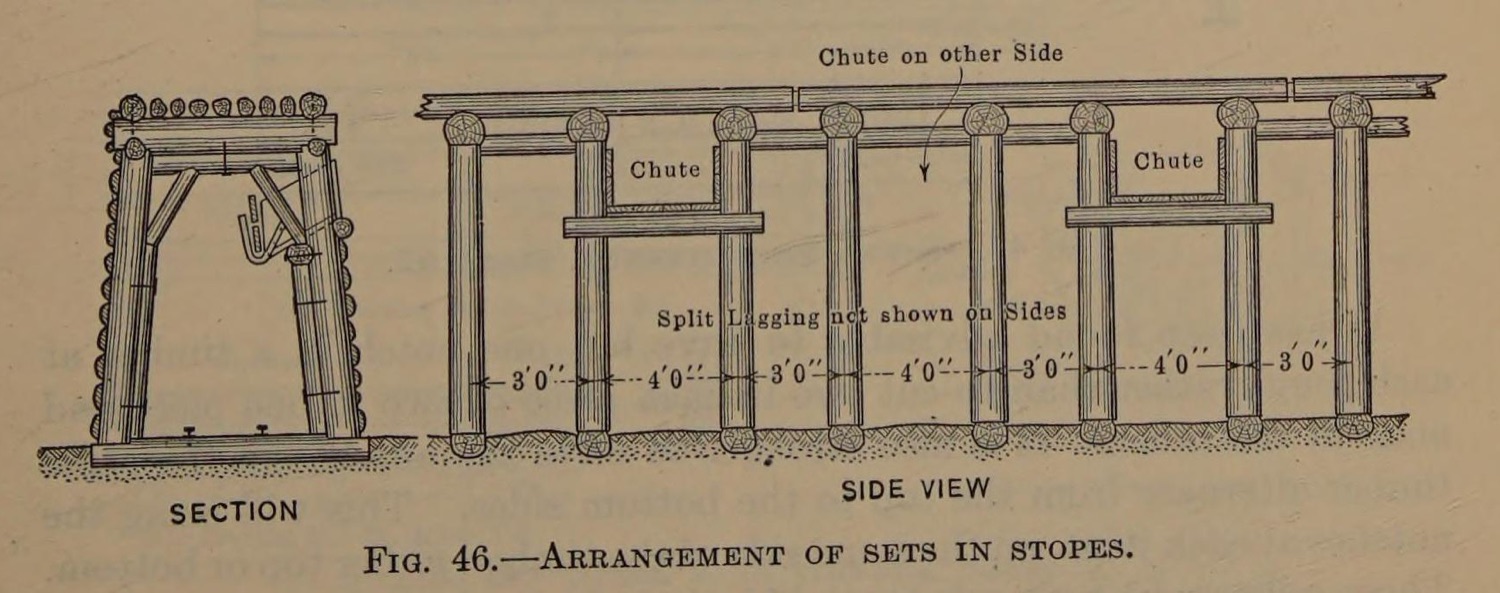
In 1918 two of the company’s engineers, C. M. Haight and B. F. Tillson, described how the Franklin mine was worked. The ore was taken out in tall slices called stopes, about 17 feet wide, mined upward from level to level, then filled with rock, and the pillars between them were mined last from the top down.
“Practically all the stopes are worked by means of set timbers,” they wrote: two eight-foot legs of round chestnut or oak, a cap across the top and a sill below, with split lagging behind. When a timber failed, the miners put in a “helping set” beside it. The timber came in by team and railroad, went down an old shaft to the 400-foot level and was sent through the ore body on timber slides. In the shafts the timbers were long-leaf yellow pine, a foot square. In 1916 timber cost the mine about ten cents for every ton of ore.
Even then steel was coming in. Haight and Tillson describe steel sets being tried in the stopes, and note that all sets, wood or steel, were recovered and used again. At Sterling Hill, which was worked until 1986, the drifts were later held with steel I-beams where support was needed, and the rock was pinned with steel rock bolts, the method that replaced timber in mines across the country after the Second World War. From 1918 on, the company could cut its mine timber from its own woods around Lake Wawayanda.
In The Picking Table
An unsigned company account, “The New Jersey Zinc Company: an important part of Sussex County for 125 years” (vol. 19, no. 1, March 1978), describes the Sterling mine of the 1970s, with roof bolts in the stopes and the old square-set timbering kept in the pillars. The abstract of the description, “New to science: wawayandaite” (vol. 31, no. 2, Fall 1990), gives the Lenape “many or several windings” and adds an editor’s note that wawayandaite was in Roebling’s hands as early as 1923. John Cianciulli’s museum news (vol. 34, no. 1, Spring/Summer 1993) records Peter Chin’s loan to the Franklin Mineral Museum of the only wawayandaite specimen then known in a private collection. William R. Truran’s note on the front cover of vol. 51, no. 1 (2010), a miner drilling a stope about 1918, suggests that the plank under his drill was trucked down from Wawayanda in Vernon and perhaps cut by the timber gang at the Ding Dong shaft. Benjamin F. Tillson’s “A report on the operations of the Franklin mine during 1910” (vol. 59, no. 1, Spring 2018), edited by Mark Boyer, includes the timbering of the stopes, the new timber yard and the lagging, timber and plank used that year. No article on Lake Wawayanda, the Ames furnace or the company’s woodland has appeared in The Picking Table.
Sources and further reading
- Dunn, P. J., Peacor, D. R., Grice, J. D., Wicks, F. J., and Chi, P. H., 1990, Wawayandaite, a new calcium manganese beryllium boron silicate from Franklin, New Jersey. American Mineralogist, vol. 75, p. 405–408. PDF
- Haight, C. M., and Tillson, B. F., 1918, Zinc mining at Franklin, N.J. Transactions of the American Institute of Mining Engineers, vol. 57, p. 720–829. Full text (archive.org)
- Mark, C. (NIOSH), 2002, The introduction of roof bolting to U.S. underground coal mines (1948–1960): a cautionary tale. Proceedings, 21st International Conference on Ground Control in Mining, p. 150–160. CDC Stacks (full text)
- The same paper, abstract. OneMine
- Shaw, E. B., 1933, Wawayanda Lake. Warwick Dispatch, October 11, 1933; transcribed by the Albert Wisner Public Library. Wisner Library
- Sterling Hill Mine, National Register of Historic Places nomination, 1990. National Park Service (PDF)
- Tillson, B. F., 1919, Wawayanda Lake. Zinc (magazine of the New Jersey Zinc Company), vol. 4, p. 292–295; and Walton, J. G., 1920, Lake Wawayanda, N.J. Zinc, vol. 5, p. 318–321. Not yet found online.
Written with Claude, an AI model made by Anthropic, from the sources listed above, and checked against them. October 2026.