Histories › Names that did not last
Dysluite, sterlingite, spartaite, algerite, schefferite, hydrohetaerolite, vanuxemite, keatingine, hydrofranklinite and polyadelphite: minerals named for the mines, their collectors and their first explorers, and how each name was taken away; clinohedrite, a name used twice; and baumite, hancockite and calcium larsenite, unnamed under the modern rules.
Many minerals from Franklin and Sterling Hill were named, described and later unnamed. Some proved to be minerals already known under another name; some were mixtures of two or three; some were only varieties. The names honored places, collectors and the first scientists to visit the mines, and each failure shows how hard it was to tell minerals apart before X-ray methods.
This page follows those names from the books and journals that gave them, read from the page images, to the later work that took them away. A good guide to all of them is A. H. Chester’s Dictionary of the Names of Minerals (1896), which gives for each name who coined it, when, where it was printed and what it was taken to mean (Chester, 1896). Names given to places that survived, such as franklinite and sterlinghillite, are on Franklin, Sterling Hill and Ogdensburg in mineral names.
Dysluite, 1822–1846: the first “new mineral” of Franklin
When Lardner Vanuxem and W. H. Keating listed the minerals of Franklin in 1822, the first entry was a name of their own: “1. Dysluite,* a new mineral.” The footnote read: “The Dysluite is a new mineral, which crystallizes in regular octohedrons. Its specific gravity is from 4. 35—4. 60. It is infusible before the blowpipe: a full account of this mineral may be expected in a subsequent number” (Journal of the Academy of Natural Sciences of Philadelphia, 1822, p. 287). The same list already included “Automalite,” the zinc spinel known in Europe.
The full account never came. Two years later they wrote that “from a multiplicity of other engagements, we have been prevented from completing our examination of a substance which we believed new, and to which we gave the name of Dysluite. We hope soon to be able to present it to the Academy” (1824, p. 1).
In January 1846 the American Journal of Science reported Francis Alger’s verdict under the heading “Dysluite identical with Automolite”: “Mr. Alger states that from recent observations of the New Jersey specimens, he is satisfied there is no reason for any longer considering the two minerals distinct” (p. 121). Automolite is now called gahnite.
The name outlived the species. Palache wrote in 1935 that the green octahedral gahnite of the old Passaic mine at Sterling Hill “was first mentioned by Vanuxem and Keating (12) as new, under the name of dysluite, a name still used in the district to describe this occurrence” (Palache, 1935, p. 44).
Sterling and Sparta, 1843–1872: spartalite, sterlingite, spartaite, stirlingite
Before the present names settled, Sterling Hill and Sparta township were tried out on several minerals. None of those names survived.
Sterlingite, 1844. Francis Alger of Boston, editing the fifth American edition of William Phillips’s Elementary Treatise on Mineralogy, headed the red zinc ore “RED OXIDE OF ZINC. STERLINGITE.” He added that it “is known to occur only in Sussex county, N. J.,” and that “at Franklin and Sterling, particularly the latter, the greatest workable quantities exist to invite the attention of capitalists” (p. 565–566). Palache noted the name was “here suggested for zincite but never accepted” (Palache, 1935, bibliography no. 38). The mineral became zincite.
Spartalite. H. J. Brooke and W. H. Miller printed the name in their new edition of Phillips in 1852: “106. SPARTALITE.—Red oxide of zinc; Phillips” (p. 218). Shepard, below, credited it to them. Chester’s dictionary gives it an earlier author: “SPARTALITE. E. J. Chapman, 1843, Chap. Min., 81, f. Sparta, N. J., its locality, and λίθος. A syn. of zincite” (Chester, 1896, p. 253).
Spartaite, 1858. August Breithaupt gave the name “Spartait” to the manganese-rich calcite of Sterling Hill (Palache, bibliography no. 73). This is the gangue that turns the old dumps black as its manganese oxidizes.
Calcimangite, 1864. Charles Upham Shepard of Amherst had long called that calcite “calcimangite” in his own cabinet. Writing on December 14, 1864, he learned that Breithaupt had named it first, and objected: “But as this last name is so nearly synonymous with Spartalite, (given in 1852 by Brooke and Miller, to the red oxyd of zinc), I would suggest the substitution of calcimangite for it, as an appellation that may serve to prevent confusion, the more especially as the two minerals occur together” (American Journal of Science, 1865, p. 175). Palache’s verdict: “a name never again used” (bibliography no. 89).
Stirlingite and roepperite, 1872. In 1870 W. T. Roepper described a zinc-bearing olivine and a manganese dolomite from Sterling Hill. Early in 1872 G. A. Kenngott, writing in the German Jahrbuch für Mineralogie, named the olivine stirlingite and the dolomite roepperite. A month later George J. Brush at Yale, in the supplement to Dana’s System of Mineralogy, named the olivine roepperite. The American Journal of Science sided with Brush’s choice but not his claim: “As the silicate is more deserving of a distinct name, it is to be regretted that Rœpper’s name cannot be affixed to it” (August 1872, p. 146). Palache, noting that “the name sterlingite had already been used for zincite” (bibliography no. 103), kept roepperite for the olivine. He also wrote that tephroite “has since been found to have so wide a range in content of zinc that no sharp line can be drawn between the two” (p. 78). Roepperite is not on today’s list of species.
None of these names is in use today. Sterling Hill had to wait until 1981, and sterlinghillite, for a mineral name that lasted.
Algerite, 1849–1854: a name for Francis Alger
Francis Alger of Boston, the editor who had proposed “sterlingite” in 1844 (above), placed a yellow mineral from Franklin in the hands of T. S. Hunt of the Geological Commission of Canada. Hunt printed Alger’s description in 1849: “It is found in the town of Franklin, Sussex county, New Jersey. The crystals are imbedded in a white crystalline limestone … They are occasionally two inches in length and rarely three, and are never more than one-eighth of an inch in thickness. Like sillimanite and scapolite they are frequently curved” (American Journal of Science, 1849, p. 103). Near the surface the crystals were “a deep brownish-yellow, which is evidently due to their partial decomposition.” Alger added: “I believe that Prof. Nuttall was the first mineralogist who expressed the opinion that this mineral might prove to be a new species.”
Hunt analyzed it and ended his paper, dated Montreal, May 5, 1849: “I offer it as a new mineral species which will take a place by the side of edingtonite; and to connect with his favorite science, the name of one who is among its most successful cultivators, I propose for it the designation of Algerite” (p. 106).
The name lasted five years. Palache’s bibliography, read from its pages, follows the argument: J. D. Dana in 1853 “Regards algerite as an alteration product of scapolite”; in 1854 J. D. Whitney’s “new analysis confirms Dana’s conclusion”; Hunt that year “Upholds the validity of the species”; and Dana answered him, classing “algerite as an alteration of scapolite” (Palache, 1935, bibliography nos. 62–65). Alger had himself noticed that the crystals near the surface were decomposing. Dana’s verdict made the whole mineral an altered scapolite, and the name dropped out of use.
Schefferite, zinc schefferite and leucaugite, 1862–1988: pyroxenes renamed
Some names were not wrong so much as retired. Pyroxenes, the family of minerals that includes jeffersonite, carried dozens of names for varieties of color and chemistry. Two were common at Franklin. Schefferite was named by the Swede J. A. Michaelson in 1862 “in honor of H. T. Scheffer, a Swedish chemist,” for “A manganese pyroxene, of yellowish or reddish-brown color” (Chester, 1896, p. 241–242). Leucaugite was J. D. Dana’s name of 1868, from the Greek for “white” and augite: “A white or grayish var. of augite” (p. 155).
At Franklin and Sterling Hill a zinc-bearing kind was called zinc schefferite, and it mattered in the mill: “Zinc schefferite is rare at Franklin, but at Sterling Hill it is in places sufficiently abundant to lower the grade of the willemite concentrate” (Palache, 1935, p. 18).
In 1988 the international commission on mineral names tidied the pyroxenes. Its table of “Obsolete pyroxene names” lists “schefferite = manganoan diopside,” “leucaugite = diopside,” and “jeffersonite = zincian manganoan diopside or augite,” with the note that these names “have been formally discarded” (Morimoto, American Mineralogist, 1988, p. 1131).
Collectors kept the old word. Mark Boyer’s article on Franklin collectors’ jargon in The Picking Table explains that “Christmas Tree Ore,” in its original sense, was the polka-dot pattern of red- and green-fluorescing calcite and willemite “in a nonfluorescent, dark brown matrix known at the time as zinc-schefferite” (vol. 53, no. 2, Fall 2012, p. 25).
Clinohedrite, 1866 and 1898: one name, two minerals
Some names did not die; they were given away. In 1866 August Breithaupt named a mineral “Clinoëdrit.” Chester’s dictionary of 1896 gives it as “CLINOHEDRITE. A. Breithaupt, 1866 … f. κλίνειν, ‘to incline,’ and ἕδρα, ‘a base.’ A kind of tetrahedrite, supposed to vary from its usual form” (p. 61): a variety of the copper ore tetrahedrite, not a species of its own.
Two years after Chester’s dictionary, S. L. Penfield and H. W. Foote described a new zinc silicate from Franklin. Its crystals have almost no parallel faces, and that “peculiar inclined faced character or appearance … has suggested the name of the mineral, clinohedrite (κλίνειν, incline, and ἕδρα, face)” (American Journal of Science, 1898, p. 289). The same two Greek words made the same name a second time, for a different reason and a different mineral. We find no mention of Breithaupt’s mineral in their paper. The Franklin mineral kept the name: clinohedrite is on the Franklin species list today, marked as first described there. It is one of the minerals in Crystals that charge.
Vanuxemite and keatingine, 1876: two names for the first explorers
In 1822 Lardner Vanuxem and William H. Keating of the Academy of Natural Sciences in Philadelphia published one of the first scientific accounts of Franklin and its minerals (see Drawing the folds). Half a century later Charles Upham Shepard of Amherst College tried to name a mineral for each of them. Both names failed.
The American Journal of Science printed Shepard’s descriptions in 1876 under the heading “New Minerals” (p. 231). Vanuxemite, from Sterling Hill, “Occurs in small irregular patches scattered through a firm ochery aggregate, proceeding from the decomposition of several zinc ores. Massive, impalpable … Color white, dull.” It “Does not adhere to the tongue, but emits a feeble clayey odor on being breathed upon.” Keatingine, from Franklin, was “Considered ‘probably a new species’” and “Closely resembles fowlerite in crystalline structure”; it was “found in a mass of yellow garnet.” The same note named a third Franklin mineral, calcozincite, an orange-red granular mass “interpenetrated with fibres of asbestus and sussexite.”
None survived. In 1877 C. W. Cross analyzed Shepard’s vanuxemite and found it “a mixture of calamine and halloysite” (Palache, bibliography no. 113), and Palache summed up all three as “later proved to be mixtures of known minerals” (no. 110). Later accounts disagree on what the mixture held. Clarence S. Ross of the U.S. Geological Survey examined a type specimen of vanuxemite from the Roebling collection in 1946 and found it “impure, being composed of two or more materials. An x-ray examination gave only extremely weak lines which were definitely not those of sauconite” (American Mineralogist, 1946, p. 413–414). The Picking Table’s list of Frondel’s mineral rulings in 1971 says the opposite, that sauconite “was identified by Ross in 1946 as a constituent of the mixture called vanuxemite” (vol. 12, no. 2, August 1971, p. 7). A later note calls the zinc clay “a mixture according to Faust 1951” (vol. 18, no. 1, March 1977).
Keatingine turned out to be a known mineral, though not everyone agreed which. Chester in 1896 called it “A syn. of fowlerite,” the zinc-bearing rhodonite (p. 142). Chester also records the spelling “keatingite”: “Variant of keatingine.” Palache found that the fibrous pink silicate Franklin collectors called “manganese wollastonite” was bustamite, and added: “The ‘keatingine’ of Shepard (112) likewise is bustamite” (Palache, 1935, p. 68).
Calcozincite lived on as a collectors’ word. Earl R. Verbeek describes it in The Picking Table as “an informal term for splintery aggregates of zincite intergrown with another mineral, usually calcite but also including sussexite and amphibole,” formed along faults (vol. 54, no. 2, Fall 2013).
Hydrofranklinite, 1882–1894, and polyadelphite, 1836: two more that were already known
Hydrofranklinite. “In 1882 Roepper (124) announced a new hydrous oxide of zinc, iron, and manganese, found at Sterling Hill in the form of octahedrons, and gave to it the name ‘hydrofranklinite,’” Palache wrote. “His investigation was unfinished at his death” (Palache, 1935). Chester explained the name: “f. ὕδωρ, ‘water,’ and franklinite, because a hydrous mineral otherwise similar to franklinite” (Chester, 1896, p. 128).
S. L. Penfield and D. A. Kreider took the problem up with specimens Brush had collected at Sterling Hill in 1875 (American Journal of Science, 1894, p. 141). The crystals were tiny, “the largest not over 1mm,” and could not be picked out by hand. Then they noticed something: “in washing the pulverized mineral, that the crystals had a decided tendency to float, owing probably to the smooth surfaces that they possess, combined with the fact that water does not seem to wet them.” By rocking a beaker so that “a wave or ripple passes over the powder,” they floated the crystals off (p. 142). Their analysis matched chalcophanite, which G. E. Moore had described from Sterling Hill in 1875, and the “octahedrons” were rhombohedrons with a flat base. As a check they borrowed a specimen from Lehigh University “which was labeled hydrofranklinite in Professor Rœpper’s own handwriting and which was in every respect similar to the material analyzed by us” (p. 143).
Polyadelphite. In 1829 Thomas Thomson, working in Glasgow on specimens sent from America, analyzed a Franklin mineral he later named polyadelphite, from the Greek for “many” and “brother,” “because it consists of five different silicates united” (Chester, 1896, p. 214). Palache calls it a “variety of garnet named by Thomson in his Mineralogy, vol. 1, p. 134, 1836” (bibliography no. 24). At Franklin, he wrote, “Great masses of yellow, green, or brown massive garnet, mingled with biotite, franklinite, rhodonite, calcite, and other minerals, were characteristic especially of the Trotter and Parker shafts … The material analyzed and named ‘polyadelphite’ by Thomson (24) was probably of this nature.” His analyses of it, he wrote, “represent manganiferous andradite or iron-calcium garnet” (Palache, 1935).
Hydrohetaerolite, 1928–2019: a companion’s companion
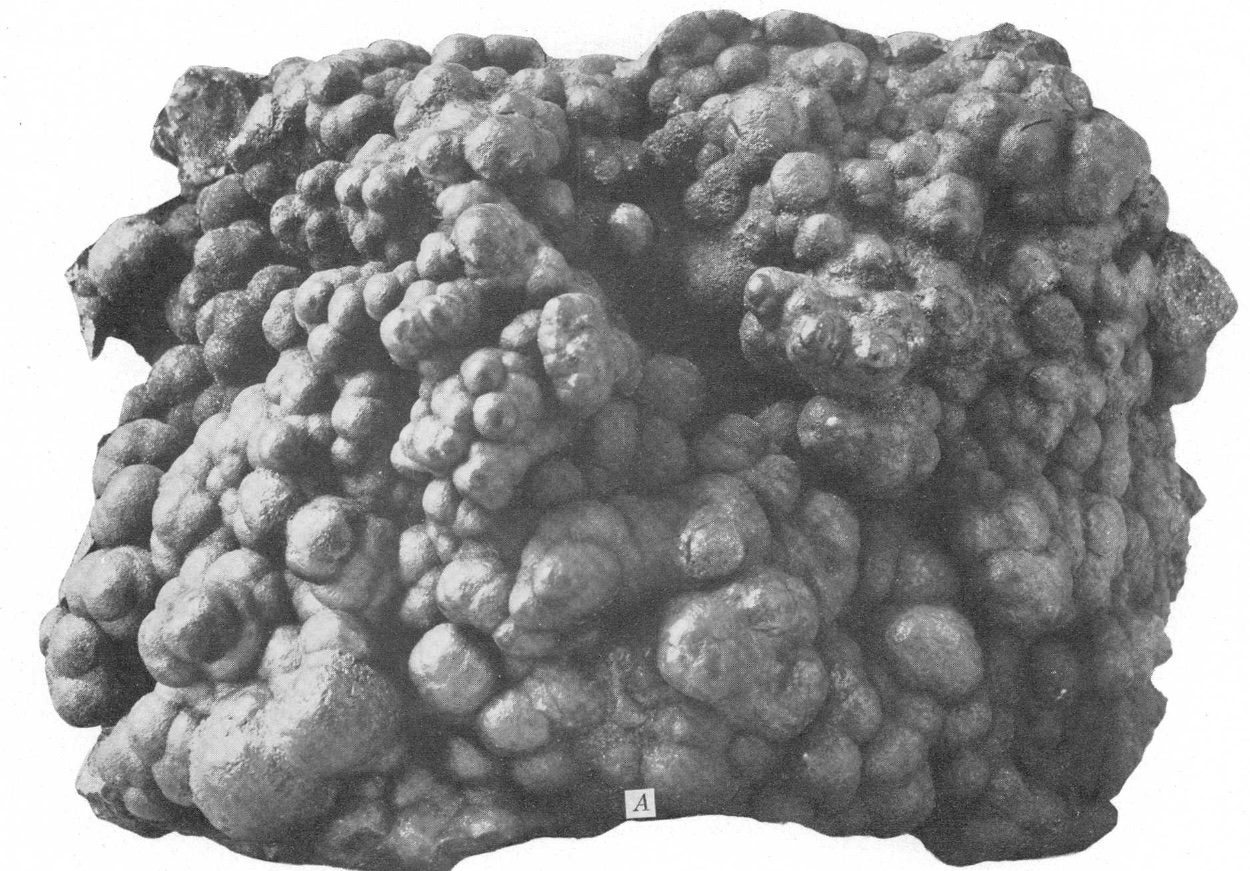
In 1877 G. E. Moore named a black zinc-manganese mineral from Sterling Hill hetaerolite, from the Greek for “a companion,” “because found with chalcophanite” (Chester, 1896, p. 120). Moore gave no analysis.
Later work found two kinds. Palache wrote that material from a new find at Sterling Hill, free of water, proved Moore right that the mineral is a zinc hausmannite, “Under these circumstances it seems quite justifiable to use his name, ‘hetaerolite’, for the anhydrous oxide. The hydrous variety is described on page 53 under the name ‘hydrohetaerolite’” (Palache, 1935, p. 49). Hydrohetaerolite, he wrote, “was found only at the Passaic mine, Sterling Hill, where it was abundant,” always with crusts of chalcophanite, the pairing that gave hetaerolite its name (p. 53). It is one of the minerals of the mud zone.
The water was its undoing. In 2019 the new nomenclature of the spinel supergroup showed that the formulas reported for it, from Leadville, Colorado, and from Switzerland, all fit hetaerolite with some hydroxyl in it: “Therefore, ‘hydrohetaerolite’ is discredited as corresponding to (OH)-bearing hetaerolite.” The authors record that it “was first reported by Palache (1928) as a hydrous counterpart of hetaerolite” (Bosi, Biagioni and Pasero, European Journal of Mineralogy, 2019, p. 189). The FOMS mineral list of 2017 still carried it as “Ogdensburg (Type Locality).”
Villyaellenite, 1988–2010: renamed miguelromeroite
A pink arsenate from Sterling Hill went onto the local list in 1988 as villyaellenite, a mineral described from Alsace only four years before. The same year a study of a Mexican find showed the Sterling Hill material to be “nearly identical chemically” to the pure manganese end of the series, not the mixed French type (Kampf and Ross, 1988, p. 1172). In 2009 that end member was named miguelromeroite, and in 2010 the list followed, not gladly: “Must the Franklin and Sterling Hill mineral list committee march to the unrhythmic drum beat of the IMA?” (The Picking Table, vol. 51, no. 1, Spring 2010, p. 17). The whole story is told on Miguelromeroite.
Baumite and the modern rules, 1975–2008: names still changing
The unnaming did not end with X-ray methods. In 2008 Earl R. Verbeek, curator and resident geologist of the Sterling Hill Mining Museum, wrote for the members of the Franklin-Ogdensburg Mineralogical Society on why the local species list had just fallen from 360 to 357 and why several familiar names had changed (“Why Are Our Mineral Names Changing?”, The Picking Table, vols. 48–49, 2007–2008, p. 14–15). The authority, he explained, is the Commission on New Minerals, Nomenclature and Classification of the International Mineralogical Association.
Some names still fell for the old reason. Baumite, “once one of our local prizes,” was described in 1975, Verbeek writes, as a zinc- and manganese-rich member of the serpentine group; “it was later shown to be a mixture of several serpentine and chlorite minerals,” and “was thus removed from the official list of local minerals” (p. 14). The name is older in The Picking Table than that date: it appears from 1968 in Frank Z. Edwards’s notes and Clifford Frondel’s reports (vol. 9, no. 2, August 1968, p. 7).
Other names fell to new rules. Under the 50:50 rule a solid solution takes the name of whichever end member dominates, so the plagioclase series, learned by most collectors as six species, shrank to albite and anorthite, and oligoclase left the local list; hyalophane went the same way when the orthoclase–celsian series was redefined. To show which species belong together, the IMA renamed members of groups: hancockite is now epidote-(Pb), and manganaxinite and ferroaxinite are axinite-(Mn) and axinite-(Fe). Verbeek counted the cost with the gain: two names to search instead of one, and “many of us mourn the passing of names we’ve long known and loved – it’s as if our history is being taken from us” (p. 14).
Calcium larsenite was renamed esperite once its supposed kinship with larsenite was disproved, “a logical and welcome change, and one which retained the historical linkage to Esper Larsen” (p. 14). The amphibole once called manganocummingtonite, and then tirodite, is now parvowinchite, and biotite is no longer a species at all but the name of a series of micas (p. 15).
Some changes only restore a spelling. Roméite was named not for the city of Rome but for the crystallographer Jean Baptiste Louis Romé de l’Isle, and the IMA put back the accents in it and in löllingite, köttigite, hübnerite and manganohörnesite. Precedence turned barite into baryte, though the local list kept the American spelling. And gageite-1A and gageite-2M, two structural variants of one mineral, became simply gageite (p. 15).
Verbeek concluded: “The terminology of mineral species is ever-changing as science advances, and has been doing so for more than two centuries” (p. 15).
In The Picking Table
Apart from Verbeek’s 2008 article on the modern rules, none of these names has an article of its own in The Picking Table, as far as a search of its full text shows (November 2026). Spartaite, vanuxemite and polyadelphite appear only in lists and passing lines: Frank Z. Edwards’s species list of 1968 includes “Calcite Spartaite” (vol. 9, no. 2, August 1968); John A. Manley’s collecting trip of 1899, reprinted in vol. 20, no. 1, March 1979, found “fine specimens of spartaite on the dumps” of the Trotter mine; and the zinc clay vanuxemite is mentioned in vol. 3, no. 2, July 1962, vol. 12, no. 2, August 1971 and vol. 18, no. 1, March 1977. The collectors’ word calcozincite is described by Earl R. Verbeek in vol. 54, no. 2, Fall 2013 and vol. 59, no. 2, Fall 2018.
Sources and further reading
- Alger, F. (ed.), 1844, An elementary treatise on mineralogy, by William Phillips, 5th ed. Boston. Red oxide of zinc, sterlingite, p. 565–566. archive.org
- [Alger, F.], 1846, Dysluite identical with automolite. American Journal of Science, 2nd ser., 1, 121. archive.org
- Anonymous, 1872, Stirlingite, Rœpperite. American Journal of Science, 3rd ser., 4, 146 (Scientific Intelligence, no. 21). archive.org
- Anonymous (signed E. S. D.), 1876, New minerals [Prof. C. U. Shepard: vanuxemite, keatingine, calcozincite, euchlorite, pelhamine]. American Journal of Science, 3rd ser., 12, 231. archive.org
- Bosi, F., Biagioni, C., and Pasero, M., 2019, Nomenclature and classification of the spinel supergroup. European Journal of Mineralogy, 31, 183–192. Hydrohetaerolite, p. 189. doi
- Brooke, H. J., and Miller, W. H., 1852, An elementary introduction to mineralogy, by the late William Phillips, new ed. London. Spartalite, p. 218–219. archive.org
- Chester, A. H., 1896, A dictionary of the names of minerals, including their history and etymology. New York: John Wiley & Sons. archive.org
- Hunt, T. S., 1849, Chemical examination of algerite, a new mineral species; including a description of the mineral, by F. Alger. American Journal of Science, 2nd ser., 8, 103–106. archive.org
- Morimoto, N., 1988, Nomenclature of pyroxenes. American Mineralogist, 73, 1123–1133. Table 6, Obsolete pyroxene names, p. 1131. PDF (MSA)
- Palache, C., 1935, The minerals of Franklin and Sterling Hill, Sussex County, New Jersey. U.S. Geological Survey Professional Paper 180. Bibliography nos. 24, 38, 62–65, 73, 89, 103, 110, 113, 124, 157; bustamite, p. 64; chalcophanite; garnet; roepperite, p. 78. PDF (USGS)
- Penfield, S. L., and Foote, H. W., 1898, On clinohedrite, a new mineral from Franklin, N.J. American Journal of Science, 4th ser., vol. 5, p. 289–293. archive.org
- Penfield, S. L., and Kreider, D. A., 1894, Mineralogical notes: 1. On the identity of hydrofranklinite and chalcophanite. American Journal of Science, 3rd ser., 48, 141–143. archive.org
- Ross, C. S., 1946, Sauconite—a clay mineral of the montmorillonite group. American Mineralogist, 31, 411–424. Vanuxemite, p. 413–414. PDF (MSA)
- Tyler, S. W., 1865, Analysis of a carbonate of lime and manganese (spartaite of Breithaupt) from Sterling, Sussex County, New Jersey; communicated, with remarks, by C. U. Shepard. American Journal of Science, 2nd ser., 39, 174–175. archive.org
- Vanuxem, L., and Keating, W. H., 1822, On the geology and mineralogy of Franklin, in Sussex County, New Jersey. Journal of the Academy of Natural Sciences of Philadelphia, 2, 277–288. Dysluite, p. 287. archive.org
- Vanuxem, L., and Keating, W. H., 1824, Observations upon some of the minerals discovered at Franklin, Sussex County, New Jersey. Journal of the Academy of Natural Sciences of Philadelphia, 4, 1–9. archive.org
Written with Claude, an AI model made by Anthropic, from the sources listed above, and checked against them. October 2026.