Histories › A map written in minerals
A mineral named for the people who were probably the first to see the Franklin ore, and one named for the hill where it came to the surface.
The original people
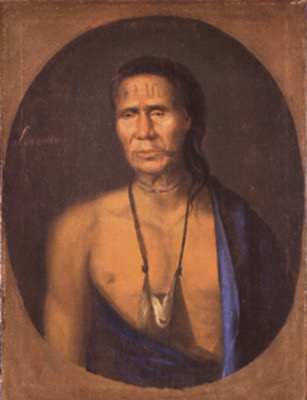
In 1984 Pete Dunn, Donald Peacor and William Simmons described a black, lustrous mineral of the stilpnomelane group from Franklin, rich in magnesium, and named it lennilenapeite “in honor of the Lenni Lenape indians, who inhabited the Franklin area and were presumably the first to find the deposits at Mine Hill and Sterling Hill, which cropped out in full view. The words ‘Lenni Lenape’ mean ‘the original people’.” For forty-two years lennilenapeite stood as the magnesium member of its group. In March 2026 the International Mineralogical Association’s commission on new minerals redefined it as the manganese member of the stilpnomelane group, K4Mn48[Si64Al8]O164(OH)52·nH2O, and in the same decision discredited franklinphilite, the Franklin mineral that had held that place, as “a mixture of lennilenapeite and nelenite” (CNMNC Newsletter 91, p. 349). The name chosen to honor the Lenape survives, with a new meaning.
The Lenape lived across what is now New Jersey and eastern Pennsylvania; the people of the Sussex hills were the Munsee. Many Lenape today prefer the plain name Lenape, which already means “the people,” and note that “Lenni Lenape” doubles it. Their names survive all over this map: Kittatinny, Wawayanda, Musconetcong, Hopatcong.
The hill where the ore came out
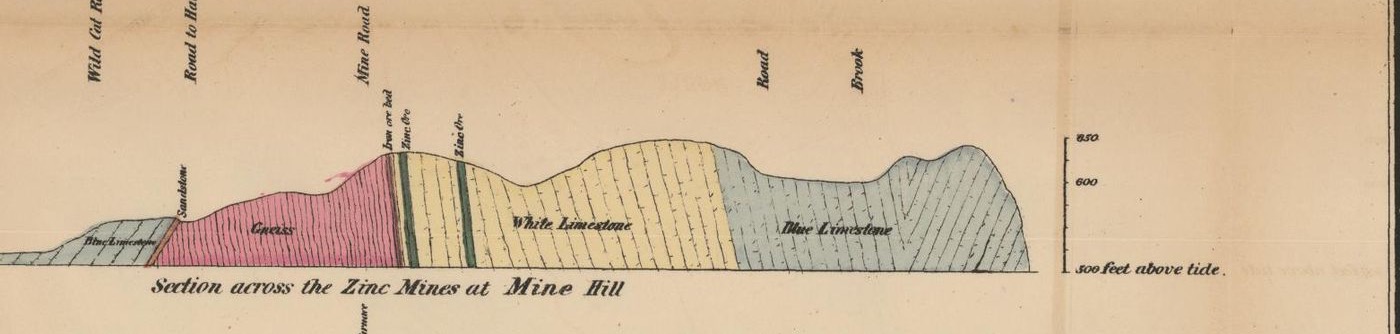
The Franklin ore body did not stay hidden underground. It came to the surface on a low rise beside the Wallkill. Charles Palache wrote that the outcrop “was on a small eminence named at an early date Mine Hill”; a deed of 1750 already speaks of the “Mine Hill Farm Tract.” The 1867 state map drew a section straight through it, showing the zinc beds standing up in the white limestone against the gneiss.
In 1984 Dunn, Peacor, Leavens and Wicks described a new layer silicate from the Franklin Mine and named it minehillite, “for Mine Hill, the hill upon which the Franklin deposit cropped out.”
In The Picking Table
Allen W. Pinger’s “A review of mineralogical, geological and mining activities in the Franklin area” (vol. 14, no. 2, August 1973), a talk of 1961, describes the Lenni Lenape of the valley as roving hunters with few villages, whose artifacts show little use of minerals beyond stone for points and tools and iron ore for paint, and dates the name Mine Hill to the deed of 1750. Both minerals were announced as new to science, lennilenapeite in vol. 24, no. 2 (1983) and minehillite in vol. 25, no. 1 (1984), and the abstracts of their descriptions followed in vol. 25, no. 2 (1984) and vol. 26 (1985). Pete J. Dunn and Bernard T. Kozykowski, in “The resurrection of Sterling Hill” (vol. 33, no. 2, Autumn/Winter 1992), suggest that the Lenni Lenape were the first to see the colorful outcrop and “the first local mineral collectors as well.” John Cianciulli’s “Minehillite” (vol. 41, no. 1, Spring 2000) tells how the first well-crystallized specimen turned up in a rock shop as margarosanite, and William R. Truran’s “From furnace to borough—Franklin’s transformation” (vol. 54, no. 1, Spring 2013) opens with the Indian crossing of the Wallkill and the Wildcat rock shelter. No article on the Lenape themselves, or on the history of Mine Hill as a place, has appeared in The Picking Table.
Sources and further reading
- Dunn, P. J., Peacor, D. R., and Simmons, W. B., 1984, Lennilenapeite, the Mg-analogue of stilpnomelane, and chemical data on other stilpnomelane species from Franklin, New Jersey. Canadian Mineralogist, vol. 22, p. 259–263; the naming is reprinted in The Picking Table, vol. 25, no. 2, Autumn 1984. The Picking Table (PDF)
- Dunn, P. J., Peacor, D. R., Leavens, P. B., and Wicks, F. J., 1984, Minehillite, a new layer silicate from Franklin, New Jersey. American Mineralogist, vol. 69, p. 1150–1155. PDF
- Lenape. Wikipedia
- Palache, C., 1935, The minerals of Franklin and Sterling Hill. U.S. Geological Survey Professional Paper 180. PDF
Written with Claude, an AI model made by Anthropic, from the sources listed above, and checked against them. October 2026.