The color words of the Lenape (Delaware), the stones and metals they name by color, the red paint of their ceremonies, and the minerals of the Franklin district that answer to them.
The people of the Franklin country
Before European settlement the valleys of the Wallkill and the upper Delaware, where the Franklin and Sterling Hill ore bodies lie, were part of the homeland of the Lenape, also called the Delaware, a country that reached from northern Delaware across all of New Jersey and eastern Pennsylvania to New York Bay, western Long Island and the lower Hudson Valley. The people of the upper Delaware Valley in Sussex County were known in seventeenth- and eighteenth-century records as the Minisink; archaeology there shows a distinct and continuous population from about 1000 CE into the historic period. In the northern third of New Jersey they spoke Munsee, one of the two Lenape languages; the other, Unami, was spoken to the south. In the eighteenth century settlement and war pushed most Lenape north and west, and in the nineteenth the federal government removed most of those who remained. Lenape communities today are in Oklahoma (the Delaware Tribe of Indians and the Delaware Nation), in Wisconsin (the Stockbridge–Munsee Community), and in Ontario.
Their presence at Franklin itself is documented. In his survey of Indian habitations in Sussex County (1915), Max Schrabisch of the Geological Survey of New Jersey excavated a rock shelter called Wild Cat Rock, three-quarters of a mile southwest of Franklin Furnace, and found two fireplaces, cord-marked and plain pottery, chips, bones, turtle shells and two flint arrow points. He judged it little used, because water was too far away.
The page is built on three kinds of record: dictionaries made by Moravian missionaries and their Lenape collaborators in the eighteenth and nineteenth centuries; ethnographic descriptions of paint and ceremony; and the present-day Lenape Talking Dictionary, which is built on recordings of Oklahoma speakers, among them Nora Thompson Dean (1907–1984) and Lucy Parks Blalock (1906–2000). Its words are in the Southern Unami dialect, not the Munsee of northern New Jersey, and are given here in its spelling. The difference comes from history: the Lenape were pushed west in the eighteenth and nineteenth centuries, and the last fluent speakers of Southern Unami lived in Oklahoma, while Munsee survived longest in Ontario. Unami and Munsee are closely related, and linguists often treat them as two languages. Where the old Munsee-reviewed dictionary and the Oklahoma recordings give the same word, as they do for the names of copper, iron and brick below, the agreement is good evidence that the word is old and shared; where only the Oklahoma form is known, it is given as Southern Unami and should not be taken as the word spoken in Sussex County.
The color words
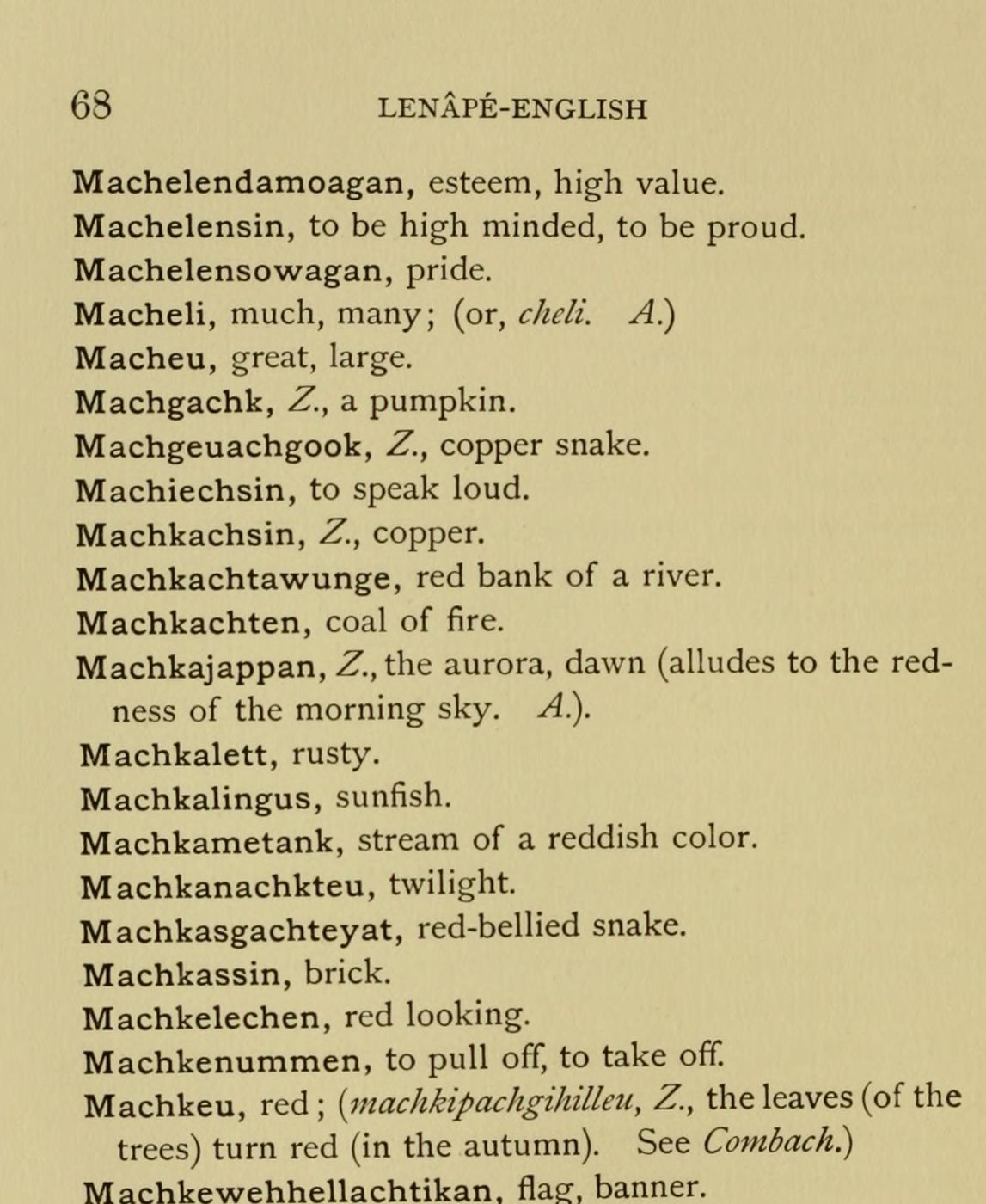
The fullest early record is A Lenâpé-English Dictionary, edited in 1888 by Daniel G. Brinton and the Rev. Albert Seqaqkind Anthony from a manuscript in the Moravian archives at Bethlehem, Pennsylvania, enlarged with words from the missionaries David Zeisberger, John Heckewelder and John Ettwein. Anthony, a Lenape of the Six Nations Reserve in Ontario whose dialect was Munsee, reviewed every entry with Brinton and added notes on current usage. The basic color terms are: machkeu, red; sukeu, black; woapeu and wapsu, white; wisaweu and wisawek, yellow; asgask, green, close to askiwi, “raw, green”; and for blue, Zeisberger’s schiwa’pew, to which Anthony adds wulih’ke, “blue, at present.” There is a general question, ta elinaxit, “what color?”
The same roots are alive in the modern dictionary: màxkèk, that which is red; sëke, black; òpsit and nòpsi, white, I am white; wisawsu, he is yellow; àskàskwe, green; and aone, blue. A dress can be màxkhèmpës, red, or aonhèmpës, blue, the color root joined to the word for a garment.
The owner of this site asked whether any of these color words comes from a substance, as English vermilion comes from a pigment. In these sources none does. The word for blood is distinct: mehuk in Brinton and Anthony, mhukw today. So is the word for paint, which is discussed below. The evidence runs the other way: the Lenape name stones, metals and earths by their color.
Stones named by color
The Lenape word for stone is achsin in the old dictionary and ahsën today. Joined to a color it names a material. Brinton and Anthony give Machkachsin, copper, and Machkassin, brick, both built on machk-, red, and Sukachsin, iron, built on suk-, black. The present-day dictionary keeps all three: màxkahsën, “red stone; copper; brick,” and sëkahsën, iron, which has been extended to wired and electrical things in general. It adds aonahsën, “blue stone; turquoise,” and the place name Opahsënink, Silver Creek in Indiana, built on the root for white. A note by Anthony in the same dictionary derives the tribal name Minsi (Munsee) from min-achsin-ink, “where the stones are gathered together”; the linguist Ives Goddard has rejected every derivation of Minisink or Munsee from a word for stone. These are the Lenape words that tie color to minerals, and they remain in the present-day dictionary.
Other words tie color to an earth or a mineral more loosely. Machkalett, rusty, is built on the red root; rust is itself a hydrated iron oxide. Wisawek is glossed “yellow; also, sulphur.” The modern dictionary has màxkhaki, red dirt or red clay, and the Pennsylvania place name Opasiskunk, “place of white mud or clay.” The old dictionary records a stream name, Machkametank, “stream of a reddish color.”
Paint
The Moravian missionary David Zeisberger (1721–1808) compiled an English–German–Onondaga–Delaware dictionary that was printed only in 1887. Under “Paint” he gives the Delaware allāman, and for “to paint” Machkhensīn, which he explains as “to paint red”: the verb itself carries the red root. The present-day dictionary has olàmàn, glossed “Indian paint,” and the name of a subgroup of the Wolf clan, òlàmàni, “Red Paint.” Zeisberger’s allāman and the modern olàmàn appear to be the same word, written down about two centuries apart.
The missionary John Heckewelder (1743–1823) described Lenape dress and ornament in his Account of the History, Manners and Customs of the Indian Nations (1819; quoted here from the 1876 edition). Men painted chiefly the head and face. Women used vermilion when they painted for dances. For a festival men laid a dark shading coat over the thighs, legs and breast, “and sometimes of a whitish clay,” then drew serpentine streaks over it in black or red paint with their fingertips. A guest whom Heckewelder watched dress for a dance had a red spot on one cheek and a black one on the other. White, in his account of wampum, meant peace and black the reverse, and black wampum sent on a peaceful errand had first to be “daubed all over with chalk, white clay, or any thing which changes the colour from black to white”; a pipe of black or red stone was likewise whitened. In English usage vermilion is the red pigment made from mercury sulfide, the mineral cinnabar. Heckewelder does not say where the Lenape obtained it.
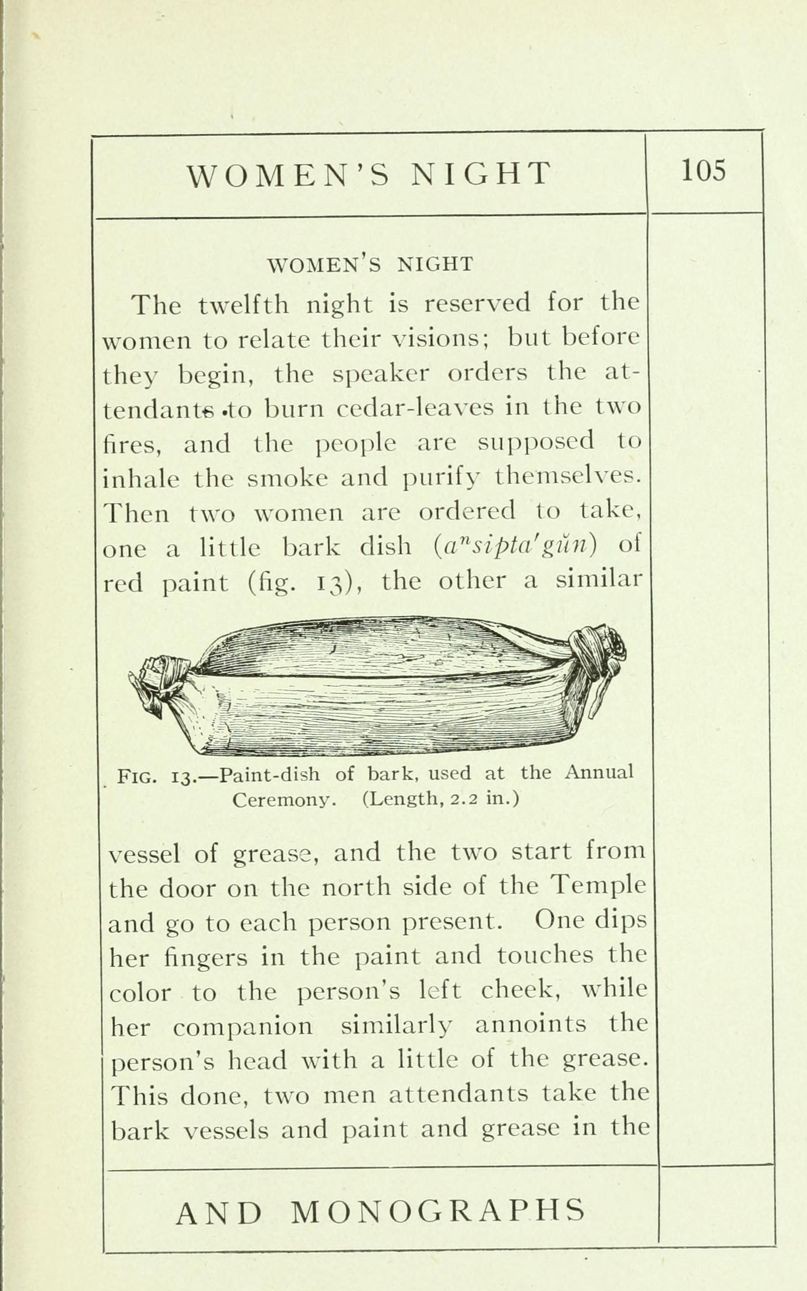
Red paint remained part of Lenape religious life into the twentieth century. The anthropologist M. R. Harrington describes the twelfth night of the annual Big House ceremony: two women carry a small bark dish of red paint (ansipta’gŭn) and a vessel of grease to each person present, and one touches the color to the person’s left cheek; the attendants then paint in the same way the twelve faces carved on the posts of the house, the drumsticks, the prayer sticks, the deerskin drum and the turtle rattles. The present-day dictionary still has ansiptakàn for these paint dishes. The face of the Living Solid Face, the being who herds the deer, was painted half red and half black, and so was the great wooden mask that represented him. A note in the Talking Dictionary records the rule that a person should not go to sleep with the red paint of the Big House on the face, because the departed would say that the person had come to see them: the dead are painted when they leave this world.
None of these sources says what the red paint was made of. They do not name ochre, hematite or any other mineral, and Heckewelder’s vermilion was by his time a trade good. The archaeological record of mineral pigments in Lenape territory has not been reviewed for this page.
The minerals of the Franklin district
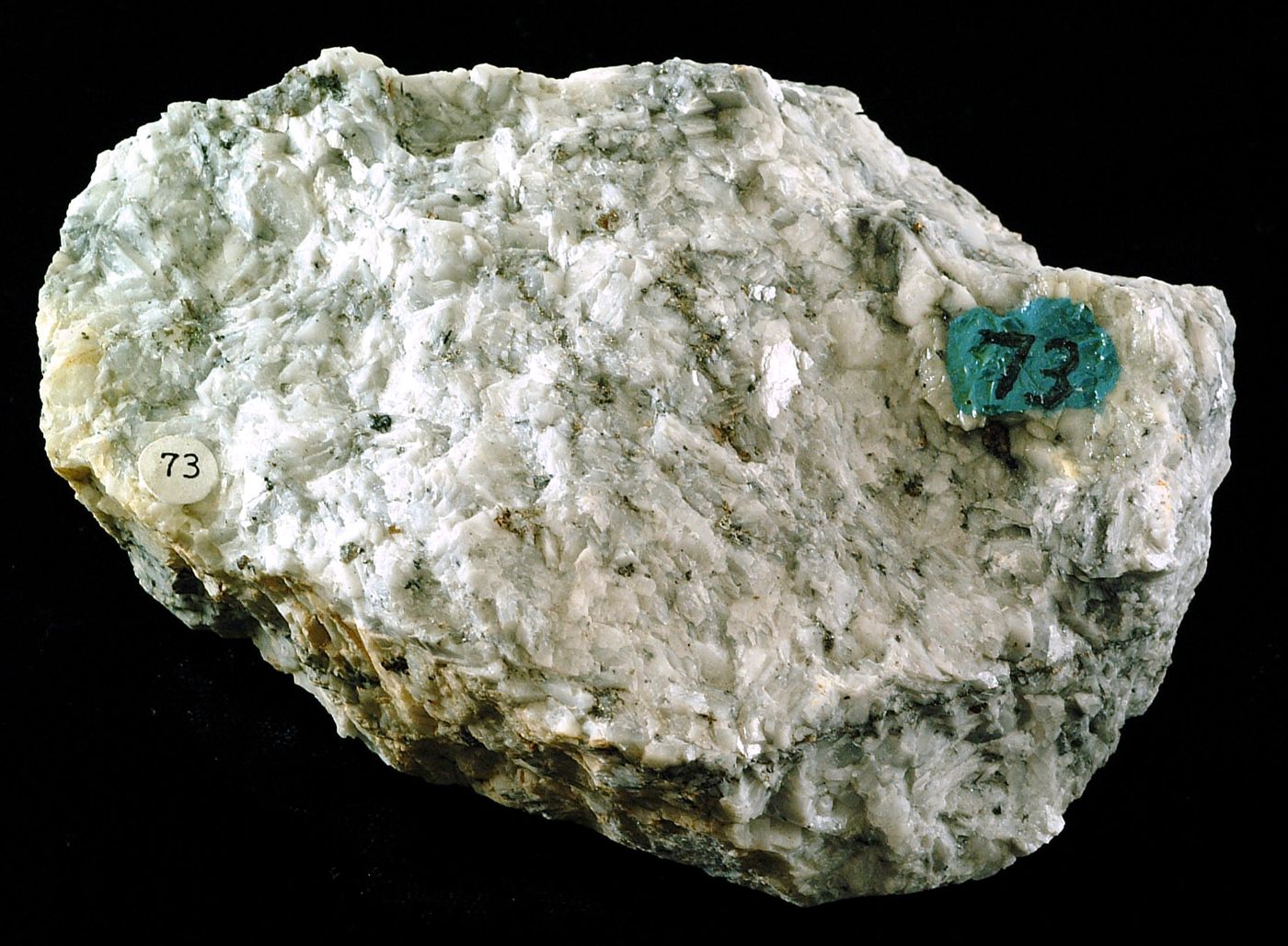
Several of the materials named above occur in the Franklin and Sterling Hill deposits, as recorded in Charles Palache’s The Minerals of Franklin and Sterling Hill, New Jersey (U.S. Geological Survey Professional Paper 180, 1935). Hematite, the iron oxide that colors red ochre, occurs at Franklin in coarse granular masses, at times weighing several hundred pounds. Limonite, the hydrated iron oxide of yellow and brown ochres (now a field name for poorly crystallized iron hydroxides, chiefly goethite, rather than a species), was abundant in the calamine deposits of Sterling Hill as coatings, stalactites and “ocherous powder”; goethite, its crystalline counterpart, was found in minute dark-brown needles at the Buckwheat mine. Graphite, a black mineral that marks, “is abundant in the Franklin limestone,” Palache writes, “in cleavage scales and plates, at both Franklin and Sterling Hill.”
Schrabisch reports that the Native people of Sussex County worked the crystalline limestone “which outcrops at many points in Vernon Valley and along the upper Wallkill” into “beautiful objects,” and that objects made of hematite had been found chiefly on Germany Flats and near Sparta. Along the upper Wallkill the crystalline limestone is the rock Palache calls the Franklin limestone, the host of both ore bodies. Schrabisch does not describe the limestone objects or say where the hematite came from.
No source consulted for this page records Lenape use of the Franklin ores as paint, or of Franklin graphite or hematite in particular. One coincidence of names is documented. Sterling Hill was called the “copper tract” in a deed of 1730, and Lord Stirling about 1772 shipped red zincite to England as a copper ore; the red mineral was taken for copper by colonists whose Lenape neighbors called copper “red stone.” No source connects the two.
Elsewhere in North America
Other North American languages also tie color to stone and shell. In the Navajo (Diné) origin story recorded by Washington Matthews in Navaho Legends (1897), First Man and First Woman adorn the sacred mountain of the east with white shell, that of the south with turquoise, that of the west with haliotis (abalone) shell, and that of the north with black beads. In Navajo the word for turquoise, dootłʼizhii, is formed from the verb dootłʼizh, to be blue or green: the stone is named for its color, as in Lenape aonahsën.
Sources and further reading
- Brinton, D. G., and Anthony, A. S., eds., 1888, A Lenâpé-English dictionary, from an anonymous MS. in the archives of the Moravian Church at Bethlehem, Pa. Philadelphia: Historical Society of Pennsylvania. Full scan (Internet Archive)
- Harrington, M. R., 1921, Religion and ceremonies of the Lenape. Indian Notes and Monographs. New York: Museum of the American Indian, Heye Foundation. Full scan (Internet Archive)
- Heckewelder, J., 1876, History, manners, and customs of the Indian nations who once inhabited Pennsylvania and the neighbouring states. New and revised ed. (first published 1819). Philadelphia: Historical Society of Pennsylvania. Full scan (Internet Archive)
- Lenape Talking Dictionary (Southern Unami dialect). talk-lenape.org
- Lenape; Munsee language. Wikipedia
- Matthews, W., 1897, Navaho legends. Memoirs of the American Folk-Lore Society 5. Boston and New York: Houghton, Mifflin. Full scan (Internet Archive)
- Palache, C., 1935, The minerals of Franklin and Sterling Hill, Sussex County, New Jersey. U.S. Geological Survey Professional Paper 180. PDF (USGS)
- Schrabisch, M., 1915, Indian habitations in Sussex County, New Jersey. Geological Survey of New Jersey, Bulletin 13. Full scan (Internet Archive)
- Zeisberger, D., 1887, Zeisberger’s Indian dictionary: English, German, Iroquois (the Onondaga) and Algonquin (the Delaware). Ed. E. N. Horsford. Cambridge, Mass.: John Wilson and Son. Full scan (Internet Archive)
Written with Claude, an AI model made by Anthropic, from the sources listed above, and checked against them. October 2026.