Some crystals become electric when warmed or squeezed, because their two ends are built differently. How the tourmaline “ash-drawer” of Ceylon led to the laws of polar crystals, and which minerals of Franklin and Sterling Hill share the property, from calamine and clinohedrite to zincite.
“Électriques par l’effet de la température” “Electric through the effect of temperature”
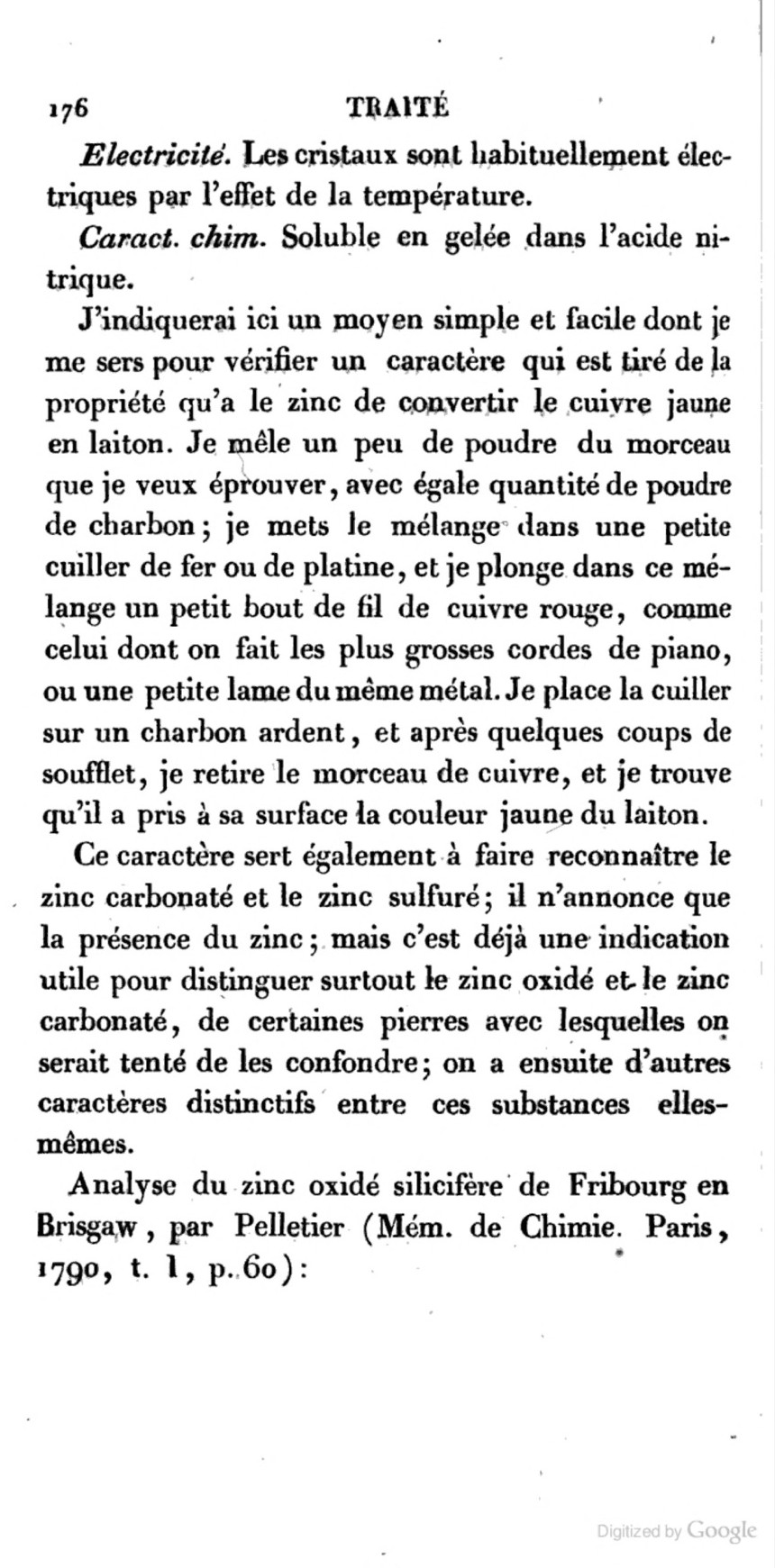
Electricité. Les cristaux sont habituellement électriques par l’effet de la température.
Electricity. The crystals are usually electric through the effect of temperature.
René-Just Haüy, Traité de minéralogie, 1822, vol. 4, p. 176
In the second edition of his Traité de minéralogie, the French crystallographer René-Just Haüy gave the zinc ore he called “zinc oxidé silicifère” a short line headed “Electricité”: “Les cristaux sont habituellement électriques par l’effet de la température” (the crystals are usually electric through the effect of temperature; vol. 4, p. 176). The mineral is the hydrous zinc silicate then called calamine and now hemimorphite, and the page on Troost and troostite tells how Haüy’s description of it bears on the New Jersey ores. This page follows the electricity.
A crystal that becomes electric when its temperature changes is called pyroelectric. One that becomes electric when it is squeezed is piezoelectric. Both effects belong only to crystals whose structure lacks a centre of symmetry, and pyroelectricity only to a smaller set of them (NASA TM-82394, p. 2), those in which one direction differs from its opposite, so that the two ends of a crystal along that direction are built differently. Such crystals often show it outwardly by growing different faces at their two ends, a habit mineralogists called hemimorphic, “half-formed.” Hemimorphite takes its name from that habit (Handbook of Mineralogy).
The story begins with tourmaline from Ceylon and runs through Haüy, the brothers Curie and the quartz oscillator. Several of the minerals of the Franklin and Sterling Hill mines belong to the right crystal classes, and one of them, clinohedrite, first described from Franklin, was tested for pyroelectricity on Franklin crystals in 1898. Where a local mineral is polar by its structure but no one is known to have measured the effect on it, that is said.
The ash-drawer from Ceylon
In its history of the year 1717 the Paris Academy of Sciences recorded “encore un petit Aiman” (another little magnet): a stone from a river in Ceylon, flat, round, brown and shining, “qui attire & ensuite repousse de petits corps legers, comme de la Cendre, de la limaille de Fer, des parcelles de papier” (which attracts and then repels small light bodies, such as ash, iron filings, bits of paper). “M. Lémery la fit voir,” the chemist Lémery showed it, and the one he had cost 15 livres (Histoire de l’Académie royale des sciences, 1717, p. 7–8, in the reprint of 1741). The notice says nothing of heat. In 1747 the Swedish naturalist Carl Linnaeus, in the preface to his Flora Zeylanica, called it the “Lapidem Electricum” and marvelled at the property in a stone “neque motu, neque tritu calefacto,” warmed neither by motion nor by rubbing (Praefatio, p. 8).
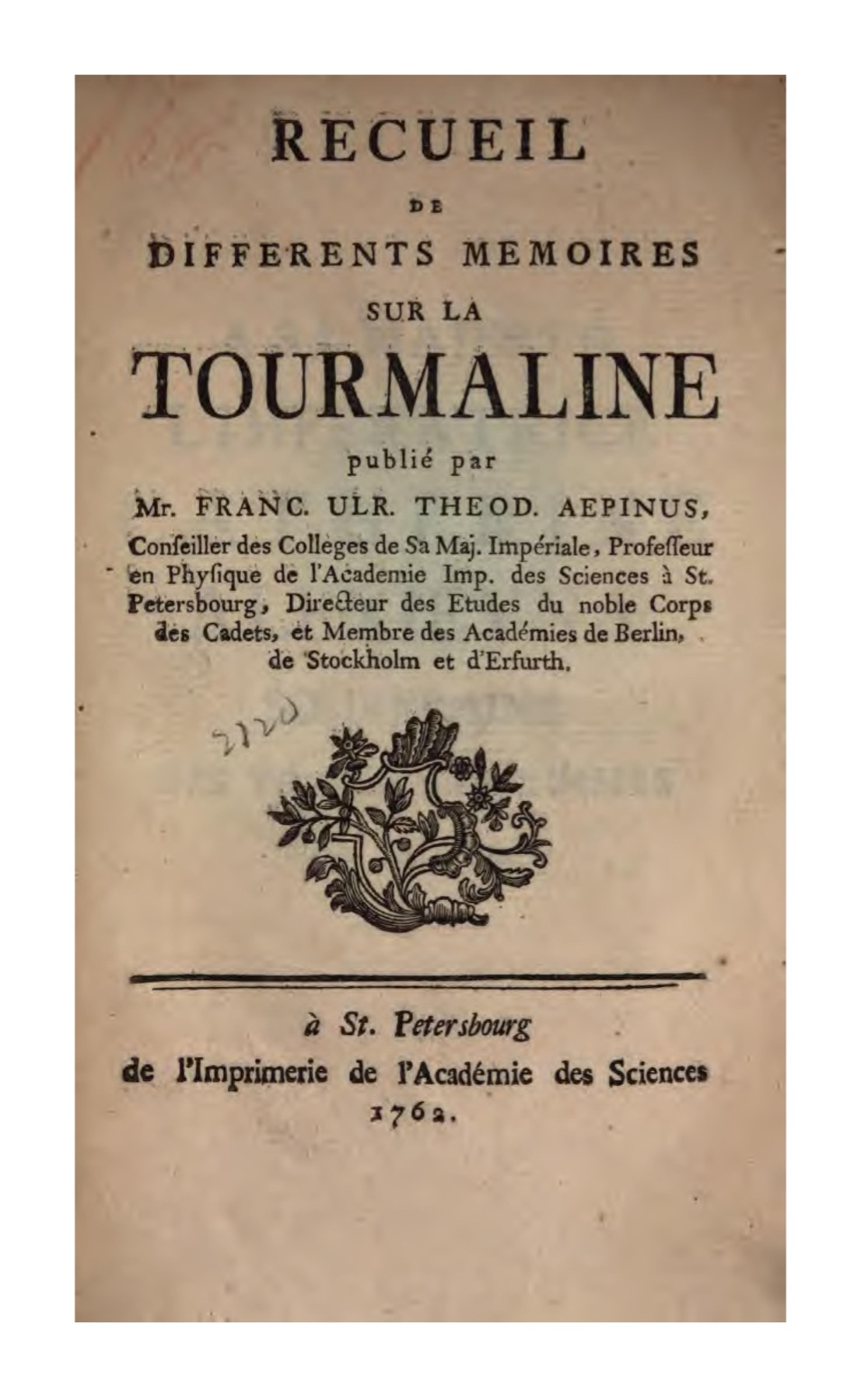
The Dutch, who traded at Ceylon, had a name for it. Franz Ulrich Theodor Aepinus, professor of physics at the Imperial Academy of Sciences in St. Petersburg, wrote that the stone “porte le nom de Trip, ou Tourmaline,” and that its property had led the Dutch to call it “Aschentrecker,” which, with its German counterpart, “signifie, attire cendre” (means “draws ash”; Recueil, 1762, p. 2). The English chemist Joseph Priestley, in his History and Present State of Electricity (1767), spelled the Dutch word “aschentrikker,” from the stone’s “property of attracting ashes, when it is thrown into the fire” (p. 315). The English painter and electrician Benjamin Wilson called it “the Tourmalin, or Ashstone” (Philosophical Transactions vol. 51, p. 308).
Aepinus first published his experiments in the history of the Berlin Academy for 1756, and gathered them in his Recueil of 1762. His first observation was that “La Tourmaline a toujours en même tems une Electricité positive et une Electricité négative; c’est à dire, que quand un de ses côtés est positif, l’autre est infailliblement négatif, et réciproquement” (the tourmaline always has at the same time a positive and a negative electricity; when one of its sides is positive, the other is infallibly negative, and the reverse; p. 9). He could excite these electricities “in the strongest degree,” Priestley reported, “by plunging the stone in boiling water” (p. 316).
In London, Wilson repeated most of Aepinus’s experiments and inferred “that the tourmalin differs in nothing from other electric bodies but in acquiring electricity by heat” (Priestley, p. 320). The decisive step, in Priestley’s judgement, was John Canton’s, in a paper read to the Royal Society in December 1759: “the tourmalin emits and absorbs the electric fluid only by the increase or diminution of its heat” (p. 321). Heating made one side, A, positive and the other, B, negative; on cooling “the side A will be negative, and the side B positive” (p. 321–322). The charge comes from the change of temperature, not from the temperature itself, and it reverses when warming turns to cooling.
Haüy: the two ends differ
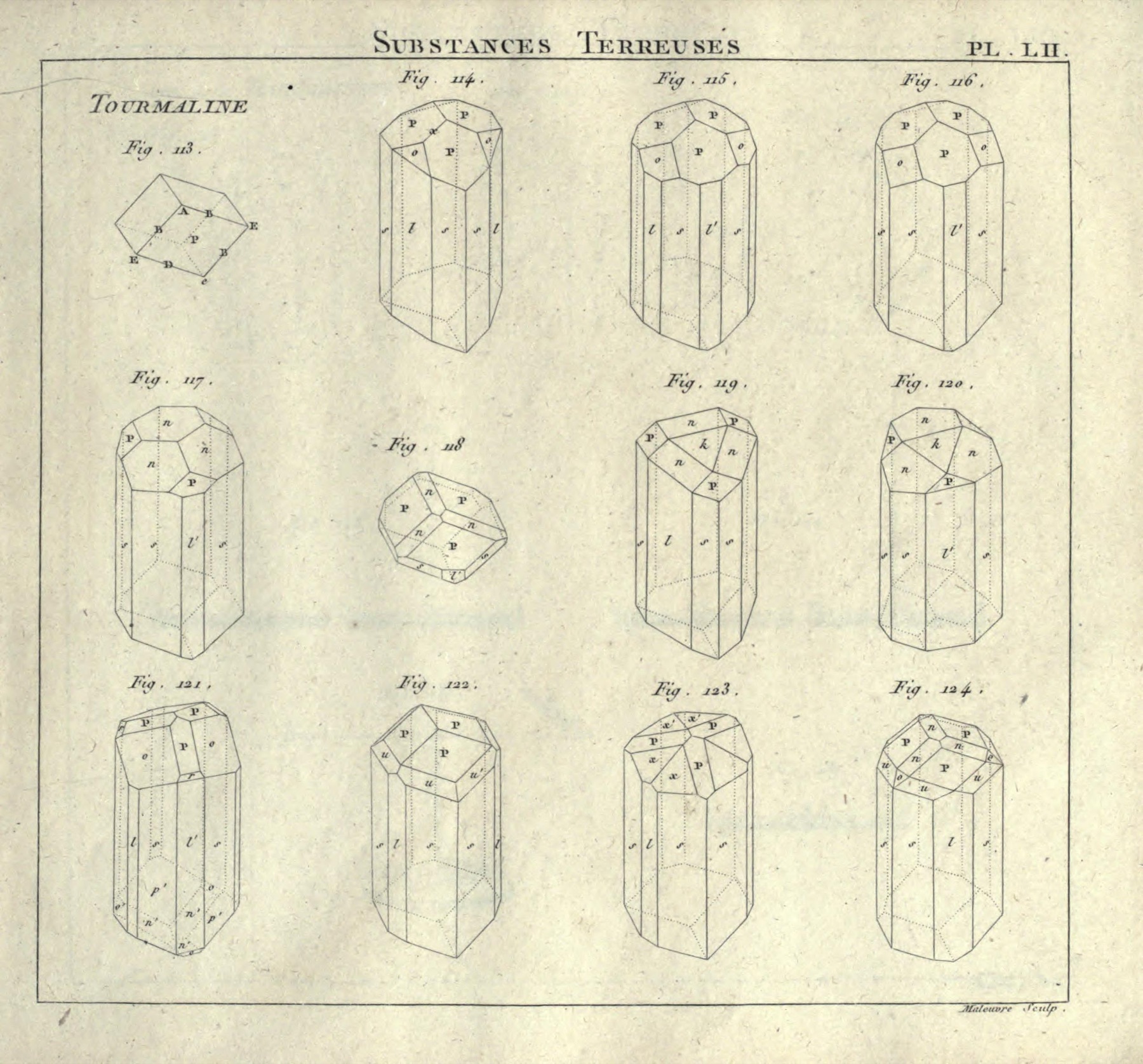
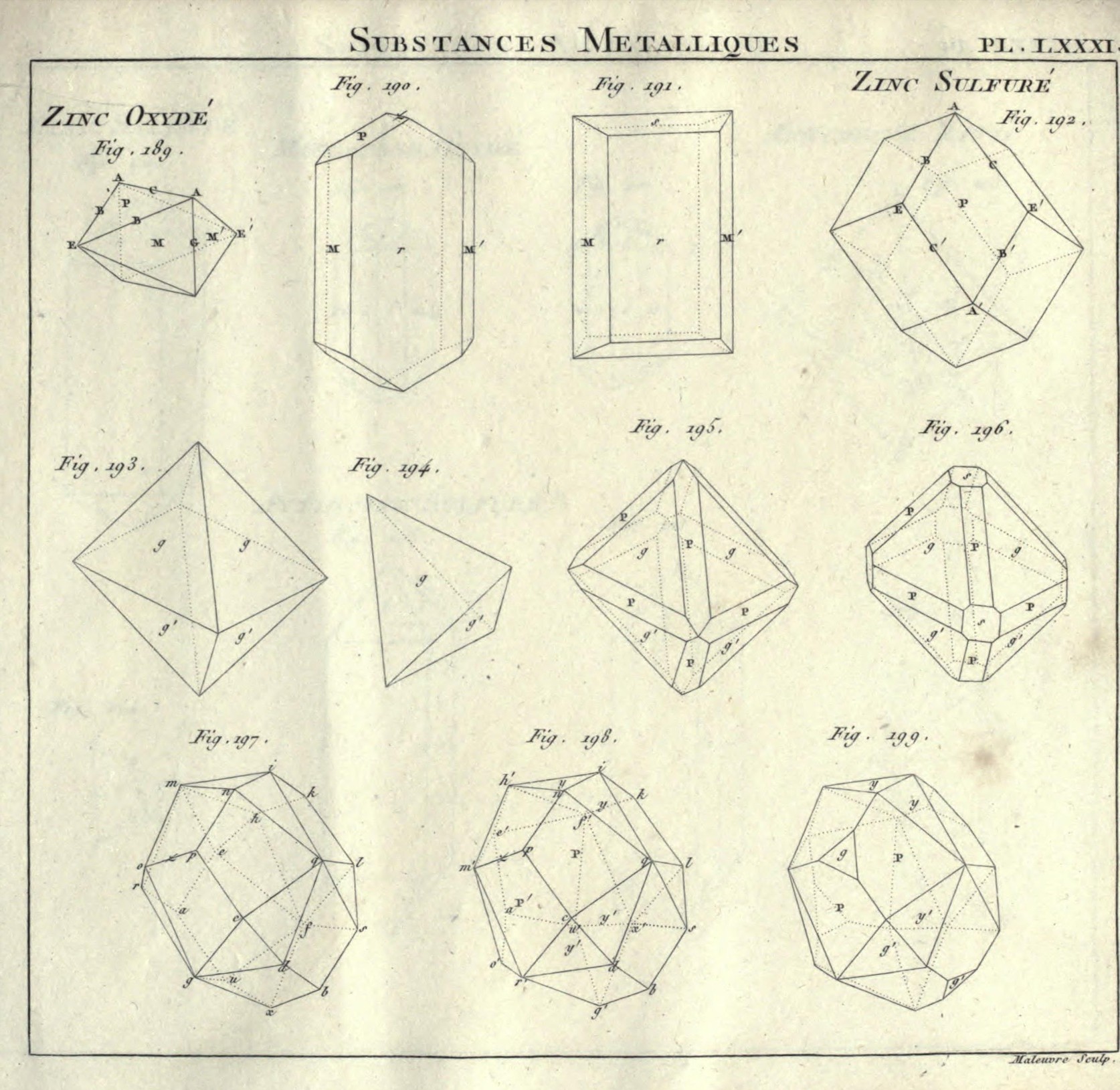
Haüy made crystal electricity part of his system. In the first volume of his Traité of 1801 he named three ways to excite electricity in a body: by rubbing, by contact with a body already electrified, “ou par la chaleur. Ce dernier moyen n’a lieu que par rapport à certaines substances minérales” (or by heat; this last way applies only to certain mineral substances; vol. 1, p. 236). Then came a general observation. In those that are crystallized, “leurs formes dérogent à la symétrie des cristaux ordinaires, de manière que les parties dans lesquelles résident les deux espèces d’électricité, quoique semblablement situées de part et d’autre, diffèrent par leur configuration” (their forms depart from the symmetry of ordinary crystals, so that the parts in which the two kinds of electricity reside, though similarly placed on either side, differ in their configuration). It followed, he wrote, that “à la seule inspection d’un de ces cristaux, on peut indiquer d’avance le côté qui donnera des signes d’électricité vitrée et celui qui manifestera l’électricité résineuse” (from simple inspection of one of these crystals one can say in advance which side will show vitreous, that is positive, electricity, and which resinous, or negative; p. 237).
Calamine was among his examples from the start. In the fourth volume of 1801 the first species of zinc is “Zinc oxydé. Calamine,” and its essential character is “Electrique par la chaleur” (electric by heat; vol. 4, p. 159). “Les cristaux s’électrisent par la chaleur” (the crystals become electric by heat), he repeated, citing the Academy’s Mémoires for 1785 (p. 160), and the other zinc ores were set apart by the lack of it: “Aucune de ces substances n’est électrique par la chaleur, comme le zinc oxydé” (none of these substances is electric by heat, as zinc oxydé is; p. 161). The analysis he printed, Pelletier’s, with about 12 parts in 100 of water, is that of a hydrous zinc silicate, hemimorphite.
The word “pyro-electricity” is in print by 1824, in the title of the Scottish physicist David Brewster’s “Observations on the Pyro-Electricity of Minerals” in the Edinburgh Journal of Science; he uses it as a term already in hand (vol. 1, p. 208). Brewster credited Lemery with the first notice of the effect and Aepinus with its first real study, and copied Haüy’s list of “pyro-electrical minerals” with their discoverers: tourmaline (Lemery), topaz (Canton), axinite (Brard), boracite (Haüy), and, all bracketed to Haüy, mesotype, prehnite, “Oxide of Zinc” and sphene (p. 209). “Haüy observed,” he added, “that the Electric Calamine was electrical at the ordinary temperature of the atmosphere, and exhibited the inversion of poles which he found in the tourmaline” (p. 210). Brewster’s own new list of minerals, from experiments of 1817 and 1818, names no zinc mineral (p. 211).
Polar crystals, under heat and under pressure
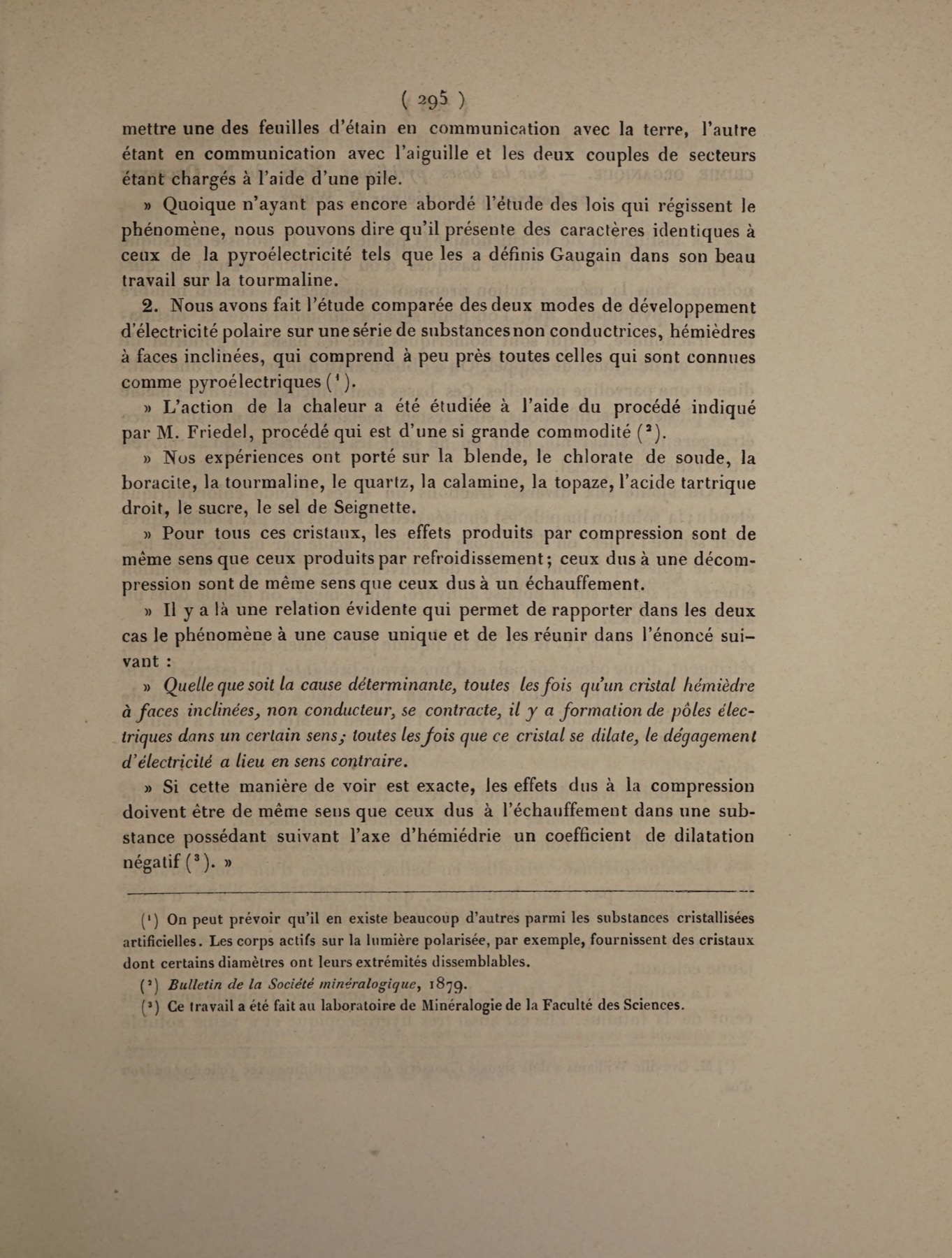
In 1880 two brothers working in the mineralogy laboratory of the Faculté des Sciences, Jacques and Pierre Curie, reported “un nouveau mode de développement de l’électricité polaire” in the same crystals: subjecting them “à des variations de pression suivant leurs axes d’hémiédrie” (to changes of pressure along their axes of hemihedry; Comptes rendus 91, p. 294). The note was presented by the chemist and mineralogist Charles Friedel, whose method of heating they used. “Nos expériences ont porté sur la blende, le chlorate de soude, la boracite, la tourmaline, le quartz, la calamine, la topaze, l’acide tartrique droit, le sucre, le sel de Seignette” (our experiments covered sphalerite, sodium chlorate, boracite, tourmaline, quartz, calamine, topaz, right-handed tartaric acid, sugar and Rochelle salt; p. 295). In all of them compression acted like cooling and release like heating, and they put the result in one rule: whenever a non-conducting crystal of this kind contracts, electric poles form in one sense, and whenever it expands, in the opposite sense. The next year they showed the converse, that a crystal given opposite charges at the two ends of such an axis contracts or expands, as the physicist Gabriel Lippmann had predicted from the conservation of electricity and of energy (Comptes rendus 93, p. 1138).
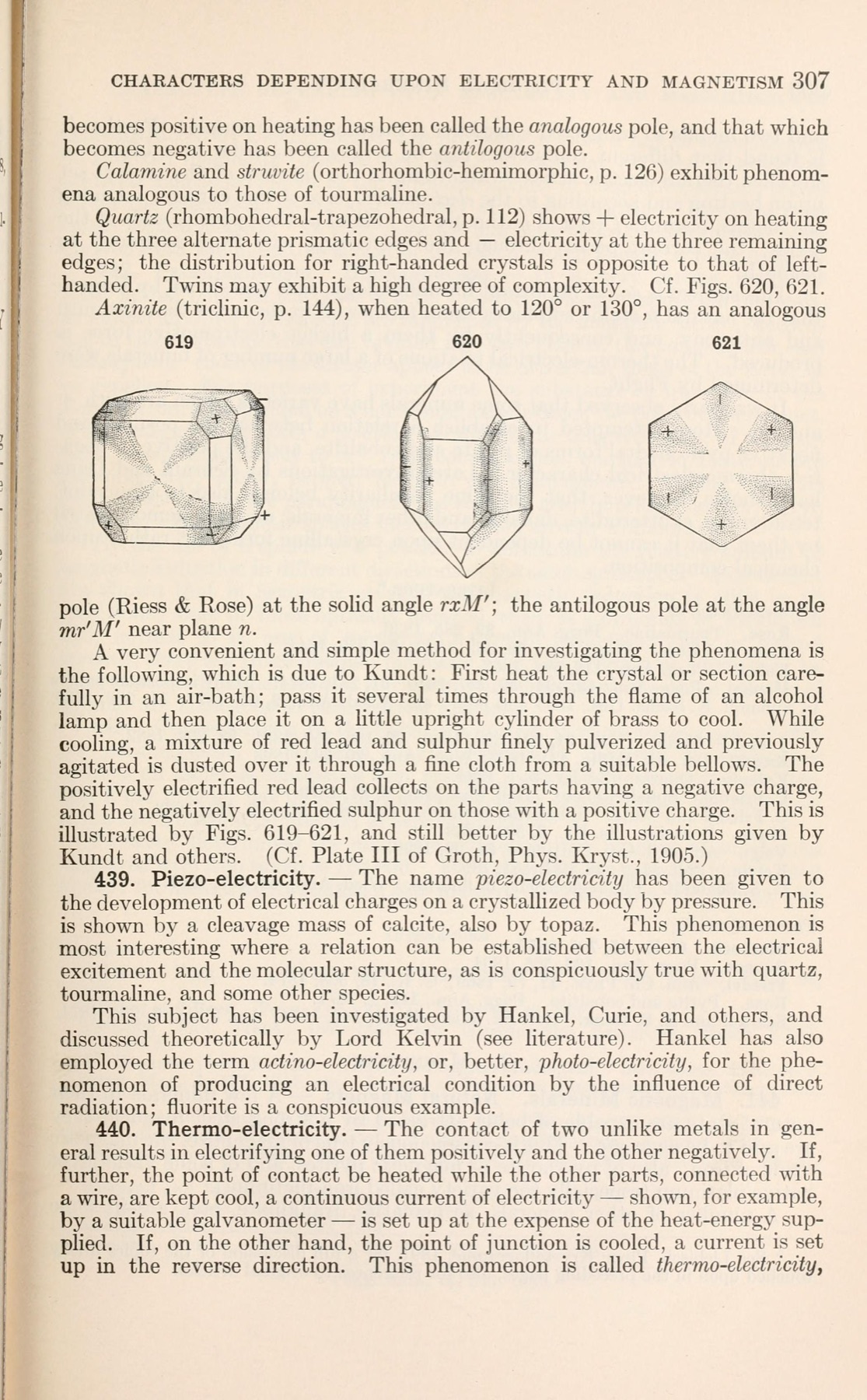
The Leipzig physicist Wilhelm Gottlieb Hankel, author of a long series of “Elektrische Untersuchungen” on what he called the “thermoelektrisch” properties of crystals, checked the Curies’ rule in 1880 and 1881. It held, he found, for tourmaline, boracite, “Kieselzinkerz” (calamine), tartaric acid, cane sugar and milk sugar, but not for rock crystal; and he proposed a name for the new effect: “die Bezeichnung Piezoelektricität” (the name piezoelectricity; Elektrische Untersuchungen, Abh. 15, p. 462). In 1883 the German physicist August Kundt published a simple way to see the charges. A warmed crystal is left to cool and dusted, through a fine cotton sieve, with a mixture of sulphur and red lead; rubbing in the sieve charges the sulphur negatively and the red lead positively, so that, as in Lichtenberg’s figures, “der negative Schwefel auf diejenigen Theile der Krystalloberfläche, welche positiv sind, die Mennige auf die negativen” settles (the negative sulphur on the positive parts of the surface, the red lead on the negative; Annalen der Physik 20, p. 593). The yellow and red patterns map the poles.
By the early twentieth century the reason was clear, and textbooks taught it. The Göttingen physicist Woldemar Voigt wrote that excitation by a uniform change of temperature can occur only in crystals that possess “einzigartige einseitige Richtungen” (unique one-sided directions), with a symmetry compatible with that of a polar vector (Lehrbuch der Kristallphysik, 1910, p. 234). Quartz, with a threefold axis and twofold axes across it, “läßt keine einzigartige Richtung zu, obgleich kein Symmetriezentrum existiert” (allows no unique direction, though it has no centre of symmetry), so any charge it shows on heating must come from heating it unevenly; Voigt called that a “falsche” (false) pyroelectricity, and he split the true effect in tourmaline into a part of its own and a part carried by the expansion of the crystal through its piezoelectricity (p. 235). In modern terms, as a NASA report of 1981 puts it, of the 32 crystal point groups 11 have a centre of symmetry; of the 21 that do not, 20 are piezoelectric, and “the pyroelectric materials form a subgroup (containing 10 crystal classes) of the piezoelectrics” (NASA TM-82394, p. 2). The ferroelectrics are a subgroup again: pyroelectric crystals whose polarization “can be reversed by an applied electric field,” a property that cannot be told from the structure alone (p. 3).
Mineralogists used the effect to read symmetry. Dana’s textbook explained that pyroelectricity was “particularly marked with crystals belonging to groups of relatively low symmetry, especially those of the hemimorphic type,” that “directions of like crystallographic symmetry show charges of like sign,” and that the end of a crystal that becomes positive on heating “has been called the analogous pole, and that which becomes negative has been called the antilogous pole” (p. 306–307). “Calamine and struvite (orthorhombic-hemimorphic …) exhibit phenomena analogous to those of tourmaline,” the same page says (p. 307), and the species entry for calamine ends “Strongly pyroelectric” (p. 539).
Calamine, now hemimorphite
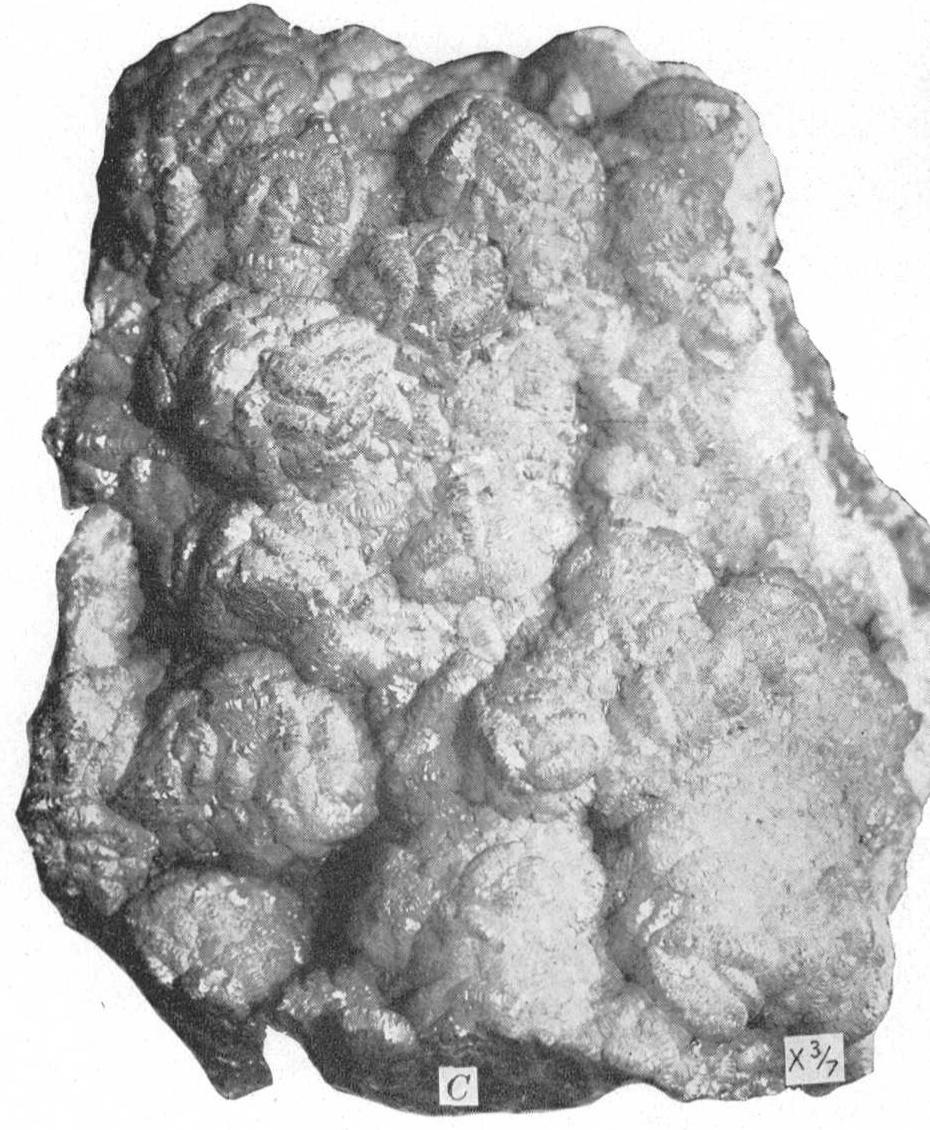
Calamine was mined at Sterling Hill. According to the Harvard mineralogist Charles Palache, during the 1870s the Noble and Passaic mines, open pits in “two great bodies of calamine” between the two legs of the ore body, were the chief sources of zinc ore there; the superintendent of the Noble mine in 1878, O. J. Conley, described the calamine as a layer 6 to 12 inches thick lying directly on the limestone (PP 180, p. 22–23). Elwood Shuster’s local history of 1927 says that the Passaic company, working Lot No. 9 of the Ogden division, “at one time produced a considerable tonnage of calamine from the open cut workings,” with “many specimens of beautiful pure white crystalline calamine” (Shuster 1927, p. 19–20), and that “a small deposit of calamine” was found in the Noble pit or “Mud mine,” on Lot No. 10, worked “1860–1870” (p. 20).
Palache classed calamine, (ZnOH)2SiO3 in his formula, as “Orthorhombic-hemimorphic,” but he could not show the hemimorphism on local crystals: “none showing double termination were observed,” and he found no measurable crystals at all among many specimens, the crystals growing instead in fan-shaped, crested, stalactitic or mammillary groups that the miners called “maggot ore” (p. 105). At Franklin it was found only in small amounts, as in a vein exposed in 1905 in the Buckwheat open cut (p. 106).
The current description agrees with the old one on symmetry. The Handbook of Mineralogy gives hemimorphite, Zn4Si2O7(OH)2·H2O, as orthorhombic, point group mm2, space group Imm2, notes that “doubly-terminated crystals show hemimorphism,” calls it “Strongly pyroelectric,” and takes its X-ray powder pattern from Sterling Hill material (Handbook of Mineralogy, hemimorphite). Point group mm2 is one of the ten polar classes. The calamine of Haüy, Brewster, the Curies and Hankel came from Europe; none of the sources read here records a test of pyroelectricity on calamine from Sterling Hill or Franklin.
Clinohedrite: tested at Yale in 1898
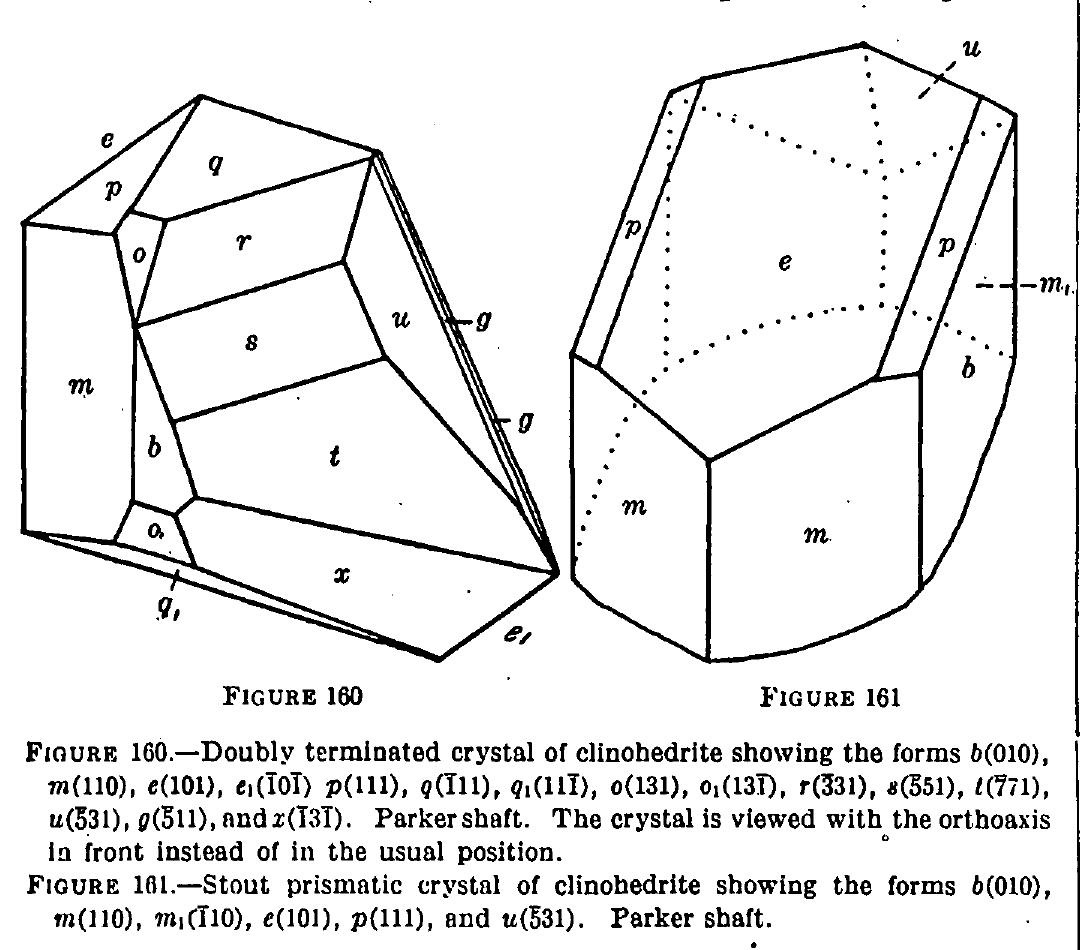
The one Franklin mineral known to have been tested for pyroelectricity on Franklin crystals is clinohedrite, a calcium zinc silicate. Samuel L. Penfield and H. W. Foote of the mineralogical laboratory of the Sheffield Scientific School at Yale described it in 1898 from specimens sent by the collectors Frank L. Nason and E. P. Hancock. Its crystals, they wrote, belong to the division of the monoclinic system “characterized by a plane of symmetry, but not an axis of symmetry,” the class that the German crystallographer Paul Groth called “domatische”; in it no form has more than two faces, only the pinacoid has parallel faces, and “the prevalence of forms without parallel faces gives to the crystals a peculiar inclined faced character or appearance, which has suggested the name of the mineral, clinohedrite” (Am. J. Sci., 1898, p. 289). The crystals were usually attached at one end, and only the free ends gave good faces (p. 290).
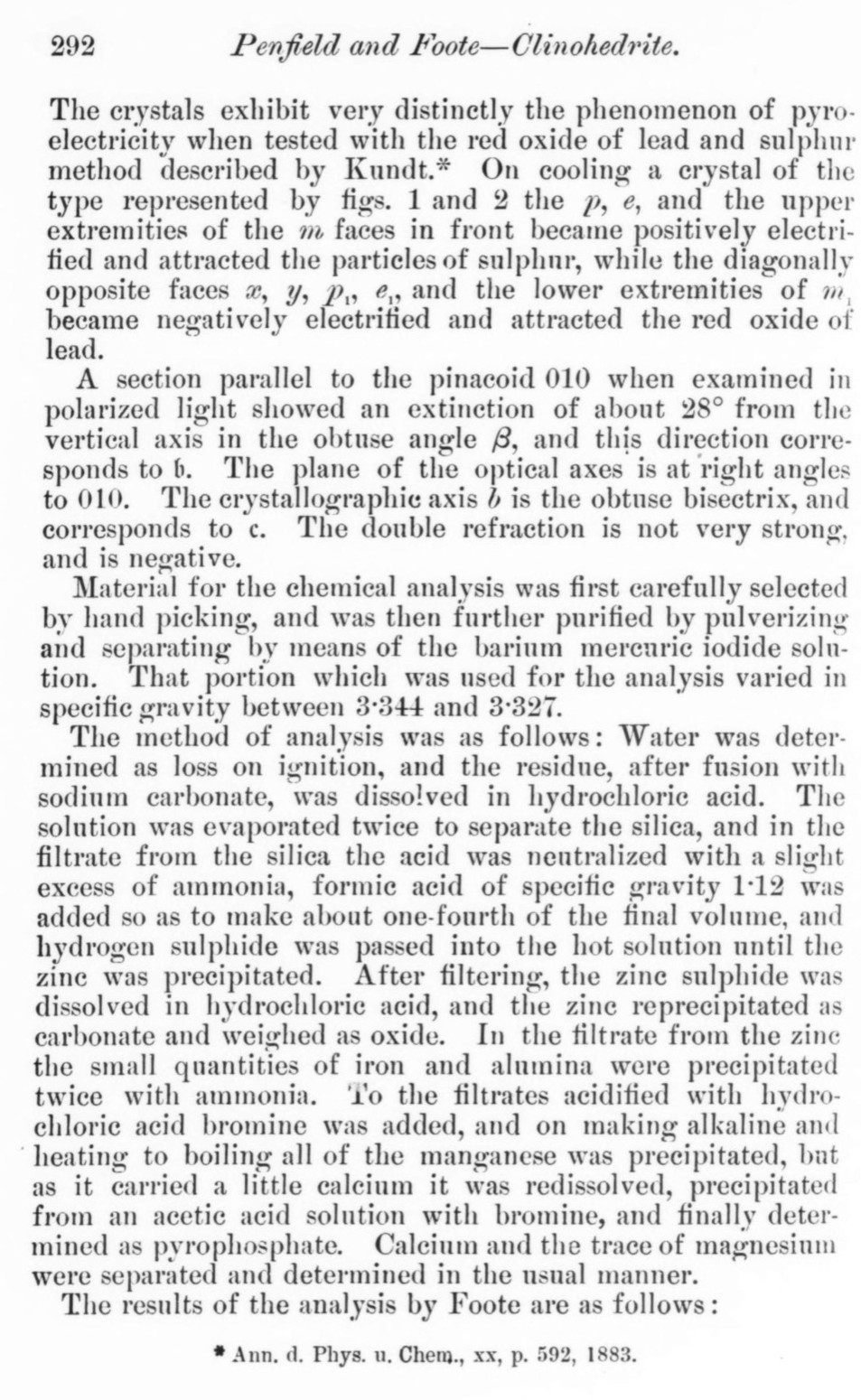
Then they used Kundt’s method. “The crystals exhibit very distinctly the phenomenon of pyro-electricity when tested with the red oxide of lead and sulphur method described by Kundt. On cooling a crystal … the p, e, and the upper extremities of the m faces in front became positively electrified and attracted the particles of sulphur, while the diagonally opposite faces … and the lower extremities of m1 became negatively electrified and attracted the red oxide of lead” (p. 292). The polar direction here lies in the plane of symmetry, not along a crystal axis, and the charges sit on diagonally opposite faces.
Palache kept the class, “Monoclinic-domatic,” wrote that “the mineral is strongly pyroelectric,” and corrected the locality: the specimens came from the dump of the Parker shaft, not the Trotter mine as Penfield and Foote had said (PP 180, p. 106). The Handbook of Mineralogy gives point group m and space group Cc, repeats “Strongly pyroelectric,” and gives Franklin and one other occurrence, the Christmas mine in Arizona (Handbook of Mineralogy, clinohedrite). Class m is polar. Writing in The Picking Table in 1996, the mineralogist Paul B. Moore called clinohedrite “This polar crystal” (vol. 37, no. 1, p. 18).
Zincite: a natural piezoelectric
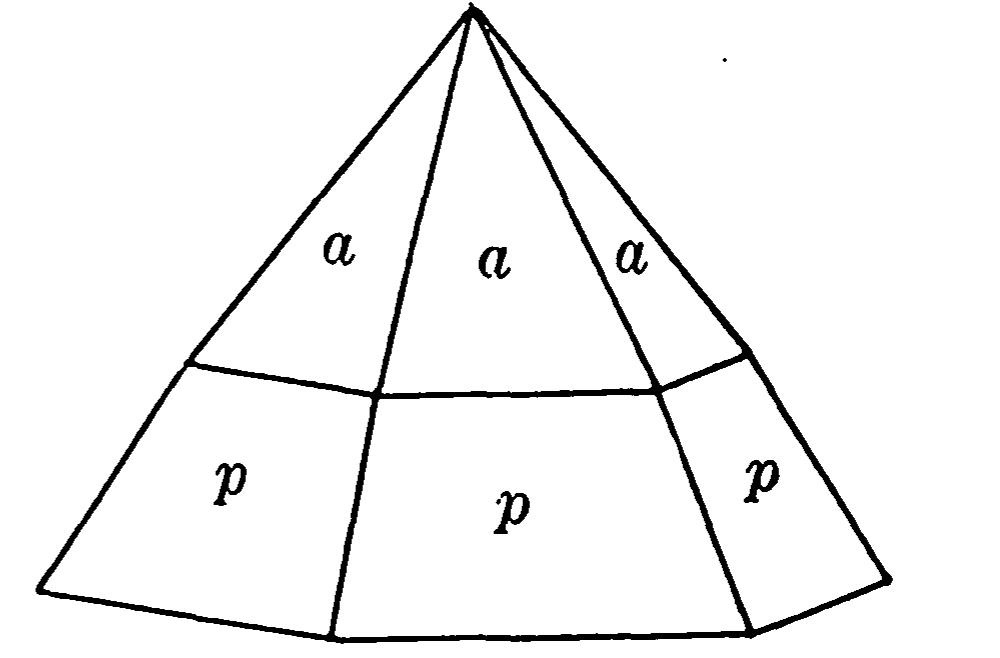
Zincite, zinc oxide with a little manganese, was the “red oxide of zinc” of the early New Jersey literature (see the page on Archibald Bruce). Palache gave it as “Hexagonal-hemimorphic” and listed its forms by pole: three pyramids and a prism at the positive pole, the base alone at the negative (PP 180, p. 37). Crystals were known to him only from the Buckwheat mine, in three types; the smallest, orange-yellow and sharply formed, from a vein with pyrochroite, stood free in their cavity and were “sharply hemimorphic, with the pyramids … above and the base alone below” (p. 39). The large crystals, locally called “ruby zinc,” had no true base other than the cleavage.
The Handbook of Mineralogy gives zincite point group 6mm and space group P63mc, from synthetic material, with “Crystals rare, typically pyramidal, hemimorphic” (Handbook of Mineralogy, zincite). That is a polar class. Moore wrote in 1995 that zincite “is a piezoelectric and polar (pyroelectric) crystal, and belongs to the wurtzite, β-ZnS, structure type” (The Picking Table vol. 36, no. 2, p. 27), and in 1996 that its polar symmetry is forced by the way its zinc–oxygen tetrahedra share only corners (vol. 37, no. 1, p. 18). The Handbook’s reference list includes a crystallographic study of 1989 whose title names the pyroelectric coefficient of ZnO.
Zinc oxide made in the laboratory is now an engineering piezoelectric: thin films of piezoelectric ZnO, with aluminium nitride and gallium nitride, have “attracted extensive research” for thin-film bulk acoustic resonators (Wang 2010, report to the U.S. Army Research Office). None of the sources read here reports a measurement of pyro- or piezoelectricity on a natural Franklin or Sterling Hill zincite crystal. Not every local crystal is hemimorphic: a specimen described in 2020 held prismatic zincite crystals entirely enclosed in esperite, “not the usual pyramidal hemimorphic morphology” (The Picking Table vol. 61, no. 2, p. 33).
Tourmaline in the Franklin Marble
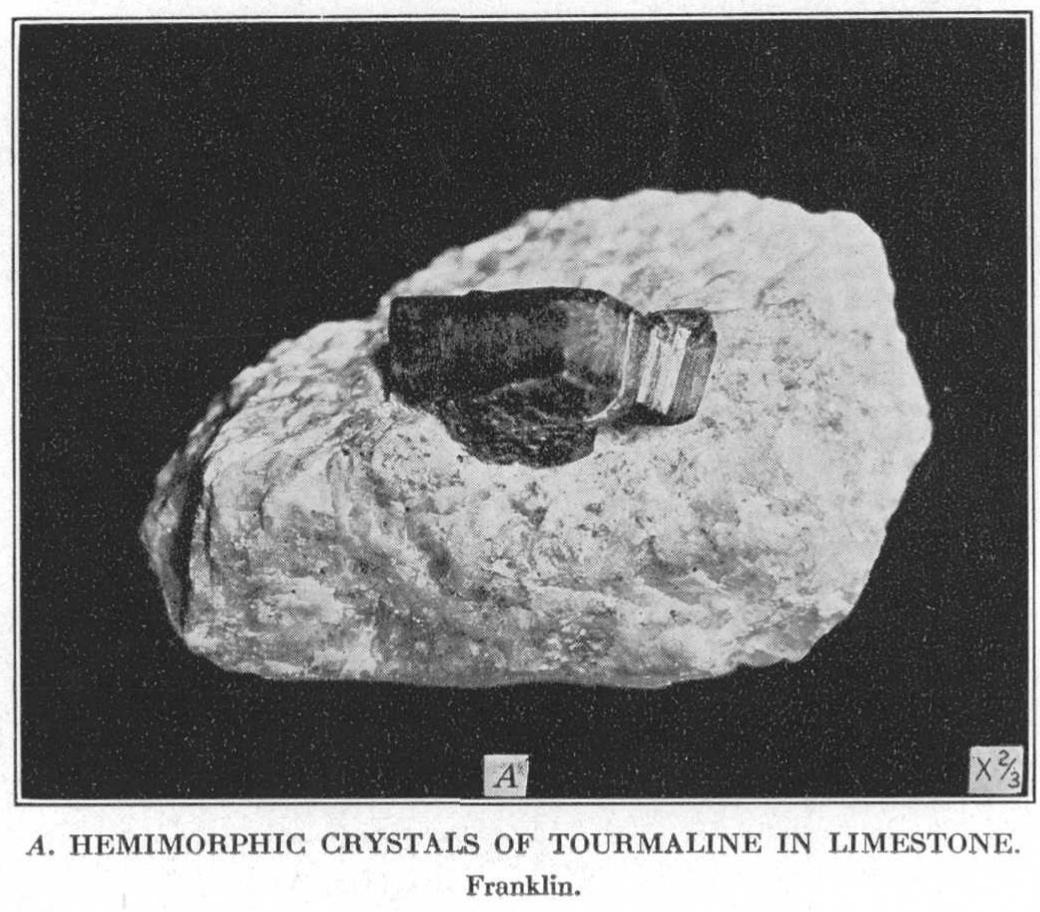
Tourmaline, the original ash-drawer, is abundant in the white limestone (the Franklin Marble) about Franklin though, as Palache wrote, it “is not a characteristic mineral of the zinc-ore bodies—indeed, it is unknown in them” except for two brown crystals from the calamine deposit at Sterling Hill (PP 180, p. 112). He classed it “Hexagonal rhombohedral-hemimorphic,” and his table of crystal combinations lists the faces of each crystal under two headings, “Antilogous pole” and “Analogous pole” (p. 111), Dana’s names for the ends that turn negative and positive on heating. Franklin crystals, he wrote, are “as a rule strikingly hemimorphic”; the most interesting locality was the Fowler quarry, where crystals isolated in the limestone “were remarkable for their large size, perfection of form, brilliant coloring, and striking hemimorphic development” (p. 112). His one analysis, of a brown crystal from Rudeville, was of the magnesium variety.
The name has changed twice. In 1977 The Picking Table reported that recent studies had reclassified the Franklin crystals from dravite to uvite, “a new member of the tourmaline group” (vol. 18, no. 2, p. 19); in 2016 Richard C. Bostwick listed the species as “Fluor-uvite … Formerly known as uvite, earlier as tourmaline,” found “as equant hemimorphic crystals in shades of green and brown, some as large as 4 cm across” (vol. 57, no. 2, p. 18). The Handbook of Mineralogy (2001) lists Franklin under both uvite and dravite, each point group 3m, space group R3m, and calls uvite “Pyroelectric and piezoelectric” (Handbook of Mineralogy, uvite; dravite). No measurement on Franklin tourmaline was found.
Other local candidates, and some that only look polar
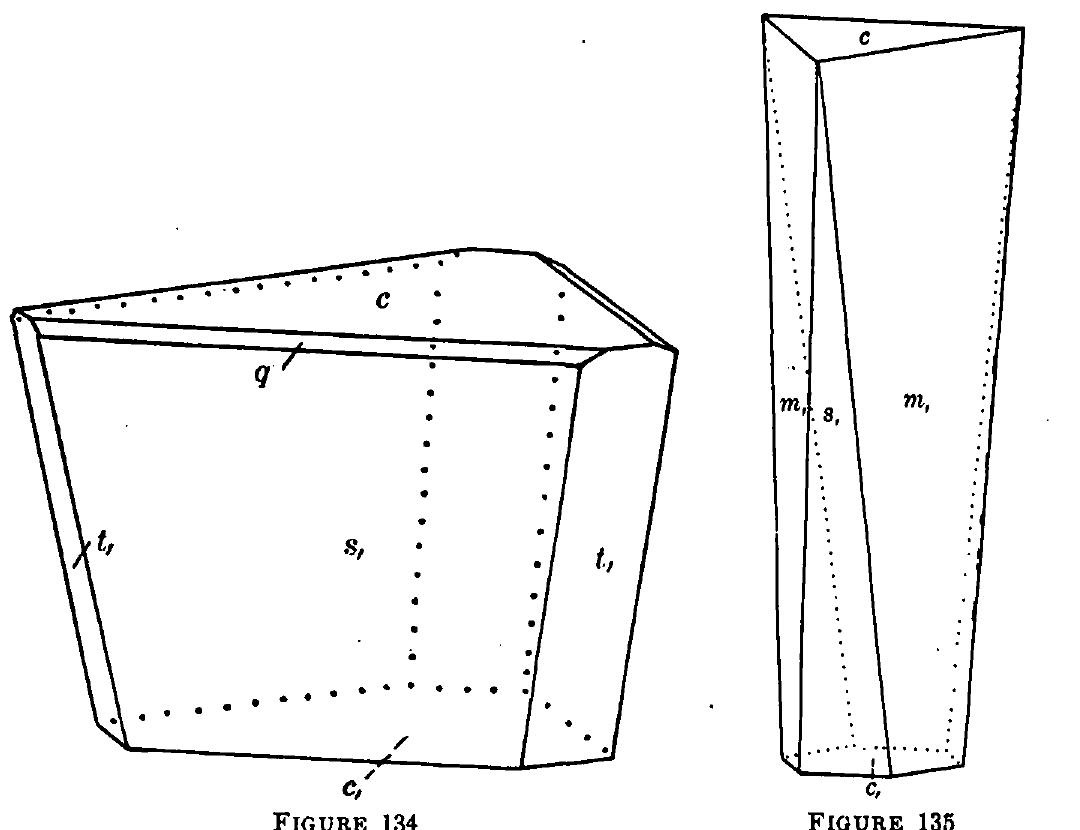
Larsenite, PbZnSiO4, a rare Franklin lead zinc silicate, was found to be piezoelectric when C. T. Prewitt, E. Kirchner and A. Preisinger determined its structure in the 1960s, space group Pna21, as the Society’s journal reported from their abstract in 1966 (The Picking Table vol. 7, no. 2, p. 2). The Handbook gives point group mm2 and “Piezoelectric” (Handbook of Mineralogy, larsenite), a polar class; Herb Yeates’s scanning-electron study found doubly terminated crystals that “show hemimorphic development … as expected for point group mm2” (vol. 33, no. 1, p. 22). Greenockite, cadmium sulfide, is 6mm like zincite (Handbook of Mineralogy, greenockite); Palache knew it only as a lemon-yellow powdery crust (PP 180, p. 28); Bostwick in 2016 knew it from both mines as yellow films and crusts, and at Sterling Hill as crystals, though confirmed specimens are rare (The Picking Table vol. 57, no. 2, p. 18). Barylite, a barium beryllium silicate on the district’s species list, has two polytypes, one polar (Pmn21) and one not (Pmnb); the Handbook prints a Franklin analysis but does not say which polytype it is (Handbook of Mineralogy, barylite).
Two local species are piezoelectric by class but not polar. Sphalerite, the “blende” of the Curies, is 4̄3m (Handbook of Mineralogy, sphalerite); at the Buckwheat mine Palache drew it as combinations of positive and negative tetrahedrons (PP 180, p. 28), the outward sign of a structure without a centre. Voigt placed “Zinkblende” among crystals with several polar axes, which “durch gleichförmige Temperaturänderung überhaupt nicht elektrisch erregt werden” (cannot be electrified at all by a uniform change of temperature; Lehrbuch, p. 802), so the word “Pyroelectric” in the Handbook’s sphalerite entry can only refer to effects of uneven heating. Cahnite, a calcium boron arsenate named for the collector and dealer Lazard Cahn, “who first noted the species,” is tetragonal, point group 4̄ (Handbook of Mineralogy, cahnite).
Habit can mislead. Palache classed friedelite as “Hexagonal-rhombohedral-hemimorphic”; crystals from the Taylor mine, found in 1909, were “sharply hemimorphic,” attached by the rhombohedral end with a brilliant base above, and “the first on which evidence of hemimorphism had been seen,” though others from the Canfield collection showed none (PP 180, p. 88–89). The Handbook now gives friedelite as monoclinic and pseudohexagonal, point group 2/m, space group C2/m, a class with a centre of symmetry, its pseudorhombohedral look coming from universal twinning, while still noting tablets that “may be hemimorphic” (Handbook of Mineralogy, friedelite). A Sterling Hill stope yielded “tan, trigonal, squat, hemimorphic friedelite crystals” in the 1970s (The Picking Table vol. 19, no. 1, p. 2). For willemite, Palache noted that the collector Frederick Canfield had figured a Sterling Hill crystal with “a striking hemimorphism,” but judged that “in the absence of corroboration” its bearing on willemite’s true symmetry “must remain doubtful” (p. 87). The Handbook gives willemite point group 3̄ and space group R3̄, again with a centre (Handbook of Mineralogy, willemite). Neither can be pyroelectric.
Beyond Franklin
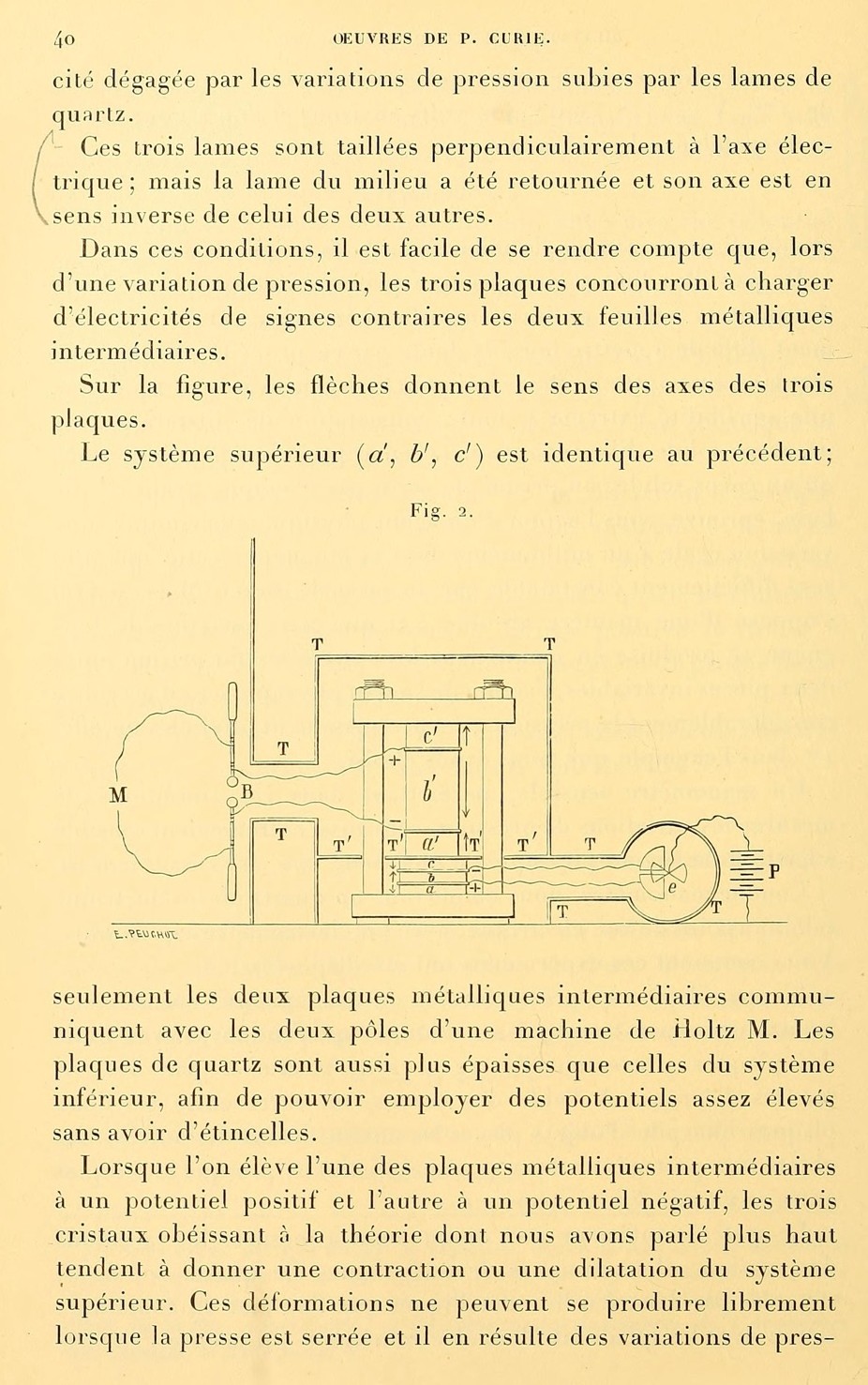
The effect soon left the mineral cabinet. Writing in the Bell System Technical Journal, Warren A. Marrison credited the first actual use of quartz resonators to the French physicist Paul Langevin, who drove large quartz crystals to send high-frequency sound through water “for submarine signaling and depth sounding”; the American physicist Walter G. Cady made the first comprehensive study of quartz resonators controlling vacuum-tube oscillators in 1921 and published it in April 1922; Alexander McLean Nicolson of Western Electric built Rochelle-salt loudspeakers and microphones (Bell System Technical Journal 27, 1948, p. 534). Horton and Marrison described the first quartz crystal clock in October 1927 (p. 538). In Rochelle salt the American physicist Joseph Valasek found electrical properties “analogous to the magnetic properties of iron,” with “an electric hysteresis,” the effect now called ferroelectricity (Valasek 1922, Synopsis).
Some of the materials, briefly. Tourmaline is pyroelectric worldwide; Dana lists localities from the Urals, Elba and Brazil to Ceylon and Madagascar (Dana 1922, p. 542). Quartz (class 32) is piezoelectric but, by Voigt’s argument, not truly pyroelectric (Voigt 1910, p. 234–235). Barium titanate was “widely used as a ceramic transducer” by 1955, when the National Bureau of Standards’ journal described ceramics of the lead titanate–lead zirconate series; a piezoelectric ceramic, it noted, requires a crystal structure “devoid of a center of symmetry” (Jaffe, Roth and Marzullo 1955, p. 239). Lithium niobate and lithium tantalate carry acoustic surface waves in signal-processing devices (Slobodnik 1971, AFCRL report). Triglycine sulfate, a ferroelectric grown from water solution, and lithium tantalate are among the materials of uncooled pyroelectric infrared detectors (NASA TM-82394, p. 4; NASA report 78-49, p. 2).
In The Picking Table
The Society’s journal has no article on pyroelectricity or piezoelectricity. The effects come up in a line or two of four issues, and hemimorphic crystals of local species in more. In issue order:
Vol. 1, no. 3 (September 1960), p. 11: a field trip to the B. Nicol quarry finds “two small fluorescent, hemimorphic tourmaline crystals.” Vol. 7, no. 2 (August 1966), p. 2: abstracts of the structures of barylite (“A strong piezoelectric effect”) and larsenite (“piezoelectric”). Vol. 18, no. 2 (September 1977), p. 19: fluorescent “Tourmaline variety Uvite.” Vol. 19, no. 1 (March 1978), p. 2: hemimorphic friedelite at Sterling Hill. Vol. 20, no. 1 (March 1979), p. 9: Pete J. Dunn on light green zincite from Sterling Hill, noting that most well-crystallized local zincite “is pyramidal in habit and hemimorphic.” Vol. 23, no. 1 (Spring 1982), p. 6: “A Small Part of Harvard at Franklin,” the Palache plate 17 tourmaline on show, its “hemimorphic form and dark-to-light-green multi-zoning … very unusual.” Vol. 24, no. 2, p. 15: Thomas A. Peters on the minerals of the Buckwheat Dolomite (reprinted from the Mineralogical Record, 1983), with microphotographs of hemimorphite crystals whose “hemimorphic nature is readily apparent.” Vol. 33, no. 1 (Spring 1992), p. 22: Herb Yeates on the lead silicates, with larsenite’s piezoelectricity and hemimorphic crystals; the same issue’s species list includes barylite.
Vol. 36, no. 2 (Fall/Winter 1995), p. 27 and vol. 37, no. 1 (Fall 1996), p. 18: Paul B. Moore’s “Closest-packed mineral structures of Franklin-Ogdensburg,” on zincite as a polar, piezoelectric crystal and on clinohedrite as a polar one. Vol. 45, no. 1 (Spring 2004), p. 14: Gary Grenier on photographing fluorescent uvite, “collected primarily for its distinctive hemimorphic green and brown crystals.” Vol. 57, no. 2 (Fall 2016), p. 18 and 20: Richard C. Bostwick’s “Fluorescent Minerals of Franklin and Sterling Hill,” with fluor-uvite, greenockite and the hemimorphite of the Noble and Passaic pits. Vol. 61, no. 2 (Fall 2020), p. 33: Steven M. Kuitems on zincite crystals in esperite that are not hemimorphic.
Not covered: the history of pyroelectricity, Penfield and Foote’s Kundt test of clinohedrite, or any measurement of the effect on local calamine, zincite or tourmaline.
Sources and further reading
- Académie royale des sciences, 1741 (reprint of the 1719 printing), Histoire de l’Académie royale des sciences, année 1717. Paris. Diverses observations de physique générale, I, p. 7–8. archive.org
- Aepinus, F. U. T., 1762, Recueil de différents mémoires sur la tourmaline. St. Petersburg: Académie des Sciences. Title page; p. 2, 9. archive.org
- Brewster, D., 1824, Observations on the pyro-electricity of minerals. Edinburgh Journal of Science, vol. 1, p. 208 ff. archive.org
- Curie, J., and Curie, P., 1880, Développement, par pression, de l’électricité polaire dans les cristaux hémièdres à faces inclinées. Comptes rendus, vol. 91, p. 294–295. archive.org
- Curie, J., and Curie, P., 1881, Contractions et dilatations produites par des tensions électriques dans les cristaux hémièdres à faces inclinées. Comptes rendus, vol. 93, p. 1137–1138. archive.org
- Dana, E. S., 1922, A text-book of mineralogy. New York: Wiley. Pyro- and piezo-electricity, p. 306–307; calamine, p. 539; tourmaline, p. 542. archive.org
- Handbook of Mineralogy. Mineral Data Publishing (2001–2005) and Mineralogical Society of America. Entries for barylite (rev. 2021), cahnite, clinohedrite, dravite, friedelite, greenockite, hemimorphite, larsenite, sphalerite, uvite, willemite, zincite. handbookofmineralogy.org
- Hankel, W. G., 1881, Elektrische Untersuchungen, 15. Abhandlung: Über die aktino- und piezoelektrischen Eigenschaften des Bergkrystalles. Abhandlungen der K. Sächsischen Gesellschaft der Wissenschaften, vol. 20. Quoted from p. 462. archive.org
- Haüy, R.-J., 1801, Traité de minéralogie. Paris: Louis. Vol. 1, p. 236–237; vol. 4, p. 159–161; vol. 5 (atlas), pl. LII and LXXXI. archive.org
- Haüy, R.-J., 1822, Traité de minéralogie, 2nd ed., vol. 4. Paris: Bachelier. Zinc oxidé silicifère, p. 175–177. archive.org
- Jaffe, B., Roth, R. S., and Marzullo, S., 1955, Properties of piezoelectric ceramics in the solid-solution series lead titanate–lead zirconate–lead oxide: tin oxide and lead titanate–lead hafnate. Journal of Research of the National Bureau of Standards, vol. 55, p. 239 ff. archive.org (PDF)
- Kroes, R. L., and Reiss, D., 1981, The pyroelectric properties of TGS for application in infrared detection. NASA Technical Memorandum 82394. archive.org (PDF)
- Kundt, A., 1883, Ueber eine einfache Methode zur Untersuchung der Thermo-, Actino- und Piëzoelectricität der Krystalle. Annalen der Physik und Chemie, N.F., vol. 20, p. 592 ff. archive.org
- Linnaeus, C., 1747, Flora Zeylanica. Stockholm: L. Salvius. Praefatio, p. 8. archive.org
- Marrison, W. A., 1948, The evolution of the quartz crystal clock. Bell System Technical Journal, vol. 27, p. 510–588. archive.org (PDF)
- Martin Marietta Laboratories, 1978, Development of improved lithium tantalate pyroelectric detectors. Technical report 78-49, for NASA Langley Research Center. archive.org (PDF)
- Palache, C., 1935, The minerals of Franklin and Sterling Hill, Sussex County, New Jersey. U.S. Geological Survey Professional Paper 180. Calamine deposits, p. 22–23; sphalerite and greenockite, p. 28; zincite, p. 37–39 and pl. 3; willemite, p. 87; friedelite, p. 88–89; calamine and clinohedrite, p. 105–107 and pl. 16; tourmaline, p. 111–113 and pl. 17. PDF (USGS)
- Penfield, S. L., and Foote, H. W., 1898, On clinohedrite, a new mineral from Franklin, N.J. American Journal of Science, 4th ser., vol. 5, p. 289–293. archive.org
- The Picking Table (Franklin-Ogdensburg Mineralogical Society), vol. 7 no. 2 (1966); vol. 33 no. 1 (1992), Yeates, H., The lead silicate minerals of Franklin, New Jersey: an SEM survey; vol. 36 no. 2 (1995) and vol. 37 no. 1 (1996), Moore, P. B., Closest-packed mineral structures of Franklin-Ogdensburg; vol. 57 no. 2 (2016), Bostwick, R. C., Fluorescent minerals of Franklin and Sterling Hill, N.J. Further issues are listed in the section above. The Picking Table (PDF)
- Priestley, J., 1767, The history and present state of electricity. London. Per. X, sec. IX, The electricity of the tourmalin, p. 314–323. archive.org
- Shuster, E. D., 1927, Historical notes of the iron and zinc mining industry in Sussex County, New Jersey. Franklin, N.J. Sterling Hill, p. 19–20. PDF
- Slobodnik, A. J., Jr., 1971, The temperature coefficients of acoustic surface wave velocity and delay on lithium niobate, lithium tantalate, quartz, and tellurium dioxide. Air Force Cambridge Research Laboratories, AFCRL-72-0082. archive.org (PDF)
- Valasek, J., 1922, Piezo-electric activity of Rochelle salt under various conditions. Physical Review, vol. 19 (thesis reprint, University of Minnesota). archive.org
- Voigt, W., 1910, Lehrbuch der Kristallphysik. Leipzig: Teubner. § 129, p. 234–235; p. 802. archive.org
- Wang, Q.-M., 2010, Dual mode thin film bulk acoustic resonators (FBARs) based on AlN, ZnO and GaN films with tilted c-axis orientation. Final report to the U.S. Army Research Office (DTIC ADA532761). archive.org (PDF)
- Wilson, B., 1760, Experiments on the tourmalin. Philosophical Transactions, vol. 51, pt. 1, p. 308 ff. (read December 6, 1759). archive.org
Written with Claude, an AI model made by Anthropic, from the sources listed above, and checked against them. October 2026.