Histories › The mines and their history
Thomas A. Edison’s iron-ore concentrating works on the mountain above Ogdensburg: a magnetic survey, giant crushing rolls, 480 magnets, briquettes, a village named Edison, the ore of the Mesabi range, and the cement plant that came after. With what it had to do with Franklin.
A mountain of lean ore

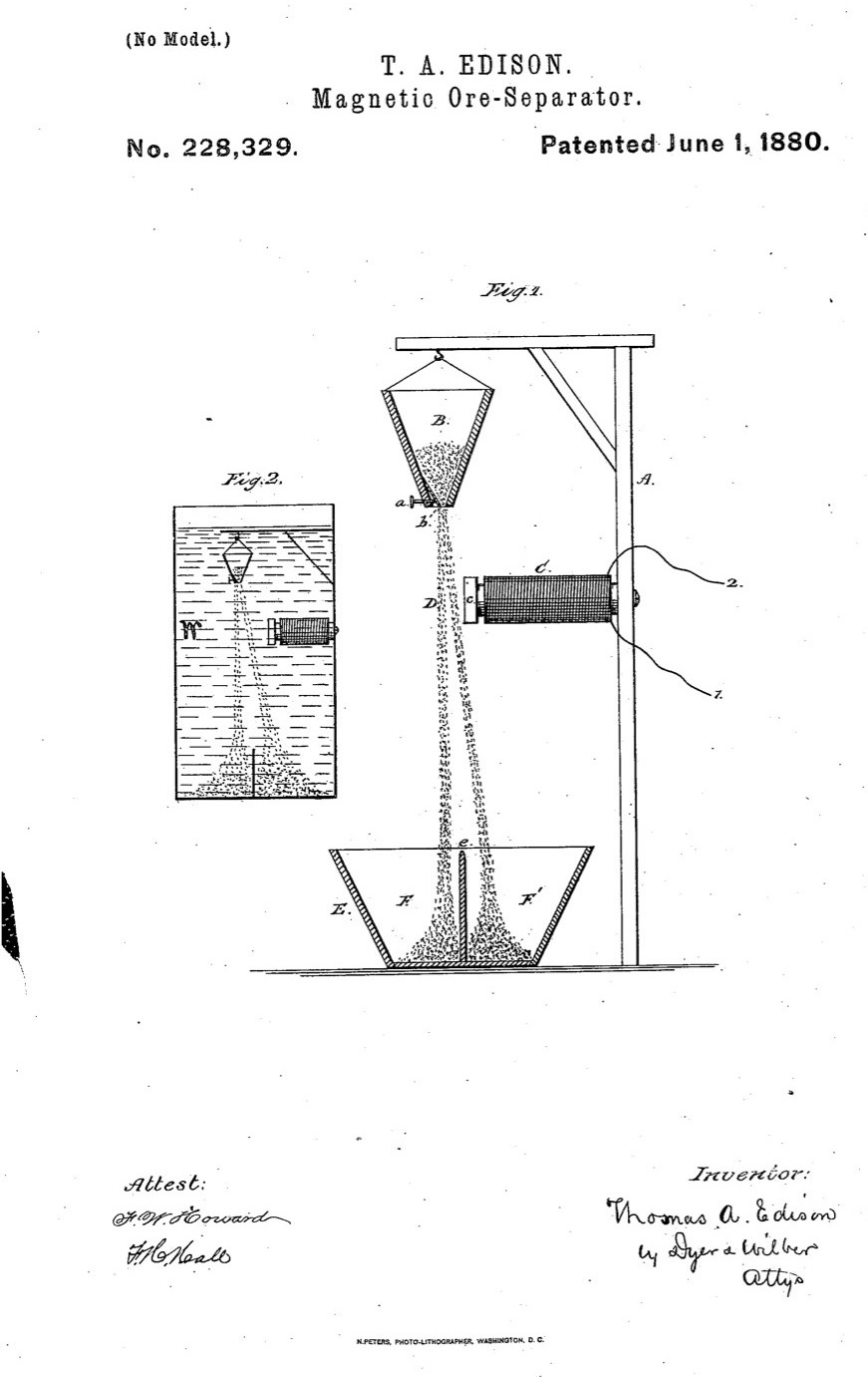
The Ogden mines lay on the mountain about two miles southeast of Ogdensburg, in Sparta Township, “at the place now known as Edison,” as the geologist William S. Bayley put it in 1910 (p. 276). Bayley dated the oldest opening, the Old Ogden mine, to 1772 (p. 277), and counted the Roberts, Pardee, Davenport and Old Ogden (or Lehigh) mines working the same vein into the 1880s. All but the Pardee closed soon after 1880, and the Pardee ran until 1884 “and perhaps a few years later” (p. 278). Ore from these mines also fed the Franklin Iron Company’s blast furnace at Franklin Furnace, as Allen W. Pinger noted. The older story of that furnace and the zinc properties is told in Before the company.
The rich ore was gone; the rock that held it was not. Edison had a magnetic separator from 1880, a device in which crushed rock “fell in a thin, broad stream in front of an electromagnet,” in the words of the Thomas A. Edison Papers. Before choosing a site he ran a magnetic survey of the Highlands, mapping where a dipping needle was pulled to the ground. Bayley called it “the most systematic work that has ever been done in the State along these lines” (p. 197).
The company that bought the Ogden belt goes by three names in the sources. Shuster calls it the New Jersey and Pennsylvania Concentrating Company, which purchased the tract “in the year 1889” (p. 23); Pinger, the “New Jersey & Penn’a Exploration and Mining Co.” (vol. 14, no. 2, August 1973, p. 14); Bayley, simply “the Edison Company,” buying “in 1889 or 1890” (p. 278). The Edison Papers give the New Jersey and Pennsylvania Concentrating Works, “organized in New Jersey on December 27, 1888” (company record). Shuster summed up the idea: Edison “foresaw great possibilities in converting the great low grade magnetite iron ore deposits of this and other countries into profitable commercial enterprises” (p. 23).
A graveyard for “Kodak fiends,” 1891
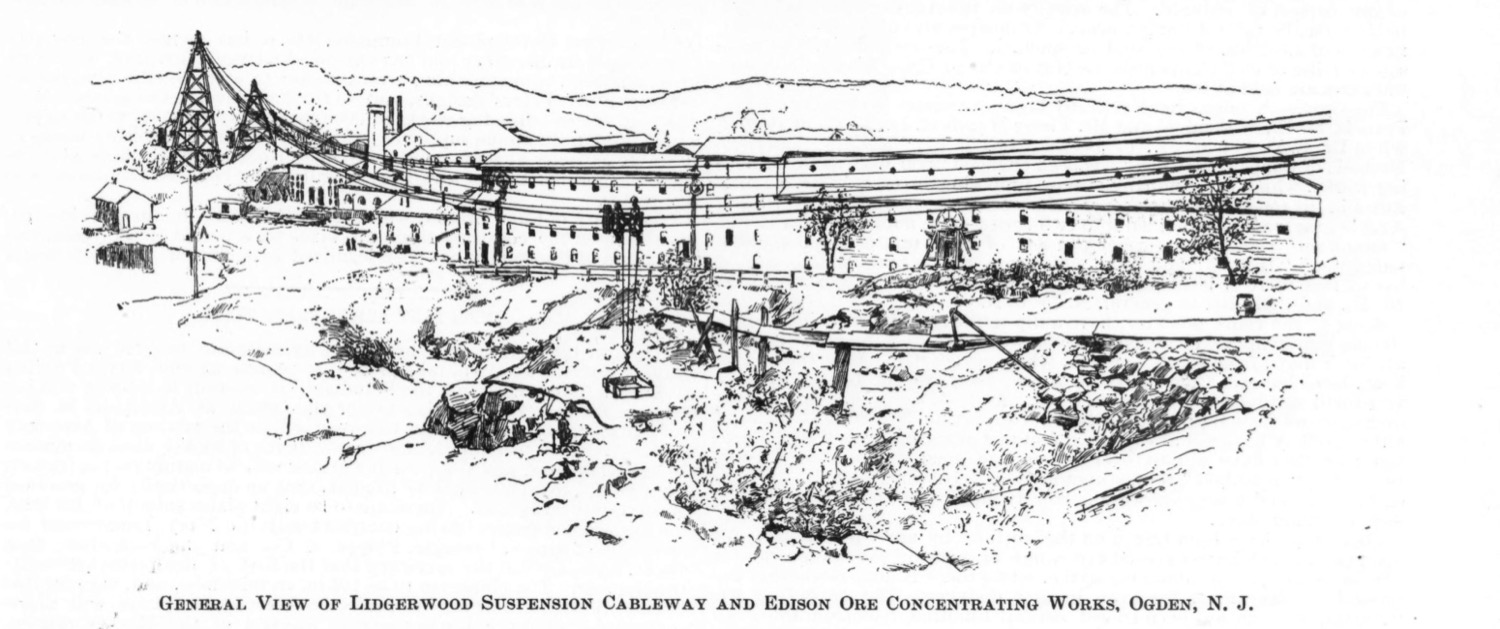
In September 1891 a writer for the Engineering and Mining Journal came up from South Ogdensburg to see the two Lidgerwood cableways that carried rock from the quarry to the crushers, and found Edison living at the mine boarding house. The rock, Edison told him, “contains on an average 16% of metallic iron,” so that roughly four tons of rock had to be handled for every ton of 64 per cent ore (p. 425). The mill was being rebuilt, and Edison “courteously but firmly declined to exhibit the machinery to visitors until it is finished and in successful operation.” Outside lay “a vast heap of abandoned machinery”: the grit of crushed magnetite and rock had got into the bearings, and “the machinery failed by wearing itself out in a very short time” (p. 426).
On the hilltop Edison showed the party one of the old workings, supposed to be over a hundred years old, “a frightful chasm, 8 or 10 ft. wide, about 200 ft long, and 175 ft. deep”: “Come here, and I will show you a hole in the ground that will make your hair curl.” The photographs printed with the article were taken, the writer added, “notwithstanding Mr. Edison’s warning that he had a graveyard on the ground for ‘Kodak fiends’” (p. 426). The joke needed no explaining in 1891. Kodak’s box camera had come out three years before, sold with the promise “You press the button, we do the rest,” and the amateurs who now snapped everything in sight were called Kodak fiends. Edison, who would not show his unfinished machinery, was telling his guests that photographers were not welcome; the journal printed the pictures anyway. The open-pit quarrying here, rock and ore taken together, was the opposite of the underground mining at Franklin described in Machines underground.
Giant rolls and 480 magnets, 1897
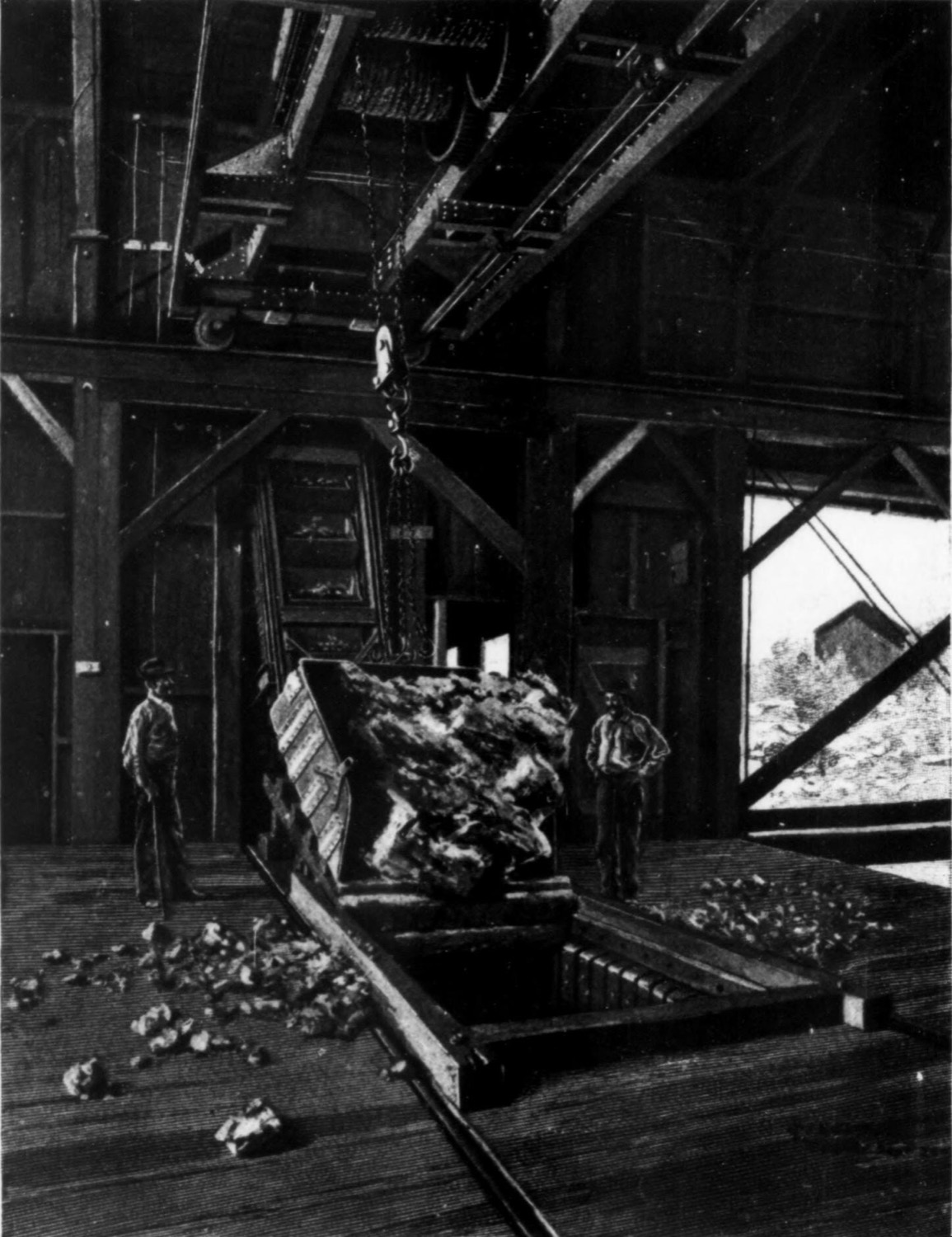
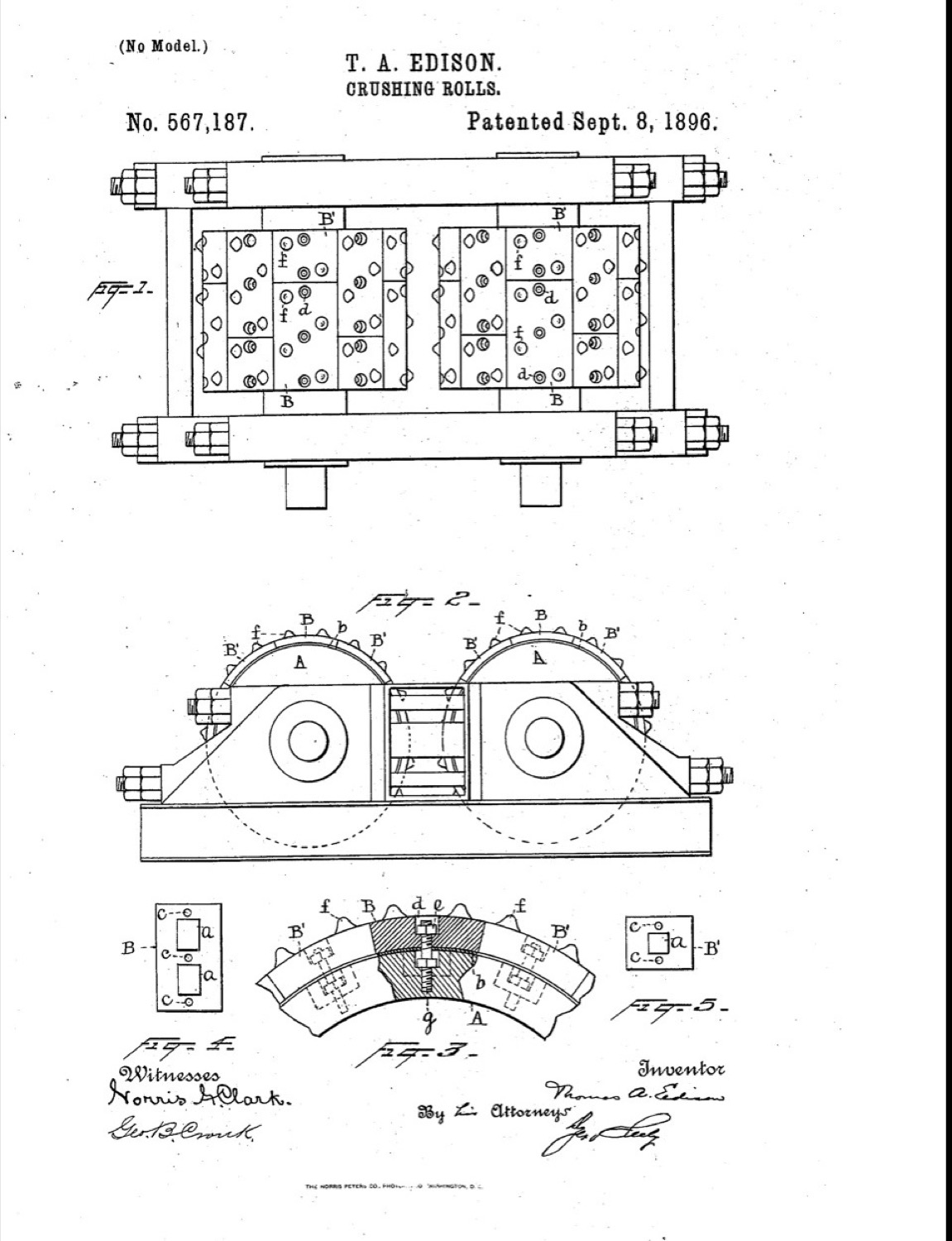
By 1897 the works were rebuilt on a far larger plan. Theodore Waters, writing for McClure’s Magazine that November, reported that engineers had spoken of the enterprise as Edison’s “‘hobby;’ others, less charitable, called it his ‘folly’” (p. 79). A steam shovel loaded blasted boulders of five and six tons into skips, and Edison, found watching it, told him: “We are making a Yosemite of our own here; we will soon have one of the biggest artificial cañons in the world” (p. 84).
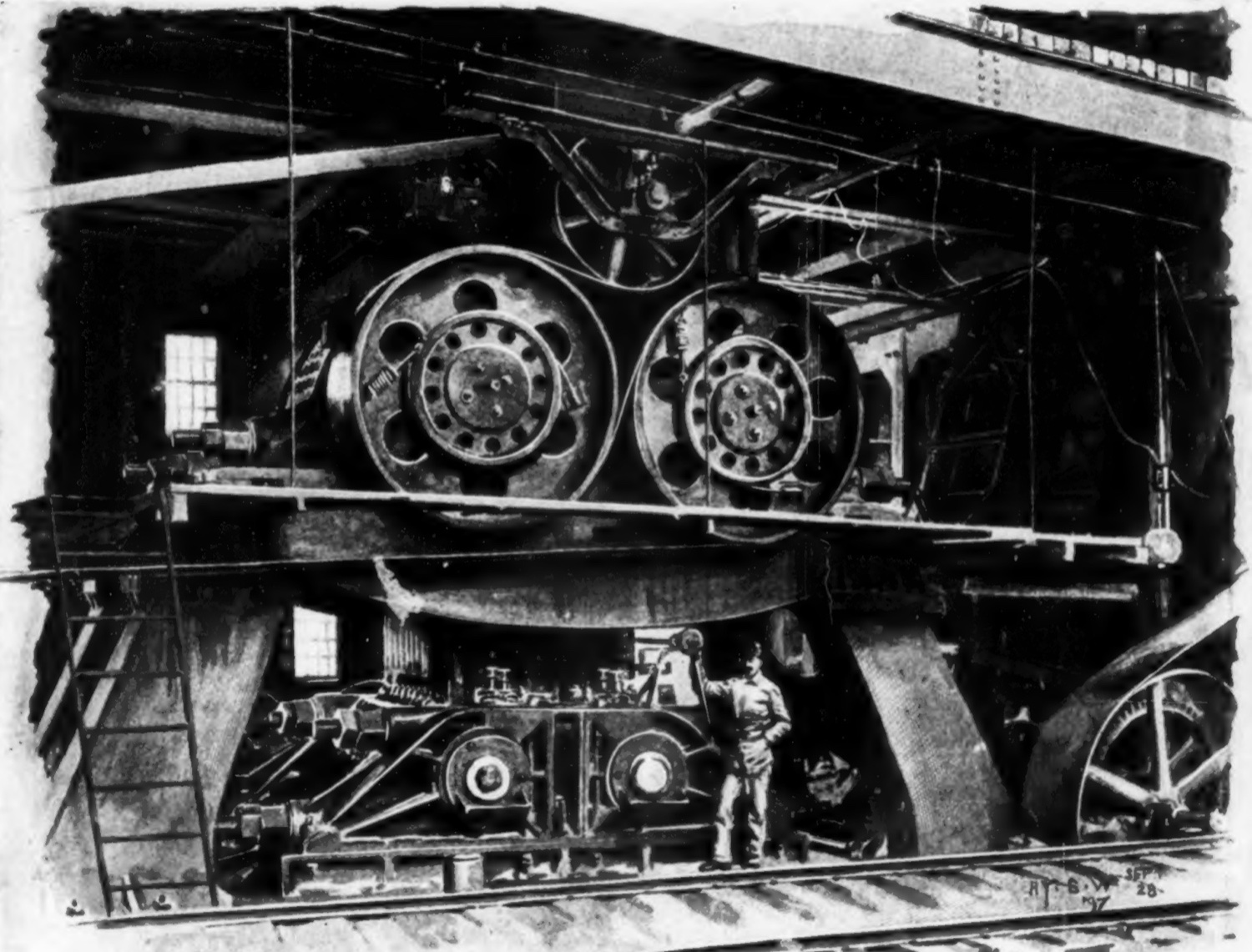
The heart of the plant was the giant rolls, “two immense rollers over six feet in diameter and five in width,” studded with teeth. The engine only brought them up to speed; “it is the momentum of the seventy tons of metal contained in the moving parts of the rolls which does the crushing” (p. 86). Further sets of rolls reduced the rock to dust, which was dried and dropped past a column of magnets, “of which there are 480” (p. 86): the sand fell straight, the magnetite was pulled aside. Mixed with a binder, the concentrate was pressed into briquettes two and a half to three and a half inches across and baked so that it would survive the freight car and the blast furnace (p. 89). Waters gave the rate: “Six thousand tons of crude ore are changed into 1,500 tons of briquettes in each day’s run of twenty hours” (p. 89). Bayley gave the separator a capacity of 700,000 tons a year (p. 278).
Edison, N.J.
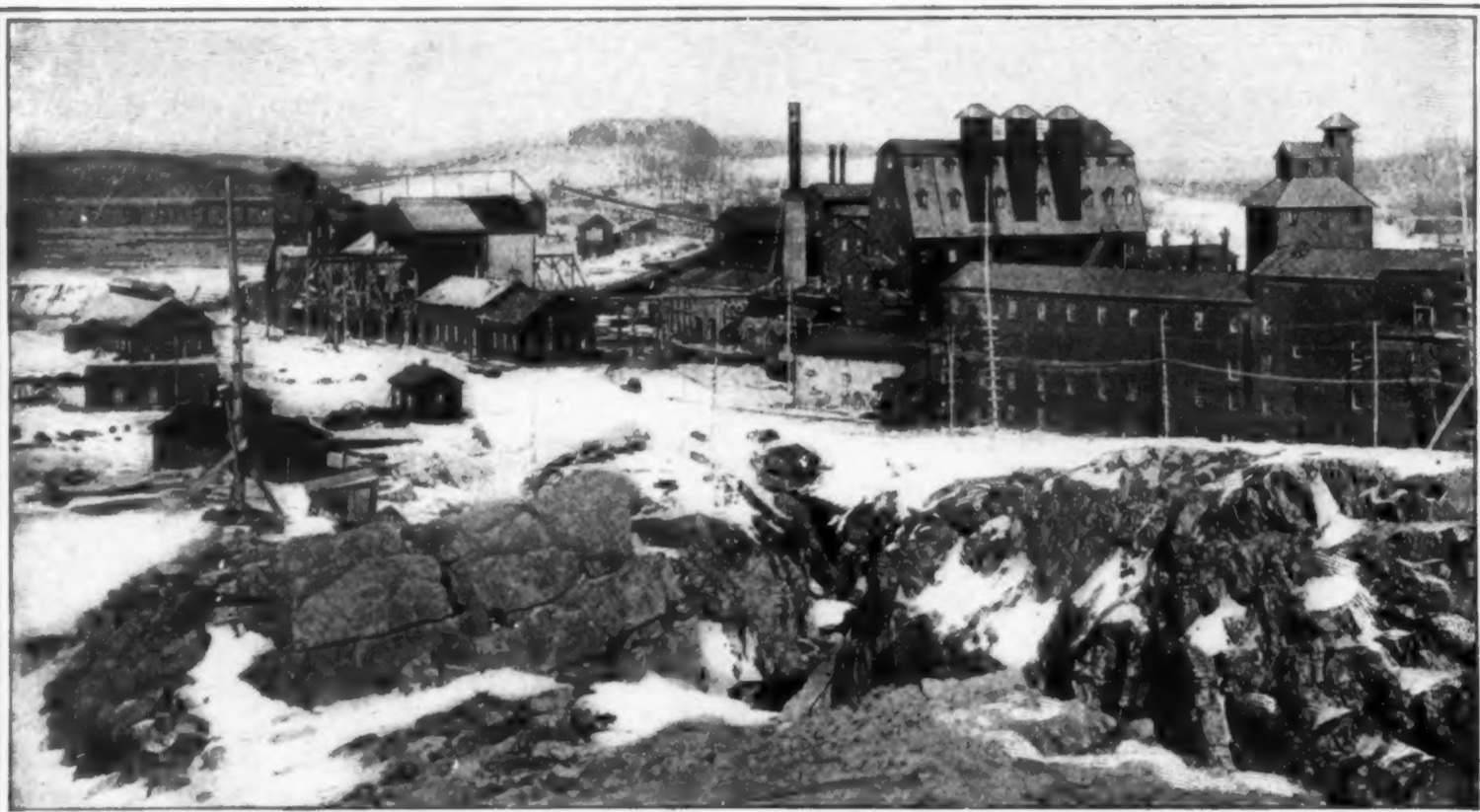
The works made a village, and the village took Edison’s name. Waters described laborers in the shanties of Summerville on the hilltop, workmen of the “intermediate class” in between, and, across the mine, the “White House,” “a little dwelling in which Edison lives with his chief men” (p. 92). Edison’s biographers Frank L. Dyer and T. C. Martin wrote that for five years he lived at Edison through the week and went home to Orange only on Saturday night (vol. II, p. 501).
When the works closed, part of the village moved to the zinc mines. William R. Truran recorded that “Some of the homes from Thomas Alva Edison’s iron-mining operation above Ogdensburg on Sparta Mountain were brought to Franklin” for housing in Laceytown, on Rutherford Avenue and on Mill Street, and that “One building, the Edison schoolhouse, became the Hungarian Church” (vol. 54, no. 1, Spring 2013, p. 15).
What the numbers say
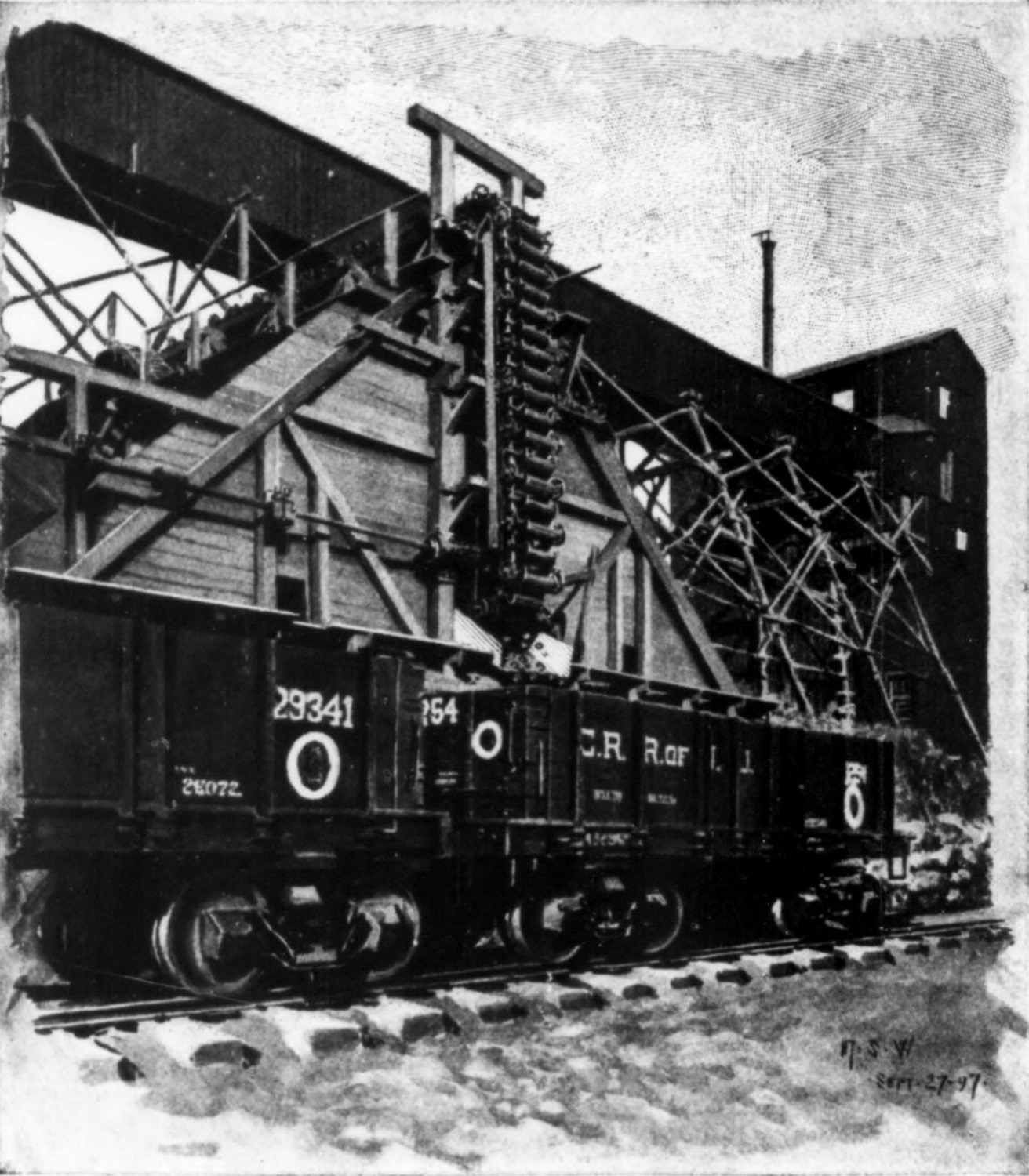
Shuster wrote that “the operation of the mill demonstrated that the mechanical equipment was a success” (p. 24); every source agrees the business was not. On the figures they disagree almost everywhere, and the figures are set out here side by side. Iron in the rock: 16 per cent, as Edison told the Journal in 1891 (p. 425); 20 per cent in the first quarrying of 1890, and 10 to 12 per cent in the trial of 1898, according to Bayley (p. 278); “only 8%,” as Shuster heard it (p. 24).
Product: Bayley says the concentrate was “a 68 per cent. Bessemer ore,” that “Experimental runs were made at intervals between 1891 and 1897, but none of the product was sold,” that a sixty-day run in 1898 made about 1,200 tons of briquettes, of which a shipment of 1,000 tons to the Thomas Iron Company analyzed 62.83 per cent iron, and that 10,000 tons of briquettes were shipped in 1899 (p. 278). The Journal in January 1898 put the briquettes at about 65 per cent iron and wrote that “The output to date has been limited to about 1,200 tons of ore-briquettes which were smelted at Catasauqua” (p. 96); Edison himself wrote that the iron made “at Crane Iron Company from our briquettes” was “abnormally strong.” Shuster gives briquets “containing about 68% metallic iron” (p. 24); Pinger, “10,000 T of concentrates” in 1900 at 62.8 per cent (vol. 14, no. 2, August 1973, p. 14).
The end: all the Ogden mines were abandoned in 1899, according to Bayley, “in consequence of the failure of the New Jersey and Pennsylvania concentrating works to concentrate successfully the ores on a commercial basis” (p. 277); operations “were shut down permanently in 1900,” according to the Edison Papers; “experiments and operation continued until 1901,” according to Pinger.
The Mesaba range
What beat the Ogden works was a mountain range in Minnesota. Waters, in 1897, already named “the discovery of the great deposits in the Masaba range of Minnesota” and the cheapening of their mining and transport as the threat to the Eastern furnaces (p. 76); today the name is spelled Mesabi. Dyer and Martin wrote that the Mesaba ore was so rich and so cheaply mined that “the market price of crude ore of like iron units fell from about $6.50 to $3.50 per ton at the time when Edison was ready to supply his concentrated product” (vol. II, p. 499). Bayley described the same squeeze from the New Jersey side: by 1898 lake ore had driven the price of New Jersey ore down to about two dollars a ton, the year the concentrating works at Edison were put into operation (p. 15). The plant was idle by the time Bayley wrote, “because of inability to manufacture briquettes at a profit” (p. 278).
From iron ore to cement
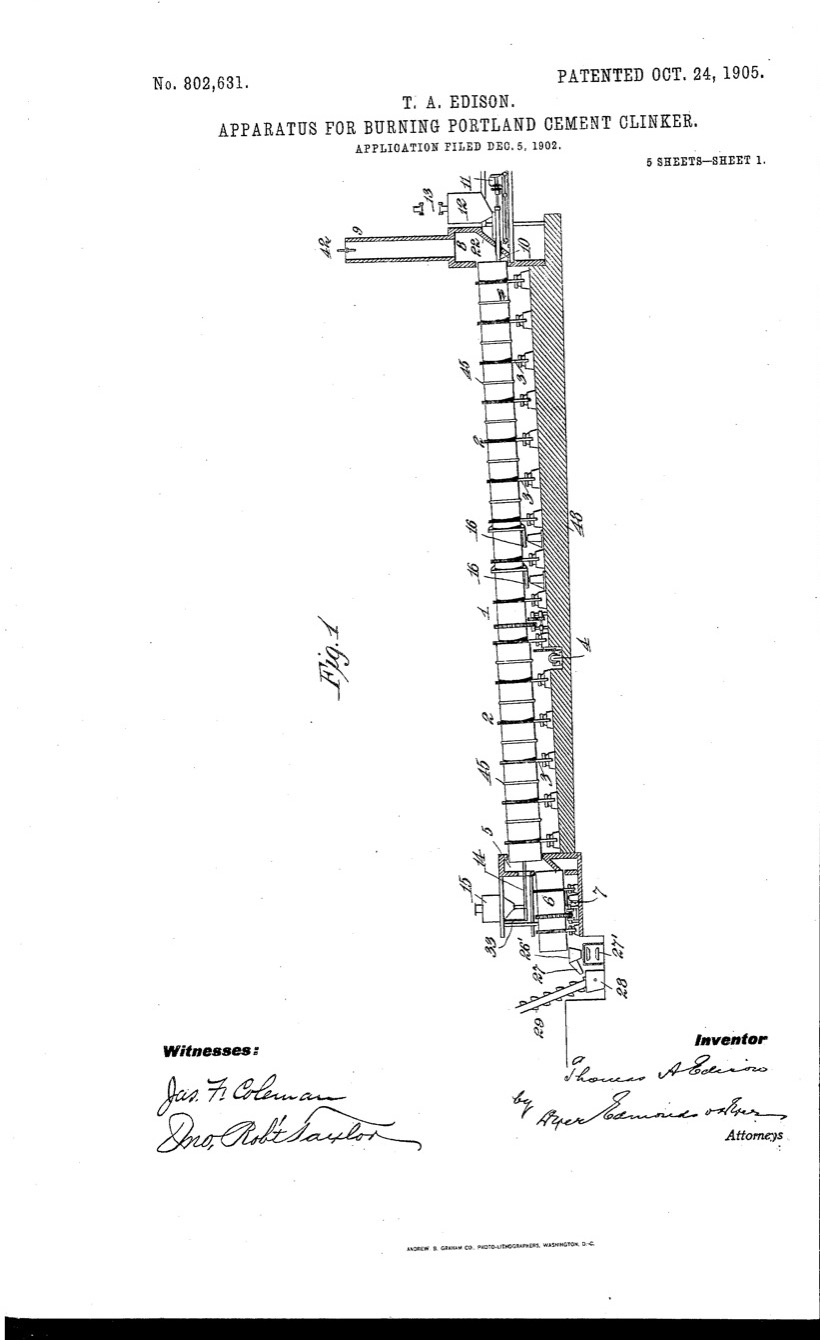
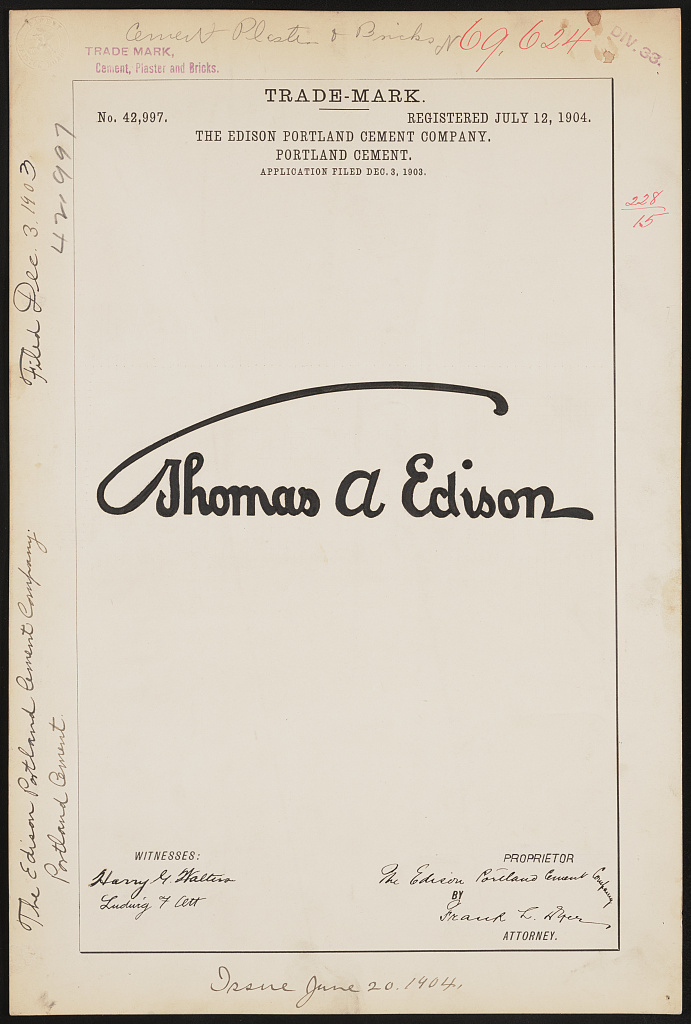
Mallory remembered the decision being made on the train home from Edison: “it was finally decided that we would apply the knowledge we had gained in the concentrating plant by building a plant for manufacturing Portland cement” (vol. II, p. 503). The Edison Portland Cement Company “was incorporated on June 7, 1899,” and, in the Edison Papers’ words, “had a mill at Stewartsville, New Jersey” (company record); Dyer and Martin call it “the cement plant at New Village, New Jersey” (vol. II, p. 504). Both place names are given here as each source has them.
The giant rolls went with him. In other cement plants, Dyer and Martin wrote, “the limit of crushing ability is ‘one-man size’—that is, pieces not too large for one man to lift,” while Edison’s rolls took rock of eight tons and more (vol. II, p. 511). He also built a kiln “one hundred and fifty feet long and nine feet in diameter,” where the usual kiln of the day was about sixty feet by six (pp. 512–513). Shuster, from Franklin, made the same point in 1927: the cement plants of New Jersey and eastern Pennsylvania “utilized many of the inventions and appliances that were created by Mr. Edison during his experiments with the Ogden ore” (p. 24).
Edison and the zinc mines
The Ogden works and the zinc mines were neighbours in the same years and faced the same problem: getting a magnetic mineral out of crushed rock. They solved it differently. Edison’s ore was magnetite, strongly magnetic, and his magnets pulled it sideways out of a falling stream. Franklin’s franklinite is only weakly magnetic, and John Price Wetherill’s separator of 1896 lifted it off a moving belt under a far stronger magnet (see Magnetic separation). Pinger’s chronology sets Wetherill’s tests at Franklin and Edison’s separator at Ogden one after the other, in 1887–1889 (vol. 14, no. 2, August 1973, p. 14).
The machinery crossed over even where the magnets did not. In Wetherill’s own description of the new concentrating plant at Franklin in 1897, the crushed ore went from the slow-speed rolls to an elevator that “delivers into the Edison dryer” (Engineering and Mining Journal, July 24, 1897, p. 98). John L. Baum wrote in 1988 that some of the sizing and elevating equipment Wetherill needed “had been refined earlier by Thomas Edison and his advice was sought,” and that a screen design on tracing cloth bearing Edison’s signature of approval was then kept at the Franklin Mineral Museum (vol. 29, no. 1, Spring 1988, p. 5). No source we found says that Edison ever tried his own process on Franklin or Sterling Hill ore.
In The Picking Table
No article in The Picking Table has been given to the Ogden works; Edison appears in passing. Allen W. Pinger’s “A review of mineralogical, geological and mining activities in the Franklin area” (vol. 14, no. 2, August 1973) gives the works a paragraph in its chronology, with dates and figures that differ from Bayley’s. John L. Baum’s “The development of Franklin ore concentration” (vol. 29, no. 1, Spring 1988) notes Edison’s advice to Wetherill. Maureen Verbeek’s interview with Pete J. Dunn lists among the chapters of his history of Mine Hill and Sterling Hill “The great Edison project (Volume 1, pages 63–66)” (vol. 44, no. 2, Fall 2003). William R. Truran’s “Recollections of Franklin: The Mining Town” (vol. 52, no. 1, Spring 2011) mentions the miners who came down from the closed iron mines, “including Thomas Edison’s mine atop Sparta Mountain,” and a former Edison house in the Sterling Park section of Franklin; Part II (vol. 53, no. 1, Spring 2012) prints a photograph of “Workers at Thomas Edison’s iron mining and milling works on Sparta Mountain above Ogdensburg.” His “From furnace to borough—Franklin’s transformation” (vol. 54, no. 1, Spring 2013) follows the Edison houses and schoolhouse to Franklin.
Sources and further reading
- Baum, J. L., 1988, The development of Franklin ore concentration. The Picking Table, vol. 29, no. 1, beginning p. 4. PDF
- Bayley, W. S., 1910, Iron mines and mining in New Jersey. Geological Survey of New Jersey, Final Report Series, vol. 7. Pp. 15, 197, 276–279 (the Ogden mines). archive.org
- Dyer, F. L., and Martin, T. C., 1910, Edison: his life and inventions. New York: Harper & Brothers. Vol. II, chap. XIX, “Magnetic ore milling work,” and chap. XX, “Edison Portland cement.” archive.org
- Engineering and Mining Journal, 1891, The Lidgerwood suspension cableway and the Edison ore concentrating works at the Ogden mines, New Jersey. Vol. 52, Oct. 10, 1891, p. 425–427. archive.org
- Engineering and Mining Journal, 1898, Edison iron ore concentrates (editorial, with a letter from T. A. Edison). Vol. 65, Jan. 22, 1898, p. 96. archive.org
- Pinger, A. W., 1973, A review of mineralogical, geological and mining activities in the Franklin area. The Picking Table, vol. 14, no. 2, beginning p. 11. PDF
- Shuster, E. D., 1927, Historical notes of the iron and zinc mining industry in Sussex County, New Jersey. Franklin, N.J.: privately published. Pp. 23–24. PDF
- Thomas A. Edison Papers, Rutgers University: “Ore Milling”; company records for the New Jersey and Pennsylvania Concentrating Works and the Edison Portland Cement Company. Edison Papers
- Truran, W. R., 2013, From furnace to borough—Franklin’s transformation. The Picking Table, vol. 54, no. 1, beginning p. 13. PDF
- Waters, T., 1897, Edison’s revolution in iron mining. McClure’s Magazine, vol. 10, no. 1 (November), p. 75–93. Both pictures on this page are from it. archive.org
- Wetherill, J. P., 1897, The Mine Hill ore deposits of New Jersey and the Wetherill concentrating plant (continued). Engineering and Mining Journal, vol. 64, July 24, 1897, p. 98–101. archive.org
Written with Claude, an AI model made by Anthropic, from the sources listed above, and checked against them. October 2026.