The color of willemite’s glow, as it was named and pictured in three systems: Werner’s words, Ridgway’s plates and Munsell’s chart.
Why green
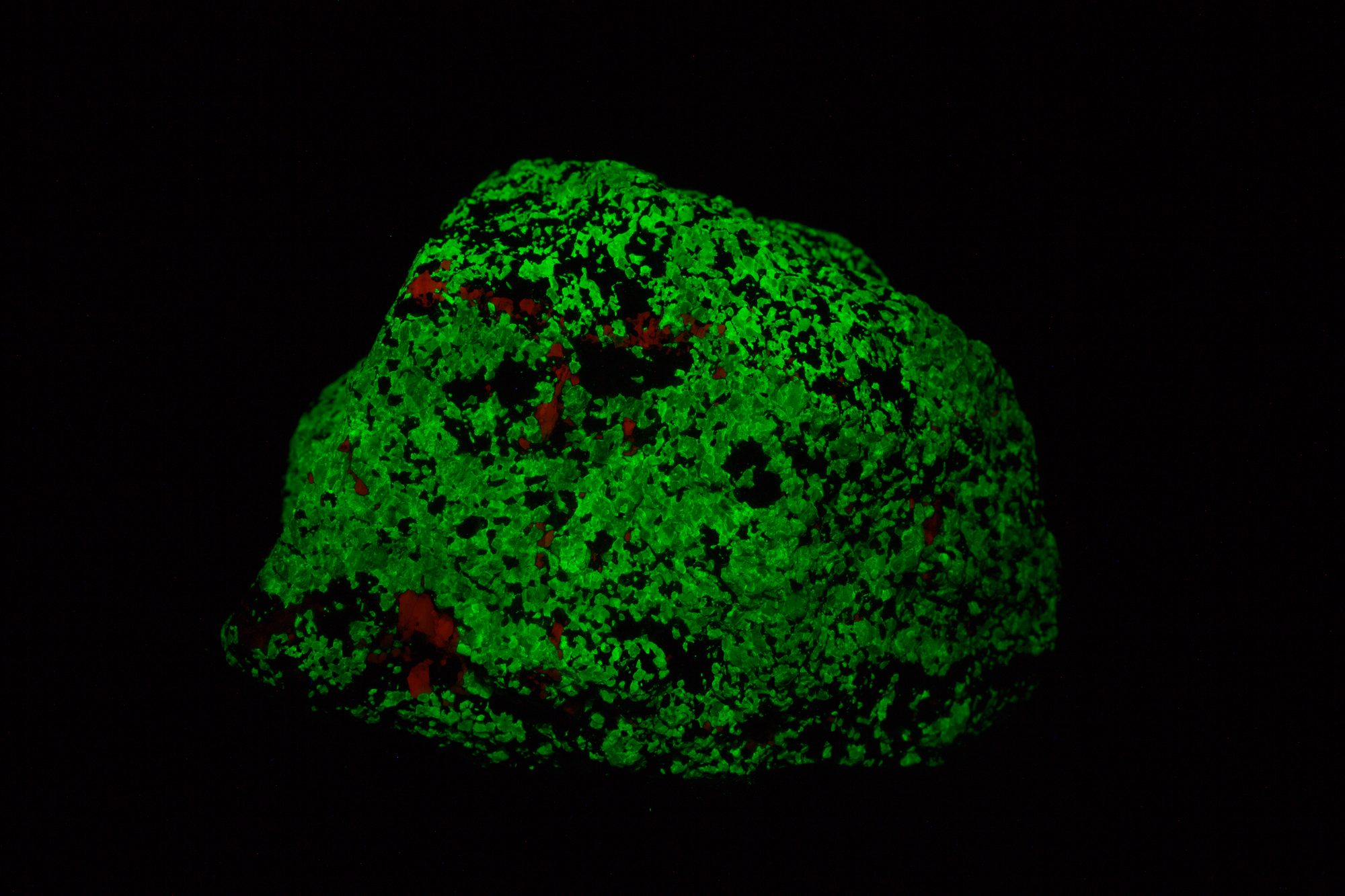
Green is the color most closely tied to Franklin: the glow of willemite under shortwave ultraviolet light (see Green light). It is also a color that each system on this site names and pictures in its own way. The sections below set out how green appears in three of them, each on its own terms. They are not compared here.
Werner: eight greens, each with a mineral
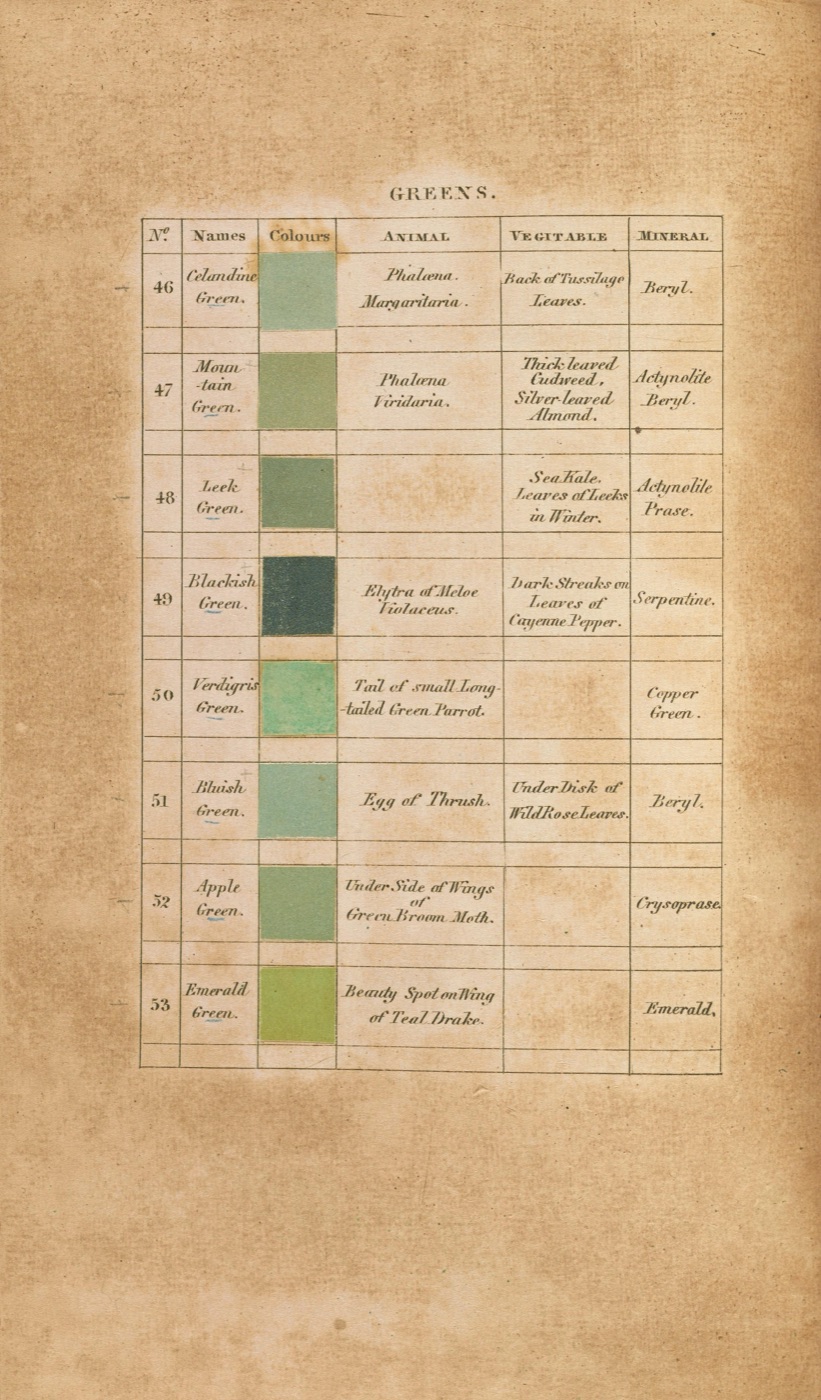
In Werner’s nomenclature (1821) green is a family of eight named colors, each fixed by a painted swatch and by an example from the mineral kingdom: celandine green (beryl), mountain green (actinolite, beryl), leek green (actinolite, prase), blackish green (serpentine), verdigris green (copper green), bluish green (beryl), apple green (chrysoprase) and emerald green (emerald). The animal and vegetable columns give, for instance, the egg of the thrush for bluish green and the tail of a small long-tailed green parrot for verdigris green.
A green is defined here by resemblance: it is the green of a known thing. No measurement is involved.
Ridgway: greens in graded series
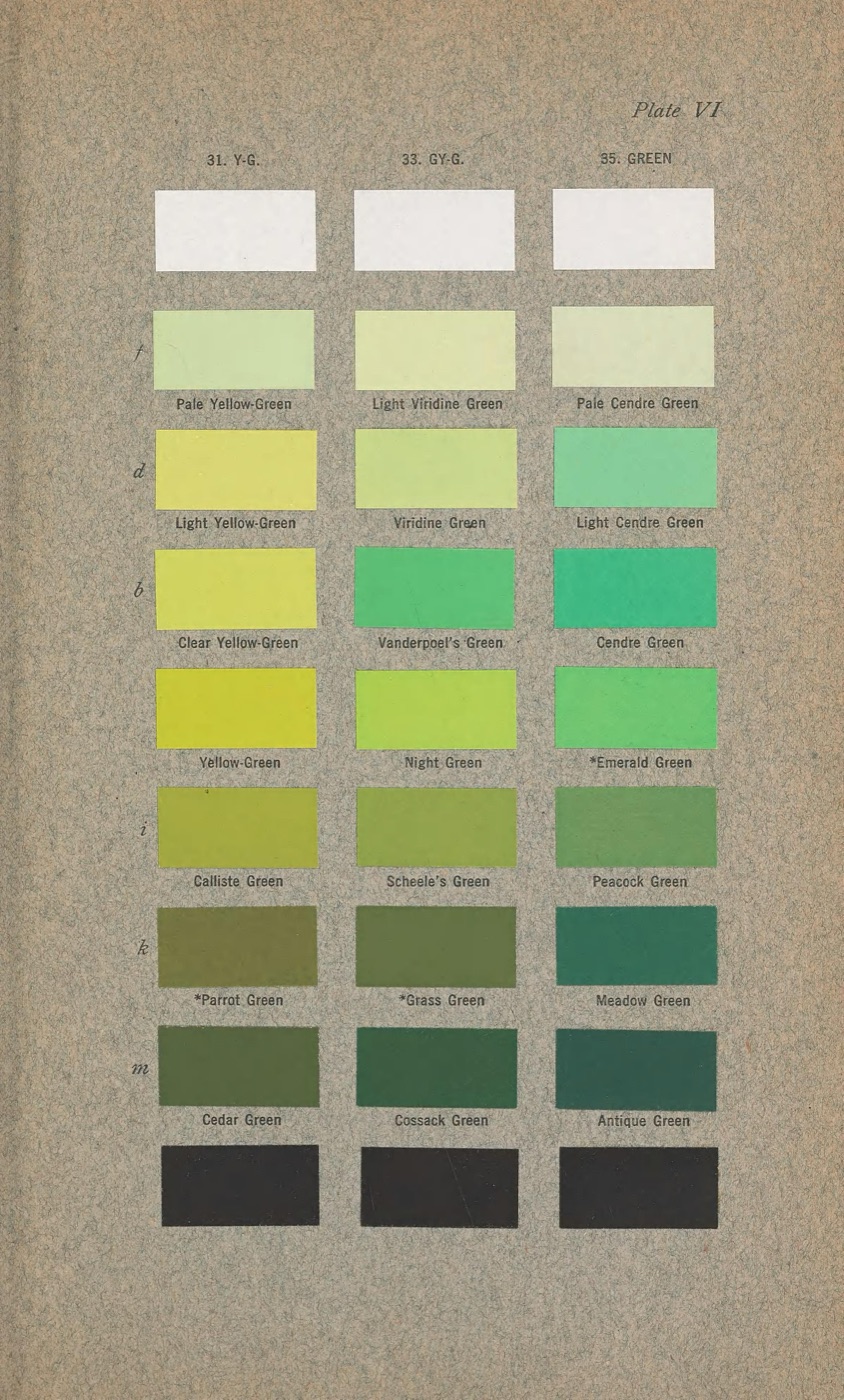
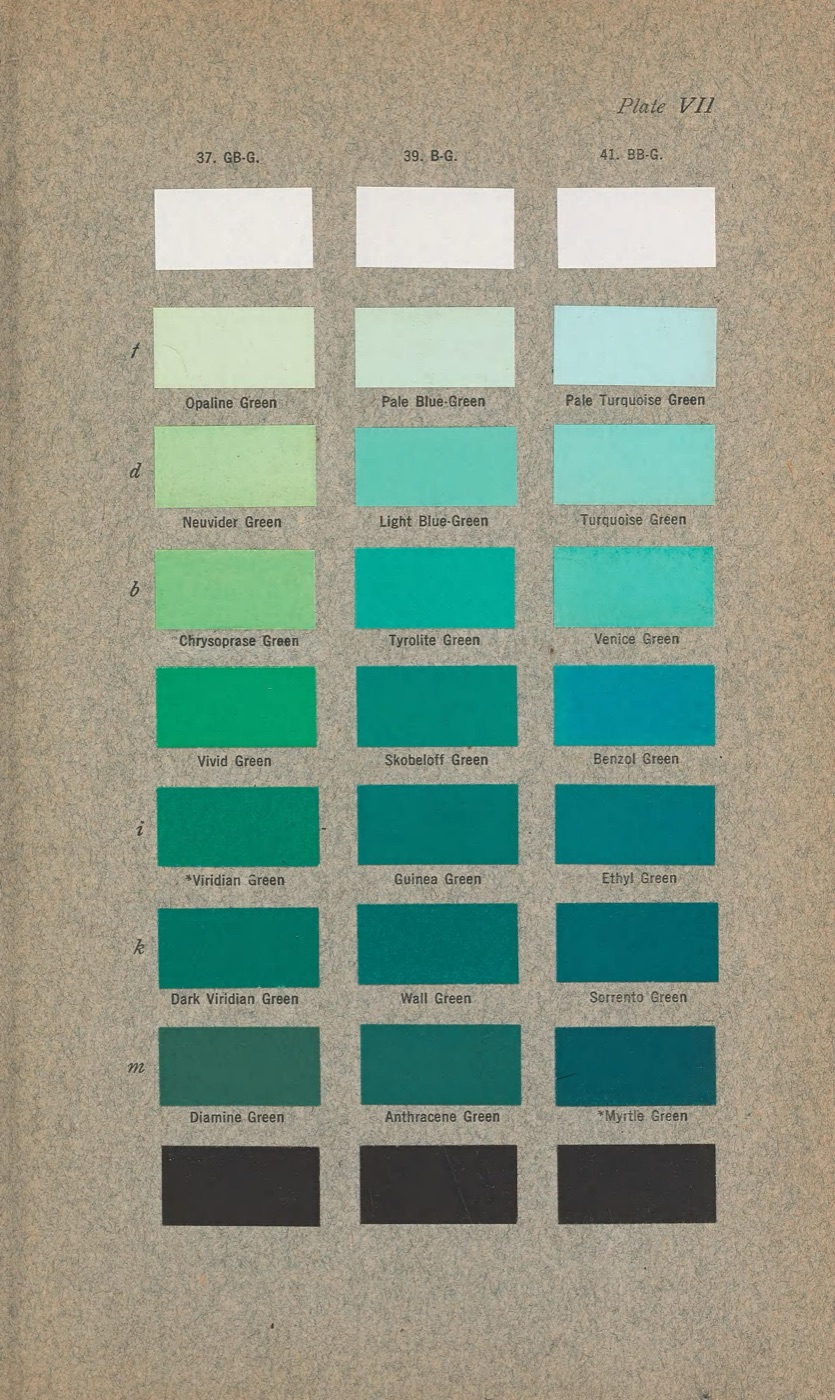
In Ridgway’s Color Standards (1912) green is a sequence of hues, each shown in columns of tints and shades from pale to nearly black, every swatch named. A green is defined by its place in an ordered series and by a printed standard to match against.
Munsell: green as numbers
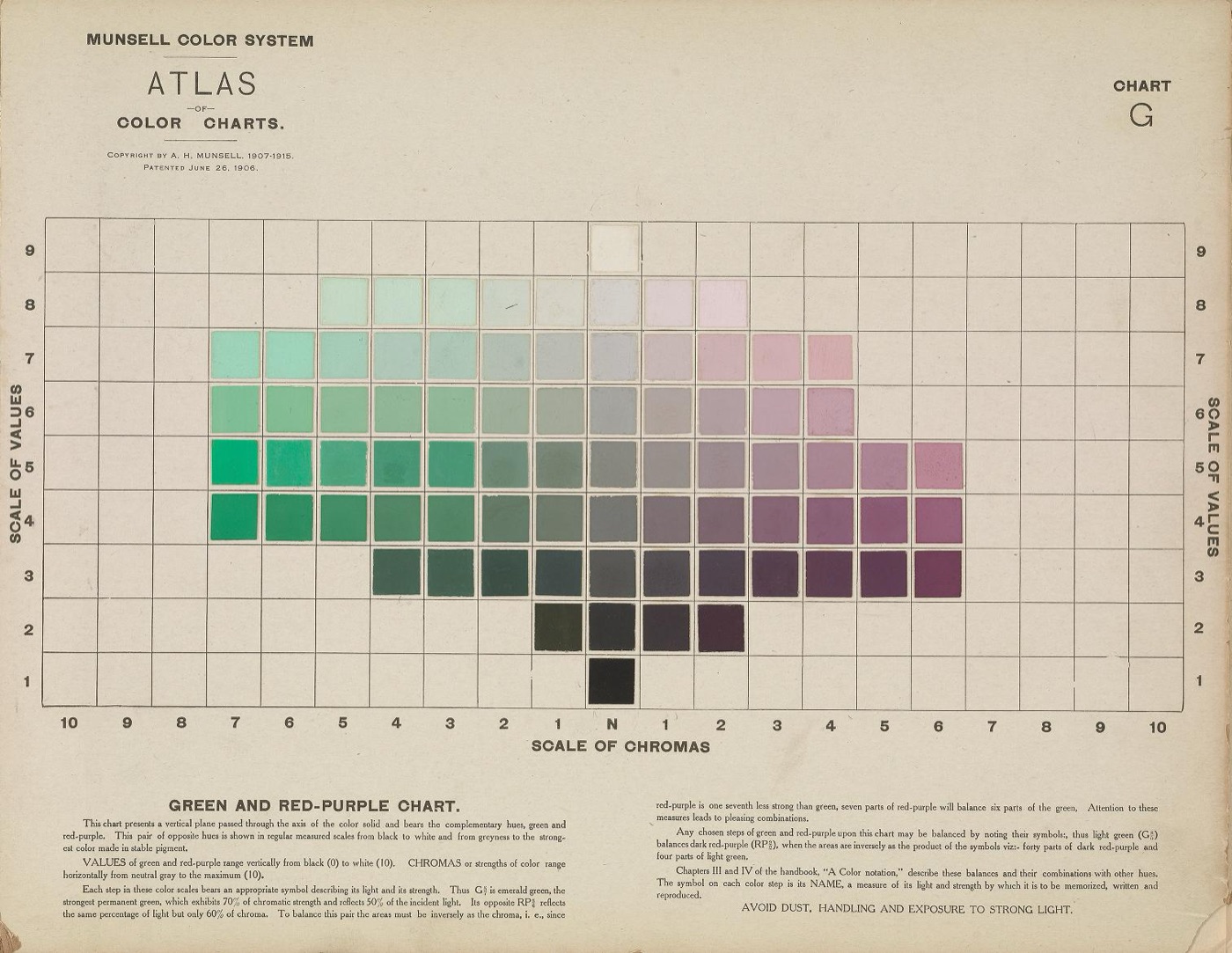
In Munsell’s atlas (1915) green is a hue, G, and every green is placed by its value (light to dark, 1 to 9) and its chroma (strength, counted outward from the gray axis). Chart G sets green on one side of the gray axis and its complementary hue, red-purple, on the other. A green is defined by a notation, not a name.
A glow is not a surface
All three systems describe the color of a surface seen in ordinary light. The green of fluorescing willemite is light given off by the mineral itself, in the dark, under ultraviolet light. None of the three was designed for it, and how such a color can be described is a question of its own (see Ultraviolet lights).
Sources and further reading
- Munsell, A. H., 1915, Atlas of the Munsell color system. Internet Archive
- Ridgway, R., 1912, Color standards and color nomenclature. Internet Archive
- Syme, P., 1821, Werner’s nomenclature of colours, 2nd ed. Internet Archive
Written with Claude, an AI model made by Anthropic, from the sources listed above, and checked against them. October 2026.