Histories › The mines and their history
Before and beside the zinc, the white limestone that holds the ore was burned for lime and quarried for furnace flux: farm kilns, the Hamburgh lime trade of the 1870s and 1880s, whitewash, and the blast-furnace flux of 1907.
The white carbonate of lime
In 1826 Dr. Samuel Fowler of Franklin described his valley to the Swedish chemist Berzelius in one sentence: “It is the region of the primitive or white carbonate of lime in which all our minerals occur” (The Picking Table 56, no. 2, p. 29). The white carbonate of lime is the rock the nineteenth century called the white limestone or crystalline limestone, and geologists now call the Franklin Marble. The zinc ores of Franklin and Sterling Hill lie inside it. How old it is, and how that question was argued, is told in How old is the white limestone?.
To a farmer or a builder the rock mattered for another reason. Burned in a kiln, limestone loses its carbonic acid and becomes quicklime, which slakes with water into the lime of mortar, plaster and whitewash, and a field dressing: lime spread on the land, like manure, to improve the soil. A pure limestone gives a pure lime. A dolomitic or “magnesian” limestone, which carries magnesium carbonate along with the calcium carbonate, gives a lime that behaves differently. The white limestone was mostly the first kind and partly the second, and much of its history as lime turns on that difference.
George H. Cook’s Geology of New Jersey (1868) summed up the analyses: “a nearly pure carbonate of lime, except at Stirling Hill, where some of the rock is a true dolomite” (p. 313).
Farm kilns and the blue stone
Why did a farmer want lime? The state geologist’s report for 1873 put it plainly: “Lime was the first of the fertilizers brought in to supplement the farmers’ home supply of manure.” Where farming was most advanced, it went on, “Our best farmers know that they get better crops where lime is judiciously applied than where it is not used at all; that weeds are less abundant and troublesome; that pastures are thicker, richer and more luxuriant; and that clover grows best on such lands” (p. 106). In modern terms, lime sweetens sour soil: it neutralizes the acid that builds up in the leached soils of the Highlands, so that clover, grass and grain can take up the nourishment already in the ground.
Lime-burning began on the farm. “Years ago it was customary for each farmer to have a kiln and burn his own lime, perhaps a kiln annually,” Cook wrote. “Now lime-burning is a business, and the farmers buy of those who make it such and keep the kilns going all the time.”
Most of that lime came from the other limestone of the region, the blue limestone of the Kittatinny Valley, which is magnesian. Cook reckoned that “probably ninety per cent. of all the lime burned” in New Jersey came from the magnesian rock (p. 391). The white limestone, despite its purity, was little used. “Throughout the long outcrop in the Vernon and Sparta valleys, there is but one quarry used, and that but occasionally” (p. 400). Of the main tract of white limestone he had just described, he wrote, “At present there are no quarries in all this extent of limestone that are worked. It has been burned at several points for lime, but this business has almost ceased” (p. 313).
Those who had burned it said it was harder to burn. Peter N. Ryerson, who had burned a large amount, thought it “much superior to the blue limestone for lime,” but said it needed “about one-third more time to burn properly a kiln of it, with wood as fuel.” His neighbor P. J. Brown said the white limestone made “a dark-colored, strong lime, which swells up about twice as much in volume in slaking as the blue-stone lime” (p. 401).
The white-lime trade, 1868–1883
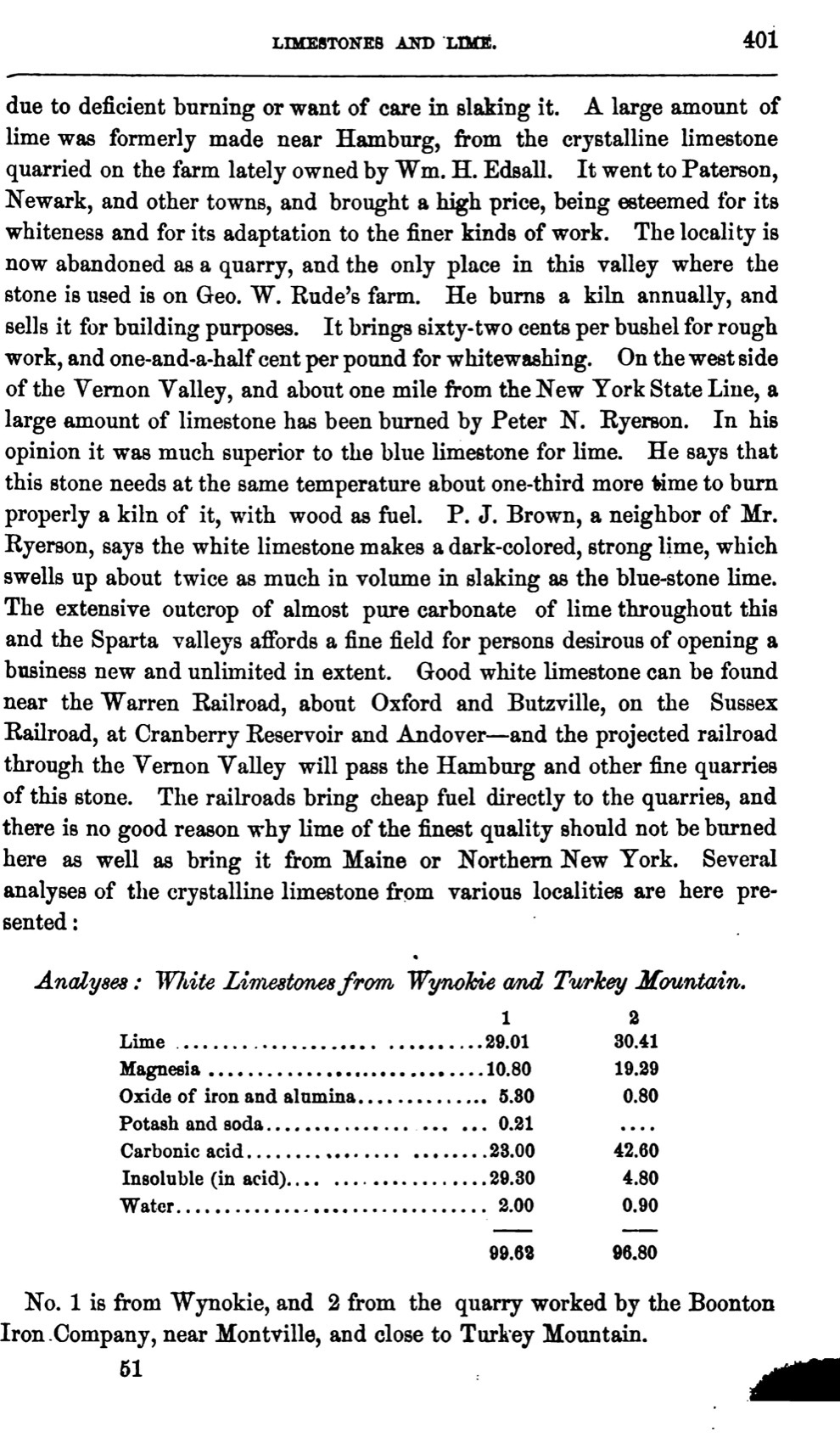
There had been a white-lime trade before. “A large amount of lime was formerly made near Hamburg, from the crystalline limestone quarried on the farm lately owned by Wm. H. Edsall,” Cook wrote. “It went to Paterson, Newark, and other towns, and brought a high price, being esteemed for its whiteness and for its adaptation to the finer kinds of work.” Cook gives no dates. Earlier writers show the trade running in the 1830s. Thomas F. Gordon’s Gazetteer of the State of New Jersey (1834) printed a notice by Dr. Samuel Fowler of Franklin on the white limestone: “When burned, it produces lime of a superior quality. A considerable quantity of this stone is burned into lime near Hamburg, and when carted to the towns below, as Patterson, Newark, &c. is sold for one dollar per bushel” (p. 247). In 1840 Henry D. Rogers, the state geologist, wrote: “It has long been made into lime near Hamburg, from whence that material has been transported over the Highlands to the towns of Patterson, Newark, &c., commanding, at times, as high a price as one dollar per bushel” (p. 87). Barber and Howe’s Historical Collections of the State of New Jersey reprinted Fowler in 1844 (p. 481).
None of the three names a farm or a burner. Cook’s Wm. H. Edsall was a Hardyston man: James P. Snell’s county history lists him as township clerk in 1854–59, 1862 and 1865–67 and a chosen freeholder from 1869 to 1872 (p. 335). “Lately owned” puts the farm in other hands by 1868. We have found no dates for lime-burning on it, and nothing that ties the lime of the 1830s to it in particular. The lime went by road: Fowler has it “carted,” Rogers hauled “over the Highlands.” Rogers mentions the Morris Canal, opened in 1831, only for another outcrop, near Lockwood, “within about three miles of the Morris canal at Stanhope,” where burning the stone was “beginning to invite attention” (p. 87). We have found nothing that sends Hamburg lime by canal.
The “finer kinds of work” were the finish of walls and ceilings. Fowler named “whitewashing, cornice work, and wall of a fine hard finish” (p. 247); Rogers called the lime “admirably adapted for the finer kinds of masonry, by the whiteness of the cement which it yields” (p. 87), his “cement” being the lime’s plaster, not a hydraulic cement. Q. A. Gillmore of the U.S. Corps of Engineers explained the terms in 1864. “Gauge stuff, or hard-finish, is composed of fine stuff (lime putty) and plaster of Paris. … It is used for the finishing coat of walls, and for cornices, mouldings, and other kinds of ornamentation” (p. 211), and fine stuff “is made of pure lump-lime slaked to paste” (p. 210). In a finishing coat the lime shows, so its whiteness was the wall’s. Purity also paid by the bushel. Gillmore’s “common, fat, or rich limes” swell in slaking “to from two to three and a half times that of the original mass” (p. 69), while the “poor or meagre limes,” carrying silica, alumina, magnesia and iron, “proceed sluggishly” (p. 70). That is the difference Brown saw between white-stone and blue-stone lime, above, and the one Cook drew between pure and magnesian lime, below.
By 1868 that quarry was abandoned. George W. Rude burned one kiln a year and sold the lime for building: sixty-two cents a bushel for rough work, “and one-and-a-half cent per pound for whitewashing.” Cook’s analysis of Rude’s stone showed a “beautiful white limestone” that “makes an excellent white lime for fine work” (p. 404).
What the trade lacked was a railroad. “The railroads bring cheap fuel directly to the quarries,” Cook wrote, “and there is no good reason why lime of the finest quality should not be burned here as well as bring it from Maine or Northern New York” (p. 401). The state geologist’s report for 1873 welcomed “the opening of the Midland Railroad across the county of Sussex”: “From Ogdensburg to Franklin much of the road bed is on crystalline limestone” (p. 106). John L. Baum dates the arrival of the first railroad at Hamburg to 1873 (The Picking Table 19, no. 1, p. 10).
Two railroads met there, built for different reasons. The Sussex Railroad, begun as Cooper & Hewitt’s line from their Andover iron mines to the Morris Canal, was allowed by an act of Feb. 4, 1863 to build “a branch road from some convenient point on the present line to Franklin Furnace,” and “to make contracts with other companies for the transportation of milk, lime, coal, etc., to the city of New York” (Snell, p. 167); it “was built with especial reference to the mining interests of the county” (p. 336). The New Jersey Midland was the New Jersey end of a through line from New York to Oswego. In 1869 D. C. Littlejohn, for the company, called the Sussex route “very favorable on account of its agricultural and mining resources,” and “In Hamburg one gentleman alone—Governor Haines—subscribed $10,000. The Ogdensburg Zinc Company pledged $50,000” (p. 166). The dates differ. Elwood D. Shuster (1927) puts the Sussex extension to Franklin in 1870 and says “The first train from Newton to Deckertown was run over these two roads on June 19, 1871” (p. 22), a run through Hamburg. Snell puts the extension in 1871, with Sussex cars running over Midland track “to Hamburg Junction” (p. 168), and dates the full opening of the New York and Oswego Midland to Aug. 18, 1873 (p. 167). Baum does not say which line or event his 1873 means.
The kilns followed. The same report noted that near McAfee Valley “the White Rock Lime and Cement Company have started a kiln and are burning about thirty barrels of first quality lime daily, and about one-fourth as much of lime for farmers’ use” (p. 106). Snell’s county history says the business was “first established in 1872 by Messrs. Rosewall & Beardsley,” and incorporated the following year, and that its market was “in Sullivan and Ulster Cos., N. Y., in Newark, and in Paterson” (p. 352).
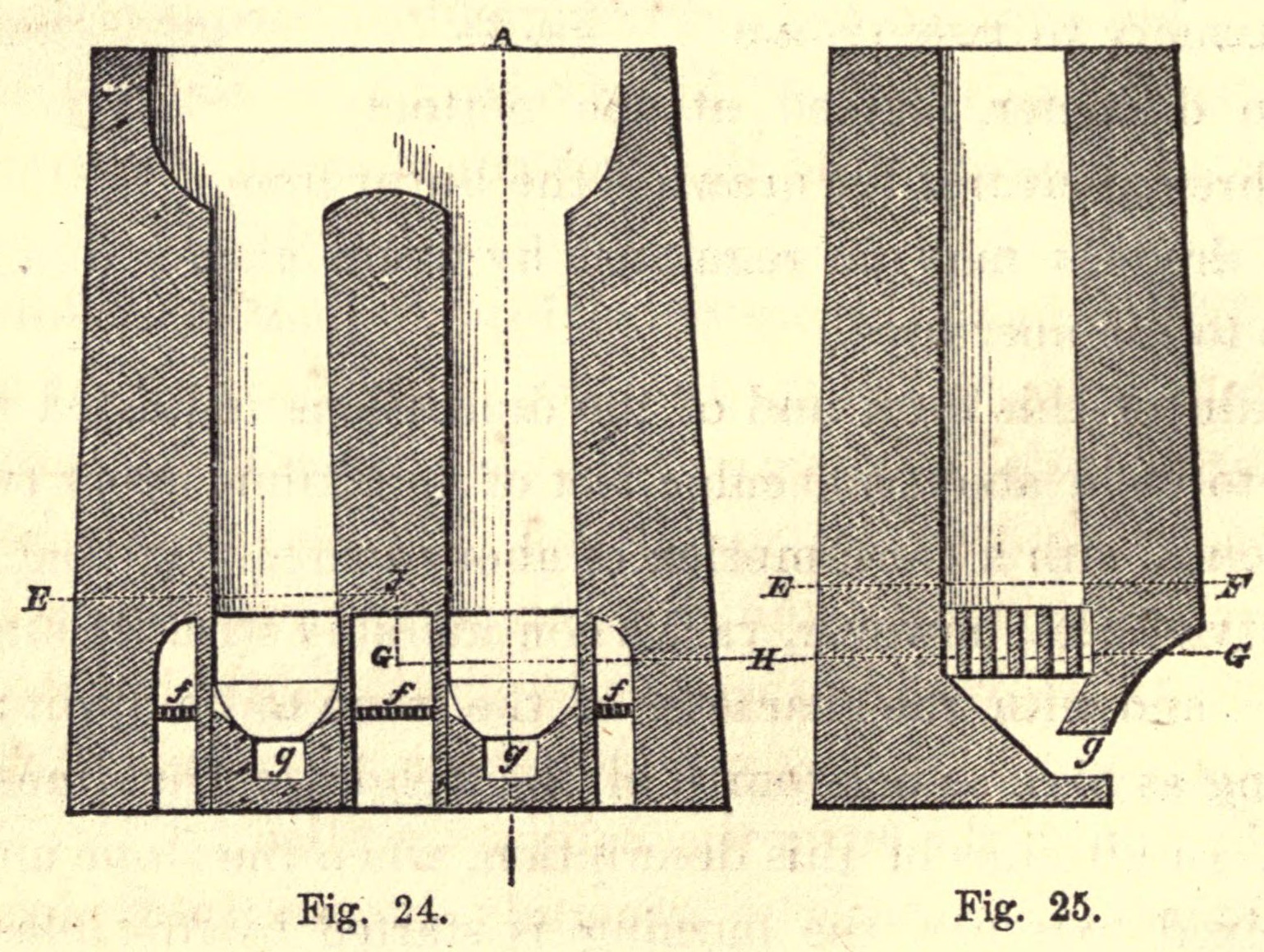
Near Hamburg (spelled Hamburgh in the state reports of the 1870s and 1880s), Sayre & Vanderhoof built the Windsor Lime-Works. Snell gives two kilns, “the first of which was erected in October, 1876, and the second in August, 1877. Both these kilns are constructed with separate fire-chambers, two on the sides of each kiln, and in such a manner that the flame only is in contact with the limestone.” Together they made 200 barrels a day. “The lime is burned with wood,” and the stone came to the kilns by a tram-road from the firm’s quarry. The market was “Paterson, Newark, Jersey City, New Brunswick, Trenton, Camden, Long Branch, and New York.”
Baum, writing in 1978, describes the Windsor works differently: “four perpetual-burning type kilns, one of them 74 feet high,” with “the charcoal fires in a separate hearth offset from the chimney,” so that “the fires could be fed and the burnt lime withdrawn in a constant process” (The Picking Table 19, no. 1, p. 10). He counts about 150 men, some of them “on the mountain making charcoal.” Snell counts two kilns burning wood, and the state report of 1883, below, says all the kilns of the district used wood; Baum counts four burning charcoal. Baum gives no date for the works he describes, and the two accounts may describe different years. Both are given here.
By 1883 the state geologist could report that “the manufacture of pure lime, for building and manufacturing purposes, from the white, crystalline limestones of Sussex county” was carried on near Hamburgh by Sayre & Vanderhoof and the Hamburgh Lime Company, and at McAfee Valley by the White Rock company. “The total product of these companies, in 1883, amounted to 121,000 barrels, besides what is sold for agricultural uses” (p. 172). Two more kilns were going up at McAfee Valley. “All of the kilns are of improved pattern and have fire-chambers separate from the kiln-shaft, and all use wood. The greater part of the product is shipped to Jersey City and New York, where it competes with the best lime from Glens Falls and the Hudson river valley.”
Some of the lime went on the walls. Snell credits the Wallkill Cement and Lime Company, which burned “a large quantity of lime from white rock limestone” on the Rude farm, with being “the first to put up lime in air-tight packages” for whitewash. The claim is Snell’s; we have found nothing to test it against.
Pure, magnesian, and the rock next to the ore
Which lime was better was argued for decades. Cook wrote that “whenever the two varieties have been fairly tried the preference has been given to the pure or fossiliferous limestone lime,” and that in Sussex County, “where the two varieties have been compared, the latter commands the highest price, and is much liked by all builders who have used it” (p. 397). For the fields he was less sure: “the proofs are not yet sufficiently numerous to assert that magnesia is positively injurious in limes for agricultural purposes.”
The 1873 report put the farmers’ view: “There has been much question among farmers as to which is the best. In places where lime has been most used, it is conceded that pure lime is quickest in its action, but that the magnesian lime lasts the longest” (pp. 106–107). Bought unslaked, a bushel of pure lime was “worth more by at least one third,” but it swelled so much more in slaking “that there is very little difference in their value, by the bushel.”
The white limestone was not pure everywhere, and least of all beside the zinc. Cook’s analysis of white limestone from “a drift-tunnel northeast of the New Jersey Zinc Company’s mine at Sterling Hill” showed 20 percent magnesia: “It is a dolomite in composition and crystalization” (p. 404). The folio of 1908 set two analyses side by side: 1.20 percent magnesium carbonate in one sample, 44.51 percent in another “from the Parker shaft of the New Jersey Zinc Company, 450 feet from the surface” (p. 26). “Much of the limestone found in connection with the zinc ore is highly magnesian,” the authors wrote, and the difference could not be seen: “it is impossible to differentiate by the eye the rock which contains an excess of magnesia from that which is well within the requirements.”
Flux
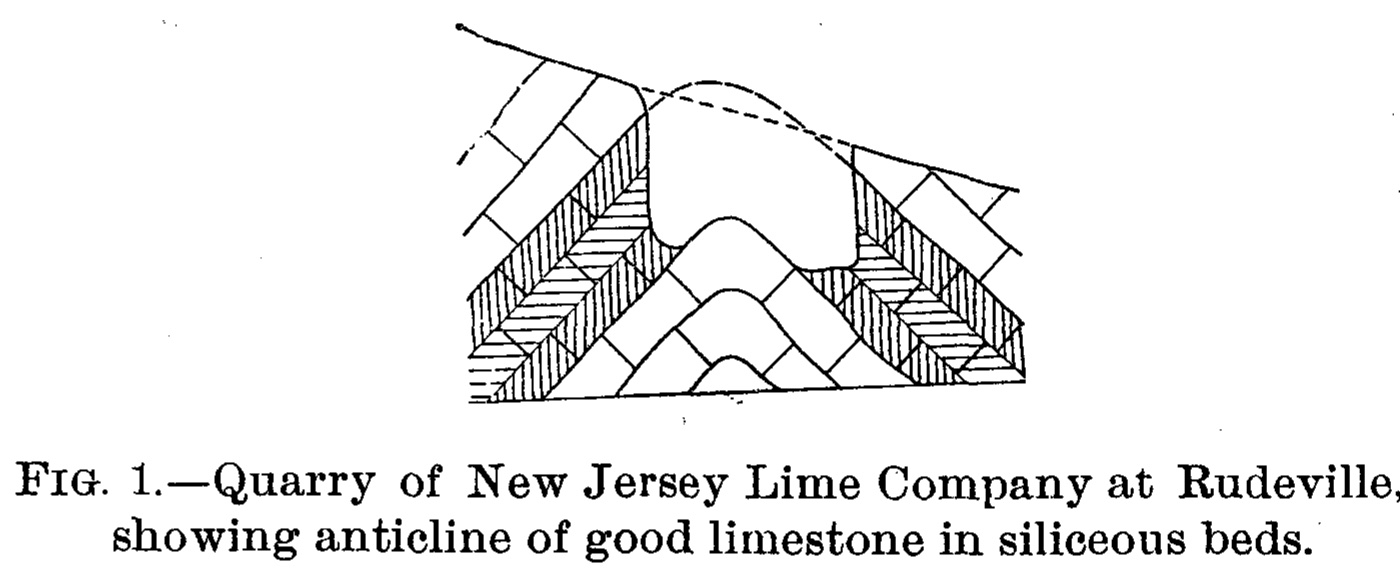

What does a flux do? An iron blast furnace was charged from the top with ore, fuel and limestone. In the heat the limestone burned to lime, which took up the earthy part of the ore (mostly silica and alumina) and the ash of the fuel into a molten glass called slag; the slag floated on the melted iron in the hearth and was run off separately, the iron tapped below it. Without the lime the earthy matter would clog the furnace and foul the iron. Thomas Turner’s Metallurgy of Iron and Steel (1895) set the standard: “The limestone which is employed in the blast furnace as a flux should be as free from silica, phosphates, and other impurities as possible. It should contain at least 90 per cent. of calcium carbonate” (p. 185). By 1907, as the folio reported, 70 to 75 percent of the white limestone quarried around Franklin went for flux, and Kümmel found the furnaces insisting on stone low in magnesia.
Limestone had a second buyer: the iron furnace, which charged it with the ore as a flux to carry off the earthy waste as slag. In 1868 Cook wrote that the white limestone “does not enter largely into the lime trade,” but that a hill near Andover “is also worked for supplying a flux to an iron furnace, being used at the Stanhope furnace” (p. 411), and that a large amount was quarried every year near Andover “and used at Boonton, in the iron furnace” (p. 400). The ironworks at Franklin Furnace had its own flux quarry in the white limestone; the folio of 1908 lists an analysis of stone “From furnace quarry at Franklin Furnace” (p. 3).
By the twentieth century flux had overtaken lime. The folio reported: “Ten or eleven quarries were in active operation during 1907, and their combined output for all purposes was 552,565 tons. From 70 to 75 per cent of the output is used for flux, chiefly in the blast furnaces at South Bethlehem, Pa., and Wharton, Stanhope, Pequest, and Phillipsburg, N. J. About 10 per cent of the output is used in the manufacture of a high-grade white lime.” Baum gives the same figures and attributes them to Charles Palache, who was one of the folio’s five authors (The Picking Table 19, no. 1, p. 9).
Purity now meant money. Henry B. Kümmel of the state survey wrote in the report for 1905 of “a marked increase in the demand for a limestone high in carbonate of lime and comparatively free from silica and magnesia,” driven by the Portland cement makers of the Lehigh Valley, by “the growing practice at blast furnaces to insist upon a non-magnesian limestone,” and by “the growing popularity of hydrated lime.” The folio added that the requirements for a fluxing stone were “much less rigid than those demanded by the cement manufacturers” (p. 26). A low-magnesia stone, under 3 percent, often “can not be mined for the prices paid.”
Odds and ends
White sand. The zinc mill made its own limestone product. “The finely crushed Franklin limestone which remains as tailings after the separation and concentration of the zinc ores makes a sharp white sand which is beginning to find its way to market, for concrete and mortar work,” the folio noted. Freight rates held it back. “Its white color makes it very desirable for concrete sidewalks.” (On the separation itself, see Pulling franklinite out with magnets.)
No marble trade. The white limestone is a marble to a geologist, but it never became a building stone. Cook put “the crystalline or white limestones of the state” under the heading “Marbles” in his chapter on building stone, but the tables that follow on that page are of sandstones (p. 515). The folio was blunt: “No building stone of any importance is produced within this region” (p. 26).
Lime in the zinc furnace (unconfirmed). Baum wrote in 1988 that when the siliceous ore made zinc oxide hard to produce, “a chance observation by Dr. G. H. Cook, State Geologist, saved the day”: Cook knew that adding lime to a refractory furnace charge had helped elsewhere, “and so it was in this case” (The Picking Table 29, no. 1, p. 4). Baum gives no source or date, and we have not found the story in Cook’s own writings. It is recorded here as Baum’s.
In The Picking Table
The journal has touched lime and flux in a handful of places. The first issue, February 1960, announced field trips to Franklin quarries, among them the old Franklin Iron Company quarry, where “the white limestone” was “quarried as a flux for the iron furnace,” and the B. Nicol quarry, “active at the turn of the century as a source of flue [flux] for the blast furnaces” (vol. 1, no. 1, p. 8). John L. Baum’s “The Bodnar Quarries” (vol. 19, no. 1, March 1978) is the journal’s one history of a lime works: the Rude quarry of 1868, the Windsor Lime Company of 1876, the kilns, the tramway and the charcoal burners. His “The development of Franklin ore concentration” (vol. 29, no. 1, Spring 1988) carries the Cook lime story above.
William R. Truran’s “From furnace to borough—Franklin’s transformation” (vol. 54, no. 1, Spring 2013) mentions a lime kiln on a rail line at the Fowler quarry and the crushing of white calcite at the Franklin quarry. An Image From the Past in vol. 57, no. 1 (Spring 2016) adds that a lime kiln of cut stone was built to make flux for the iron furnace of 1874, and was photographed in the early 1880s. Fowler’s letter of 1826 is in Mark Boyer’s “Letters From the Past” (vol. 56, no. 2, Fall 2015).
We have not found in the journal the White Rock Lime and Cement Company, the 1883 output of 121,000 barrels, the competition with Glens Falls, Snell’s whitewash packages, the farmers’ argument over pure and magnesian lime, or the tailings sold as white sand.
Sources and further reading
- Barber, J. W., and Howe, H., 1844, Historical Collections of the State of New Jersey. New York. Vernon (Fowler’s notice reprinted), p. 481. archive.org
- Baum, J. L., 1978, The Bodnar quarries. The Picking Table, vol. 19, no. 1, p. 9–10. PDF
- Baum, J. L., 1988, The development of Franklin ore concentration. The Picking Table, vol. 29, no. 1, p. 4. PDF
- Boyer, M., 2015, Letters from the past (Fowler to Berzelius, 1826). The Picking Table, vol. 56, no. 2, p. 29. PDF
- Cook, G. H., 1868, Geology of New Jersey. Newark: Board of Managers, Geological Survey. White limestone, p. 313; limestones and lime, p. 391–411; building stone, p. 515. archive.org
- Geological Survey of New Jersey, 1874, Annual report of the State Geologist for the year 1873. Lime, p. 105–107. archive.org
- Geological Survey of New Jersey, 1883, Annual report of the State Geologist for the year 1883. Lime, p. 171–172. archive.org
- Gillmore, Q. A., 1864, Practical Treatise on Limes, Hydraulic Cements, and Mortars (U.S. Engineer Department, no. 9). New York: D. Van Nostrand. Fat and meagre limes, p. 69–70; Rockland kilns, p. 142–143; plastering, p. 210–211. archive.org
- Gordon, T. F., 1834, A Gazetteer of the State of New Jersey. Trenton: Daniel Fenton. Sussex County (with Samuel Fowler’s notice), p. 247. archive.org
- Hopkins, G. M., Jr., 1860, Map of Sussex Co., New Jersey. Philadelphia: Carlos Allen. Franklin Furnace village plan. North Jersey History Center copy, Princeton University Library. Princeton
- Kümmel, H. B., 1906, Chemical composition of the white crystalline limestones of Sussex and Warren Counties. Annual report of the State Geologist for the year 1905, p. 175 ff. archive.org
- Rogers, H. D., 1840, Description of the Geology of the State of New Jersey, being a final report. Philadelphia. White limestone for lime, p. 87. archive.org
- Shuster, E. D., 1927, Historical Notes of the Iron and Zinc Mining Industry in Sussex County, New Jersey. Franklin. Railroads, p. 22. PDF
- Snell, J. P., 1881, History of Sussex and Warren Counties, New Jersey. Philadelphia: Everts & Peck. Railroads, p. 165–168; Hardyston civil list, p. 335; Hamburg and Franklin Furnace, p. 336; Windsor Lime-Works and the stone mill, p. 339; White Rock Lime and Cement Company, p. 352. archive.org
- Spencer, A. C., Kümmel, H. B., Wolff, J. E., Salisbury, R. D., and Palache, C., 1908, Franklin Furnace folio, New Jersey. U.S. Geological Survey Geologic Atlas, Folio 161. Franklin limestone, p. 3; limestone, sand and building stone, p. 26. USGS
- Turner, T., 1895, The Metallurgy of Iron and Steel. J. B. Lippincott. Limestone as flux, p. 185. archive.org
Written with Claude, an AI model made by Anthropic, from the sources listed above, and checked against them. October 2026.