For most of the nineteenth century geologists argued over whether the white limestone that holds the zinc ores was among the oldest rocks in New Jersey or a young limestone baked by granite. The answer came from pebbles in a quarry face in 1896, and a date from zircon in 2009.
Two limestones
The zinc ores of Franklin and Sterling Hill lie in a coarse, white, crystalline limestone, a marble. Along the Wallkill valley it runs beside a second limestone, gray-blue, fine-grained and plainly bedded. In the old reports they are simply the white limestone and the blue limestone.
Were they the same rock? If the white limestone was only the blue one changed by heat, then it was as young as the blue, and so were the ores in it. If not, the white limestone belonged with the ancient crystalline rocks of the Highlands, and the ores were far older than anything with a fossil in it.
The question was argued for most of the nineteenth century. This page follows it from the first statement of 1826 to the settlement of 1896–1908, and then to the dates that were finally put on the rock a century later.
Names. The white limestone is today’s Franklin Marble; the Franklin Furnace Folio of 1908 called it the Franklin limestone. The blue limestone is the Kittatinny limestone of the 1908 Folio, now part of the Kittatinny Supergroup, of Cambrian and Ordovician age. The Potsdam sandstone of the older writers, the Hardistonville quartzite of Wolff and Brooks (1898) and the Hardyston quartzite of the Folio are today’s Hardyston Quartzite, of Cambrian age. Primitive, Azoic (“without life”) and Archean were successive words for the oldest rocks, below anything with fossils; today they are Precambrian, and more exactly Proterozoic.
1822–1868: primitive, or baked?
The earliest statement comes from the man who owned the mines. On June 25, 1826, Dr. Samuel Fowler of Franklin wrote to the Swedish chemist Jöns Jacob Berzelius, sending him franklinite and zincite. His letter, as Mark Boyer reprinted it from James P. Snell’s History of Sussex and Warren Counties (1881), describes the valley this way: “There has been as yet but a very imperfect examination of the minerals of this place: I allude particularly to the valley comprising Franklin and Sparta, in New Jersey, and Warwick, in New York, which is a continuation of the same valley. The whole distance is about 25 miles. It is the region of the primitive or white carbonate of lime in which all our minerals occur” (The Picking Table 56, no. 2, p. 29). To Fowler “primitive” meant what it meant to the geologists of his day, following Werner: among the first and oldest rocks of the earth.
Four years earlier Lardner Vanuxem and William H. Keating had drawn the white and the blue limestones as separate rocks of different ages (see Drawing the folds). The first state geologist, Henry D. Rogers, disagreed. In his report of 1836, as Wolff and Brooks later quoted it, he wrote of the white limestone: “I regard it as having been originally the blue limestone of the district, invaded at some period subsequent to its formation by these veins of mineral matter [i. e. the zinc ore veins, and veins of syenite and quartz] in a highly heated or molten state.” He repeated the view in his final report of 1840. The white limestone, on this reading, was blue limestone baked.
George H. Cook, later state geologist, took the other side in a letter to the American Journal of Science in 1861. He had shown James D. Dana and Benjamin Silliman Jr. the rocks at Franklin Furnace, and wrote that he had pointed out to them “the faithfulness of Vanuxem and Keating’s original description of the geological occurrence of the rocks of that locality; and the correctness of their conclusion, that the white and blue limestones found there, are of different ages. Since their description was written it has been asserted that the white limestone is of the same age as the blue limestone, though changed in appearance by metamorphic action.” (The journal printed his name “Cooke.”)
William Kitchell’s survey of the 1850s had already put the white limestone with the oldest rocks, and Cook’s Geology of New Jersey of 1868 did the same. By 1890 the state geologist could write that the white limestones had “been described in the reports of the Geological Survey since 1864, as members of the series of crystalline rocks of the Azoic or Archean age.”
1890: Nason’s fossils
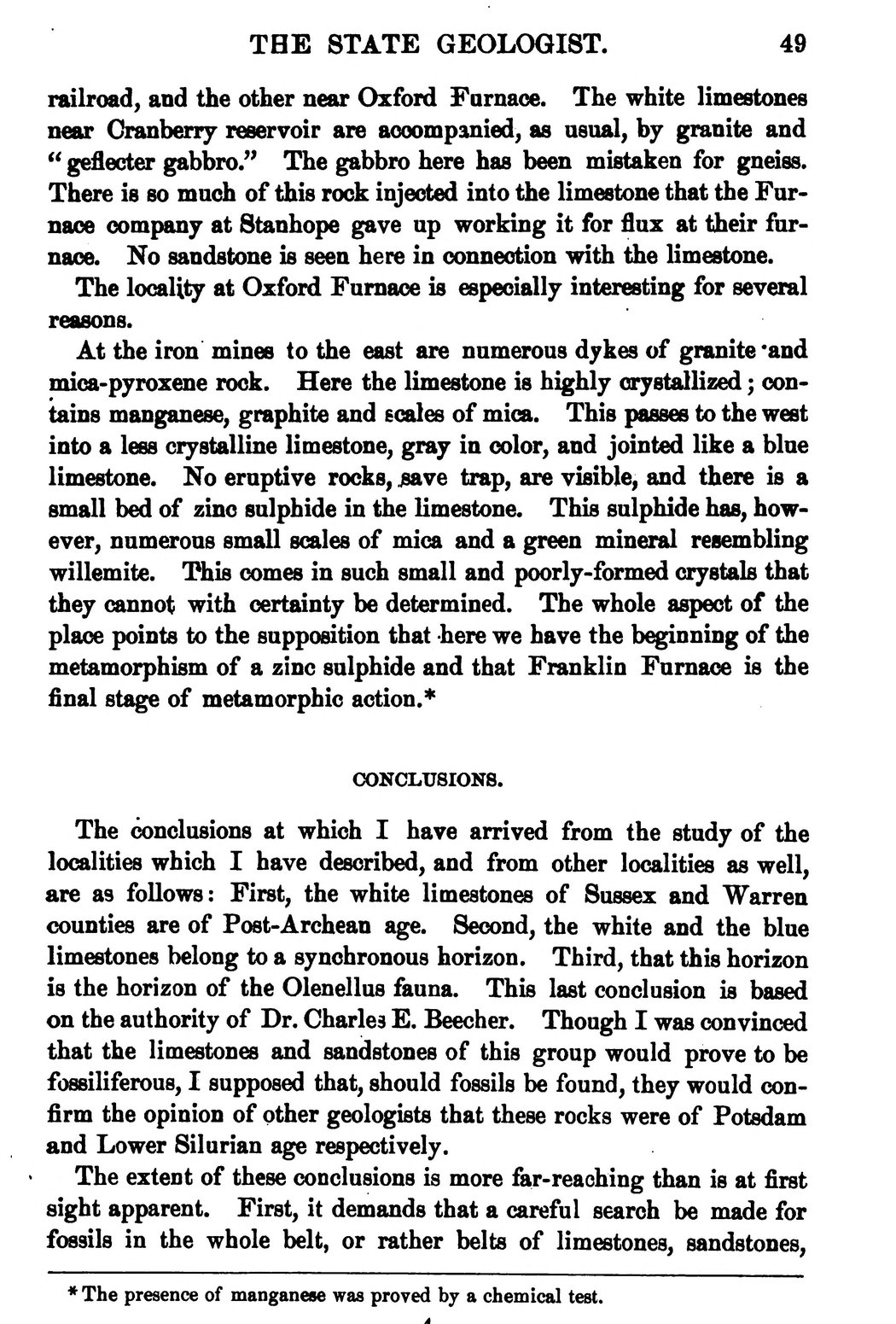
That same sentence introduced the challenge. Frank L. Nason, an assistant geologist on the state survey, had spent the summer and autumn of 1890 mapping the limestones of the Vernon valley, and the state geologist reported that his “careful examination of the outcrops has resulted in the discovery of organic remains in these limestones which give a clue to their age and determine their relative horizon” (p. 10). Charles E. Beecher of Yale referred the fossils to the Cambrian.
The fossils were not in the white limestone. As Dana’s review put it, it was “the bluish, semi-crystalline limestone of Sussex Co. and the associated sandstone” that had “afforded Dr. C. E. Beecher Lower Cambrian fossils” (p. 70–71); one place was the old furnace quarry at Franklin Furnace. His argument was that the white limestone was the same rock. He reported places where the two met with a full gradation between them, and of one such place he added in a footnote: “This point convinced Dr. Beecher that the two limestones are the same” (p. 46). He traced the change from blue to white to granite and other igneous rocks that cut the limestone, and he found graphite in both.
His paper, “The Post-Archean Age of the White Limestones of Sussex County, N. J.,” ends with three conclusions: “First, the white limestones of Sussex and Warren counties are of Post-Archean age. Second, the white and the blue limestones belong to a synchronous horizon. Third, that this horizon is the horizon of the Olenellus fauna. This last conclusion is based on the authority of Dr. Charles E. Beecher” (p. 49). Olenellus is a trilobite of the Early Cambrian.
If Nason was right, the zinc ores were Cambrian too, or younger. His life and his later work are told on the page Frank L. Nason and nasonite.
1891: Dana’s doubts
James D. Dana of Yale reviewed the report in the American Journal of Science the following summer. He summarized Nason’s evidence as graphite in both limestones, “the passage of one into the other at some localities,” and the inference that the white limestone owed its crystallization to contact with granite. Then he wrote: “The conclusion is a wide-reaching one, and the facts should have full investigation before it is adopted.”
He did not believe a granite dike could bake a whole belt of limestone into coarse marble; for that, “the enclosing limestone should be hot enough for its own crystallization—the condition attending metamorphism.” And he had seen in Massachusetts an apparent passage between two limestones that turned out to be of different ages (p. 71).
Nason answered Dana in the American Geologist in 1891 and returned to the subject twice more in 1894, the second time under the title “Summary of facts proving the Cambrian age of the white limestones of Sussex County, N. J.” (as listed by Palache, no. 165).
1893–1894: Kemp, Hollick and a review
For a few years Nason’s view led. James F. Kemp of Columbia, writing on the ore deposits in 1893, described the ores as lying in “a narrow belt of rock, which probably is, as Mr. Nason strongly argues, blue Cambrian limestone, locally altered by granite intrusions” (Kemp 1893, p. 91).
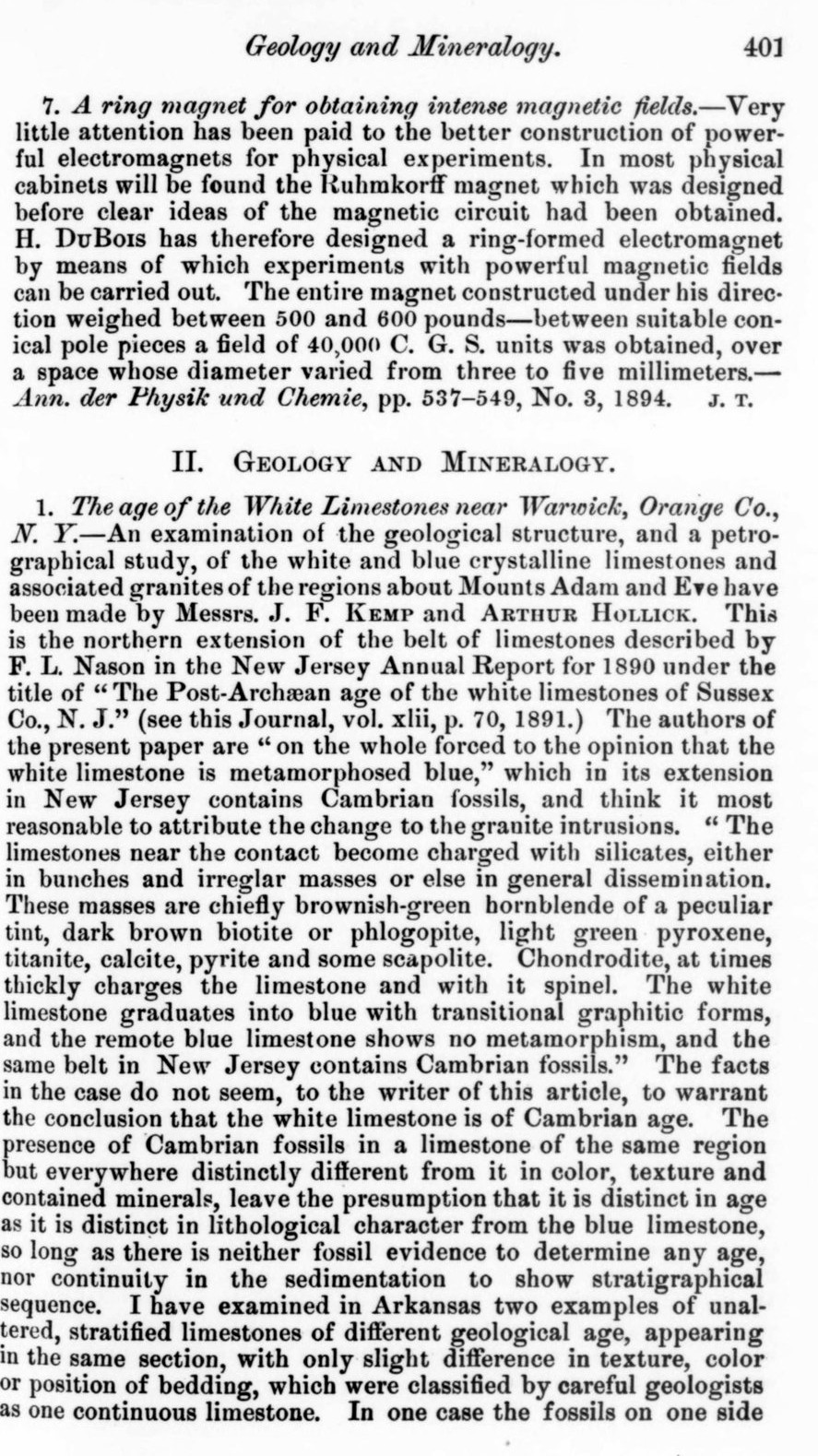
In 1894 Kemp and Arthur Hollick published a study of the granite at Mounts Adam and Eve, near Warwick, New York, at the north end of the same limestone belt, in the Annals of the New York Academy of Sciences. The American Journal of Science reviewed it that May. According to the review, the authors were “on the whole forced to the opinion that the white limestone is metamorphosed blue,” and thought it most reasonable to attribute the change to the granite intrusions. Wolff and Brooks later summed them up the same way: they “were inclined to adopt the view of its Cambrian age” (p. 437).
The reviewer did not agree. He signed only “H. S. W.,” and Wolff and Brooks and Palache identify him as Henry S. Williams. “The facts in the case do not seem, to the writer of this article, to warrant the conclusion that the white limestone is of Cambrian age.” He had seen in Arkansas two limestones of different ages that careful geologists had taken for one, and he concluded: “The presumption is in favor of the theory of their different age until they can be shown to be continuous, and in the absence of such evidence it is unprofitable to confuse them” (p. 402).
So the two pages of 1894 hold both sides at once. Kemp and Hollick, as quoted there, took the white limestone for altered blue; Williams, their reviewer, held the two distinct. Bibliographies have sometimes listed the review under Kemp and Hollick’s names and given them Williams’s opinion.
In the same year Lewis G. Westgate, working on the white limestone of Jenny Jump Mountain in Warren County, came down on Williams’s side. He held it older than the blue limestone because it was thoroughly crystalline, interbedded with the old gneisses, and showed no tendency to grade into the blue (as summarized by Wolff and Brooks).
1896–1898: pebbles in the quartzite
The question went to the U.S. Geological Survey. John E. Wolff of Harvard and Alfred H. Brooks mapped the white limestone belt for the Survey and published “The Age of the Franklin White Limestone of Sussex County, New Jersey” in the Survey’s Eighteenth Annual Report, printed in 1898. It opens with a review of every earlier opinion, from Rogers and Cook to Nason, Dana, Kemp and Hollick, Williams and Westgate.
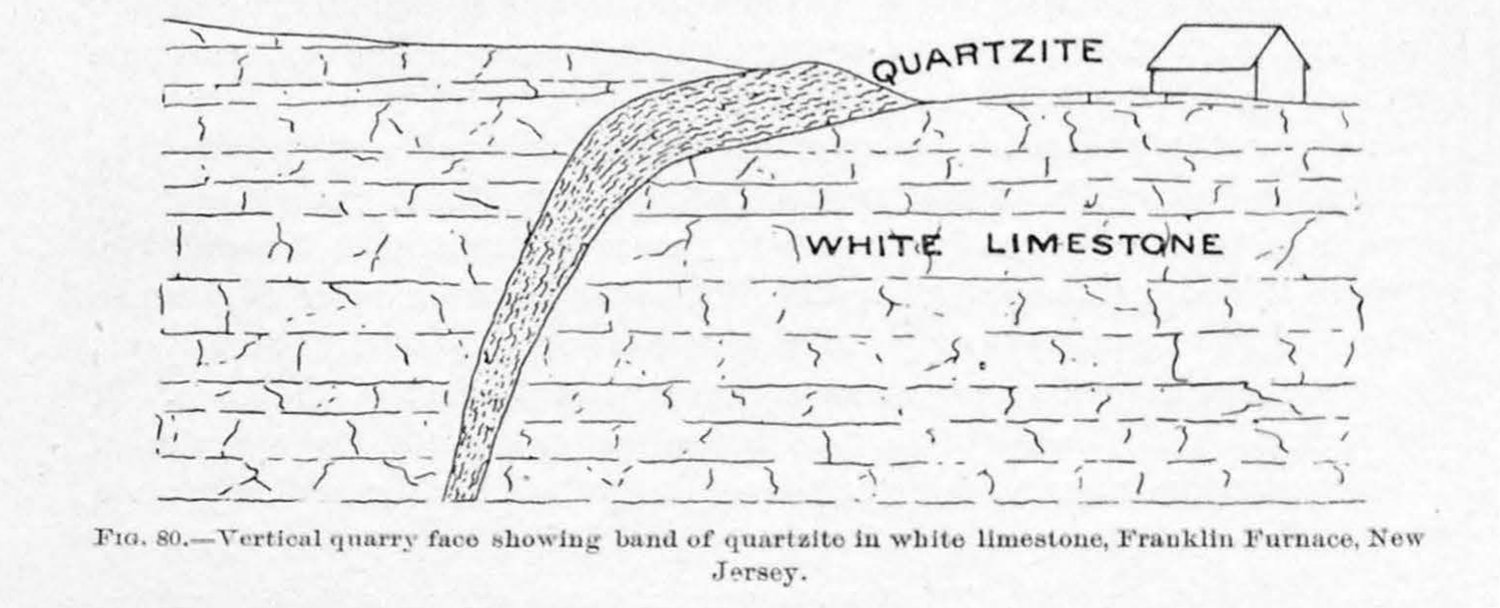
Their decisive evidence was a quarry face. In 1896 a new quarry in the white limestone at Franklin Furnace was opened, and that September its 35-foot face exposed a band of quartzite, sketched in their figure 80, that ran down into the white limestone, curving and narrowing as it went. “The important feature seen in these blocks is that large pebbles or bowlders of typical white limestone are inclosed in the quartzite” (p. 455). The pebbles had the white limestone’s graphite, its yellow mica and its mottled calcite. A sand had been laid down on the white limestone after it was already marble, and had picked up pieces of it.
Nason had worked at the same spot. Wolff and Brooks quote his description of a nearby patch: “This excavating showed the sandstone going under the limestone with a northwest dip” (p. 455, quoting Nason, p. 46). Where Nason saw the sandstone running under the limestone, and so older than it, Wolff and Brooks saw the quartzite filling a crevice in the limestone’s worn surface: “It is plain that this quartzite (arkose) contains the débris of the white limestone and was laid down on its eroded surface, which was necessarily creviced and irregular” (p. 455).
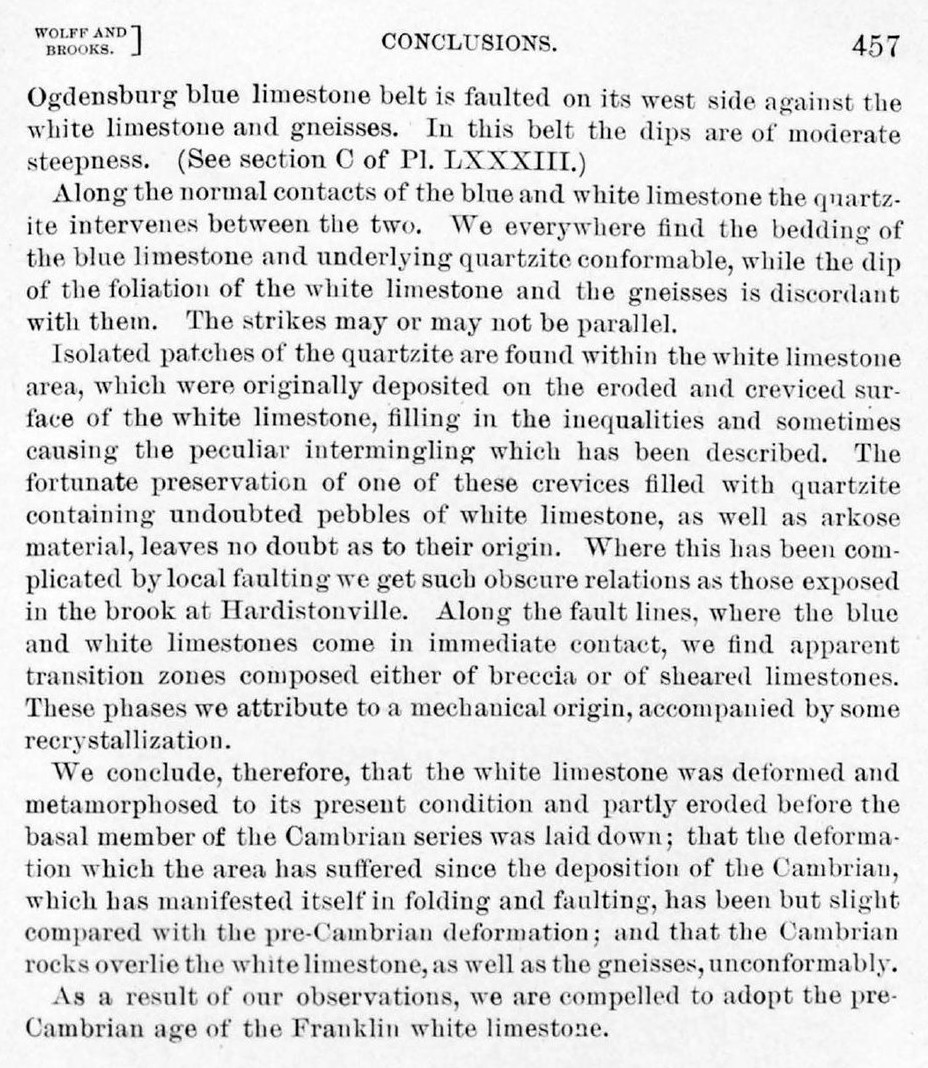
They explained Nason’s gradations the same way. Where the two limestones touched without the quartzite between them, they found faults, with breccia and sheared rock along them. Their conclusion: “We conclude, therefore, that the white limestone was deformed and metamorphosed to its present condition and partly eroded before the basal member of the Cambrian series was laid down; that the deformation which the area has suffered since the deposition of the Cambrian, which has manifested itself in folding and faulting, has been but slight compared with the pre-Cambrian deformation; and that the Cambrian rocks overlie the white limestone, as well as the gneisses, unconformably.” And then: “As a result of our observations we are compelled to adopt the pre-Cambrian age of the Franklin white limestone” (p. 457).
Their map of the belt, and their new name for the quartzite, are shown on the pages Drawing the folds and Hardyston jasper.
1908: the Franklin limestone
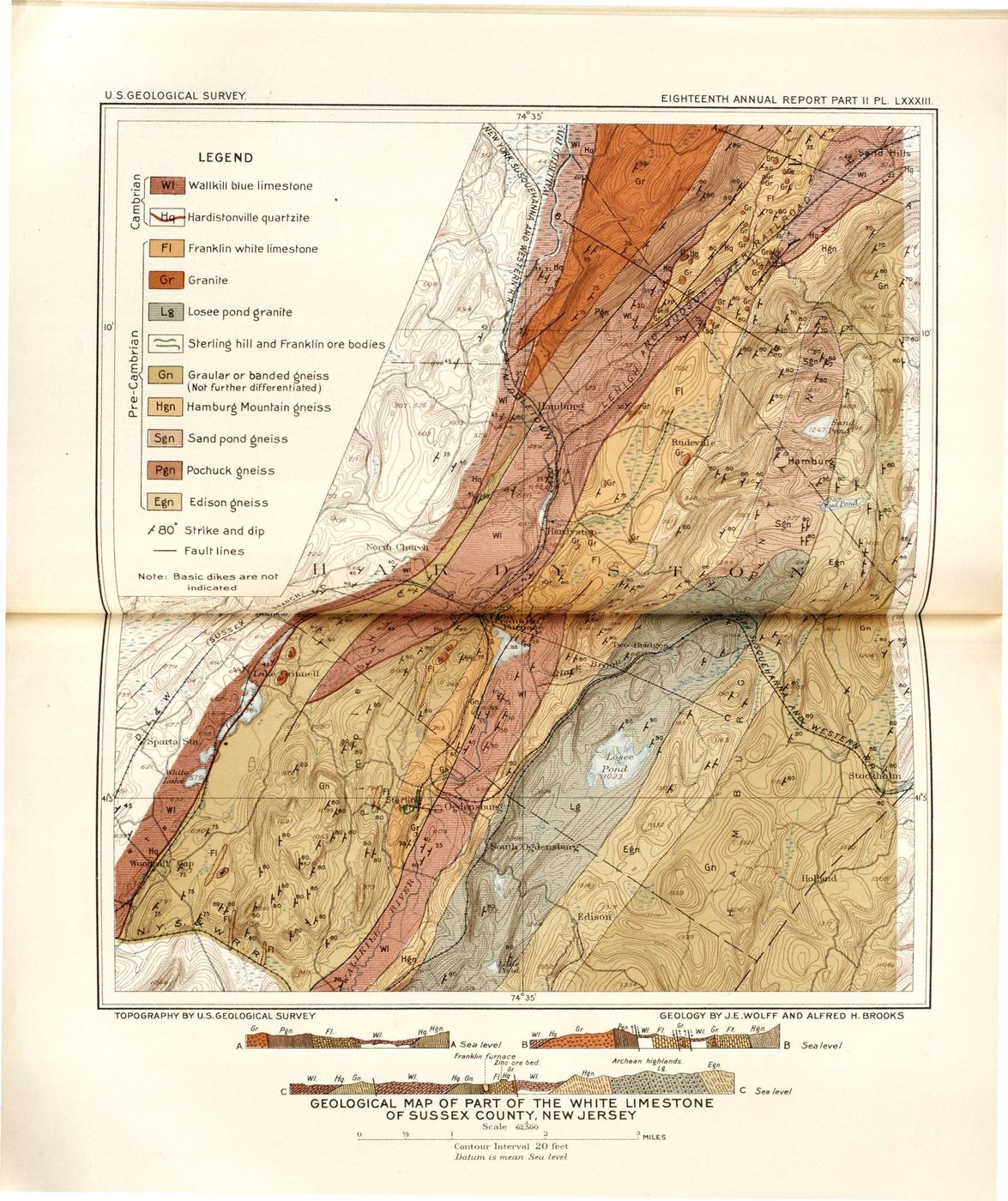
When the Survey published the Franklin Furnace Folio in 1908, the white limestone had a formal name. the Folio called it the Franklin limestone and listed it first among the pre-Cambrian rocks of the quadrangle. Of its age the Folio says: “The question in regard to the age of the limestone, which was long in dispute, has been settled by the work of Wolff and Brooks, published in 1896.” The apparent transitions between the white and blue limestones, it adds, “are shown to be confined to localities where the blue limestone has been faulted down against the white rock.” The same paragraph sends readers to the Eighteenth Annual Report, part 2, of 1898, pages 431–437; 1896 was the year of the quarry face, and 1898 the year the report was printed.
Spencer’s own chapter on the geologic history begins: “The oldest geologic records in the Franklin Furnace district are found in the Pochuck gneiss and the Franklin limestone.” Of the gap between the marble and the first Cambrian sand on top of it, he wrote: “It is probable that the interval between the original deposition of the Franklin limestone and the deposition of the Hardyston quartzite was longer than the sum of all the subsequent periods.”
He could not say how long. In 1908 nobody could put a number on a rock without fossils.
1935: Palache’s verdict
Charles Palache’s monograph of 1935 gave the history in its annotated bibliography. Of Nason’s 1890 paper he wrote: “An important paper, describing in detail the relations of the white limestone, which is regarded as a metamorphic phase of the Cambrian blue limestone. This molded geologic opinion on the matter until disproved by Wolff” (no. 141). Of Wolff and Brooks: “The final and conclusive proof of the pre-Cambrian age of the white limestone, with an excellent résumé of the literature relating to the topic” (no. 177).
Palache also noted that Kemp, in the 1900 edition of his textbook on ore deposits, still built his speculations on the origin of the ores “on the hypothesis of the post-Cambrian age” (no. 184). Not everyone changed at once.
Today: about 1.3 billion years
Wolff and Brooks settled the order of events: marble first, then a long gap, then the Cambrian. The number came a century later, and it came, as Nason had wanted, from rocks in contact with the marble, though not from fossils.
Marble cannot be dated directly, since it lacks the right minerals. Richard A. Volkert of the New Jersey Geological Survey and Fred Young described in 2009 how the Survey had instead dated zircon grains from metamorphosed volcanic rocks, metarhyolites, that lie against the marble, using a high-resolution ion microprobe operated by John Aleinikoff of the U.S. Geological Survey. Metarhyolite with the Franklin Marble gave 1,299 to 1,294 million years. “Given that rocks older than 1299 million years are not found in the Highlands outside of the Wanaque area,” they wrote, “an age of 1299 to 1294 million years is interpreted for the Franklin Marble” (The Picking Table 50, no. 2, p. 27). Monazite grains dated the high-grade metamorphism that made the marble what it is now; the editor, summing up the work the next spring, put the formation of the zinc deposits as they now stand at “1050 to 1025 million years ago” (vol. 51, no. 1, Spring 2010, p. 3), in the Ottawan phase of the Grenville Orogeny.
An earlier estimate by the same authors gave a younger figure. In 2002 Young and Volkert called the marble “1.1 to 1.2 billion-year-old,” an age inferred from the rocks below and the granites that cut it (The Picking Table 43, no. 2, p. 14). The zircon ages of 2009 replaced it.
The 2025 guidebook of the Geological Association of New Jersey sums up the sequence: the Franklin Marble belongs to a series of metamorphosed sedimentary and volcanic rocks laid down on the older Losee Suite, with volcanic layers in the series dated about 1,299 and 1,240 million years; it was intruded by the Byram and Lake Hopatcong granites at 1,188 to 1,182 million years, metamorphosed in the granulite facies at 1,045 to 1,024 million years (its figure 2), and cut by the Mount Eve Granite about 1,019 million years ago. Mount Eve is one of the two hills near Warwick where Kemp and Hollick had studied the granite in 1894.
The fossils turned up in the end, too. In 1999 stromatolites, the layered remains of mats of cyanobacteria, were found in the Franklin Marble in Sussex County (vol. 43, no. 2, Fall 2002, p. 14). They are fossils, as Nason had hoped to find, but of an age he never imagined: Proterozoic, not Cambrian.
In a sense Fowler’s “primitive” limestone of 1826 was nearer the truth than Nason’s. The white limestone is some eight hundred million years older than the blue.
In The Picking Table
The Picking Table has no article devoted to the old argument, but it touches the age of the marble often. In the first issue, Robert W. Metsger’s “Origin of Some of the Ore Minerals” (vol. 1, no. 1, February 1960, abstract of a talk of November 1959) reports potassium–argon determinations placing the formation of the ore minerals about one billion years ago, the same as the gneisses. J. L. Rodda’s talk on chemical reactions at Sterling Hill (vol. 1, no. 3, September 1960) stresses the immense interval of erosion before the Paleozoic rocks were laid down. John L. Baum’s “The Origin of Franklin-Sterling Minerals” (vol. 12, no. 1, February 1971) begins a billion years ago, with sand, silt and carbonate on the floor of a great sea. David K. Cook’s bibliography of the district, printed in installments from vol. 11, no. 2 (1970), lists Cook (1861), Nason (1890, 1891) and Wolff and Brooks (1898).
Allen W. Pinger’s 1961 symposium address, printed in vol. 14, no. 2 (1973), gives the whole quarrel a sentence: a controversy on the age of the white limestone “that lasted until 1898, when Wolff and Brooks established the pre-Cambrian age.” He dates its start to J. Pierce in 1820. Pete J. Dunn’s “Research in Mineralogy (1889–1890)” (vol. 30, no. 2, Fall 1989) notes that Nason “began what would become a long and substantial debate in the literature concerning the age of the Franklin marble.”
The modern dates arrive in issue order as follows. Fred Young and Richard Volkert’s “Evidence of Early Life in Precambrian Rocks of the New Jersey Highlands” (vol. 43, no. 2, Fall 2002) describes the stromatolites of 1999. Volkert’s research, funded by the Franklin Mineral Museum, FOMS and the Sterling Hill Mining Museum, is reported in vol. 47, nos. 1–2, and in a museum report of vol. 50, no. 1 (2009), and in full in Volkert and Young’s “Coaxing Long-Held Secrets From Precambrian Rocks of the New Jersey Highlands” (vol. 50, no. 2, Fall 2009). Young’s “From the Editor’s Desk” (vol. 51, no. 1, Spring 2010) quotes the conclusion that 1050 to 1025 million years ago “is the actual time of formation” of the zinc deposits and prints the abstract of Peck, Volkert and others in Economic Geology (2009).
Two articles of 2015–2016 use the dates. Earl R. Verbeek’s “Fluid Flow in Metamorphic Rocks, Part 3” (vol. 56, no. 2, Fall 2015) describes, in a gravel pit near McAfee, an old cave in the Franklin Marble filled with Hardyston sandstone of Cambrian age: the same kind of evidence Wolff and Brooks used, found anew. He notes that about 250 million years passed between the marble’s first accumulation as carbonate mud and its metamorphism. The same issue carries Mark Boyer’s “Letters From the Past”, with Samuel Fowler’s letter of 1826 to Berzelius and its “primitive or white carbonate of lime.” Warren Cummings, in “Aluminum-Rich Mineral Assemblages at Lime Crest Quarry” (vol. 57, no. 1, Spring 2016), places the deposition of the Franklin Marble just after 1.3 billion years ago.
No article in The Picking Table has told the nineteenth-century argument itself: Nason’s fossils, Dana’s review, Kemp and Hollick’s paper and Williams’s answer, or the pebbles in Wolff and Brooks’s quarry face.
Sources and further reading
- Boyer, M., 2015, Letters from the past [Samuel Fowler to J. J. Berzelius, June 25, 1826, from J. P. Snell, History of Sussex and Warren Counties, 1881]. The Picking Table, vol. 56, no. 2, p. 29. The Picking Table (PDF)
- Cook, G. H. [printed “Cooke”], 1861, Note on the probable age of the white limestone, at Sussex and Franklin zinc mines, New Jersey. American Journal of Science, 2nd ser., vol. 32, p. 208–209. archive.org
- Dana, J. D., 1891, [Review of the] Annual report of the State Geologist of New Jersey for the year 1890. American Journal of Science, 3rd ser., vol. 42, p. 70–72. archive.org
- Di Maio, M. P., Herman, G. C., and Verbeek, E. R., eds., 2025, Revisiting the Sterling Hill orebody. Geological Association of New Jersey, 41st annual conference. J. H. Puffer, ch. 1, p. 25 and fig. 2. PDF
- Kemp, J. F., 1893, The ore-deposits at Franklin Furnace and Ogdensburg, New Jersey. Transactions of the New York Academy of Sciences, vol. 13, p. 76–98. Quoted from p. 91. archive.org
- Kemp, J. F., and Hollick, A., 1894, The granite at Mounts Adam and Eve, Warwick, Orange County, N. Y., and its contact phenomena. Annals of the New York Academy of Sciences, vol. 8, p. 638–654. Not read; quoted as given by Williams (1894). BHL
- Nason, F. L., 1891, The post-Archean age of the white limestones of Sussex County, N. J. Annual Report of the State Geologist of New Jersey for the year 1890, p. 25–50. With the state geologist’s summary, p. 10–11. archive.org
- Palache, C., 1935, The minerals of Franklin and Sterling Hill, Sussex County, New Jersey. U.S. Geological Survey Professional Paper 180. Bibliography, nos. 141, 165, 167, 169, 177, 184. PDF
- Spencer, A. C., and others, 1908, Franklin Furnace folio, New Jersey. U.S. Geological Survey, Geologic Atlas of the United States, folio 161. Franklin limestone, “Age,” p. 3; geologic history, p. 19. Text (PDF)
- Volkert, R. A., and Young, F., 2009, Coaxing long-held secrets from Precambrian rocks of the New Jersey Highlands. The Picking Table, vol. 50, no. 2, p. 24 ff.; Franklin Marble, p. 27. The Picking Table (PDF)
- Williams, H. S. [“H. S. W.”], 1894, The age of the white limestones near Warwick, Orange Co., N. Y. [review of Kemp and Hollick]. American Journal of Science, 3rd ser., vol. 47, p. 401–402. archive.org
- Wolff, J. E., and Brooks, A. H., 1898, The age of the Franklin white limestone of Sussex County, New Jersey. U.S. Geological Survey, 18th Annual Report, part II, p. 425–457. Historical review, p. 433–438; quarry, p. 454–455; conclusions, p. 456–457; plate LXXXIII. PDF
- Young, F., and Volkert, R., 2002, Evidence of early life in Precambrian rocks of the New Jersey Highlands. The Picking Table, vol. 43, no. 2, p. 14 ff. The Picking Table (PDF)
Written with Claude, an AI model made by Anthropic, from the sources listed above, and checked against them. October 2026.