Histories › The people behind the minerals
The Passaic Zinc Company’s chemist, deaf from boyhood, who named two Sterling Hill minerals and was remembered by a third.
A chemist for the zinc company
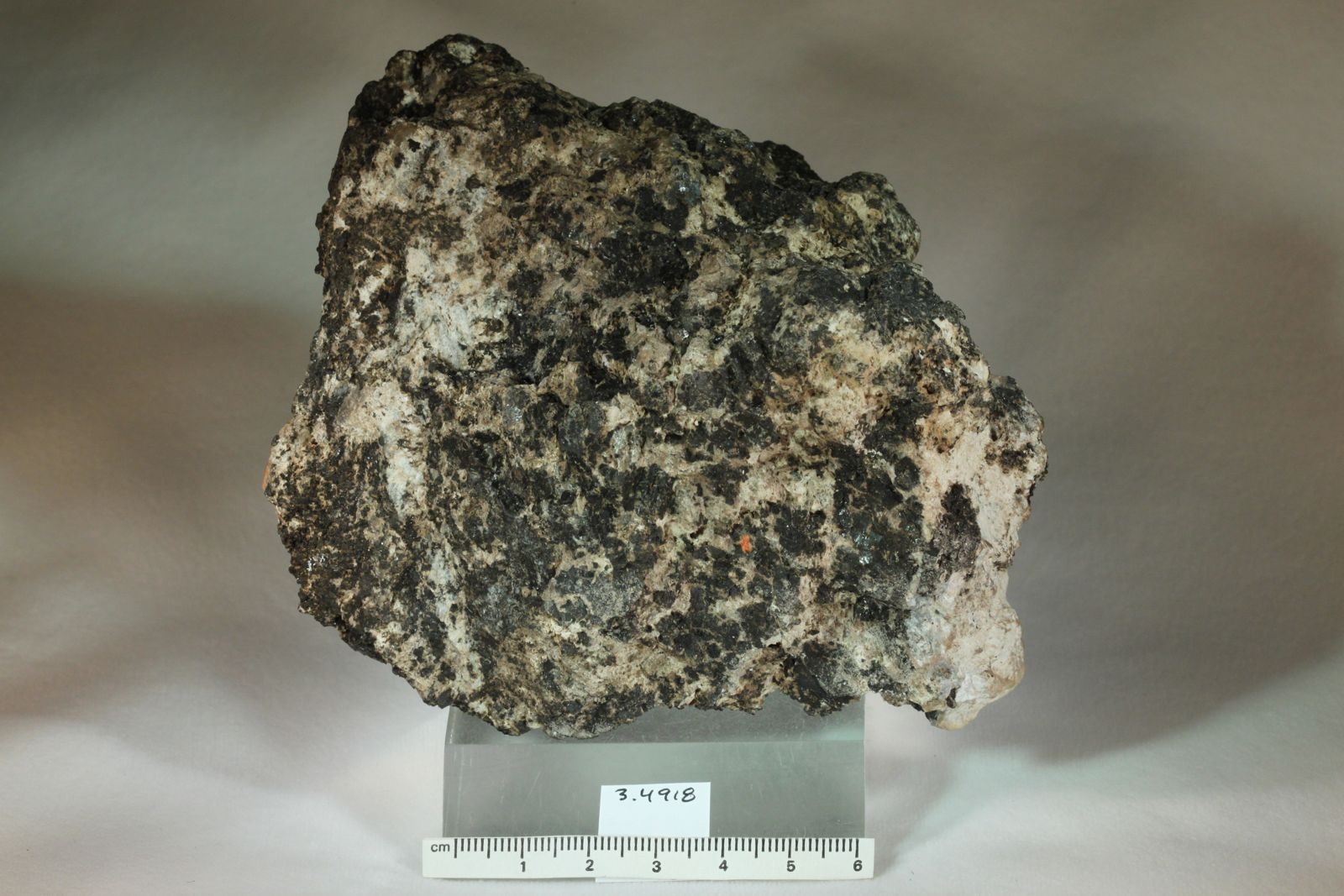
Gideon E. Moore was born in New York in 1842, the son of one of the first settlers of San Francisco. Scarlet fever cost him his hearing as a boy. By the time he went to college he was profoundly deaf. He read lips but preferred to write.
He graduated from Yale’s Sheffield Scientific School in 1861 and went west, where he became chief assayer to the Gould & Curry mine on the Comstock Lode at Virginia City, Nevada (the company’s 1866 report names “Mr. Moore, our Superintendent of Assaying”). Then he went to Germany, studied under Fresenius at Wiesbaden, and took his doctorate at Heidelberg summa cum laude, in 1869 or 1870 (the sources differ). He is listed among the first deaf Americans, perhaps the very first, to earn a Ph.D.
In 1872 he became chemist of the Passaic Zinc Company, which was working ore from Sterling Hill, and he stayed with it and the companies that followed until his death in 1895. He took out patents on the treatment of Franklin zinc ores, and he described three new minerals: brushite, from a cargo of guano unloaded at Camden, and two first found at Sterling Hill, chalcophanite and hetaerolite.
Mooreite
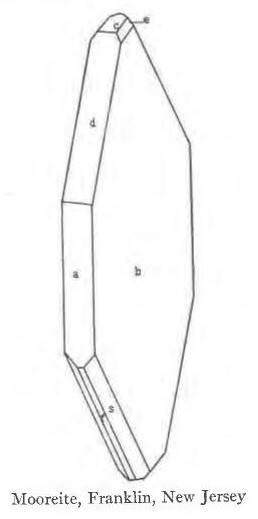
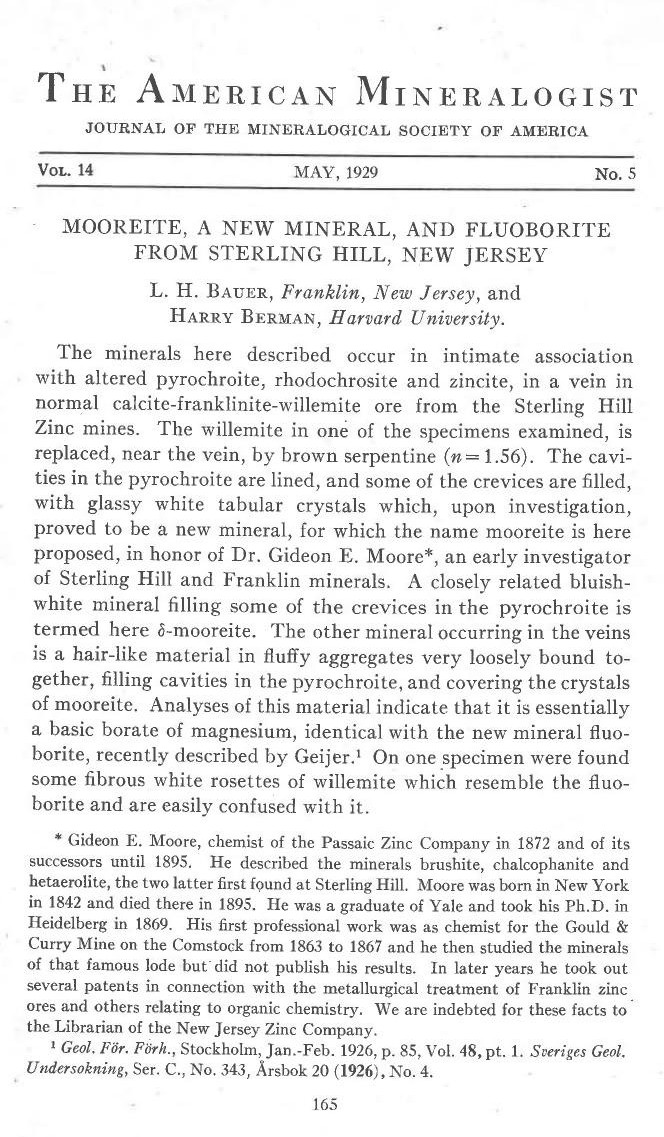
In 1929, more than thirty years after his death, two mineralogists named a new Sterling Hill mineral for him. L. H. Bauer, the New Jersey Zinc Company’s chemist at Franklin, and Harry Berman of Harvard found glassy white tabular crystals lining cavities in a vein of altered pyrochroite in the Sterling Hill ore, and called them mooreite, “in honor of Dr. Gideon E. Moore, an early investigator of Sterling Hill and Franklin minerals.” Their short footnote is still one of the few printed accounts of his life; they thanked the librarian of the zinc company for the facts.
Beside the mooreite was a bluish-white mineral they took for a close chemical cousin and called delta-mooreite. Twenty years later, in 1949, Joan Prewitt-Hopkins of Radcliffe College studied both by X-ray and showed that delta-mooreite was a species of its own. She named it torreyite, for John Torrey, one of the first scientists to write about the Franklin minerals. So Moore’s mineral led to a second one.
His brother, Henry Humphrey Moore, also deaf, became a painter. Gideon Moore’s story is told in histories of deaf Americans in science; it has hardly been told among the collectors of the mines where he worked.
In The Picking Table
The Society’s journal has followed mooreite, not the man. Frank Z. Edwards’s “The minerals of Sterling Hill 1962–65” (vol. 7, no. 2, August 1966) reports the once-scarce mineral “now freely available” as white coatings on North Ore Body specimens, and his “The exclusive minerals of Franklin/Ogdensburg, N.J.” (vol. 9, no. 1, February 1968) keeps it on the list of minerals known only from the district. A note of 1975 describes a vug with about a hundred sharp quarter-inch crystals, “by far, the finest specimen of this species I have ever seen” (vol. 16, no. 2, August 1975), and Edwards’s Post Palache series tells the story of delta-mooreite and torreyite (vol. 17, no. 2, September 1976). Paul B. Moore treats the structure of mooreite in “Closest-packing and hydrogen bonds in minerals of the Franklin Marble” (vol. 36, no. 1, Spring/Summer 1995), and Stephen Sanford’s “The breakdown of franklinite” (vol. 62, no. 2, Fall 2021) cites Gideon Moore’s 1875 account of chalcophanite formed where franklinite decayed in the Mud Zone. No article on Gideon Moore’s life has appeared in The Picking Table; he turns up only in passing, as in a 1997 review of Pete J. Dunn’s monograph that mentions “the mooreite (Gideon Moore of the nineteenth century).”
Sources and further reading
- Bauer, L. H., and Berman, H., 1929, Mooreite, a new mineral, and fluoborite from Sterling Hill, New Jersey. American Mineralogist, vol. 14, p. 165–172. With the footnote on Moore. PDF
- Gallaudet University Library, deaf people in history: Gideon E. Moore. Gallaudet
- Lang, H. G., and Meath-Lang, B., 1995, Deaf persons in the arts and sciences: a biographical dictionary. Greenwood Press, p. 261–263.
- Moore, G. E., 1865, On brushite, a new mineral occurring in phosphatic guano. American Journal of Science, 2nd series, vol. 39, p. 43–44. archive.org
- Moore, G. E., 1877, Preliminary notice of the discovery of a new mineral species [hetaerolite]. American Journal of Science, 3rd series, vol. 14, p. 423. archive.org
- Obituary Record of Graduates of Yale University, 1895, Sheffield Scientific School, class of 1861, p. 338–339. archive.org
- Prewitt-Hopkins, J., 1949, X-ray study of holdenite, mooreite, and torreyite. American Mineralogist, vol. 34, p. 589–595. PDF
- Texas Woman’s University, Deaf Scientists Corner: Gideon E. Moore. TWU
As far as we can find, this life has not been written up in The Picking Table. Written with Claude, an AI model made by Anthropic, from the sources listed above, and checked against them. October 2026.