Histories › The people behind the minerals
The poet who ran a duchy’s silver and copper mines and gathered some 18,000 rocks, minerals and fossils, and the iron mineral named for him in 1806, though not, at first, the mineral that bears his name today.
A minister of mines
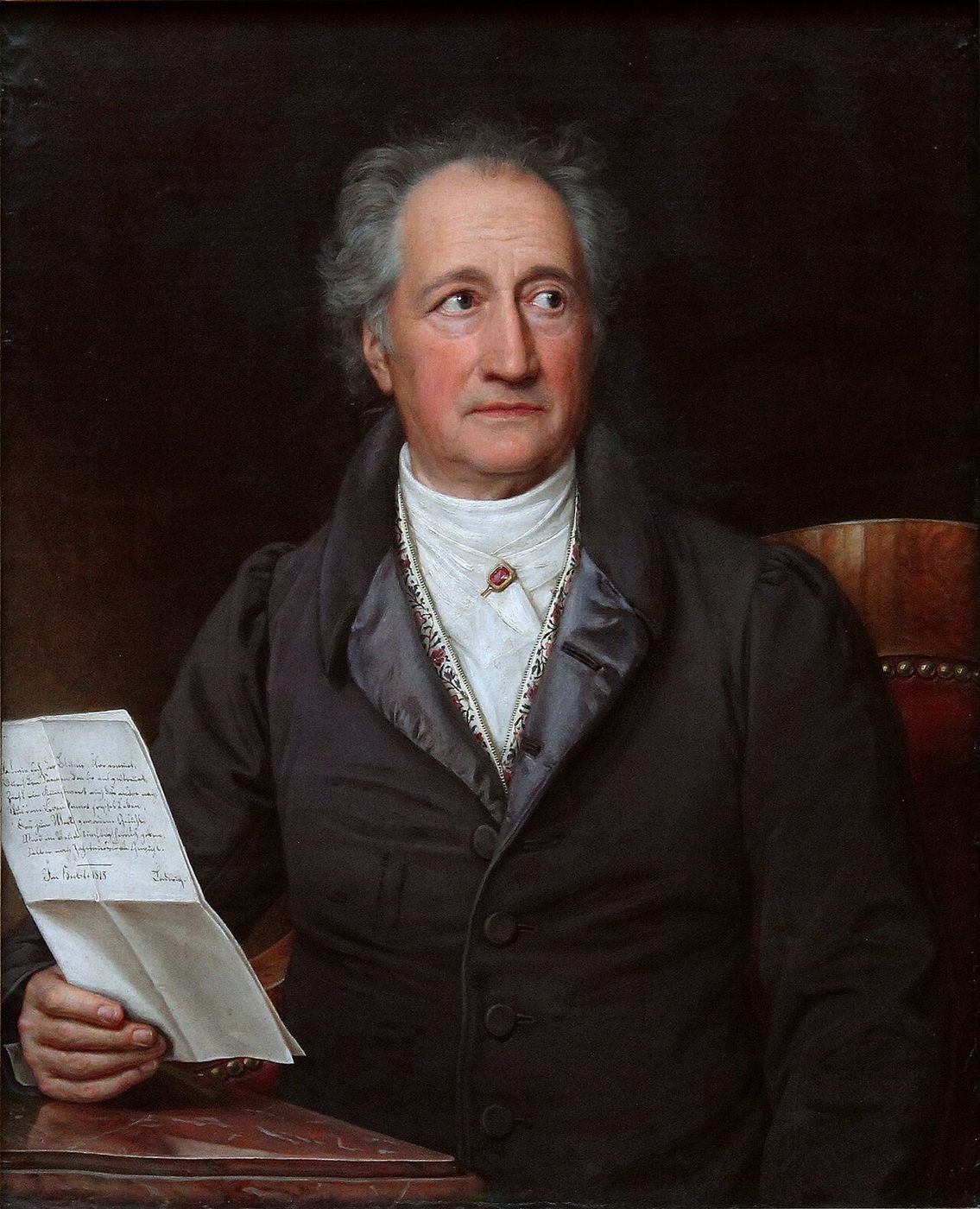
Johann Wolfgang von Goethe (1749–1832) settled in Weimar in 1775, after the success of The Sorrows of Young Werther, and entered the service of Duke Carl August of Saxe-Weimar. In his first ten years there he sat on the duke’s privy council and on the war and highway commissions, and he oversaw the reopening of the old mines at Ilmenau, in the Thuringian Forest (Wikipedia).
Mining at Ilmenau went back to the fifteenth century. According to the mining historian Rainer Slotta, writing in Der Anschnitt (1998), the workings flooded in 1739, when the dam of the lower Freibach pond broke and the pumping machinery was left without water to drive it. After eight years of preparation, the sinking of a new shaft, the Neuer Johannes, began in 1784 under Goethe’s direction. Shortly before it reached the copper-bearing Kupferschiefer, heavy inflows of water forced the installation of four underground water wheels, each about 12 meters high, to lift the water to the Martinroda drainage adit. The first ton of ore was raised in 1792, but the smelting trials did not give the hoped-for result. On October 22, 1796, the Martinroda adit collapsed. It was reopened after a year and a half, but the mine was given up in 1814. Slotta calls Goethe the duke’s “Bergwerksminister,” minister of mines, and writes that with the collapse Goethe’s interest in mining at first faded.
The collector
His interest in the earth did not fade. In a survey of Goethe as a geognost, the paleontologist Fritz F. Steininger (2007) counts some fifty years of work in the earth sciences, more than a hundred published essays on geological subjects, and object collections of more than 18,000 minerals, rocks and fossils. Among the things Steininger singles out are Goethe’s ideas on the coloring of geological maps and his description of the Carlsbad twins of feldspar. Goethe, he notes, also laid the foundation of the collections of the University of Jena.
Goethe collected to understand, not to own. He asked for Saxon specimens not as single handsome pieces but in sets: the metals worked by the Saxon mines, the vein minerals that carried them, and the country rock around them. To Chancellor Müller he said, in Steininger’s quotation, that possession was necessary to him in order to form correct ideas of things, and that he loved possession not for the sake of the thing possessed but for the sake of his own education.
The geological collection survives. The Klassik Stiftung Weimar, which keeps Goethe’s house and collections, describes it in a 2022 publication as about 18,000 rocks, minerals and fossils, among the largest private collections of the period around 1800 still preserved.
Göthit, 1806
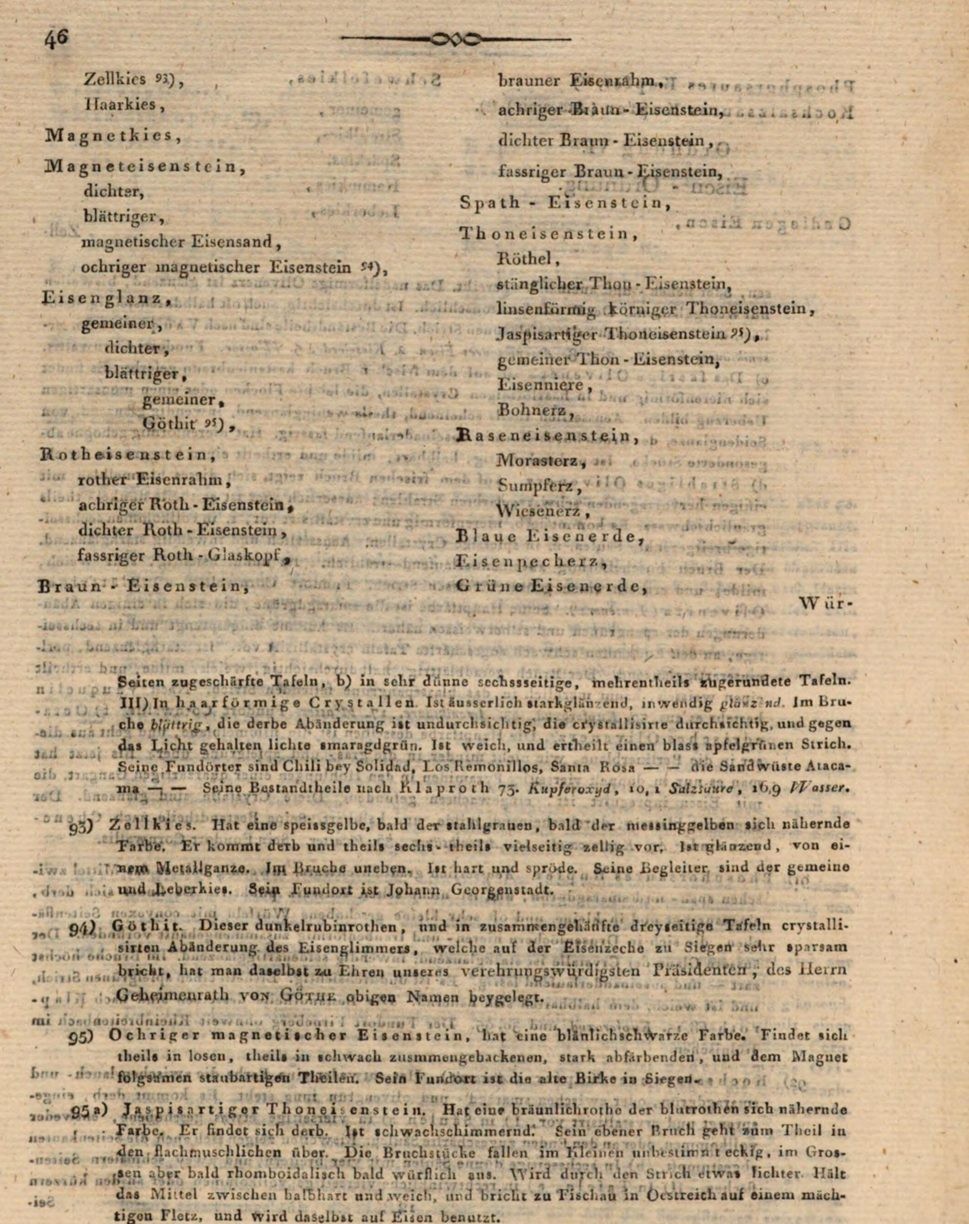
Johann Georg Lenz (1745–1832) taught mineralogy at Jena, where he was made associate professor in 1794, and in 1796–97 he founded the Societät für die gesammte Mineralogie, a mineralogical society. Goethe was its president; a history of the society by Johanna Salomon (1990) is titled for the society “under Goethe.”
In 1806 Lenz published Tabellen über das gesammte Mineralreich (Tables of the whole mineral kingdom), a short Wernerian list with notes. Under the iron minerals, as a kind of foliated specular iron, stands “Göthit,” and note 94 explains it: “This dark ruby-red variety of iron mica, crystallized in clustered three-sided plates, which occurs very sparingly at the Eisenzeche at Siegen, has been given the above name there in honor of our most venerable President, Privy Councillor von Göthe.” Lenz was recording a name given at Siegen, not coining one at Jena. The International Mineralogical Association’s catalogue of type mineral specimens cites this page as the naming publication, gives the type locality as the Hollertszug mine at Herdorf, in the Siegerland, and lists the repository of the type material as unknown.
Which mineral?
What Lenz described is not quite what is called goethite today. Two forms of iron hydroxide occur together in the brown iron ores of the Siegerland. One is the thin, transparent, bright ruby-red scales known to German miners as Rubinglimmer, ruby mica; the other is the needle-like crystals and yellow-brown, radially fibrous, velvety crusts known as Nadeleisenerz, needle iron ore, and Samtblende. Lenz’s dark ruby-red plates are the first of these.
In 1921 Karl Willmann, of Freiburg, reviewed the confused names of the natural iron hydroxides in the Centralblatt für Mineralogie. The ruby-red platelets, he wrote, especially fine in the gossans of the Siegen deposits, were first called Rubinglimmer and were later named goethite by Lenz in Goethe’s honor. He objected to a usage proposed by the French mineralogist Alfred Lacroix, lepidocrocite for the ruby mica and goethite for the needle iron ore, as “historically quite untenable,” because the name goethite had been given to the ruby mica, not to the needle ore.
Lacroix’s usage prevailed. Goethite now means the α form of iron oxide-hydroxide, α-FeO(OH), the common mineral of the needle ores and brown crusts, and lepidocrocite the less common γ form, γ-FeO(OH), with the same composition and a different crystal structure. The name made at Siegen in Goethe’s honor has passed, in effect, from the scarcer of the two minerals to the more abundant.
Brown iron ore and yellow earth
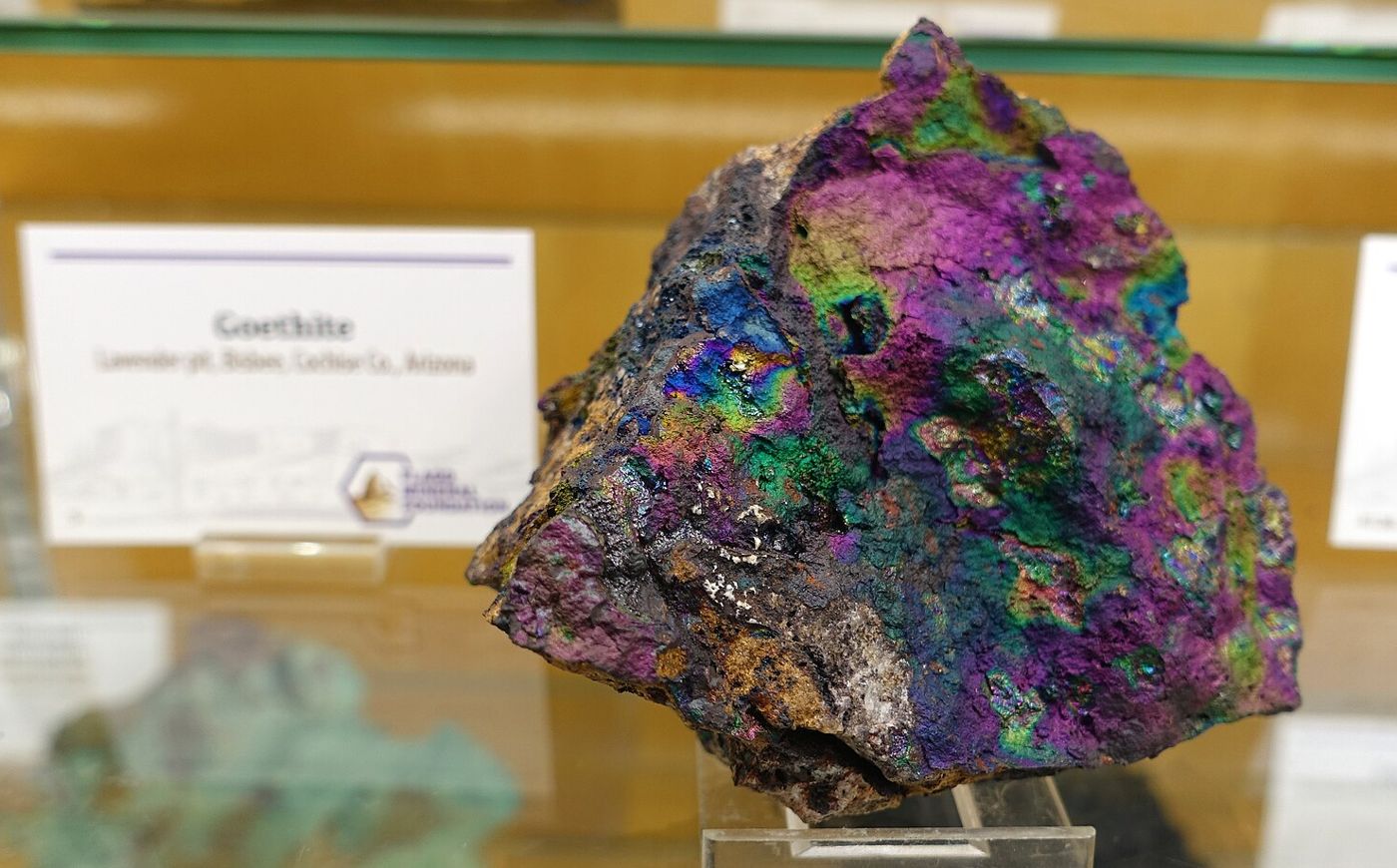
Goethite is orthorhombic, blackish brown in crystals and yellowish to reddish brown in masses, and its streak is brownish yellow to ocher-yellow. The Handbook of Mineralogy describes it as a common weathering product of many iron-bearing minerals and an important component of ore in weathered iron deposits; in the material called limonite it is nearly cryptocrystalline. It is the chief coloring mineral of the yellow ochres and raw siennas (see Mineral pigments).
There is a coincidence in this. The man whose name went to the mineral of yellow earth also wrote at length on color as it is seen. His Zur Farbenlehre (1810) is described on its own page, Goethe, Zur Farbenlehre.
At Franklin and Sterling Hill
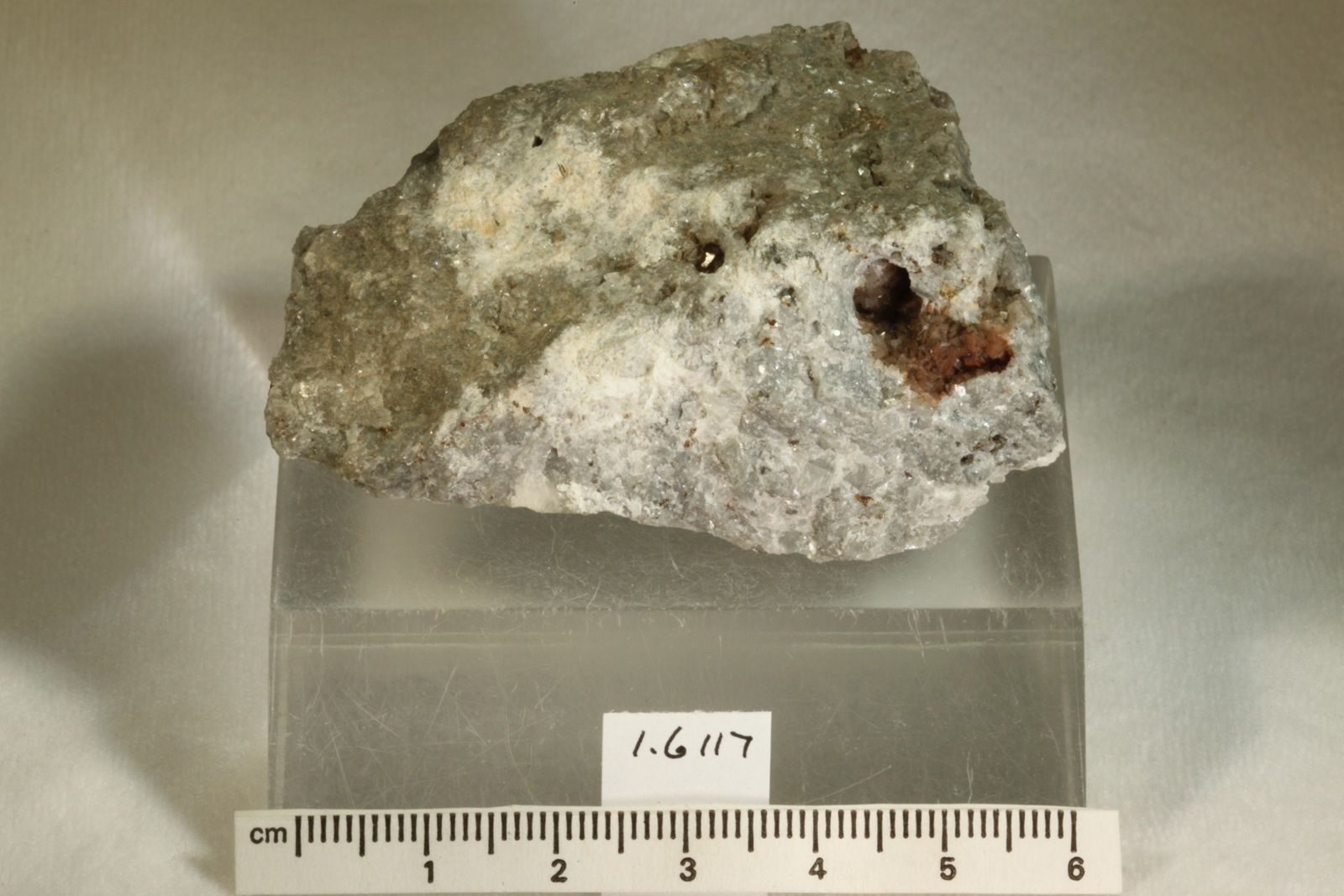
Goethite is a minor mineral in the Franklin district. Charles Palache, in The Minerals of Franklin and Sterling Hill (U.S. Geological Survey Professional Paper 180, 1935, p. 49), gives it a single short paragraph: it is found in minute needle-like crystals of dark-brown color, implanted on tiny globules of hematite, in cavities of the gray dolomite at the Buckwheat mine, Franklin. Elsewhere he lists goethite among the minerals, “mostly well crystallized,” that line those dolomite cavities with calcite, quartz, albite, sphalerite, pyrite, millerite and hematite (p. 55), and among the oxides found more rarely in the vugs of the hydrothermal veins (p. 22). His entry for limonite, on the same page as goethite, records it as an alteration product of franklinite and magnetite, found abundantly only in the calamine deposits of Sterling Hill.
The Yale Peabody Museum holds a goethite from the Franklin mine, YPM MIN 016117.
In The Picking Table
Goethite comes up in The Picking Table as a Franklin and Sterling Hill mineral, never for its name. Thomas A. Peters, Robert Koestler, Joseph J. Peters and Christian H. Grube’s “Minerals of the Buckwheat dolomite, Franklin, New Jersey”, reprinted from the Mineralogical Record in vol. 24, no. 2 (1983), describes it under the scanning electron microscope as one of the most common minerals of the dolomite, in platelets on rutile needles, in bladed sprays and in hair-like crystals around hematite spherules. Stephen Sanford’s “The breakdown of franklinite” (vol. 62, no. 2, Fall 2021) names it, with hemimorphite and hydrohetaerolite, as one of the daughter minerals of franklinite in the Mud Zone of the Sterling mine. No article on Goethe or on the naming of goethite has appeared in the journal.
Sources and further reading
- Anthony, J. W., Bideaux, R. A., Bladh, K. W., and Nichols, M. C., eds., Handbook of Mineralogy: Goethite. Mineral Data Publishing. PDF
- Goethite, Lavender pit, Bisbee, Arizona, University of Arizona Mineral Museum. Photo: Daderot, CC0. Commons
- IMA Commission on Museums, Catalogue of type mineral specimens, G (2021), entry for goethite. PDF
- Institute of Geosciences, Friedrich Schiller University Jena, history (on J. G. Lenz and the Societät für die gesammte Mineralogie). Jena
- Johann Wolfgang von Goethe. Wikipedia
- Klassik Stiftung Weimar, 2022, Stiftung entdecken (Klassisch modern), on Goethe’s geological collection. PDF
- Lenz, J. G., 1806, Tabellen über das gesammte Mineralreich. Jena: Göpferdt. Page 46, note 94, “Göthit.” Bayerische Staatsbibliothek copy. Full scan (Internet Archive)
- Lepidocrocite. Wikipedia
- Palache, C., 1935, The minerals of Franklin and Sterling Hill, Sussex County, New Jersey. U.S. Geological Survey Professional Paper 180. Goethite and limonite, p. 49; dolomite, p. 55; hydrothermal veins, p. 22. PDF
- Schuh, C. P., Annotated bio-bibliography: Jena Mineralogical Society (with Salomon, J., 1990, Die Sozietät für die gesamte Mineralogie zu Jena unter Goethe). Mineralogical Record
- Slotta, R., 1998, Porzellantasse, Ilmenau, um 1800 (Meisterwerke bergbaulicher Kunst und Kultur, no. 85). Der Anschnitt, vol. 50, no. 5–6. PDF
- Steininger, F. F., 2007, Johann Wolfgang von Goethe, ein „Geognost“ seiner Zeit. Berichte des Naturwissenschaftlichen Vereins für Schwaben, vol. 111, p. 13–22. PDF
- Stieler, J. K., Portrait of Goethe, 1828. Commons
- Willmann, K., 1921, Die natürlichen Eisenoxydhydrate. Centralblatt für Mineralogie, Geologie und Paläontologie, 1921, p. 673–678. PDF
- Yale Peabody Museum, goethite, Franklin mine, YPM MIN 016117. Yale
As far as we can find, this life has not been written up in The Picking Table. Written with Claude, an AI model made by Anthropic, from the sources listed above, and checked against them. October 2026.