The minerals that painters ground into color, as preserved in Harvard’s Forbes Pigment Collection, including zinc whites made by the New Jersey Zinc Company.
The collection
The Forbes Pigment Collection was begun about 1900 by Edward W. Forbes, later director of Harvard’s Fogg Art Museum, after early Italian paintings he had bought began to deteriorate. It became the reference collection behind the conservation of paintings in the United States and now holds some 2,500 samples of pigments, binders and other materials, kept at the Harvard Art Museums’ Straus Center for Conservation and Technical Studies (see Harvard’s short history of the collection).
Many of its samples are minerals, or pigments made from minerals. They are listed below by the minerals they come from, with Harvard’s own titles, makers and dates where the record gives them, and each links to Harvard’s record. Some are the natural mineral ground for painting; others are manufactured equivalents, which are marked. Each group notes which of its minerals occur at Franklin and Sterling Hill, following Palache’s Minerals of Franklin and Sterling Hill (1935). Harvard’s images may be viewed on its site; they are linked here rather than copied.
Samples from the Forbes collection were also analyzed for CAMEO, the Museum of Fine Arts, Boston’s database of conservation materials, and its entries show why a label is not proof. One bottle labeled malachite gave infrared and Raman spectra of brochantite, another copper mineral; a vial from a bottle labeled “Azurite, Florence 1923” proved to hold ultramarine. CAMEO also has entries for zinc white, Chinese white (zinc white as Winsor & Newton introduced it for watercolor in 1834), lithopone (first produced in 1874, when it was called Orr’s white), titanated lithopone and willemite.
Copper minerals
Malachite and azurite, the green and blue carbonates of copper, were ground for painting from antiquity; chrysocolla, a copper silicate, more rarely. Their manufactured counterparts, green and blue verditer, are basic copper carbonates made by precipitation, and the collection holds both. At Franklin and Sterling Hill: malachite, azurite and chrysocolla all occur, as minor secondary minerals (Palache, 1935).
- Malachite (Mountain Green), James Newman, Straus.67
- Malachite, Yamanaka, Straus.66
- Green Verditer (Malachite Green), Roberson, 1927, Straus.68 — manufactured
- Azurite #1, Straus.85
- Azurite #2, Straus.86
- Azurite, L. hue, Florence, 1923, Straus.1793
- Konjo (coarsely ground azurite), Straus.818
- Blue Verditer, Roberson, 1927, Straus.1788 — manufactured
- Chrysocolla, mineral ground into pigment, Straus.65
Lapis lazuli and ultramarine
Natural ultramarine was extracted from lapis lazuli, a rock whose blue mineral is lazurite, and was for centuries the most costly of blues. A synthetic ultramarine, chemically similar, was introduced in France in the 1820s. Lazurite is not among the Franklin and Sterling Hill minerals.
Mercury and arsenic sulfides
Cinnabar, mercury sulfide, gave the red called vermilion; the same compound was later made artificially. Realgar and orpiment, the red and yellow sulfides of arsenic, are brilliant and poisonous. None of the three, cinnabar, realgar or orpiment, is recorded from Franklin or Sterling Hill by Palache.
- Cinnabar (Natural), Spain, Straus.143
- Cinnabar, Straus.576
- Vermilion (English), F. Weber, 1927, Straus.144 — manufactured
- Realgar, Hamilton, Macedonia, 1916, Straus.147
- Realgar, Macedonia, Straus.579
- Arsenic Sulphide, Red Powder, Realgar, J. T. Baker, Phillipsburg, N.J., Straus.1403
- Orpiment (King’s Yellow), Roberson, 1929, Straus.60
- Orpiment, 1916, Straus.1141
Iron and manganese earths
The ochres, siennas and umbers are earths colored by iron oxides, hematite for the reds and goethite for the yellows, with manganese oxides darkening the umbers. Green earth owes its color to the clay-like minerals celadonite and glauconite. At Franklin and Sterling Hill: hematite and goethite occur, and limonite is reported (Palache, 1935; limonite is now a field name for poorly crystallized iron hydroxides, chiefly goethite, not a species); the iron mines of Sussex County, such as Andover, worked iron ores.
- Hematite, Straus.1445
- Taisha (Red Ochre), Straus.816
- Yellow Ochre, Padua, 1919, Straus.1187
- Yellow Ochre (French), Lefranc, Straus.41
- Raw Sienna (American), goethite, clay, Reichard-Coulston, Straus.42
- Raw Sienna, Italy, 1920, Straus.38
- Raw Umber, Turkey, F. Weber, 1927, Straus.8
- Terra Umbra Naturale, Siena, 1923, Straus.1369
- Burnt Umber (American), Reichard-Coulston, Straus.11
- Green Earth (Terre Verte), Fezandie & Sperrle, Straus.73
- Burnt Terre Verte (Verona Brown), F. Weber, 1934, Straus.13
Lead pigments
Lead white, the basic lead carbonate (in nature the mineral hydrocerussite; cerussite is the plain carbonate), was the painter’s principal white for centuries; massicot and litharge are lead oxides, and Naples yellow is a lead antimonate. At Franklin: galena and cerussite (Palache spells it “cerusite”) occur; massicot and litharge are not recorded.
- Flake White (Lead White), Wadsworth, Howland, 1924, Straus.157
- Kremnitz White (White Lead), Munich, 1923, Straus.158
- Massicot, Mallinckrodt, Straus.63
- Litharge, Mallinckrodt, Straus.62
- Naples Yellow, J. D. Pemberthy, Straus.61
- Real Naples Yellow, Roberson, 1914, Straus.1231
- Galena, Wadsworth, Howland, 1924, Straus.589 — needs to be confirmed: Harvard’s record gives a lead-white formula, not lead sulfide
Zinc: the New Jersey Zinc Company
Zinc white, zinc oxide, was made from the ores of Franklin and Sterling Hill (see the history of the New Jersey Zinc Company). Lithopone is a white of zinc sulfide precipitated with barium sulfate. Every sample here except the last is recorded as made by the New Jersey Zinc Company. Zincite, the natural zinc oxide, and sphalerite, the zinc sulfide, are both Franklin and Sterling Hill minerals; zincite is one of the three ore minerals of the district.
- Sphalerite, Zinc Sulfide, Zinc White, Chinese White, Zinc Oxide, Straus.592
- Acicular Zinc Oxide, 1942, Straus.160
- Zinc White (Green Seal), 1942, Straus.161
- Zinc White (White Seal), 1942, Straus.174
- Lithopone, 1942, Straus.166
- Titanated Lithopone, 1942, Straus.167
- Zinc Oxide, J. T. Baker, Phillipsburg, N.J., Straus.1055 — not Franklin ore
Whites and fillers
Several minerals were ground as whites, extenders or grounds: barite (barium sulfate), gypsum and anhydrite (calcium sulfates), calcite in chalk, whiting and marble dust, and talc, magnesite and mica. At Franklin and Sterling Hill: barite, gypsum, anhydrite, calcite, talc and micas (phlogopite, muscovite) occur (Palache, 1935); calcite, as the Franklin Marble, is the rock that holds the ore. Magnesite is not recorded.
Other mineral sources
Graphite gave the black of “black lead”; ilmenite, an iron-titanium oxide, is an ore of titanium white. Smalt is a potash glass colored with cobalt roasted from cobalt ores, and Egyptian blue is a synthetic calcium copper silicate that also occurs in nature as the rare mineral cuprorivaite. At Franklin: graphite is common in the Franklin Marble, and ilmenite is recorded (Palache, 1935); graphite also occurs at the Franklin Quarry (see the Quarries pages).
Sources and further reading
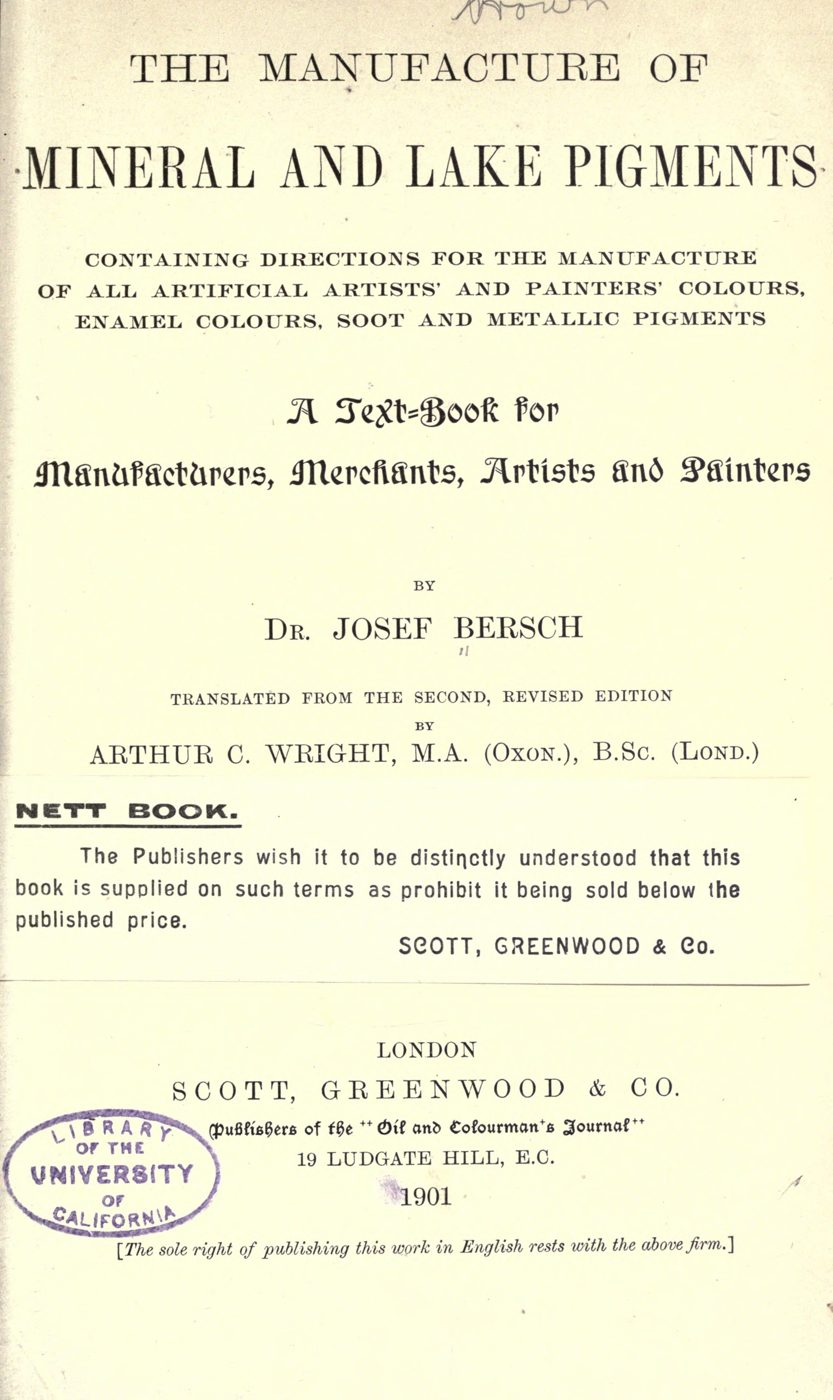
- Bersch, J., 1901, The manufacture of mineral and lake pigments, translated by A. C. Wright. London: Scott, Greenwood & Co. Internet Archive
- CAMEO: Conservation and Art Materials Encyclopedia Online, Museum of Fine Arts, Boston. CAMEO
- Harvard Art Museums: a short history of the pigment collection and art conservation in the United States, 2013. Harvard Art Museums
- Harvard Art Museums/Straus Center for Conservation and Technical Studies, Forbes Pigment Collection. Records cited individually above. Collections search
- Pigments Through the Ages (WebExhibits), for the mineral sources of individual pigments. WebExhibits
Written with Claude, an AI model made by Anthropic, from the sources listed above, and checked against them. October 2026.