The poet’s long study of color as it is seen, written against Newton’s optics, with a color circle of his own.
A theory of color as seen
Johann Wolfgang von Goethe (1749–1832) published Zur Farbenlehre with J. G. Cotta in Tübingen in 1810. He studied color as it appears to the eye: afterimages, colored shadows, the colors seen at the edges of light and dark through a prism. The work has three parts: a didactic part setting out his observations, a polemical part against Newton’s theory of light, and a historical part on earlier writers on color.
The didactic part was translated into English by the painter Charles Lock Eastlake as Goethe’s Theory of Colours (London: John Murray, 1840).
The color circle
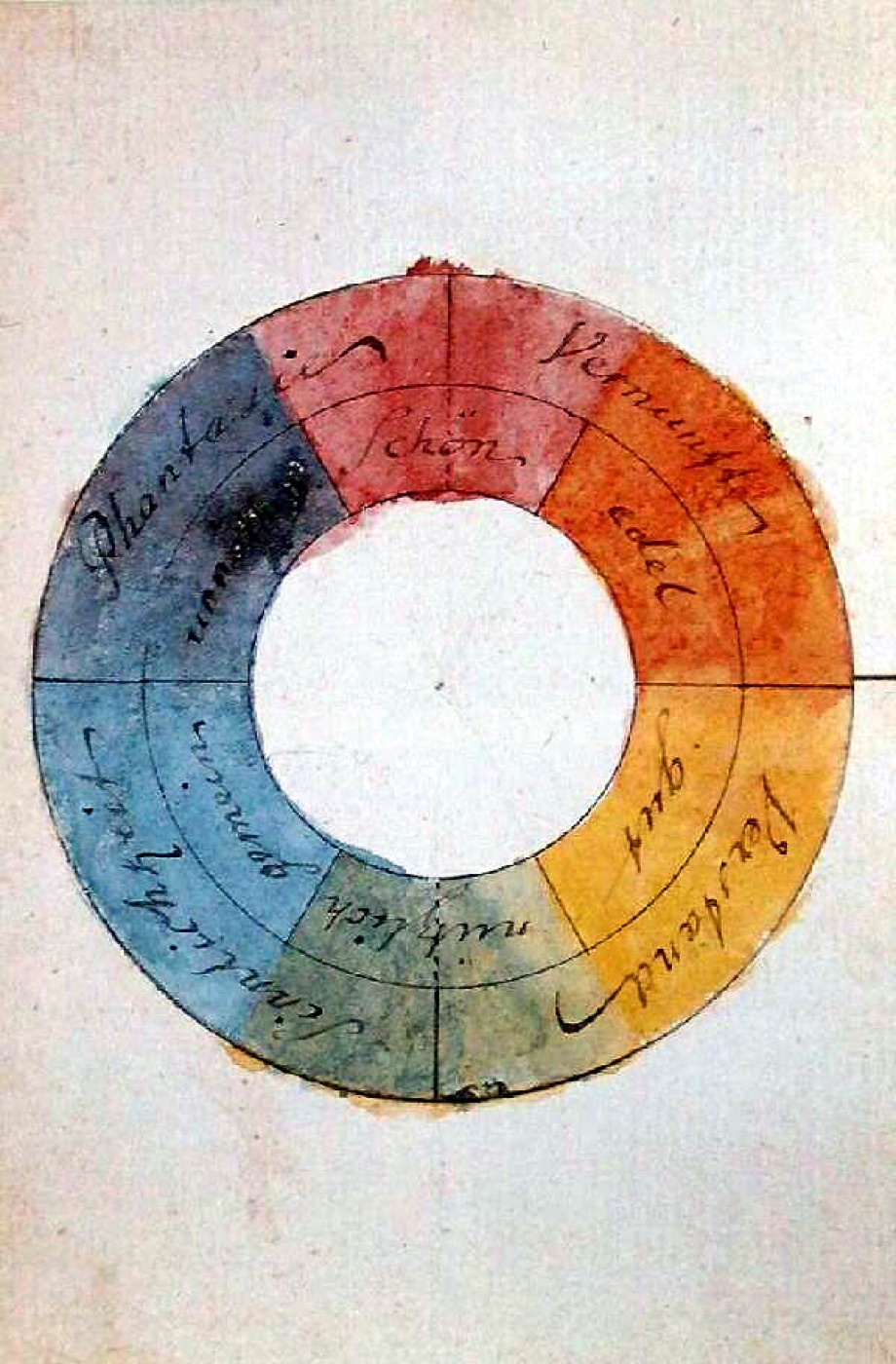
The watercolor circle of 1809 arranges the hues in a ring. Its title says it was drawn to symbolize the life of the human mind and spirit: for Goethe, color had moral and aesthetic meaning as well as optical causes.
Goethe was also a collector of minerals. The iron oxide-hydroxide goethite was named for him in 1806.
Sources and further reading
- Goethe, Farbenkreis zur Symbolisierung des menschlichen Geistes- und Seelenlebens, 1809. Freies Deutsches Hochstift. Commons
- Goethe, J. W. von, 1810, Zur Farbenlehre. Tübingen: J. G. Cotta. Getty Research Institute copy. Full scan (Internet Archive)
- Goethe, J. W. von, 1840, Goethe’s theory of colours, translated by C. L. Eastlake. London: John Murray. Full scan (Internet Archive)
Written with Claude, an AI model made by Anthropic, from the sources listed above, and checked against them. October 2026.