How mineralogists describe color now: the color, streak and luster lines of the Handbook of Mineralogy, Mindat’s search by color, and the streak test as Werner defined it.
Color, streak and luster
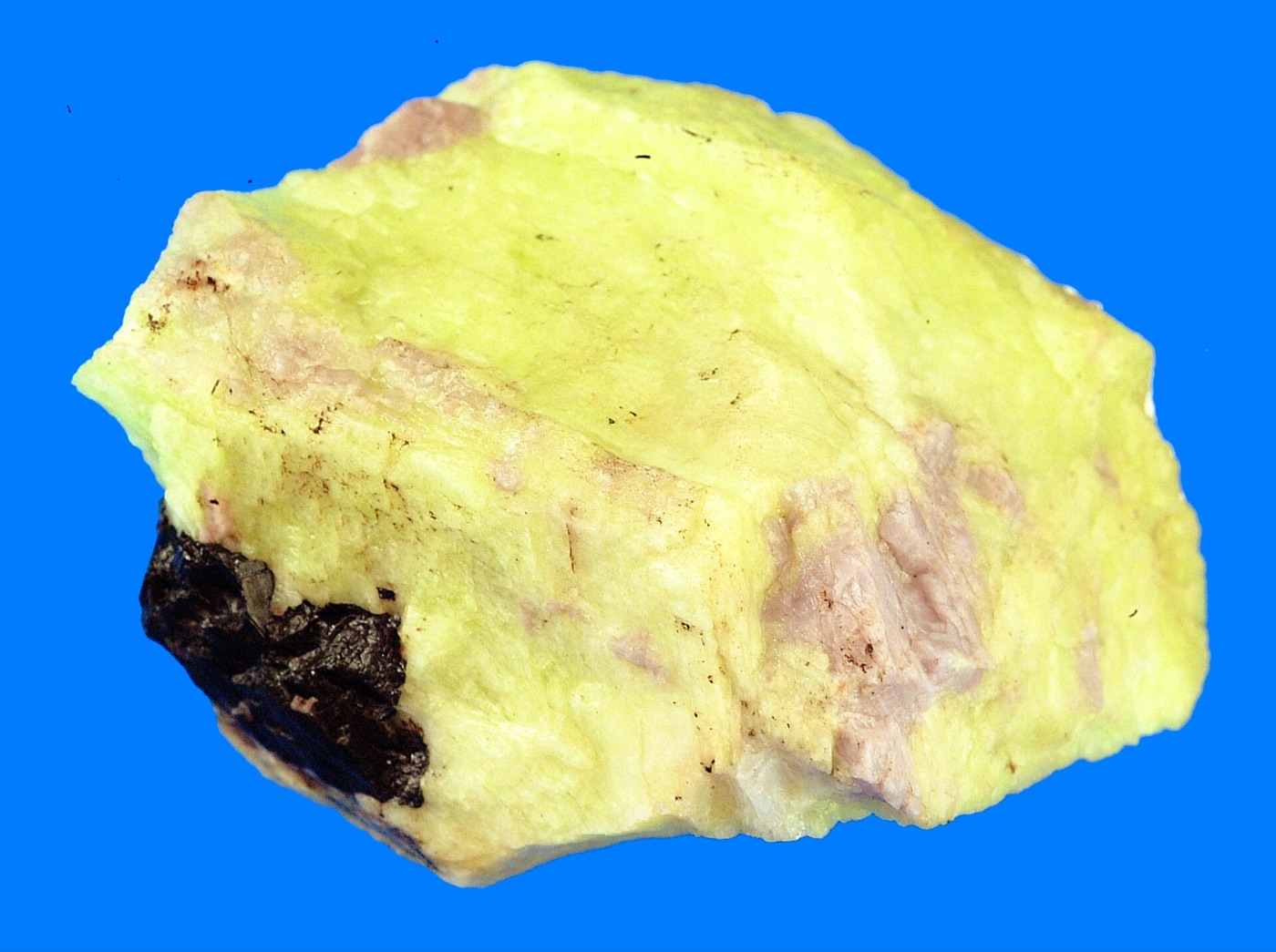

A modern mineral description gives color as a short list of words, followed by the streak and the luster. The Handbook of Mineralogy (Mineral Data Publishing; its data sheets are free to read but under copyright, so they are linked here, not reproduced) describes willemite in these words: “Color: Colorless to white, gray, flesh-red, dark brown, honey-yellow, apple-green, blue; colorless in thin section. Streak: White. Luster: Vitreous to resinous.” Fluorescence is given a line of its own: “Typically strongly fluorescent in yellow-green to yellow-orange under SW and LW UV; may be phosphorescent.”
The color line is a range, not a single color: it records what the species has been seen to show across its occurrences. Its words are everyday names, often joined to a familiar thing (honey-yellow, apple-green); two of them, apple-green and flesh-red, are also names in Werner’s nomenclature. The Handbook gives hardystonite as “white, pinkish, light brown,” and notes that “a dull violet fluorescence can be observed in some samples under UV”; for calcite it says the mineral “may fluoresce red, blue, yellow, and other colors” and is phosphorescent.
The streak
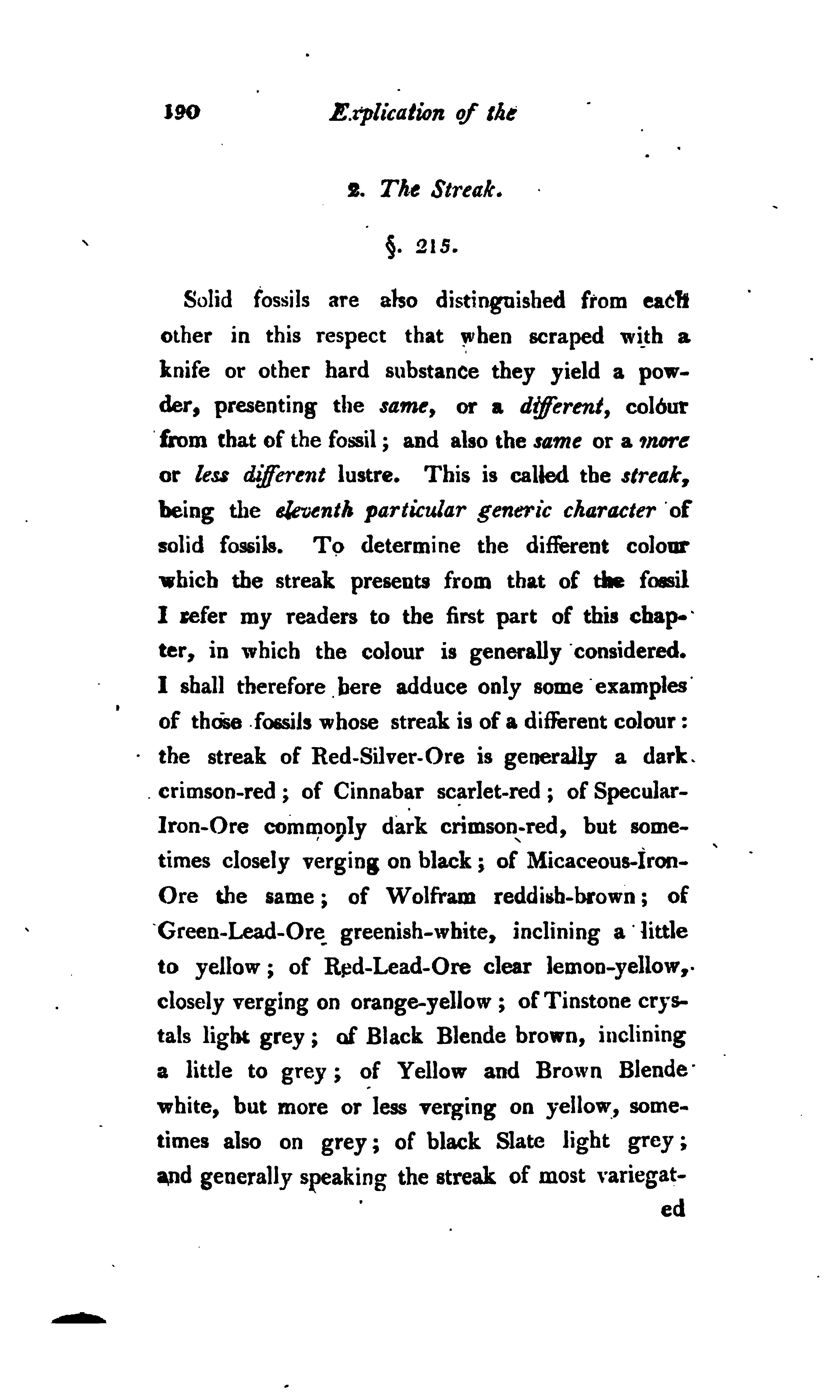
Color in the mass varies with impurities, grain size and weathering; the color of the powder generally varies less. That is the purpose of the streak. Abraham Gottlob Werner defined it in his treatise on the external characters of minerals (1774), which Thomas Weaver translated into English in 1805. Werner, like other writers of his time, calls minerals “fossils”:
Solid fossils are also distinguished from each other in this respect that when scraped with a knife or other hard substance they yield a powder, presenting the same, or a different, colour from that of the fossil; and also the same or a more or less different lustre. This is called the streak, being the eleventh particular generic character of solid fossils.
Among his examples are cinnabar, with a scarlet-red streak, and specular iron ore, “commonly dark crimson-red, but sometimes closely verging on black.” Of the zinc ore blende (sphalerite) he writes that the streak of black blende is “brown, inclining a little to grey,” and that of yellow and brown blende “white, but more or less verging on yellow, sometimes also on grey.” The Handbook’s line for sphalerite today reads “Streak: Pale brown to pale yellow and white.” Werner scraped with a knife; mineralogists now usually rub the specimen across a plate of unglazed porcelain.
Searching by color: Mindat
Mindat, the online mineral database of the Hudson Institute of Mineralogy, lists a “Colour Search” among its photograph tools: a color wheel from which a user picks a color, with the option of narrowing the search to one mineral name (archived copy). Here a color is a value picked from a screen rather than a word, and what is searched is photographs, taken under whatever light each photographer used. The questions of light and perception this raises are set out on Perception.
Fluorescent color in words
Fluorescent colors are described in the same plain words, with the ultraviolet band named (SW for shortwave, LW for longwave), as in the willemite entry above. Charles Palache warned in 1928 that “the description of these fluorescent colors in ordinary color terminology is apt to be misleading”; why that is so is discussed on Seeing fluorescence.
Sources and further reading
- Anthony, J. W., Bideaux, R. A., Bladh, K. W., and Nichols, M. C., eds., Handbook of Mineralogy. Mineral Data Publishing (data sheets for willemite, hardystonite, calcite and sphalerite; © Mineral Data Publishing). Handbook of Mineralogy
- Mindat.org, Colour Search (archived copy). Wayback Machine
- Palache, C., 1928, The phosphorescence and fluorescence of Franklin minerals. American Mineralogist, vol. 13, p. 330–333. PDF
- Werner, A. G., 1805, A treatise on the external characters of fossils, translated by Thomas Weaver. Dublin. Full scan (Internet Archive)
- Willemite, quartz and franklinite, GeoDIL number 257 (photo: Darla Sondrol), CC0. Wikimedia Commons
Written with Claude, an AI model made by Anthropic, from the sources listed above, and checked against them. October 2026.