Crayola: a color vocabulary for children (1903 to today)
How a box of eight school crayons became the most widely shared set of color names in America, and how those names have been changed.
The box of eight
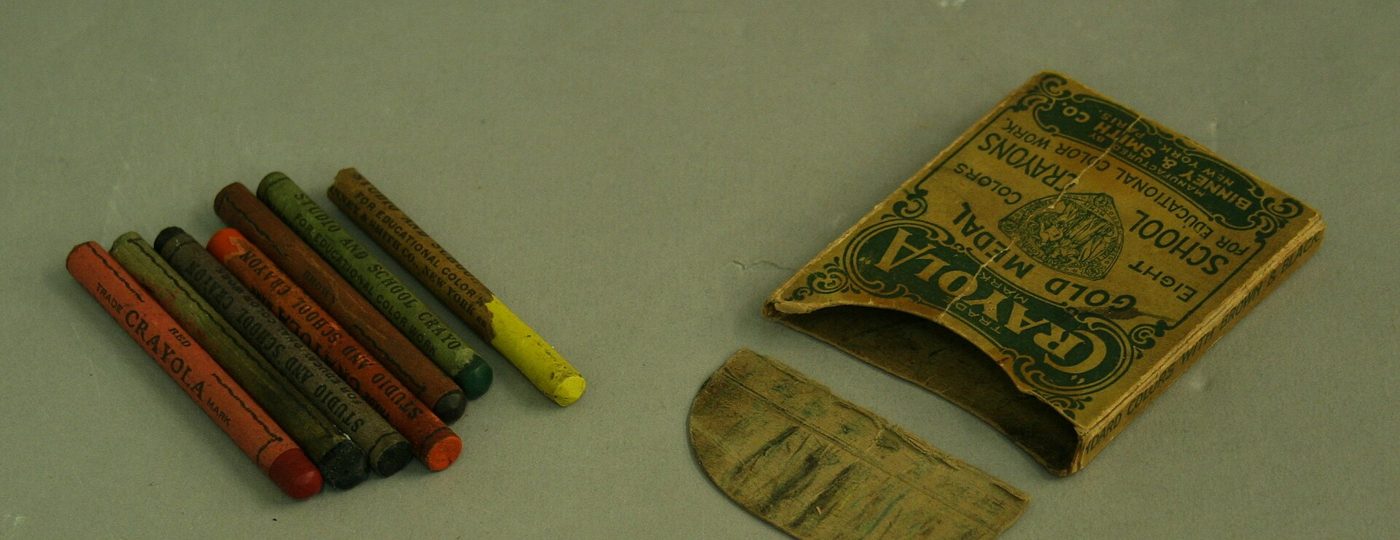
An early box of eight Gold Medal School Crayons by Binney & Smith, of the kind that won a medal at the 1904 World’s Fair. Missouri Historical Society, public domain.
Binney & Smith, a New York firm with a mill at Easton, Pennsylvania, put its first box of Crayola crayons on sale in 1903. According to Crayola, it held eight colors and sold for a nickel: red, orange, yellow, green, blue, violet, brown and black. Every color named on this page is shown as a small swatch; each links to its place in the table of all the standard colors at the foot of the page. The name was coined by Alice Binney, a former schoolteacher and the wife of the company’s co-founder Edwin Binney. As Smithsonian Magazine tells it, she joined craie, French for chalk, to “ola,” from oleaginous, oily: a chalk-shaped stick made of wax.
The first box said “violet,” the physicist’s word for the end of the spectrum, not “purple.”
A larger vocabulary
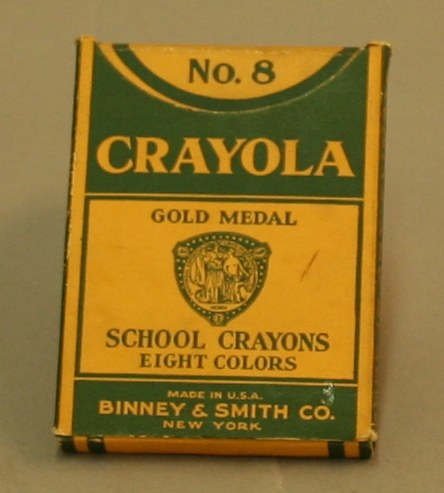
Crayola Gold Medal School Crayons, eight colors, Binney & Smith Co., New York. The medal on the box is the one won at the 1904 World’s Fair in St. Louis. Missouri Historical Society, public domain.
The company’s price list of 1913 offers boxes of six, eight, twelve, sixteen, eighteen and twenty-four crayons. Over the century the range grew to more than a hundred named colors. For many Americans these names, learned in a classroom before any other color vocabulary, are the first set of color terms they own.
Names changed
Because children use the names, the company has changed several of them when their meaning came into question. The dates below come from Crayola’s own “crayon chronology,” which is no longer online. They are given as quoted from it in secondary sources, and the 1962 change is confirmed by Smithsonian Magazine.
1958.Prussian blue was renamed midnight blue, in response to requests from educators. The crayon itself did not change, only its name. Prussian blue is the name of a real pigment, an iron compound first made in Berlin early in the eighteenth century.
1962.Flesh was renamed peach, partly as a result of the civil rights movement. The table of colors records that it began in 1903 as “flesh tint” and was briefly called “pink beige” in 1956–58.
1999.Indian red was renamed chestnut, because some children took the name to describe the skin of Native Americans. The name in fact came from the artists’ pigment Indian red, a red iron oxide named for its origin in India.
In 2017 dandelion became the first color removed from the box of twenty-four, as NPR reported at the time. Its replacement was a blue named bluetiful. Crayola’s list now records that dandelion returned in 2026.
Names from pigments and minerals
Many of the early names were borrowed from the artists’ colorman, and several of those pigments were made from minerals. English vermilion (1903–1935) takes its name from vermilion, mercuric sulfide, the color of the mineral cinnabar. Venetian red and Indian red are names of red iron-oxide pigments. raw sienna, burnt sienna, raw umber and burnt umber are the earth pigments: iron-oxide clays, the umbers darkened by manganese oxide, used raw or roasted. cobalt blue, ultramarine blue and Prussian blue are pigment names as well; ultramarine was ground from lapis lazuli before it was made artificially in the 1820s. gold, silver, copper, aquamarine and turquoise blue are named for metals and gemstones.
The names do not say what pigment was in the wax, and Crayola’s formulas are its own. But the iron-oxide reds, yellows and browns are the colors of hematite and goethite, and the umbers owe their darkness to manganese, the metals of the Franklin and Sterling Hill ore. Both hematite and goethite occur in the two mines (see Goethe and goethite).
Measuring a crayon
In 2008 the computer scientist Aubrey Jaffer measured the 120 colors then in Crayola’s range for his study of color-name dictionaries. He describes what he found:
“Deep in Crayola’s website is a page presenting the 120 Current Crayola™ Crayon Colors. Each color is presented by a GIF showing a squiggle of the crayon color on a white background (except for the white squiggle on a black background). Crayola gives no technical details of their measurement methodology; but color process control is not their primary focus.” … “Their dictionary is mostly idiosyncratic with some combinatorial names thrown in.” Aubrey Jaffer, Color-Name Dictionaries
Jaffer wrote a program that read the color of each squiggle at the same pixel and built from it a table of the 120 colors, with a printed catalog and a plot of the colors in sRGB space. He found that 23 of the colors fall outside the sRGB gamut of a computer screen, mostly saturated reds, that neither black nor white is fully saturated, and that the colors cluster rather than spread evenly. He also photographed two green crayons from different boxes to show that the same named crayon varies.
Why it belongs here
The mineralogists’ color names in Werner and Ridgway were made for specialists. Crayola’s names were made for everyone. They show the other side of the same problem: a color name is useful only as long as the people who use it agree on what it means.
Every standard color, 1903 to today
The 186 colors of Crayola’s regular boxes from 1903 to the present, in the order of the spectrum, with the years each was made. Colors no longer made are shown with a dashed border; hold the pointer over a swatch, or read beneath it, for its earlier names. Each swatch has its own link. The years and earlier names follow Ed Welter’s history of Crayola colors as compiled in Wikipedia’s list of Crayola crayon colors. The screen colors are those of Crayola’s website, or approximations where it gives none; a crayon on paper looks different with every stroke.