Histories › The mines and their history
A calcium manganese silicate first found as tiny blue-green crystals on a dump at Franklin in 1898, thought for decades to be nearly lost, and now known to have run all through the north end of the mine.
Found on a dump, 1898
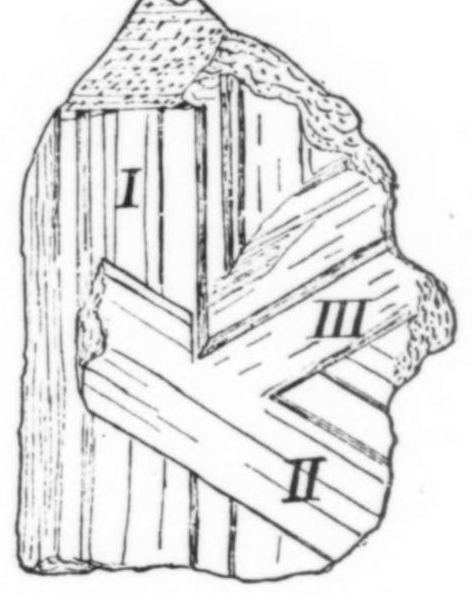
In November 1899 Samuel L. Penfield and Charles H. Warren of Yale announced several new minerals at once, under the title “Some new Minerals from the Zinc Mines at Franklin, N. J.” They came, the authors wrote, “for the most part from the one-thousand-foot level of the Parker Shaft on North Mine Hill,” and they came close to being lost: “at the time that they were brought to the surface, about two years ago, the fact that several new species were being mined was not known, and a quantity of material, which it is believed would prove to be very profitable hunting ground for the new species, was thrown upon the dump and subsequently covered up” (p. 339).
Collectors had noticed. The authors thanked E. P. Hancock of Burlington, J. J. McGovern of Franklin, F. L. Nason, F. A. Canfield and W. M. Foote (p. 339), Two of the minerals in the same paper were named for Hancock and Nason, and McGovern got his in 1927 (see nasonite and mcgovernite).
The second mineral in the paper was glaucochroite. “This mineral was collected by S. L. Penfield in September, 1898, and was subsequently sent to New Haven for identification by Mr. W. M. Foote, who had collected several specimens of it earlier in the season.” Its crystals were small: “The largest crystals thus far observed do not average over 2mm in greatest diameter” (p. 343).
Blue-green and color
Warren’s analysis gave a simple formula: “The formula of glaucochroite is therefore CaMnSiO4, that of monticellite being CaMgSiO4.” It was a calcium manganese silicate of the olivine family, and the authors placed it accordingly: it “takes therefore a place in the system of mineralogy next to monticellite as a member of the chrysolite group” (p. 345).
The name came from its color: “The name glaucochroite has been given to this species because of its color, from γλαυκός = blue-green and χροια = color” (p. 346). The crystals sat in a white matrix that was itself new, nasonite, “intimately associated with brown garnet and yellow axinite” (pp. 345–346).
They also thought it rare: “So far as known, only a small amount of glaucochroite has been found” (p. 345).
Palache’s two crystals, 1935
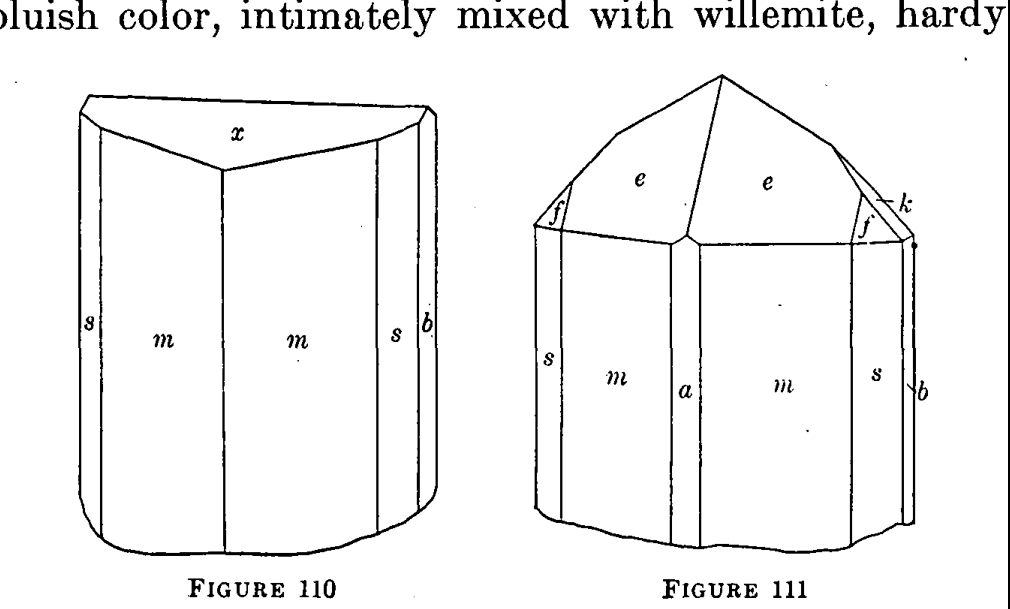
Penfield never found a crystal with its ends intact. Charles Palache of Harvard did, decades later: “The author was so fortunate as to obtain two minute crystals having excellent terminations from a specimen presented by the Foote Mineral Co.” (Palache, 1935, p. 79). He drew them, and they are the two crystals above.
Palache agreed that it was scarce. “Very few specimens of glaucochroite have been preserved. The mineral came from the same part of the Parker shaft as clinohedrite and like it was found only on the mine dump” (p. 79). He recorded one other find: “The only other discovery of glaucochroite at Franklin was made in 1927, when specimens from the deep levels of the mine were found on the picking table. The glaucochroite here is a coarse granular form of bluish color, intimately mixed with willemite, hardystonite, tephroite, and franklinite” (p. 80). He also noted that crystals described by Samuel G. Gordon as glaucochroite had been shown by W. T. Schaller, on optical tests, to be tephroite (p. 80).
Far more plentiful, 1969
The picture changed with X-rays. In February 1969 the editor of The Picking Table, Frank Z. Edwards, reported from a visit to Harvard that David Cook “has also found that glaucochroite is far more plentiful at Franklin than originally believed. X ray analyses have shown that the brownish rim around esperite is glaucochroite. Also, that other gray massives are glaucochroite and not tephroite. However, the gray blue mineral, associated with Parker Shaft material, is glaucochroite as originally identified” (“Harvard Research on Franklin Minerals,” vol. 10, no. 1, February 1969, p. 7).
In 1987 Peter B. Leavens, Pete J. Dunn and Donald M. Burt gathered every specimen they could find and published a study of its composition, occurrence and formation. They found it widespread: “There are a number of references to glaucochroite on the mine-level maps, which suggest that it was widely distributed in the northern parts of the mine” (Leavens and others, 1987, p. 423). For the original crystals they could muster only “the 15 available specimens of glaucochroite crystals” (p. 424). And they listed the kinds: “Euhedral crystals occur in a number of assemblages with nasonite, willemite, clinohedrite, hardystonite, diopside, and cuspidine. Massive, coarse-grained, blue glaucochroite occurs with willemite, franklinite, calcite, hardystonite, leucophoenicite, and andradite. Massive, fine-grained brown glaucochroite occurs with esperite, hodgkinsonite, calcite, willemite, zincite, and franklinite” (p. 423).
Their study also settled a companion. Cuspidine, a calcium silicate with fluorine, had been on the Franklin list only on Palache’s interpretation of an old analysis. Leavens and his colleagues confirmed it, in the glaucochroite crystal assemblages (p. 424).
A color that will not hold still
Glaucochroite is hard to photograph. Gary Grenier warned collectors in 1996: “massive glaucochroite, blue-gray when viewed in daylight, may appear on film as greyish pink to a pronounced reddish-pink when photographed under artificial light” (“Mineral Photography: Table-Top Tripod Methods in Photomacrography,” vol. 37, no. 1, Spring/Summer 1996, p. 13).
It is no longer Franklin’s alone. Leavens and his colleagues noted later finds in a skarn at Anakit on the Lower Tunguska in Siberia and in the Wessels mine in South Africa (p. 423). But Franklin is where it was found, named and, over most of a century, understood.
In The Picking Table
Glaucochroite appears in The Picking Table mostly in passing: on species lists, in Frank Z. Edwards’s “The Exclusive Minerals of Franklin/Ogdensburg, N.J.” (vol. 9, no. 1, February 1968, p. 13), in John L. Baum’s “The Parker Mine” (vol. 24, no. 1, Spring 1983, p. 10), and in Peter Chin and Gary Grenier’s “Roeblingite and the ‘Parker Shaft Minerals’” (vol. 39, no. 2, Fall/Winter 1998, p. 15), which lists it first among them. The abstract of the 1987 study is in vol. 31, no. 2, Fall 1990, p. 18. No article of its own has appeared there.
Sources and further reading
- Edwards, F. Z., 1969, Harvard research on Franklin minerals. The Picking Table, vol. 10, no. 1, February 1969, p. 7–8. PDF
- Grenier, G., 1996, Mineral photography: table-top tripod methods in photomacrography. The Picking Table, vol. 37, no. 1, Spring/Summer 1996, p. 9–16. PDF
- Leavens, P. B., Dunn, P. J., and Burt, D. M., 1987, Glaucochroite (olivine, CaMnSiO4) from Franklin, New Jersey: its composition, occurrence, and formation. American Mineralogist, vol. 72, p. 423–428. PDF
- Palache, C., 1935, The minerals of Franklin and Sterling Hill, Sussex County, New Jersey. U.S. Geological Survey Professional Paper 180. Glaucochroite, p. 79–80. PDF
- Penfield, S. L., and Warren, C. H., 1899, Some new minerals from the zinc mines at Franklin, N. J., and note concerning the chemical composition of ganomalite. American Journal of Science, 4th ser., vol. 8, p. 339–353. Glaucochroite, p. 343–346. archive.org
Written with Claude, an AI model made by Anthropic, from the sources listed above, and checked against them. October 2026.