Isaac Newton split sunlight with a prism, named seven colors in the spectrum, and arranged them on a circle to predict the color of any mixture.
The prism experiments
Isaac Newton (1642–1727) reported his first experiments on color in a letter to the Royal Society, sent from Cambridge on 6 February 1671/72 and printed in the Philosophical Transactions (no. 80, 19 February 1671/72, p. 3075 onward). He wrote that at the beginning of 1666 he had procured “a Triangular glass-Prisme” and let a beam of sunlight from a small hole in his window shutter pass through it onto the opposite wall. He expected the colored image to be round. It was oblong, about five times longer than it was broad.
From this and further experiments, some with two prisms, he drew the conclusion stated in the journal’s summary of the letter: that light “is declared to be not Similar or Homogeneal, but consisting of difform rays, some of which are more refrangible than others,” and that colors are not qualities produced by refraction but “Original and Connate properties” of the rays themselves. White sunlight is a mixture; the prism separates what is already there.
Seven colors
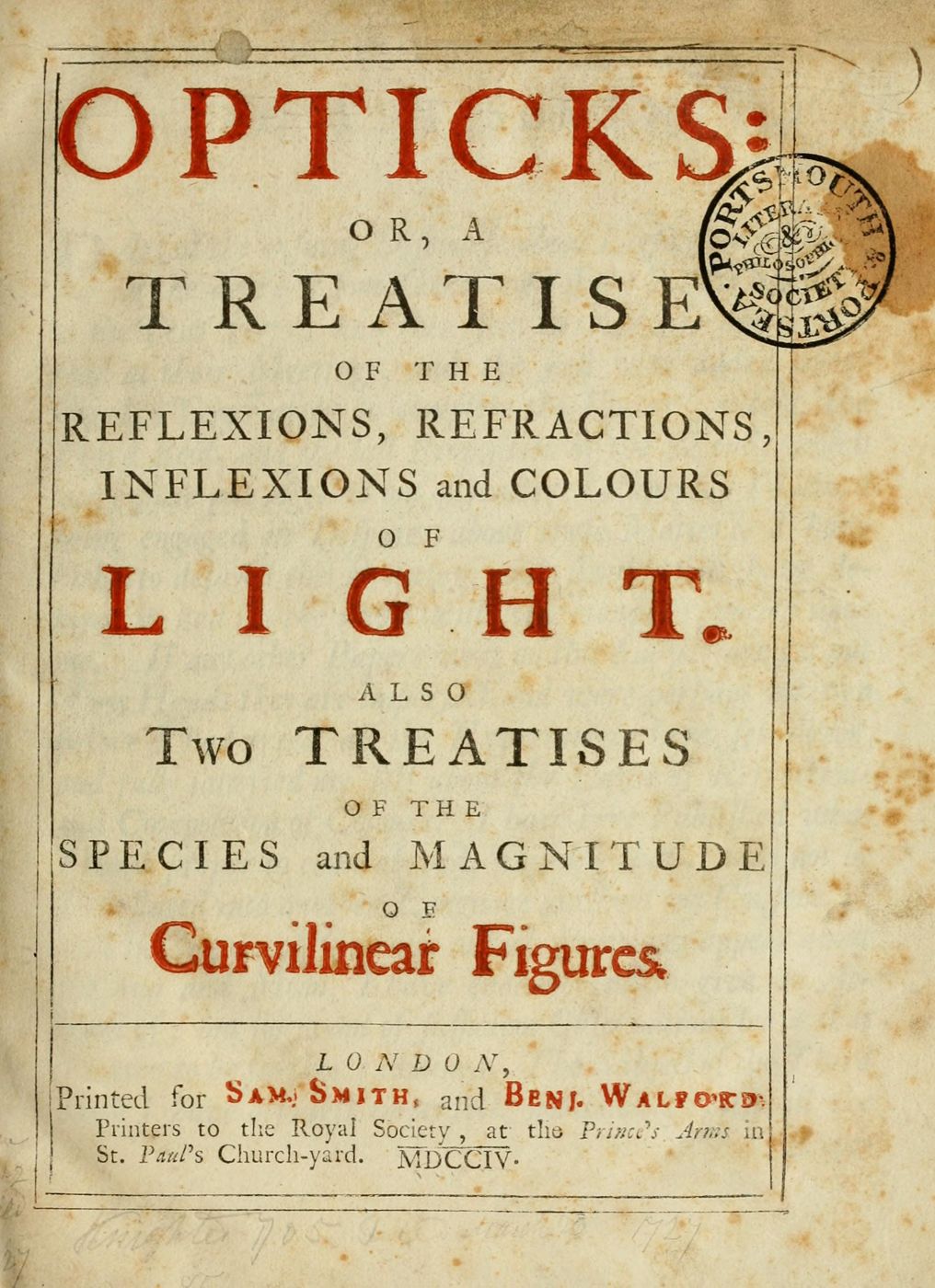
Newton set out the full theory in Opticks: or, a Treatise of the Reflexions, Refractions, Inflexions and Colours of Light (London, 1704). In Book I, Part II, Proposition III, he describes how he traced the outline of the spectrum on paper and had the boundaries between the colors marked by “an Assistant whose Eyes for distinguishing Colours were more critical than mine.” Repeating this several times, he found that the boundaries divided the length of the spectrum “after the manner of a musical Chord.” The spaces between them, he wrote, are taken up by the colors red, orange, yellow, green, blue, indigo and violet.
Seven is therefore not a count of what every eye must see. It follows from a division of the spectrum that Newton matched to the seven intervals of the musical octave. Orange and indigo, the two names most often questioned, are the ones that complete the seven.
Mixing painters’ powders
Newton also tested his theory on pigments. In the same part of the book he describes mixing orpiment, “a certain full bright purple, which Painters use,” viride aeris and blue bise until the mixture became a grey that leaned toward none of the colors. He rubbed it thickly on the floor of his room in full sunlight, laid a piece of white paper beside it in the shade, and looked from twelve or eighteen feet away: the powder appeared whiter than the paper. A visiting friend, asked which of the two whites was the better, could not say. Orpiment, the bright yellow arsenic sulfide among the powders, is a mineral, and was a common painters’ pigment in Newton’s time.
The color circle
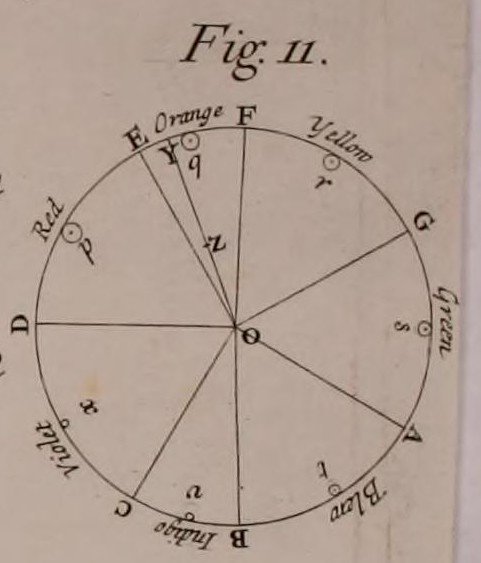
Proposition VI of the same part sets the problem: “In a mixture of primary Colours, the quantity and quality of each being given, to know the Colour of the compound.” Newton’s answer is a diagram. He draws a circle and divides its circumference into seven parts “proportional to the seven musical Tones or Intervals of the eight Sounds, Sol, la, fa, sol, la, mi, fa, sol, contained in an Eight,” that is, in proportion to the numbers 1/9, 1/16, 1/10, 1/9, 1/10, 1/16, 1/9. The arcs are, in order, red, orange, yellow, green, blue, indigo and violet, so that the two ends of the spectrum meet.
To find the color of a mixture, a small circle is drawn at the center of gravity of each color’s arc, its size proportional to the number of rays of that color in the mixture, and the common center of gravity of all these circles is found. A line from the center of the circle through that point shows, where it meets the circumference, the color of the mixture; the point’s distance from the center is proportional to the fullness or intensity of the color, “that is, to its distance from whiteness.” White lies at the center.
Later systems on this site, among them Harris and Goethe, were written in response to Newton.
Sources and further reading
- Newton, I., 1672, A letter of Mr. Isaac Newton ... containing his new theory about light and colors. Philosophical Transactions 6 (80), 3075–3087. Scan (Internet Archive)
- Newton, I., 1704, Opticks: or, a treatise of the reflexions, refractions, inflexions and colours of light. London: Sam. Smith and Benj. Walford. Full scan (Internet Archive)
- Newton, I., 1730, Opticks. 4th ed. London: William Innys. Full scan (Internet Archive)
Written with Claude, an AI model made by Anthropic, from the sources listed above, and checked against them. October 2026.