Three thousand years ago, without metal tools, the Olmec ground pieces of magnetite, ilmenite and hematite into concave mirrors true enough to focus the tropical sun, probably hot enough to light tinder; and the two mineral reds, cinnabar and hematite, of Maya burials, among them the tomb of the Red Queen at Palenque.
Stone mirrors that gather the sun
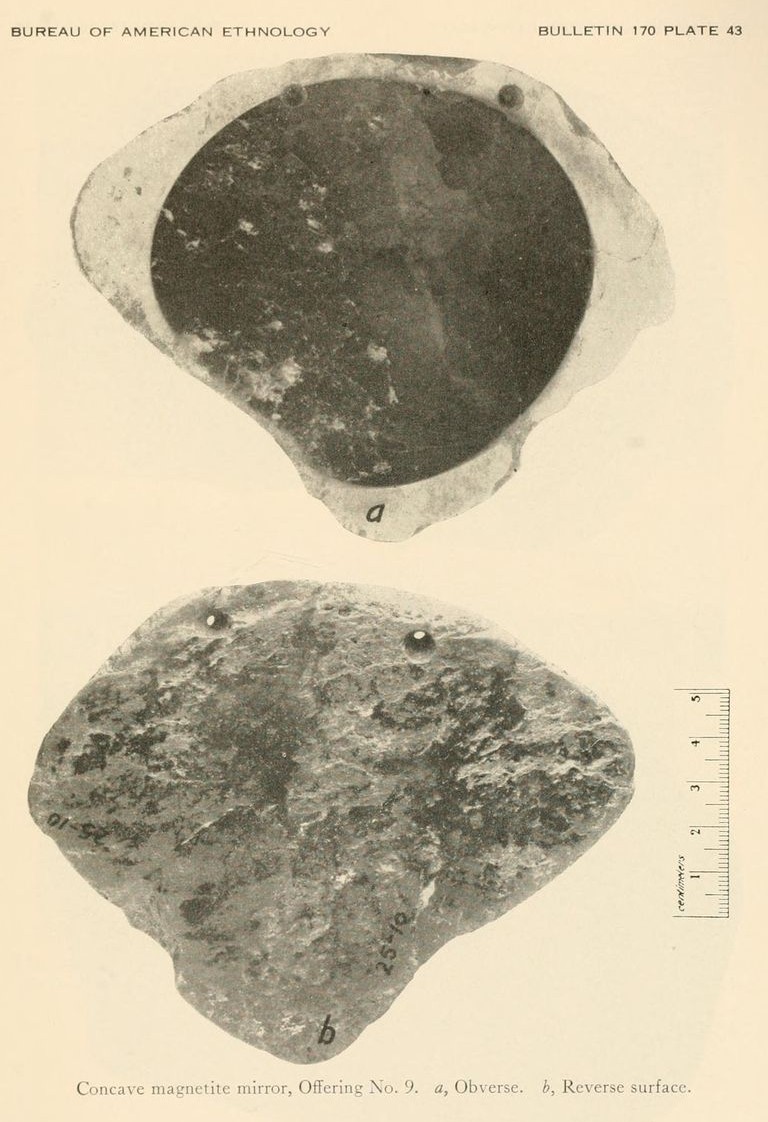
Three thousand years ago, with no metal tools, only stone, sand and patience, Olmec craftsmen took lumps of iron ore and ground them into concave mirrors: dark, glossy dishes of magnetite, ilmenite and hematite, curved so truly that they gather sunlight to a point. The physicist who studied the best of them judged that in the tropical sun they could probably set tinder alight. They are some of the most remarkable things ever made from a mineral, and the minerals are ones that occur at Franklin and Sterling Hill.
Among the most finely made objects of early Mesoamerica are mirrors cut and polished from iron ore by the Olmec of the Gulf Coast of Mexico, in the present states of Veracruz and Tabasco. Karl Taube (2004) writes that the Olmec mirrors of hematite, ilmenite and magnetite evoke the importance of these ores as precious materials among the Early Formative Olmec. At San Lorenzo, the great Olmec center of that period, sculptures and figurines show ballplayers wearing mirror pectorals on the chest, and excavations by Ann Cyphers uncovered more than eight tons of perforated iron ore cubes, brought from sources in Oaxaca and Chiapas, which Taube suggests may have served as units of wealth as well as beads.
The finest mirrors that survive come from La Venta, in Tabasco, the Olmec center of the following Middle Formative period. In 1955 Philip Drucker, Robert Heizer and Robert Squier excavated a pair of offerings flanking the central axis of its main ceremonial complex, each of which held a concave mirror among rows of celts: in Offering No. 9 a mirror of magnetite, in Offering No. 11 a mirror of ilmenite. Their report, published by the Smithsonian Institution as Bulletin 170 of the Bureau of American Ethnology in 1959, gives the mirrors two technical appendixes, one on their optics and one on their minerals.
How the mirrors were made
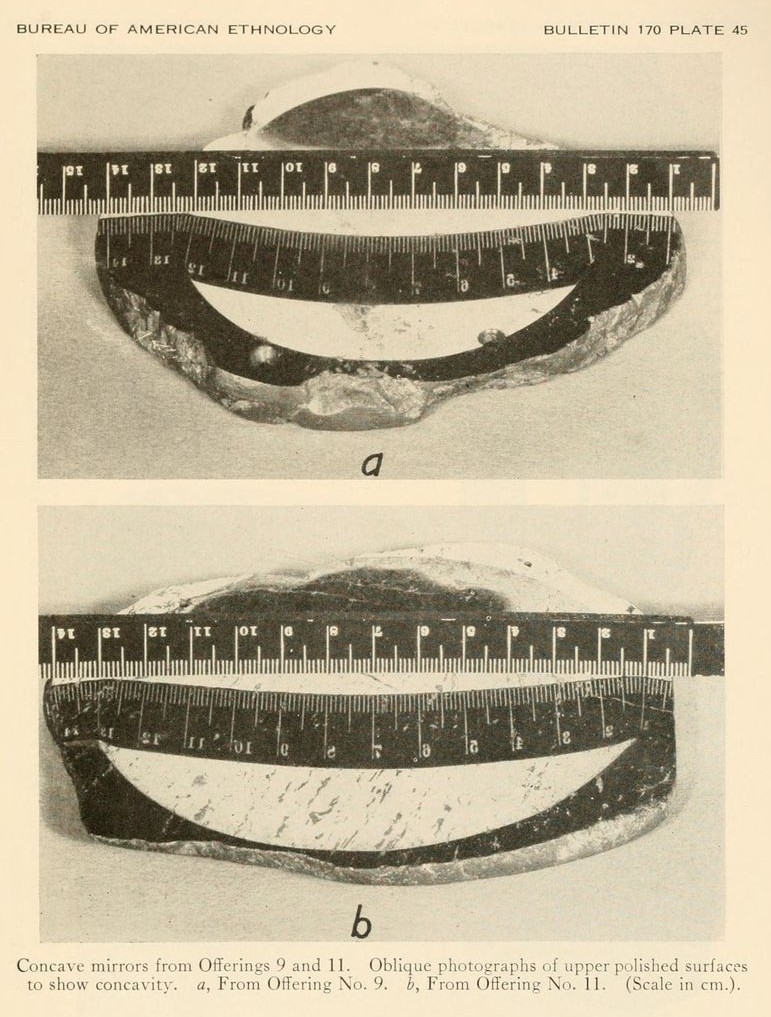
The excavators describe the two mirrors as exceptional specimens in every respect, the largest of their kind found at the site. Each was made from a piece of very hard material, ground flat on both sides; on one side a central concavity was ground out, and the concavity and the flat border around it were given an extremely high polish, so that the mirror returns a slightly magnified image. Both were perforated along one edge, presumably for suspension. Monument 23 at La Venta wears what is probably such a mirror on its chest, hung from a three-strand necklace, and the excavators suggest that the large rounded plaques worn by figures on other monuments are mirrors of this kind rather than jade.
The minerals were identified by the geologist Garniss Curtis, by optical examination and Knoop hardness tests. The mirror of Offering 9 is a coarse-grained aggregate of magnetite, hematite and ilmenite, mostly magnetite, with the hematite in streaks around the magnetite grains, which suggested to Curtis a vein origin. The mirror of Offering 11 is fine-grained, weakly magnetic ilmenite, with intergrowths of hematite making up about ten percent of it. Of the smaller mirrors found in 1942 and 1943, two are almost entirely coarse-grained magnetite, two are ilmenite like that of Offering 11, and one is made entirely of lamellar blades of hematite. Curtis measured the hardness of the ilmenite at 680 to 920 on the Knoop scale, the magnetite at 485 to 555, the hematite at 330 to 600.
None of these ores is found near La Venta, where the local rock is a soft limestone and sandstone. Curtis concluded that the mirrors almost certainly came from deposits in the metamorphic and granitic province to the south. They were carved from pieces 3 to 6 inches across whose unpolished backs have the appearance of stream-rounded boulders, and he thought it probable that the ore was gathered from streams after it had been eroded from its source.
How the grinding and polishing were done is not known. The physicist Jonas Gullberg, who studied the La Venta mirrors for the report, found under the microscope no clear trace of abrasion marks: the polishing had brought out the microscopic structure of the mineral, something that in modern practice is revealed only by polishing combined with etching, and he thought that only an extremely slow and laborious technique could produce it. He judged that the polish probably represents the limit of perfection that the material will allow.
The optics of a concave mirror
At first sight the mirrors appeared spherical. Measuring them, Gullberg found that the radius of curvature grows progressively greater from the center toward the edge, an effect almost identical to the modern practice of parabolizing a reflector, which improves its focusing of light; and the shaping runs along both the long and the short axis of each mirror. Whether this subtle and almost unbelievable molding of the surface was deliberate, or followed from the stroke and pressure of hand grinding, he could not decide. Where the focal lengths of the two axes differ, a mirror behaves in part like a cylindrical one and brings sunlight to a focus not at a point but along a short line, which he photographed on a matte black surface. The number of mirrors and the similarity of their curves, he wrote, exclude chance; in a culture without metals, the choice of these minerals points to a deliberate selection of their semimetallic luster.
Gullberg considered what the mirrors could do. In tropical sunlight they are probably capable of igniting tinder. They can throw a picture of the landscape onto a shaded surface held near the focus, like a camera obscura. Held close to the face, any concave mirror magnifies: the mirror of Offering 11, with very different focal lengths on its two axes, gives a mildly distorted image, and a small mirror from Offering 1943-E has so short a focal length that it returns little more than a magnified image of the observer’s eye. He thought it best to regard these effects as incidental to the curvatures and the reflecting power of the stone, not as proof of any one use. No mirror he had seen in the museums of Europe even remotely resembled them.
Later observers have described the images. The physicist José Lunazzi, who photographed Olmec mirrors at the Museo Nacional de Antropología in Mexico City, gives their focal lengths as from 5 cm to more than 80 cm and writes that with some concave mirrors a hand or even a face can be seen floating in the air, inverted, 8 to 16 cm in front of the mirror. He cites the reflectivity of polished magnetite as 21 percent and of hematite as 28 percent, against 55 percent for pyrite (p. 4). John Carlson published a study of the Olmec iron-ore mirrors in 1981, with an illustrated catalogue of mirrors; as Lunazzi reports, Carlson held that their near-spherical form could arise naturally from the grinding.
Mirrors and rule
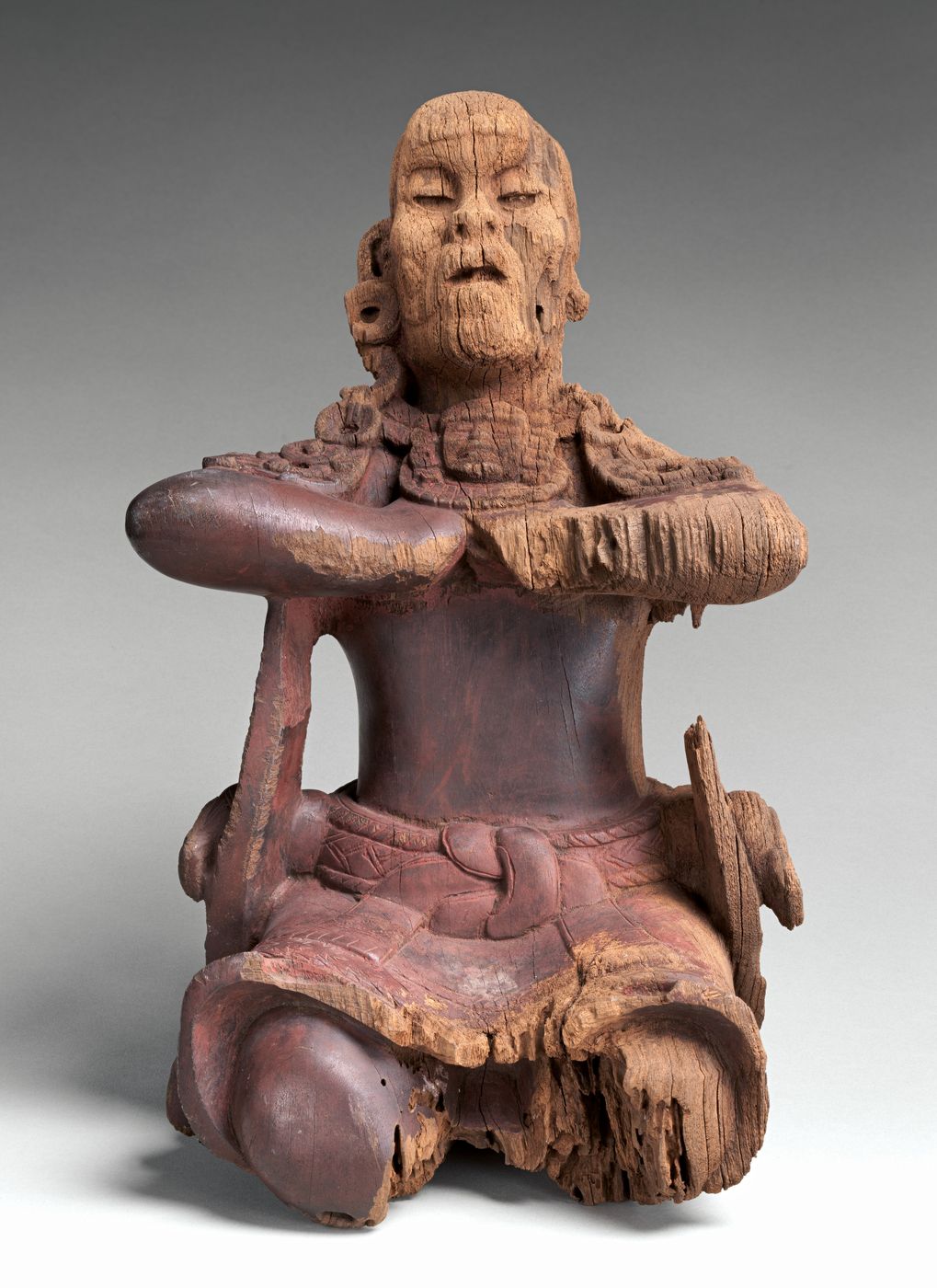
In Mesoamerica the mirror was an instrument of divination and an emblem of office. Taube, following Carlson, notes that the use of mirrors in divination is widely documented, and that such mirrors often served as emblems of high office. The early colonial Motul dictionary of Yucatec Maya defines u neen kab, the mirror of the land or of the people, as the priest, chief or governor, the mirror in which all see themselves. In Late Postclassic Central Mexico the preeminent being of sorcery and magic was Tezcatlipoca, whose name means “smoking mirror.” At La Venta itself, the cache known as Offering 1943-E held a magnetite mirror within a cruciform arrangement of green celts, which Taube relates to the Olmec identification of mirrors with the center of the world.
Later mirrors were made differently. Zachary Nelson and his colleagues (2009) note that mirrors of hematite and of pyrite are known from later Maya contexts, and that composite mirrors, mosaics of pyrite over a backing, are relatively common in Maya excavations. On Maya painted vessels, rulers look into mirrors as they are dressed.
A stone that points?
The same iron oxides hold one more property, and it has drawn the Olmec into the history of the compass. Lodestone is magnetite that is naturally magnetized; a sliver of it, free to turn, settles along the earth’s magnetic field. The oldest Chinese description of a pointing device, in Wang Chong’s Lunheng of about 70–80 CE, speaks of a “south-pointing spoon” that “comes to rest pointing at the south” when thrown on the ground, and Han-dynasty diviners are thought to have shaped such spoons from lodestone. In Europe the compass first appears in the writings of Alexander Neckam, about 1190.
In excavations at San Lorenzo, Paula Krotser and Michael Coe found a small polished bar of hematite, catalogued as M-160, in a level radiocarbon-dated to about 1400–1000 BCE. The astronomer John B. Carlson tested it and published his results in Science in 1975 under the title “Lodestone compass: Chinese or Olmec primacy?” He found the bar magnetic and, floated so that it could turn freely, consistent in the direction it came to rest. Carlson proposed that the Olmec knew of magnetism a thousand years before the Chinese, and may have used it for orientation or divination. Other scholars read the bar as part of an ornament, its magnetism incidental, and the question remains open.
It belongs here because it comes from the same people and the same minerals as the mirrors: polished iron ores, worked for what they could do with light and, perhaps, with the earth’s field. Magnetite, the lodestone mineral, is a local mineral at Franklin and Sterling Hill (Franklin Mine and Sterling Mine on mindat.org). Palache’s survey of the two mines does not mention lodestone.
Two mineral reds
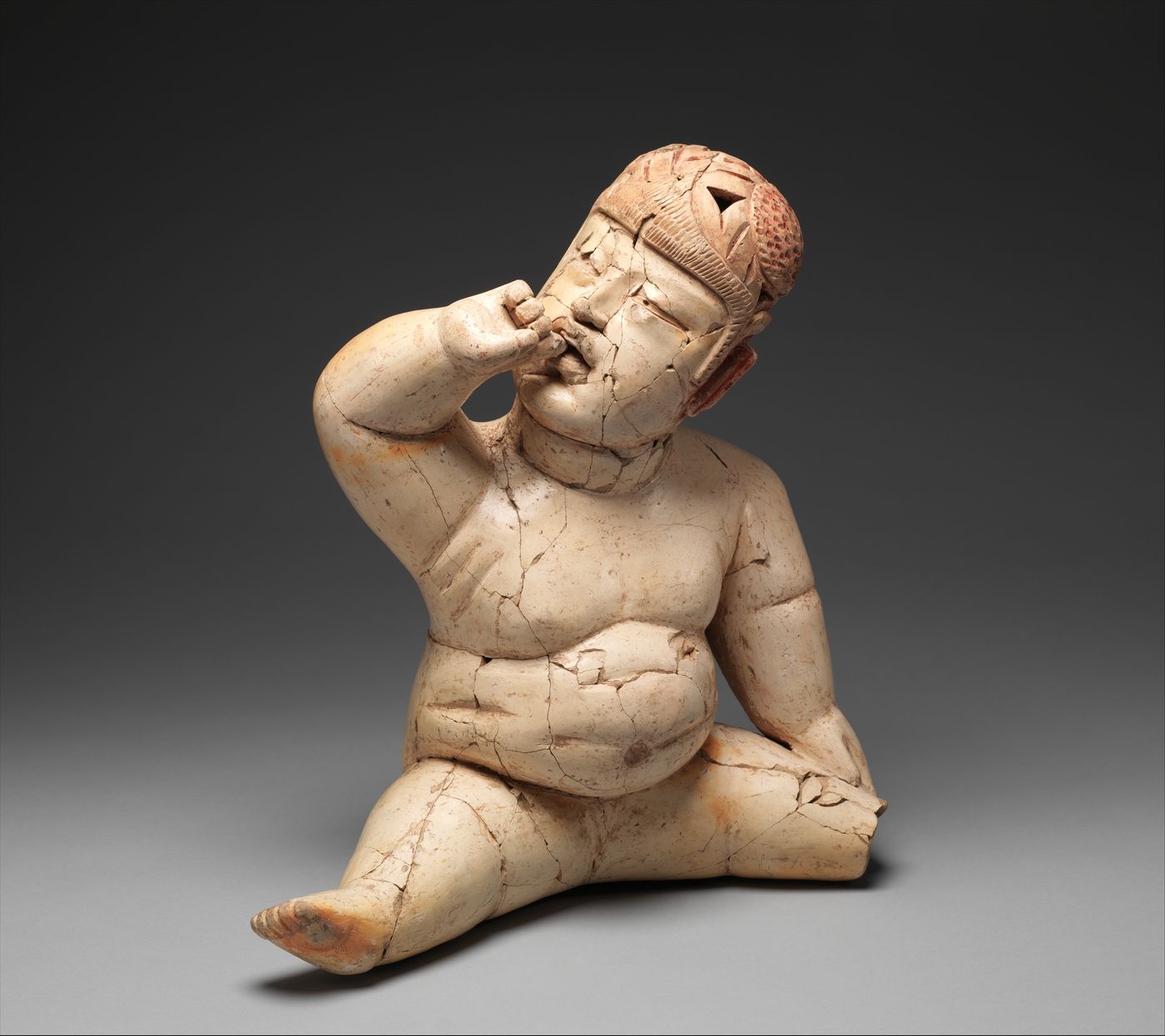
Mesoamerica had two mineral reds: cinnabar, the sulfide of mercury, and hematite, the oxide of iron, as red ochre or red earth. They were often used together. María Teresa Doménech-Carbó and her colleagues (2020) analyzed two red pigments left in a painted offering dish beside the dead in Tomb 19 at Río Azul, in the Petén of Guatemala, a tomb cut into the rock whose walls are painted with glyphs and figures in reddish hues. Both pigments were mixtures of variable amounts of cinnabar and iron oxides, mainly hematite, which give them their red-orange hue; the authors trace the minerals to outcrops within the region of Río Azul, such as Uaxactún. As they write, pigments were placed in Maya tombs as offerings and were also used to wrap the bodies of the dead, as if in a shroud.
The Red Queen of Palenque
The most remarkable use of cinnabar known from the Maya is a tomb at Palenque, in Chiapas. In May 1994 the Palenque archaeological project of the Instituto Nacional de Antropología e Historia began consolidating Temple XIII, which stands beside the Temple of the Inscriptions, and found a sealed chamber inside it. Through a small opening cut in its wall the archaeologists saw, as Arnoldo González Cruz describes it, a vaulted chamber, 3.80 by 2.50 meters, almost filled by a limestone sarcophagus. The sarcophagus, carved in one piece, was painted red with cinnabar; on its lid lay a censer, and at its two ends lay a boy of about eleven and a woman of 30 to 35, apparently sacrificed to accompany the principal burial.
Lifting the lid, a slab 2.40 meters long, took fourteen hours. Inside lay a woman of 40 to 45, 1.54 meters tall, with a diadem of jade beads, some 1,140 pieces that had once formed a mask, plaques of malachite, pearls, shells, bone needles and obsidian blades. The walls of the sarcophagus, the body and everything with it were heavily covered in a red dust identified as cinnabar. The tomb has no inscription, and its occupant has been known since then as the Red Queen. The ceramics place it, tentatively, between 600 and 700 CE. González Cruz notes that the inside of Pakal’s sarcophagus, in the neighboring Temple of the Inscriptions, was also painted red with cinnabar, and that in the Red Queen’s tomb the cinnabar had penetrated the surface layers of the bone, making it harder to extract DNA.
The other great pigment of the Maya, a blue made from indigo and a clay mineral, has a page of its own: Maya blue.
The date on the timeline
On the timeline of color systems this page is placed at 1150 BCE, the beginning of the San Lorenzo phase (1150–900 BCE), which Taube calls the great period of occupation at San Lorenzo, when Olmec ballplayers were shown with mirror pectorals and iron ore was worked there by the ton. The mirrors of La Venta are later, from the Middle Formative apogee of that site, about 900 to 500 BCE; the tombs of Río Azul and Palenque are later still, and the Red Queen is dated to the seventh century CE.
Local minerals: Franklin and Sterling Hill
The three minerals of the Olmec mirrors are all local minerals at the two New Jersey zinc mines this site describes. The record used here is Charles Palache’s The Minerals of Franklin and Sterling Hill (U.S. Geological Survey Professional Paper 180, 1935), with the list of mineral species found at Franklin and Sterling Hill revised by the Mineral List Committee in August 2017, which counts 367 species and marks each F for Franklin or O for Ogdensburg, the town of the Sterling Hill mine.
Magnetite (local mineral; Franklin Mine and Sterling Mine on mindat.org), the mineral of the Offering 9 mirror. Palache writes that magnetite is very similar in appearance to franklinite, from which, without a chemical analysis, it can be told only by its black streak and stronger magnetism (p. 44). It is the principal ore mineral of the iron-ore bed that underlies the zinc deposit at Franklin on its west side; at Sterling Hill it occurs chiefly in the pegmatite, and also in bunches of ore between the two legs of the zinc ore body (p. 45). The 2017 list gives magnetite F, O.
Franklinite, the ore mineral of the district, (Zn,Mn,Fe)(Fe,Mn)2O4, is closely related to magnetite. Palache describes both under the heading “Spinel group” (p. 42), and notes phases intermediate between magnetite and franklinite, poor in zinc and high in iron and manganese (p. 45).
Ilmenite (local mineral; Franklin Mine and Sterling Mine on mindat.org), the iron-titanium oxide of the Offering 11 mirror. Palache’s record is slight: ilmenite had been listed as found at Franklin, but he saw no specimen confirming it; a specimen from the stripping of the calamine deposit at Sterling Hill showed jet-black crystals of ilmenite as much as an inch across, with black octahedrons of spinel, in limestone, and grains and crystals were reported from a limestone quarry at Rudeville, near Franklin (p. 42). The 2017 list gives ilmenite F.
Hematite (local mineral; Franklin Mine and Sterling Mine on mindat.org), present in the La Venta mirrors and one of the two reds of Maya burials. Palache describes coarse granular masses of hematite and small complex crystals at Franklin (pp. 41–42), and writes that, as the coloring matter of jasper and as an alteration product of franklinite, hematite is widespread at both Franklin and Sterling Hill but not a conspicuous mineral at either (p. 42). The 2017 list gives hematite F, O. Cinnabar, the other red, is not a Franklin or Sterling Hill mineral.
The Olmec mirror makers took their ore from streams south of La Venta, and nothing connects them with New Jersey. What is shared is the minerals themselves: the magnetite, ilmenite and hematite that the Olmec ground into mirrors occur, with franklinite, in the ores of Franklin and Sterling Hill.
Sources and further reading
- Carlson, J. B., 1981, Olmec concave iron-ore mirrors: the aesthetics of a lithic technology and the Lord of the Mirror (with an illustrated catalogue of mirrors). In E. P. Benson (ed.), The Olmec and Their Neighbors: Essays in Memory of Matthew W. Stirling, pp. 117–147. Washington, D.C.: Dumbarton Oaks. Cited here through Taube 2004 and Lunazzi 1996.
- Doménech-Carbó, M. T., Vázquez de Ágredos-Pascual, M. L., Osete-Cortina, L., Doménech-Carbó, A., Guasch-Ferré, N., Vidal-Lorenzo, C., 2020, Funerary colors in Pre-classical Maya culture: the red pigment in the 19th tomb of Rio Azul (Peten, Guatemala). Heritage Science 8, 47. Open access (CC BY 4.0). Publisher
- Drucker, P., Heizer, R. F., Squier, R. J., 1959, Excavations at La Venta, Tabasco, 1955. Smithsonian Institution, Bureau of American Ethnology Bulletin 170. Offerings 9 and 11, pp. 177–181; Appendix 3, J. E. Gullberg, Technical notes on concave mirrors, pp. 280–283; Appendix 4, G. H. Curtis, The petrology of artifacts and architectural stone at La Venta, pp. 284–288; plates 43–46, 62–63. Public domain. Internet Archive
- González Cruz, A., The Red Queen. Mesoweb Palenque Features. Instituto Nacional de Antropología e Historia, Proyecto Arqueológico Palenque. PDF (Mesoweb)
- Lunazzi, J. J., 1996, On the quality of the Olmec mirrors and its utilization. Proceedings of SPIE 2730, 2–7 (preprint, arXiv physics/0701327). PDF (arXiv)
- Mineral species found at Franklin-Sterling Hill, NJ, revised by the Mineral List Committee, August 2017. In: Franklin-Ogdensburg Mineralogical Society, 2017 Mineral Show booklet, pp. 3–5. PDF
- Mirror-bearer, Maya, 410–650 CE. Metropolitan Museum of Art, 1979.206.1063. Public domain. The Met
- Nelson, Z., Scheetz, B., Mata Amado, G., Prado, A., 2009, Composite mirrors of the ancient Maya: ostentatious production and Precolumbian fraud. The PARI Journal 9(4), 1–7. PDF (Mesoweb)
- Palache, C., 1935, The minerals of Franklin and Sterling Hill, Sussex County, New Jersey. U.S. Geological Survey Professional Paper 180. Hematite, pp. 41–42; ilmenite and the spinel group, p. 42; magnetite, pp. 44–45. PDF
- Seated hollow figure with helmet, Olmec, 1200–800 BCE. Metropolitan Museum of Art, 1979.206.1134. Public domain. The Met
- Taube, K. A., 2004, Olmec Art at Dumbarton Oaks. Washington, D.C.: Dumbarton Oaks Research Library and Collection. San Lorenzo and La Venta, pp. 7–18; mirrors, pp. 141–145. Internet Archive
Written with Claude, an AI model made by Anthropic, from the sources listed above, and checked against them. October 2026.