A blue made in ancient Mesoamerica by binding the plant dye indigo to the clay mineral palygorskite, stable enough to survive centuries of tropical weather.
A clay and a dye
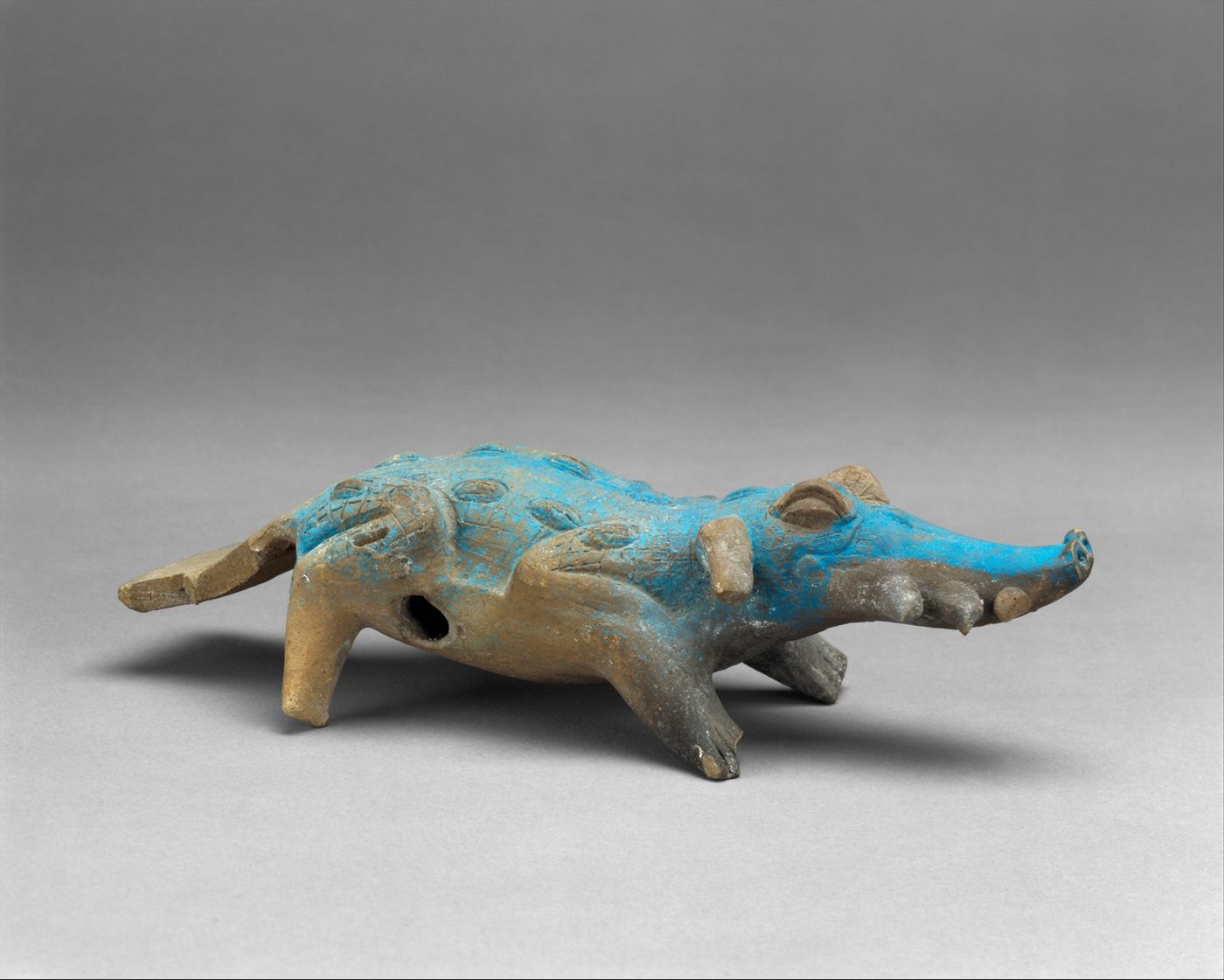
Maya blue is a bright, slightly greenish blue used in Mesoamerica on wall paintings, sculpture, pottery and figurines. It is neither a ground mineral nor a dye alone but a hybrid of the two: a small amount of indigo, the blue colorant of the leaves of Indigofera plants, bound to palygorskite, a fibrous magnesium-aluminum clay mineral.
According to the review by Dean Arnold and colleagues (Ancient Mesoamerica, 2025), it was first used on architecture at Calakmul, in Campeche, Mexico, at the end of the Preclassic period, and became widespread in the Late Classic on figurines, murals and fine ceramics. Its use continued into the early colonial period and, in places, into the nineteenth century. The earliest date is not settled: Arnold places the first use at about 50 BCE, while the study that identified Maya blue on a façade at Calakmul assigns it more broadly to the Late Preclassic, about 300 BCE to 300 CE. This page is placed in the timeline at Arnold’s date, about 50 BCE.
How it was identified
For a long time the pigment was a puzzle: it looked like a mineral blue but owed its color to no copper or other coloring metal. As the Arnold review summarizes the history, in 1962 Rutherford J. Gettens reported in American Antiquity that X-ray diffraction showed the clay in it to be attapulgite, the mineral now called palygorskite. In the same year Anna O. Shepard proposed that the pigment was a clay-organic complex with indigo. In 1966 H. van Olphen showed that a blue with the same properties could be made from palygorskite, a small amount of indigo (about two percent) and low heat, generally no more than 150 °C, and in 1967 Kleber and colleagues identified the organic colorant as indigo.
How it was made

In 2008 Arnold, Jason Branden, Patrick Ryan Williams, Gary Feinman and J. P. Brown published in Antiquity their analysis of a bowl from the Sacred Cenote at Chichén Itzá that still held melted copal incense. On the base of the offering they found indigo, Maya blue and palygorskite. They concluded that the pigment was made by burning copal together with palygorskite and indigo, the incense supplying the low, sustained heat the reaction needs, as part of a ritual. Not all specialists accept that conclusion: the presence of copal and Maya blue together does not by itself show that one was used to produce the other, or that making the pigment was a ritual act.
The palygorskite came from the northern Yucatán. Arnold’s group has traced it to a mine in the cenote at Sacalum, whose name comes from the Yucatec Maya sak lu’um, “white earth,” and to the mines near Ticul where potters dug their temper.
Why it lasts
Indigo by itself fades in sunlight and is attacked by acids. Bound to palygorskite it becomes, in the words of the Arnold review, “resistant to dilute acids, alkalis, solvents, oxidants, reducing agents, moderate heat, and bio-corrosion.” Experiments by Manuel Sánchez del Río and colleagues (Archaeometry, 2006) found that pigments made with palygorskite resisted acid far better than those made with the related clay sepiolite, and that Maya blue can be destroyed by very intense acid treatment under reflux.
Palygorskite is built of fibers threaded by fine channels that normally hold water, and gentle heating drives part of that water out. How the indigo is then held is still debated. In the leading models the indigo molecules sit inside the channels or across their openings and are fixed by hydrogen bonds to the clay or to the water bound in it; other models have been proposed. On any of them, the mineral shelters the dye.
Sources and further reading
- Arnold, D. E., Ball, J. W., Dussubieux, L., and Taschek, J., 2025, Palygorskite from Sacalum, Yucatán in Maya Blue from the eastern Maya Lowlands: new evidence from Buenavista del Cayo, Belize and LA-ICP-MS analysis. Ancient Mesoamerica 36 (1), 81–105. Cambridge (open access)
- Arnold, D. E., Branden, J. R., Williams, P. R., Feinman, G. M., and Brown, J. P., 2008, The first direct evidence for the production of Maya Blue: rediscovery of a technology. Antiquity 82 (315), 151–164. Antiquity
- Crocodile whistle and rattle, Maya, 700–800 CE. Metropolitan Museum of Art, 1979.206.1143, CC0. The Met
- Sánchez del Río, M., Martinetto, P., Reyes-Valerio, C., Dooryhée, E., and Suárez, M., 2006, Synthesis and acid resistance of Maya blue pigment. Archaeometry 48 (1). Preprint (arXiv)
- Vázquez de Agredos Pascual, M. L., Doménech Carbó, M. T., and Doménech Carbó, A., 2011, Characterization of Maya Blue pigment in pre-classic and classic monumental architecture of the ancient pre-Columbian city of Calakmul. Journal of Cultural Heritage 12, 140–148. Journal
Written with Claude, an AI model made by Anthropic, from the sources listed above, and checked against them. October 2026.