Heraldry uses a fixed set of colors with their own names, a rule for combining them, and, from the seventeenth century, a code of lines and dots for showing them in black and white.
Metals, colours and furs
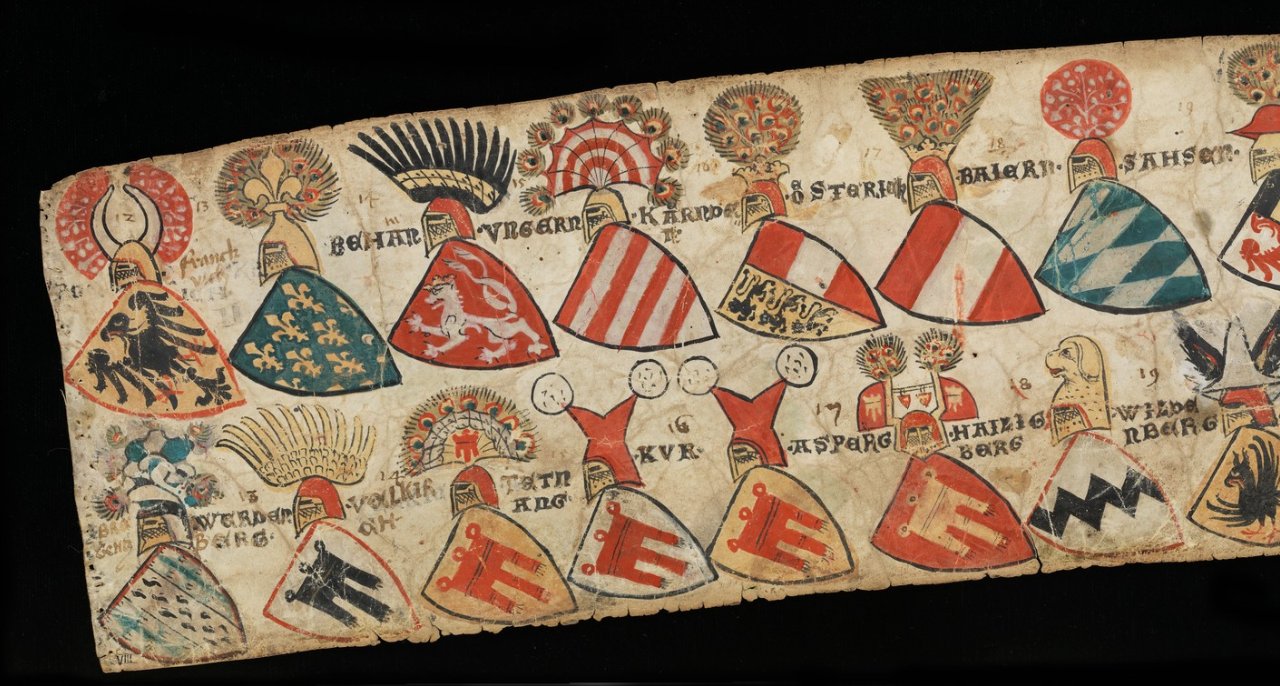
A coat of arms is described in words before it is painted, and the words for its colors form a small, closed vocabulary. The colors of heraldry, called tinctures, fall into three classes. The two metals are or (gold, often painted yellow) and argent (silver, often painted white). The colours proper are gules (red), azure (blue), vert (green), sable (black) and purpure (purple). The furs, chiefly ermine and vair, are patterns standing for pelts.
The names denote a class, not a shade. Any red is gules and any blue is azure; the painter chooses the pigment. What matters is that the reader of the description and the viewer of the shield agree on which of the few tinctures is meant.
Two of the names lead back to natural materials. Azure comes through Old French from the Arabic and Persian name of lapis lazuli, itself taken from a place in Badakhshan where the stone was found. Sable is the fur of the sable, a marten. Painted azure was itself often a mineral: azurite, or ultramarine ground from lapis lazuli (see mineral pigments).
The rule of tincture
The basic rule of heraldic design is that metal is not placed on metal, nor colour on colour: a gold charge goes on a red or blue field, a red charge on gold or silver. The rule keeps a shield legible at a distance. Exceptions are rare and noted as such; the best known are the arms of the crusader Kingdom of Jerusalem, gold crosses on silver.
Bartolo’s ranking of colors
The jurist Bartolo da Sassoferrato (Bartolus), who taught law at Perugia, wrote a legal treatise on arms, the Tractatus de insigniis et armis, late in his life, in the 1350s. In it he mentions that the emperor Charles IV had granted him and his kin a red lion with two tails on a gold field. The treatise was published only after his death; its editor of 1883 worked from printed editions beginning with one of 1493.
Bartolo ranks the colors by what they represent. Gold is the noblest, because it stands for light, and nothing is nobler than light; red or purple comes next, standing for fire; azure is third, standing for air; white is nobler than black, and black is the lowest. Where colors share a shield or a banner, the nobler color should take the nobler place: the upper part, or the part next to the staff.
Colors in black and white
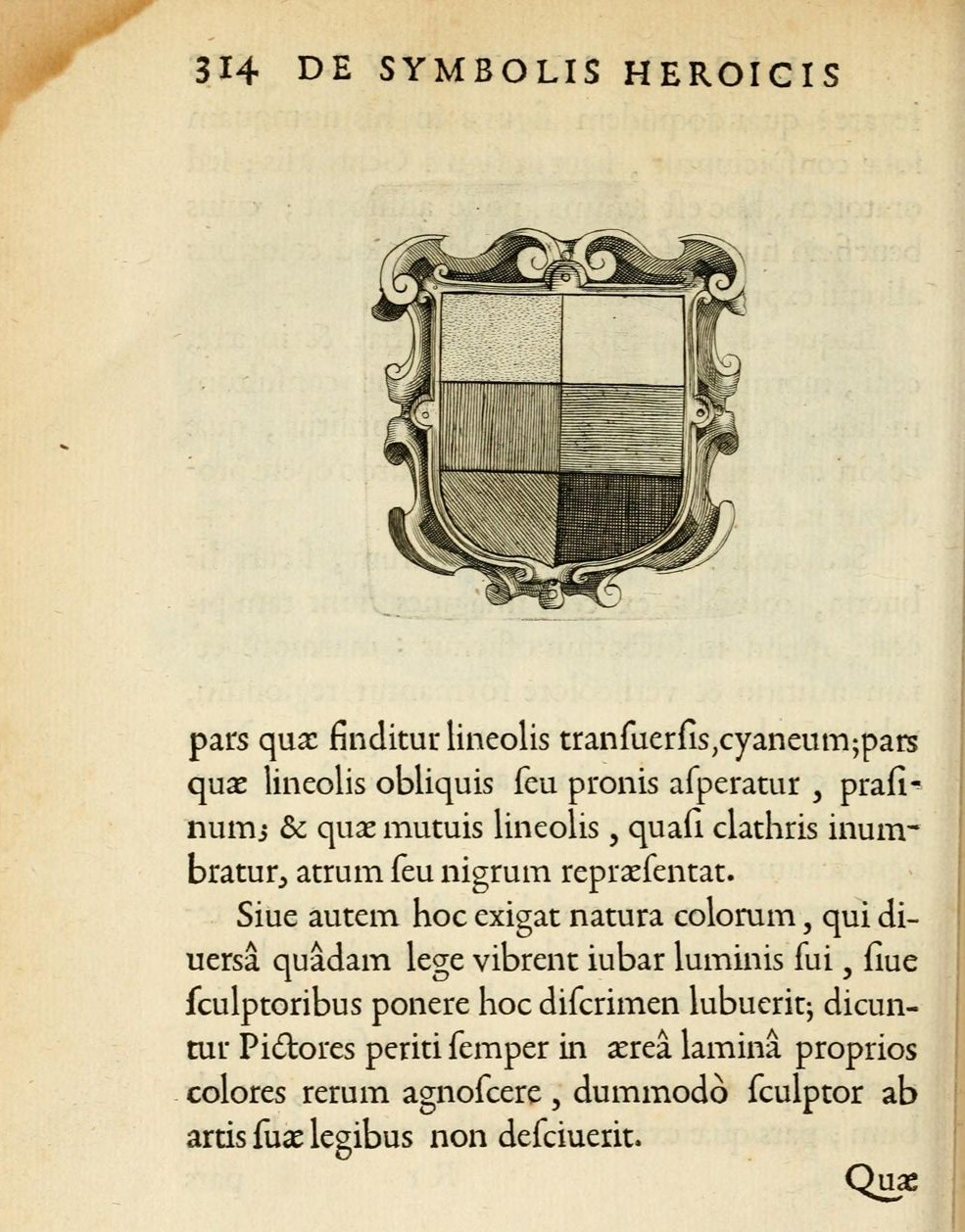
An engraving printed in one ink cannot show color, and in the early seventeenth century several engravers and heralds devised codes of lines and dots to stand for the tinctures. The code that became standard is generally credited to the Roman Jesuit Silvester Petra Sancta, who used it throughout his Tesserae gentilitiae (Rome, 1638). Similar systems were printed by others in the same decades, and historians differ over who devised it first.
Petra Sancta had already printed a table of the code in his De symbolis heroicis (Antwerp, 1634). There he explains it: the part engraved with dots shows gold; the part left untouched by the graver, silver or white; upright lines, red; horizontal lines, blue; oblique lines, green; and lines crossed like a lattice, black. On the next page he adds that skilled painters are said to recognize the proper colors of things in a copper engraving, provided the engraver has kept to the rules of his art.
The code made heraldic color something that could be read, not only seen. It is still used in heraldic engraving and in printed books of arms.
Sources and further reading
- Bartolo da Sassoferrato, Tractatus de insigniis et armis. Latin text with German translation. Bonn: P. Hauptmann, 1883. Full scan (Internet Archive)
- Hatching (heraldry). Wikipedia
- Petra Sancta, S., 1634, De symbolis heroicis libri IX. Antwerp: Officina Plantiniana Balthasaris Moreti. Full scan (Internet Archive)
- Petra Sancta, S., 1638, Tesserae gentilitiae. Rome: heirs of Francesco Corbelletti. Full scan (Internet Archive)
- Zürcher Wappenrolle (Zürich armorial), c. 1340. Schweizerisches Nationalmuseum, AG 2760. e-codices
Written with Claude, an AI model made by Anthropic, from the sources listed above, and checked against them. October 2026.