Red and yellow iron oxides, black charcoal and manganese oxides: the minerals behind the oldest painted images, from the hand stencils of Sulawesi, Spain and Patagonia to the ochre workshop at Blombos Cave.
Earth colors
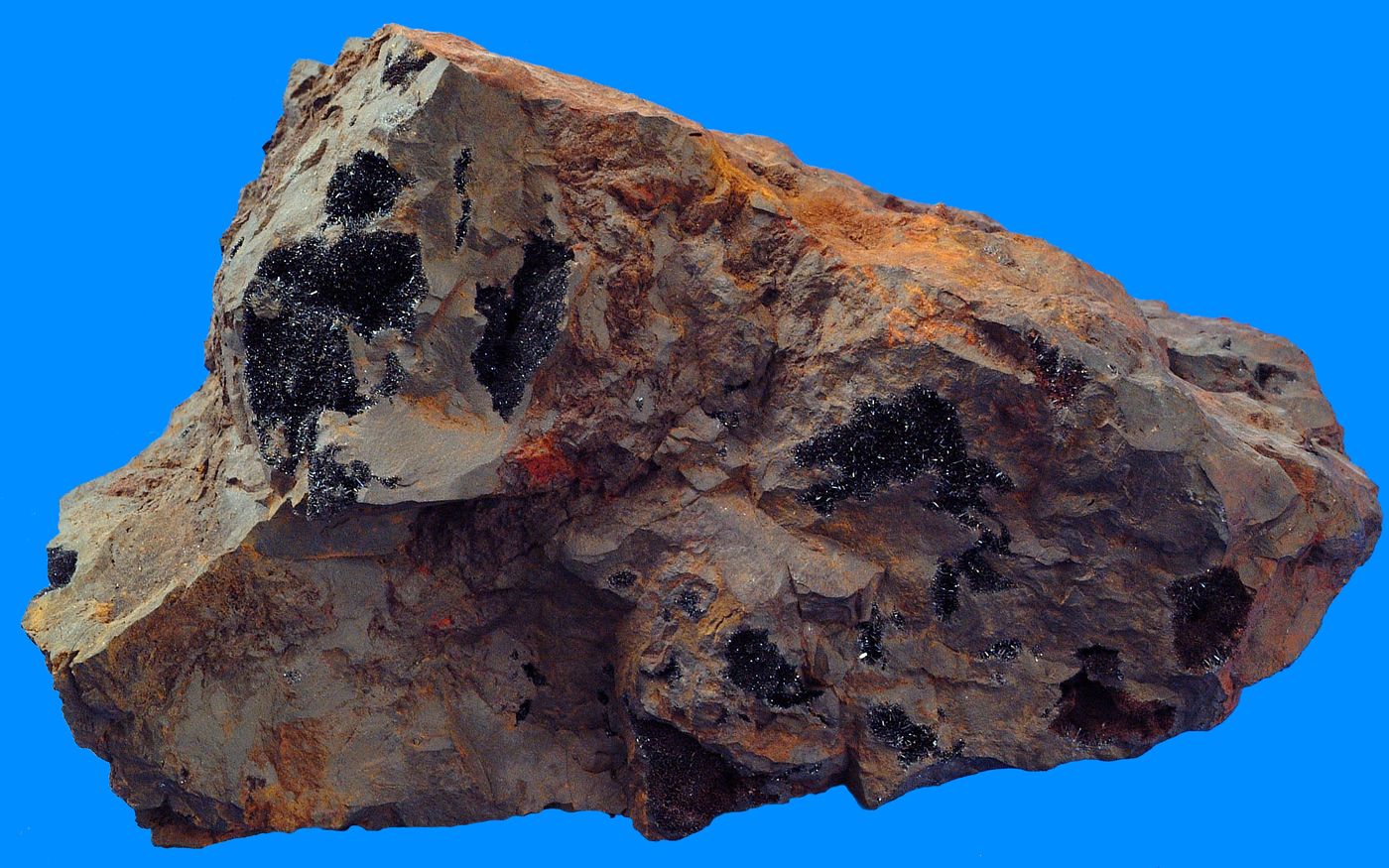
The oldest colors people used were ground minerals. Archaeologists call the commonest of them ochre, which Christopher Henshilwood and his colleagues (2011) define as an earth or rock containing red or yellow oxides or hydroxides of iron. The red is hematite, the iron oxide Fe2O3; the yellow is goethite, the iron oxide-hydroxide FeO(OH), often in the poorly crystallized material called limonite. Black came from charcoal and from oxides of manganese. These few minerals account for nearly all of the color in the paintings of the Ice Age caves.
The use of the pigments is far older than any painting that survives. At Blombos Cave, on the southern Cape coast of South Africa, 300 km east of Cape Town, excavations in 2008 uncovered two toolkits for making an ochre-rich paint, found together with the two abalone shells (Haliotis midae) in which it had been mixed and stored. Optically stimulated luminescence dating of the sand in which the shells lay gave 101,000 ± 4,000 years.
The workshop shows the whole process. Henshilwood and his colleagues infer that pieces of ochre were rubbed on quartzite slabs to a fine red powder, or knapped and crushed with hammerstones; that goethite-rich or hematite-rich stone was ground with quartzite grinders; and that the hematite powder was then stirred in the shells with charcoal, crushed and probably heated bone, rich in marrow fat, stone chips, quartz grains and a liquid. The ochre itself contained quartz, hematite, muscovite or illite, and goethite. One grinder was used first on yellow goethite and later, after it had been reshaped, on red ochre. What the mixture was used for is not known; the authors suggest decoration of a surface or of the skin, or protection.
Hand stencils
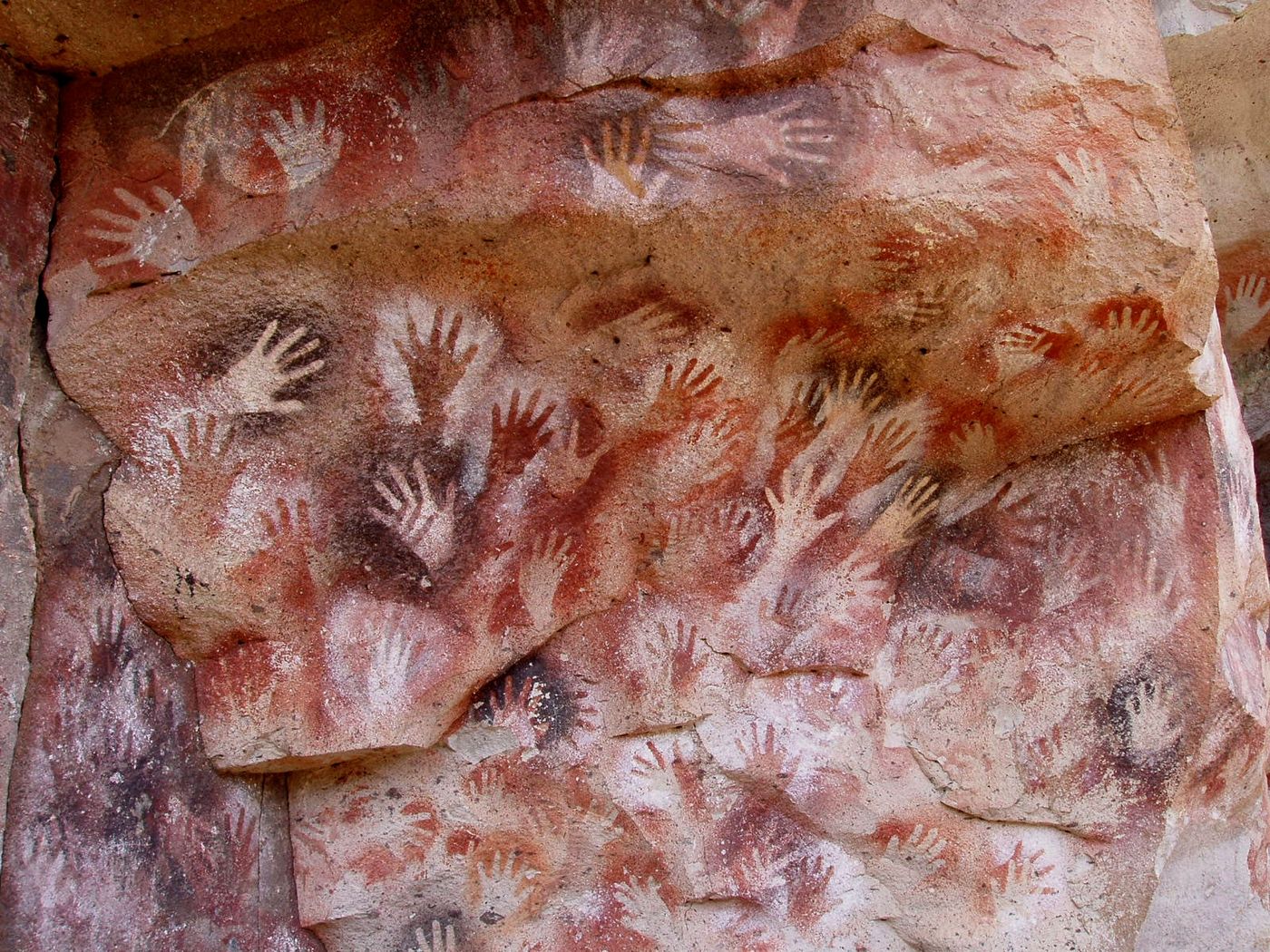
A hand stencil is made by holding a hand flat against the rock and spraying pigment around it. When the hand is taken away, its outline remains as a bare shape in a cloud of color. Dirk Hoffmann and his colleagues (2018) point out that stencils, unlike positive hand prints, cannot be made by accident: they require a light source and the selection and preparation of the coloring material beforehand. Stencils are among the earliest dated images in caves on several continents.
Sulawesi. In the limestone caves of the Maros-Pangkep karst in southwestern Sulawesi, Indonesia, Maxime Aubert and his colleagues (2014) dated a hand stencil at Leang Timpuseng to at least 39,900 years ago. In 2026 Adhi Agus Oktaviana and his colleagues reported a hand stencil from Liang Metanduno, on Muna Island off southeastern Sulawesi, with a minimum age of 67,800 years. Only a 14 by 10 cm patch of faded pigment survives, with part of the fingers and palm; one fingertip appears to have been narrowed on purpose, by adding pigment or by moving the hand, a kind of stencil so far known only from Sulawesi.
Spain. Hoffmann and his colleagues (2018) dated thin crusts of calcium carbonate that had formed over paintings in three Spanish caves by the uranium-thorium method. A crust over a red hand stencil at Maltravieso, Extremadura, one of about sixty red stencils in the cave, gave a minimum age of 66,700 years; a red linear sign at La Pasiega, Cantabria, and red paint on a stalactite curtain at Ardales, Andalucía, gave minimum ages of 64,800 years and more. Because these dates are some 20,000 years earlier than the arrival of modern humans in Europe, the authors concluded that the painters were Neanderthals. The conclusion is disputed. Randall White and 43 co-authors (2020) argued that uranium-thorium dates on such crusts can be too old if uranium has been lost from the carbonate, and that the case for Neanderthal authorship was not made; Hoffmann and colleagues replied in the same volume, defending their results. The question remains open.
France. In the cave of Gargas, in the Hautes-Pyrénées, there are many negative hands, some in black. Émilie Chalmin and her colleagues (2006) report that some of the black hands were made with charcoal (in the Hand Sanctuary) and others with manganese oxides (in the Entrance Gallery); the minerals are described below.
Patagonia. At the Cueva de las Manos, on the Río Pinturas in Santa Cruz Province, Argentina, the art is much younger. The ICOMOS evaluation of 1999, written when the site was proposed for the World Heritage List, gives the first occupation of the rock shelter as about 9300 BP, established by excavation and radiocarbon dating, and says that from about 7000 BP the art was dominated by hand stencils. X-ray diffraction showed the pigments to be the iron oxides hematite and maghemite for red and purple, kaolin for white, natrojarosite for yellow, and manganese oxide for black, with gypsum sometimes added; traces of the pigments were found in the excavated layers at the entrance.
Nearly all of these ages are minimum ages. The pigment itself, if it contains no charcoal, cannot be dated; what is dated is the calcite that later grew over it, so the painting is older than the date by an unknown interval.
Red and yellow: the iron minerals
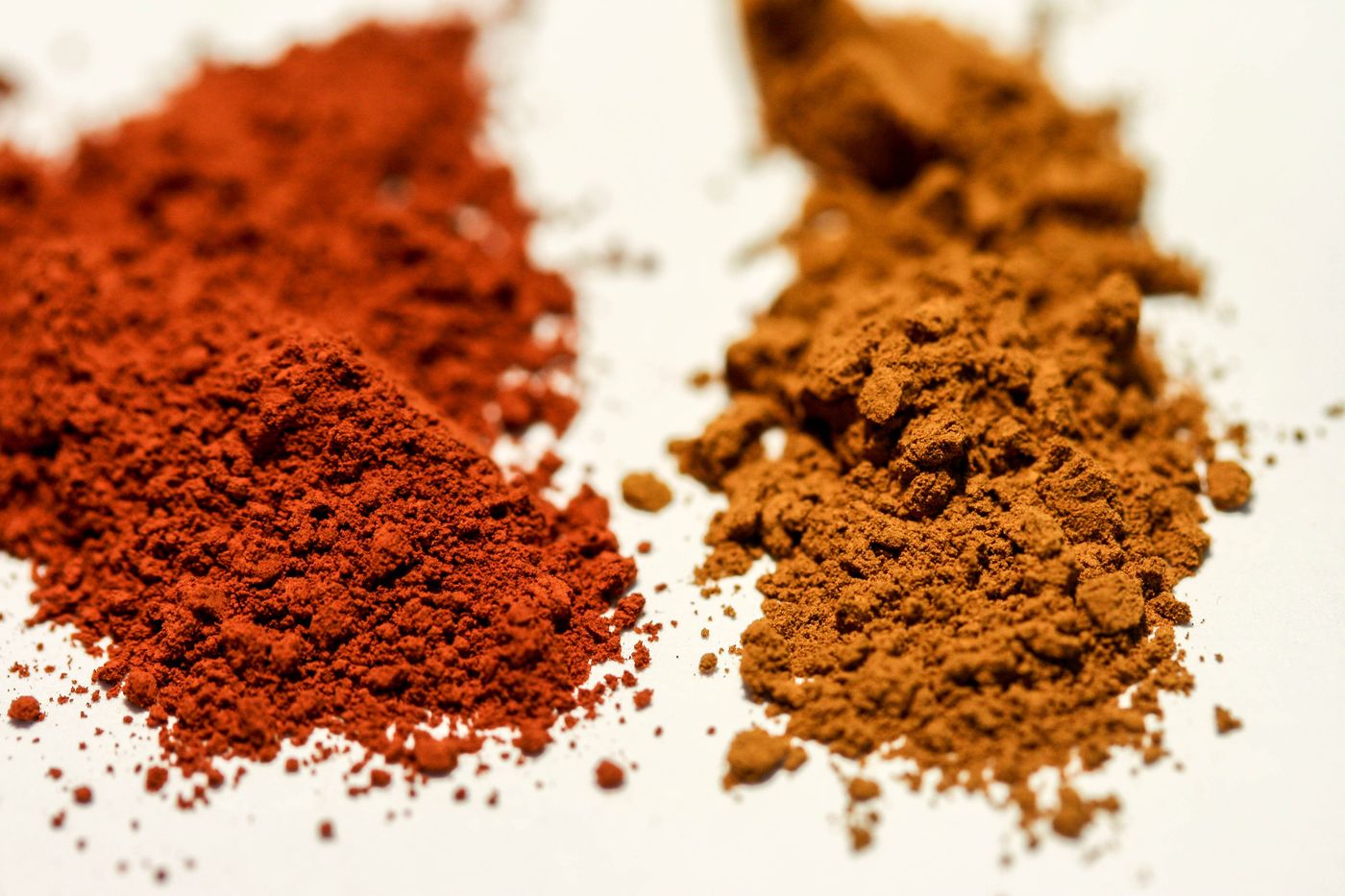
Red can be dug or made. Goethite loses water when it is heated and turns into hematite. As Hélène Salomon and her colleagues (2015) put it, the yellow iron oxide-rich mineral goethite changes into the red iron oxide-rich mineral hematite when it is heated to around 250–300 °C, and the red deepens as the temperature or the heating time increases. A painter with yellow ochre and a fire therefore had red as well.
Whether Palaeolithic painters did this can be tested. Marie-Pierre Pomiès, Michel Menu and Colette Vignaud, in “Red Palaeolithic pigments: natural hematite or heated goethite?” (1999), established criteria by which hematite made from heated goethite can be told from natural hematite: under X-ray diffraction some of its peaks are broadened and others are not, and under the electron microscope its crystals show the pores left by escaping water. Applied to archaeological material, as Salomon and her colleagues summarize, these criteria point to possible heating of goethite at the Pyrenean rock shelter of the Moulin de Troubat, but to none in about a hundred pigment samples from the walls and floors of Lascaux, where the wide range of hues was natural. Salomon’s own study found strong evidence of deliberate heating of yellow goethite-rich material at two French sites of the Solutrean and Magdalenian periods.
Black: charcoal and manganese oxides
Black was made either from charcoal or from manganese minerals, and the difference matters to archaeologists, because charcoal can be radiocarbon dated and a mineral cannot. At Chauvet-Pont d’Arc, in the Ardèche, the black drawings are charcoal, and Anita Quiles and her colleagues (2016) built their chronology of the cave in part on radiocarbon dates of nineteen of them. Their model places most of the dated black drawings in a first period of activity between 37,000 and 33,500 years ago.
The manganese blacks turned out to be more varied than had been supposed. Chalmin and her colleagues (2006) note that pyrolusite (MnO2), hollandite, bixbyite and romanechite had already been identified in prehistoric black pigments. Using transmission electron microscopy and X-ray absorption spectroscopy at the manganese K-edge, they identified several further minerals. At Gargas, the black of one hand stencil was a mixture of manganite (γ-MnOOH) with hollandite and cryptomelane, used raw without any extender; the black of a neighboring hand was mainly manganite and pyrolusite, with a little cryptomelane, so the two hands were painted from two different preparations. A horse’s head at the entrance of the cave of Ekain, in the Spanish Basque Country, was painted with groutite (α-MnOOH). A faceted black “crayon” from Combe Saunière, in the Dordogne, was nearly pure manganite, and a raw block from the same site was todorokite with a little romanechite.
At Lascaux, the same group reported in 2007, X-ray absorption spectra of black pigment from the ears and muzzle of a bull revealed a mixture of manganese oxides that included hausmannite (Mn3O4), never before found in prehistoric pigments (Chalmin et al. 2007; Phys.org report).
Two conclusions follow from this work. Chalmin and her colleagues found no sign that the black pigments had been heated: they were ground, mixed and used as found. And some of the minerals, manganite and groutite in particular, are very rare or unknown in the regions where the paintings were made, so that, as they write, either the local sources are exhausted or lost, or the raw material traveled farther than had been supposed.
The date on the timeline
On the timeline of color systems this page is placed at 40,000 BCE. The figure is a round one, chosen because it lies close to the oldest cave paintings that had been dated before 2018, the stencil at Leang Timpuseng (at least 39,900 years) and a red disc on the Panel of Hands at El Castillo, Cantabria (at least 40,800 years), both cited by Hoffmann and his colleagues. It is not the date of any one painting. The minimum ages from Spain and from Muna are older, and the preparation of ochre at Blombos is older still, by some 60,000 years.
Local minerals: Franklin and Sterling Hill
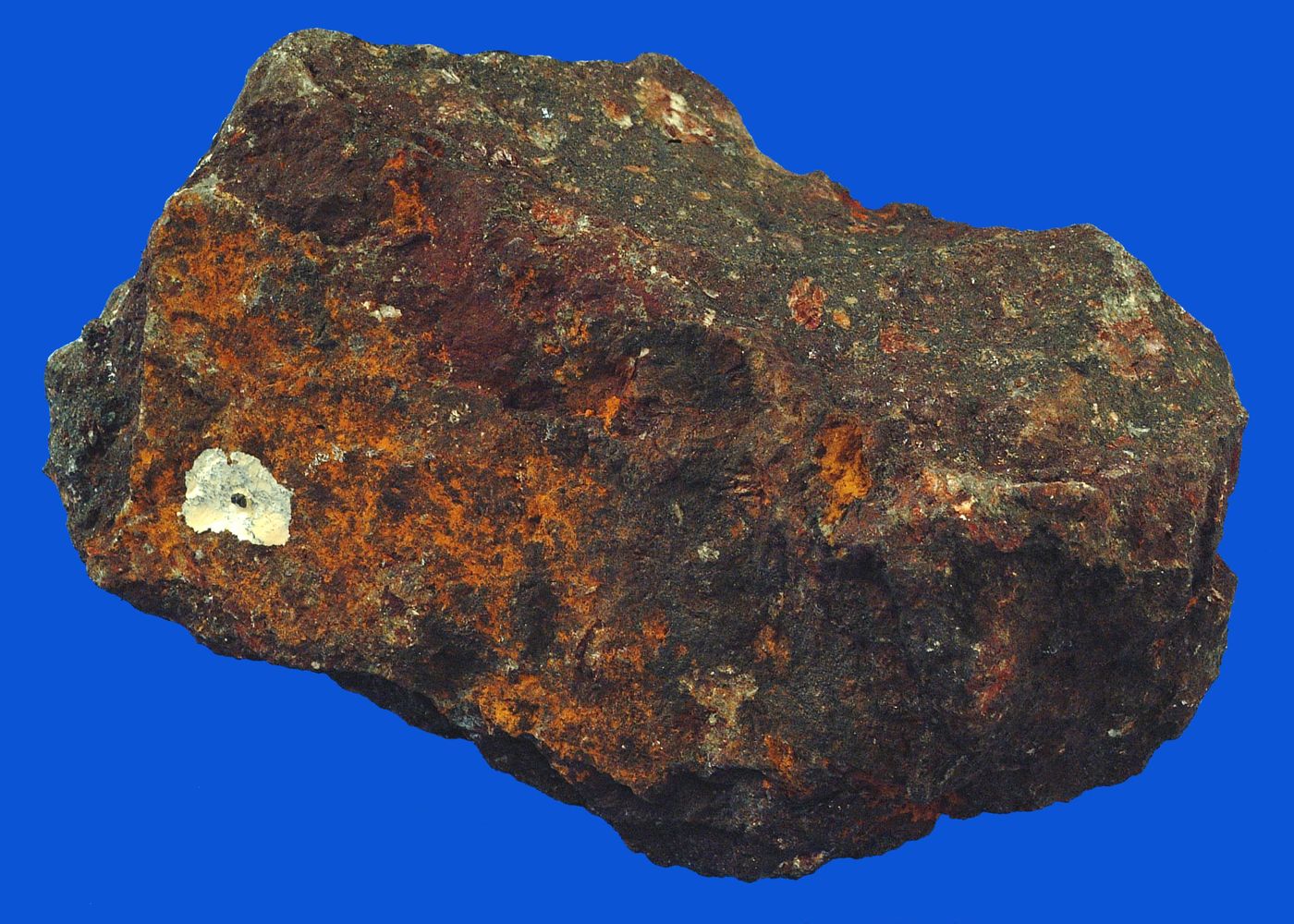
The minerals of the cave painters are, in small measure, minerals of the two New Jersey zinc mines this site describes. The ore of Franklin and Sterling Hill is itself an oxide of iron, manganese and zinc: franklinite, (Zn,Mn,Fe)(Fe,Mn)2O4, is its most abundant mineral, and Charles Palache, in The Minerals of Franklin and Sterling Hill (U.S. Geological Survey Professional Paper 180, 1935, p. 18), gives the franklinite concentrate of the Franklin mine as 34 to 40 percent iron and 12 to 16 percent manganese.
Hematite (local mineral; Franklin Mine and Sterling Mine on mindat.org). Palache describes coarse granular masses of hematite with exceptionally perfect rhombohedral parting, found at times in masses of several hundred pounds, and small, complex crystals (pp. 41–42). As the coloring matter of jasper and as an alteration product of franklinite, he writes, hematite is widespread at both Franklin and Sterling Hill, but not a conspicuous mineral at either.
Goethite and limonite (local minerals; Franklin Mine and Sterling Mine on mindat.org). Goethite occurs only sparingly, as minute dark-brown needles on tiny globules of hematite in the dolomite of the Buckwheat mine; limonite, the ochreous iron hydroxide (today a field name for poorly crystallized goethite and its kin, not a species), formed abundantly only in the calamine deposits of Sterling Hill, as an alteration product of franklinite and magnetite (Palache, p. 49). The mineral and the man it was named for are the subject of a separate page, Goethe, the mines of Ilmenau, and goethite.
Manganese oxides (local minerals; Franklin Mine and Sterling Mine on mindat.org). Palache records manganite, the mineral of the Gargas hands and the Combe Saunière crayon, as clusters of slender black needles on calcite in a vein at the Franklin mine (p. 49). On the dump of the Noble mine at Sterling Hill there were compact, coal-black masses that appear to be psilomelane (an old name for hard black manganese oxides, most now identified as romanèchite or other species), and between the calamine bed and the limestone there was a layer of soft black or brown manganese-rich clay, probably wad (p. 53), the miners’ name for soft, unidentified manganese oxides. Chalcophanite, a hydrous oxide of manganese and zinc, was first described from Sterling Hill, where it formed from altered franklinite (p. 52). Hetaerolite, ZnMn2O4, shining black with a dark-brown streak, was long known as zinc hausmannite (p. 48): it is the zinc counterpart of the hausmannite found at Lascaux.
Not every cave black is a Franklin mineral. Pyrolusite, groutite, romanechite and hausmannite are not among the species Palache recorded from the district; of pyrolusite he notes only a specimen of unknown source in which manganite appears to have replaced it. Nor did the cave painters have anything to do with New Jersey. The connection is one of chemistry: the red, yellow and black of the oldest paintings are the oxides of iron and manganese, and so is much of the ore at Franklin and Sterling Hill.
Sources and further reading
- Aubert, M., Brumm, A., Ramli, M., Sutikna, T., Saptomo, E. W., Hakim, B., Morwood, M. J., van den Bergh, G. D., Kinsley, L., Dosseto, A., 2014, Pleistocene cave art from Sulawesi, Indonesia. Nature 514, 223–227. Publisher
- Burnt sienna and raw sienna, photograph by A,Ocram, 2015. CC0. Wikimedia Commons
- Chalmin, E., Farges, F., Vignaud, C., Susini, J., Menu, M., Brown, G. E., Jr., 2007, Discovery of unusual minerals in Paleolithic black pigments from Lascaux (France) and Ekain (Spain). AIP Conference Proceedings 882, 220–222. Publisher
- Chalmin, E., Vignaud, C., Salomon, H., Farges, F., Susini, J., Menu, M., 2006, Minerals discovered in paleolithic black pigments by transmission electron microscopy and micro-X-ray absorption near-edge structure. Applied Physics A 83, 213–218. PDF (ORBi)
- Franklinite with hematite and limonite (GeoDIL number 1517), photograph by Nessa Eull. CC0. Wikimedia Commons
- Hand stencils, Cueva de las Manos, photograph by Mariano (Wikimedia user Marianocecowski), 2005. Public domain. Wikimedia Commons
- Hematite and goethite, Steep Rock mine, Ontario (GeoDIL number 937), photograph by Twyla Baker. CC0. Wikimedia Commons
- Henshilwood, C. S., d’Errico, F., van Niekerk, K. L., Coquinot, Y., Jacobs, Z., Lauritzen, S.-E., Menu, M., García-Moreno, R., 2011, A 100,000-year-old ochre-processing workshop at Blombos Cave, South Africa. Science 334, 219–222. PDF
- Hoffmann, D. L., Standish, C. D., García-Diez, M., Pettitt, P. B., Milton, J. A., Zilhão, J., et al., 2018, U-Th dating of carbonate crusts reveals Neandertal origin of Iberian cave art. Science 359, 912–915. PDF
- Hoffmann, D. L., Standish, C. D., García-Diez, M., Pettitt, P. B., Milton, J. A., Zilhão, J., et al., 2020, Response to White et al.’s reply: ‘Still no archaeological evidence that Neanderthals created Iberian cave art’. Journal of Human Evolution 144, 102810. Publisher
- ICOMOS, 1999, Advisory body evaluation: La Cueva de las Manos, Río Pinturas (Argentina), No. 936. PDF (UNESCO)
- Oktaviana, A. A., Joannes-Boyau, R., Hakim, B., Burhan, B., Sardi, R., Adhityatama, S., et al., 2026, Rock art from at least 67,800 years ago in Sulawesi. Nature 650, 652–656. Open access. PDF
- Palache, C., 1935, The minerals of Franklin and Sterling Hill, Sussex County, New Jersey. U.S. Geological Survey Professional Paper 180. Ore concentrates, p. 18; hematite, pp. 41–42; hetaerolite, p. 48; goethite, manganite and limonite, p. 49; chalcophanite, p. 52; psilomelane, p. 53. PDF
- Pomiès, M.-P., Menu, M., Vignaud, C., 1999, Red Palaeolithic pigments: natural hematite or heated goethite? Archaeometry 41, 275–285. Publisher
- Quiles, A., Valladas, H., Bocherens, H., Delqué-Količ, E., Kaltnecker, E., van der Plicht, J., et al., 2016, A high-precision chronological model for the decorated Upper Paleolithic cave of Chauvet-Pont d’Arc, Ardèche, France. Proceedings of the National Academy of Sciences 113, 4670–4675. Full text (PMC)
- Rare minerals illuminate 17,000-year old questions. Phys.org, March 2007; on the work of Chalmin, Farges and G. E. Brown at the Stanford Synchrotron Radiation Laboratory. Phys.org
- Salomon, H., Vignaud, C., Lahlil, S., Menguy, N., 2015, Solutrean and Magdalenian ferruginous rocks heat-treatment: accidental and/or deliberate action? Journal of Archaeological Science 55, 100–112. PDF (ORBi)
- White, R., Bosinski, G., Bourrillon, R., Clottes, J., Conkey, M. W., et al. (44 authors), 2020, Still no archaeological evidence that Neanderthals created Iberian cave art. Journal of Human Evolution 144, 102640. Publisher
Written with Claude, an AI model made by Anthropic, from the sources listed above, and checked against them. October 2026.