How anthropologists asked speakers of more than a hundred languages to name the same set of color chips.
Basic Color Terms
In Basic Color Terms: Their Universality and Evolution (University of California Press, 1969), the anthropologist Brent Berlin and the linguist Paul Kay compared the color words of ninety-eight languages. They proposed that languages draw their basic color terms from eleven categories (in English: white, black, red, green, yellow, blue, brown, purple, pink, orange and gray), and that languages acquire them in a fixed order of seven stages. The book is in copyright and is cited here without a link.
The World Color Survey
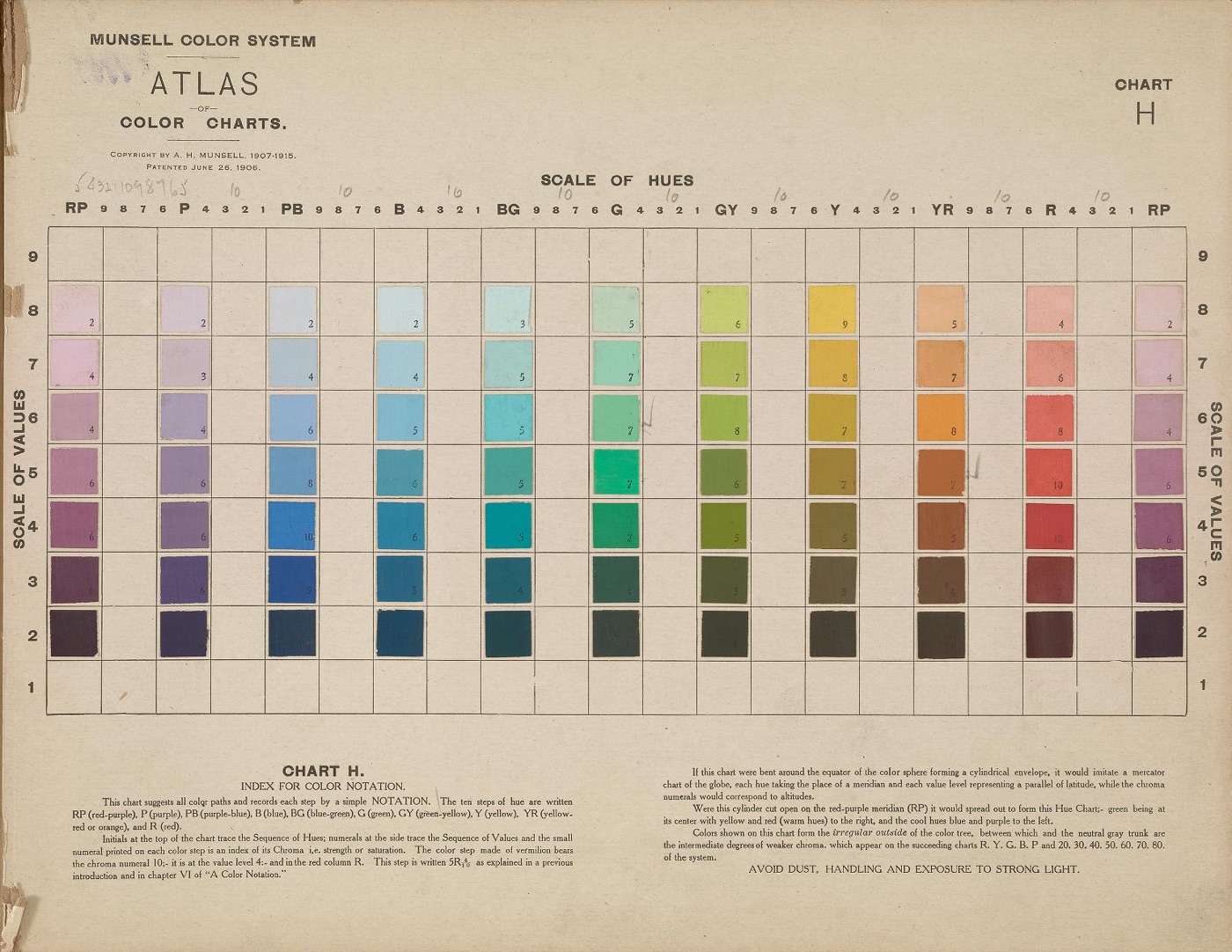
To test these claims on languages without a written tradition, Kay, Berlin and their colleagues began the World Color Survey in the late 1970s, with field workers of the Summer Institute of Linguistics (SIL) and support from the National Science Foundation. In each of 110 unwritten languages, about twenty-four speakers named each of 330 Munsell color chips. The results are published online by the University of California, Berkeley, where the full data may be downloaded, and in the book The World Color Survey by Kay, Berlin, Luisa Maffi, William R. Merrifield and Richard Cook (CSLI Publications; dated 2009 in catalogues and 2010 by the publisher).
Sources and further reading
- Berlin, B., and Kay, P., 1969, Basic color terms: their universality and evolution. Berkeley: University of California Press.
- Kay, P., Berlin, B., Maffi, L., Merrifield, W. R., and Cook, R., The World Color Survey. Stanford: CSLI Publications. CSLI
- The World Color Survey. University of California, Berkeley. WCS
Written with Claude, an AI model made by Anthropic, from the sources listed above, and checked against them. October 2026.