The oldest surviving treatise on minerals, which describes how the painters’ reds, yellows, blues and whites were dug, washed, burned and made.
The first book on minerals
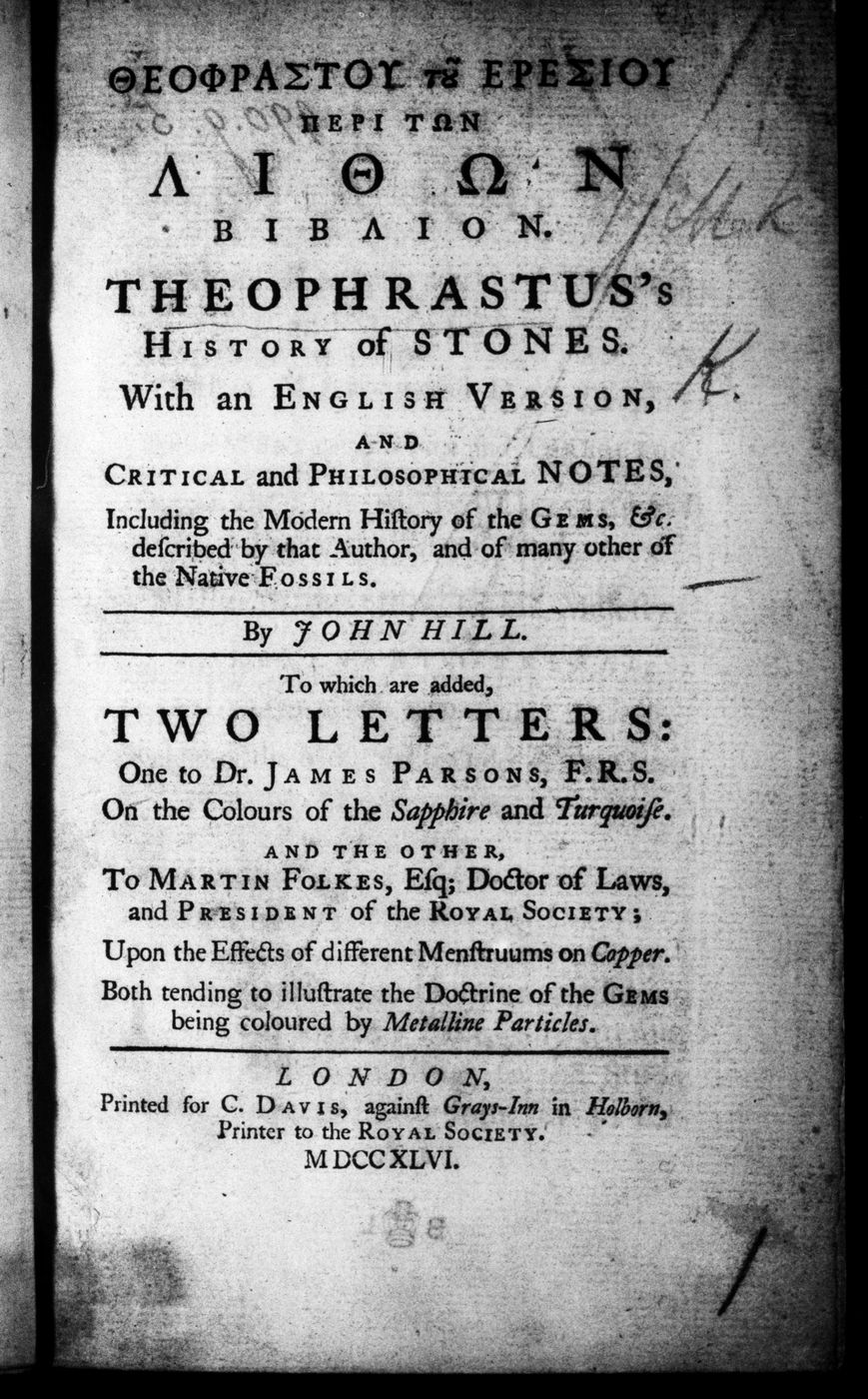
Theophrastus of Eresos (about 371 to about 287 BCE) was Aristotle’s pupil and his successor as head of the school at the Lyceum in Athens. His short treatise On Stones (Peri lithōn, Latin De lapidibus) is the oldest surviving work devoted to minerals. It describes stones and earths by their color, hardness, weight and behavior in fire, and it gives an account of the pigments painters obtained from them.
The text itself fixes the date closely. Theophrastus says that the preparation of cinnabar was invented about ninety years earlier, “Praxibulus being at that Time in the Government at Athens.” Praxibulus was archon in 315–314 BCE, so the treatise was written in or soon after that year.
The first edition of the Greek text as a work on its own, and the first translation into a modern language, was John Hill’s of 1746, with the Greek on the left-hand pages, the English on the right, and long notes below. The standard modern edition, by Earle R. Caley and John F. C. Richards (Columbus, 1956), is still in copyright and is cited here but not quoted.
Reds: reddle, Sinopic earth and burned ochre
Theophrastus treats ochre (yellow) and reddle (miltos, red earth) as earths of one nature that differ in color. Painters, he says, use ochre in place of orpiment, since the two scarcely differ in color when powdered. Reddle and ochre are dug in pits in Cappadocia, where the workmen are in danger of suffocation; the best reddle comes from Keos, and some is also found in iron mines. There are also the Lemnian reddle and the Sinopic, which is dug in Cappadocia and shipped from Sinope. The Sinopic is of three kinds, deep red, whitish, and one between them that is used unmixed.
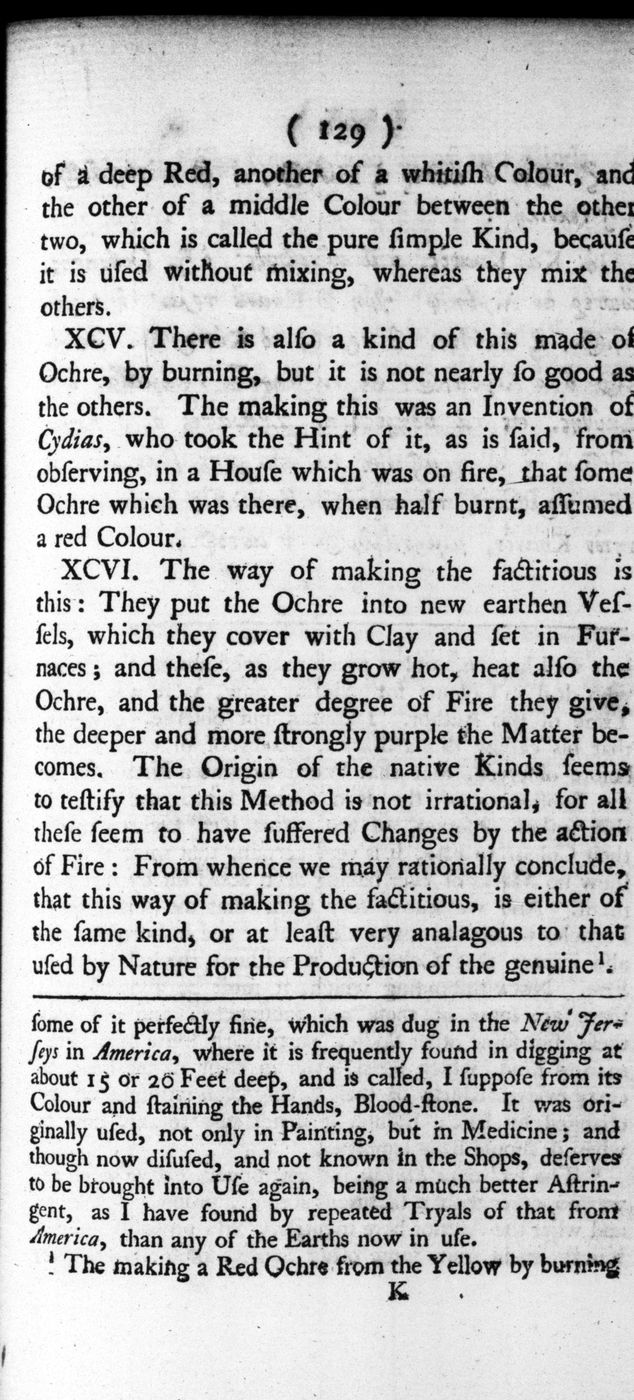
A red can also be made from ochre by fire. Hill’s translation gives the story: “The making this was an Invention of Cydias, who took the Hint of it, as is said, from observing, in a House which was on fire, that some Ochre which was there, when half burnt, assumed a red Colour.” The ochre is put into new earthen pots sealed with clay and set in a furnace, and “the greater degree of Fire they give, the deeper and more strongly purple the Matter becomes.” Theophrastus adds that the natural red earths also seem to have been changed by fire. The change he describes is the conversion of yellow iron oxide-hydroxide to red iron oxide.
In his note on the Sinopic earth, Hill records that he had seen some “perfectly fine, which was dug in the New Jerseys in America, where it is frequently found in digging at about 15 or 20 Feet deep, and is called, I suppose from its Colour and staining the Hands, Blood-stone.”
Cinnabar, native and worked
There are two kinds of cinnabar, native and “factitious.” The native comes from Spain, hard and stony, and from Colchis, where it is found on cliffs and brought down with arrows. The other comes from a single place a little above Ephesus. It is “only a Sand, shining like Scarlet,” which is ground fine in stone vessels and washed again and again in vessels of brass or wood; what settles is the cinnabar. What Theophrastus calls the made kind is therefore a natural mineral sand refined by grinding and washing.
The method, he says, was found by Callias, an Athenian from the silver mines, who gathered the shining sand thinking it held gold. When it did not, he kept it for the beauty of its color. Theophrastus concludes that “Art imitates Nature, and sometimes produces very peculiar Things,” and turns to the production of quicksilver.
Blue, white and green
Of kyanos, which Hill translates “Lapis Armenus,” Theophrastus says there is a native kind and a made kind from Egypt, and three sorts in all, the Egyptian, the Scythian and the Cyprian; the Egyptian is best for strong colors and the Scythian for weak ones. The kings of Egypt, he reports, recorded in their annals which of them first made the artificial blue in imitation of the native. The native kind is usually taken to be a blue copper mineral, most likely azurite; the Egyptian is generally identified with the synthetic pigment now called Egyptian blue.
Two pigments are made from metals. White lead (ceruse) is made by setting lead over strong vinegar in jars, scraping off the white crust that forms, and repeating the process; the scrapings are ground and boiled. Verdigris is made in a similar way by setting copper over the lees of wine.
For a mineral collection this is the most directly relevant of the classical texts on color. Each pigment is described by its locality, its occurrence in the ground, and what fire and water do to it.
Sources and further reading
- Caley, E. R., and Richards, J. F. C., 1956, Theophrastus on Stones: introduction, Greek text, English translation, and commentary. Columbus: Ohio State University. In copyright; cited, not quoted.
- Hill, J., 1746, Theophrastus’s History of Stones. With an English version, and critical and philosophical notes. London: C. Davis. Full scan (Internet Archive)
Written with Claude, an AI model made by Anthropic, from the sources listed above, and checked against them. October 2026.