A Viennese entomologist’s color circle and his table of thirty-six blues, each named in German, Latin and French.
A naturalist’s problem
Ignaz Schiffermüller (1727–1806), a Jesuit, taught architectural drawing at the Theresianum in Vienna from 1759 for fifteen years. Alongside theology he studied botany, mineralogy and above all butterflies; with Michael Denis he compiled the catalogue of the butterflies of the Vienna region published in 1775 and 1776. Describing their colors required words that other naturalists would understand in the same way.
His Versuch eines Farbensystems (“Essay on a color system”) was published in Vienna by Augustin Bernardi in 1772 and dedicated to Prince Kaunitz. He names earlier attempts by the entomologists Scopoli and Rösel von Rosenhof as insufficient, and draws on the color theory of the French Jesuit Louis-Bertrand Castel.
The circle and the blues
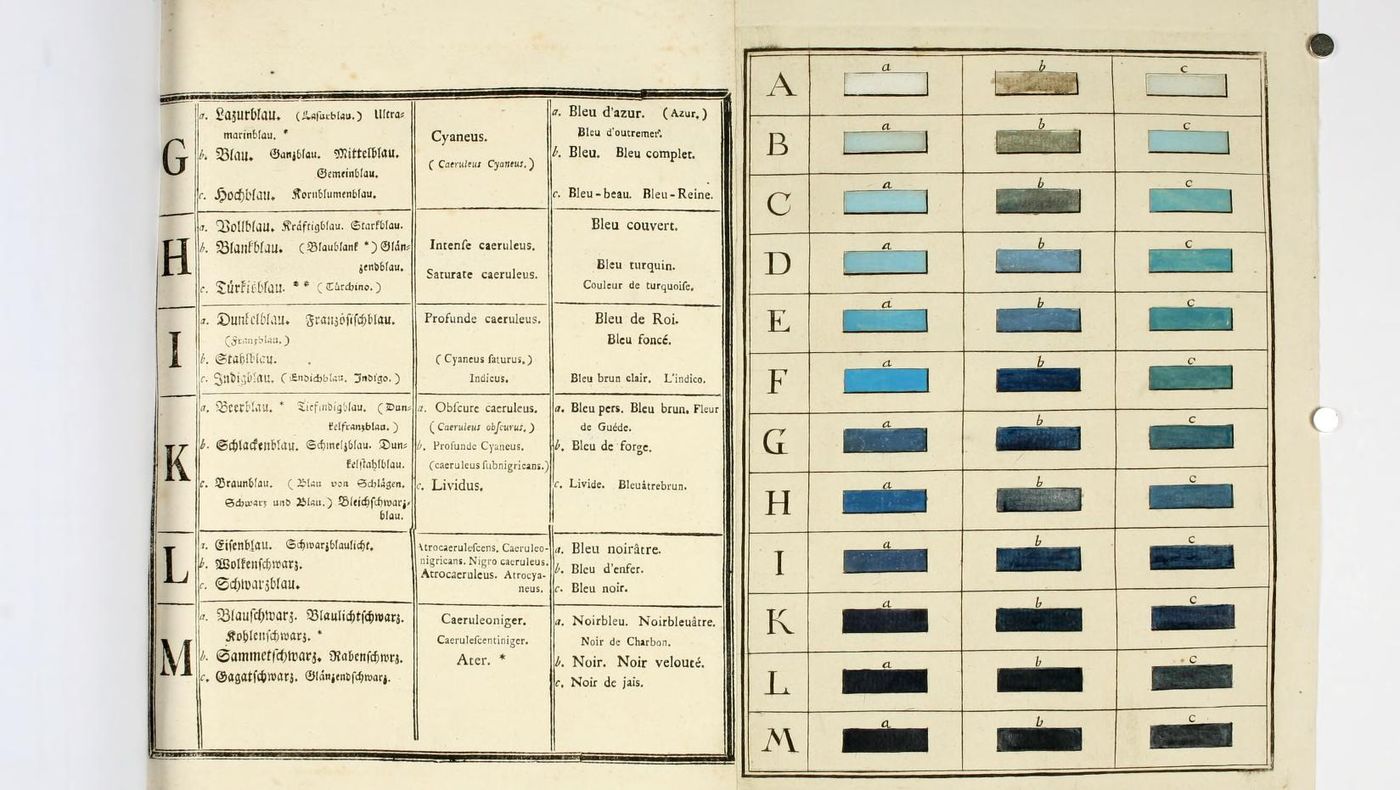
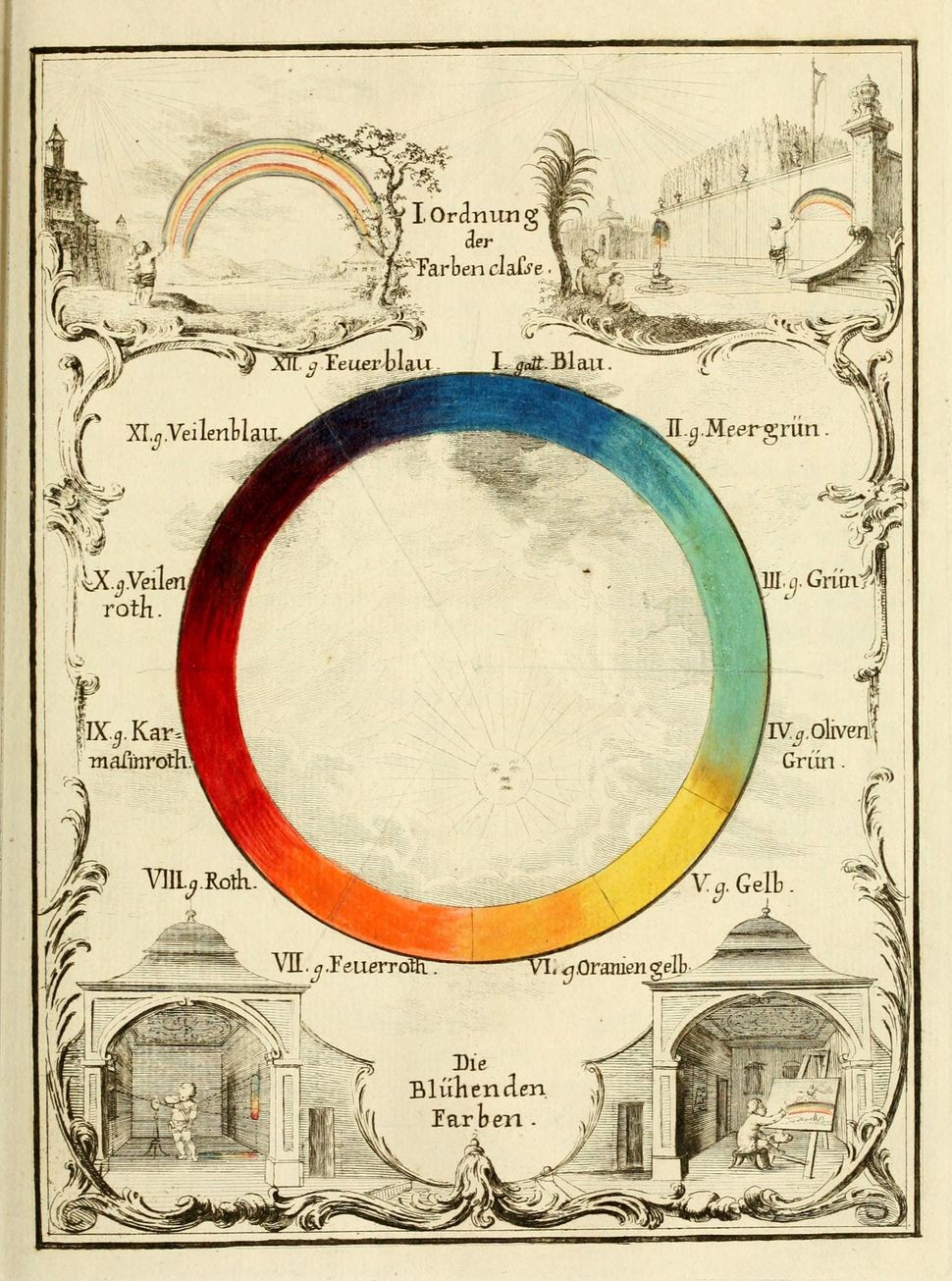
The engraved circle sets twelve saturated colors in order around a ring, beginning and ending with blue; it is among the early circles to place complementary colors opposite one another. Schiffermüller then works out one color family in full as a model. The table of blues divides the family into twelve grades, lettered A to M, from white through pale, sky and full blue to blue-black, each with three shades (a, b, c): thirty-six blues, with eighty-one German names and their Latin and French equivalents. A folding plate carries a hand-painted swatch for each.
Many of the names come from stones and metals. The table includes silver white, sapphire blue, azure or ultramarine blue, turquoise blue, steel blue, iron blue, coal black and jet black. In a footnote on turquoise he takes up the mineralogists, some of whom described the stone as bluish green, and argues from Pliny and later writers that true oriental turquoise inclines to blue.
Blue pigments from the mines
The text discusses the blue pigments themselves. Mountain blue (Bergblau), he writes, varies with how it is washed and with the mineral it is made from. The “Armenian stone” named by Pliny came in his own day from the copper mines of the Tyrol, Hungary and the Banat: a kind of lapis lazuli, paler than the true stone and without its specks of pyrite. Other ores that give mountain blue, softer, sometimes slaty, granular or earthy, are what the mineralogists usually call copper blue, because they owe their color to copper. For painting on walls, he notes, only stone, mineral or earth colors will withstand the lime, and among the blues that leaves almost only ultramarine and smalt.
Sources and further reading
- Ignaz Schiffermüller. Wikipedia (German)
- Ignaz Schiffermüller. Wikipedia
- Schiffermüller, I., 1772, Versuch eines Farbensystems. Wien: Augustin Bernardi. Full scan (Internet Archive)
Written with Claude, an AI model made by Anthropic, from the sources listed above, and checked against them. October 2026.