A painter’s color sphere, with white and black at the poles and the pure colors around the equator, published with an essay by the mineralogist Henrik Steffens.
The sphere
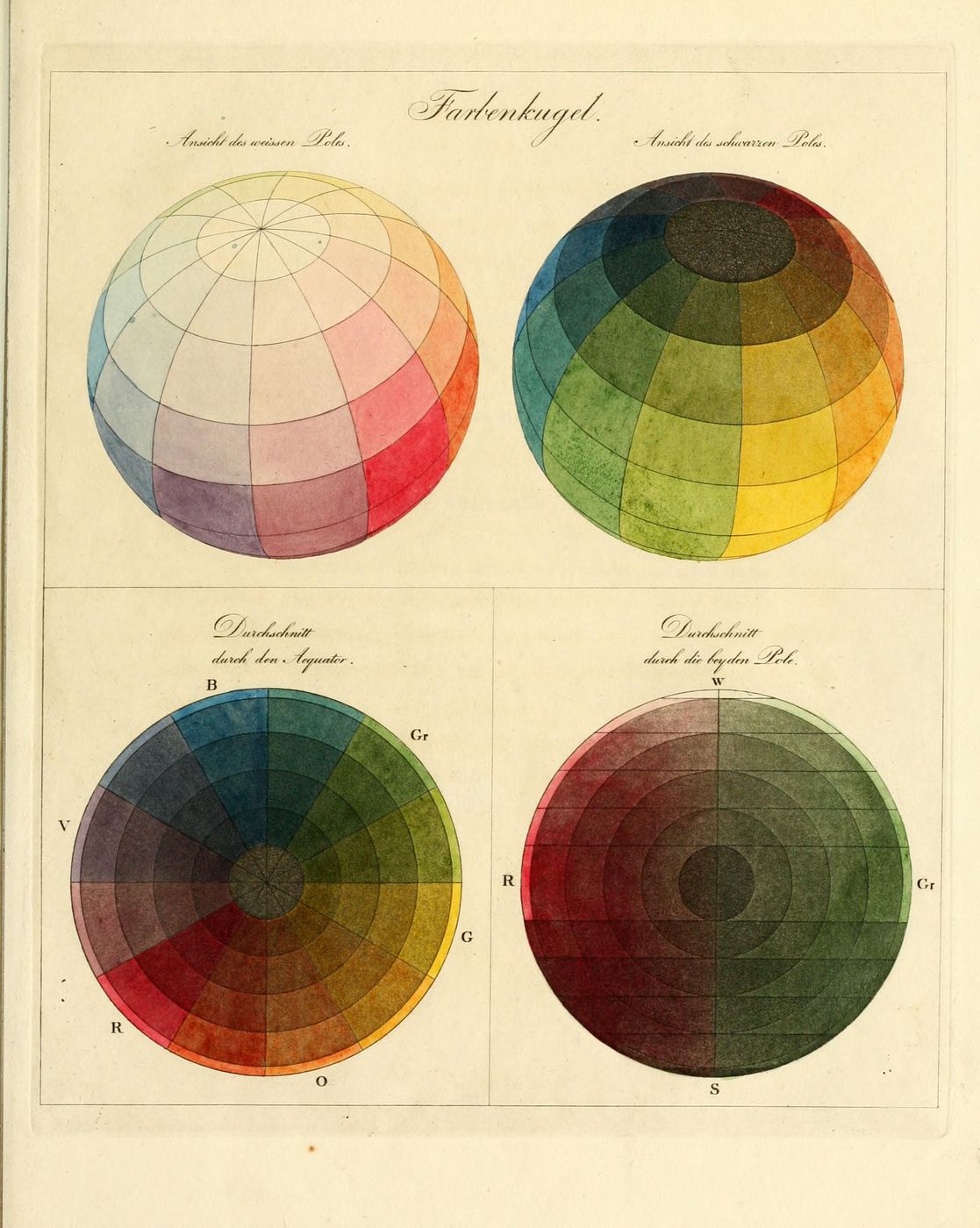
Philipp Otto Runge (1777–1810), a painter of the German Romantic school, worked in Hamburg. He took it as known that there are only three colors, yellow, red and blue, and sought the complete order of all their mixtures with each other and with white and black. His letters to Goethe trace the idea: by November 1807 he had expanded the circle of hues into a sphere with white and black as opposite poles. He completed the manuscript in 1809, and it was published in Hamburg by Friedrich Perthes in 1810. Runge died of tuberculosis on 2 December of that year.
The full title is Farben-Kugel, oder Construction des Verhältnisses aller Mischungen der Farben zu einander, und ihrer vollständigen Affinität, with an appended essay on harmony in combinations of colors. Runge works from five elements, white, black, yellow, red and blue. The pure colors lie around the equator; toward the white pole they lighten, toward the black pole they darken; and every section through the axis passes through gray where opposite colors meet. The surface, he says, is divided twelvefold only for convenience and should be imagined as a continuous transition. Because every mixture has its place in relation to all the others, he calls the sphere a general table by which anyone who needs particular tables of colors can find his way back to the whole.
Harmony
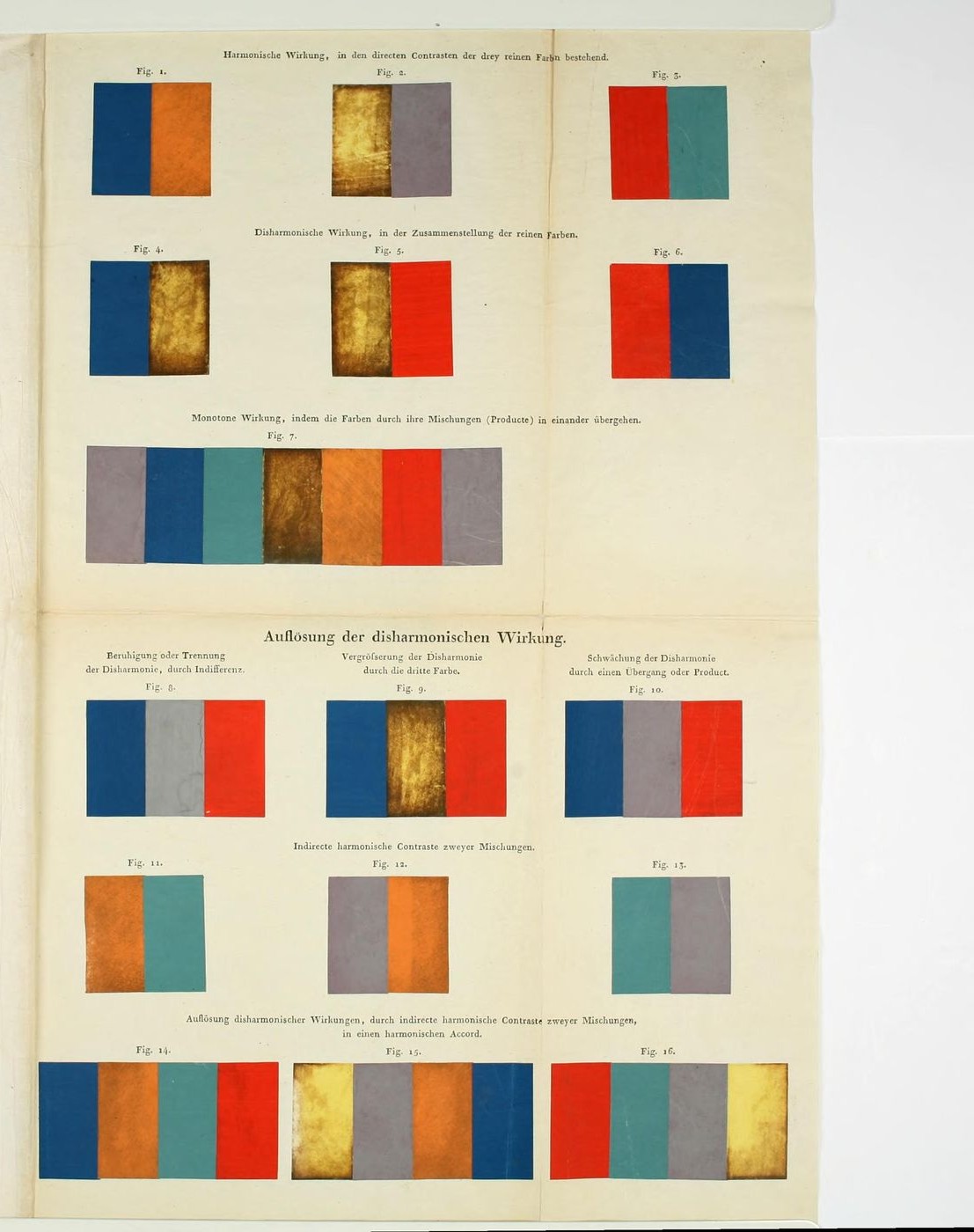
A separate folding table illustrates the appended essay. Its painted bands show the “harmonious effect” of the direct contrasts of the three pure colors, the “disharmonious effect” of placing pure colors side by side, the “monotonous effect” of colors passing into one another through their mixtures, and the ways a disharmony can be resolved: by a neutral color between, by a third color, or by a transition.
Steffens on the colors of nature
The book closes with an essay by Henrik Steffens (1773–1845), then professor at Halle, on the meaning of colors in nature. Steffens had trained in mineralogy and geology, and he argues from minerals and metals. The metals, he writes, show a prevailing gray: copper inclines to red, lead to blue and gold, between them, to yellow, but only in gold is the color pure. Black, in his account, belongs to the metals and to sulfur combined with hydrogen, and he lists the black sulfur precipitates of mercury (the “mineral ethiops”), copper, iron, lead and nickel, and probably those of bismuth and cobalt; the bright colors appear on the side of oxidation, in the light metal oxides and metallic salts.
Sources and further reading
- Philipp Otto Runge (life, letters to Goethe, the color sphere). Wikipedia
- Runge, P. O., 1810, Farben-Kugel, oder Construction des Verhältnisses aller Mischungen der Farben zu einander, und ihrer vollständigen Affinität. Nebst einer Abhandlung über die Bedeutung der Farben in der Natur, von Henrik Steffens. Hamburg: Friedrich Perthes. Full scan (Internet Archive)
Written with Claude, an AI model made by Anthropic, from the sources listed above, and checked against them. October 2026.