The Roman encyclopedia’s account of mineral pigments, its division of colors into florid and austere, and the four colors of the Greek painters.
Pigments among the metals and earths
Gaius Plinius Secundus (23/24–79 CE), a Roman officer and administrator of equestrian rank, dedicated his Natural History in thirty-seven books to the future emperor Titus in 77 CE. He died two years later on the Bay of Naples, in the eruption of Vesuvius. Books 33 to 37 treat metals, earths and stones; the pigments appear with the metals in book 33 and with the earths and the history of painting in book 35.
The English translation used here is John Bostock and H. T. Riley’s, published in six volumes in 1855–57. Its chapter numbers differ from the section numbers of modern editions, which are given below.
Florid and austere colors
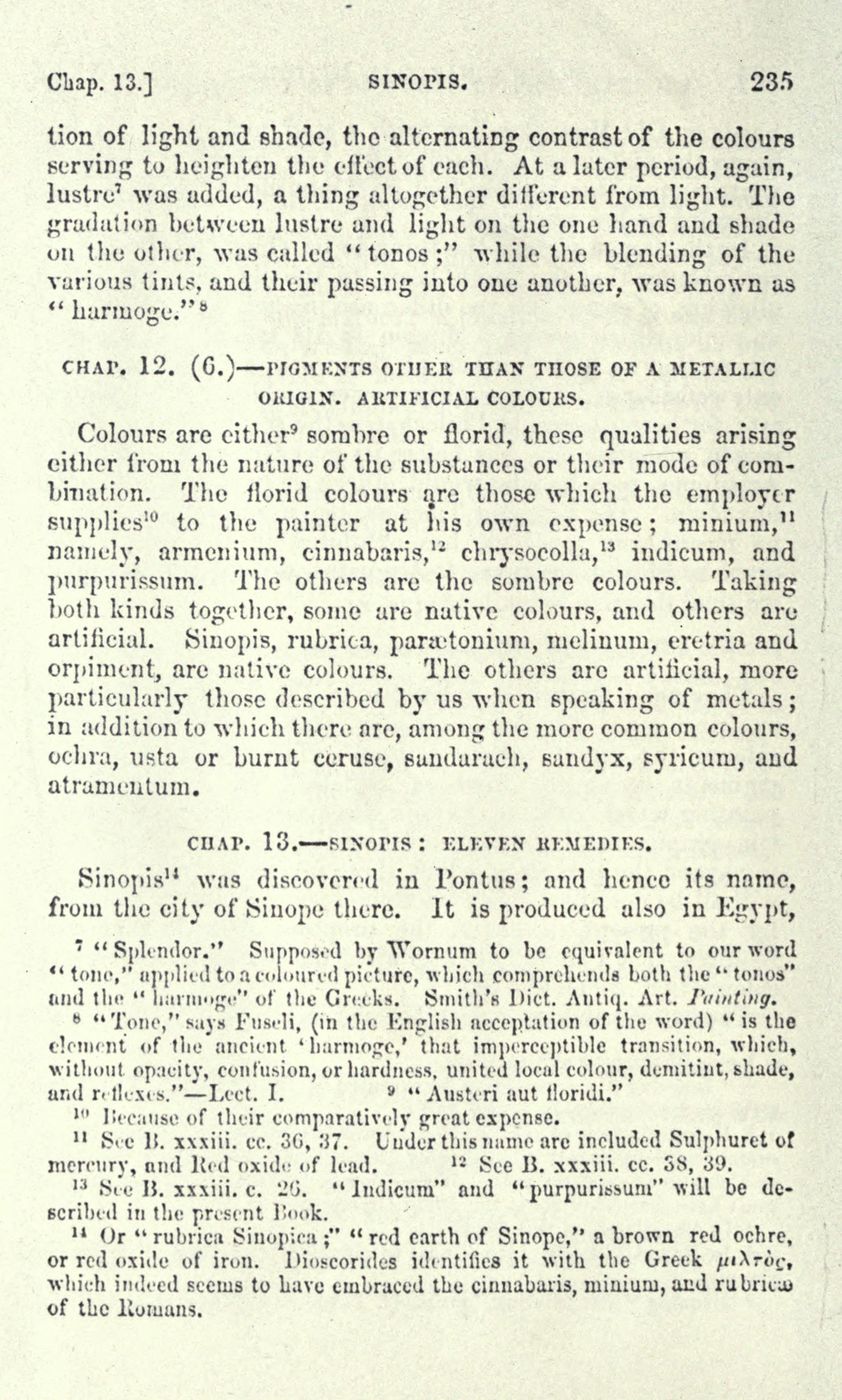
At 35.30 Pliny divides the painters’ colors in two. In Bostock and Riley’s words, “Colours are either sombre or florid” (austeri aut floridi). “The florid colours are those which the employer supplies to the painter at his own expense; minium, namely, armenium, cinnabaris, chrysocolla, indicum, and purpurissum. The others are the sombre colours.” The division is economic as much as visual: the florid colors were costly enough that the patron bought them himself.
Pliny divides the same colors a second way, into native and artificial. Sinopis, rubrica, paraetonium, melinum, eretria and orpiment are native; the rest are made, among them ochre, burnt ceruse, sandarach, sandyx, syricum and atramentum. Several of his names do not mean what the same words mean now. His minium is the mineral cinnabar, mercury sulphide; his cinnabaris is a red resin, the “dragon’s blood” of later writers; and red lead, which later took the name minium, appears in his text as a cheaper adulterant.
Minium from Sisapo
Pliny’s fullest account of a mineral pigment is of minium, in book 33. It came, he says, “from hardly any other quarter but Spain; that of most note coming from Sisapo,” in Baetica, where the mine was part of the revenues of the Roman people (33.118). The ore was not refined on the spot but sent to Rome under seal, about two thousand pounds a year, and washed there; its price was fixed by law at no more than seventy sesterces a pound. Sisapo is generally identified with the district of Almadén, which remained the world’s chief source of mercury into modern times. Pliny describes the adulteration of minium with a cheaper red made by roasting stones from silver and lead mines, and a test with hot iron for detecting it.
Of the blue caeruleum (33.161) he writes that it “is a kind of sand,” of which there were formerly three kinds, the Egyptian, the most esteemed, the Scythian and the Cyprian; more recently it had been imported from Puteoli and from Spain. He describes also sinopis, the red earth named after Sinope, the ochres, chrysocolla and verdigris.
Four colors
At 35.50 Pliny states that the great Greek painters worked with four colors only. In Bostock and Riley’s translation: “It was with four colours only, that Apelles, Echion, Melanthius, and Nicomachus, those most illustrous painters, executed their immortal works; melinum for the white, Attic sil for the yellow, Pontic sinopis for the red, and atramentum for the black.” Three of the four are earths: a white earth from Melos, a yellow ochre from Attica, and a red earth shipped from Sinope on the Black Sea. There is no blue.
Pliny uses the claim to reproach his own time, when “India sends to us the slimes of her rivers, and the corrupt blood of her dragons,” and no painting of quality is made. Whether the painters he names really used only four colors has long been doubted. The translators’ note points out that Pliny elsewhere credits early painters with other colors, and that the passage of Cicero on which he may have drawn does not support him. The four-color palette is best read as Pliny’s report of a tradition, not as a description of surviving works.
Sources and further reading
- Pliny the Elder, Natural History, book 35, Latin text. LacusCurtius
- Pliny the Elder, The Natural History, translated by John Bostock and H. T. Riley, vol. 6 (books 32–37). London: Henry G. Bohn, 1857. Full scan (Internet Archive)
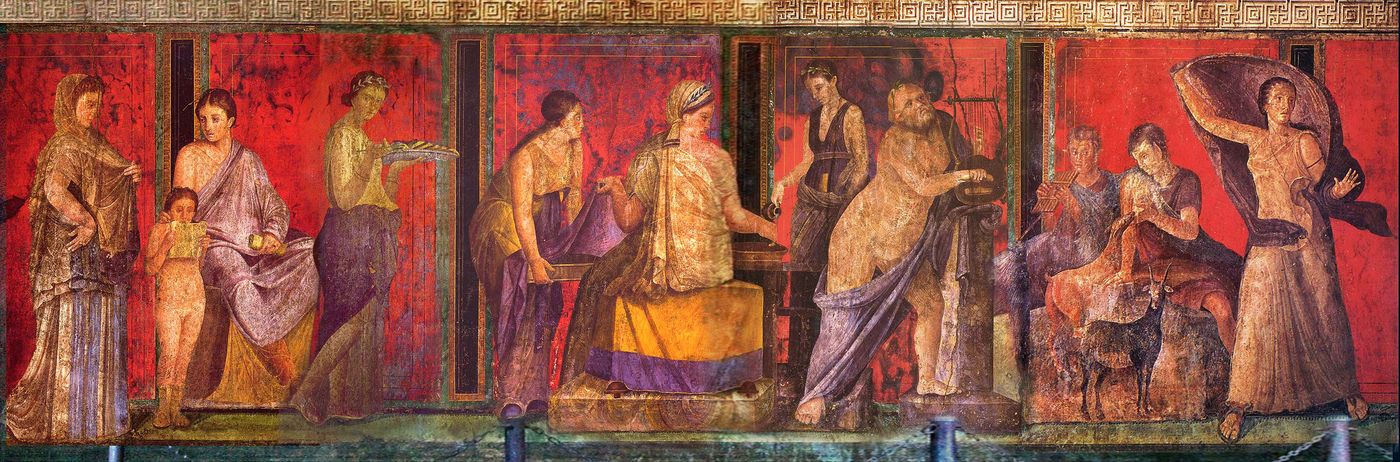
- Villa of the Mysteries, Pompeii, composite of photographs by WolfgangRieger. Wikimedia Commons, public domain. Commons
Written with Claude, an AI model made by Anthropic, from the sources listed above, and checked against them. October 2026.