The glazed brick friezes of Susa, the paint on the reliefs of Persepolis, and the minerals identified in them, from Egyptian blue and lead antimonate to cinnabar and malachite.
The glazed friezes of Susa
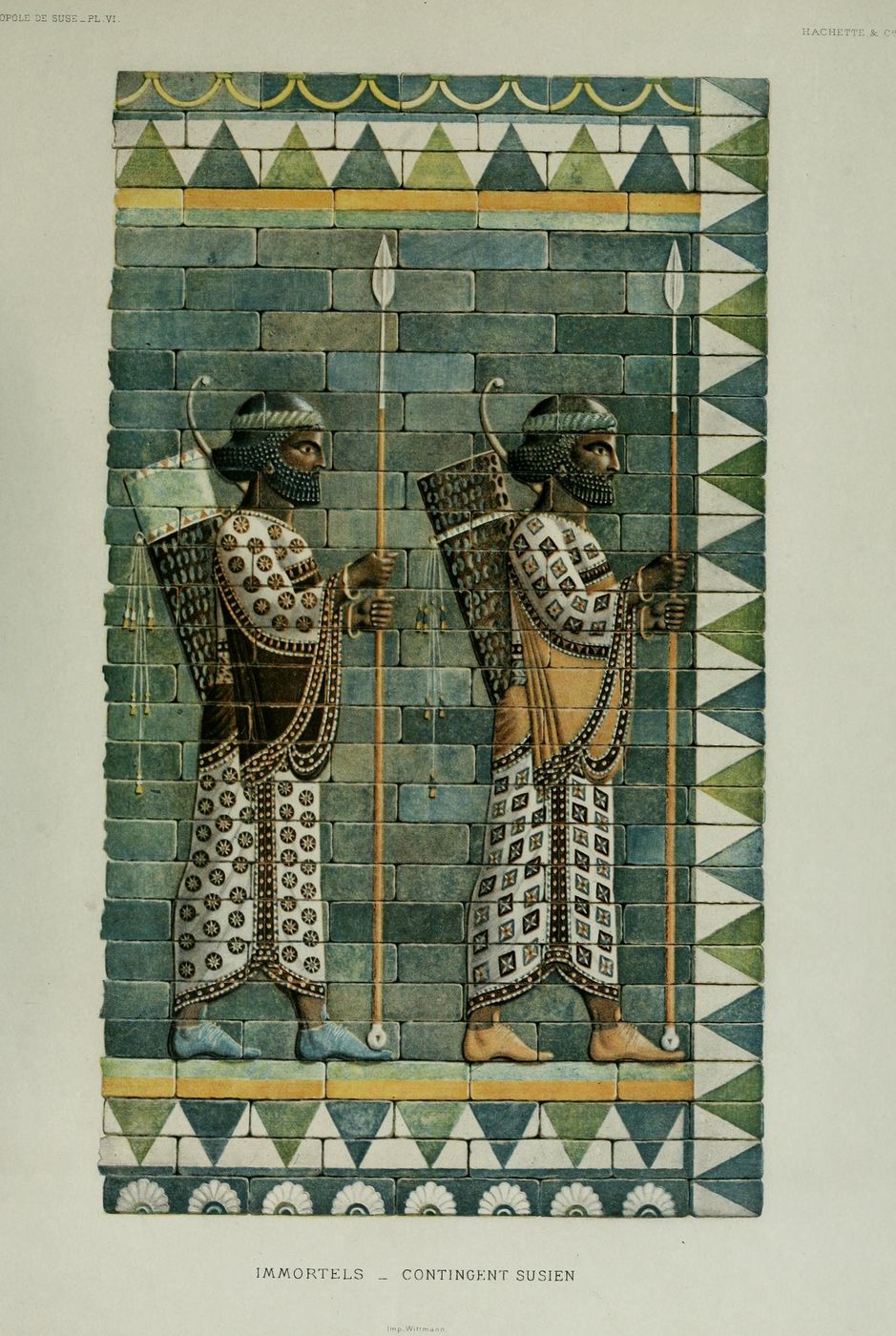
The Achaemenid kings decorated their palaces at Susa with friezes of glazed brick: rows of archers and striding lions in white, yellow and green on blue and blue-green grounds. Marcel Dieulafoy excavated the citadel of Susa in 1884, 1885 and 1886 under the auspices of the Musée du Louvre, and published the glazed bricks, with chromolithographed plates, in the third part of L’Acropole de Suse (1891).
The page is placed at about 510 BCE, early in the reign of Darius I. Aloiz, Douglas and Nagel (2016) give the founding of Persepolis by Darius at around 520 BCE; the friezes of Susa and the paint of Persepolis cannot be dated more closely than to his reign and those of his successors, and the Achaemenid empire lasted until 330 BCE.
The Susa bricks were made differently from those of Babylon. Aloiz and colleagues summarize the evidence: the glazed bricks of Assyria and of Neo-Babylonian Babylon were made of calcareous clay from the Tigris and Euphrates alluvium, with 12–14 percent alumina, whereas Achaemenid bricks were made in the faience technique, from sand or powdered quartz with lime and alkali; Annie Caubet found less than 1.7 percent alumina in twelve glazed bricks from Elam. Other studies have found clay in some Achaemenid bricks from Susa. Textual evidence suggests that the brickmakers at Susa under Darius were Babylonian. Raised lines of a less fusible material separated the fields of colored glaze, which ran between them when fired, a technique documented at Susa.
The glaze colorants
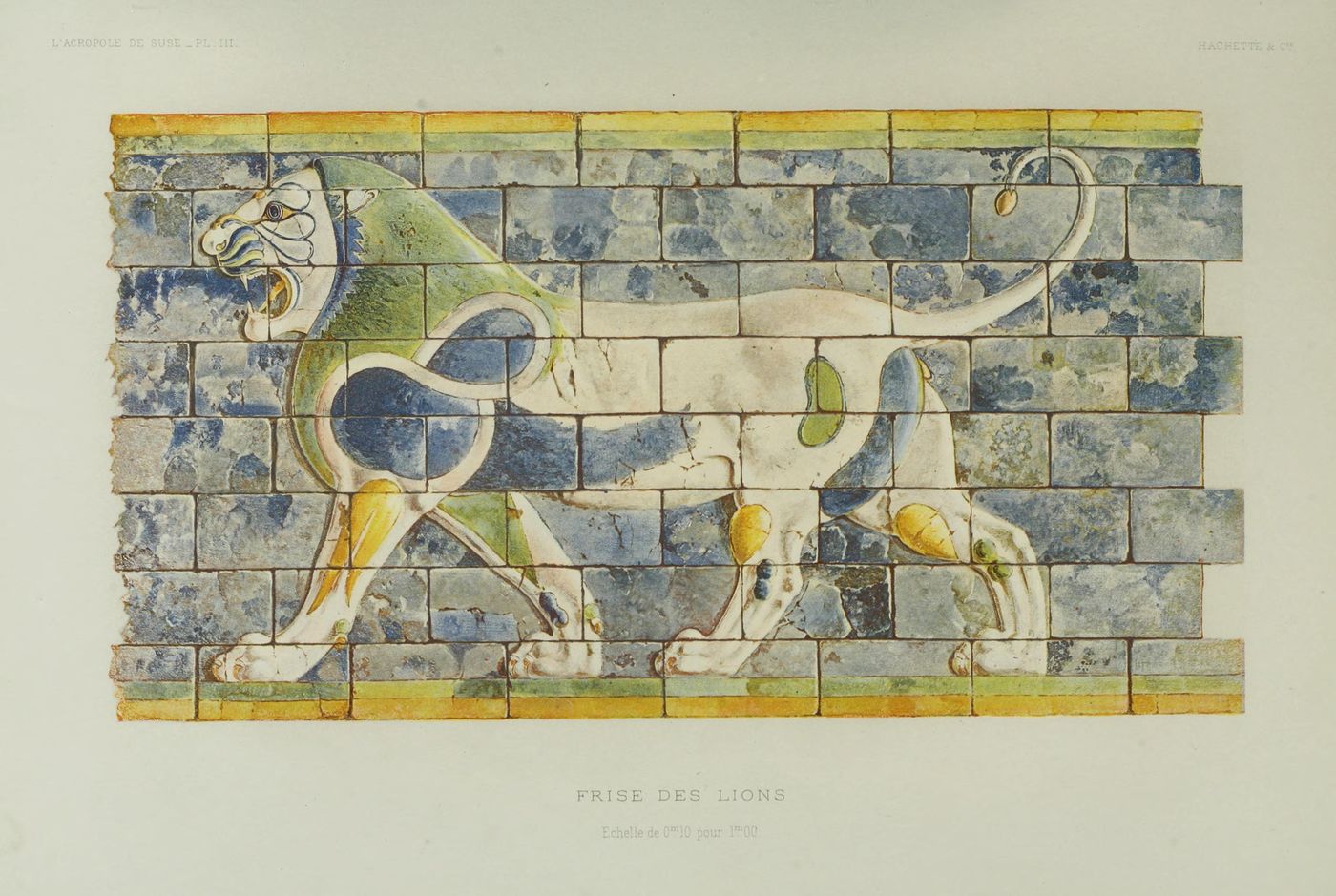
The glazes are colored by minerals and metal compounds, many of them the same as at Babylon. On glazed brick fragments from Persepolis excavated by Ernst Herzfeld, Aloiz and colleagues found a pale yellow glaze colored with lead antimonate, a yellowish green glaze colored with copper and deepened with particles of the yellow, and a white glaze probably colored with calcium antimonate, which has also been found as a white at Achaemenid Susa. One study of Susa bricks found sodium antimonate as the white.
At Tol-e Ajori, 3.5 km from the Persepolis terrace, excavations since 2011 have uncovered an Achaemenid monumental gate of the second half of the sixth century BCE whose bricks, Amadori and colleagues (2023) write, are very similar to those of the Ishtar Gate at Babylon, with the plan of the inner Ishtar Gate and the same bulls and dragons. There they identified calcium antimonate and brizziite, the sodium antimonate NaSbO3, as white opacifiers, lead antimonate as the yellow, cobalt and copper as the colorants of the blue glazes, and copper with the yellow opacifier for the greens. They note that the cobalt blues of Susa and of the Persepolis terrace differ in their manganese, nickel and zinc from those of Tol-e Ajori and the Ishtar Gate, which suggests a change in the supply of cobalt.
Darius’s foundation inscriptions from Susa state where his materials came from. Matin (2024) notes that two of them say that the materials with which the terrace was painted were brought from Ionia, but cautions that these texts are symbolic rather than administrative and do not give the exact origin of every material and craftsman.
Paint on the stone of Persepolis
The limestone reliefs of Persepolis were painted. Matin notes that early travelers and excavators saw colored pigment on newly exposed surfaces, that some traces survive on the monuments of the terrace and at Naqsh-e Rostam, and that the systematic study of this polychromy was begun in the 1970s by Judith Lerner and Ann B. Tilia and resumed by Alexander Nagel.
The pigments were identified by Stodulski, Farrell and Newman (1984). Specimens taken from the surfaces of the reliefs at Persepolis and Pasargadae, and bulk specimens excavated at Persepolis, proved to be Egyptian blue, malachite, hematite, cinnabar and yellow ochre. A second group of excavated materials, also thought to be pigments, comprised Egyptian blue, azurite, the rare green mineral tyrolite, sulfur, a mixture of calcite and yellow ochre, and realgar. They used optical and scanning electron microscopy, emission spectrography, X-ray diffraction and fluorescence, and infrared spectroscopy.
Analysis of painted plaster from Herzfeld’s excavations confirms the palette. Aloiz and colleagues found Egyptian blue, its calcium, copper and silicon close to the formula of the mineral cuprorivaite, CaCuSi4O10; cinnabar, the mercury sulfide HgS; red ochre; and malachite whose particles grew as overgrowths on quartz, showing that it was the natural mineral, not a manufactured green. Floors at Persepolis were painted with hematite. Beneath the paint, Askari Chaverdi and colleagues (2016) found that the dark grey limestone of several monuments had been covered on purpose with a thin whitish layer of fluorapatite, probably from calcined animal bone, with calcite, and in one sample a second white layer of barium sulfate that may be the remnant of a polychrome finish.
A pigment workshop at Persepolis
Some of the pigments were made on the spot. Excavations in the craft zone of Persepolis West yielded colored residues that Amadori and colleagues (2021) identified as Egyptian blue, azurite, malachite, and red and yellow ochres colored by hematite and goethite. Matin (2024) reviews the evidence, including a bronze scrap with a crust of Egyptian blue, and concludes that pigments, Egyptian blue among them, were produced there. Persia thus joins the few regions, with Egypt, Greece, southern Italy and eastern Anatolia, where the manufacture of Egyptian blue is attested.
Who made it is not known. The Persepolis archives mention Egyptian painters, and Matin considers that such craftsmen may have been brought to produce the pigment, but notes that Egyptian blue was known in the Near East long before, and that some Egyptian blue fragments from Persepolis resemble those of Nineveh and Nimrud more than those of Egypt; the samples are too few for a conclusion.
Minerals that also occur at Franklin and Sterling Hill
Several of these pigment minerals occur in the New Jersey zinc deposits, though none is important there. Palache (1935) describes hematite as widespread at both Franklin and Sterling Hill but not conspicuous, and malachite and azurite as rarities at both mines; calcite is the sole gangue mineral of both ore bodies and the principal mineral of the Franklin marble. Cinnabar, realgar and tyrolite are not among the minerals he lists.
Sources and further reading
- Aloiz, E., Douglas, J. G., Nagel, A., 2016, Painted plaster and glazed brick fragments from Achaemenid Pasargadae and Persepolis, Iran. Heritage Science 4, 3. PDF (open access)
- Amadori, M. L., Matin, E., Poldi, G., Mengacci, V., Arduini, J., Callieri, P., Askari Chaverdi, A., Holakooei, P., 2023, Archaeometric research on decorated bricks of Tol-e Ajori monumental gate (6th century BC), Fars, Iran: new insight into the glazes. Journal of Cultural Heritage 60, 63–71. PDF (University of Urbino)
- Amadori, M. L., Vagnini, M., Vivani, R., Anselmi, C., Askari Chaverdi, A., Callieri, P., 2021, Advances in characterization of colourful residues unearthed in Persepolis West craft zone using microscopic and spectroscopic techniques. Microchemical Journal 167, 106304. Publisher
- Askari Chaverdi, A., Callieri, P., Laurenzi Tabasso, M., Lazzarini, L., 2016, The archaeological site of Persepolis (Iran): study of the finishing technique of the bas-reliefs and architectural surfaces. Archaeometry 58, 17–34. Publisher
- Dieulafoy, M., 1891, L’Acropole de Suse d’après les fouilles exécutées en 1884, 1885, 1886 sous les auspices du Musée du Louvre. Troisième partie: Faïences et terres cuites. Paris: Hachette. Pl. III and Pl. VI. Full scan (Internet Archive)
- Matin, E., 2024, Persepolis West: evidence for a pigment production site and its connections with Achaemenid royal-official buildings. Ancient Civilizations from Scythia to Siberia 29, 262–306. Accepted manuscript. PDF (University of Bologna)
- Palache, C., 1935, The minerals of Franklin and Sterling Hill, Sussex County, New Jersey. U.S. Geological Survey Professional Paper 180 (hematite, calcite, malachite, azurite). PDF
- Stodulski, L., Farrell, E., Newman, R., 1984, Identification of ancient Persian pigments from Persepolis and Pasargadae. Studies in Conservation 29, 143–154. Publisher
Written with Claude, an AI model made by Anthropic, from the sources listed above, and checked against them. October 2026.