A Nobel chemist’s primer of color, in which every color is described by its hue and its content of white and black.
A chemist’s color primer
Wilhelm Ostwald (1853–1932) received the Nobel Prize in Chemistry in 1909. In retirement he turned to color. Die Farbenfibel, a primer with color samples, was published by Unesma in Leipzig; the record of the Wilhelm Ostwald Park counts the 1917 edition as the first, while other sources give 1916. It ran to fifteen editions by 1930. The Science History Institute has scanned the 1921 edition.
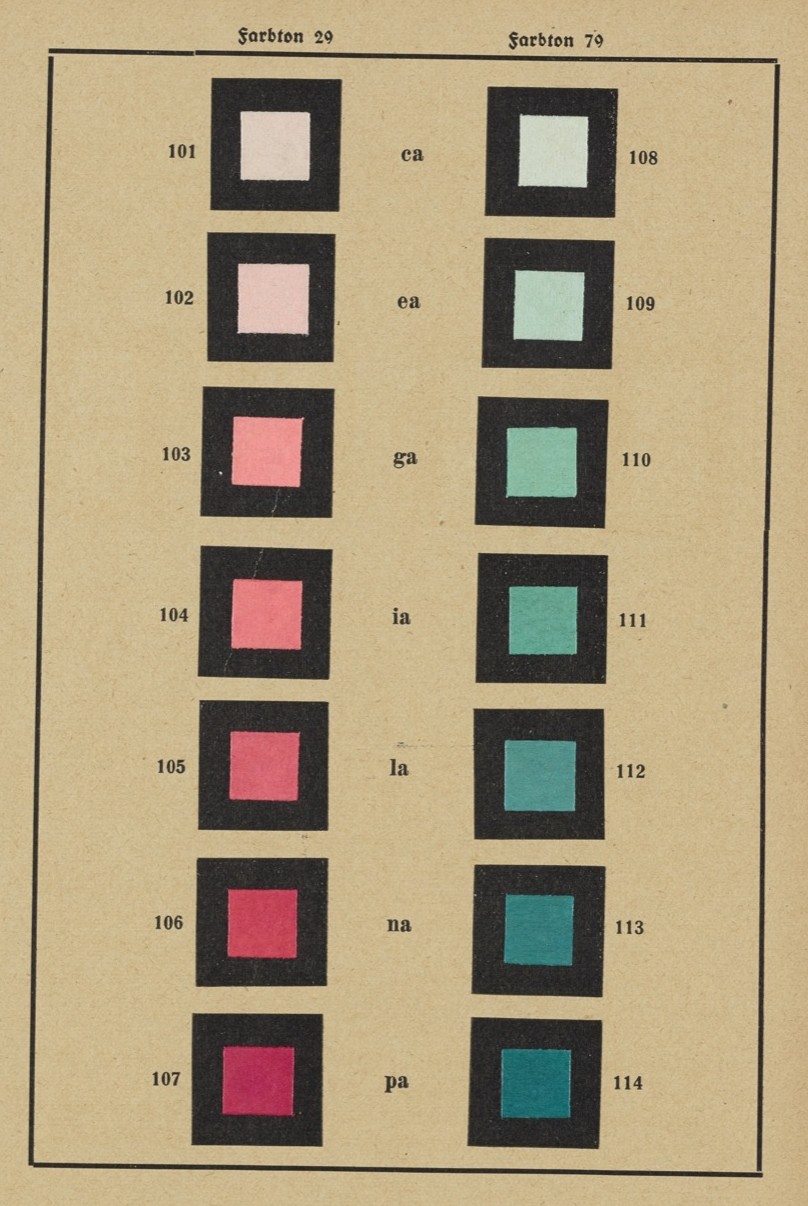
Ostwald described each color by its hue, numbered around a circle, and by its content of white and black, written as a pair of letters. The page above shows two hues side by side, each in a graded series with its letter codes. Die Harmonie der Farben followed in 1918 and Die Farbschule in 1919.
Later use
Winsor & Newton published an English version in 1930, translated by J. Scott Taylor. In the United States the Container Corporation of America issued the Color Harmony Manual in 1942, based on Ostwald’s system and prepared by Egbert Jacobson, with 680 color chips; its fourth edition appeared in 1958.
Sources and further reading
- Ostwald color system. Wikipedia
- Ostwald, W., 1921, Die Farbenfibel. Leipzig: Unesma. Science History Institute. Full scan (Science History Institute)
Written with Claude, an AI model made by Anthropic, from the sources listed above, and checked against them. October 2026.